







Abstract
A series of new bisquaternary ammonium inhibitor molecules p-xylylenebis[trialkylammonium chloride] were prepared in excellent yields by reacting α,α′-dichloro-p-xylene with a group of tertiary amines such as N,N-diallyl-N′-formyl-1,12-diaminododecane, N,N-diallyl-, N,N-diethyldodecylamine and N-dodecylpyrrolidine. Inhibition efficiencies (IEs) for different concentrations of bisquaternary salts for the inhibition of corrosion of mild steel in 1, 4 and 7·7M HCl as well as 0·5M H2SO4 exposed for 6 h at 60°C were determined gravimetrically. While in the presence of 400 ppm all the inhibitor molecules exhibited excellent %IEs of ⩾99 in 1M HCl, p-xylylenebis[N,N-diallyl, N-dodecylammonium chloride] provided very good %IE of 97 and 94 respectively in 4 and 7·7M HCl. The inhibitors imparted good to very good IE in arresting mild steel corrosion in 0·5M H2SO4; p-xylylenebis[N,N-diallyl, N-dodecylammonium chloride] performed the best, giving %IE of 94 at 400 ppm. The interactions of the π electrons in the diallyl moiety with the low lying vacant d orbitals of iron help the inhibitor molecules to undergo adsorption and interfere with the anodic dissolution process. Comparable results for the IEs were obtained by the electrochemical method using Tafel plots of the synthesised compounds. The adsorption of these compounds on the mild steel surface was found to obey Frumkin and Temkin adsorption isotherms in 1M HCl and 0·5M H2SO4 respectively.
Keywords
Introduction
Organic compounds containing oxygen, sulphur and nitrogen are widely used in industrial acid cleaning, acid descaling, acid pickling and oil well acidising in order to restrain the corrosion attack on metallic materials.1 – 5 Since chloride ions impart effective synergism in the inhibition of corrosion by organic cationic inhibitors, they are highly efficient in arresting corrosion of mild steel in HCl.6 – 8 However, these compounds are not good inhibitors in plain sulphuric acid media.9 Since the surface charge of iron in both HCl and H2SO4 is positive, the organic cations are reluctant to be adsorbed on the metal surface. This is mostly true in H2SO4 solutions but not so in HCl as a result of the poor adsorbability of sulphate ions.10,11 The specific adsorption of Cl− having a smaller degree of hydration leads to the species  , which is expected to shift the position of the corrosion potential E corr with respect to the potential for zero charge E q = 0 to more positive values than E corr, thus allowing the physical adsorption of organic cation.12,13 The formation of a close packed layer of (FeCl−…Inh+)ad would inhibit iron ions to enter the bulk of the solution, thereby arresting the anodic dissolution of iron in HCl solutions.14,15 It is well known that the protective properties of a cation type of inhibitor in H2SO4 medium can be improved with the addition of halide ions.16 The cathodic hydrogen evolution, on the other hand, is the competitive adsorption cationic inhibitor molecule In+ to form (Fe…In+)ads instead of (Fe…H+)ads and thus inhibit corrosion by hydrogen evolution reaction.
There are not many organic inhibitors that are equally effective against corrosion attack on mild steel in HCl as well as H2SO4 media. In recent years, organic compounds containing isoxazolidine10,17 – 20 and diallylammonium moieties21 have been reported to be quite effective in the inhibition of mild steel corrosion in both HCl and H2SO4 media. The organic inhibitors may undergo physi- or chemisorption on the metal surface by displacing water molecules on the surface to form a compact barrier film22 or by the formation of a coordinate covalent bond via interaction of the non-bonded (lone pair) and π electrons in the inhibitor molecules with the vacant d orbitals of the metal.23
It has been shown24 that because of multiple adsorption sites, the polymers as well as oligomers are better corrosion inhibitors than their corresponding monomers25,26 as a result of an entropically favourable displacement of many water molecules from the metal surface by a single large oligo/polymer molecule. The presence of multiple bonding sites makes the desorption of the inhibitor molecule a slower process. Incorporation of multiple functional groups within a molecule is expected to help the inhibitor lock in on the metal surface strongly. With this in mind, we report herein the synthesis of a novel class of bisquaternary ammonium salts (Fig. 1) and their inhibiting effect on the corrosion of mild steel in 1M HCl and 0·5M H2SO4 solutions using gravimetric measurements and potentiodynamic polarisation curves. There are few reports that dealt with bisquaternary ammonium salts as the corrosion inhibitor for mild steel.27 – 29 Bisquaternary ammonium salts in general are widely used as surfactant that always have antimicrobial properties.30
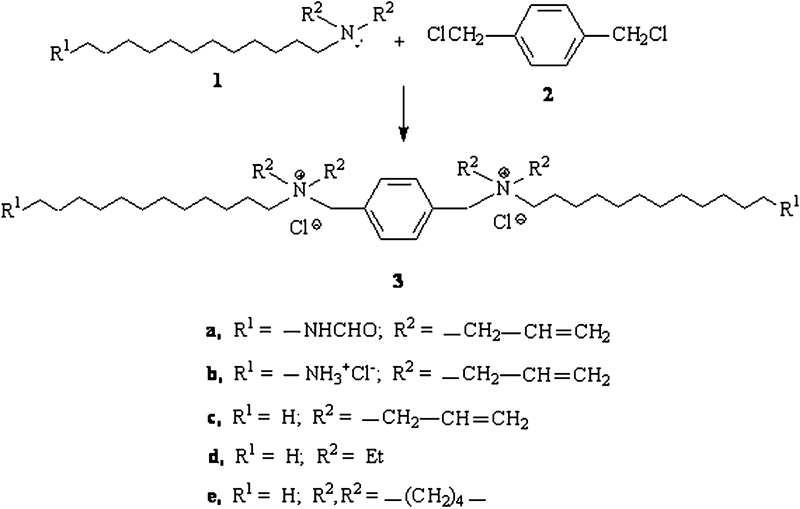
New bisquaternary ammonium salts
Experimental
Materials
1,12-Diaminododecane, pyrrolidine, ethyl formate, diethylamine, 1-bromododecane, allyl bromide and allyl chloride, α,α′-dichloro-p-xylene, obtained from Fluka Chemie AG, were used as received. All solvents were of high pressure liquid chromatography grade. All glassware was cleaned using deionised water.
Physical methods
Melting points are recorded in a calibrated Electrothermal IA9100 Digital Melting Point Apparatus. 1H spectra were measured in CDCl3 using TMS as internal standard on a JEOL LA 500 MHz nuclear magnetic resonance spectrometer. All the reactions were carried out under a positive atmosphere of N2. Elemental analysis was carried out on a Carlo-Erba Elemental Analyzer Model 1106. The new compounds synthesised below gave satisfactory elemental analyses. Infrared and nuclear magnetic resonance analysis confirmed that the required molecular structure had been correctly synthesised.
Synthesis of inhibitor molecules
Preparation of amines 1
Amine
A mixture of 1-bromodecane (7·5 g, 30 mmol) and diethylamine (11 g, 150 mmol) was heated at 60°C in a closed vessel for 72 h. At the end, the reaction mixture was cooled and stirred with a solution of NaOH (0·6 g, 0·03 mol) in water (50 cm3) and extracted with ether (2×25 cm). The organic layer was dried (Na2SO4), concentrated and distilled to obtain the diethyl derivative
p-Xylylenebis[N,N-diallyl-N-(12-formylamino-1-dodecyl)ammonium chloride] (3a)
A solution of amine
p-Xylylenebis[N,N-diallyl-N-(12-amino-1-dodecyl)ammonium chloride hydrochloride] (3b)
A solution of diquaternary salt
p-Xylylenebis[N,N-diallyl-N-(1-dodecyl)ammonium chloride] (3c)
A solution of diallylamine
p-Xylylenebis[N,N-diethyl-N-(1-dodecyl)ammonium chloride] (3d)
A solution of N,N-diethyl-1-dodecylamine
p-Xylylenebis[N-(1-dodecyl)pyrrolidinum chloride] (3e)
A solution of N-decylpyrrolidine
Specimens
Corrosion inhibition tests by gravimetric and electrochemical measurements in 1, 4 and 7·7M HCl and 0·5M H2SO4 were performed using coupons prepared from mild steel having the composition: 0·089C, 0·34Mn, 0·037Cr, 0·022Ni, 0·007Mo, 0·005Cu, 0·005V, 0·010P and 99·47Fe. The test specimens for the electrochemical measurements were machined in a flag shape from a mild steel sheet of 1 mm thickness. The stem of the flag, which measured ∼3 cm, was insulated by an insulating paint araldite. The remaining area was ∼1 cm2 and provided 2 cm2 of exposed area. The mild steel specimens were abraded with increasing grades of emery papers (100, 400, 600 and 1500 grit size), then degreased with acetone and washed with deionised water. The specimens were dried and kept in a desiccator.
Solutions
Solutions of 1, 4 and 7·7M HCl and 0·5M H2SO4 were prepared from reagent A.C.S. concentrated HCl and H2SO4 (Fisher Scientific Company) using distilled and deionised water. The concentration range of the inhibitors employed was 0-400 ppm (ppm refers to parts per million by weight). All corrosion experiments were carried out with electrolyte solutions in equilibrium with the atmosphere (i.e. aerated solutions) while no additional aeration was performed.
Gravimetric measurements
Inhibitor efficiency was determined at 60°C for 6 h by hanging the steel coupon measuring 2·5×2·0×0·1 cm into 250 cm3 1 or 4M HCl or 0·5M H2SO4 containing various amounts (from 0-400 ppm) of the synthesised inhibitors. (However, in 7·7M HCl, a volume of 500 cm3 and the steel coupon measuring 2·5×2·0×0·15 cm were used.) After the elapsed time, the coupons were cleaned through a procedure that consisted of wiping the coupons with a paper tissue, washing with distilled water and acetone, followed by oven drying at 110°C.
The %IE was determined using the following equation

Electrochemical measurements: Tafel extrapolation method
For potentiodynamic polarisation study, mild steel coupons with an exposed area of 2·0 cm2 were used, and experiments were carried out in 250 cm3 of solution of 1M HCl or 0·5M H2SO4 containing 0 and 200 ppm (or 400 ppm) inhibitors at 60°C with exposure time of 30 min [or until a steady state open circuit potential (OCP) was obtained]. The electrochemical cell was assembled in a 500 mL round bottomed flask consisting of mild steel coupon as working electrode; a graphite rod of ∼5 mm diameter worked as a counter electrode, and a saturated calomel electrode (SCE) was used as reference electrode. All three electrodes were connected to a potentiostat (Model 283, EG&G PARC). Potential range of ±250 mV with respect to the OCP and a scan rate of 1·6 mV s−1 were applied.
Results
Synthesis of inhibitor molecules
The new bisquaternary ammonium inhibitor molecules
Gravimetric measurements
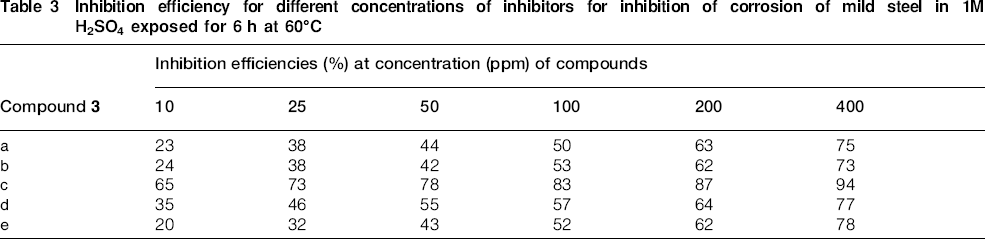
The results of weight loss measurements for various concentrations of inhibitor molecules at 60°C after 6 h of immersion in 1M HCl, 3 h immersion in 4·0M HCl and 2 h immersion in 7·7M HCl are reported in Table 1. At higher concentrations of HCl, the %IEs of the compounds were determined only at the concentration of 400 ppm. For the sake of comparison, the %IEs at 200 ppm in 1M HCl by gravimetry are also included in Table 2, which reports the results of electrochemical results by Tafel extrapolations. The %IEs in the presence of various concentrations of inhibitor molecules in 0·5M H2SO4 are reported in Table 3. The weight loss measurements were carried out for the 4th or even 5th time in order to get the desired standard deviation of 0·3-3·5% in the %IE values in the lower concentration range and within 0·5% in the higher concentration range.
Inhibition efficiency for different concentrations of inhibitors for inhibition of corrosion of mild steel in 1M HCl (6 h), 4·0M HCl (3 h) and 7·7M HCl (2 h) exposed at 60°C
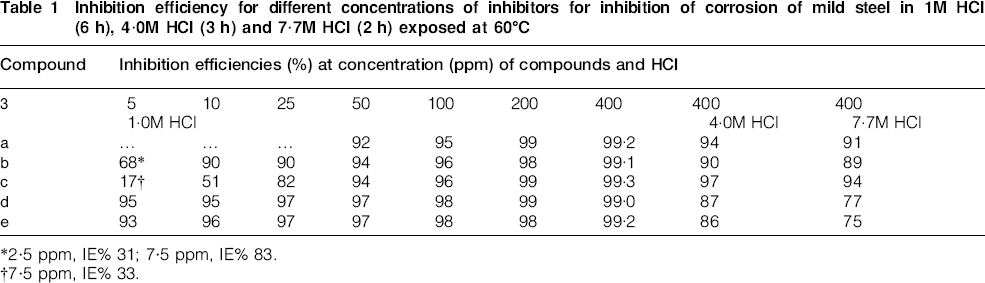
*2·5 ppm, IE% 31; 7·5 ppm, IE% 83.
†7·5 ppm, IE% 33.
Corrosion IEs using gravimetric and electrochemical methods: results of Tafel plots of mild steel sample in various solutions containing 200 ppm inhibitors in 1M HCl at 60°C for 6 h
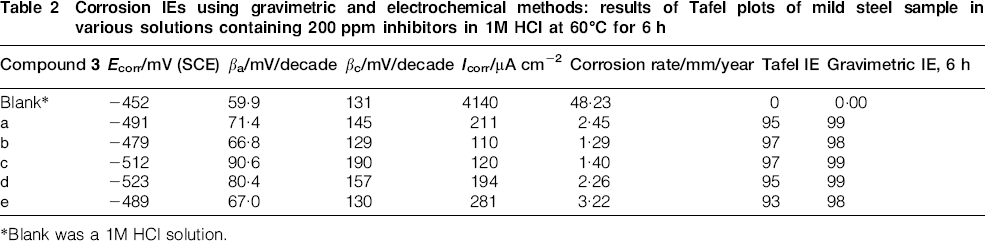
*Blank was a 1M HCl solution.
Inhibition efficiency for different concentrations of inhibitors for inhibition of corrosion of mild steel in 1M H2SO4 exposed for 6 h at 60°C
Electrochemical measurements: Polarisation curves
Each pair of Tafel plots was analysed to obtain the corrosion current density and the corrosion potential.19 The collected data were analysed by 352 SoftCorrII software, which utilises an advanced numerical fit to the Butler–Volmer equation by taking into consideration that many systems do not provide sufficient linear region to permit accurate extrapolation. The curve fitting procedures have the advantage that it does not require a fully developed linear portion of the curve.32,33
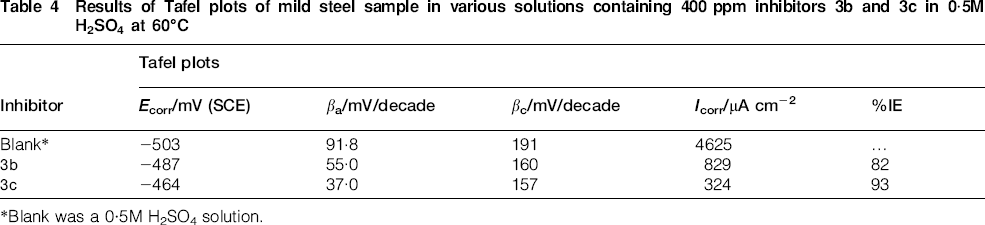
The results of the Tafel plots for mild steel in 1M HCl (blank) and 1M HCl solution containing 200 ppm of the inhibitors at 60°C are summarised in Table 2, whereas the results in 0·5M H2SO4 are presented in Table 4.
Results of Tafel plots of mild steel sample in various solutions containing 400 ppm inhibitors
*Blank was a 0·5M H2SO4 solution.
Adsorption isotherms
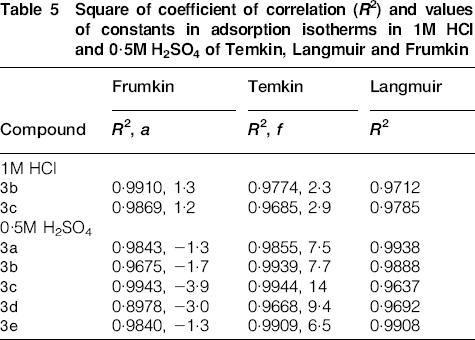
Surface coverage (θ, fractional IE) values, as determined by the weight loss measurements for various concentrations C (ppm in mg L−1, was changed to mol L−1) of the inhibitors, were used to find the best adsorption isotherm between those more frequently used, i.e. Temkin (K adsC = e fθ), Langmuir [θ/(1−θ) = K adsC] and Frumkin34 [K adsC = θ/(1−θ)e −2aθ]. The correlation coefficient indicated the best fit for the Frumkin adsorption isotherm for inhibitors in 1M HCl (Tables 1 and 5 and Fig. 2) and the Temkin isotherm in 0·5M H2SO4 (Tables 3 and 5 and Fig. 3), where K ads is the equilibrium constant of the adsorption process, and ‘a’ is the attraction constant. Frumkin adsorption isotherms for some of the inhibitors in 0·5M H2SO4 are displayed in Fig. 4. The linear fitting slope for the Frumkin isotherms gave the values of ‘2a’ for the compounds. Some of the molecules also gave good fit for the other adsorption isotherms (Table 5). For the Temkin isotherm, the linear fitting slope gave the values of 1/f (Table 5), where f is a molecular interaction parameter35 related to the molecular interactions in the adsorption layer as well as the energetic inhomogeneity of the surface.36
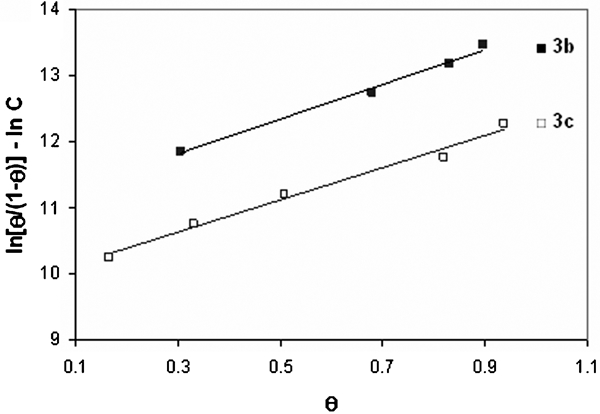
Frumkin adsorption isotherms of 3b and 3c in 1M HCl at 60°C
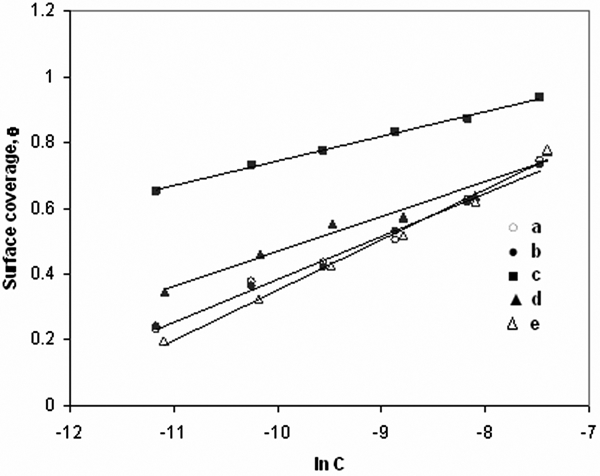
Temkin adsorption isotherms of 3a–e in 0·5M H2SO4 at 60°C
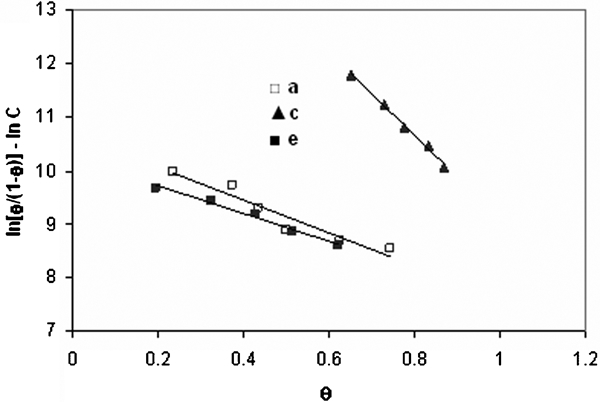
Frumkin adsorption isotherms of 3a, 3c and 3e in 0·5M H2SO4 at 60°C
Square of coefficient of correlation (R 2) and values of constants in adsorption isotherms in 1M HCl and 0·5M H2SO4 of Temkin, Langmuir and Frumkin
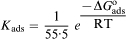
The equilibrium constant of the adsorption process K ads is related to the free energy of adsorption ( ) by
) by
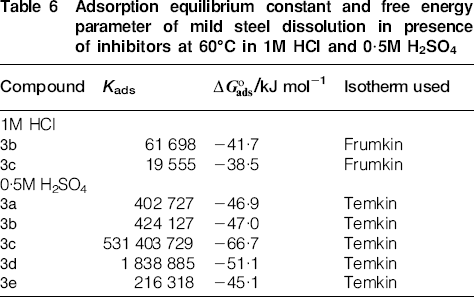
 that were obtained from the Frumkin adsorption isotherms are summarised in Table 6.
Adsorption equilibrium constant and free energy parameter of mild steel dissolution in presence of inhibitors at 60°C in 1M HCl and 0·5M H2SO4
 /kJ mol−1
Discussion
The bisquaternary ammonium salts
All the salts used in this study were surface active and exhibited excellent IEs (Table 1). At an inhibitor concentration of 400 ppm, all the compounds exhibited IE of ∼99% in 1M HCl. Note that compounds
The compounds
Even though the gravimetric method is the more simple and reliable method for the determination of IE, the inhibitors were also subjected to electrochemical study for the purpose of comparison. The results presented in Table 2 revealed that the IE in the presence of 200 ppm, determined by the electrochemical method using Tafel plots, corroborated the results from gravimetric method. Table 2 and Fig. 5 showed that E corr values in the presence of all the inhibitors shifted significantly in the more negative direction by 26-70 mV. However, such moderate shifts may not permit to classify the inhibition of corrosion solely under cathodic control. A displacement of OCP by at least 85 mV in relation to that measured for the blank solution is suggested to classify a compound as cathodic or anodic type inhibitor.38 Cathodic current densities in the presence of inhibitor are found to be significantly lower than in its absence, indicating that the cathodic hydrogen evolution reaction is mostly retarded. A moderate increase in the values of the Tafel slopes in most cases indicated that the inhibitors did affect the corrosion reactions to some extent. The most significant effect is assumed to be the formation of a barrier film that hindered the diffusion of ions to or from the metal surface. The above results along with the OCP shifts suggest that the studied compounds in HCl solution act as mixed type inhibitors under the predominance of cathodic control.
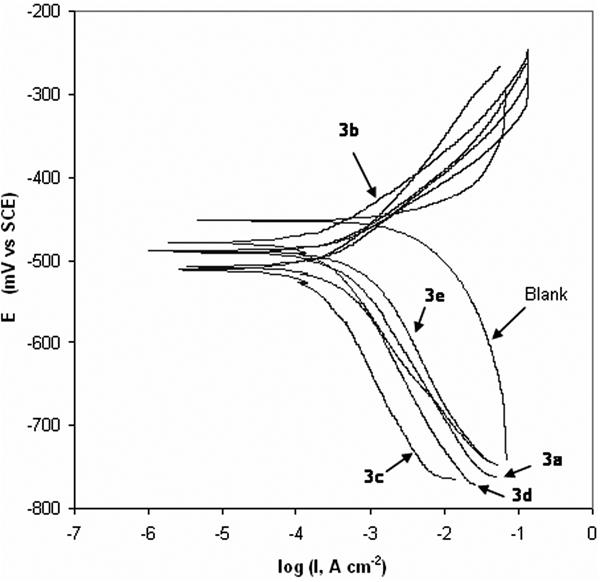
Potentiodynamic polarisation curves for mild steel in 1M HCl (blank) and 1M HCl containing 200 ppm of 3a–e at 60°C
Next, we focused our attention to study corrosion inhibition of
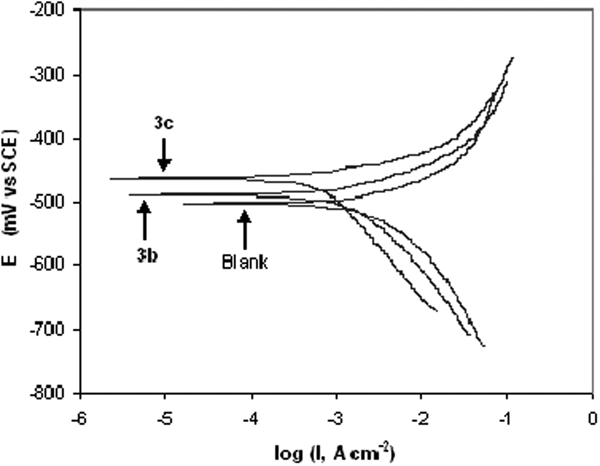
Potentiodynamic polarisation curves for mild steel in 0·5M H2SO4 (blank) and 0·5M H2SO4 containing 400 ppm of 3b and 3c
The Tafel plots (Fig. 6 and Tables 3 and 4) in 0·5M H2SO4 revealed that the corrosion potentials (E corr) have been shifted in the noble (less negative) direction with reference to the blank. The modest anodic shifts are indicative of the suppression of the anodic reaction as the main effect. However, lower values of the slopes of both branches indicate that corrosion reactions are not adversely affected in the presence of the inhibitors. The diffusion of ions to or from the metal surface is hindered owing to the formation of a barrier film. While the corrosion inhibition by these molecules was predominantly under cathodic control in 1M HCl, the inhibition in 0·5M H2SO4 was found to be under anodic control.
The adsorption of inhibitor molecules
The positive value of the attraction constant ‘a’ for the inhibitor molecules in 1M HCl provides evidence of the mutual attraction between adsorbed organic molecules, presumably as a result of the van der Waals forces of attraction between the hydrophobic spacers linking the quaternary nitrogens.39,40 The negative values of ‘a’ in H2SO4, on the other hand, indicate mutual repulsion presumably among the positive nitrogens.
The spontaneity of the adsorption process is assured by the negative values of  (Table 6) in acidic media. The
  values, as obtained by analysing the adsorption isotherms, were found to be ˜−40 kJ mol−1 in HCl and −45 to −67 kJ mol−1 in H2SO4. Since the
  values up to −20 kJ mol−1 are consistent with the physisorption, while those between −80 and −400 kJ mol−1 are associated with chemisorption, the experimental
  values, therefore, indicate that the adsorption mechanism of the inhibitor molecules on steel in 1M HCl and 0·5M H2SO4 solution was both electrostatic adsorption and chemisorption.41,42 The highest
  value of −67 kJ mol−1 for the adsorption of
Conclusions
Bisquaternary ammonium salts  points towards physisorption as the major contributor and chemisorption as the minor contributor for the adsorption of inhibitors on the metal surface. Among the compounds studied,
Footnotes
Acknowledgements
Facilities provided by the King Fahd University of Petroleum and Minerals and the University of Dammam and financial assistance by King Abdulaziz City of Science and Technology (KACST) (grant no. AR-20-72) are gratefully acknowledged.