







Abstract
The efficiency of dicarboxylate corrosion inhibitors for mild steel in near neutral NaCl solution was studied using electrochemical methods as open circuit potential, potentiodynamic polarisation curves and electrochemical impedance spectroscopy. Surface analysis was carried out to determine the kind of protection afforded by these inhibitors and to establish the inhibition mechanism. The results show that adipate and sebacate are good inhibitors, and their effectiveness is strongly dependent on chloride concentration. In the case of sebacate, the concentration required for inhibition was determined, and it was found that full protection strongly depends on the chloride concentration. Furthermore, it was shown that the mixture of benzotriazole with these dicarboxylates significantly improves the inhibition performance. The combination of these inhibitors exhibits a synergistic protective effect as it leads to higher efficiencies compared to those obtained when used individually.
Introduction
Mild steel is the most common type of steel as it is relatively low cost and provides material properties accepted for many applications. However, corrosion is a severe problem for mild steel in aqueous media. Currently, corrosion control technologies are widely used, including protective coatings, anodic and cathodic protections, corrosion inhibitors, polymers and corrosion resistant metals and alloys. In many applications as building and automotive, steel is protected by a coating system. A sacrificial zinc layer applied by galvanisation is also often used to increase the durability of steel made materials. On the other hand, for water cooling systems, cooling towers or heat exchangers, where steel is in continuous contact with water, the use of passivating inhibitors is the most convenient and economic method for controlling the corrosion of steel.1 – 8
In all cases, it is assumed9 – 13 that the electrochemical dissolution of the metal in aqueous solutions occurs on the bare surface (uncoated metal or scratched coating) through the adsorption of an aggressive anion (chloride) and the formation of soluble complexes or salts of metallic cations.
In order to prevent corrosion damage produced by the activity of chloride ions, organic corrosion inhibitors may be used. Indeed, these inhibitors could act by blocking the adsorption of chloride ions on the substrate by competitive adsorption.14,15
Several organic compounds containing P, N, O and S in their structures have been reported to exert inhibitive effects on steel corrosion in neutral media.16 – 20 Such compounds may be directly added to the aggressive solutions or incorporated in protective coatings. As reported in recent publications,21 – 25 such inhibitors are also incorporated inside nanocontainers that may be further integrated in paints or hybrid sol–gel coatings.
Particularly, compounds with functional groups containing oxygen have been reported to act as effective inhibitors thanks to their competitive adsorption through the formation of surface complexes.15,26 – 28 For example, compounds with carboxylic groups such as alkyl carboxylates, benzoates and their substituted forms have the ability to form complexes with Fe ions,29,30 competing successfully with Cl−.
Previous studies31 – 37 have revealed that straight chain aliphatic sodium monocarboxylates of general formula CnH2n+1–COONa have good inhibitive properties on many metals (aluminium, copper, zinc, iron, magnesium alloys and lead). In addition, these compounds are non-toxic as they are derived from fatty acids extracted from vegetable oils.
Particularly, it is well known that the salts of carboxylates support the passivation of mild steel in near neutral solutions.38-41 However, the passivating ability seems to be strongly dependent on the chain length. Short chain length (0⩽n⩽5) monocarboxylates were found to behave either as corrosive (formate n = 0) or only as weak inhibitive. However, for n = 6, the inhibition effectiveness rises rapidly and remains high up to n = 10. For even longer chain lengths (n⩾11), the inhibitor effectiveness declines considerably due to their low solubility in water. They form surfactants having a very low critical micellar concentration.
As for the monocarboxylates, short chain (n⩽3) alkyl dicarboxylates [−OOC(CH2)nCOO−] were found either corrosive (oxalate, n = 0) or weak inhibitive for mild steel.31 As n increases, the inhibitor effectiveness raises but less rapidly than for monocarboxylates. Good protection is obtained from adipate (n = 4) up to tetradecanedioate (n = 12). Effectiveness then drops abruptly for hexandioate (n = 14). If the micelle formation is responsible for the reduced inhibitor efficiency of n>11 monocarboxylates, the dicarboxylates show high critical micellar concentrations for n up to 13, as would be expected from the presence of two ionised polar heads.
Using a long term (50 days) weight loss test, Mercer38 has shown that dicarboxylates with n between 3 and 8 give almost complete protection to mild steel in main waters. This range compares well with the n = 5-8 deduced from short term tests.42
The precise mechanism of rust inhibition by carboxylates is, however, not completely understood. Previous studies43 – 46 have concluded that it is the hydrophobic character of the film formed by the interaction with the metallic interface (strong reduction in the surface wettability) that offers good protection against corrosion. The formation of an organic film would result from the precipitation on the surface of metal soaps of type (CnH2n+1COO−)mMm+. A preliminary stage of oxidation of the metal is thus necessary to induce precipitation of this soap.
The inhibitive effect of several carboxylates can be enhanced by the addition of a second inhibitor.45,47,48 Rammelt et al. observed that combining benzotriazole (BTA) with sodium benzoate49 or hexanate50 improves the corrosion resistance of mild steel in near neutral air saturated solutions without the presence of chloride ions. Whereas Kuznetsov et al.51 showed that passivation of iron and low carbon steel by BTA in borate buffer solution can be improved by its equimolar mixture with sodium phenyl undecanoate.
The purpose of the present work is to investigate how dicarboxylates NaOOC(CH2)nCOONa (n = 1, 2, 4 and 8), in combination or not with BTA, can provide a high and stable protection against corrosion of steel in neutral NaCl media.
This study is essentially based on electrochemical measurements, including open circuit potential (OCP) evolution with time, potentiodynamic polarisation curves and electrochemical impedance spectroscopy (EIS). Understanding of the protective mechanism is carried out with the help of surface examination [X-ray photoelectron spectroscopy (XPS), time of flight secondary ion mass spectrometry (ToF-SIMS), SEM and atomic force microscopy (AFM)] of the electrode surface after immersion in 0·02M NaCl solution with or without inhibitors.
Experimental
Materials
Sodium salts of malonic (n = 1), succinic (n = 2), adipic (n = 4) and sebacic (n = 8) acids were used as inhibitors in these experiments. These salts, purchased from TCI-Europe, were obtained as high grade reagents and used without further purification. The dicarboxylates were applied alone (10−3–10−1M) and as a mixture with BTA of purity ⩾99% (Merck) (10−3–10−1M).
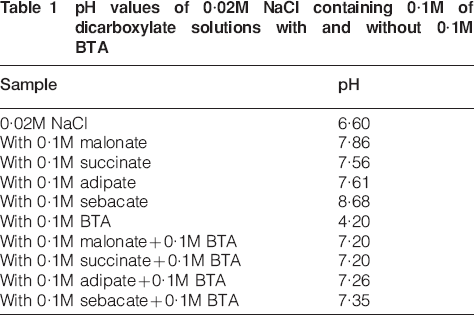
The measurements were performed at natural pH. The pH values of 0·02M NaCl solutions with 0·1M of dicarboxylates and in mixture with 0·1M BTA are given in Table 1.
pH values of 0·02M NaCl containing 0·1M of dicarboxylate solutions with and without 0·1M BTA
The substrate used in this study is mild steel DC04 with the following chemical composition: C, 0·03 wt-%; Mn, 0·21 wt-%; Cr, 0·04 wt-%; Al, 0·03 wt-%; Ni, 0·02 wt-%; Si, <0·01 wt-%; Cu, 0·03 wt-%; and the remainder is iron.
The steel samples were degreased in a commercial alkaline solution (Ridoline C72) at 60°C for 20 s and flash etched in HCl 50% solution at ambient temperature for 5 s followed by rinsing in demineralised water.
The samples analysed by AFM were previously abraded using wet emery papers up to 1200 mesh and further polished with diamond polishing paste having a particle size of 1 μm followed by cleaning with distilled water and treated with ultrasonic cleaning in ethanol–acetone solution (10 min).
The immersion tests were carried out at ambient temperature and open atmospheric conditions. The samples were immersed vertically in different inhibitive solutions, and after taking out the specimens, their surface was visually inspected.
Electrochemical measurements
The electrochemical measurements were performed with a conventional three-electrode arrangement, consisting of mild steel as working electrode, a platinum net as counter electrode and an Ag/AgCl (sat. KCl) reference electrode (all potentials are given versus this reference electrode). The tested surface area is 4·5 cm2. The electrochemical cell was put inside a Faraday cage to avoid external electrical interferences.
All the electrochemical measurements were carried out in static aerated electrolytes at room temperature (∼23°C). The OCP and potentiodynamic polarisation measurements were performed with a 273A EG&G Potentiostat computer controlled by Powersuite.
Anodic and cathodic polarisation curves were obtained at a scan rate of 10 mV min−1 starting from OCP.
The EIS measurements were performed with an SP-150 from Biologic computer controlled by EC-Lab.
Each experiment has been repeated at least three times.
Surface characterisation
The XPS experiments were performed on a Physical Electronic 5000 Versa-Probe XPS instrument using a monochromatised Al Kα X-ray source of 1486·6 eV with 24·6 W.
The ToF-SIMS surface analysis was carried out using a ToF-SIMS IV instrument from ION-TOF GmbH. A Ga+ 25 keV ion beam at a current of 0·12 pA rastered over a scan area of 300×300 μm was used as analysis beam. The detection was made in positive ion mode.
The ToF-SIMS spectra were analysed by principal component analysis (PCA) method using the SIMCA-P11 software supplied by Umetrics, Sweden. The peak intensity of the secondary ions was normalised to the total ion count before performing the PCA in order to correct the differences in total secondary ion yield from spectrum to spectrum. The normalised spectra were exported from the acquisition software (IONSPEC v3·16) to the SIMCA-P11 analysis software which mean centres and scales the variables.
The AFM analyses were carried out with the help of an atomic force microscope Dimension Icon Di ICON from Veeco. The AFM observations were performed at room temperature in tapping mode using a silicon cantilever NCHV (Veeco Instruments) or in contact mode using a silicon cantilever SNL-10 (Veeco Instruments).
The SEM analysis was performed using a scanning electron microscope Philips XL20 at a high voltage up to 30 kV, equipped with an EDAX detector.
Results and discussion
As the aim of the present study is to follow and understand the mechanism of formation of a protective layer in the presence of inhibitive compounds, most of the electrochemical measurements were carried out with a low concentration of chlorides and a relatively high concentration in the inhibitive compound.
Effect of dicarboxylate chain length
The evolution with time of the OCP gives information on the type of inhibition and allows determining inhibitor threshold concentrations. In the present study, the variation of the OCP of mild steel was followed versus time in aerated non-stirred 0·02M NaCl solutions with or without various disodium dicarboxylates at 25°C (Fig. 1).
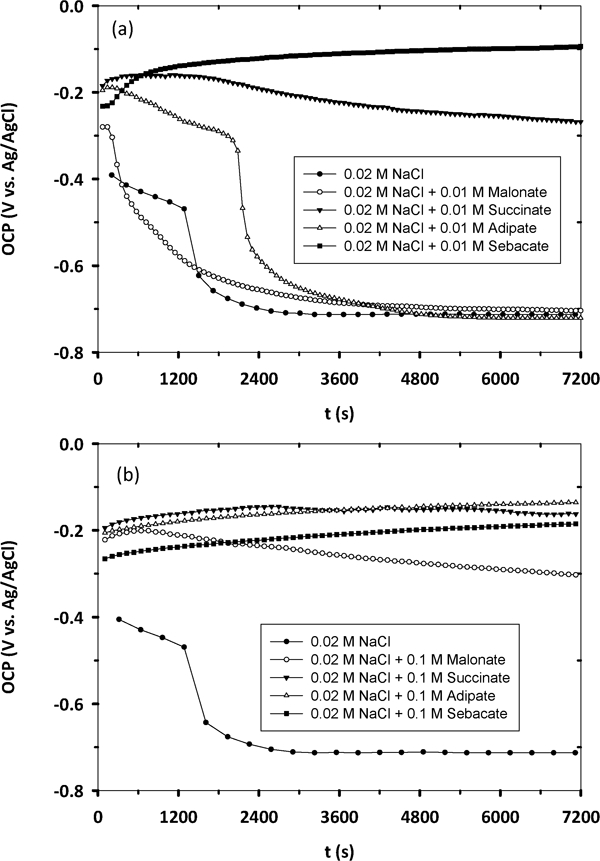
Open circuit potential variation versus time of mild steel in 0·02M NaCl solution without and with a 0·01M and b 0·1M of various sodium dicarboxylates
In the absence of carboxylates, the OCP is initially close to −350 mV(Ag/AgCl) and decreases quickly towards more negative values down to −700 mV(Ag/AgCl), indicating the initial dissolution of the native oxide film and the corrosion of the metal.
The introduction of 0·01M of sodium sebacate and adipate causes an instantaneous increase in the OCP, which reaches values superior to −100 mV(Ag/AgCl) with sebacate according to the passivation of steel (Fig. 1a). For this concentration, sodium malonate and succinate do not strongly influence the OCP.
However, for a higher concentration (0·1M), a positive shift of the corrosion potential is observed with the four selected dicarboxylates, which occur immediately after immersion (Fig. 1b). This behaviour indicates the formation of a protective passive film on the steel surface.
To better understand the protection mechanism of a compound and its effect on the kinetics of the anodic and cathodic reactions, polarisation measurements were carried out.
The compounds examined have no effect on the cathodic reaction corresponding to the reduction of dissolved oxygen. These curves are thus not shown here.
In contrast, the anodic curves are strongly modified by adding the inhibitive specie (Fig. 2). It can be clearly seen that the introduction of 0·1M of succinate, adipate or sebacate induces a significant decrease in the corrosion current together with a shift of the corrosion potential towards more noble values. The presence of dicarboxylates results in the formation of a passive film evidenced by the appearance of a passivation plateau. This plateau is moreover larger when the alkyl chain length is increased. A large passive range of 280 mV can be observed in the case of sodium sebacate.
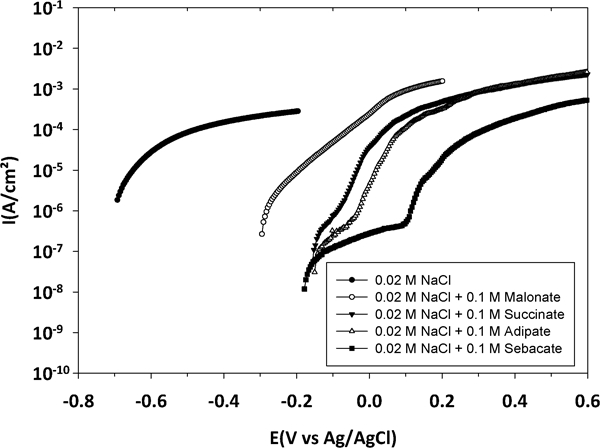
Anodic polarisation curves recorded for DC04 mild steel after 2 h of immersion in 0·02M NaCl solution without and with 0·1M of various sodium dicarboxylates
Based on the positive shift of the corrosion potential and the marked decrease in the anodic current density upon introducing dicarboxylates in the aggressive solution, these dicarboxylates are considered as inhibitors of predominant anodic effect.
The potential range of passivity is larger using sebacate with a passive current density of ∼0·4 μA cm−2. The breakdown of the passive film is observed near +100 mV(Ag/AgCl).
The corrosion behaviour of steel, both with and without inhibitors, has also been investigated by EIS as a function of immersion time (short exposure).
An example of Bode plots of mild steel in the presence of 0·1M sodium sebacate is shown in Fig. 3 for different contact times. Compared to the EIS spectrum obtained without inhibitor, the presence of sodium sebacate leads to a significant increase in the total impedance.
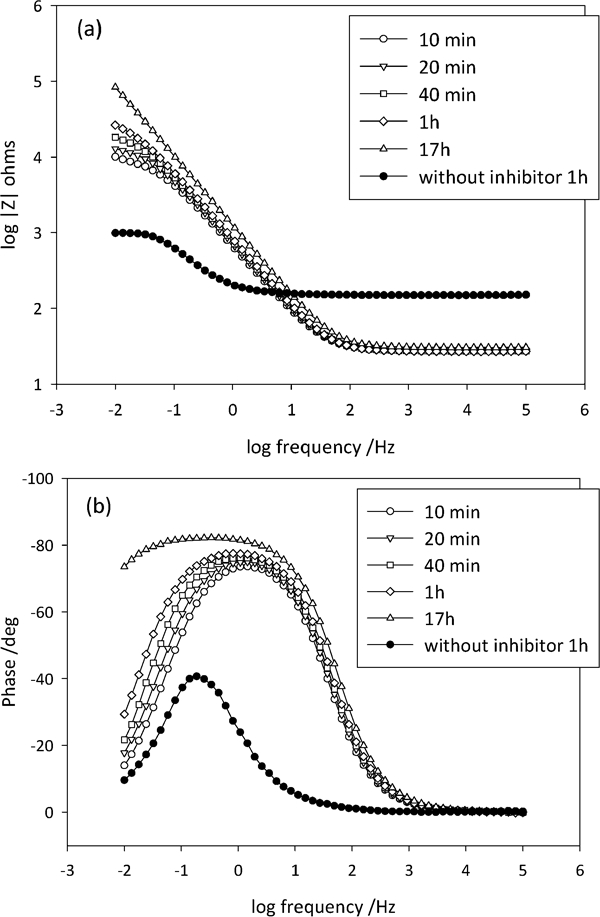
Bode plots in a modulus and b phase for DC04 mild steel in contact with NaCl 0·02M+sodium sebacate 0·1M at different contact times: EIS spectrum obtained without inhibitor after 1 h of contact is plotted for comparison
The EIS data obtained with the different carboxylates were modelled using a single time constant equivalent circuit, as shown in Fig. 4, with a resistance (R s representing the ohmic drop in the electrolyte solution) in series with a semicircuit consisting of the parallel combination of the charge transfer resistance (R ct) and the capacitance metal/electrolyte solution interface (C dl).
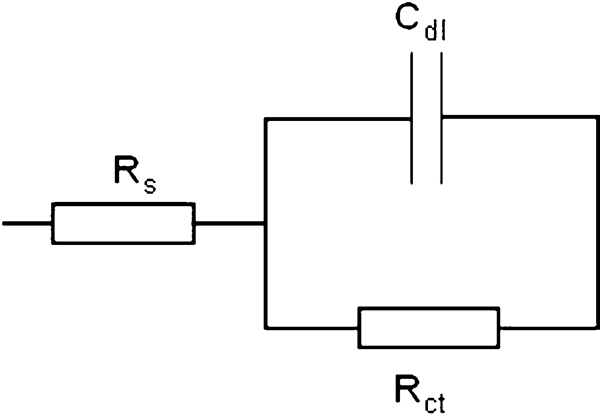
Equivalent circuit used to fit impedances obtained for mild steel in 0·1M dicarboxylate solutions
Figure 5 shows the evolution with immersion time of the charge transfer resistance values obtained by experimental data fitting for the different dicarboxylates. It can be observed that in the case of malonate, Rc t is only slightly higher than without inhibitor. The addition of sebacate and adipate causes, however, a significant increase in R ct. These values are two decades higher than that obtained in the absence of inhibitors (R ct passes from 4×10³ to ∼4×10⁵ Ω), indicating the formation of a good protective film on the metal surface.
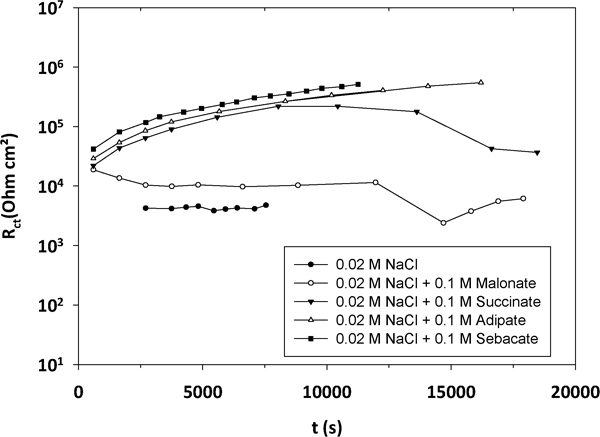
Variation of R ct of DC04 steel samples as function of immersion time in 0·02M NaCl solution without and with 0·1M of various sodium dicarboxylates
The use of succinate leads to high values of R ct up to 3 h of immersion, and for a longer period of time, the values start to decrease. This decrease may be associated with a slow loss of the protective properties of the passive layer.
Visual observations of the surface samples after the immersion test show a DC04 steel coupon corroded uniformly over its entire surface after 70 h of immersion in 0·02M NaCl solution containing 0·1M of sodium malonate, while the coupon exposed to 0·02M NaCl with 0·1M sodium sebacate retained its metallic appearance with no visible corrosion even after 1 year of immersion.
In the case of sebacate, the influence of the concentration on the inhibition effectiveness was also evaluated. Figure 6 presents the evolution of charge transfer resistance R ct as a function of immersion time for three concentrations (0·005, 0·01 and 0·1M).
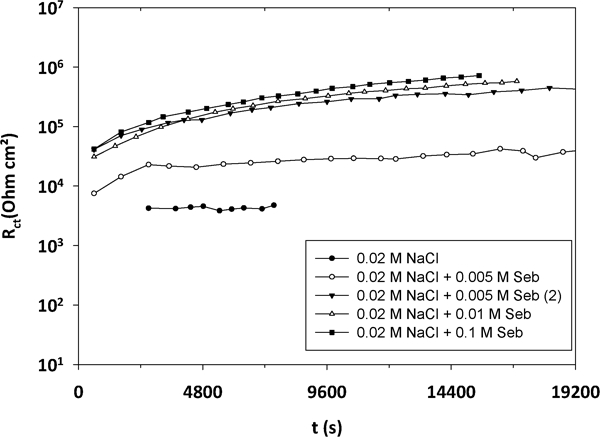
R ct of DC04 steel samples as function of immersion time for various concentrations in sodium sebacate and in 0·02M NaCl solution
The concentration of 0·005M is a critical concentration for which a protective film is formed in some cases, while for other samples, a poor protection is observed. This uncertainty could be explained by the heterogeneities of the steel surface. For concentrations >0·005M, the R ct values do not depend on the concentration in sebacate. While a protective film is formed, increasing the sebacate concentration will not lead to enhanced protection. As shown in Fig. 6, a sebacate concentration of >0·005M is thus sufficient to form a good protective layer in 0·02M sodium chloride.
What is also remarkable is the rapid increase of the charge transfer resistance at the early moments of contact of the metal with the electrolyte. The formation of the protective layer is thus extremely fast and results in a quasi-instantaneous passivation of steel.
Protection mechanism
The SEM energy dispersive spectroscopy analysis was performed before and after 2 months of immersion in 0·1M sebacate solution. The main difference in energy dispersive spectra between the untreated and sebacate treated samples is the carbon peak, which is a little more intense for this last one (due to the carbon atoms of sebacate).
In order to better understand the inhibition mechanism, the thin layer deposited on the steel surface after 3 h of immersion in the presence of sebacate was further characterised by PCA of ToF-SIMS data.
The PCA, described in detail elsewhere,52 has the ability to identify the key peaks that characterise a sample and contribute to the differences between samples. Figure 7 shows the results of a multivariate ToF-SIMS analysis of the reference sample and the 0·1M sebacate treated sample. The surface treated sample could be clearly differentiated from the untreated counterpart by the presence of peaks characteristic of hydrocarbon chains going until 10 carbon atoms and the presence of peaks C2H3O+ and C3H3O+ that are probably due to carboxylate surface functional groups (–CH2–COO).
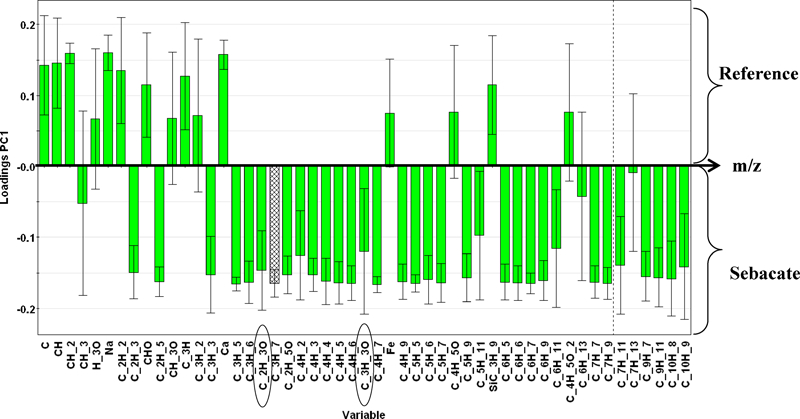
Multivariate analysis using PCA of positive ion ToF-SIMS spectra of polished DC04 steel surface (reference) and after immersion in 0·1M sebacate solution without NaCl for 3 h
The formation of a protective film on the steel surface is supposed to be due to a complex formed between the iron ion corrosion products and the dicarboxylate anion. This metal dicarboxylate acts as a passivating layer on the metallic surface. The ToF-SIMS analysis indeed confirms the presence of a strongly adsorbed film.
According to the literature,53,54 this complex can have one of the structures shown in Fig. 8.
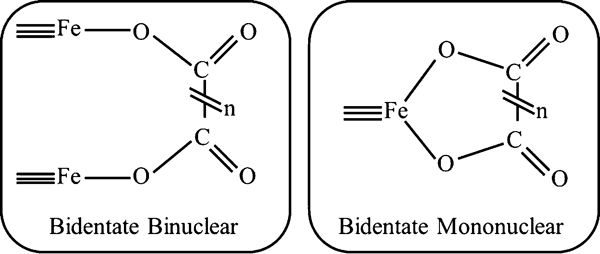
Proposed complex structures formed between iron oxide and dicarboxylate ligand
The formation of the film probably occurs through an initial adsorption of carboxylate on the steel surface, this adsorption being stronger in the presence of a native oxide layer. Indeed, by comparing the behaviour of pickled and only degreased steel (Fig. 9), one notices that the growth of a protective layer is faster in the presence of an oxide layer (degreased steel).
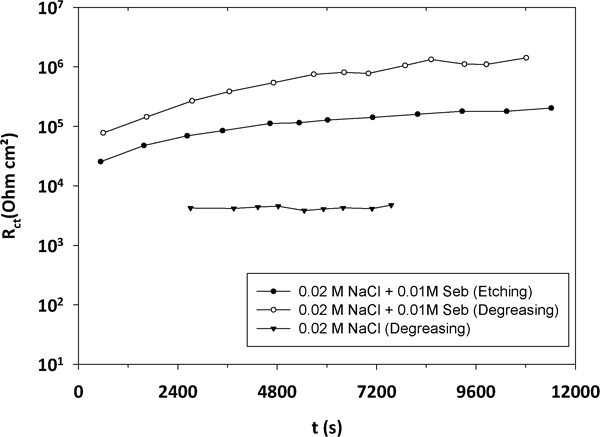
Variation of R ct as function of immersion time for 0·02M NaCl solutions without and with 0·01M sodium sebacate for both degreased and etched DC04 steel samples
The dissolution of steel produces ferrous ions that react with carboxylate ions to form an insoluble iron complex on the metal surface.55 The film grows continuously as ferrous ions are produced. This explains the progressive increase in the R ct values with time.
A minimum sebacate concentration is necessary to form or stabilise the protective layer, while increasing further its concentration has no effect, indicating saturation in the amount of adsorbed sebacate on the surface.
The present data clearly indicate that straight chain aliphatic dicarboxylates [−OOC(CH2)nCOO−, n = 1-8] can inhibit the corrosion of mild steel in near neutral solutions, but their effectiveness is critically dependent on their alkyl chain length. The longer carbon chains (n⩾4) give indeed better corrosion inhibition.
This dependence can be explained by the stability degree of the dicarboxylate complex structure. Indeed, it was shown56 that when the alkyl chain is short (n<4), the adsorption on iron oxides is mainly established by one carboxylic functional group, whereas the other end is undissociated. Furthermore, the pH solution may also condition the stability of the dicarboxylate complex. 53 53,57
Apparently, the larger dicarboxylates, e.g. adipate or sebacate, form more stable insoluble complexes and thus protect the metal from degradation in solutions at neutral pH.
Effect of NaCl concentration on corrosion inhibition of sodium sebacate
The effect of chloride ion on the anodic polarisation curves of mild steel in 0·1M sodium sebacate solutions with different concentrations of NaCl is shown in Fig. 10.
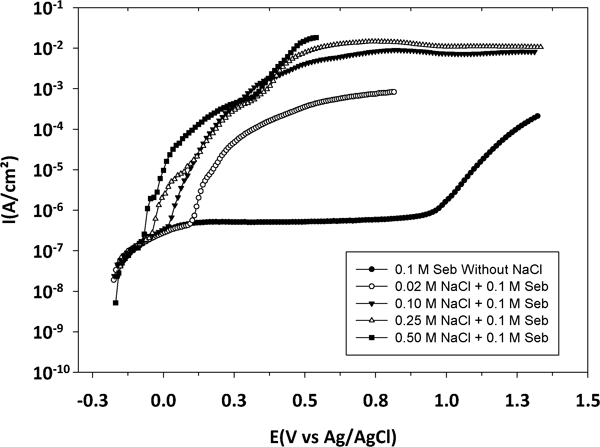
Anodic polarisation curves recorded for DC04 mild steel after 2 h of immersion in 0·1M sodium sebacate solutions with different concentrations of NaCl (0·02, 0·10, 0·25 and 0·50M)
In sodium sebacate solution, in the absence of any aggressive anions such as Cl−, mild steel shows a passivation behaviour with a passive current density of 0·6 μA cm−2. This passivity range is followed by an increase in the current density at 1000 mV(Ag/AgCl) resulting from the onset of oxygen evolution according to the following electrochemical reaction

The observation of the specimens after anodic polarisation revealed the presence of pits in those samples tested in solutions containing chlorides. No pits or generalised corrosion was found in the absence of chloride ions.
The dependence of pitting potential on chloride concentration has been reported in several investigations. In general, a logarithmic relationship according to the following equation is proposed8,58 – 60

A similar relationship was found in this research for 0·1M sebacate solutions (Fig. 11) with values of −117 and −52 mV for a and b parameters respectively. The lowest pitting potential was recorded for a solution of 0·1M sodium sebacate +0·5M NaCl with a value of −70 mV(Ag/AgCl).
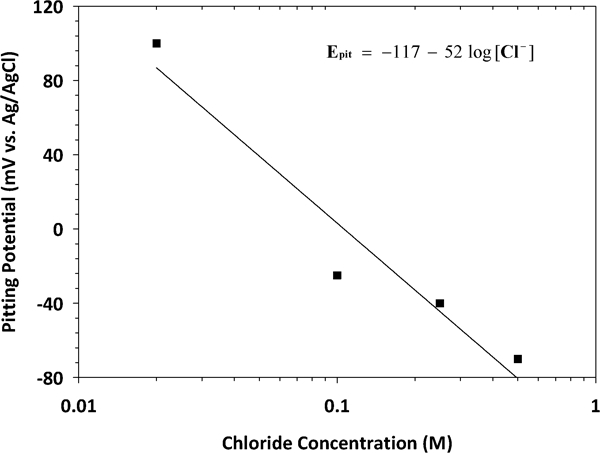
Pitting potential of samples of mild steel DC04 in 0·1M sodium sebacate solutions (determined from anodic polarisation curves of Fig. 10) as function of concentration of NaCl
Long immersion times were also explored (up to 2 weeks). Figure 12 shows the evolution with time of OCP in 0·1M NaCl with different concentrations of sodium sebacate. The curve for 0·001M sodium sebacate exhibits a strong decrease of the OCP to ˜−0·7 V(Ag/AgCl) after ∼12 h of immersion. This potential drop is certainly related to the attack of the passive film by the adsorption of chloride and thus to the activation of the metal. When the sodium sebacate concentration increases to 0·005 and 0·01M, the first corrosion damage appears on the specimen surface after 45 and 46 h of immersion respectively. In contrast, no breakdown was observed for the passive film formed in 0·1M NaCl with at least 0·05M sodium sebacate after >340 h of immersion.
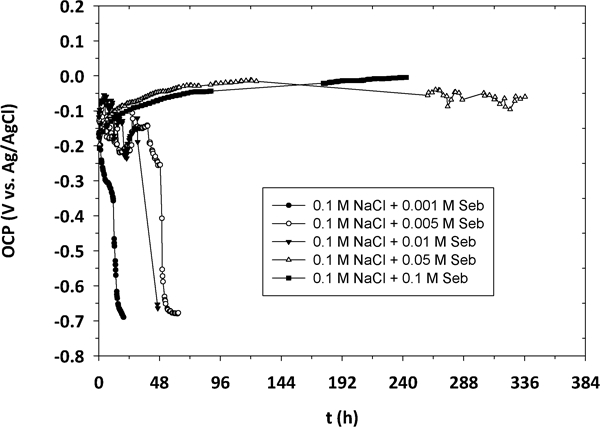
Open circuit potential variation of mild steel in 0·1M NaCl with different concentrations of sodium sebacate
The same results were obtained for the NaCl concentration of 0·25M.
When the NaCl concentration increases to 0·5M, the passivity breakdown is observed after only 29 h of immersion in 0·1M sodium sebacate with many metastable pits.
The addition of dilute concentration of sodium sebacate (0·005M) to 0·02M NaCl retards the passivity breakdown that occurs after 90 h of immersion.
The time of breakdown initiation increases with increasing sebacate content in the solution. Sebacate and chlorides are competing iron complexing agents. The ratio between sebacate and chloride concentration thus needs to be high enough (⩾0·25) to maintain the passive layer integrity.
Effect of mixture with BTA
The synergetic effect of mixtures of 0·1M BTA with 0·1M of the different disodium dicarboxylates on the electrochemical behaviour of mild steel was investigated. The anodic polarisation curves recorded (Fig. 13) show that the mixtures of sebacate or adipate with BTA improve the mild steel passivation. This result is in agreement with the work of Pemberton et al.47 These authors have shown a synergistic effect between disodium sebacate and BTA for the corrosion inhibition of cast iron and mild steel in distilled water and in sodium sulphate solution.
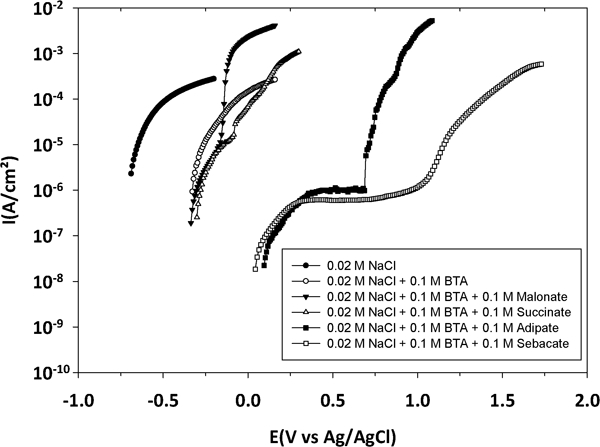
Anodic polarisation curves of DC04 mild steel after 2 h of immersion in 0·02M NaCl solutions without and with 0·1M of various sodium dicarboxylates/0·1M BTA mixtures
A large passivity domain is indeed observed for these two dicarboxylates. This passivity range is longer than for the inhibitors used separately, indicating a real and strong synergistic effect of this combination.
The difference between the pitting potential E pit and the corrosion potential E corr may be considered a measure of the inhibition efficiency, 61 61,62 i.e. the larger the difference between those two potentials, the higher resistance to pitting.
As can be seen from Table 2 and Fig. 14, the inhibition efficiency, defined by the measure of magnitude of ΔE (E pit−E corr) increases strongly when the mixture with BTA is used.
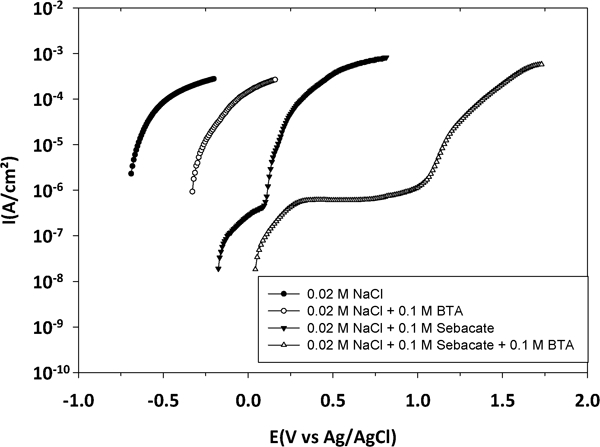
Anodic polarisation curves of DC04 mild steel after 2 h of immersion in 0·02M NaCl solutions without and with 0·1M of BTA, sodium sebacate and sebacate/BTA mixture
Electrochemical parameters for mild steel in 0·02M NaCl solutions containing 0·1M of dicarboxylates and their mixture with 0·1M BTA

Indeed, the extension of the passivity region was found up to 1000 mV in the sebacate/BTA mixture, whereas in the absence of BTA, this value does not exceed 300 mV.
The effect of BTA concentration was also studied (Fig. 15). The passivity range widens with the inhibitor concentration, and a remarkable shift of E pit to more noble values is observed when the BTA concentration increases (E pit shifts from 100 mV(Ag/AgCl) without BTA to 825 mV(Ag/AgCl) in the presence of 0·005M BTA).
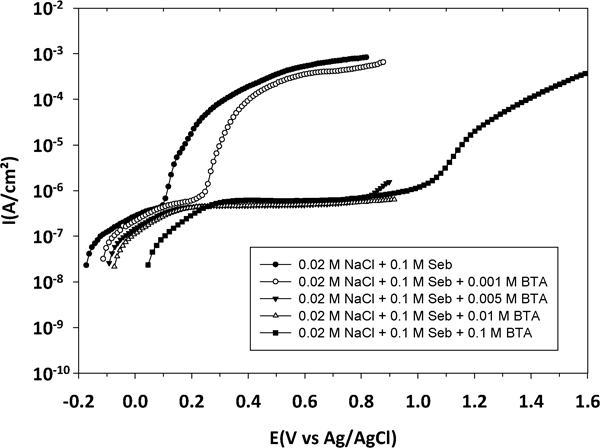
Anodic polarisation curves of DC04 mild steel after 2 h of immersion in mixture of 0·1M sodium sebacate and 0·1M of various sodium dicarboxylates/BTA
The synergistic effect of BTA with 0·1M sebacate is visible from 0·001M and is maximum for 0·005M BTA. Increasing further the concentration of BTA only affects the value of the corrosion potential, which reaches positive values for 0·1M of BTA.
The AFM images reported in Fig. 16 show the surface of polished steel immersed for 22 h in a mixture of 0·1M sebacate/0·1M BTA (Fig. 16b and c) in comparison with the initial polished steel surface (Fig. 16a).
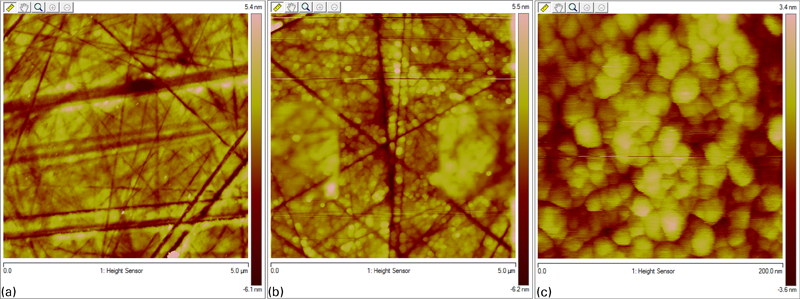
Images (AFM) of polished steel DC04 a contact mode in air, b contact mode in situ in mixture sebacate/BTA solution and c (200×200 nm) tapping mode in air after immersion of 22 h in mixture sebacate/BTA solution
The AFM image in Fig. 16c shows clearly that the surface is covered continuously and homogeneously by a thin layer of small particles.
It should be noted that in the case of sebacate alone, these particles were not detected.
It is likely that this layer is associated to a complex formed between corrosion products from steel surface and BTA present in the test solution.63,64
Indeed, the XPS spectrum of the film formed on the polished steel put in contact for 5 h with a solution containing the sebacate/BTA mixture shows a signal due to the presence of nitrogen atom (399·5 eV, N1s). According to the literature,64 this peak can be associated with the formation of metal (n+) BTA complexes.
In order to interpret the mechanism of the synergistic effect between sebacate and BTA, two acceptable explanations have been developed.49,51 The first one supposes that sebacate acts primarily on the iron dissolution rate by plugging the pores in the formed oxide layer with insoluble ferric dicarboxylate complexes, whereas BTA is strongly adsorbed on the oxide layer.49 The second explanation50 is based on the fact that the adsorption of BTA on the steel surface is improved by the preliminary adsorbed sebacate.
Conclusions
Results of OCP and anodic polarisation measurements showed that non-toxic dicarboxylates with alkyl chain length of ⩾4 support the passivation of mild steel in near neutral solutions.
These dicarboxylate (n⩾4) inhibitors function by blocking the anodic reaction of the metal surface while the cathodic reaction is essentially unaffected.
Particularly, sebacate provides protection even at low concentration (5×10⁻³M in 0·02M NaCl solution).
The critical inhibitor concentrations were then determined by defining the sebacate concentration necessary to suppress corrosion. The sodium sebacate amount required strongly depends on the NaCl concentration.
The EIS reveals that dicarboxylates form a thin protective layer on steel. The proposed mechanism of inhibition involves the formation of iron dicarboxylate complex on the metal surface after an initial oxidation of iron into ferrous ions. This insoluble ferric compound strongly prevents attack of the oxide layer by chloride ions.
The effectiveness of dicarboxylates (n⩾4) can be increased if a mixture with BTA is used. The highest degree of inhibition was observed for disodium sebacate/BTA mixture that also showed a clearly pronounced increase in the pitting initiation potential.
The synergistic effect in the corrosion protection is certainly due to a more favourable adsorption of BTA.
Footnotes
Acknowledgements
This work was performed within the framework of the project called ‘Clearzinc’ financed by the European Union (European Regional Development Founds) and the Région Wallonne. The authors would like to thank V. Huart, A. Roobroeck, D. Cossement, F. Renaux and Y. Paint for their help.