







Abstract
The aim of the present work is to study the effect of surface mild steel preparation on its electrochemical behaviour in neutral chloride solution without and with an inorganic inhibitor. Various surface preparations are examined: alkaline degreasing, acid pickling and polishing. Open circuit potential measurements and potentiodynamic polarisations are used as corrosion monitoring techniques. The effect of chloride concentration is evaluated. The ability of inorganic inhibitors (Na2MoO4, NaNO2, Na2WO4 and Na2VO3) to stabilise the passive state of steel in chloride containing solutions is assessed by electrochemical and surface analysis techniques. The results reveal that, among the four inhibitors studied, the sodium molybdate is the best environmentally friendly corrosion inorganic inhibitor for steel.
Introduction
Mild steel is the most commonly used material for industrial and domestic applications (construction materials, households, automotive industry, etc.) worldwide. However, corrosion is the major problem for mild steel in aqueous media. In pure air at ambient temperature, a thin protective oxide film forms on the surface of mild steel. Unlike that formed on stainless steel, it is not protective in the presence of electrolytes, and it usually breaks down.1 Many methods such as coatings, phosphating, anodic or cathodic controls and inhibitor use are adopted to minimise the corrosion damages of steel.2 – 6
Of particular interest for us is the use of inhibitors. Corrosion inhibitors are substances that, when introduced into a corrosive environment at low concentration, reduce the corrosion rate by acting directly at the metal surface.6
Nowadays, there are numerous corrosion inhibitors,7,8 but not one of them equals the efficiency of chromate and dichromate inhibitors. The strong objection against the use of chromate and dichromate inhibitors is their toxicity. Attention has been focused on molybdate and tungstate inhibitive efficiency because they are similar in chemical structure and periodicity (group VI ions). Unlike chromate inhibitors, sodium molybdate Na2MoO4 and sodium tungstate Na2WO4 are non-toxic, environmentally friendly corrosion inhibitors.9,10 Their use as corrosion inhibitors has been repeatedly described.10 – 13 These agents are classified as anodic inhibitors, but unlike  , the
, the  and
and  ions have less oxidising properties. Their use requires the presence of O2 or other oxidising agents.11
The corrosion of steel in neutral NaCl solutions is initiated through two main mechanisms: formation and build-up of a passivating iron oxide layer and partial destruction of this layer by pitting. Cheng et al.14 concluded that the main role of Cl− in pitting is to increase the probability of the breakdown of the passive film rather than to inhibit the surface repassivation. Molybdate is one of the most beneficial chemical compounds that retard pitting growth of carbon steel in chloride solutions. The beneficial effect of molybdate was attributed by some investigators to its enrichment in the passive film.15 In fact, Fujioka et al.15 showed that Mo containing compounds can repair the defect of the passive film of iron in borate buffer solution and inhibit pit growth.
Nitrite is an oxidising agent that inhibits mild steel corrosion in neutral and alkaline solutions (pH 6 and above) and accelerates corrosion in acidic media (pH 4 and below). Synergistic inhibition action of nitrite in conjunction with molybdate has been reported in the literature.16 Nitrite improves corrosion inhibition efficiency of molybdate.
Several studies have been conducted on the corrosion of steel in chloride media in the presence of corrosion inhibitors.15,17 – 19 However, the effect of the surface preparation has not yet been systematically investigated. As the mild steel surface is altered by changing the surface preparation method,20 one may expect an impact of the surface reactivity towards inhibiting compounds. Indeed, the composition and topography after degreasing, pickling or mechanical polishing are not the same.
The purpose of the present paper is to study, using electrochemical and surface analysis techniques, the corrosion inhibition in chloride media provided by inorganic inhibitors (Na2MoO4, NaNO2, Na2WO4 and Na2VO3) of mild steel. The effects of three different surface preparations including alkaline degreasing, hydrochloric acid pickling and mechanical polishing are investigated and compared.
Sodium molybdate was selected and studied in more detail among other inhibitors as the best environmentally friendly corrosion inorganic inhibitor for steel. Inhibition mechanisms for molybdate on mild steel corrosion proposed in few works are different.5,19 We suggest explaining the  inhibitive mechanism in the light of the steel surface state.
The evolution of the open circuit potential (OCP) with time gives information concerning the potential stability and the layer formation kinetics in the presence of the inhibitor and allows us also to assess the effect of surface preparation on the efficiency of the corrosion inhibitors. The polarisation curves reveal the operating mode of the inhibitor (anodic, cathodic, passivity, etc.), the sensitivity to pitting corrosion and the magnitude of the passivity range (anodic polarisation).
Experimental
Materials
Planar mild steel specimens having dimensions of 4 cm×5 cm×0·67 mm were used. The composition of mild steel (DC04) used is Fe–0·079C–0·01S–0·008P–0·223Mn (wt-%). The mild steel DC04 was annealed at 800°C and oiled.
The microstructures of mild steel were characterised by optical microscopy after mirror polishing and etching with 4% nital (HNO3). As shown in Fig. 1, the mild steel surface presents a uniform ferritic microstructure with a low amount of tertiary cementite in grain boundaries. The grain size varies from 10 to 50 μm.
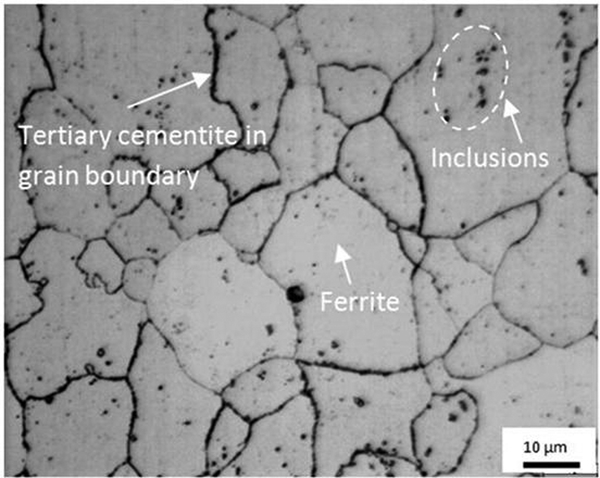
Optical micrograph of DC04 steel etched with 4% nital
Sodium molybdate Na2MoO4.2H2O (99·5%) from Chem Lab, sodium nitrite NaNO2 (>99%), sodium tungstate Na2WO4.2H2O (⩾98%) from Merck and sodium vanadate Na2VO3 (⩾98%) from Fluka were used without further purification.
Metal surface preparation
Three surface preparations are tested:
alkaline degreasing with alkaline cleaning solution (pH 12·8) based on a NaOH solution; the degreasing was performed according to the following sequence:
acetone degreasing
immersion in the alkaline solution at 60°C for 30 s
rinsing with deionised water at room temperature for 20 s
rinsing with deionised water at 60°C for 20 s
drying with laboratory paper
acid pickling using HCl involving the following steps:
alkaline degreasing (following procedure 1)
acid pickling (5 s) in HCl (37 wt-%) diluted 50% with deionised water
rinsing with deionised water at room temperature
drying with laboratory paper
mechanical preparation (polishing) according to the following sequence:
polishing with 320, 500, 600, 800 and 1200 grades silicon carbide paper
acetone degreasing
drying with laboratory paper.
Electrochemical measurements
The electrochemical measurements were carried out in a conventional three-electrode cell in which the working electrode was the DC04 mild steel sample (surface, 4·5 cm2); the counter electrode was a platinum plate, and the reference electrode was an Ag/AgCl (sat. KCl) electrode. The three electrodes were connected to a potentiostat PARSATAT 2273 from Ametek Computer controlled by PowerSuite. In order to avoid crevice corrosion, a silicon ring was used as sealing between the sample surface and the cell.
Open circuit potential measurements and potentiodynamic polarisations are used as corrosion monitoring techniques. All electrochemical experiments were performed at room temperature. Anodic polarisation is performed on mild steel after 2 h of stabilisation of the OCP. Deionised water containing 0·02M NaCl served as aqueous corrosive environment at pH 6·8. The solution with inhibitor was 0·02M NaCl+0·05M inhibitor. The scan rate was 10 mV min−1 for all the tests. Each test was performed at least three times to ensure reproducibility. The low NaCl concentration, compared to inhibitor concentration, was chosen to highlight the inhibition effect and be able to compare the differences appearing between the inhibitors.
Surface characterisation
The roughness measurements were performed using Profiler (Multisensory NanoJura) and its optical system acquisition with vertical resolution up to 2 nm.
X-ray photoelectron spectroscopy (XPS) analysis of steel samples was performed using a VG ESCALAB 220 iXL system with an Al Kα (1486·6 eV) monochromatic X-ray source. The C 1s peak (285 eV) was used as a binding energy reference.
The time of flight secondary ion mass spectrometry (ToF-SIMS) measurements were performed using a ToF-SIMS spectrometer (ION-ToF, IV). Mild steel surface was irradiated with a pulsed 25 keV Ga+ ion beam.
Results and discussion
Evolution of roughness and surface observation
Figure 2 displays optical images of DC04 mild steel after different surface preparations. Roughness varies with the steel substrate preparation. After industrial alkaline degreasing, the roughness is in the order of 1·5 μm. After acid pickling, surface steel has been uniformly attacked by acid (roughness, ∼1·4 μm) and is not mainly changed compared with steel simply degreased. After polishing with 1200 grit SiC paper, the roughness is low and ∼0·15 μm.
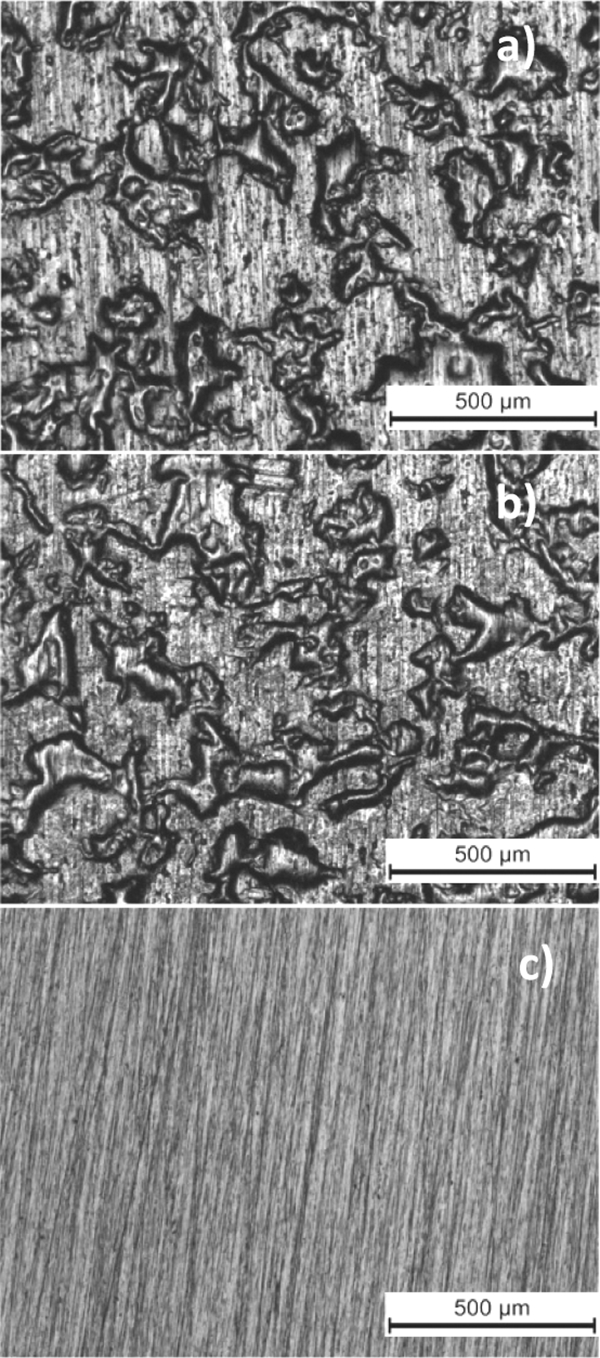
Optical micrographs of DC04 steel after a industrial degreasing (R a = 1·54 μm), b acid pickling (R a = 1·43 μm) and c mechanical polishing (R a = 0·15 μm)
X-ray photoelectron spectroscopy analysis
Figure 3a displays the Fe 2p XPS spectra after different surface preparations. The Fe 2p XPS spectra obtained on mild steel after mechanical polishing or acid pickling present two peaks. The peak at 707 eV is associated to metallic iron, and the one at 711 eV to the iron oxide as presented in other studies.21 The fit of experimental data Fe 2p XPS spectra obtained on mild steel after industrial degreasing are shown in Fig. 3b. The pick positions at 710·59 and 711·59 eV correspond to iron oxide Fe2O3 and ferrous hydroxide FeOOH respectively.22 These oxide and hydroxide are present at the extreme surface of steel after degreasing.
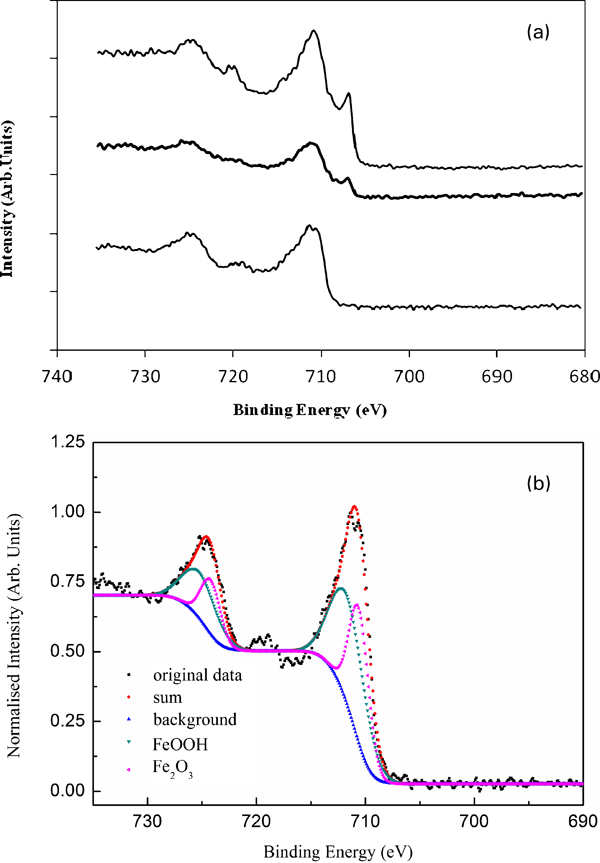
Fe 2p XPS spectra obtained for DC04 steel after three different surface preparations
The fitting for XPS spectra of Fe 2p is also determined on pickled and polished specimens (not shown here). The best fitted curves for experimental data (giving the minimum value of χ 2) indicate that the oxide formed on the extreme surface is mainly composed of Fe2O3.22
After mechanical polishing and acid pickling, the various iron oxides were removed and formation of a new thin film oxide was observed. Since XPS is a surface analysis method (few nanometres), the film oxide formed on the steel after polishing and pickling has to be thin since the peak of metallic iron can still be detected. On the contrary, in the case of degreased mild steel, the absence of peak of iron is indicative of the presence of a thicker oxide layer. The iron oxide observed after mechanical polishing is probably formed during the treatment because it induces a significant increase of the surface temperature and substantial plastic deformation at the local surface area, which promotes faster surface oxidation.23
Surface preparation effect in chloride media
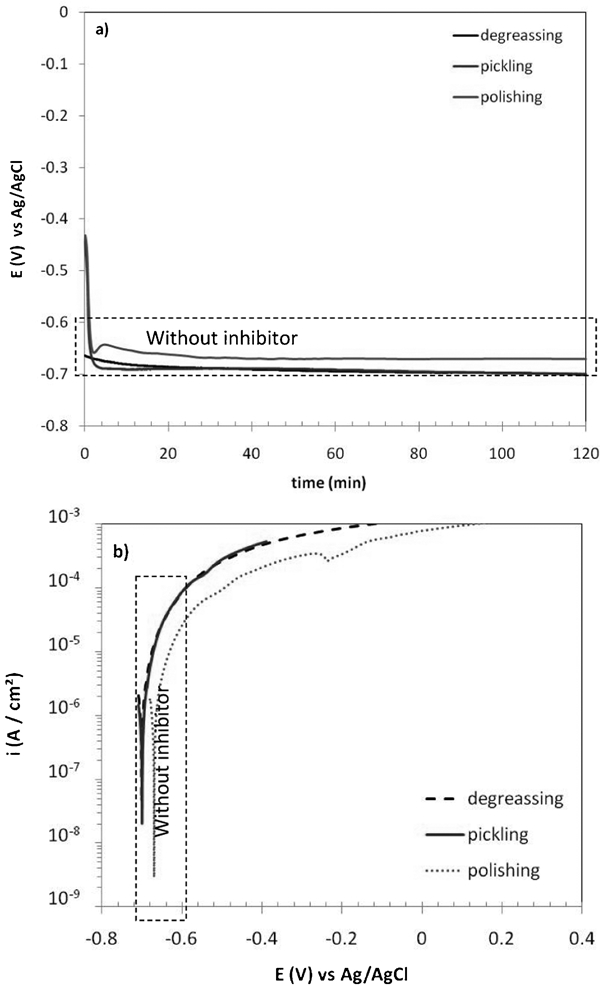
Figure 4 displays the evolution of the OCP with time (Fig. 4a) and anodic polarisation measurements of DC04 mild steel after different surface preparations in 0·02M NaCl electrolyte without inhibitor (pH 6·8) (Fig. 4b). Just after immersion, a potential of −0·3 V/ref was recorded for mild steel polished and −0·4 V/ref for mild steel degreased or pickled. No significant evolution of OCP is observed for the polished specimen (to SiC 1200 grade) after 2 h of immersion. The potential decreases from −0·28 to −0·4 V/ref. This means that the thin oxide film formed after polishing is not significantly altered after 2 h of immersion in a NaCl solution. After a certain immersion time, higher than 2 h, the OCP of polished steel decreases and reaches the corrosion potential.
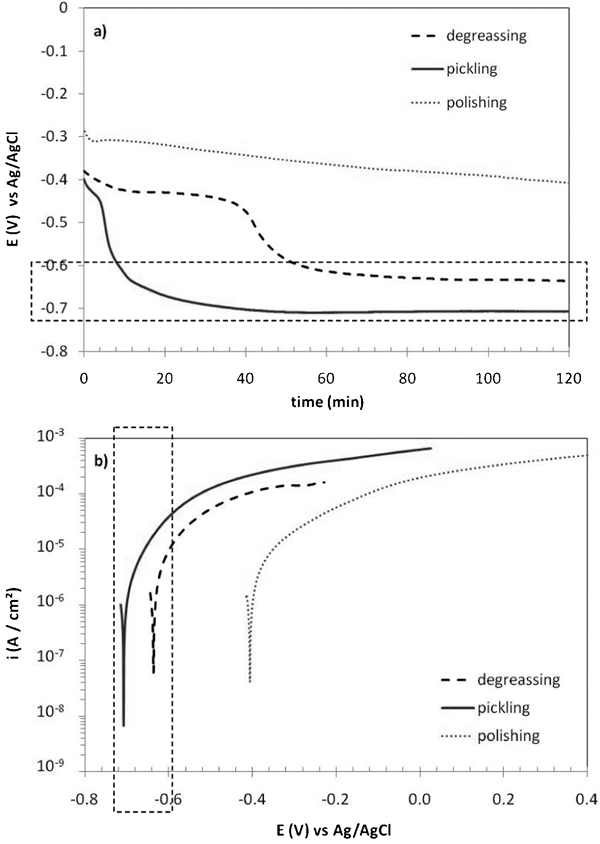
Open circuit potential as function of a immersion time and b anodic polarisation measurements in 0·02M NaCl of DC04 mild steel submitted to different surface preparations as indicated
Two potential stability regions are observed for mild steel when industrial degreasing is carried out (Fig. 4a). The first potential region is located around −0·4 V/ref associated to the protective pre-existing oxide film, reinforced by the alkaline degreasing. After 40 min of immersion, the oxide breakdown occurs and the potential changes towards more negative values. The second region corresponds to the active dissolution of steel in neutral aerated solution.
With HCl pickling, the pre-existing oxide film was removed and the freshly thin oxide film quickly breaks down after contact with the electrolyte. The potential changes rapidly towards more negative values and stabilises in the second potential region. These results indicate that the structure of the new thin oxide film formed after polishing and pickling is different.
Regarding the polarisation curves, they all have the same profile with a shift of the corrosion potential towards more positive values for the polished mild steel. For the three surface preparations, generalised corrosion of mild steel occurs after anodic polarisation. No passivity zone is detected.
Effect of NaCl concentration on OCP of DC04 mild steel
Figure 5 shows the influence of NaCl concentration on the evolution with immersion time of the OCP of degreased DC04 mild steel. At the early immersion times, the potential is lower for increasing NaCl concentrations. A potential of −0·22 V/ref was recorded for 0·001M NaCl, while a potential of around −0·45 V/ref was obtained for concentrations higher than 0·25M.
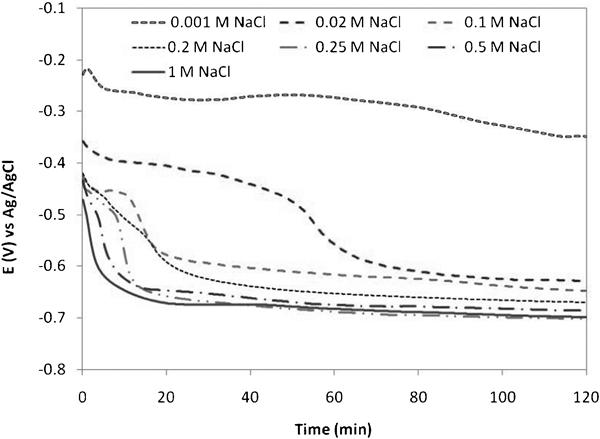
Open circuit potential evolution with immersion time for different NaCl solutions of DC04 mild steel after industrial degreasing
At a very low concentration, no significant evolution of OCP is observed after 2 h of immersion. At this concentration (0·001M NaCl) and after 2 h, the natural protective oxide film is not significantly altered.
As shown in Fig. 5, the two regions of stable potentials are observed for NaCl concentrations higher than 0·02M. However, with increasing NaCl concentration, the first region becomes smaller and disappears at a high concentration (1M NaCl). This indicates that the natural protective oxide film breaks down more rapidly with the increase of the Cl− concentration. The potential changes rapidly towards more negative values and stabilises in the second potential region.
Chloride ions produce a localised attack of the pre-existing oxide film on steel.24 The attack initiates only at certain sites (probably weak spots in the film associated with inclusions, dislocations or other surface defects). The increase of Cl− concentration enhances the probability for initiating a localised attack on the surface.
Electrochemical measurements when inorganic inhibitor is added to NaCl electrolyte
The ability of inorganic inhibitors (Na2MoO4, NaNO2, Na2WO4 and Na2VO3) to stabilise the passive state of steel in chloride containing solutions is studied by electrochemical and surface analysis techniques.
Electrochemical measurements in presence of sodium molybdate (Na2MoO4)
Figure 6 shows the OCP (Fig. 6a) and the anodic polarisation curves (Fig. 6b) recorded for different surface preparations of DC04 mild steel in 0·02M NaCl in the presence of 0·05M sodium molybdate (pH 7·2).
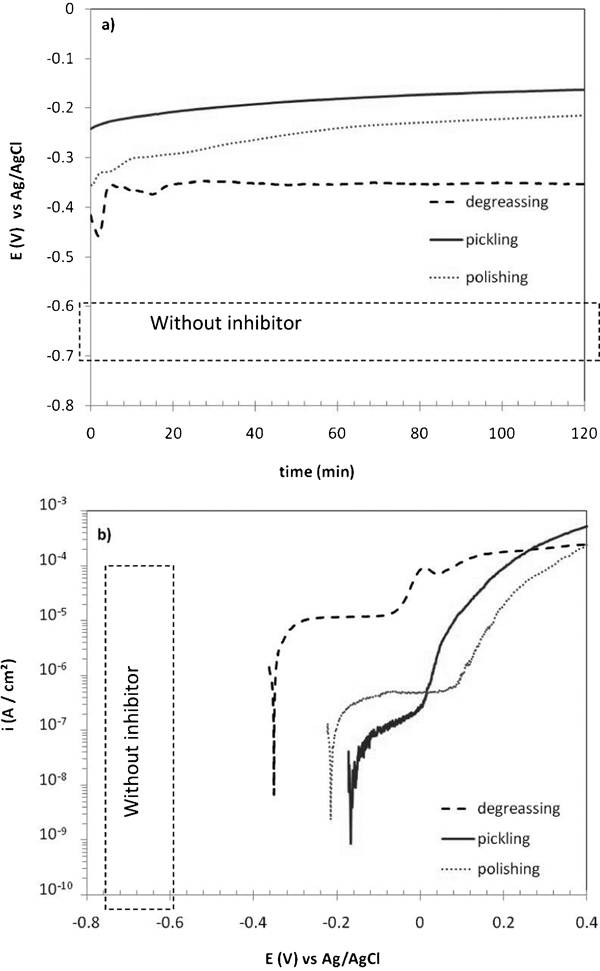
Open circuit potential evolution with a immersion time and b anodic polarisation measurements in 0·02M NaCl+0·05M Na2MoO4 of DC04 mild steel submitted to different surface preparations; rectangle in broken line is potential range measured in absence of inhibitor
The potential shifts towards more positive values when the inhibitor is added to the NaCl solution. The effect of sodium molybdate clearly depends on the surface preparation in the presence of a low concentration of sodium chloride (Fig. 6). In fact, after pickling and polishing, the potential increases from −0·25 to −0·17 V/ref and from −0·35 to −0·23 V/ref respectively. This evolution of potential indicates a passivation of steel in the presence of molybdate ions by reinforcing the pre-existing oxide film and/or the formation of a new film onto the steel surface.
After degreasing, the potential remains around −0·4 V/ref. This fact may be explained by considering the reparation of the defect in the pre-existing natural oxide by the molybdate ions.
The polarisation curves indicate that molybdate is an anodic inhibitor that leads to passivity of the steel substrate after pickling or polishing of the surface. We note that the passivity is better after pickling than polishing treatments. The current density is indeed lower with pickled steel (10−8 A cm−2 after pickling and ∼10−7 A cm−2 after polishing). Nevertheless, for pickled surfaces, the pitting appears at a lower potential value than for polished ones.
For industrial degreasing, the effect of molybdate can be observed but the current density remains high, ∼10−5 A cm−2.
Contradictory information is available regarding the mechanism of action of  as corrosion inhibitor. Sastri et al.25 suggest that the inhibition of steel by molybdate is due to the formation of MoO3 in the passive film. Al-Refaie6 contradicts this proposition and suggested that
  ions are simply adsorbed at the surface of the substrate. Sakashita and Sato26 suggest that in chloride solutions, the corrosion of iron covered with a precipitated film of hydrous ferric oxide is accelerated by the enrichment of Cl− ions under the film, which may decrease the local pH and introduce a diffusion flux in the film. The adsorption of
  ions on the oxide changes the ion selectivity of the precipitate film from an anion selective to a cation selective film in NaCl solutions. This cation selectivity of the film may inhibit the corrosion of iron because of H+ ions diffusing out of the film.
Based on this suggestion and on electrochemical results as well as XPS analysis (Fig. 3), we may conclude that the inhibitive effect of  ions is better when the film oxide is thin (after pickling and polishing) than for a thicker oxide film (after degreasing). This may be due to the diffusion of H+ ions out of the film that is easier and faster when the oxide film is thin, avoiding a local pH decrease with, as a result, an inhibition of the mild steel corrosion.
Electrochemical measurements in presence of sodium nitrite (NaNO2)
Figure 7 displays OCP (Fig. 7a) and anodic polarisation curves (Fig. 7b) for different surface preparations of DC04 mild steel in 0·02M NaCl in the presence of 0·05M sodium nitrite (pH 6·9).
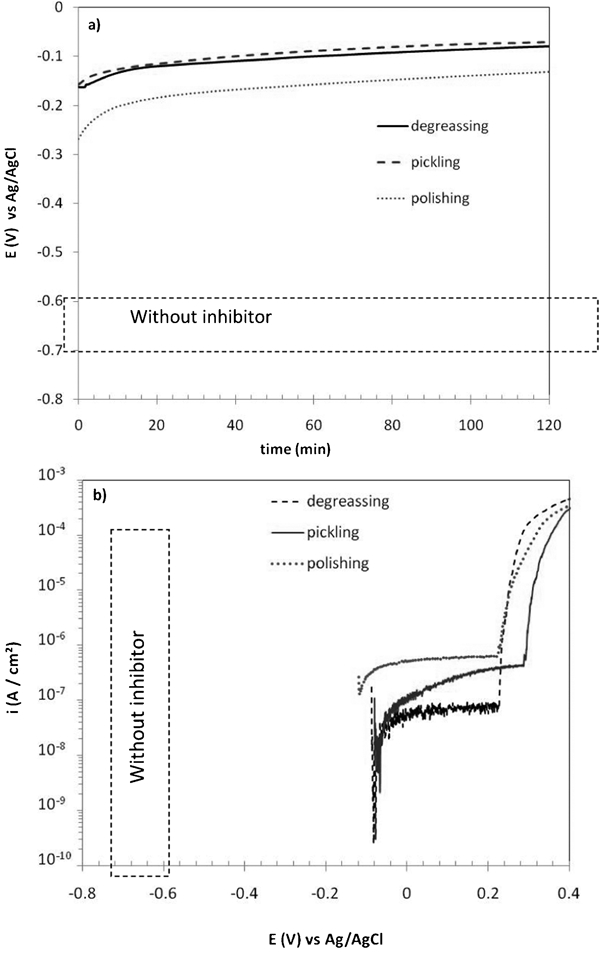
Open circuit potential evolution with a immersion time and b anodic polarisation measurements in 0·02 M NaCl+0·05M NaNO2 of DC04 mild steel submitted to different surface preparations; rectangle in broken line is potential range measured in absence of inhibitor
For the three types of surface preparation, the potential increases with time and depends less on the surface preparation than with molybdate. In fact, sodium nitrite has a high inhibition effect on mild steel regardless of the surface preparation.
The polarisation curves show that nitrite is an anodic inhibitor that induces a large passivity zone. The current density of the passivity zone is lower for degreased samples than for pickled and polished ones. However, for the degreased and polished surfaces, the pitting appears at the same potential.
Sodium nitrite produces a ferric oxide barrier on steel, leading to a good protection against corrosion. In fact, ferrous ions produced on the mild steel surface are converted to insoluble and stable ferric oxide in the oxide stability region (near neutral and alkaline region) according to the reaction in equation (1)27

Electrochemical measurements in presence of sodium tungstate Na2WO4
Figure 8 displays OCP (Fig. 8a) and anodic polarisation curves (Fig. 8b) for different surface preparations of DC04 mild steel in 0·02M NaCl containing 0·05M sodium tungstate (pH 7·5). Tungstate shows a behaviour similar to molybdate. In fact, after pickling and polishing, the OCP increases with time and stabilises at −0·15 V/ref after 2 h of contact with the electrolyte. This potential increase indicates a passivation of steel in the presence of tungstate ions by reinforcing the pre-existing oxide film and/or formation of a new film onto the steel surface.
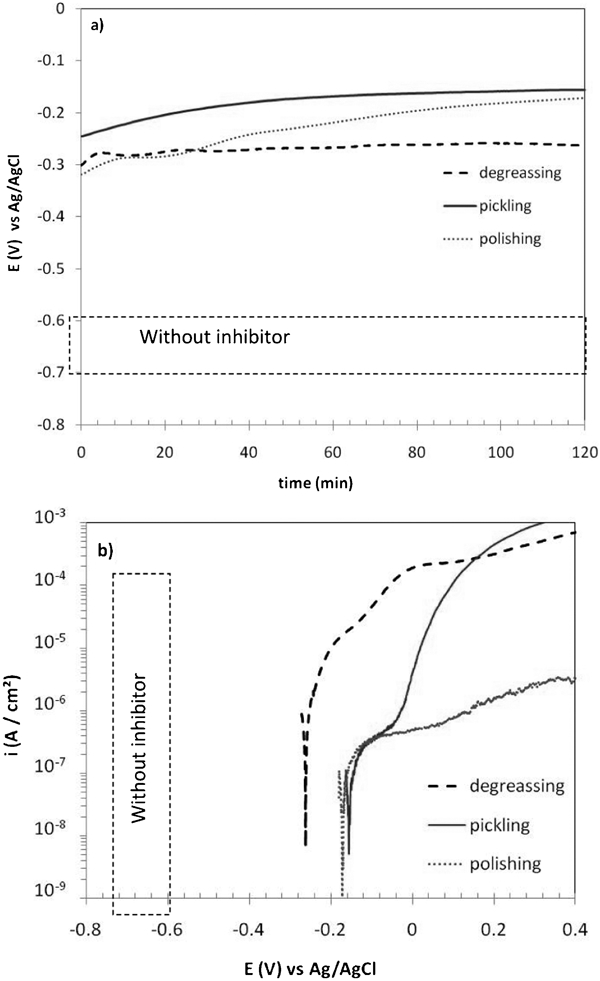
Open circuit potential evolution with a immersion time and b anodic polarisation measurements in 0·02M NaCl+0·05M Na2WO4 of DC04 mild steel submitted to different surface preparations; rectangle in broken line is potential range measured in absence of inhibitor
After degreasing, the potential is maintained at around −0·35 V/ref.
The polarisation curves show that tungstate is an anodic inhibitor that permits the passivity of steel substrate after pickling or polishing surface preparation. We note that this passivity is better than for polished sample. Corrosion current densities are ∼10−7 A cm−2.
After industrial degreasing, the corrosion potential is shifted towards more positive values, but no effect of tungstate is observed on steel corrosion.
Electrochemical measurements in presence of sodium vanadate Na2VO3
The OCP and anodic polarisation curves for different surface preparations of DC04 mild steel in 0·02M NaCl containing 0·05M sodium vanadate (pH 6·8) are shown in Fig. 9.
Open circuit potential evolution with a immersion time and b anodic polarisation measurements in 0·02M NaCl+0·05M Na2VO3 of DC04 mild steel submitted to different surface preparations; rectangle in broken line is potential range measured in absence of inhibitor
These results indicate that sodium vanadate accelerates the corrosion of mild steel, and no inhibitive effect was observed regardless of the surface preparation.
Corrosion inhibition efficiency
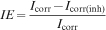
The inhibition efficiency IE (%) was defined using equation (2)29
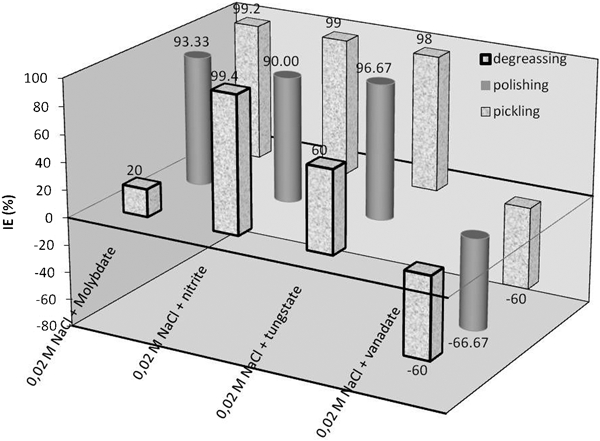
Inhibition efficiency of studied inorganic inhibitors (0·02M NaCl+0·05M inhibitor) of DC04 mild steel submitted to different surface preparations
All investigated inorganic compounds, except vanadate, have significant inhibition efficiency (Fig. 10). We observe clearly for all inorganic inhibitors investigated, except sodium nitrite, that industrial degreasing as a surface preparation leads to a lower inhibitive effect compared to pickling and polishing.
Figure 11 shows the superposition of OCP (Fig. 11a) and anodic polarisation measurements (Fig. 11b) of acid pickled DC04 mild steel in 0·02M NaCl+0·05M of the different tested inorganic inhibitors. Sodium molybdate and tungstate lead to the same OCP evolution (Fig. 11a). However, in the presence of sodium molybdate, the corrosion current in the passive range is lower and the pitting potential is higher than with sodium tungstate (Fig. 11b).
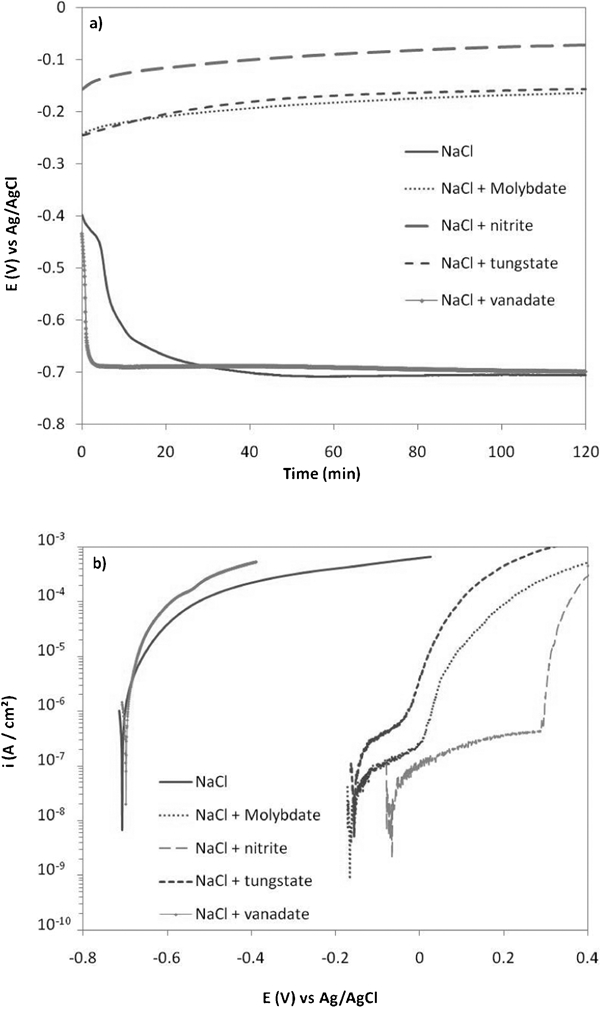
Open circuit potential evolutions with a immersion time and b anodic polarisation measurements of DC04 mild steel acid pickled in 0·02M NaCl+0·05M of different inorganic inhibitors
The inhibition efficiency of the selected inorganic inhibitors consequently decreases as follows

Effect of NaCl concentration on sodium molybdate inhibition
The corrosion inhibition was examined for different NaCl concentrations (0·02, 0·1 and 0·5M). The concentration of sodium molybdate was in all cases fixed to 0·05M. Figure 12 shows that a higher NaCl concentration induces an increase of the current density of the passivity zone and a decrease of the pitting potential. The molybdate must first be adsorbed on the iron surface before it can act as an inhibitor.19 With increasing the chloride concentration, Cl− ions compete more strongly with molybdate for adsorption sites, and a larger amount of molybdate is thus required to ensure the corrosion inhibition.
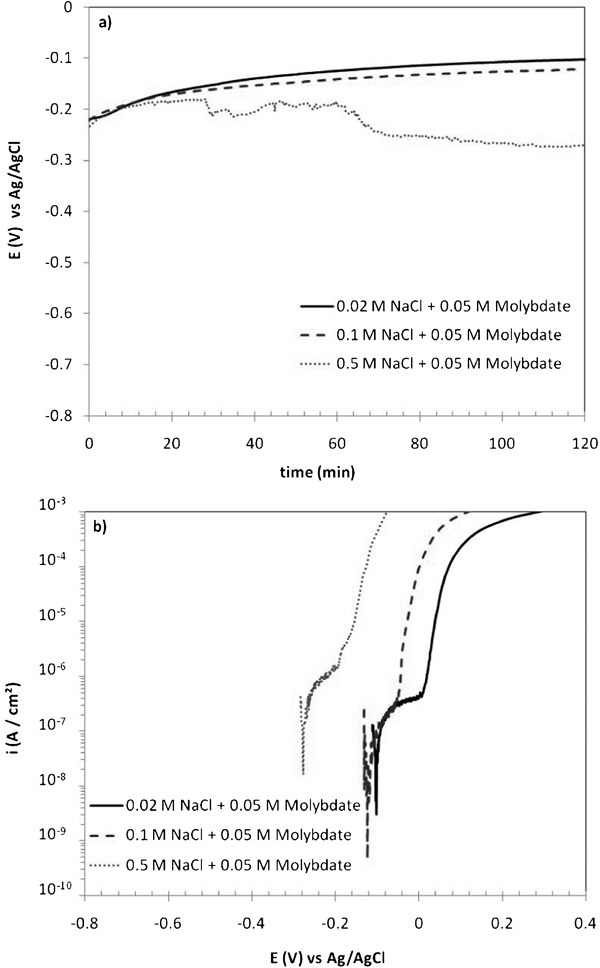
Open circuit potential evolution with a immersion time and b anodic polarisation measurement in 0·05M Na2MoO4+(0·02, 0·1, 0·5M) NaCl of DC04 mild steel HCl pickled as indicated
X-ray photoelectron spectroscopy analysis
X-ray photoelectron spectroscopy was used to determine the nature of the layer formed on the surface of mild steel after immersion in a sodium molybdate solution.
Figure 13 shows the typical XPS survey spectrum recorded on steel DC04 after 30 min of immersion in 0·02M NaCl and 0·1M Na2MoO4. The C 1s peak (285 eV) was used as a binding energy reference.
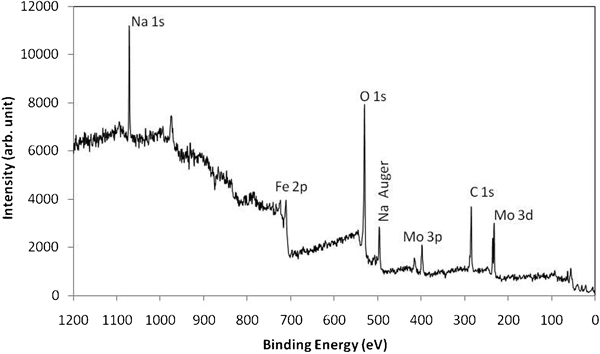
X-ray photoelectron spectroscopy survey spectrum recorded on polished DC04 mild steel after 30 min of immersion in 0·02M NaCl+0·1M Na2MoO4 (Al Kα: 1486·6 eV)
Four main peaks are observed at 710, 530, 285 and 232 eV corresponding to Fe, O, C and Mo respectively.
Figure 14 shows high resolution XPS spectra of the Fe 2p and Mo 3d transitions respectively. The main two signals (Fig. 14a) located at ∼724 and 710 eV can be ascribed to the photoemission peaks from Fe 2p1/2 and Fe 2p3/2; these results indicate the oxidation of Fe to Fe2O3.5,29
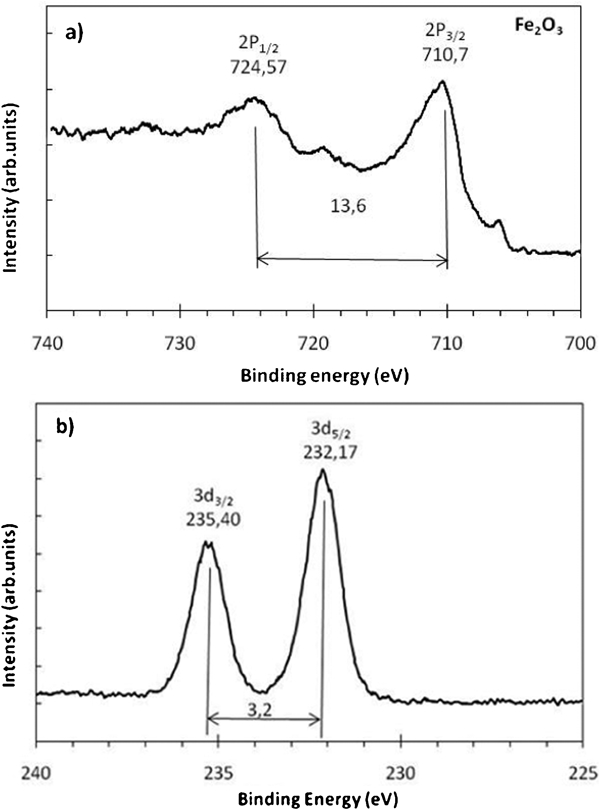
High resolution XPS spectra of a Fe 2p transition and b Mo 3d transition recorded on polished DC04 mild steel after 30 min of immersion in 0·02M NaCl+0·1M Na2MoO4 (Al Kα: 1486·6 eV)
The high resolution XPS of the Mo peak (Fig. 14b) shows two clearly responses located at ∼232 eV (3d5/2) and 235 eV (3d3/2), which correspond to Na2MoO4,30 indicating the adsorption of molybdate on mild steel surface.6
X-ray photoelectron spectroscopy analysis reveals that the film formed on the mild steel surface in the presence of sodium molybdate added to the electrolyte is mainly composed of adsorbed molybdate and iron oxide Fe2O3.
According to the work of Al-refaie6 and Palache et al.,31 the nature of film formed on the mild steel surface is most probably ferrimolybdite [Fe2 (MoO4)3.8H2O].
Surface analysis with ToF-SIMS
The distribution of Fe and Mo elements on the mild steel surface is observed using ToF-SIMS technique (Fig. 15). In general, the distribution of Mo element on the surface is homogeneous with a small difference of distribution in the holes. In fact, only a small amount of Mo+ was detected in the holes. It appears that the protector film is formed homogeneously on the entire surface except in the hollow of topography.
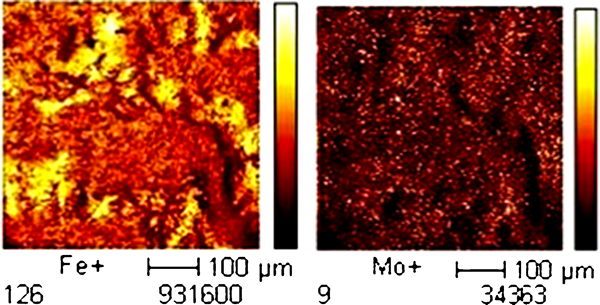
Images (ToF-SIMS) of distribution of Fe and Mo recorded on polished DC04 mild steel after 30 min of immersion in 0·02M NaCl+0·1M molybdate (500×500 μm)
Atomic concentration depth profile
The variations in chemical composition with XPS depth profiles of iron, oxygen, molybdenum and carbon are obtained from the XPS survey scans for DC04 steel polished to SiC 1200 after 2 h of immersion in 0·05M sodium molybdate (Fig. 16).
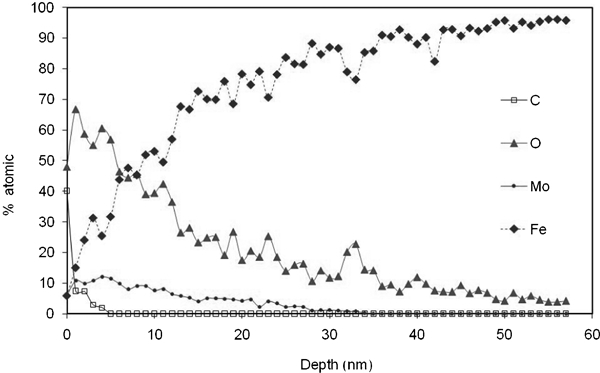
X-ray photoelectron spectroscopy depth profiles (at-%) for iron, oxygen, molybdenum and carbon recorded for DC04 steel polished to SiC 1200 after 2 h of immersion in 0·05M sodium molybdate (Al Kα: 1486·6 eV)
Figure 16 shows that iron concentration increases with depth as expected. On the other hand, the concentrations in oxygen and molybdenum decrease with depth. Molybdenum concentration at the surface was ∼10 at-% and decreases to 0 at-% at a depth of ∼25 nm. According to this result, the thickness of the passivating film formed by Fe2O3 and adsorbed molybdate is expected to be ∼25 nm.
The high carbon concentration at the surface is due to organic carbon contamination during the specimen preparation.
Conclusions
The nature and thickness of the oxide present at the mild steel surface depends on the kind of surface preparation, and this clearly affects the behaviour of DC04 mild steel in NaCl electrolyte solution.
When the Cl− concentration increases, the breakdown of the natural oxide is faster. The chloride ions enhance the number of possible sites for corrosion initiation.
Four inorganic corrosion inhibitors were tested with different surface preparations of DC04 mild steel. No inhibition effect was observed for vanadate, while nitrite presented excellent inhibition properties regardless of the surface preparation. However, nitrite at high concentration has been rejected because of its toxicity. The behaviour of DC04 mild steel in the presence of sodium molybdate depends on the surface preparation. The best corrosion inhibition is obtained when acid pickling is used as the surface preparation.
In general, tungstate and molybdate ions show a comparable corrosion inhibition effect for mild steel. However, molybdate ions have a greater inhibition effect than tungstate ones for acid pickled mild steel.
The detailed study of the corrosion inhibition by sodium molybdate has revealed that a protective layer composed of adsorbed molybdate and Fe2O3 with a thickness of ∼25 nm is rapidly formed (2 h) in the presence of the inhibitive species.
Footnotes
Acknowledgements
This work is part of the CLEARZINC project supported by FEDER program (EU) and the CONVERGENCE program (Région Wallonne). The authors thank Damien Cossement and Fabian Renaux for their help in XPS and ToF-SIMS analysis.