







Abstract
The paper evaluates the effect of nitriding treatment on the corrosion behaviour of graphite reinforced aluminium alloy 6061 composites. The composites were prepared using the liquid metallurgy technique. The graphite content in the composites was varied from 1 to 7% (by weight) in steps of 2%. The nitriding process was carried out at 500°C for 24 h. Energy dispersive X-ray analysis was used to confirm the implantation of nitrogen in the composites. Three categories of specimens, namely, the nitrided composites, non-nitrided composites as well as non-nitrided and unreinforced specimens, were tested. Immersion corrosion test using the weight loss method was employed to study the effect of corrosion over a period ranging from 24 to 120 h in steps of 24 h at ambient temperature. The test solution used was aerated 1 N NaCl acid. It was observed that the nitrided specimens exhibited less weight loss compared to the non-nitrided specimens in general. The composites with greater content of graphite exhibited low corrosion rate.
Introduction
Metal matrix composites (MMCs) are prime candidate materials for industrial applications in the aerospace, automotive and power utility industries. Although MMCs encompass a very wide range of matrix reinforcement combination, graphite particle combination seems to be the most interesting for industrial applications because of the various advantages. The combination of properties such as high modulus and stiffness, low density and reduced coefficient of thermal expansion are the main attributes of MMCs.1
Aluminium matrix composites are used extensively in a great variety of engineering applications, including pistons, wheels, brake drums, connecting rods and cylinder heads and driving shafts in the automotive industry.2 Wendt et al.3 have reported that the aluminium–graphite composites have been successfully tested as material for bearing, piston and liners in engines and electrochemical machineries. The presence of graphite particles in the matrix of aluminium alloys increases their seizure resistance and enables them to run under boundary lubrication without galling. Therefore, improvement in the surface properties, such as hardness and corrosion resistance, is important for current industrial application.4
Nitriding is a promising method for surface treatment to improve hardness, wear, corrosion and fatigue resistance of materials. There have been a number of studies on the surface analysis of aluminium alloys implanted with nitrogen.5,6 Zhang et al.5 have demonstrated that nitrogen can be used to improve pitting resistance of Al 6061 that is exposed to a salt solution or marine environment. It is also stated that a continuous layer of aluminium nitride (AiN) can protect the underlying aluminium substrate from pitting. Among different nitriding process, gas nitriding is one of the most widely adopted methods to enhance various mechanical and corrosion properties.7
Although several techniques such as coatings and cathodic protection8,9 have been investigated to improve the corrosion resistance of composites and have provided various levels of improved corrosion resistance, McCafferty et al.10 have stated clearly that nitriding is one of the best methods to improve the corrosion resistance.
The aim of this work is to study the corrosion behaviour of the nitrided graphite reinforced aluminium alloy 6061 and compare the same with the non-nitrided specimens and ascertain the importance of such treatments for composite materials.
Experimental
Preparation of composites
In the present study, the liquid metallurgy route has been adopted to fabricate the composite. Al 6061 is the matrix alloy, the chemical composition of which is Al–0·36Cu–0·99Mg–0·80Si–0·12Fe–0·02Mn–0·01Ni–0·01Zn–0·007Pb–0·005Sn–0·01Ti–0·12Cr (wt-%). The optical emission spectroscopy was used to determine the various elements in the alloy. The reinforcement material used was graphite with an average size of 20 μm. Preheated graphite was introduced into the vortex of the effectively degassed Al 6061 molten metal. Similar method has been used by Sharma et al.11 and Pillai and Pandey.12 The content of graphite used as reinforcement was varied from 1 to 7% (by weight) in steps of 2%.
Nitriding of specimens
The samples were cut into size of diameter 15×15×6·3 mm. The prepared samples were washed in distilled water and then with acetone and later subjected to the nitriding process. The samples that are prepared were kept inside the specially made crucible. The oxygen that was present in the chamber was removed by introducing nitrogen for ∼60 min. A temperature of 500°C was maintained for 24 h, ammonia gas was introduced into the air tight furnace chamber and a feedrate of 1·573×10−4 m3 s−1 was maintained. Ammonia decomposes, giving the nitrogen in nascent form or monatonic nitrogen, which is the only form capable of entering the metal and diffusing in it.
Test
Immersion corrosion test was performed on the specimens as per ASTM G31 standards. Specimens with dimension of 15×15×6·3 mm were polished with 1200 mesh emery paper weighed and immersed in aerated 1 N NaCl solution at ambient temperature for a period of 24-120 h in steps of 24 h. At the end of each time period, the specimens were cleaned with acetone in an ultrasonic bath and weighed.
Results and discussion
The as cast microstructure of the aluminium alloy 6061 is as shown in Fig. 1. Figure 2 is the microstructure of the composite showing uniform distribution of the particles in the alloy matrix. Although particle clustering could not be eliminated completely, significant improvements in the distribution of the particles, which hold the key to performance in composites, were achieved by controlling the processing parameters.
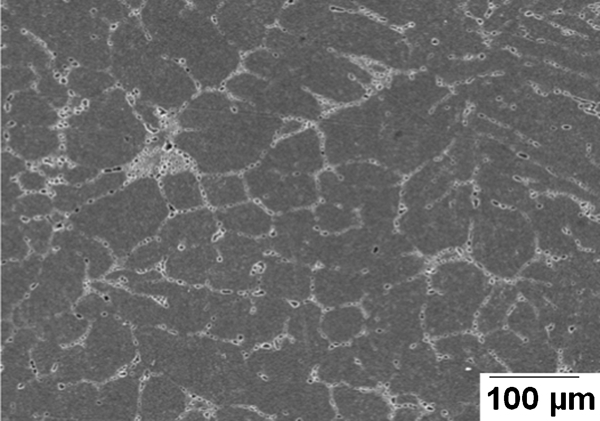
Image (SEM) of cast aluminium alloy 6061
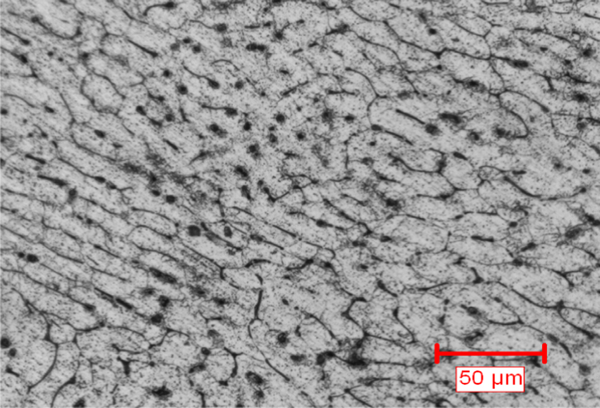
Micrograph showing uniform distribution of graphite particles in matrix
The weight loss data for the specimen tested are provided in Figs. 3 and 4. Weight loss due to corrosion was significant in all cases, and it is to be mentioned that the weight loss was due to matrix corrosion predominantly and to some extent by particle dropout. Particle dropout was confirmed by the visual examination of the corrosion debris. It is evident from the results displayed in the graph shown in Fig. 4 that nitriding significantly improves the corrosion resistance of the composites. The corrosion rate in the case of both nitrided and non-nitrided composites decreases with the increase in the duration of exposure and also with the increase in the content of graphite. This clearly shows the significant influence that the reinforcing graphite particles have on corrosion susceptibility of the matrix phase. Interestingly, corrosion attacks occurred predominantly in the vicinity of the reinforcing particle, which is clearly evident from the SEM image shown in Fig. 5.
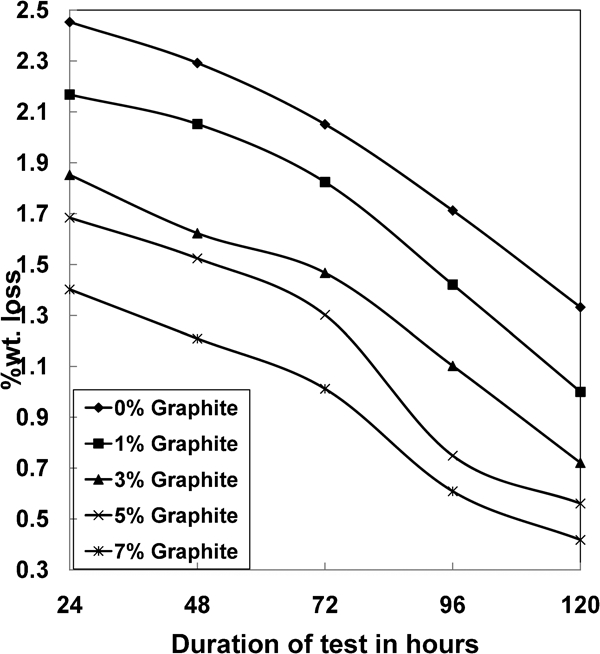
Graph of percentage weight loss versus duration of test for non-nitrided specimens
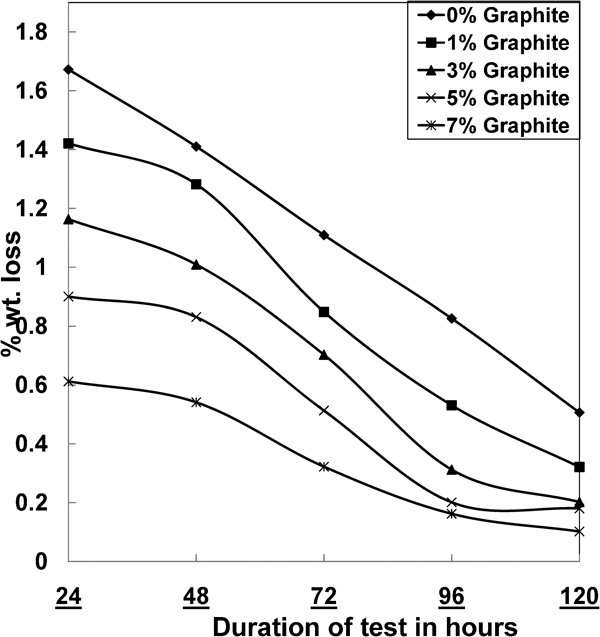
Graph of percentage weight loss versus duration of test for nitrided specimens
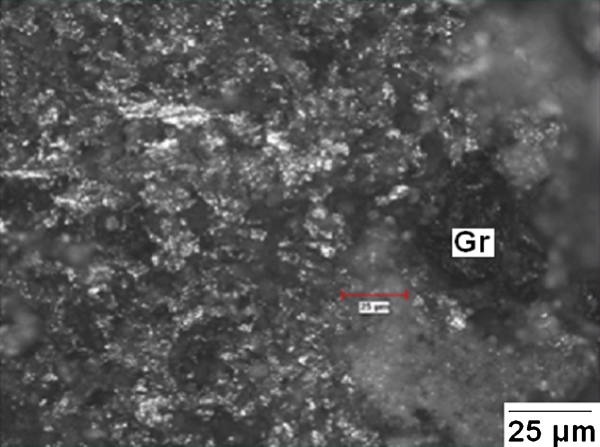
Image (SEM) showing corrosion attacks in vicinity of graphite particle
Effect of graphite particles
It can be clearly seen from the graphs shown in Figs. 3 and 4 that the percentage weight loss due to corrosion decreases with the increase in graphite content. In other words, the greater the graphite content, the greater is the corrosion resistance of the composites. However, when the graphite content is increased, there is lesser matrix material available for corrosion, which results in an expected reduction in the corrosion weight loss observed. The corrosion weight loss observed seems to be considerably more than proportionate with the percentage of graphite added. Quantitatively, adding 7% of graphite to the alloy matrix reduces corrosion weight loss by >50%. Seah et al.13 have attributed corrosion resistance to the interference of the graphite network with the reaction between the acid and the metallic matrix.
Effect of nitriding
It is clearly evident from the graph shown in Fig. 4 that nitriding certainly plays a significant role in reducing the weight loss of the specimen. The layer of AiN formed on the nitrided specimens effectively reduces the quantity of corrosion damage. This is attributed to be the prime reason for improved corrosion resistance in nitrided composites. The presence of nitrogen in the specimens is confirmed by the EDX provided in Fig. 6.
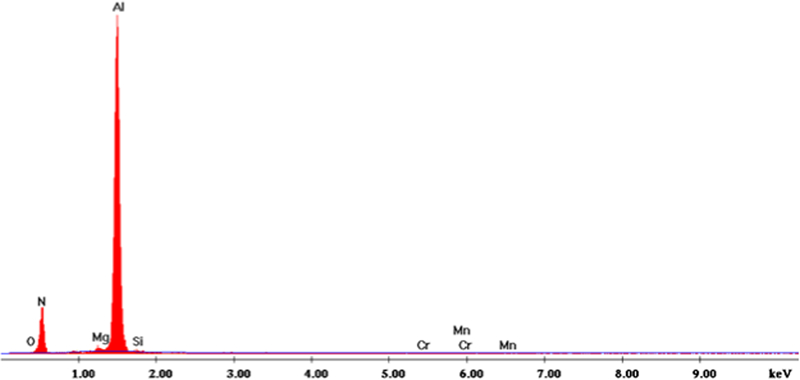
Energy dispersive X-ray of nitrided composite to show presence of nitrogen
The detailed mechanism by which the nitriding process improves corrosion resistance of composites could not be clearly determined. Several possible explanations have been offered by various investigators. Zhang et al.5 have reported that nitrogen can be used to improve corrosion resistance of Al 6061 that is exposed to a salt solution or marine environment. It is also reported that a continuous layer of AiN can protect the underlying Al substrate from corrosion. McCafferty <@?show=[to]?>et al.,10 who have worked on pitting behaviour of aluminium ion implanted with nitrogen, have reported that the effect of implanted nitrogen on pitting behaviour of aluminium is similar to that in nitrogen containing stainless steels where nitrogen at the metal surface inhibits the dissolution kinetics or aids the repassivation process in the pit forming  ions that buffer the pit electrolyte. Furthermore, Massiani et al.14 showed that nitrogen implantation into a 5Cu–Al alloy improved resistance to general corrosion in aqueous solutions.
Galvanic corrosion certainly exists in the aluminium–graphite system since aluminium is in contact with a more noble material, i.e. graphite, which has a higher chemical potential than aluminium. The mechanism involved in the above system is not very clear, and also since not much of work has been carried out before on nitriding of composites, the authors are unable to precisely arrive at an explanation. However, the presence of the layer of AiN formed on the specimens effectively reduces the quantity of corrosion damage.
Conclusions
The composites with greater content of graphite exhibited lower corrosion rate. In addition, the corrosion rate was found to decrease with increase in the duration of the test. It is clearly evident that nitriding has a significant influence on the rate of corrosion. The nitrided composites exhibited less weight loss compared to the non-nitrided specimens. The layer of AiN formed on the nitrided specimens prevents corrosion effectively. This is attributed to be the prime reason for improved corrosion resistance in nitrided composites.