







Abstract
The electrode reaction and the change in composition and morphology of the rust layer on rebar surfaces after electrochemical realkalisation treatment are investigated by electrochemical measurement and scanning electron microscopy. The results show that the rust layer is gradually reduced following the sequence Fe3+→Fe2+→Fe0 through mechanisms postulated to involve proton exchange and dissolution–deposition. The realkalisation process can restore the alkalinity of the pore solution in carbonated concrete adjacent to cathodically polarised rebar and also reduce rust layers on rebar in severely carbonated concrete structures. However, though the alkalinity of pore solution is restored and the corrosion potential of the rebar in deeply carbonated concrete becomes more noble after cathodic polarisation, the rebar cannot repassivate while polarised. Thus, to assist in repassivation, additional inhibitor injection is proposed. The results demonstrate that the adjunction of inhibitor can limit the corrosion of the rebar. Therefore, the combination of inhibitor plus electrochemical treatment is likely to prolong the durability of deeply carbonated reinforced concrete structures.
Introduction
A major reason for the deterioration of reinforced concrete is the corrosion of steel reinforcement caused by the decrease in pH of the pore solutions due to carbonation (absorption of atmospheric CO2). Electrochemical realkalisation (ERA) is a well established commercial process where a continuous current is applied between the steel reinforcement (rebar) and an auxiliary external electrode. In this method, the rebar is polarised cathodically to a potential at which oxygen and/or water reduction occur, and coincidentally, chloride ions migrate away from the rebar. This raises the pH of the concrete local to the rebar, producing a favourable hydroxide/chloride ratio and, in principle, re-establishing passivity once the current is switched off. The method has great potential for non-destructive repair of concrete because only those areas with obvious defects need to be removed and replaced.1
Since cathodic treatment of rebar was first proposed, much research effort has been undertaken, for example, as a function of pore solution pH,2,3 corrosion potential,4 electroosmotic flux,5 materials structure6 and electrochemical reactions.7 However, a few studies have considered the limits of cathodic treatment. For example, Gonzalez et al.8 found that rusted steel reinforcement in deeply carbonated concrete could not be repassivated after cathodic polarisation and concluded that it is only suitable for structures where the carbonation does not reach the steel reinforcement and, hence, the steel has not yet started to corrode significantly.
Meanwhile, there has been little research on the electrochemical processes occurring on corroded (i.e. rusty) rebar in deeply carbonated concrete. During the cathodic polarisation, alternative electrochemical reactions may occur on the rusted rebar, while the repassivation may not be solely dependent on the pH value but also on the surface state of the rebar. In this paper, the electrochemical reactions on rusted steel obtained from historic structures are studied and analysed, while the feasibility of combining inhibition with realkalisation is also investigated.
Experimental
Historic corroded rebar
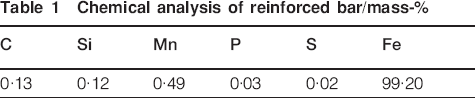
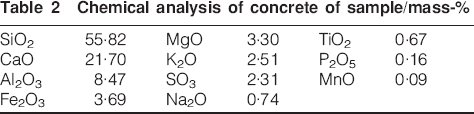
Specimens were collected from an old heat treatment workshop built in the 1950s in the Shanghai 3rd Bicycle Plant. The concrete is carbonated, the carbonation depth is ∼80 mm (Fig. 1a), the reinforced steel in the concrete is corroded, the thickness of the rust layer is ∼1 mm and the dark brown surface looks very coarse. The chemical compositions of reinforced steel (also called rebar) and concrete were analysed using X-ray fluorescence analysis (see Tables 1 and 2). The specimens were cut from the carbonated concrete structure with a centrally embedded reinforced steel rod (50×50×70 mm), and the dimension of the rebar is Φ10×90 mm. A copper wire was attached to the rebar as a conductor, and the upper and bottom surfaces were covered with epoxy resin (Fig. 1b).
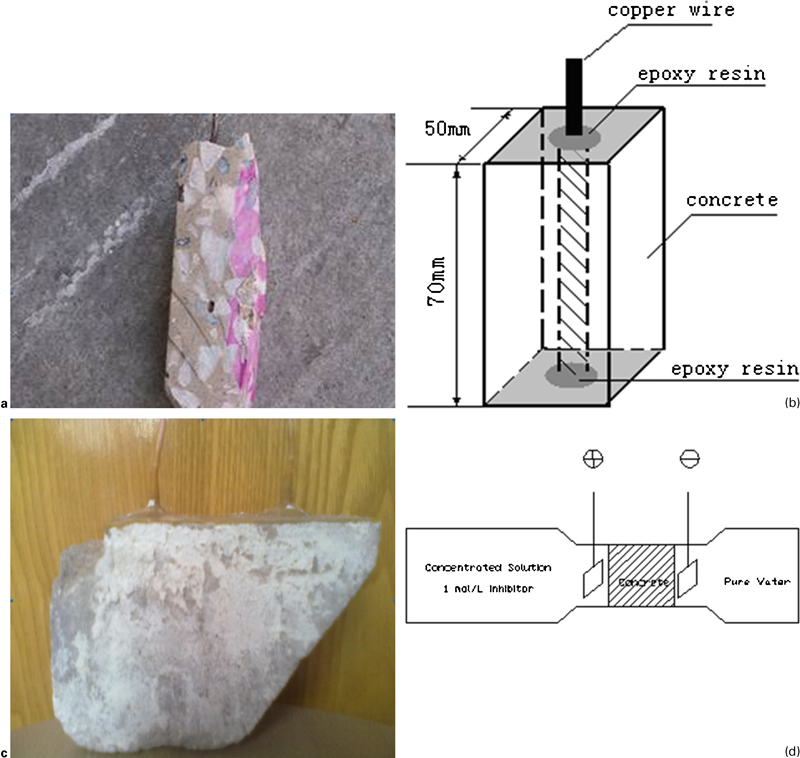
Carbonated concrete and scheme of specimens and material transfer experimental apparatus
Chemical analysis of reinforced bar/mass-%
Chemical analysis of concrete of sample/mass-%
For comparison, a sample of bare reinforcement steel from the same concrete structure was used for test specimens with the rust removed by grinding on SiC paper to 1500 grit. A copper wire was connected to the rebar as the conductor; both ends of the test specimens were covered with epoxy resin with 5 cm2 left exposed.
The morphology of the surface of the rebar, including the rusted later, was studied using an environmental scanning electron microscope coupled with energy dispersive X-ray (EDX) spectroscopy (FEI Sirion200D1615).
Procedures
The realkalisation of the carbonated concrete specimens was carried out in a sealed flask using a nickel net as an auxiliary anode in a tank, which was connected to a second separated flask using a salt bridge. This cell arrangement avoided any error due to oxygen evolution at the anode on overall hydrogen collection. The test solution was saturated Ca(OH)2 solution or saturated Ca(OH)2+1 mol L−1 LiOH solution. The solution in the sealed flask was bubbled with nitrogen (for 1 h) to remove dissolved oxygen, ruling out the effect of reduction of dissolved oxygen on the rebar during the cathodic treatment. During realkalisation treatment, the current density was maintained at 0·4 mA cm−2 for 21 days. Evolved hydrogen was collected and the volume measured using the water displacement method. A saturated calomel electrode was used as a reference electrode to measure the corrosion potential of the rebar.
Electrochemical measurements were carried out using a PARSTAT2273 workstation and its analysis software. Cyclic voltammetry was conducted in saturated Ca(OH)2 solution or in saturated Ca(OH)2+1 mol L−1 LiOH solution after purging dissolved oxygen from the solutions at a scan rate of 10 mV s−1. The potentiodynamic curve was carried out in saturated Ca(OH)2 solution or in saturated Ca(OH)2+1 mol L−1 LiOH solution at a scan rate of 1 mV s−1. All electrode potentials were measured relative to the SCE. All experiments were carried out at room temperature (25°C). Corrosion inhibitor performance was studied according to ASTM G31-72; thus, a saturated Ca(OH)2 solution with 2000 ppm NaCl+0·01M NaOH was used for electrochemical measurements. The specimens were immersed in the solution for 16 h before electrochemical measurements. The inhibitor used in the experiment is dimethylethanolamine (DMEA), and its chemical formula is (CH3)2NCH2CH2OH.
The migration of the corrosion inhibitor within the concrete was also studied across a plug of diameter 60 mm and length 30 mm. The concrete consisted of ordinary Portland cement/water/sand/aggregate in a ratio of 1∶0·65∶2·25∶3·68. After accelerated carbonation, the experimental apparatus was assembled according to Fig. 1d. The apparatus used the constant current method with an applied current density of 2 A m−2. As shown, the corrosion inhibitor was injected in the concentrated solution side, while the other side contained water. During inhibitor permeation, 10 mL aliquots of solution, taken from the water side, were used to analyse the concentration of inhibitor passing through the concrete.
Realkalisation of natural carbonated concrete was undertaken using 1M Na2CO3 and 1M DMEA solution respectively. A current density of 2 A m−2 was applied to the electrodes for 30 days. After the realkalisation treatment, the specimens were taken out from the electrolyte and exposed to air at 25±1°C, during which electrochemical parameters were measured periodically after 3 days initial immersion for equilibration.
Results
H2 evolution
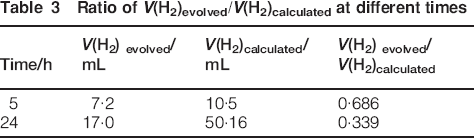
Figure 2 shows the volume of H2 evolved from different rebar electrodes during simulated ERA tests. For the rust free rebar, the volume of H2 was close to the calculated volume assuming 100% current efficiency for the electrolysis of water. However, the volume of H2 evolved from the rusted rebar after the same had charge passed was significantly less than the calculated volume, which indicates that the current efficiency for water reduction was <100%. Furthermore, the colour of the rust changed from dark yellow to black, implying the formation of magnetite. For different electric quantities, the ratio of V(H2)evolved/V(H2)calculated decreased with the increase of charge passed for the rusted rebar electrode (Table 3).
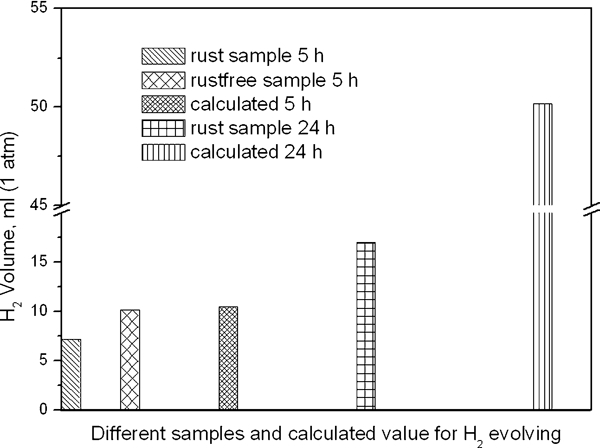
Volume of H2 evolving from rebar electrode with and without rust through same charge in saturated Ca(OH)2 solution for 5 and 24 h (calculated volume means that all charge were used for H2 evolving reaction): current density, 0·4 mA cm−2
Ratio of V(H2)evolved/V(H2)calculated at different times
Electrode reaction on rebar during cathodic polarisation
Figure 3 shows the cyclic voltammetry curves of rusted rebar in the saturated Ca(OH)2 solution and in saturated Ca(OH)2+1M LiOH solution. The current peaks of each cathodic peak and anodic peak increased with cycle times. There was only one obvious peak at about −0·6 V in the positive scan. In calcium hydroxide, the anodic peak corresponded to the reaction Fe2+→Fe3+, while no peak was found for the reaction Fe0→Fe2+. However, when 1M LiOH was added to the Ca(OH)2 solution, two peaks appeared in the positive scan, at −0·92 and −0·7 V, which corresponded to Fe0→Fe2+ and Fe2+→Fe3+ respectively. Meanwhile, all peak potentials shifted in the negative potential direction after adding LiOH to the Ca(OH)2 solution. It was also found that peaks III and III’ for Fe(II) to Fe shifted in the positive potential direction with an increase of cycle times and formed a new peak.
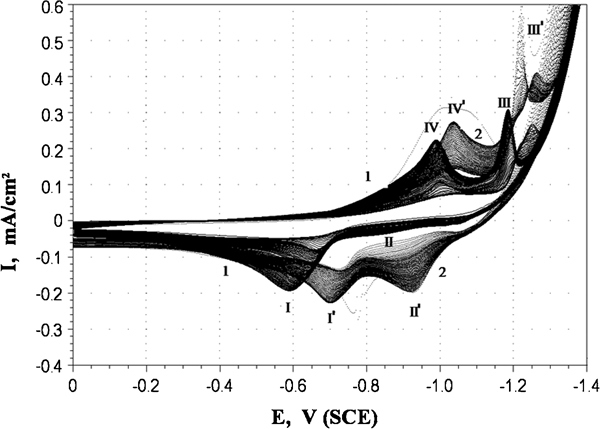
Cyclic voltammetry curves of rebar in saturated Ca(OH)2 solution (1) and in saturated Ca(OH)2+2 mol L LiOH solution (2), all solution are oxygen free (scan rate: 10 mV s−1)
Composition change of rust after cathodic polarisation
Figure 4 shows the surface of rusted rebar after ERA treatment using a backscatter electron microscope. Some Fe particles were scattered in the rust (Fig. 4a), and EDX characterised that metallic Fe was reduced from the oxide (Fig. 4c). Figure 4b shows that the rust was reduced to Fe crystals after ERA treatment.
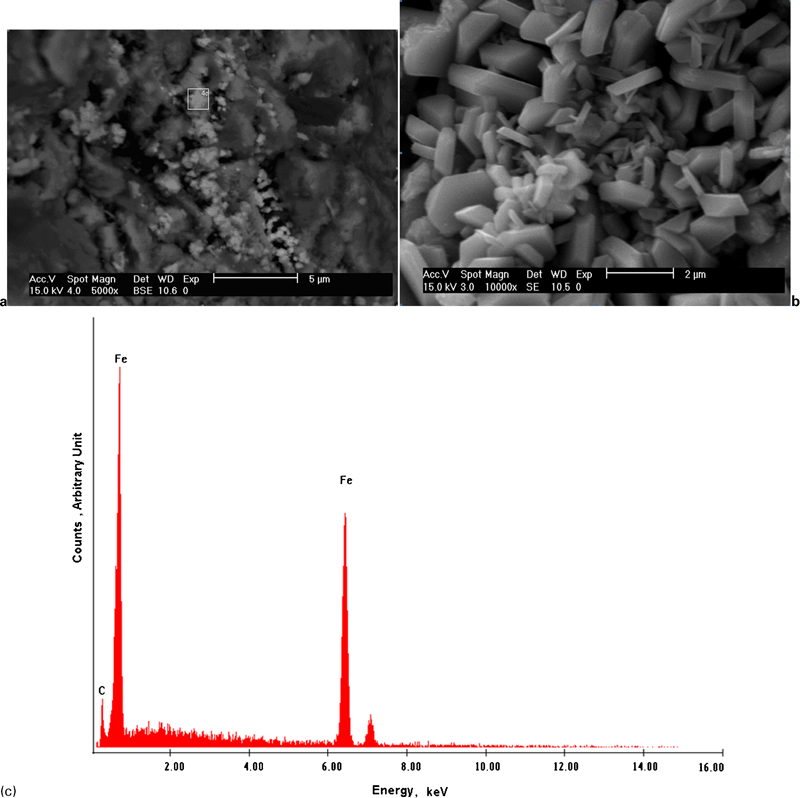
a, b backscattered electron micrograph and c EDX analysis of rust on rebar after realkalisation treatment
Rebar inhibition by DMEA in simulated solution
Figure 5a shows the polarisation curve for rebar after immersion in saturated Ca(OH)2 solution with 2000 ppm NaCl+0·01M NaOH containing different inhibitor concentrations for 16 h. With increasing inhibitor concentration, the corrosion potential of the rebar electrode was shifted to more positive potentials, and the corrosion current density was reduced by 20 times compared with the blank solution.
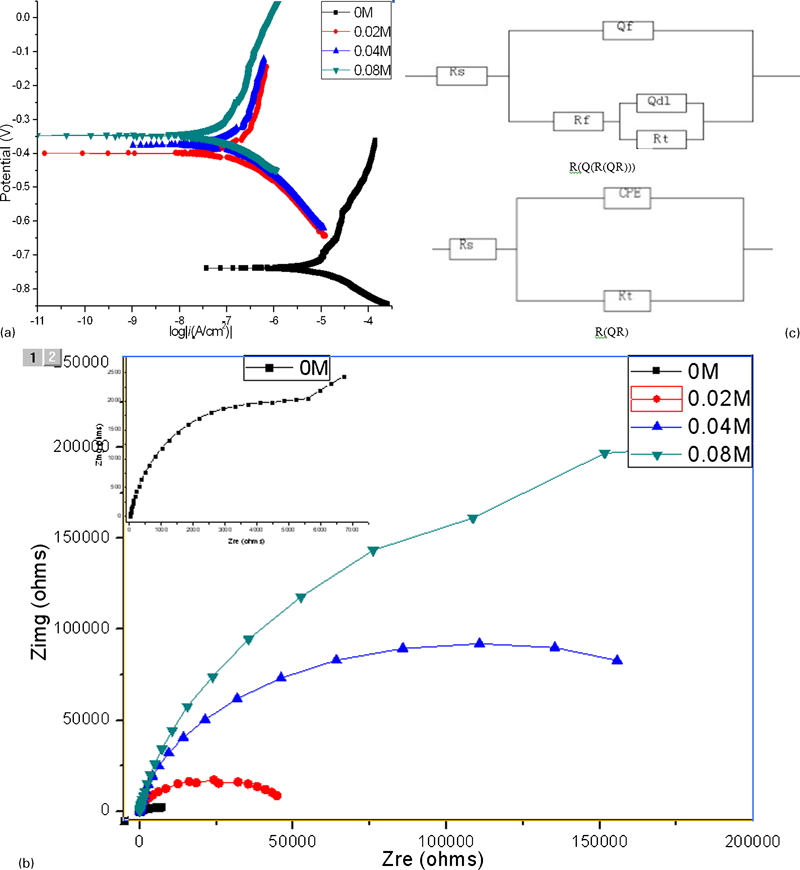
a Tafel polarisation curves for Q235 steel in 2000 ppm NaCl+0·01M NaOH+saturated Ca(OH)2 containing different concentrations of DMEA, b Nyquist diagrams for Q235 steel in 2000 ppm NaCl+0·01M NaOH+saturated Ca(OH)2 containing different concentrations of DMEA and c equivalent circuits of electrochemical impedance spectroscopy (EIS)
Figure 5b shows the EIS of the rebar electrode in the saturated Ca(OH)2 solution with 2000 ppm NaCl+0·01M NaOH containing different concentrations of inhibitor. The Nyquist plot contains one capacitive loop in the high and middle frequency ranges, while the uninhibited sample also showed low frequency diffusion impendence. The capacitive loop might be correlated with the charge transfer electrode reaction on the rebar, while the low frequency Warburg impedance may correspond to a diffusion controlled reaction at the corrosion potential.9
According to the above analysis, different equivalent circuits were used to fit the EIS data (Fig. 5c). In some cases, simulation of the impedance spectra could be improved by replacing the capacitance (C) with a constant phase elements (Q). Inhibition efficiency was calculated according to equation (1)
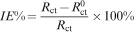
 are the charge transfer resistances with and without DMEA respectively. The fitting results are presented in Table 4.
Parameters of EIS
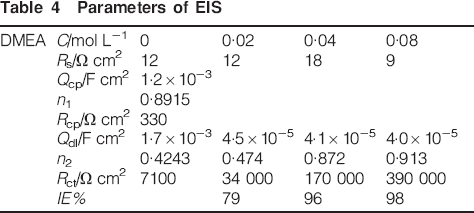
Figure 6 shows the concentration of the inhibitor (DMEA) as a function of migration time with and without an applied electric field, from which it is evident that the migration rate of the inhibitor under the electric field was significantly higher.
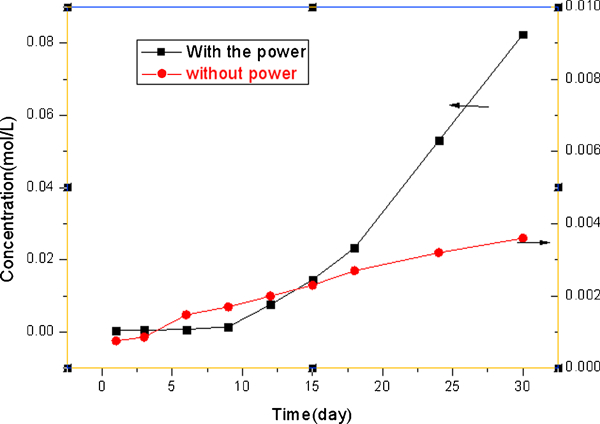
Concentration of DMEA as function of transfer time with and without electric field
Cathodic treatment with and without inhibitor addition
Figure 7 shows the polarisation curve of the rebar before/after realkalisation in saturated Ca(OH)2 solution and in saturated Ca(OH)2+1M LiOH solution. After cathodic treatment, the carbonated concrete was cut, and the cross-section was confirmed to be basic using phenolphthalein solution. The pH value decreased from the centre to the fringe on the cross-section, confirmed with precision pH test paper. The pH value reached 13·1 surrounding the rebar, meaning that the electrolysis of water played a main role to increase the pH value, and OH− produced from water electrolysis was transmitted to the concrete from the rebar surface.
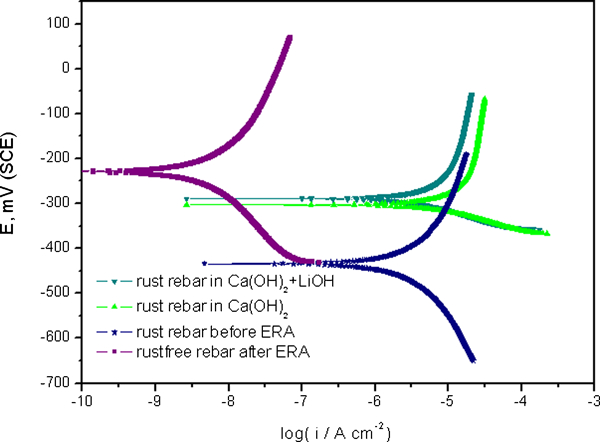
Polarisation curve of rebar before/after realkalisation in saturated Ca(OH)2 solution and in saturated Ca(OH)2+1 mol L−1 LiOH solution
After ERA treatment, the open circuit potential (OCP) of the rebar increased in the positive potential direction, and the final OCP value was different for different surface states of the rebar (Fig. 7). For rust free rebar, as in other reports,1,3 the OCP was close to 0·2 V and the corrosion current was small, i.e. after ERA treatment, the rebar was repassivated. Meanwhile, for rusty rebar, the OCP was a more negative value in the range −0·7 to −0·3 V, and the corrosion current was larger than that of the rust free rebar.
For rusty rebar in deeply carbonated concrete, Fig. 8 shows that the corrosion potential became more negative near the hydrogen evolution potential during the process of realkalisation (Fig. 8a). The corrosion current density increased, but the increase of the corrosion current rate in the solution containing inhibitor was much smaller than that in Na2CO3 solution (Fig. 8b).
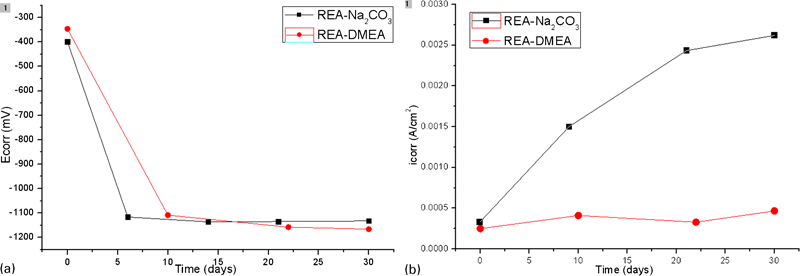
a E corr changes of rebar in concrete with different times during realkalisation process in 1M Na2CO3, 1M DMEA solution respectively and b i corr changes of rebar in concrete with different times during realkalisation process in 1M Na2CO3, 1M DMEA solution respectively
After cathodic treatment, the corrosion potential became more noble, while the corrosion current decreased with increased measurement time (Fig. 9a and b). In the presence of inhibitor, the corrosion potential of the rebar increased further while the corrosion current was smaller than that in the Na2CO3 solution only. This showed that the addition of corrosion inhibitor influenced the corrosion process in protecting the steel and improving the state of reinforcement for the duration of the experiment.
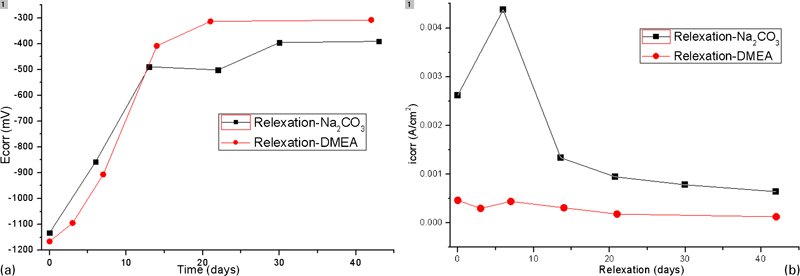
a E corr changes of rebar in concrete with different relaxation times and b i corr changes of rebar in concrete with different relaxation times
Discussion
Reduction of iron oxide on rebar
The aim of realkalisation via cathodic treatment is to restore the pH of the pore solution around the rebar, and this is achieved by water electrolysis. That is to say, during the realkalisation process (and in the absence of oxygen), all the electric charge should be used for water electrolysis. In this experiment, the oxygen was removed by bubbling N2. Therefore, the evolution of H2 should characterise the water electrolysis reaction on the cathode during ERA treatment. However, the volume of evolved H2 from the rusty rebar was significantly less than from the oxide free rebar for the same charge passed (in Fig. 2). Consequently, the ratio of V(H2)evolved/V(H2)calculated decreased with the increase in passed charge, which indicated that an alternative cathodic process was occurring, presumably reduction of iron oxide.
There have been many investigations on the electrochemical transformation between Fe and its oxides in an alkaline environment.10,11 Such research has found that the reactions have fair reversibility.12 From the peak potential of the cyclic voltammetry curves in Fig. 3 combined with the thermodynamic equilibrium potential as a reference point, it could be found that the anodic peak potential was positive compared with the equilibrium potential, and the cathodic peak potential was more negative than the equilibrium potential.12 The anodic peaks (peak I, peak I') of the positive scan may therefore correspond to the oxidation of Fe(II) to Fe(III), and peak IV and peak IV’ may be their reversible peaks. However, the anodic peak for Fe to Fe(II) could not be found in the cyclic voltammetry curves, while there was a reduction peak (peak III, peak III') for Fe(II) to Fe in the negative scan. The anodic peak for Fe to Fe(II) became evident after adding 1M LiOH to the solution, and the peaks for Fe(II) to Fe(III) also shifted to negative potentials after adding LiOH. This shows that the introduction of Li+ can change the redox process of the electrode and improve the electrode surface oxide layer composition and structure.13 The peaks III and III’, corresponding to the reduction of Fe(II) to Fe, shifts to positive potentials. This phenomenon may be explained by the direct reduction of ferrous hydroxide to Fe. With increasing cycle times, the [Fe(OH)n]2−n concentration increases, the reduction potential displays a positive shift and the peak current also increases.
Reduction mechanism for iron oxides on rebar after cathodic treatment
There are two modes for the reduction of iron oxide.12,14 One is the dissolution–deposition mode, in which a [Fe(OH)n]2−n species of Fe(II) oxide complex with OH− in alkaline solution is reduced and deposited to form the metallic iron. The other is the proton exchange mode, when the oxide on the electrode accepts an electron from the electrode; the proton enters into the crystallites of the oxide and forms OH− to keep electroneutrality and then transforms to H2O when the Fe(II) is reduced to Fe.
Figure 4 shows a scanning electron microscopy image of the surface of the rebar after cathodic treatment. Iron crystallites are seen to have formed; the empty space around the iron grains implying that reduction is likely to occur obeys the dissolution–deposition mode. This is in accordance with the cyclic voltammetry curves mentioned above. While the reduction of Fe(III) to Fe(II) may obey the proton exchange mode due to the lower dissolvability of Fe(OH)3 or Fe3O4 in alkaline solution, Fe(OH)2 transforms to [Fe(OH)n]2−n and is reduced to Fe0 by the dissolution–deposition mode. Furthermore, it should be pointed out that not all oxides can be reduced due to the difference of crystal structure of iron oxides14 and, importantly, the existence of loose oxide with low electric conductivity.
Cathodic polarisation of rebar in saturated Ca(OH)2 and in saturated Ca(OH)2+1M LiOH
After cathodic treatment, repassivation of rebar in carbonated concrete depends on two conditions. The first is that the alkaline environment locally to the rebar has been restored to pH>10. The second condition depends on the surface state of the rebar. Thus, the formation of a compact passive film on a smooth rust free surface is considerably easier than on a rebar covered with loosely adherent rust. Generally, in deeply carbonated concrete, rebar corrodes in a relatively low pH environment, forming a rust layer. Although it is possible to reduce rust to metallic iron in alkaline conditions, the Fe crystals are fine, dispersive and do not form a compact deposit because of the low concentration of [Fe(OH)n]2−n, so the rebar is also not easily passivated in this condition. Similar results have also been found by Gonzalez.15
Inhibition of rebar using DMEA after cathodic polarisation
The previous work showed that ethanolamine could act as inhibitor for the rebar in concrete.16 – 18 In this work, using DMEA, Fig. 5a shows the polarisation curve of rebar immersed in saturated Ca(OH)2 solution with 2000 ppm NaCl+0·01M NaOH containing different concentrations of inhibitor for 16 h. As shown in Table 4, the decrease of Q dl indicates that a protective film is formed due to the inhibitor. In addition, the charge transfer resistance increased with an increase in inhibitor concentration, and the low frequency diffusion impedance disappeared. This means that the rate controlling step is an electrode reaction other than the diffusion and indicates that the presence of the inhibitor passivates the rebar electrode.
Inhibitor migration in concrete
It is important for effective application that an inhibitor has maximum availability at the electrode (rebar in this case). When DMEA dissolves in water, it hydrolyses and forms DMEA+ ions; thus, under an applied electric field with the rebar as the cathode (negative electrode), migration of the DMEA+ ion is promoted towards the rebar. At the conclusion of the migration experiment reported in Fig. 6, the concentration of DMEA reached 0·0823M in the exit side.
As described above, although realkalisation can raise the pH of pore solution in carbonated concrete, repassivation of the rebar is difficult because of its coarse surface, and the reduced oxide products formed during realkalisation cannot readily transform into a protective passive film. However, passivation is more effective with added DMEA inhibitor. Finally, it is well known that transformation of iron oxides into metallic iron will reduce the molar volume.19 Thus, the reduction of iron oxide may reduce the internal stresses of the concrete caused by rebar corrosion. Therefore, combining inhibition with auxiliary realkalisation should improve the strength and durability of the concrete structure.
Conclusions
The H2 evolution test and the cyclic voltammetry measurement show that iron rust can be reduced to metal iron particles. However, not all iron oxides on the rebar can be reduced due to the low electric conductivity of a loose rust layer.
After cathodic polarisation treatment, the corroded rebar does not readily repassivate because the corroded rebar has a coarse surface. Although the rust could be partially reduced to iron, the reduction product cannot form a compact iron layer, so it is difficult to enter a passive state.
In the alkaline environment, the corrosion inhibitor has good inhibition effect for rebar. The addition of DMEA inhibitor in the external electrolyte can effectively restrain the corrosion of the rebar. Therefore, combining inhibition with cathodic realkalisation should improve the durability of concrete structures.
Footnotes
Acknowledgements
This work was supported by the National Natural Science Foundation of China (grant nos. 50771062 and 50678127).