







Abstract
The influence of chloride concentration on the salt spray corrosion behaviour of new AZ91D and AM50 alloys containing rare earth (RE) elements was evaluated. The corrosion rate of both materials increased with increasing chloride concentration, particularly for NaCl concentrations above 2 wt-%. The addition of Nd or Gd reduced the amount of β-Mg17Al12 phase and resulted in the formation of RE containing intermetallics that were less noble than the Al–Mn inclusions but more noble than the β-Mg17Al12 phase. The latter modifications decreased the corrosion rate of the AM50 alloy by up to 90% but did not give a clear benefit to the corrosion resistance of the AZ91D alloy.
Keywords
Introduction
Corrosion rate of magnesium alloys is higher than that of aluminium alloys or steel in the presence of saltwater.1 – 3 This is a serious limitation for the application of magnesium alloys in automotive and aerospace industries, where their light weight can be used to great advantage. Therefore, the majority of applications are restricted to mild atmospheric environments, where magnesium alloys have been reported to perform comparably to steel and some aluminium alloys.4
The atmospheric corrosion behaviour of magnesium alloys differs from that observed in aqueous solutions.5,6 The main cathodic process in aqueous solution is water reduction, whereas oxygen reduction or both oxygen and water reduction are likely to occur during atmospheric corrosion under thin electrolyte layers.7,8 The presence of atmospheric CO2 also has a noticeable effect as it tends to inhibit pitting corrosion of magnesium alloys. This effect has been attributed to the formation of a protective film composed of a mixture of magnesium carbonates.9 – 11 As an example, in the presence of 350 ppm CO2, the average corrosion rate of AM20, AM60 and AZ91 alloys was only 25% of that registered in CO2 free air.12
Other relevant factors affecting atmospheric corrosion of magnesium alloys include temperature, relative humidity (RH) and, more importantly, concentration of chloride ions.13 – 15 Normally, corrosion rate increases as temperature and RH increase, although corrosion rate of commercial Mg–Al alloys is insignificant for RH values below 80-90% in the absence of NaCl.16 – 18
There are relatively few studies related to the dependence of the atmospheric corrosion of magnesium alloys on the amount of NaCl concentration. For the AZ91D and AM50 magnesium alloys exposed to high humidity environments (75, 85 and 95%RH), Lebozec et al.7 observed a linear dependence between the corrosion rate and the amount of NaCl previously deposited on the surface (14-240 μg cm−2). Similarly, Lindstrom et al.12 observed higher corrosion rates with increasing amounts of NaCl (0-70 μg cm−2) deposited on the surface of the AZ91 alloy exposed to 95%RH with and without the presence of CO2. In case of salt spray tests, Merino et al.19 observed higher corrosion damage of AZ31, AZ80 and AZ91D alloys with increasing chloride ion concentration (2, 3·5 and 5 wt-%NaCl) and temperature (20 and 35°C). The detrimental effect of NaCl is usually associated with the formation of a highly conductive thin electrolyte layer, which facilitates coupling of spatially separated anodic and cathodic processes and breaking of the protective film.8
The atmospheric corrosion behaviour of Mg–Al alloys is also affected by their composition and microstructure. It has been demonstrated that low impurity levels, high aluminium concentration in the α-Mg phase and large volume fractions of β phase are beneficial,20 – 22 whereas Al–Mn particles have a minor role, which is possibly related to their location in areas with high aluminium content.9
Rising environmental restrictions and the need for lightweight materials are driving research efforts to develop magnesium alloys with improved corrosion resistance properties. In recent years, new magnesium alloys containing rare earth (RE) elements have been developed to improve their characteristics for different applications.23 – 26 They are normally based on the AM (Mg–Al–Mn) and AZ (Mg–Al–Zn) systems, as those are the best candidates due to their widespread application in the automobile sector.27
The effects of RE elements on the corrosion behaviour of Mg–Al alloys immersed in aqueous solutions can be summarised as follows:
suppression of microgalvanic couples due to substitution of Al–Mn inclusions by Al–RE phases with lower potential values16,30 – 32
incorporation of RE in the Mg(OH)2 lattice33
entrapment of impurities in RE containing intermetallic compounds34
On the other hand, still very few investigations concern with the atmospheric corrosion of Mg–Al alloys modified with RE elements,39 and the above mentioned effects are yet to be confirmed. For instance, previous results of the authors carried out in high humidity environments (80, 90 and 98%RH) revealed that the addition of Nd or Gd, in the range of 0·2-1·5 wt-%, clearly reduces the corrosion rate of the AM50 alloy, whereas it does not have a significant benefit on the corrosion resistance of the AZ91D alloy. The latter was explained by a greater relative diminishment of the area fraction of β phase in the modified AZ91D alloy compared with the modified AM50 alloy.16
In order to ascertain the influence of NaCl concentration on the atmospheric corrosion behaviour of Mg–Al alloys modified with RE elements, which to the best of the authors’ knowledge has not been previously reported, the present study investigates the corrosion behaviour of AM50 and AZ91D alloys modified with small additions of Nd and Gd in laboratory controlled environments with NaCl concentrations ranging from 0 to 3·5 wt-%.
Experimental
Test materials
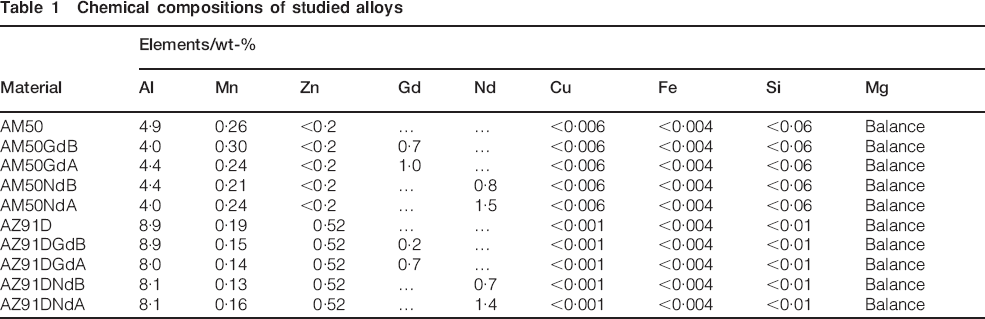
Table 1 shows the nominal compositions of the alloys determined by wavelength dispersion X-ray fluorescence (PANanalytical Axios). AM50 and AZ91D alloy ingots (Magnesium Elektron Ltd, UK) and Nd and Gd (99·9%, Metall Rare Earth Ltd, China) were used to prepare the alloys. Melting was carried out in an electrical furnace held at 740°C under Foseco MAGREX 60 covering flux to protect molten magnesium from oxidation. Nd or Gd was added to the melt and held for 30 min to ensure complete dissolution. The gravity cast billets of 45 mm in diameter were homogenised at 350°C for 24 h, air cooled and then rectified to 40 mm diameter before extrusion at 350°C with an extrusion ratio of 4∶1 and an extrusion rate of 0·4 mm s−1. A stress relief treatment at 350°C for 2 h was performed on the extruded bars, which were finally sectioned into 2·5 mm thick specimens.
Chemical compositions of studied alloys
Specimen preparation and characterisation
For metallographic characterisation, samples were wet ground through successive grades of silicon carbide abrasive papers from P120 to P2000, followed by diamond finishing to 0·1 μm. Acetic picral reagent (4·2 g picric acid+10 mL acetic acid+70 mL ethanol+10 mL H2O) was used to reveal the grain boundaries and constituents of the alloys. Quantitative metallography was performed using the image analysis software ImageJ. Samples were examined with a scanning electron microscope (SEM, JEOL JSM-6400) equipped with Oxford Link energy dispersive X-ray (EDX) microanalysis hardware. For X-ray diffraction (XRD) studies, a Philips X'Pert diffractometer (Cu Kα = 1·54056 Å) was used.
Surface potential maps of polished specimens were obtained with a Nanoscope IIIa MultiMode atomic force microscope (AFM, Veeco-Digital Instruments) working in tapping mode in order to obtain information on the local nobility of the microconstituents of the studied alloys on a submicrometre scale. A silicon tip with a 20 nm thick platinum coating was used for simultaneous acquisition of topographic and surface potential images. The AFM tip was calibrated by performing a potential ramp on a reference sample consisting of aluminium coated with a thin gold layer. The tip to sample distance was kept constant at 50 nm using a two-pass technique, where the height data are recorded in tapping mode during the first pass and the tip lifts above the surface to an adjustable lift height and scans the same line while following the height profile recorded in the first pass. All measurements were made at room temperature with an RH in the range of 40-65%.
Gravimetric measurements
Gravimetric measurements were performed using specimens of working area of 7 cm2. The specimens were placed in a CCK-KX (CCI, Spain) salt spray chamber. Mass gain was determined by measuring mass changes over corrosion time after 7 days of exposure to the conditions given in Table 2. The atmosphere was that of the laboratory, with a CO2 concentration of ̃350 ppm.
Salt fog conditions

Tests alloys were ground to P1200 grit using series of emery paper with water as lubricant. Before the tests, specimens were measured and weighed. At the end of the tests, the specimens were washed with water at 38°C and then dried with hot air. Corrosion rates were calculated using the metal loss measured by weighing the specimens after removing the corrosion products by pickling in a solution containing 200 g L−1 CrO3 and 1 g L−1 AgNO3 at room temperature for 5-10 min. The tests were reproduced twice to ensure the reliability of the results. Samples were weighed using a Sartorius BP 211D balance with a precision scale of 0·01 mg.
Characterisation of corrosion products
Once the specimens were evaluated by gravimetric tests, SEM examination was carried out in order to study the composition, morphology and evolution of corrosion products formed on the surface. Likewise, the composition of the corrosion layer was also analysed by low angle XRD.
Results and discussion
Microstructural characterisation
The optical micrograph of the unmodified AM50 and AZ91D alloys revealed α-Mg equiaxial grains with an average size of ̃6·6 and ̃6·0 μm respectively and coarse particles of β phase (Mg17Al12) (Fig. 1a and b). Al–Mn inclusions with an average composition of 70·2Al–29·5Mn–0·3Fe (at-%), according to EDX analysis, were also observed. The area fraction of Al–Mn inclusions (f Al–Mn) was ̃0·2%, for both alloys and that of the β-Mg17Al12 phase (fβ) was ̃7·1 and ̃0·5% for the AZ91D and AM50 alloys respectively.
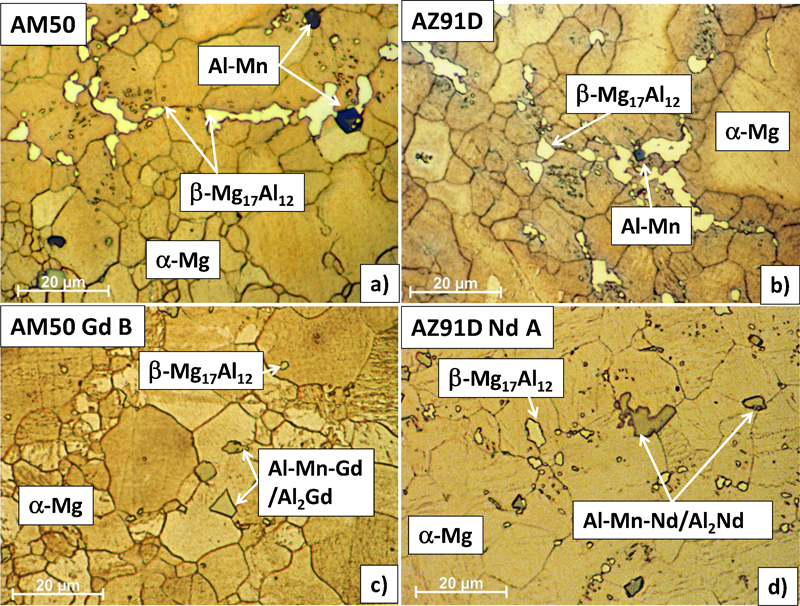
Optical micrographs of a AM50, b AZ91D, c AM50GdB and d AZ91DNdA alloys
The addition of Nd or Gd decreased the area fraction of β phase down to ̃0·1 and ̃2·6% for the AM50 and AZ91D respectively (Fig. 1c and d). Significant grain coarsening was observed for the modified AZ91D alloy (up to ̃11 μm) (Fig. 1d) but not for the AM50 alloy. This was attributed to the large reduction in the amount of β phase observed for the AZ91D alloy. The addition of Nd and Gd led to formation of Al2Nd, Al2Gd, Al–Mn–Nd and Al–Mn–Gd instead of Mg–RE intermetallic compounds due to the larger difference in electronegativity between the RE and Al than that between RE and Mg (Fig. 2).40 Thus, small Nd and Gd additions (0·8 wt-%) promoted the precipitation of Al–Mn–Nd/Gd inclusions, whereas further additions (1·0-1·5 wt-%) increased the population density of Al2Nd and Al2Gd intermetallic compounds. Energy dispersive X-ray analysis of the extracted Al–Mn–Nd and Al–Mn–Gd particles revealed an average composition of 63Al–27Mn–10Nd (at-%) and 67Al–25Mn–8Gd (at-%) respectively.
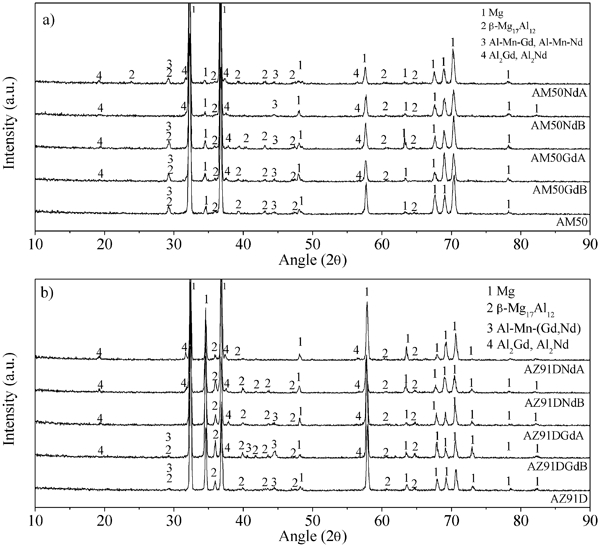
X-ray diffraction patterns of studied alloys
The local nobility of the different microconstituents in the AM50 alloy was studied using AFM (Figs. 3 and 4). According to the topographical images, surface potential images and potential profiles, the β-Mg17Al12 phase and Al–Mn inclusions revealed a cathodic behaviour with potentials ̃50 and ̃300 mV higher respectively than that of the surrounding magnesium matrix. This suggested that microgalvanic corrosion is more likely to occur at the Al–Mn/α-Mg interface, although this depends upon the flow and magnitude of the galvanic current as well as the total resistance to the current flow.
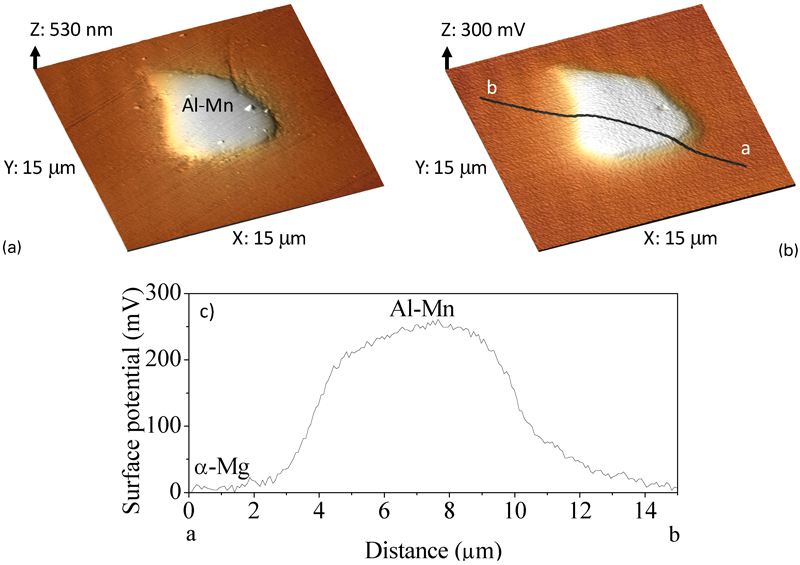
a topographic image, b surface potential map and c potential profile of Al–Mn inclusion in AM50 alloy
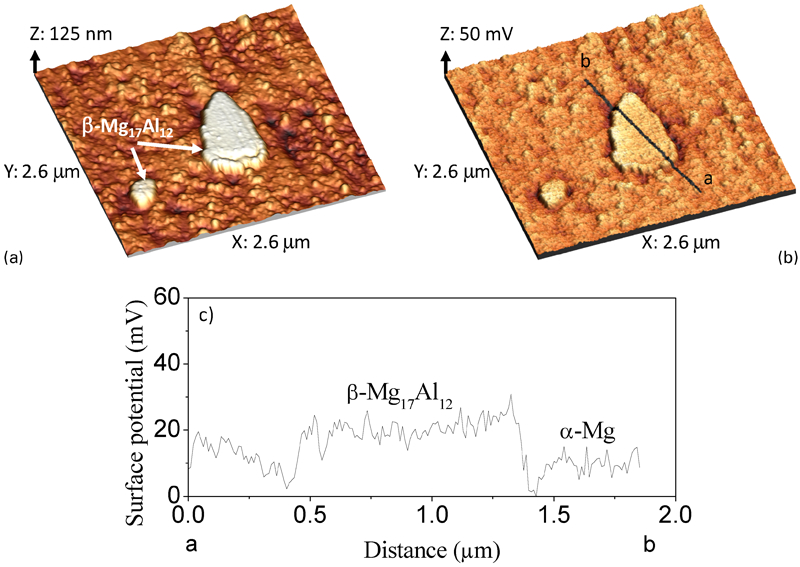
a topographic image, b surface potential map and c potential profile of β-Mg17Al12 phase in AM50 alloy
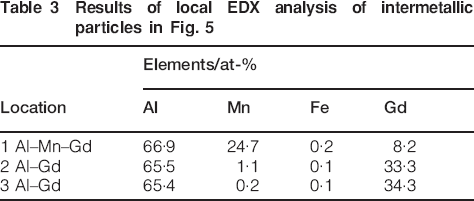
The SEM image, topographic image, surface potential map and potential profiles of a selected area of the AM50GdA alloy are shown in Fig. 5. Energy dispersive X-ray analysis of the Gd containing particles labelled as 1, 2 and 3 are given in Table 3. The Al–Mn–Gd particles presented a cathodic behaviour with a potential value ̃170 mV higher than the magnesium matrix, whereas the Al2Gd particles revealed potential differences only slightly higher (̃90 mV) than those observed for the β-Mg17Al12 phase. In case of Al–Mn–Nd and Al2Nd, the potential values were similar or slightly lower than those corresponding to Gd containing intermetallics.16,32 These values were comparable to those obtained by Liu41 for Al–RE intermetallics formed on the AM60 alloy modified with Ce or La.
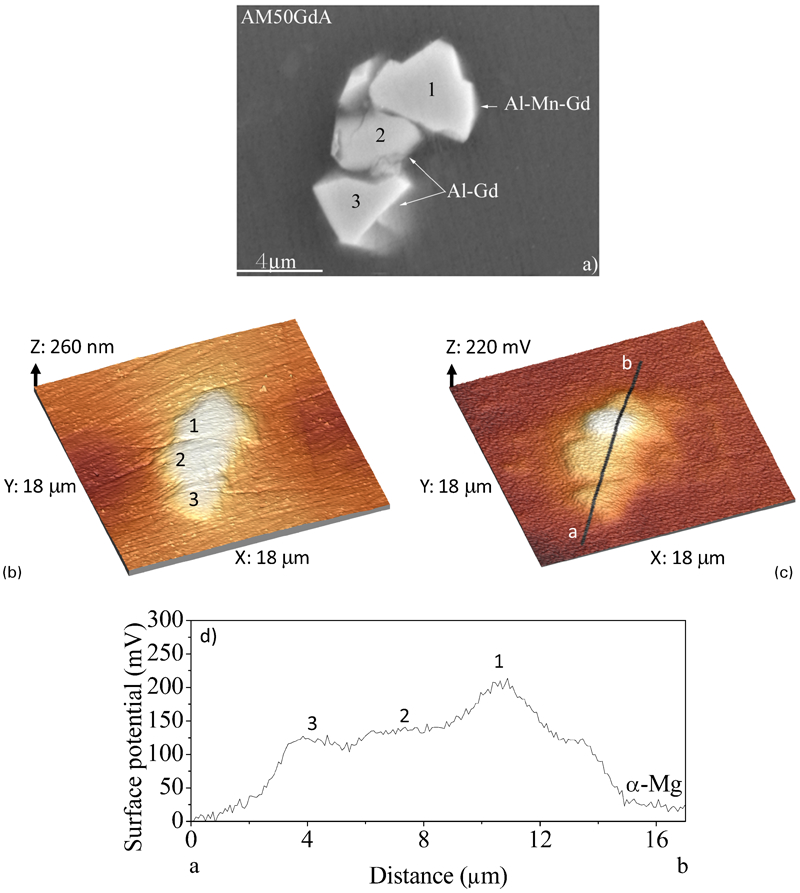
a image (SEM), b topographic image, c surface potential map and d potential profile of Gd containing phases in AM50GdA alloy
Results of local EDX analysis of intermetallic particles in Fig. 5
Gravimetric results
The corrosion rates P, calculated from weight loss measurements after removing the corrosion products by pickling in a solution containing 200 g L−1 CrO3 and 1 g L−1 AgNO3 at room temperature for 5-10 min, are shown in Fig. 6. For each NaCl concentration, the corrosion rate of the AM50 was always higher than that of the AZ91D, which is in good agreement with previous studies.7 For instance, at 0 and 3·5 wt-%NaCl, the AM50 and the AZ91D alloys exhibited values of 0·14-17·6 and 0·07-1·1 mm/year respectively. The higher corrosion resistance of the AZ91D alloy is possibly associated with the presence of a finely divided and continuous net of β phase acting as a barrier against electrochemical corrosion.42,43 Electrochemical corrosion phenomena are possible due to the high RH of the salt spray environment (̃100%RH), which allows the formation of aqueous droplets in microdented, depressed or hollow sites through condensation. These sites with the aqueous droplets acting as electrolyte will be electrochemically corroding much more rapidly than in a normal atmospheric oxidation process at room temperature.44
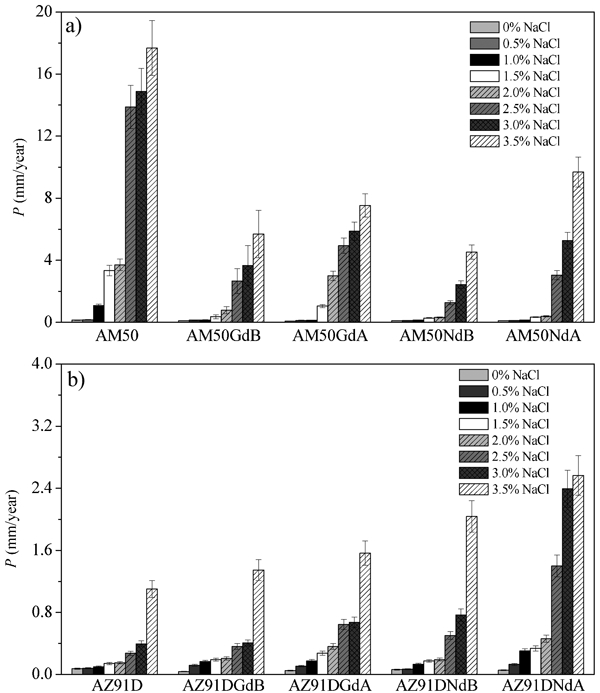
a AM50 alloys; b AZ91D alloys
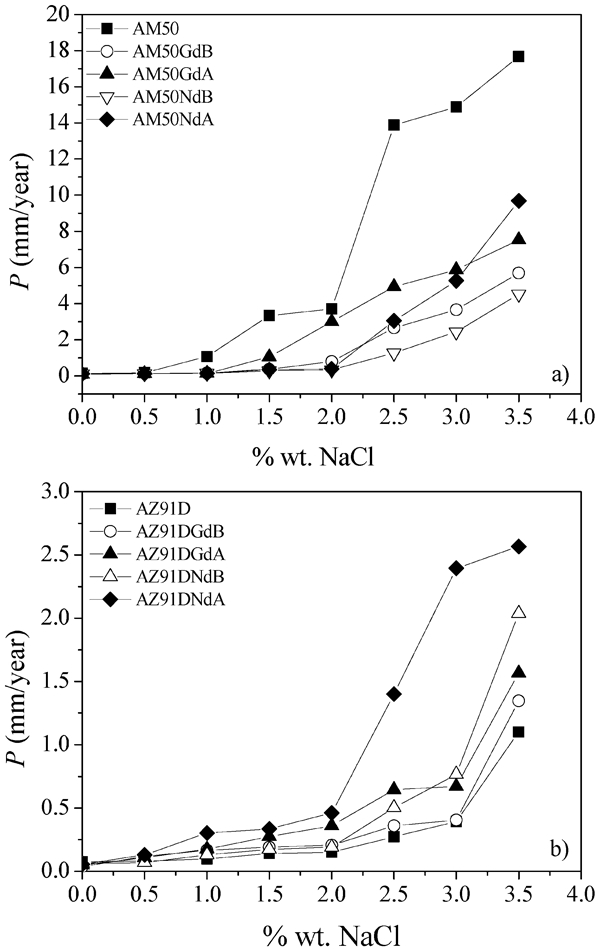
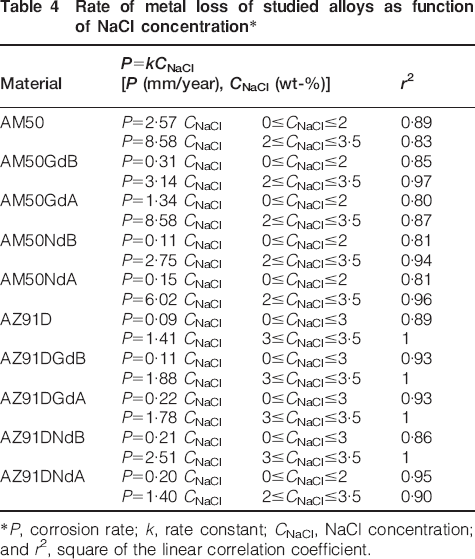
Figure 7 shows the corrosion rate obtained from salt spray tests as a function of NaCl concentration. As expected, the corrosion rate of all the alloys increased with increasing chloride concentration. This is usually associated with the highly conductive electrolyte droplets formed on the surface and with the chloride ions facilitating the breakdown of the partially protective [Mg(OH)2] film.39 A comparison of the corrosion rate values and the data in Table 4 indicated that the AM50 alloys were more susceptible to changes in NaCl concentration than the AZ91D alloys. For instance, an increase in the NaCl concentration from 0 to 3·5 wt-%NaCl resulted in the increase in the corrosion rate of the unmodified AM50 alloy by 125 times, whereas for the unmodified AZ91D alloy, the factor was only 15 times.
a AM50 alloys; b AZ91D alloys
Rate of metal loss of studied alloys as function of NaCl concentration*
*P, corrosion rate; k, rate constant; C NaCl, NaCl concentration; and r 2, square of the linear correlation coefficient.
As illustrated in Fig. 7 and Table 4, with the increase in chloride ion concentration, the gradient of the corrosion rate increased, that is, the influence of chloride ion concentration was much higher at higher NaCl concentrations. This behaviour is different from that observed in previous studies,7 where the change of the chloride ion concentration at lower range of concentrations affected the corrosion rate much more compared to that of higher range of concentrations. Possibly, the continuous removal of corrosion products during the salt spray test, as opposed to the accumulation of insoluble corrosion products during high humidity12 and immersion tests,45 is responsible for such behaviour. With respect to the results by Dhanapal et al. on the salt spray corrosion behaviour of the AZ61A alloy, the discrepancy might be ascribed to the relatively short times used in their study.39
The effect of Gd and Nd additions on the salt spray corrosion behaviour of AM50 and AZ91D alloys is complex, and it is closely related to changes in the microstructure of the alloys, in particular, to variations in composition and area fraction of secondary phases, resulting in significant differences between the AM50 and AZ91D alloys.
Gd and Nd additions clearly improved the corrosion behaviour of the AM50 alloy in these environments, showing lower corrosion rates: between 0·1 and 4·5 mm/year for Nd additions and 0·08 and 5·7 mm/year for Gd additions depending on the NaCl concentration (0-3·5 wt-%) (Figs. 6 and 7). For 0 and 0·5 wt-%NaCl, the addition of Gd or Nd reduced the corrosion rate by about 15-30%, whereas for higher NaCl concentrations the effect was more noticeable and corrosion rates of modified AM50 alloys were about 50-90% smaller than that of the unmodified AM50 alloy. Surface potential maps suggest that the beneficial effect of Gd and Nd was related to the diminishment of the microgalvanic couples due to complete replacement of Al–Mn particles by less noble Al2RE and Al–Mn–RE intermetallics. This effect was more evident as the conductivity of the electrolyte increased at higher NaCl concentrations. An excessive addition of Gd and Nd led to an overall increase in the corrosion rate compared with small Gd and Nd additions, which is related to the higher number of second phase particles and therefore the larger total cathodic area.
A less clear effect was observed in case of the AZ91D alloy. Gd and Nd additions reduced the corrosion rate by about 15-50% at 0 wt-%NaCl, but they increased it at higher NaCl concentrations. In the absence of NaCl, the smaller corrosion rate could be explained in the same terms as for the AM50 alloy (suppression of microgalvanic couples). For saline environments, the behaviour was possibly related to a less efficient β phase network in case of modified AZ91D alloys, where the precipitation of Al2RE and Al–Mn–RE intermetallics consumed Al atoms, resulting in a reduction in size and volume fraction of the β-Mg17Al12 phase.
Characterisation of corrosion products
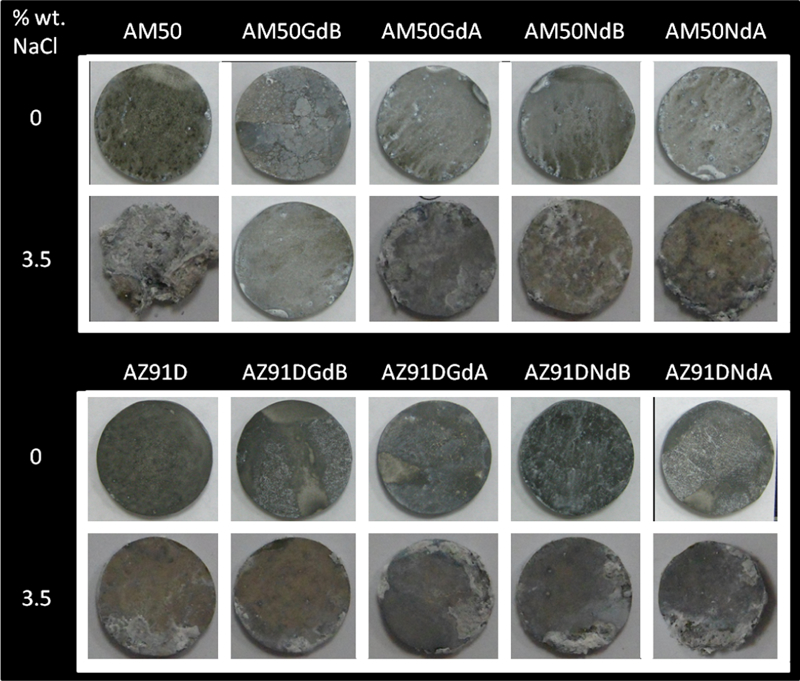
The surface appearances of test alloys after exposure to salt spray at 35°C for 7 days are shown in Fig. 8. The surface degradation for all the alloys at 0 wt-%NaCl was less significant than the one observed at 3·5 wt-%NaCl. For the highest salt concentration, the AZ91D alloy with higher aluminium content revealed lower degree of corrosion than the AM50 alloy. Small additions of Nd or Gd considerably decreased the surface degradation of the AM50 alloy. However, further Nd and Gd additions slightly reduced the corrosion resistance of this alloy. A less obvious trend was observed in case of the modified AZ91D alloys. The AZ91DNdA alloy with higher addition of Nd (1·4 wt-%) revealed a higher level of corrosion than the mother alloy, whereas the rest of the materials showed a similar surface appearance compared with the AZ91D alloy.
Surface appearance of materials after exposure to 0 and 3·5 wt-% salt spray at 35°C for 7 days
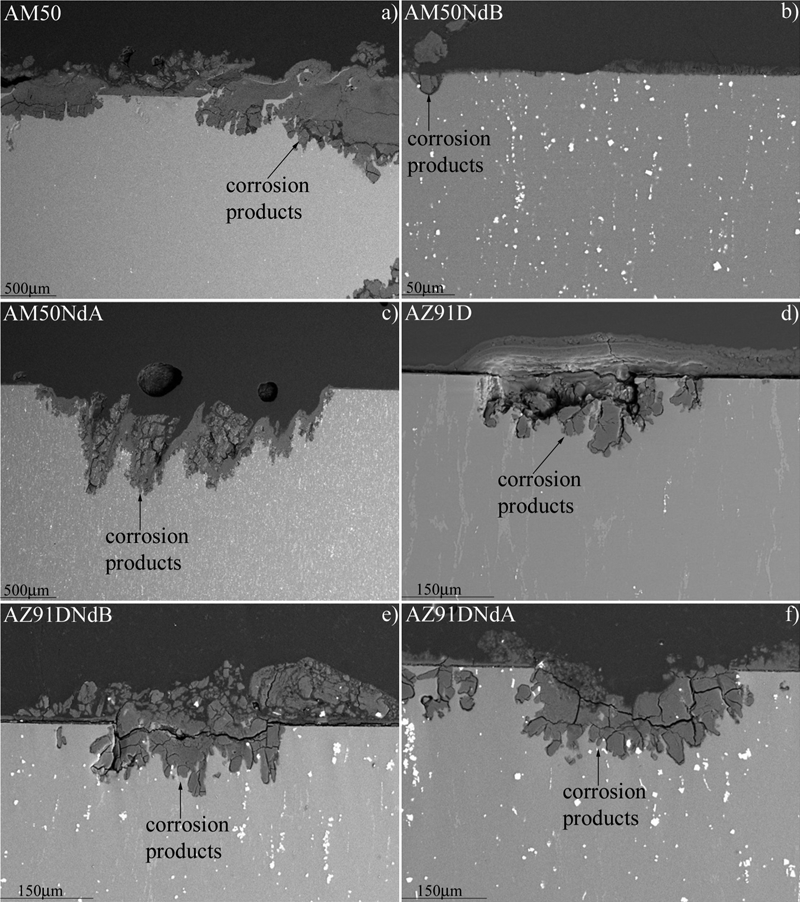
The backscattered scanning electron micrographs of the cross-sections of the tested materials modified with Nd after exposure to 3·5 wt-% salt spray at 35°C for 7 days are presented in Fig. 9 (similar results were observed for the specimens containing Gd). For all the alloys, irregular pits were observed, which tended to spread laterally and cover the whole surface without tendency for deep pitting (Fig. 9a). This corrosion morphology is commonly observed for magnesium alloys immersed in aqueous chloride solutions15,21 or exposed to thin electrolyte layers contaminated with NaCl.46 The addition of approximately 0·7-0·8 wt-%Nd clearly improved the corrosion resistance of the AM50 alloy, and only small areas of the surface were corroded (Fig. 9b and c). The unmodified AZ91D alloy, with higher aluminium content than the AM50, revealed lower degree of corrosion (Fig. 9d). In case of the AZ91DNdB and AZ91DNdA alloys, corrosion pits appeared to be deeper than those observed in the AZ91D alloy (Fig. 9e and f), which could be associated with the less effective β phase network in these alloys.
a AM50 alloys; b AM50NdB; c AM50NdB; d AZ91D; e AZ91DNdB; f AZ91DNdA
A detail of a corrosion pit formed on the AZ91DNdA alloy after 7 days of exposure in 3·5 wt-%NaCl salt spray at 35°C is presented in Fig. 10. According to the X-ray elemental maps, the corrosion products were rich in magnesium and oxygen, possibly consisting of magnesium hydroxides and/or carbonates. Previous studies by Rosalbino et al.33 suggested incorporation of RE into the corrosion products, although there was no evidence of it in this study (Fig. 10d).
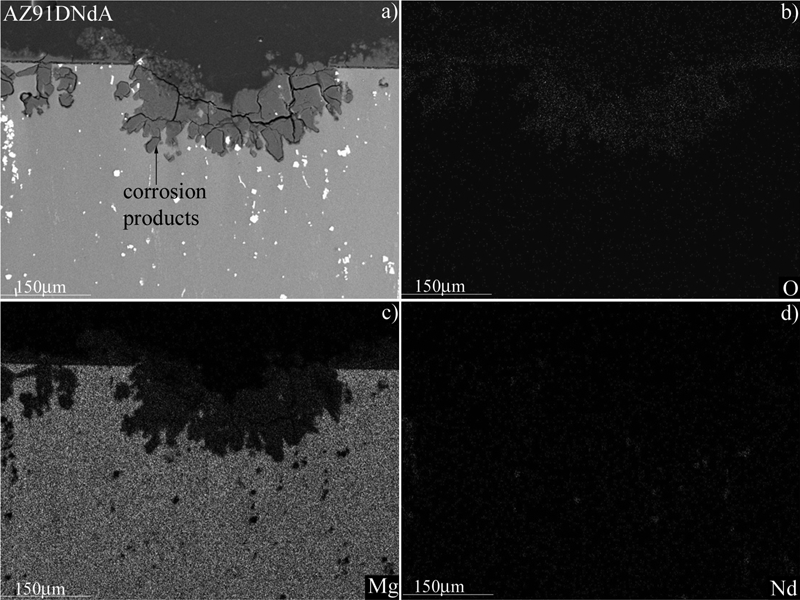
a backscattered electron micrograph and b–d X-ray elemental maps of cross-section of AZ91DNdA after exposure to 3·5 wt-% salt spray at 35°C for 7 days
The low angle XRD study (incident angle, 1°) of test materials after exposure to salt spray environment at 3·5%NaCl for 7 days at 35°C (Fig. 11) revealed peaks corresponding to the substrate and corrosion products in the form of brucite [Mg(OH)2] and hydromagnesite [Mg5(CO3)4(OH)2.4H2O]. This hydrated magnesium carbonate hydroxide forms through the reaction of Mg(OH)2 with atmospheric CO2.8
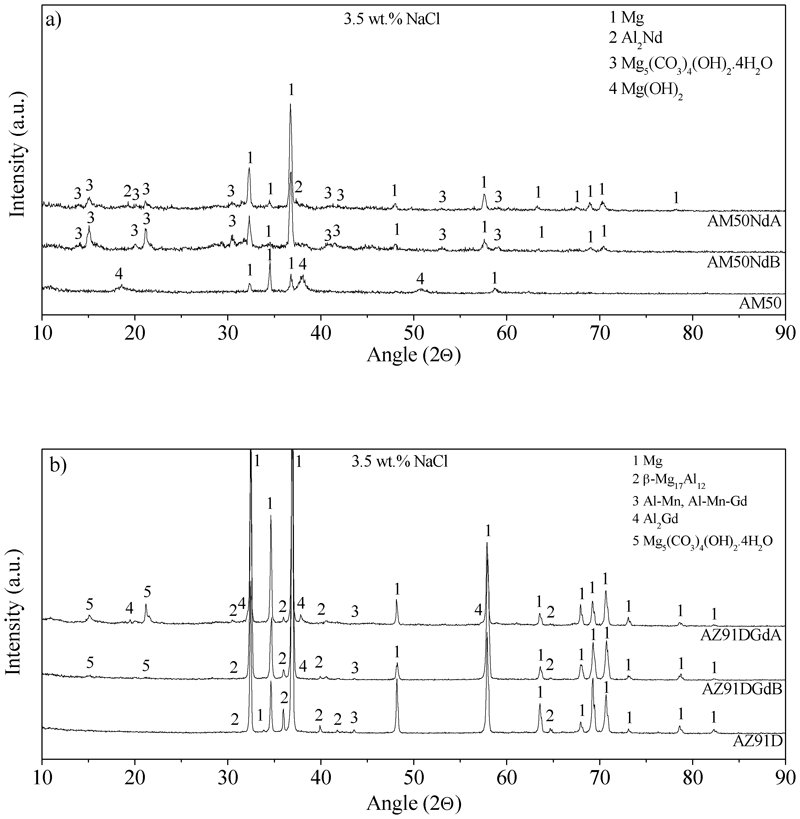
Low angle (1°) XRD patterns of a AM50 alloys and b AZ91D alloys after exposure to 3·5 wt-% salt spray at 35°C for 7 days
Conclusions
The addition of Nd or Gd to the AM50 and AZ91D alloys modified the microstructure of the mother alloys, resulting in formation of Al2RE and Al–Mn–RE intermetallic compounds and consequent reduction of the fraction of β-Mg17Al12 phase. According to surface potential maps, RE containing intermetallics were less noble than the Al–Mn inclusions and suppressed microgalvanic couples that are detrimental for the corrosion behaviour of AM50 and AZ91D magnesium alloys.
For each NaCl concentration, the AZ91D alloy showed higher corrosion resistance than the AM50 alloy. This was associated with the presence of a finely divided and continuous net of β phase acting as a barrier against corrosion.
The corrosion rate of all materials increased with increasing chloride concentration, particularly for NaCl concentrations above 2 wt-%. The influence of chloride ion concentration was much higher at higher NaCl concentrations.
The corrosion resistance of AM50 alloys increased with the addition of Nd or Gd by up to 90%. In case of low NaCl concentration (<1 wt-%), the modified AM50 alloys revealed corrosion rates similar to those observed for the AZ91D alloy. The additions of Gd and Nd gave no significant benefit to the corrosion resistance of the AZ91D alloy.
Brucite [Mg(OH)2] and hydromagnesite [Mg5(CO3)4(OH)2.4H2O] formed on the surface of tested materials after 7 days in salt spray environment. The addition of Nd or Gd did not modify the corrosion morphology or composition of the corrosion products.
Footnotes
Acknowledgements
The authors are grateful to the MCYT (Spain, project no. MAT 2009-09845-C02-01) and the MANOEQ of Departamento de Metalurgia Física of CENIM (CSIC) for supply of the test materials. R. Arrabal and E. Matykina are grateful to the MICINN (Spain) for financial support via the Ramon y Cajal Programme (grant nos. RYC-2008-02038 and RYC-2010-06749). K. Paucar is grateful to the Fundación Carolina for funding a grant. M. Mohedano is grateful to the UCM for funding a grant.