







Abstract
The potential and limits of the electrochemical noise (EN) measurement technique for the detection of stress corrosion cracking (SCC) initiation in austenitic stainless steels under simulated boiling water reactor (BWR) conditions was investigated at PSI within a small feasibility study. Because of the limited throwing power in low conductive, high purity water, it seems obvious that the distance between EN electrode and the specimen (or cracking location) plays an important role on the detectability of SCC initiation by the EN technique. This effect was evaluated by performing constant extension rate tensile tests in a simulated BWR environment (high purity water, T = 288°C, p = 9 MPa, O2 content = 2 ppm) with simultaneous potential noise measurements versus multiple reference electrodes. These experiments confirmed that for the detection of SCC initiation by EN measurements the electrode distance is a limiting factor for the application in low conductivity electrolytes. The detection sensitivity decreases with increasing distance between the specimen surface and the reference (or counter) electrode. Furthermore, it was evaluated that the basic/background noise level is very low in highly reducing environment.
Keywords
Introduction
Background
Economically efficient operation of nuclear power plants at very high safety levels requires implementation of proactive plant aging and life management methods. The continuing occurrence of stress corrosion cracking (SCC) and other corrosion phenomena in boiling (BWRs) and pressurised water reactors (PWRs) worldwide1 – 3 clearly demonstrates a need for the development of advanced, non-destructive, continuous monitoring tools for the early detection of SCC initiation. The electrochemical noise (EN) measurement technique is a promising tool for continuous, in situ corrosion monitoring in technical systems and has the potential to detect nucleation and initiation of localised corrosion processes.4 Currently, EN seems to be the major promising technique with some potential for the early detection of SCC initiation in structural components of BWRs and PWRs, although no extensive systematic studies have been performed so far and the basic and quantitative understanding of EN during SCC is still rather limited.5 – 11
Previous work
During a previous research project (KORA-I12) a small feasibility study was started, investigating the potential and limits of the EN technique for the early detection of SCC initiation in austenitic stainless steel under simulated BWR conditions. For this purpose constant extension rate tensile (CERT) and constant load tests were performed in aqueous thiosulphate solution at room temperature, as well as in autoclaves in a simulated BWR environment. In reference 12 the results are briefly summarised. EN transients and an increase in the electrochemical current (ECN) and decrease in the electrochemical potential noise (EPN) signal level, indicating SCC initiation, could be observed during the room temperature experiments.4 CERT tests with round bar tensile specimens in high temperature water showed a similar behaviour, although single transients could not be identified in most cases. These results together with tests combining the EN measurement technique with independent online crack growth monitoring by direct current potential drop technique revealed that early SCC detection by EN is possible under stable and stationary lab conditions in oxygenated high temperature water.13 Individual intergranular (IG) semielliptical surface flaws with a surface crack length and crack depth of ̃150 μm could be detected by EN measurements. However, on the other hand, only crack initiation and the subsequent surface or near surface growth could be detected by EN measurements in high purity water with low conductivity.
Owing to these very promising results the feasibility study was continued in the framework of a follow-up project (KORA-II) with the main focus on the aspect of the limited throwing power of current in low conductive, high purity water and its impact on the EN signal. This effect was evaluated by performing CERT tests in simulated BWR environment with simultaneous EPN measurements versus multiple reference electrodes (REs). Additionally, the effect of hydrogenated high temperature water on the behaviour of the EN signal has been studied. In the current paper these investigations are briefly summarised.
Material and experimental procedure
Material and specimen
For the SCC tests, a rod material of the high carbon austenitic stainless steel AISI 304 (DIN 1·4301) was used, since this steel could be easily sensitised and showed a sufficiently high susceptibility to intergranular (IG) SCC (Tables 1 and 2). For the current investigations this material was heat treated to different degrees of sensitisation. The applied heat treatment at 620°C for 5, 9 or 24 h resulted in high degrees of sensitisation (values from double loop electrochemical potentiokinetic reactivation (EPR) tests ranging from 11 to 22%; measured according to JIS G 05801986). Flat tensile specimens with a gentle notch on one side of the specimen were used for the investigations (Fig. 1). The specimens were electrically insulated from the autoclave and test facility by ceramic bushings and washers.
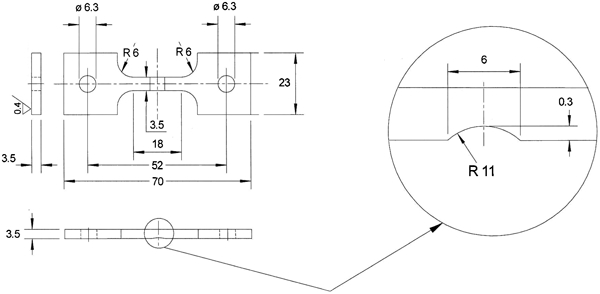
Schematic of flat tensile specimen with notch (dimensions in mm)
Mechanical properties and heat treatments of investigated austenitic stainless steel [AISI 304/DIN 1·4301, water quenched (WQ), R p0·2 = yield strength, R m = ultimate tensile strength]
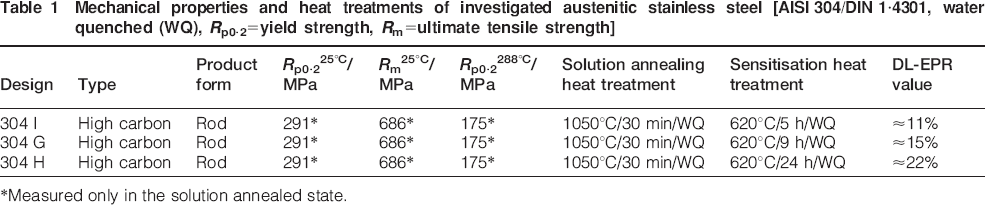
*Measured only in the solution annealed state.
Chemical composition of investigated austenitic stainless steel in wt-%

Experimental procedure
Test set-up, environmental conditions and procedure
A sophisticated, refreshing, high temperature water loop with autoclave and integrated electromechanical loading system was used for the SCC initiation studies with EN measurements under simulated BWR conditions (Fig. 2). This system was optimised for these kinds of measurements in many pretests. The CERT tests were performed in oxygenated, high temperature water [288°C with 2 ppm dissolved oxygen (DO) content]. The electrochemical corrosion potential (ECP) of the specimens and the redox potential of the environment (Pt-probe) were measured (during the preoxidation phase only) with a Cu/Cu2O ZrO2 membrane RE. The ECP of the stainless steel and redox potential was about +160 mV(SHE) and +300 mV(SHE) respectively. The effect of dissolved hydrogen (DH) on the EPN signal was investigated by adding different hydrogen–oxygen mixtures or only hydrogen to the high temperature water, which resulted in ECPs of −65, −220 and −560 mV(SHE) and redox potentials of −400, −480 and −535 mV(SHE) respectively. In all experiments, 50 ppb sulphate (as 0·02M Na2SO4) was added to the high purity water to promote SCC in the stainless steel specimens. The specimens were preoxidised at a small preload for at least one week before a constant pull rod stroke rate (vpull rod) of 3·6×10−9 m s−1 (nominal strain rate is 2×10⁻⁷ s−1) was applied until SCC occurred. The specimens were unloaded before complete failure. After finishing the experiments, the specimens were carefully analysed using a scanning electron microscope (SEM). In most cases the specimens were opened by mechanical overloading in air at room temperature for analysis of the in-depth cracking and of the fracture mode.
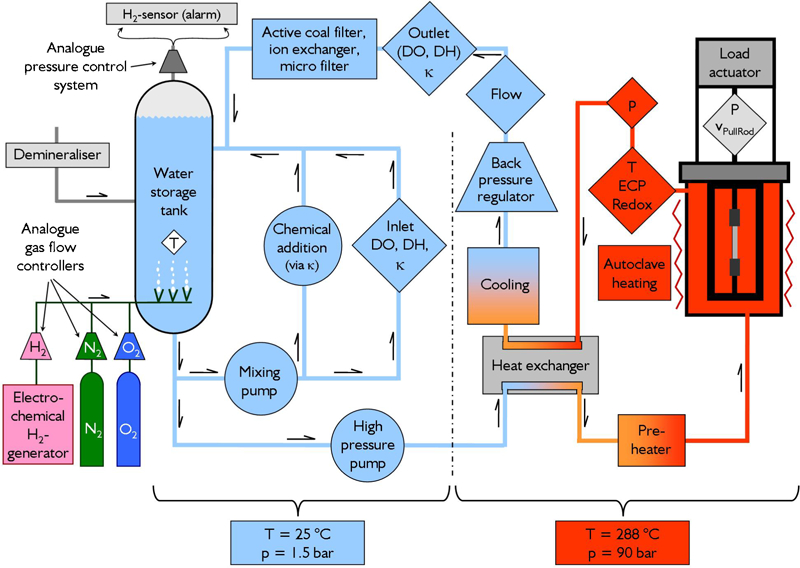
Schematic of high temperature water loop with autoclave and electromechanical tensile machine
Electrochemical noise measurements
EPN was recorded by a newly developed EN measurement device (EcmNoise, IPS, Germany) with a sampling rate of 2 Hz. The EN measurement device was qualified and characterised according to a guideline for EN measurement equipments developed by the European Cooperative Group on Corrosion Monitoring of Nuclear Materials – ECG-COMON.14 Two EPN signals were measured simultaneously with two Pt-wire pseudo REs which were positioned in different distances to the notch root (≈location of crack initiation) of the flat tensile specimen (Fig. 3). The smallest distance which could be tested (without getting in contact with the specimen) was 0·4 mm, whereas the longest distance tested was 16 mm.
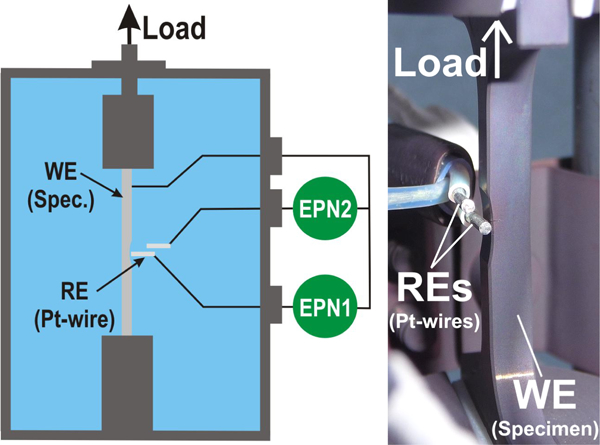
Simplified schematic (left) and photograph (right) of set-up for EPN measurements during CERT tests with flat, notched tensile specimens
Results and discussion
A series of eight CERT tests with simultaneous EPN measurements were performed. In all tests crack initiation could be detected successfully by the EN measurements. Additionally, four experiments in different (oxidising to reducing) environments with EPN measurements were conducted, whereas SCC could not be initiated under reducing conditions. Therefore, only the basic/background noise pattern, recorded under a small preload was evaluated.
General behaviour of EPN signal during SCC in oxidising environment
Figure 4 shows the typical behaviour of the EPN signal (and stress) during a test where SCC initiated around the onset of plastic yielding at the notch root. This was shown by a clear drop of the baseline potential signal and by transients in cathodic direction, at least if the RE was positioned close to the specimen surface. After the specimen was unloaded to the small preload, the EPN signal slowly returned to the original level and no further transients could be observed. The fractographical post-test investigations showed IG SCC cracking (Fig. 5). This behaviour of the EPN signal was observed in many tests of the first part of the feasibility study12,13 and could be clearly attributed to SCC initiation. The observed cathodic polarity and the shape of individual potential transients are related to oxide film rupture and repassivation events during crack initiation at different surface locations, as well as to surface crack growth of previously formed microcracks. The initiation process of IG SCC thus involves local anodic dissolution, which would be in line with a slip dissolution mechanism,15 as schematically shown in Fig. 6. The superposition of such potential (or current) signals from initiation events at different surface locations and the surface crack growth of microcracks under slow straining conditions with increasing plastic strain may result in a quasi-continuous drop of the potential. Furthermore, superimposed crevice currents and resulting potential changes to the differential aeration cell in the crack mouth region, which vary with the crack mouth opening, may further contribute to these signal changes.
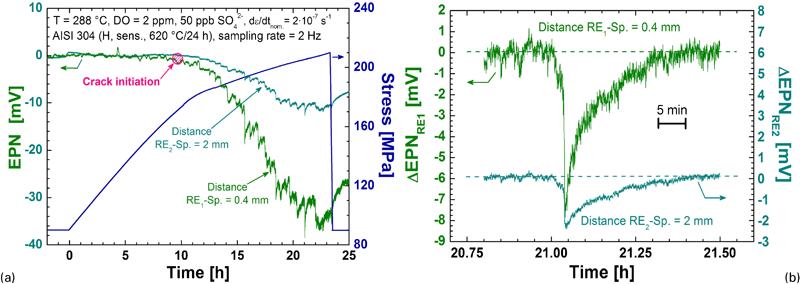
Typical course of two simultaneously recorded EPN signals and stress during a CERT test in high temperature water; crack initiation was detected (by drop of potential signal and transients) more clearly with RE positioned closer to specimen a, example of individual potential transient from a at higher resolution b
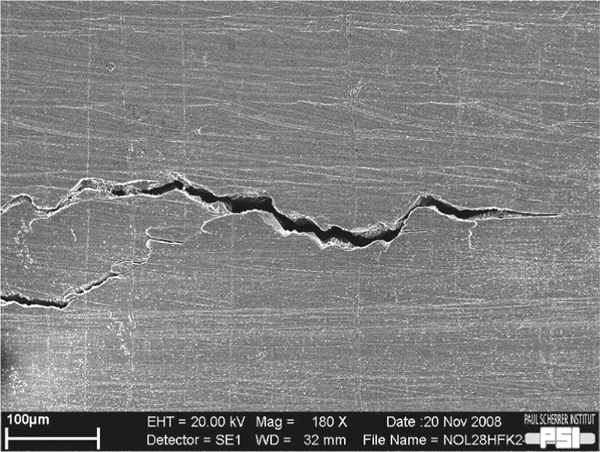
Image (SEM) of IG cracking in specimen from test shown in Fig. 4
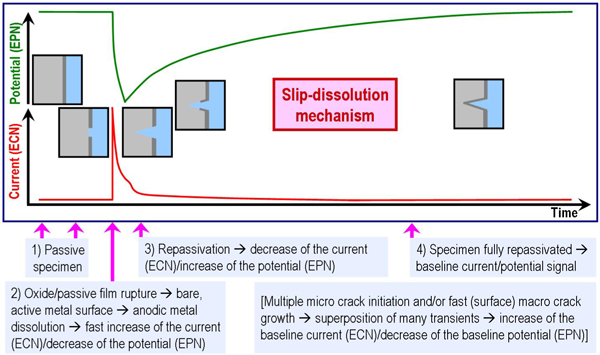
Schematic of origin of current and potential noise transients according to slip dissolution mechanism15
Additional tests where the specimen was unloaded at an earlier stage (Fig. 7) or where the straining was interrupted several times (Fig. 8) and tests with less sensitised stainless steel further confirmed the observations and conclusions stated above. A lower extend of cracking lead to a less pronounced drop of the EPN signal and lower number of transients. These results also revealed that the effect of electrode distance could be investigated with the current test setup and procedure.
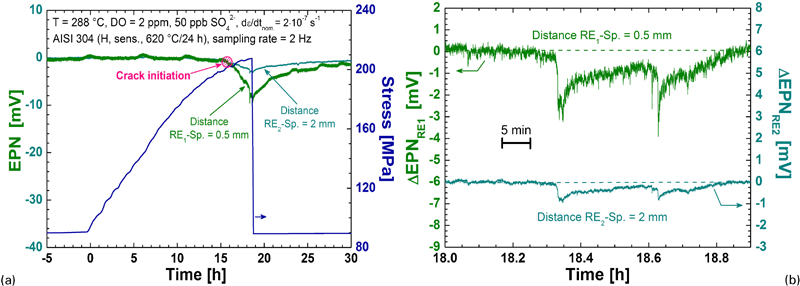
Typical course of two simultaneously recorded EPN signals and stress during CERT test in high temperature water; crack initiation was detected (by drop of potential signal and transients) more clearly with RE positioned closer to specimen a, example of two individual potential transients from a at higher resolution b
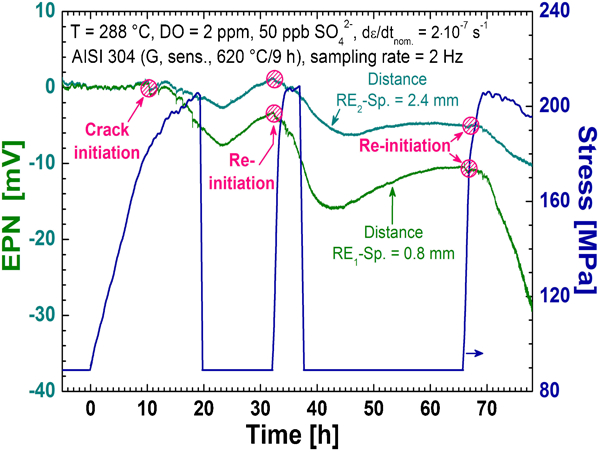
Typical course of two simultaneously recorded EPN signals and stress during CERT test which was interrupted two times; crack initiation could reproducibly be detected and was more clearly visible with RE positioned closer to specimen
Effect of electrode distance on EPN signal
With the two pseudo REs used in the CERT tests it was possible to simultaneously measure the EPN signals of the same cracking events in two different distances from the cracking location. The two potential transients in Fig. 4b, measured 0·4 and 2 mm away from the notch root, clearly show different amplitudes, even though both transients originate from exactly the same cracking event. The best possible explanation for this phenomenon is the restricted throwing power of the current in the low conductivity, high purity water. The conductivity of the water at 288°C, containing 50 ppb of sulphate, amounts 6·96 μS cm−1 (corresponding to 0·19 μS cm−1 at 25°C) which can still be regarded as a very low value, e.g. compared to tap water with a conductivity of ̃500 μS cm−1 (at 25°C). Despite the fact that in this high resistivity electrolyte (resistivity≈0·14 MΩ cm) the potential difference between the local anode (initiating crack) and cathode (surrounding metal surface) is large compared to high conductivity electrolytes, it can only be measured in direct proximity of the electrode couple because of the very high Ohmic potential drop. According to Ohm's law the resistance is increasing linearly with distance. Therefore, the measurable potential response of the anodic dissolution events, taking place on the specimen surface during crack initiation and early growth, is getting weaker with increasing distance (of the RE).
The longest RE distance studied in the current test row was 16 mm. The EPN signal, together with a 2 mm electrode signal, can be seen in Fig. 9 and the corresponding post-test fractography in Fig. 10. From the 16 mm EPN signal alone SCC initiation could not be resolved anymore, as the drop of the signal level was too small to be related to crack initiation or growth events. The transients measured in the 16 mm EPN (see Fig. 9b) were in the range of low frequency fluctuations caused by disturbances, very localised changes of the water chemistry or oxidation processes.
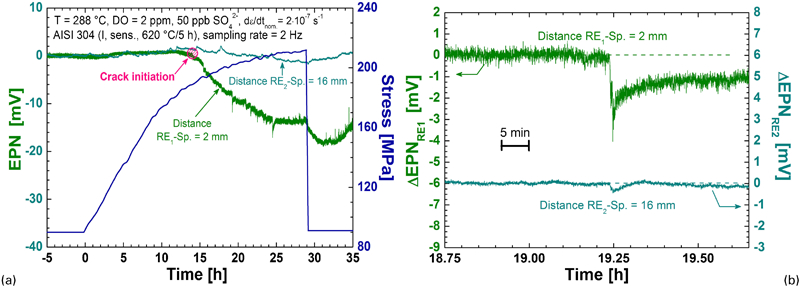
Typical course of two simultaneously recorded EPN signals and stress during CERT test in high temperature water; crack initiation could hardly be detected with RE positioned 16 mm away from notch root a, example of individual potential transient from a at higher resolution b
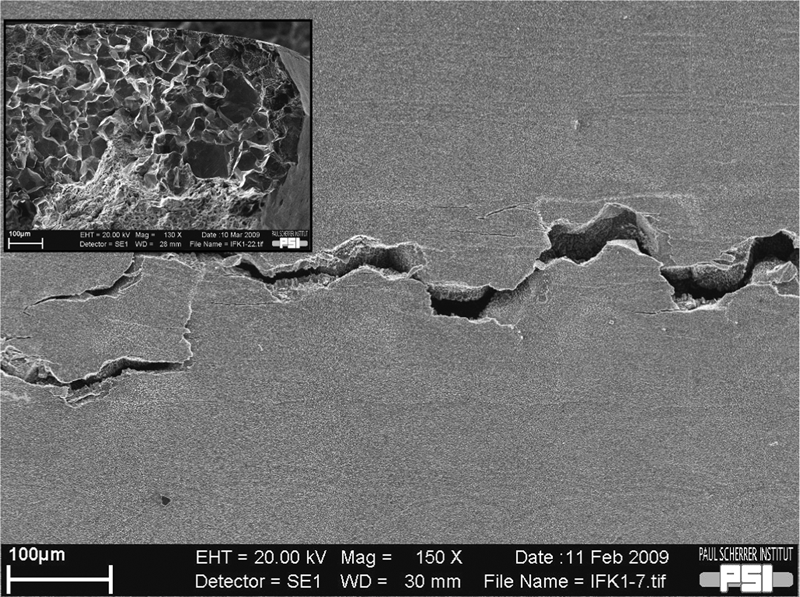
Image (SEM) of IG cracking in specimen from test shown in Fig. 9
In Fig. 11 the ratios of EPN transients from eight tests, measured simultaneously with two REs, are plotted versus the RE distance ratios. A linear relationship can be identified by applying a linear fit (slope = 0·8) of all data. A slope of one would have been expected, but probably due to the rather large scatter in the data a small deviation from that value is observed.
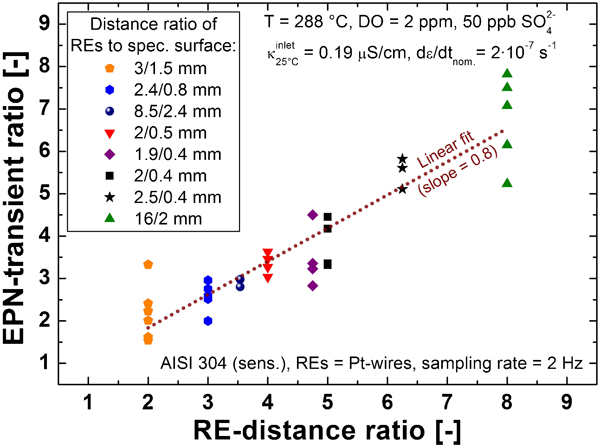
Ratios of EPN transients from eight tests, measured simultaneously with two REs, plotted versus distance (RE to notch root) ratios
Regarding these results it is very questionable if EN measurements can be used as real time in situ SCC monitoring tool for the surveillance of whole BWR plant components. The only possibility using the EN technique in BWR plants might be to develop carefully designed and calibrated SCC warning sensors. A slightly improved sensitivity of the technique could be expected in primary PWR environment where the conductivity is by a factor of 30 higher (̃200 μS cm−1) compared to BWR water. Nevertheless, the EN technique is still a very valuable in situ corrosion monitoring tool for the detection of SCC initiation in high temperature water lab investigations where only extremely few SCC monitoring techniques are available.8
Effect of hydrogen on EPN signal
Additional CERT tests were performed under reducing conditions with two different hydrogen/oxygen mixtures and with hydrogen only to see how the EN signal behaves and if SCC initiation can also be detected. Unfortunately SCC could not be generated in these reducing environments. Nevertheless, the behaviour of the basic EPN pattern could be studied with the current test set-up at a small preload of 1 kN.
In Fig. 12 the standard deviation (calculated over periods of 4 h) of the EPN, recorded under highly oxidising, intermediate and reducing conditions, are compared to each other. The lowest basic noise level is observed under reducing conditions. Rather high standard deviation values of the EPN were measured in the high temperature water with mixtures of hydrogen and oxygen, whereas the EPN standard deviation with a DO content of 2 ppm lies in between the values mentioned before. Analysing the power of the EPN over the whole frequency range by fast Fourier transformation [see power spectral densities (PSDs) in Fig. 13, calculated according to the formulae given in Ref. 14], the picture looks similar in the low frequency area (down to 5×10⁻⁴ Hz). In the high frequency range (up to 1 Hz) the power of the EPN signal, measured under oxidising conditions, reaches the highest values. This is related to the facts that in oxygenated high temperature water a significant part of the EPN is generated by the Pt pseudo RE which potential value is undefined and the potential of the stainless steel specimen is determined by oxidation processes and reduction of oxygen. On the other hand, when only hydrogen is present in the high temperature water Pt acts as hydrogen electrode and the potential is therefore very stable. The specimen also has a stable potential because the corrosion/oxidation activity is usually rather limited at very low ECPs (≈redox potential). This results in a very quiet EPN signal with the lowest power spectral density over the whole frequency range. The Pt and stainless steel potentials are less stable in the intermediate potential range [−5 and −220 mV(SHE)], which causes the stronger EPN fluctuations especially at lower frequencies. The ECPs are in the transition region of low to high potential values (see Fig. 14), in which very small changes in the local water chemistry/environment (flow, pH, DO/DH contents, etc.) can lead to rather large shifts in ECP, which can explain the observed low frequency fluctuations.
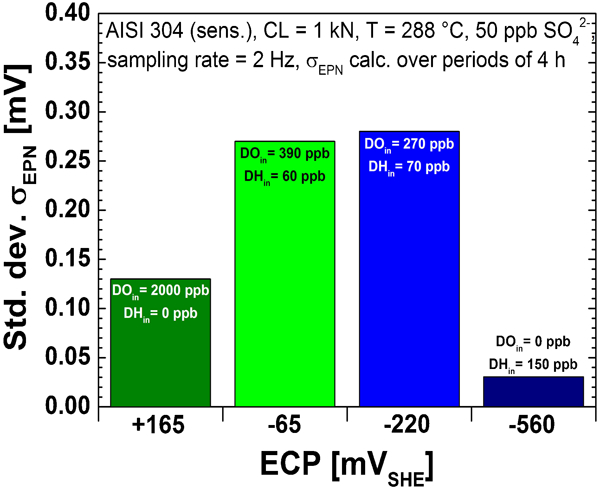
Standard deviation of EPN signals recorded at small preload of 1 kN, calculated over periods of 4 h
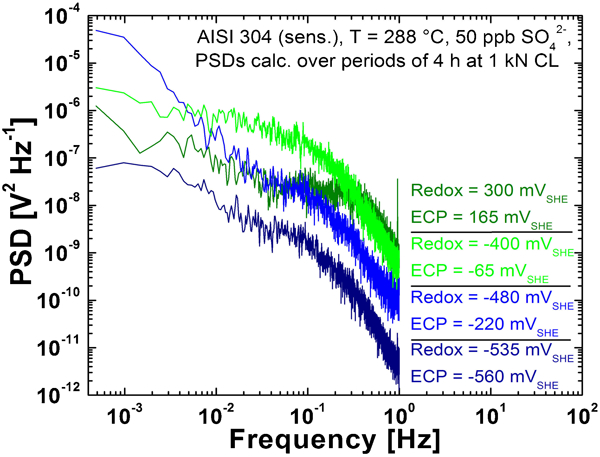
PSD of EPN signals recorded at small preload of 1 kN, calculated by fast Fourier transformation over periods of 4 h
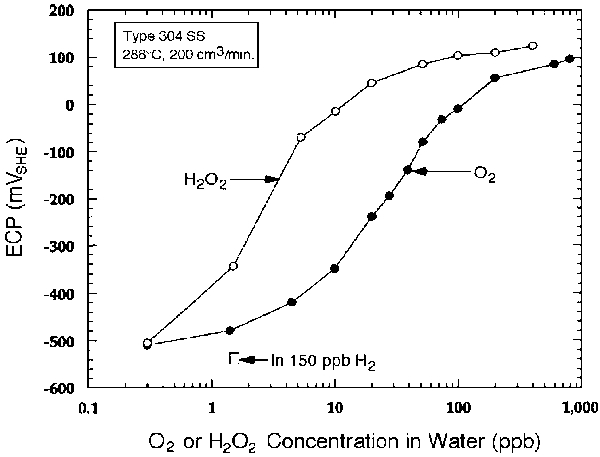
ECP of AISI 304 stainless steel in high temperature water as function of oxygen or hydrogen peroxide concentration16 © NACE International 2012, reproduced with permission from NACE
It is concluded that the very low basic noise level in hydrogenated high temperature water is a good prerequisite for the general ability to detect SCC initiation, e.g. under BWR/HWC conditions. Because of the lower background noise level, potential (or current) transients could eventually be resolved more clearly than in oxidising NWC environment. However, the final proof has to be delivered by EN measurements during CERT tests with a more SCC susceptible material. Heavily cold worked stainless steel could provide such a material for future investigations.
Summary and conclusions
In a first feasibility study in the framework of the KORA-I project the potential and limits of the EN technique for the early detection of SCC initiation in austenitic stainless steel under simulated BWR conditions have been investigated. The SCC initiation experiments with independent online crack growth monitoring by DCPD indicated that early SCC detection by EN is possible under stable and stationary lab conditions in oxygenated high temperature water. Individual small IG semielliptical surface flaws with a surface crack length and crack depth of ̃150 μm could be detected by EN measurements. However, on the other hand, only crack initiation and the subsequent surface or near surface growth could be resolved by EN measurements in high purity water with very low conductivity.
This feasibility study has been completed in a follow-up project (KORA-II) mainly by investigating the effect of electrode distance on the EN signal during SCC initiation. These experiments confirmed that for EN measurements the electrode distance plays an important role in low conductivity electrolytes. The detection sensitivity increases almost linearly with decreasing distance between specimen surface and reference (or counter) electrode. It is concluded that with suitable positioning of the reference (or counter) electrode, early detection of SCC initiation by the EN technique is possible under stable and stationary lab conditions in oxygenated high temperature water. Furthermore, it was evaluated that the basic/background noise level is very low in highly reducing environment, which is generally advantageous for the detection of SCC initiation by the EN technique. Owing to a lack of SCC occurring in the current stainless steel in hydrogenated high temperature water, this could not be further investigated in the framework of the KORA-II project.
Footnotes
Acknowledgements
The results described in this paper were generated within the KORA-II research programme. The financial support of the project by the Swiss Federal Nuclear Safety Inspectorate (ENSI) is gratefully acknowledged. Thanks are also expressed to B. Baumgartner, L. Nue, R. Schwenold, U. Tschanz and E. Groth (all PSI) for their experimental contribution to this work.