







Abstract
This paper consists of an investigation of the protective properties of a new polyurethane coating (supramolecular polymers) based on hydrogen bonding. It means that the covalent bonds are partially substituted with hydrogen bonds, which are able to induce self-healing properties in the coating after thermal treatment. The idea is to evaluate if the self-healing ability can restore the barrier properties, and therefore the protective properties, in the case of damaged (scratched) coatings for corrosion protection. The corrosion protection properties characterisation has been carried out using electrochemical impedance spectroscopy measurements. The barrier properties are strictly related to the covalent bonds networks in this class of materials, at least for percentages of hydrogen bonds replacement until to 25%. Some partial recovery after artificial defect has been demonstrated, even it is not sufficient at the moment, and with quite large defect, to completely recover the protective properties. The present preliminary work demonstrates that the potential of multiple hydrogen bonds can be effectively exploited in coating applications owing to the combination of improved damage response behaviour and protection from corrosion phenomena. Further experimental work will be carried out in order to verify if, for smaller dimensions, the complete recovery of the system can be obtained.
Introduction
The increasing market expectations and the complexity of the factors involved in coatings’ degradation processes represent the driving force from improving the durability of organic coatings. Many strategies are now available to satisfy this need. From the conceptual point of view, the strategies can be classified into two main groups:1 damage prevention2 and damage management2 – 5 approaches. The basic idea behind the damage prevention concept foresees the enhancement of the material resistance to degradation processes, such as chemical, physical and mechanical stresses jeopardising the integrity of the coating. Although very good results can be obtained adopting this approach, it should be remembered that, as the formation of damage during use can never be excluded, these materials invariably need periodic inspection to monitor damage development, thus calling for actions and costs, sooner or later.
Conversely, damage management approach is based on the active response of the material to the external chemical, physical or mechanical stimuli, which could affect the coating properties.2 Active response must be intended both as ‘removing’ or ‘healing’ capabilities offered by the material once the coating has been damaged, and ‘preemptive healing’ by acting against the nucleation of the defect. These smart materials are the subject of a huge amount of studies in several research fields. In coating applications, numerous examples can be mentioned, and excellent surveys about these topics are available in the literature.4 Healing by microencapsulation,3,6 – 10 by reversible covalent networks thermoplastic3 and by the introduction of hydrogen bonding are some characteristic examples of the damage management strategy.
Polymers based on supramolecular chemistry represent a promising application of this strategy. In general, supramolecular chemistry in polymer science introduces a new approach in the design and synthesis of polymeric materials. The repeating units are held together by non-covalent interactions, such as hydrogen bonds, π−π interactions, metal coordination and van der Waals forces.
These highly directional secondary interactions assembling the units provide novel properties essentially owing to the reversibility of this kind of linkages. Consequently, the response of the material to external stimuli is significantly different from that one of traditional macromolecules based on covalent bonds.11 – 15 One of the most promising systems concerns supramolecular polymers based on hydrogen bonding.16,17
This paper consists of an investigation of the protective properties of a new polyurethane coating in which the covalent bonds are partially substituted with hydrogen bonds. In this way, we are trying to evaluate if the self-healing ability can restore the barrier properties and therefore the protective properties, in the case of damaged (scratched) samples. Similar systems were already studied by Wietor et al. and Dimopoulos et al.18,19 proving preemptive healing properties related to the supramolecular networks, without any evaluation about the corrosion protection properties.
Quadruple hydrogen bonding ureidopyrimidinone (UPy) moieties can be a promising tool also in cross-linked systems, in which applications can be in coatings field. One of the positive features of the UPy unit is its ease of synthesis from available commercial reagents. The 2(6-isocyanatohexylaminocarbonylamino)-6-methyl-[1H]pyrimidinone is obtained from 2-amino-4-hydroxy-6-methylpyrimidine using sixfold excess of 1,6-hexyldiisocyanate (HDI). With the addition of pentane, the product precipitates, and then it is filtered and washed with some more pentane. The obtained white powder is dried under reduced pressure.20,21 The excess of HDI is recovered by distillation.
Experimental
Based on the results obtained by Wietor et al. and Diamopulos et al.,18,19 the synthesis of the novel binder was achieved according to steps:
synthesis of 2(6-isocyanatohexylaminocarbonylamino)-6-methyl-[1H]pyrimidinone
functionalisation of acrylic polyol with 2(6-isocyanatohexylaminocarbonylamino)-6-methyl-[1H]pyrimidinone
extension with HDI of the product.
Synthesis of self-complementary units (step 1)
The first step concerns the production of the self-complementary units providing quadruple hydrogen bonds. This unit was obtained by linking a 2-ureido-4[1H]-pyrimidinone unit to a reactive isocyanate group. The synthesis of 2(6-isocyanatohexylaminocarbonylamino)-6-methyl-[1H]pyrimidinone was carried out according to the procedure of Eindhoven's group.20,21 The reagents (2-amino-4-hydroxy-6-methylpyrimidine and HDI) were provided by Sigma Aldrich. In Table 1, the amounts of reagents for step 1 are reported. The batch size was 25 g.
Amount of reagents step 1
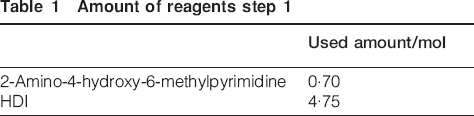
The solution was heated at 100°C for 16 h using oil bath to maintain a constant temperature. The batch was continuously stirred by magnetic stirring, and the reaction was carried out under nitrogen flow. After 16-18 h, pentane was added, and the product settled. The liquid was removed, and fresh pentane was added. The operation was repeated four times to eliminate the pentane and the excess of isocyanate in it. The product was then filtered and put under vacuum at 100°C overnight. The success of the reaction was checked by nuclear magnetic resonance (NMR) analysis. The spectra were recorded on a Bruker Avance 400 MHz instrument at a constant temperature of 298 K. Deuterated chloroform (CDCl3) was used as reference for both 1H (CHCl3 at 7·260 ppm) and 13C-NMR (CHCl3 at 77·00 ppm). In Figs. 1 and 2, 1H-NMR and 13C-NMR spectra are reported. Good agreement with the data available in literature20,21 were found.
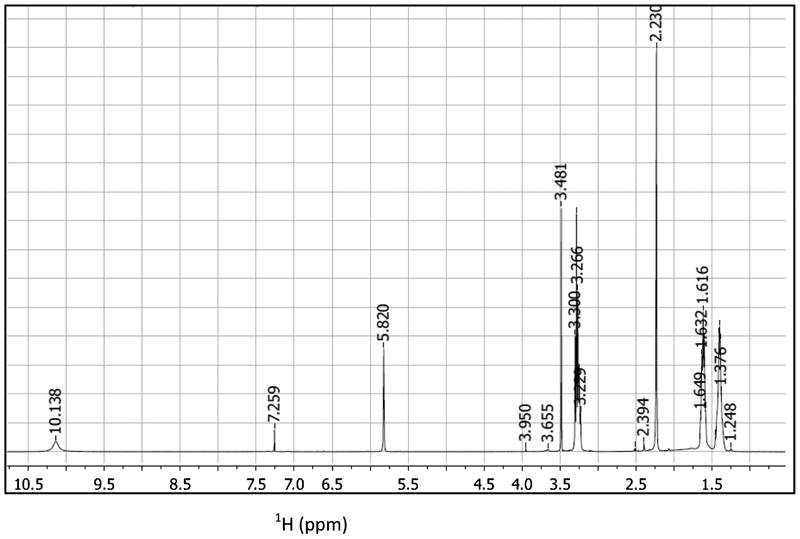
1H-NMR spectrum
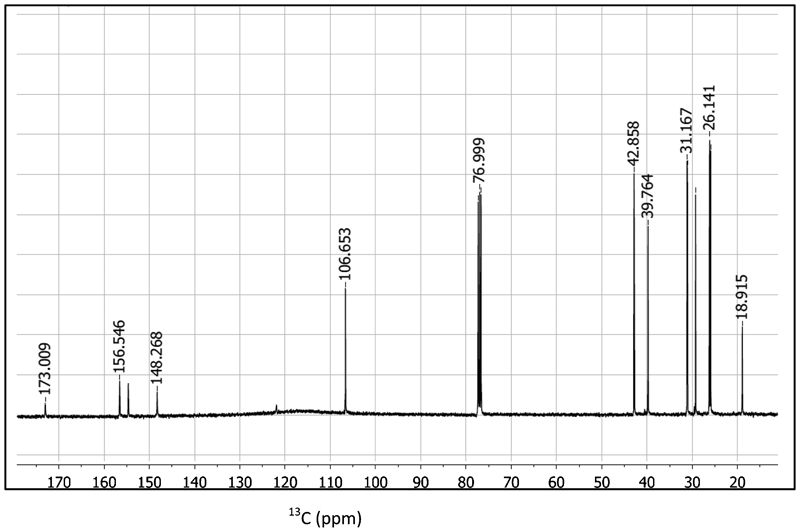
13C-NMR spectra
Functionalisation of acrylic polyol (step 2)
In the second step, an acrylic polyol, commonly used in formulation of commercial polyurethane coatings, was functionalised with the 2(6-isocyanatohexylaminocarbonylamino)-6-methyl-[1H]pyrimidinone. A defined number of OH groups pendant from the backbone of the polyol react with the NCO group of the UPy units.
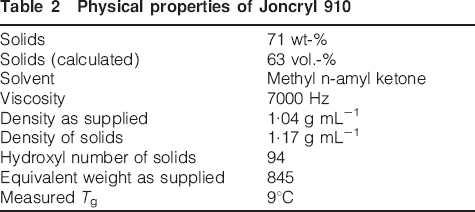
In Table 2, the properties of the acrylic polyol Joncryl 910 (BASF) used in the second formulation step are summarised.
Physical properties of Joncryl 910
The product obtained from step 1 was added in a round flask to the acrylic polyol; anhydrous chloroform was used as solvent, dibutyltindilaurate as catalyst. The batch was maintained at 60°C for 24 h using an oil bath under magnetic stirring and nitrogen flow. A condenser was used to collect the vapors.
The completeness of the reaction was checked by Fourier transform infrared spectroscopy. The presence of the NCO group peak (2270 cm−1) was monitored until its disappearance was registered.
Extension with HDI (step 3)
The remaining OH groups of the acrylic polyol were reacted with the NCO groups supplied by HDI. Dibutyltindilaurate was used again as catalyst.
The amount of reagents was calculated on the basis of equivalent weights in order to obtain different ratios between covalent bonds and multiple hydrogen bonds. In Table 3, the equivalent weights of the reagents used in the formulation steps are reported.
Equivalent weights of reagents
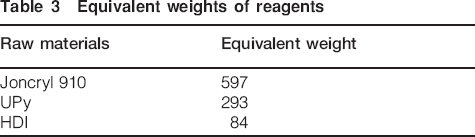
Both in the second and third steps, the reactions were performed with a slight excess of NCO containing reagent (NCO/OH = 1·05), a common practice in polyurethane coatings formulation, which takes into account the likelihood that NCO functional groups react with moisture.22
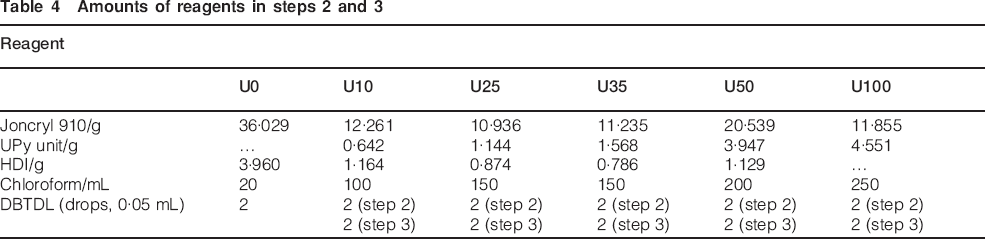
In Table 4, the amounts of reagents used in steps 2 and 3 are reported. The quantities of this samples were calculated to obtain 0% (U0), 10% (U10) 25% (U25), 35% (U35), 50% (U50) and 100% (U100) of OH groups of the acrylic polyol reacted.
Amounts of reagents in steps 2 and 3
Just after the addition of HDI in step 3, the coating was applied on steel Q panels by an adjustable film applicator. The average thickness of the films was 60±10 μm. The samples were dried at room temperature for 1 week before testing. Following literature information, it takes 1 week to complete cross-linking of the material.
To establish the role played by the number of hydrogen bonds in the thermal behaviour of the new resin, differential scanning calorimetry (DSC) tests were performed. The measurements were carried out using a Mettler DSC30 instrument. The two thermal cycles cover the temperature range from −20 to 200°C under a nitrogen flow of 100 mL min−1 and with heating rate of 10°C min−1. Before the measurement, the samples were put in a vacuum oven at 60°C for 24 h to eliminate the presence of residual solvent. After the first heating, the samples were weighed to check any weight loss due to solvent evaporation. A second scan was therefore performed.
The protective properties were investigated via electrochemical impedance spectroscopy (EIS). The swept frequency range was from 105 to 10−2 Hz, and the voltage signal amplitude was 20 mV. Three electrode set-ups were used, with Ag/AgCl as reference electrode, and platinum as counter electrode. The cell area was 15·9 cm2. The EIS tests were carried out on the samples, monitoring their behaviour during 24 h of immersion in 0·3 wt-%Na2SO4 aqueous solution. Electrochemical tests were performed using a Princeton Applied Research Potentiostat 273A and Schlumberger HF Frequency Response Analyser SI 1255.
Some EIS measurements were also performed on samples with an artificial defect (a hole of 50 μm) before and after a thermal treatment (1 h at 60°C) to explore any damage recovery phenomena. The artificial defects were obtained by drilling with a very sharp steel tool (for dental use) until the substrate. The defects have been observed before and after the thermal treatment by an environmental scanning electron microscope TMP ESEM FEI (backscattering images obtained in low vacuum mode).
Results and discussion
Figure 3 displays the DSC curves during the first and second heating respectively. With respect to the base material (U0), the introduction of UPy units clearly modifies the thermal response of the material. The introduction of the UPy units modifies the DSC curves shape at first heating above the glass transition temperature. A more and more pronounced broad peak can be easily recognised with increasing UPy content. Since these peaks are no longer present in the second heating DSC curves, they could be associated to residual cross-linking reactions. This finding is also corroborated by the increasing of glass transition temperature T g derived from the second heating curves. The peaks in the first heating DSC curves are disturbing the T g evaluation; however, a clear trend as a function of the composition is visible in Fig. 4. Greater UPy units percentage higher T g (Fig. 4). As revealed by Fig. 4, the increment in T g does not vary linearly with the UPy units percentage. The effects appear more evident at low percentages of UPy units, while a trend toward a saturation seems to characterise the global response of the material.
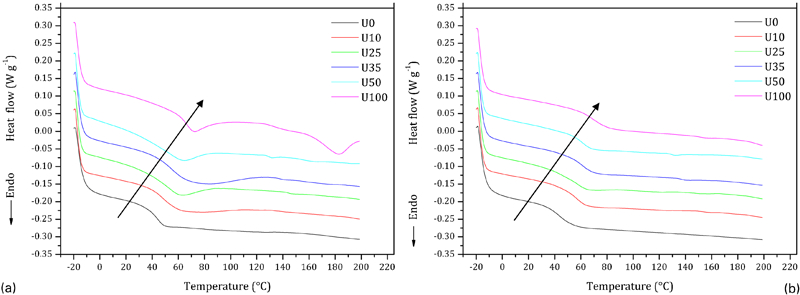
Effects of sample composition onto DSC curve:
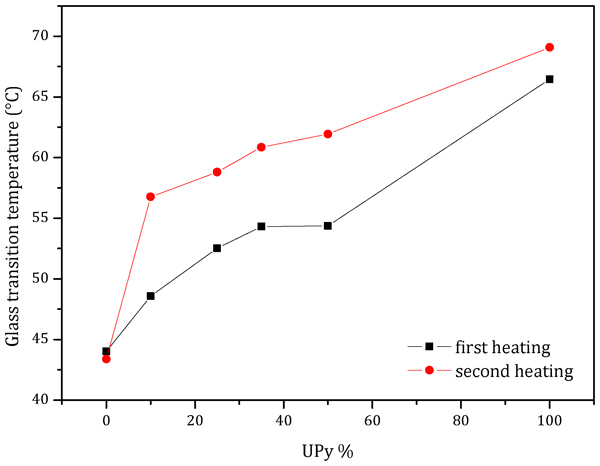
Glass transition temperature as function of sample formulation
The EIS results were performed onto the samples until 25% of OH groups reacted with UPy units, being this kind of materials the most promising for a possible practical application. In fact, for higher percentages of OH groups, the application of the film was found quite difficult due to the brittle behaviour of the coating, and it is not possible to propose for any practical corrosion protection a very brittle coating. Similar findings were observed by Eindhoven's groups.19
The results obtained for sample U25 compared to the reference sample U0 are reported as example in Figs. 5–7. The figures display the Nyquist and Bode plots of the EIS spectra measured during 24 h of immersion in sulphate aqueous solution. From the analysis of these data, the introduction of hydrogen bonds does not modify significantly the electrochemical response of the coating, in particular the total impedance of the systems at the beginning of immersion time is quite similar.
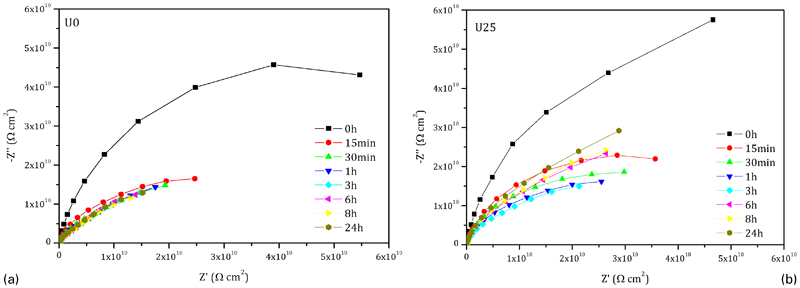
Nyquist plot of EIS data as function of immersion time for reference a sample U0 and b sample U25
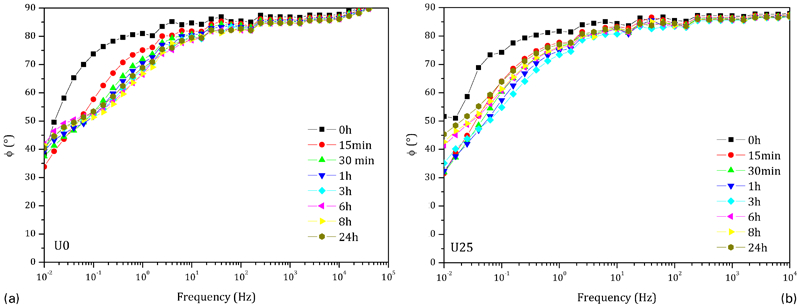
Electrochemical impedance spectroscopy phase (Bode plot) as function of immersion time for reference a sample U0 and b sample U25
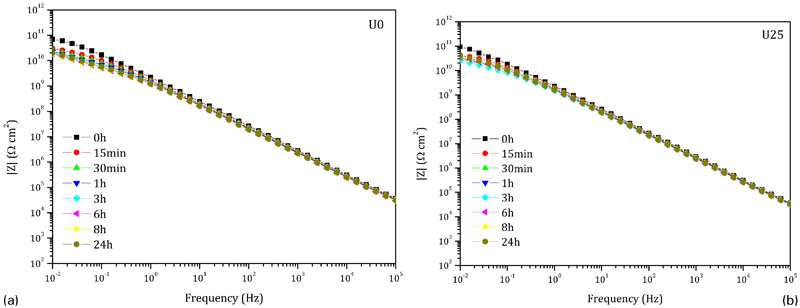
Electrochemical impedance spectroscopy modulus (Bode plot) as function of immersion time for reference a sample U0 and b sample U25
As it can be drawn from the experimental data, small but appreciable differences between the reference and modified material can be detected especially at longer time of immersion. A significant decrease in the coating resistance (Fig. 5) characterised the response during the first stages of immersion in both cases, but the amount of the drop does not seem to be dependent upon the coating chemical composition. The effects of the presence of hydrogen bonds are conversely recognisable, as the time of immersion increases and therefore the self-healing ability can be supposed. For >6 h, the trend of Nyquist curves reveals an increase in the coating resistance in the modified material.
From the Bode phase plots (Fig. 6), two time constants can be recognised in the curves in both cases. This means that a slight interaction of the electrolyte solution with the substrate occurs at the interface. For this reason, the raw data have been fitted using the equivalent electric circuit represented in Fig. 8.23 One time constant is related to the coating characteristics (C c is coating capacitance, and R p is the pore resistance), the second one to the Faradaic phenomenon at the interface coating/substrate (C dl is the double layer capacitance, and R ct is the charge transfer resistance).
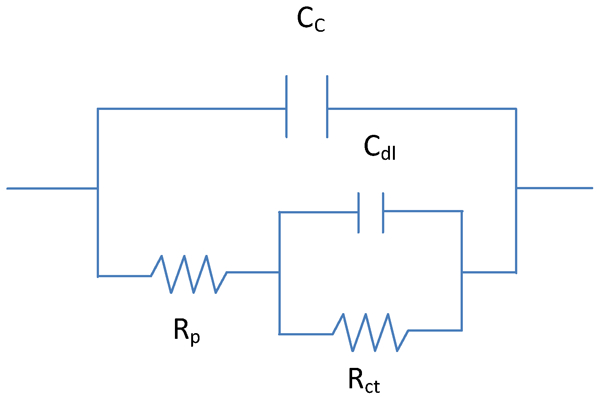
Equivalent electrical circuit used for fitting EIS data
Some considerations about the coating water uptake can be drawn from the trend of the coating capacitance derived from the data fitting. For fitting the EIS data, a true capacitance has been used instead of a constant phase element often used for modelling the coating capacitance. The exponents of a constant phase element representing the coating capacitance are very close to 1 (>0·99), and therefore, the element can be approximated with a true capacitance.
The coating capacitance C c is given by the formula expressed in the following equation


As shown in Fig. 9, in both the samples, the coating capacitance increases during immersion time. Only sample U0 has a limited decrease at the end of the test, but it remains in any case at higher values than U25. The C c values are very similar at the beginning of the test, but they reach higher values for the reference sample. From the Brasher and Kingsbury equation (considering as C c the values after 6 h of immersion), the derived water uptake values expressed as volume fraction are 12% for the reference sample and 9% for the modified material. From these results, it is possible to conclude that the introduction of UPy moieties has a slight but appreciable positive effect on the barrier properties of the coating. A possible reason of this behaviour can be related to a more compact structure of the coating when a higher number of hydrogen bond is present. This matrix structure, with UPy moieties, because of the hydrogen bonds limiting macromolecular mobility, could reduce the water diffusion through the coating.
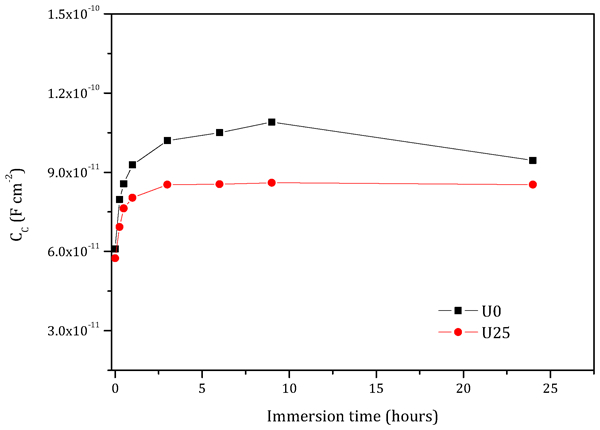
Coating capacitance trend versus immersion time
The results of the EIS measurements performed on the samples with an artificial defect are reported in Fig. 10 (sample U25), where the effect of the thermal treatment is compared with the original samples.
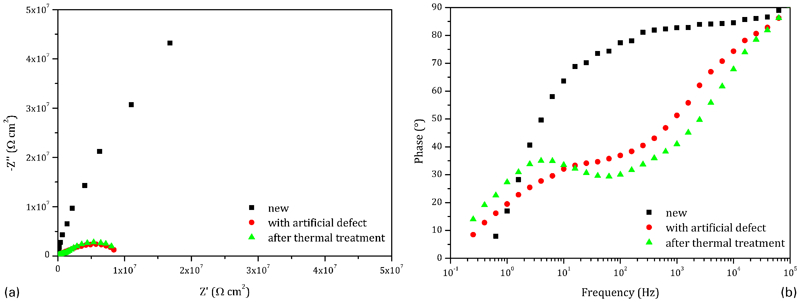
Electrochemical impedance spectroscopy data a Nyquist plot and b Bode phase plot of sample U25: new, with artificial defect and after thermal treatment
As shown in the Nyquist and phase plots, after creating the artificial defect, the second loop corresponding to the Faradaic process is clearly recognisable. The thermal treatment does not seem to produce any detectable change in EIS response.
The electronic micrographs displayed in Fig. 11 before and after the heat treatment show a partial damage recovery but not sufficient to reclose the defect, and consequently, the thermal treatment has a negligible effect on the EIS response. In fact, it is possible to note that the diameter of the defect is reduced from ∼50 to 30 μm (area reduction higher than a factor of 2). However, the defect is too big to be completely closed. When a protective organic coating is used for limiting corrosion on steel, we can have two different kinds of defects depending on the cause and dimension. Quite big defects (in the order of ≥100 μm) due to scratches and very small defect due to abrasion or mar processes (around or <1 μm). Considering this last kind of defect, further investigations will be carried out with smaller defects to prove in these conditions a complete recovery of the barrier effects.
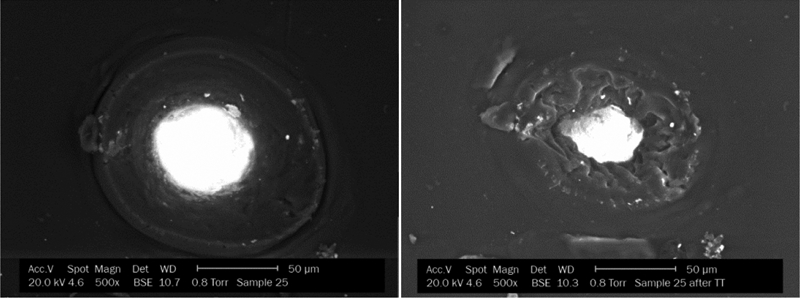
Artificial defect before and after thermal treatment
Conclusions
Damage management is now regarded as the best strategy for developing high performance organic coatings. In this framework, hydrogen bonding supramolecular chemistry surely represents one of the most promising and challenging approaches. However, a lack of knowledge still remains about the role of hydrogen bonding in the water absorption characteristics, namely in the coating barrier properties.
In order to assess the effects of hydrogen bonding in the barrier properties of thermosetting polyurethane resins, a new polyurethane binder employing supramolecular cross-links was firstly produced. A characterisation of the protective behaviour was then carried out via EIS for different ratios of covalent/hydrogen bonds.
The present study probes that the partial replacement of covalent bonds with hydrogen bonds does not negatively affect the barrier properties of the investigated thermosetting polyurethane resin.
Barrier properties appear to be mainly defined by the covalent bonds networks in this class of materials, at least for percentages of hydrogen bonds replacement until 25%.
Some partial recovery after artificial defect has been demonstrated, although it is not sufficient at the moment, and with quite large defect, to completely recover the protective properties.
The present preliminary work demonstrates that the potential of multiple hydrogen bonds can be effectively exploited in coatings applications owing to the combination of improved damage response behaviour and protection from corrosion phenomena. Further experimental work will be carried out in order to verify if, for smaller dimensions, the complete recovery of the system can be obtained.
Footnotes
Acknowledgements
The authors, and in particular E. Scrinzi, thank Professor J. Baghdachi (Eastern Michigan University) for the support in the activity of coatings formulation.