







Abstract
The inhibiting effect of dithiocarbamate (DTC) on bronze alloy TM 23 corrosion in acid medium was evaluated. Dithiocarbamate parabanic and DTC glycoluril were successfully synthesised from parabanic acid and glycoluril respectively. The compounds were characterised using elemental analysis and infrared spectroscopy. Quantum chemical calculations, weight loss test, polarisation curves and adsorption isotherms were performed. Dithiocarbamate parabanic is a more effective inhibitor of bronze alloy TM 23 than DTC glycoluril in an aqueous solution of nitric acid. Quantum chemical calculation indicated that these inhibitors interact with bronze alloy surface through dithiocarbamate groups. The two substances studied, DTC parabanic and DTC glycoluril, act as inhibitors cathode for bronze alloy TM 23 in 0·1 mol L−1 nitric acid. The adsorption of these inhibitors on bronze alloy TM 23 surface in acid media follows the Langmuir adsorption isotherm.
Introduction
The cleaning process of bronze pieces is usually made using acidic solutions and corrosion inhibitors. The major mechanism of inhibitors is attributed to its adsorption on the metal surface through donating electron atoms like N, O and S.1 – 3 Compounds with the thiocarbamyl group (C = S) shows high efficiency as corrosion inhibitors.4,5 A class of molecules with thiocarbamyl group is the dithiocarbamate (DTC).
Dithiocarbamates are used in the quantitative determination of several metals6 and as lubricants in oils.7 Many authors studied the application of sodium diethyl DTC as corrosion inhibitor for iron alloys8 – 10 in acidic solution.
The aim of this work is to study the use of DTCs as corrosion inhibitors of bronze in HNO3 0·1 mol L−1 aqueous solution. Copper is the main element in bronze alloy, which has a high reduction potential and requires a strong oxidant such as HNO3 solution for its dissolution.11,12 Many artefacts and masterpieces of art were made of bronze, and inhibitors have been widely used in their processes of conservation and restoration.13 Recently, inhibitors are used as additives in protective layers.14
The DTCs were synthesised from parabanic acid and glycoluril. Precursor compounds with more than one amidic group and with more than one DTC group were used. The molecule of glycoluril has four amidic groups, and parabanic acid has two amidic groups. The correlation of corrosion inhibition efficiency with the number of DTC groups in the molecule was evaluated.
Material and methods
A dispersion containing 3·5 mmol of glycoluril in 20 mL of dimethylformamide was mixed with 14 mmol of NaOH and 14 mmol of CS2 under stirring for 48 h. The precipitate was separated by centrifugation and washed with dimethylformamide, followed by ketone and ethanol. The precipitate was dissolved in sufficient water and precipitated again by addition of acetone. The final precipitate containing DTC {tetrasodium 2,5-dioxodihydroimidazo[4,5-d]imidazole-1,3,4,6(2H,5H)-tetracarbodithioate} glycoluril was dried under reduced pressure.
The same procedure was performed with the other inhibitor synthesised, (disodium 2,4,5-trioxoimidazolidine-1,3-dicarbodithioate) parabanic, DTC parabanic.
The inhibitor molecules were drawn in Gauss View 3·0, and quantum calculations were carried out in Gaussian 03W.15 Quantum chemical calculations were carried out using the B3LYP/6-311G method.16
Elemental analysis (CHN) was made using a CHN Perkin-Elmer 2400 apparatus. Infrared spectra were recorded with a Perkin-Elmer Spectrum GTX Fourier transform infrared spectroscopy in the range of 4000-400 cm−1 unit with a resolution of 4 cm−1.
Bronze alloy TM 23 [composition (mass-%): 72Cu–15Pb–8Zn–5Sn] with dimensions of 2·5×2·5×0·5 cm for weight loss tests was mechanically polished using 220, 320, 500, 600, 1200 and 1500 SiC sandpapers to obtain a mirror-like surface. Bronze alloy TM 23 samples were degreased by immersion in acetone ultrasonic bath for 5 min and dried in air flow. Bronze alloy TM 23 samples were weighed before immersion in corrosion media in a 0·00001 g Sartorius analytical balance. Experiments were performed at 25°C for 24 h of immersion in aerated 0·1 mol L−1 HNO3 solutions. All techniques were performance in solutions with 1·104, 2·104, 4·104, 8·104 and 1·6·105 mg m−3 of inhibitors. The corroded samples were then removed from the solutions, cleaned with distilled water and immersed in a 1∶2 HNO3/water solution for 3 min to remove the corrosion products. They were weighed again to obtain the final weight. The procedure was repeated until mass constant. The experiments were performed by triplicate, and the average value of weight loss was reported.
Electrochemical experiments were performed using a three-electrode cell. Bronze alloy TM 23 electrodes of 3×1×1 cm were used to prepare working electrodes. A copper wire is welded on the surface of the working electrode to provide an electrical contact and sealed with an epoxy resin. The exposed area was 1 cm2. The reference electrode was an Ag/AgCl. Platinum wire was used as the counter electrode. The anodic potentiodynamic polarisation curves were recorded using an Ominimetra PG-29 potentiostat/galvanostat equipment. The curves were recorded after stabilisation of the open circuit potential at a scan rate of 1 mV s−1 in 0·1 mol L−1 HNO3. All techniques were performed in solutions with 1×10⁴, 2×10⁴, 4×10⁴, 8×10⁴ and 1·6×105 mg m−3 of inhibitors. The potential started from cathodic [−0·65 V(Ag/AgCl)] to anodic potential [0·1 V(Ag/AgCl)].
Results and discussion
Results from elemental analysis are listed in Table 1. The data are in good agreement with the proposed structures for the inhibitors (Fig. 1).
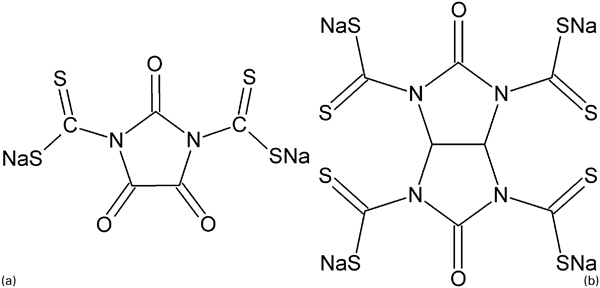
Structures for a DTC parabanic and b DTC glycoluril
Elemental analysis (CHN) results for synthesised inhibitors

Infrared spectra of dithiocarbamates can be interpreted by the study of the thioureide band C–N and C–S, C = S stretching bands. The thioureide band appears between 1650 and 1450 cm−1, and the C–S stretching appears near 1000 cm−1.17
Some bands of the parabanic acid were absent in the infrared spectrum of DTC parabanic. Those bands were attributed18 to ν N–H (3174 and 3029 cm−1) and δ N–H (1376 and 1315 cm−1). This was also observed in the spectrum of DTC glycoluril. The ν N–H (3360 cm−1) and δ N–H (1511 and 1253 cm−1)19 were absent in the inhibitor spectrum. This result suggests complete substitution of amidic hydrogen in both compounds. The thioureide band appeared at 1447 and 1595 cm−1 in the spectrum of DTC parabanic and DTC glycoluril respectively. In the spectra of inhibitors, there is a broadening of the bands near 1000 cm−1. The broadening was originated by the overlapping of bands of the precursors with ν CS stretching. Those large bands were centred at 1133 and 1000 cm−1 for the DTC parabanic and the DTC glycoluril respectively. Those spectra are shown in Fig. 2.
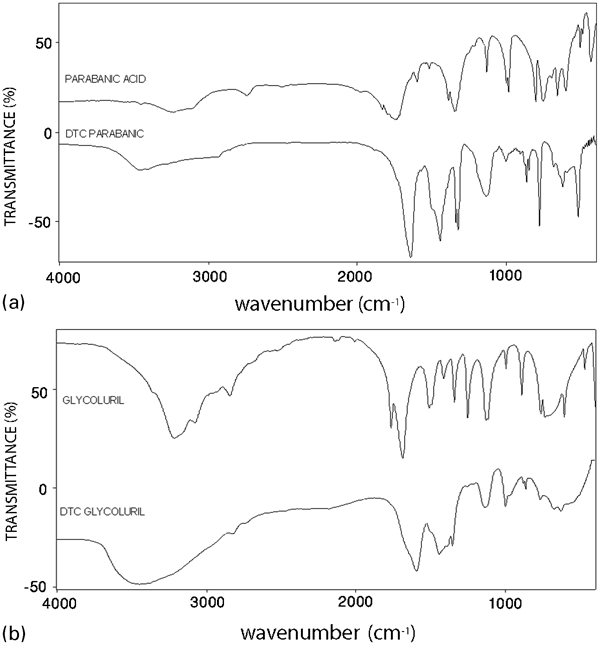
Infrared spectra of a parabanic acid and DTC parabanic and b glycoluril and DTC glycoluril
The corrosion inhibition efficiency of a molecule can be correlated to some quantum chemical properties.1,16,20 – 24 In order to obtain this kind of data, density functional theory (DFT) calculations were performed for each inhibitor. The optimised geometries of DTC parabanic and DTC glycoluril are shown in Fig. 3. The quantum chemistry parameters of both inhibitors are listed in Table 2.
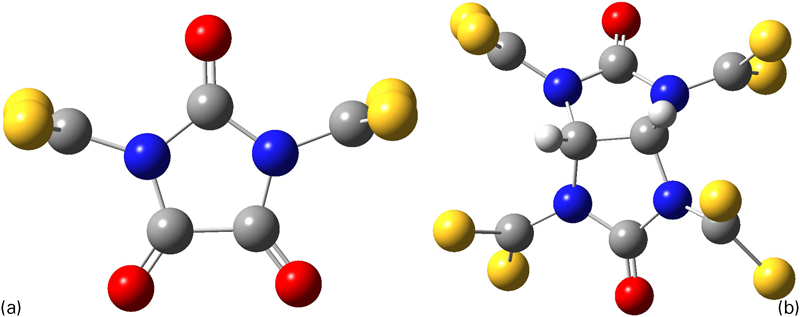
Optimised geometries of a DTC parabanic and b DTC glycoluril
Quantum chemistry parameters of DTC parabanic and DTC glycoluril

The energy gap between LUMO and HOMO orbitals is an important parameter correlated to corrosion inhibition efficiency.24 Low values of Δ = E LUMO−E HOMO are responsible for high inhibition efficiency. This parameter is associated with the ability of the inhibitor to donate electrons in its HOMO orbital to metals and accept electrons from metal in its LUMO orbital. Low values of the energy gap facilitate this process. The lower value of E LUMO−HOMO for DTC parabanic suggests better inhibition efficiency for this inhibitor, as compared to DTC glycoluril. The absolute value of dipole moment is also a parameter correlated to corrosion inhibition efficiency. The DTC parabanic shows a lower value of dipole moment (Table 2) than DTC glycoluril. High inhibition efficiency can be associated to a lower value of dipole moment.25,26 When a molecule has a low dipole moment, it becomes less solvated by water and more available to interact with the metal surface.27 These results suggest that DTC parabanic has higher inhibition efficiency than DTC glycoluril.
Another important aspect is the location of HOMO orbitals in the inhibitor molecules. According to frontier orbital theory, the region of HOMO orbital is generally the site of metal coordination.28 DTC parabanic and DTC glycoluril molecules were synthesised with two and four dithiocarbamate groups to improve its ability to coordinate metal atoms on the alloy surface. Figure 4 displays the location of the HOMO orbital in the inhibitor molecules. In both molecules, the HOMO orbitals were localised principally on the dithiocarbamate group. This orbital is distributed in four dithiocarbamates groups along the molecule in DTC glycoluril. That distribution leads to a greater delocalisation of the HOMO charge over the molecule leading to an increase in the gap Δ = E LUMO−E HOMO and a lower inhibition efficiency. This behaviour was already observed for a group of substituted uracils.29
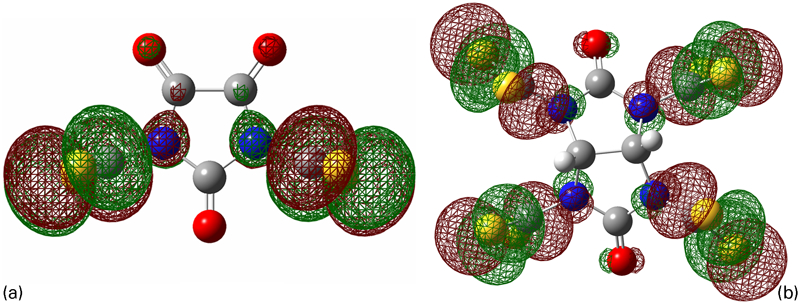
HOMO orbitals in a DTC parabanic and b DTC glycoluril
The weight loss data of the bronze alloy TM 23 after immersion in 0·1 mol L−1 HNO3 for 24 h with the different concentrations studied of DTC parabanic and DTC glycoluril at 25°C are listed in Table 3. The inhibition efficiency υ w% was calculated using equation (1)29

Corrosion rate and inhibition efficiency obtained using immersion tests for bronze alloy TM 23 in aqueous solution of 0·1 mol L−1 HNO3
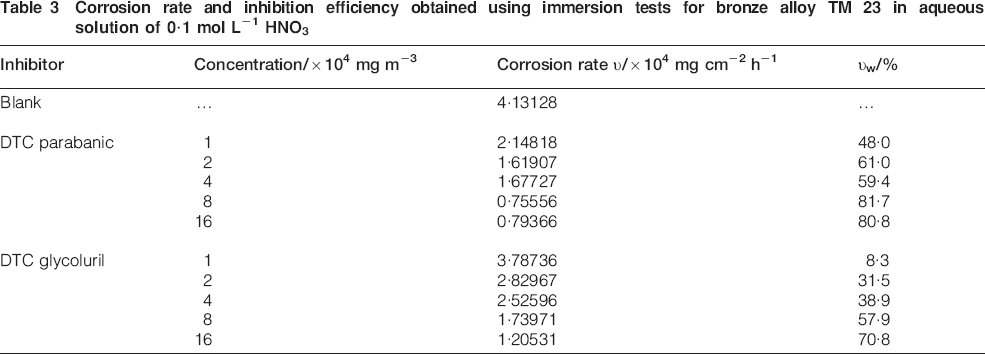
The results showed that inhibition efficiencies increased as the concentration increased. Corrosion rates decreased as the concentrations increased. DTC parabanic is more effective than DTC glycoluril in inhibition of the corrosion process. These results were predicted by quantum chemistry calculations.
Polarisation curves for bronze alloy TM 23 in 0·1 mol L−1 HNO3 in concentrations studied of DTC parabanic and DTC glycoluril are shown in Figs. 5 and 6 respectively. Cathodic currents decreased by addition of both inhibitors. Increase in concentration of DTC parabanic and DTC glycoluril caused pronounced decrease in cathodic currents, while slight changes occurred with anodic currents. Decrease in cathodic currents was more significant with DTC parabanic addition. The two substances studied, DTC parabanic and DTC glycoluril, act as inhibitors cathode for bronze alloy TM 23 in 0·1 mol L−1 nitric acid.
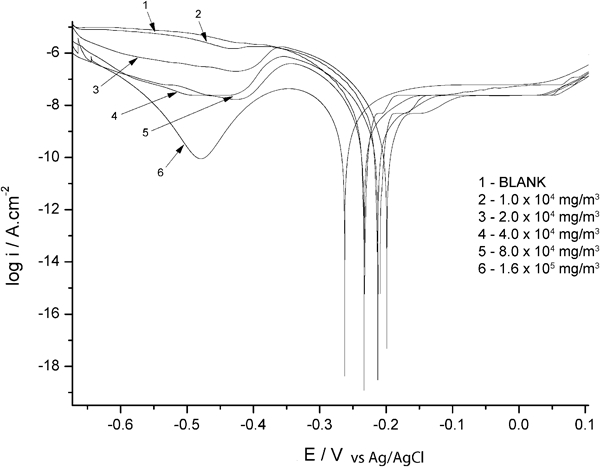
Polarisation curves for bronze alloy TM 23 in 0·1 mol L−1 HNO3 aqueous solution containing several concentrations of DTC parabanic
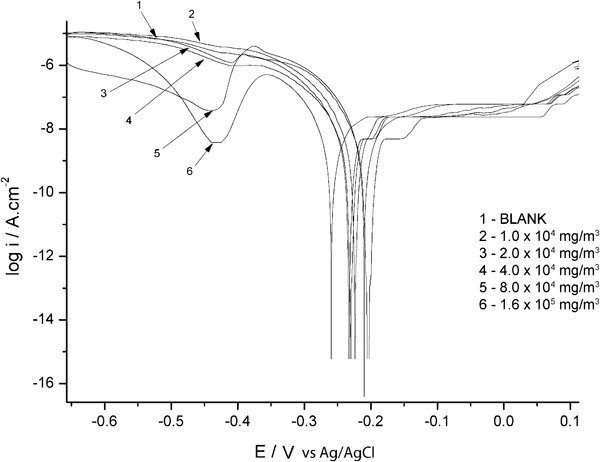
Polarisation curves for bronze alloy TM 23 in 0·1 mol L−1 HNO3 aqueous solution containing various concentrations of DTC glycoluril
A higher decrease in the cathodic currents below −400 mV was observed for both inhibitors. For DTC parabanic inhibitor, one peak of minimum of current density was identified for contents of 2, 4, 8 and 16·104 mg m−3. For DTC glycoluril, a significant minimum of current density was identified for contents of 8 and 16×104 mg m−3.
The cathodic reactions occurring in a solution of HNO3 (Ref. 12) are



According to Burke et al.,30 equilibrated metal surface (EMS) is a state that yields the normal Cu/Cu2+ transition, which is found above −400 mV.31 Metastable metal surface (MMS) state transition is observed below −400 mV and is a high energy state and shows high inhibition of corrosion.32 The high decrease in cathodic currents below −400 mV can be attributed to the MMS state. The change from MMS state to EMS state should be responsible for the increase in cathodic current due to decrease in the inhibition.
The mode of inhibition was attributed to the cathodic inhibition. In both states, EMS and MMS, the following mechanism was proposed. The first step in the reduction in nitrates is adsorption. This adsorption is, however, a fast and reversible process what makes  be weakly bonded to the metal surface and liable to competitive adsorption effects.33 The molecules of inhibitors should preferentially adsorb on the metal surface avoiding adsorption of
  and consequently its reduction. Since this reduction is decreased with the increase in inhibitor concentration, more molecules of inhibitor adsorb to the metal surface leaving less available areas for
  adsorption. The adsorption of inhibitor and
  also competes with oxygen adsorption.
The lowest value of corrosion potential was observed for the highest content of inhibitors. The corrosion potential range was from −0·26 to −0·20 mV(Ag/AgCl).
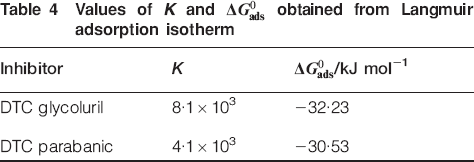
In order to obtain more information about the interaction between DTC parabanic, DTC glycoluril and the bronze surface, different adsorption isotherms were tested. Assuming a direct relationship between inhibition efficiency E% and surface coverage θ33 for various inhibitor concentrations, data obtained from weight loss tests were utilised to determine the adsorption characteristics of inhibitors on bronze alloy TM 23 in 0·1 mol L−1 HNO3 solution. Attempts were made to fit these θ values to various adsorption isotherms including Frumkin, Langmuir and Temkin.34 By far, the best fit was obtained with the Langmuir adsorption isotherm for both inhibitors. The plot of θ (1−θ) versus C inh is shown in Fig. 7, and Table 4 shows values of K and  obtained from Langmuir adsorption isotherm. According to this isotherm, θ is related to the inhibitor concentration, C inh via

 by
by

 value is useful to distinguish chemisorption from physisorption. Values less negative than −20 kJ mol−1 are taken to signify physisorption, and values more negative than −40 kJ mol−1 are taken to signify chemisorption. However, this criterion is by no means foolproof.35 The calculated values of
  are −30·53 and −32·23 kJ mol−1 for DTC parabanic and DTC glycoluril respectively. The calculated values were intermediary −20 and −40 kJ mol−1, which makes difficult to determine the mode of adsorption. As discussed above, the polarisation curves showed a decrease in cathodic current densities with the increase in concentration of both inhibitors. This decrease was attributed to adsorption of the inhibitors molecules on the bronze alloy TM 23 surface.
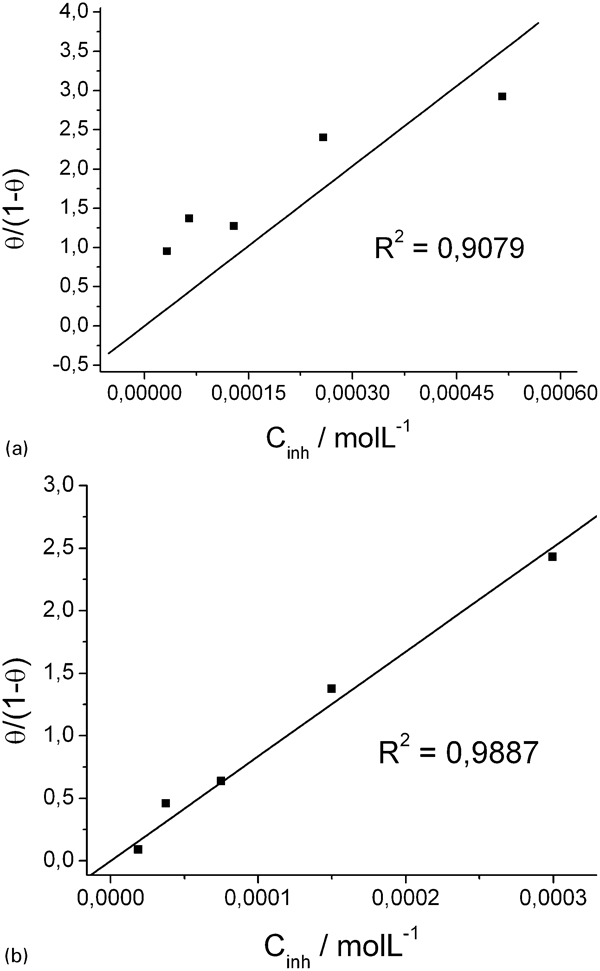
Langmuir adsorption isotherm for a DTC parabanic and b DTC glycoluril on bronze TM 23 in 0·1 mol L−1 HNO3
Values of K and obtained from Langmuir adsorption isotherm
 /kJ mol−1
Conclusions
Dithiocarbamate parabanic and DTC glycoluril were successfully synthesised from parabanic acid and glycoluril respectively. DTC parabanic is a more effective inhibitor of bronze alloy TM 23 than DTC glycoluril in an aqueous solution of 0·1 mol L−1 HNO3. The inhibition efficiency increased as the inhibitor concentration increased. The higher number of dithiocarbamate groups in the molecule of DTC glycoluril did not increase its inhibition efficiency in relation to the DTC parabanic. This result can be associated to the higher delocalisation of the HOMO orbital in DTC glycoluril molecule.
Quantum chemical calculation indicated that these inhibitors interact with bronze alloy TM 23 surface through dithiocarbamate groups. These inhibitors act as cathodic inhibitors. The adsorption of these inhibitors on bronze alloy TM 23 surface in acid media follows the Langmuir adsorption isotherm. Results from polarisation curves together with  values suggest that adsorption occurs through physisorption.
Footnotes
Acknowledgements
This work was supported by CNPq (National Council for Scientific and Technological Development), Brazil.