







Abstract
In this study, the new original copolymer film of pyrrole and 2-amino-4-methyl-pyridine has been electrochemically synthesised on 7075 aluminium alloy. The synthesis was achieved in aqueous oxalic acid containing 1∶1 monomer feed ratio. The characteristics of copolymer film were compared with polypyrrole film on Al under the same conditions. The characterisation of synthesised polymers was realised with the help of scanning electron microscopy. Fourier transform infrared spectroscopy and gel permeation chromatography techniques. The conductivity values of films were measured with four-probe technique. The stability of copolymer film as a coating material has also been investigated in 3·5% NaCl solution. The quantum theoretical calculations have been employed, and some parameters (dipole moment, energy of the highest occupied molecular orbital and lowest unoccupied molecular orbital) were determined. The calculated quantum parameters revealed correlation with experimental data. Under such severe conditions, the copolymer film exhibits protective coating behaviour on Al. This original, highly stable and conductive copolymer film can find wide application area for various purposes (anticorrosive, electrocatalytic, etc.).
Introduction
Electrochemically synthesised conducting polymers (ESCP) have been widely studied in recent years due to a great variety of potential applications in several fields, such as electrocatalysis,1,2 sensors3,4 and anticorrosion coatings.5–7 In particular, ESCP coatings have been applied to metallic surfaces, such as aluminium8–12 and stainless steel,13–15 as a novel method of corrosion protection. Generally, ESCP such as polyaniline function both by restricting contact between the environment and the substrate and, furthermore, by raising the potential of the substrate in the noble direction, thus encouraging passivation. Although several papers have recently been published on the preparation and properties of various classes of ESCP,16–18 more detailed studies are required in order to reveal their basic properties. Depending on the metal used and the condition of synthesis, different effectiveness of corrosion protection is obtained. Consequently, many studies have been made to obtain optimum conditions for the electrodeposition of these materials,19–25 with cyclic voltammetry widely accepted as the best method for synthesis of ESCP.26–29 Electrochemical synthesis is generally undertaken in an oxalic acid solution,30–33 and polypyrrole (PPy), polyaniline and their derivatives are the most widely used electropolymer backbones.20–23,26–33 For optimum corrosion protection applications, copolymers of the pyrrole and aniline chains may be preferred, and, for example, aluminium can be protected against corrosion via this method.9–12,24,29–30,34–37
The corrosion protection efficiency of an ESCP depends on the selection of the monomers. These organic species must be strongly adsorbed on the metal and generate a stable polymer film on the surface under electro-oxidation. We decided to use pyrrole and 2-amino-4-methyl-pyridine monomers because of their closer oxidation potential value and also their higher corrosion inhibition abilities.10,14,17,29 This study focuses on the electrochemical synthesis of the copolymer poly(pyrrole-co-2-amino-4-methyl-pyridine) in oxalic acid solution on aluminium substrates. There are no previous literature reports of the synthesis of this copolymer either by electrochemical or by chemical methods. The characteristics of copolymer film were compared with PPy film on Al under the same conditions. The surface conductivity of the electropolymers was determined using the four-terminal dc method. Surface morphologies were characterised by scanning electron microscopy (SEM) images. The chemical functionality of the films was characterised using Fourier transform infrared spectroscopy (FTIR), and gel permeation chromatography (GPC) was used to investigate the molecular weight and physical properties of the films. The corrosion protection property of the coatings was investigated in 3·5% NaCl solution via electrochemical impedance spectroscopy (EIS) and polarisation techniques.
Experimental
Chemicals and apparatus
Pyrrole, 2-amino-4-methyl pyridine (AMP) (Fig. 1), oxalic acid and other chemicals used in this study were all purchased from Merck Chemical Company in high purity grades. The pyrrole monomer was distilled before use, while the other analytical grade chemicals were used without any further purification. Electropolymerisation experiments were performed in an aqueous solution of 0·1M monomer (pyrrole/AMP, 1∶1) containing 0·4M oxalic acid solution as supporting electrolyte. Electropolymerisation and all other electrochemical experiments were carried out in a conventional three-electrode system. The working electrode was 7075 aluminium–zinc–magnesium alloy with the following chemical composition: 0·40Si–1·60Cu–0·30Mn–2·50Mg–0·30Cr–5·60Zn (wt-%). The surface area of the electrode was 0·196 cm2, while the rest of electrode was isolated with thick polyester block and electrical conductivity was provided by a copper wire. The counter electrode was a platinum sheet (with 2 cm2 surface area), and Ag/AgCl (3 mol dm−3 KCl) electrode was used as the reference. All the potential values given in this paper were referred to this reference electrode. Before each experiment, the Al alloy electrode was mechanically polished with abrasive paper (1200 grade) and cleaned in a 1∶1 acetone/ethanol mixture then rinsed with water. A CHI 604 electrochemical analyser was used for all electrochemical experiments. This system was interfaced to a personal computer to control the experiments, and the EIS data were analysed using ZView (version 2·0) framework/analysis software. The anodic polarisation measurements were obtained from the open circuit potential value of electrodes to 1·8 V with 4 mV s−1 scan rate.
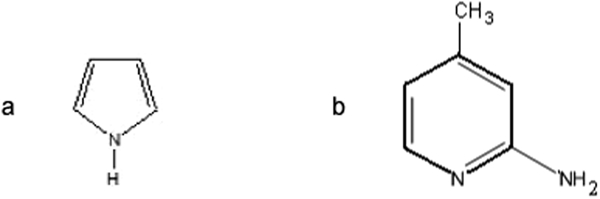
Structural representation of a pyrrole and b 2-amino-4-methyl-pyridine (AMP)
Electrochemical synthesis
The PPy films were deposited electrochemically on the surface of Al alloy electrodes at a scan rate of 50 mV s−1 over a potential range of 0·0 and 1·2 V(Ag/AgCl) in 0·1M monomer (pyrrole) with 0·4M oxalic acid supporting electrolyte. Similarly, copolymer films were synthesised by electropolymerisation of a 0·1+0·1M mixture of pyrrole and AMP on the Al alloy substrate in aqueous 0·4M oxalic acid solution using cyclic voltammetry with the same potential range and scan rate. After electropolymerisation, the coated electrodes were removed from the electrolyte, rinsed with distilled water and dried at 40°C. The thickness of layers was determined using a thickness meter (Exacto FN, 101 180-0202). The surface conductivities of the deposited polymer samples were then measured using a conventional four-probe technique. For this purpose, four-point probe (serial number FPP 470) was used. The conductivity measurements were obtained at 20°C.
Characterisation of copolymer films
The surface morphologies of the films were examined using SEM with a Carl Ziess EVO 40 SEM instrument. The structures of the copolymer were analysed using FTIR spectrophotometry (PerkinElmer RX 1); for FTIR measurements, the polymer films were peeled off the electrode surface and pressed with bulk KBr into tablets for analysis.
Gel permeation chromatography
The electropolymer samples were dissolved in N,N-dimethyl formamide [HCON(CH3)2] with concentrations ranging from 1·2 to 1·4 mg mL−1 by solution aided by ultrasonication (WiseClean WUCD06H) for 30 min before analysis. Gel permeation chromatograph was undertaken using a Shimatzu (communication module, CBM-20A; liquid chromatograph, LC-20AD; degasser, DGU-20A3) with standard RID-10A detector and a Nucleogel GPC 104-5 column. The temperature was set at 40°C, and the flowrate was 0·5 mL min−1. The polystyrene standards, which are given in Table 1, were used for calibration.
Infrared spectroscopy peaks of polymer films
Corrosion measurements
The corrosion studies of uncoated and polymer coated Al alloy electrodes were carried out in 3·5% NaCl solution using EIS. Electrochemical impedance spectroscopy measurements were recorded at the open circuit potential E ocp in the frequency range from 103 to 10−3 Hz using the amplitude of 7 mV. The EIS data were analysed using Z-View2 fitting software. The anodic polarisation curves were recorded as a function of electrode potential in the anodic direction from the E ocp to 1·8 V at a constant sweep rate of 4 mV s−1.
Quantum theoretical calculations
The quantum theoretical calculations were carried out using density functional theory with 6-311++G (d,p) basis set for all atoms with the Gaussian 03W programme. Some electronic properties such as energy of the highest occupied molecular orbital E HOMO, energy of the lowest unoccupied molecular orbital E LUMO, energy gap ΔE between LUMO and HOMO and Mulliken charges on the backbone atoms for dipyrrole and pyrrole-co-2-amino-4-methyl-pyridine were determined. The optimised molecular structures and HOMO surfaces were visualised using Gauss View.
Results and discussions
Electrochemical synthesis
Figure 2a shows the cyclic voltammograms (CVs) of Al alloy in oxalic acid solution without any added monomer. The intense anodic currents observed at the first cycle are reduced significantly during the subsequent cycles. This is due to the thickening of the protective anodic oxide film on Al that results in an increase in the resistance of the surface and consequent reduction in current.9,29,38–40 Figure 2b shows the CV of Al alloy in pyrrole containing oxalic acid solution for the first, the seventy-fifth and the one hundredth scan. An increase in current is observed at potential greater than ∼0·7 V, indicating the onset of PPy polymerisation. The reduction peak observed on the reverse scan is related with the reduction in the produced PPy film.41–44 Figure 2c demonstrates the CV of Al alloy in the monomer mixture (pyrrole and AMP) containing oxalic acid solution for the first, the seventy-fifth and the one hundredth scan; electro-oxidation was also observed above a potential of ∼0·7 V. During following cycles, the monomer oxidation process shifted to lower potential values. In Fig. 2c, successive scans resulted in a gradual current increase and redox peaks associated with the oxidation/reduction in the copolymer appear. This provides evidence that the conductivity, continuity and electrochemical stability of the copolymer film were good. Thus, a macroscopically continuous black film on the Al surface was observed at the end of the experiment. The average thickness of PPy and copolymer films on aluminium was 18·3±0·2 and 19·3±0·2 μm respectively, which were determined by a thickness meter. The measured conductivity values were (1·6±0·3)×10−3 and (3·7±0·3)×10−3 S cm−1 for PPy and copolymer coatings respectively.
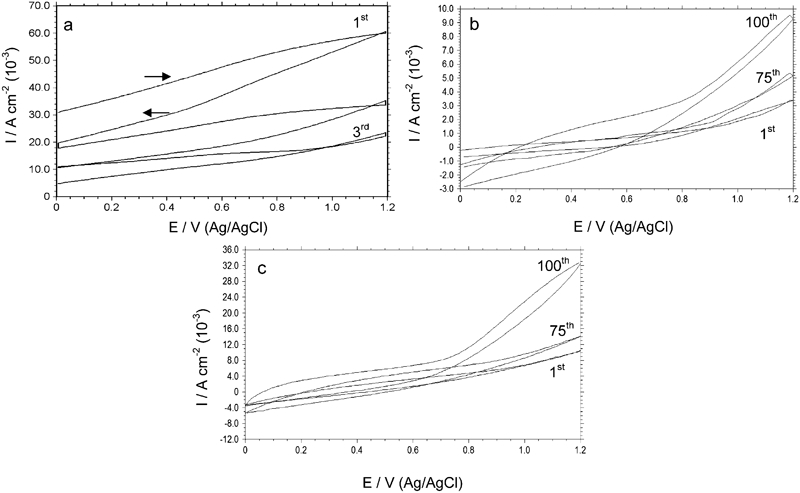
Cyclic voltammograms recorded for Al electrode in a 0·4M oxalic acid, b 0·4M oxalic acid+0·1M pyrrole and c 0·4M oxalic acid+0·1M (pyrrole/AMP, 1∶1) solutions: scan rate was 50 mV s−1
Characterisation of copolymer films
The microstructure of the polymer films was investigated via SEM (Fig. 3). Figure 3a shows the PPy coated Al alloy surface, which is relatively uniform with some regular granules distributed homogeneously over the film; the well known cauliflower-like spherical particles varying in diameter between 1 and 2 μm are clearly evident on the PPy coated surface. The microstructure of the copolymer coated Al alloy is shown in Fig. 3b, where it is clear that the copolymer coated surface is much smoother and more compact, with only minor ‘cauliflower’ nodules compared with the PPy coated surface.
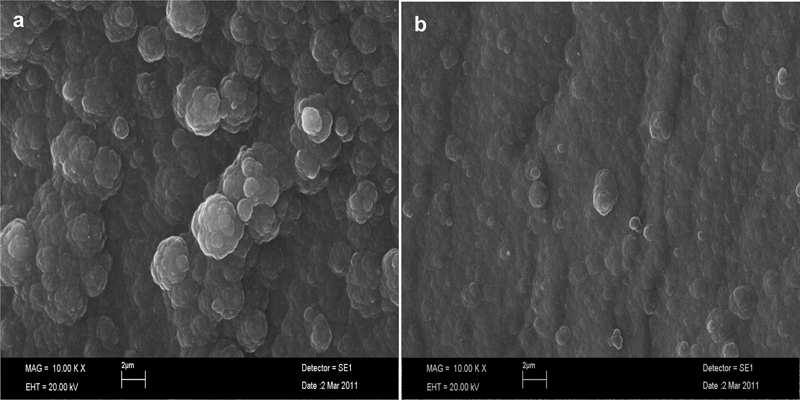
Images (SEM) of a Al/PPy and b Al/poly(pyrrole-co-2-amino-4-methyl-pyridine) surfaces
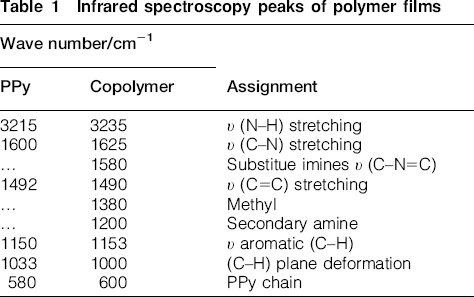
Spectroscopy (FTIR) of the PPy and copolymer films is shown in Fig. 4. Furthermore, observed assignments are given in Table 1, and the chemical structures of the reduced and oxidised film units are shown in Fig. 5. In Fig. 4, the –N–H stretching vibration band appeared at around 3215 and 3235 cm−1, which is characteristic of the reduced and oxidised state of PPy (Fig. 5a) and copolymer (Fig. 5b) respectively.23,31,45 In Fig. 4 and Table 1, the –C–N– stretching vibration peak was observed at 1600 and 1650 cm−1 for PPy and copolymer. 22 The peak at 1580 cm−1 is related with the substitute imines in oxidised units of copolymer. 45 The peaks were appeared at 1492 and 1490 cm−1 for PPy and copolymer (Fig. 4). They were related with the –C = C– stretching of reduced and oxidised form of pyrrole and AMP units located along the polymer chain (Figs. 4 and 5).23,46 The peak at 1380cm−1 is attributed to the presence of methyl group. 46 The methyl group peak in the FTIR spectrum of copolymer film indicates the presence of AMP unit in the copolymer chain (Figs. 4 and 5). Furthermore, secondary amine peak was observed in Fig. 4b, which indicated the presence of AMP unit.
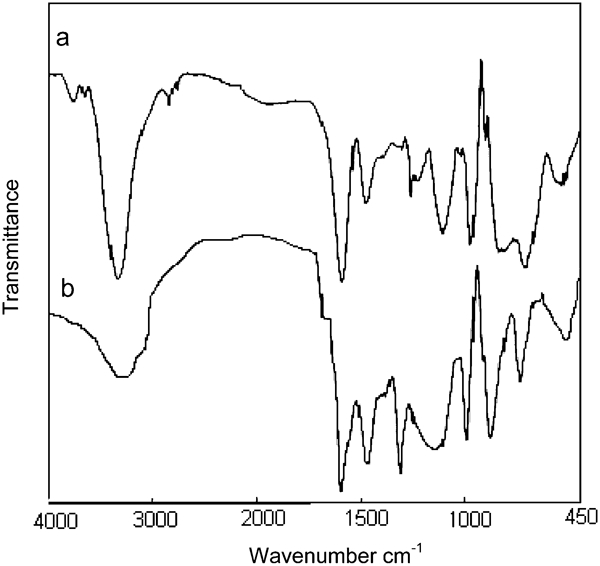
Spectra (FTIR) of a PPy and b copolymer films
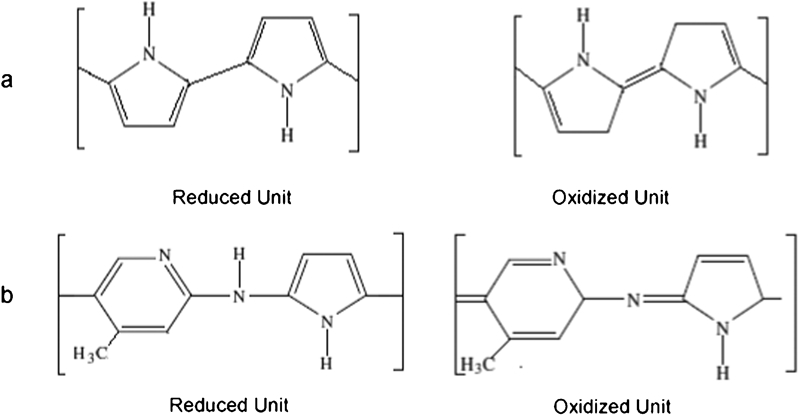
Structural representations of a PPy and b copolymer films
Gel permeation chromatography
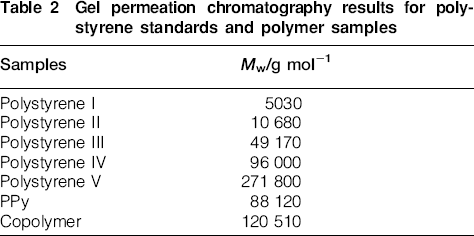
Gel permeation chromatography characterises the molecular weight distribution of the polymers providing molecular weight data and molecular weight distribution curves.47–51 The GPC results for the PPy and copolymer samples are given in Table 2. After ∼10 injections, the adsorption sites had become saturated, and full recovery was achieved. The average molecular weight values were 88 120±500 and 120 510±500 g mol−1 for the PPy and copolymer samples respectively. The difference in molecular weights is related to the difference between the monomer structures: pyrrole, 67 g mol−1; 1∶1 pyrrole 67 g mol−1+AMP, 108 g mol−1 in polymer chains. Thus, for a similar number of repeat units, the overall molecular mass will be greater for the copolymer.
Gel permeation chromatography results for polystyrene standards and polymer samples
Corrosion measurements
The corrosion of coated and uncoated Al alloy samples was evaluated using EIS and potentiodynamic polarisation. Figure 6 illustrates the Nyquist plots and the fitted EIS curves after short term (4 h) immersion. As observed in Fig. 6a, the Nyquist plot shows a semicircle with a diameter of 2566 Ω for the uncoated electrode. However, application of the electropolymerised coatings increased substantially the resistance values as can be observed in Fig. 6b and c. This difference confirms that the coatings act as a physical barrier, which separates the metallic substrate from the electrolyte medium. It is also possible that they form a redox pair, in which the electropolymer coatings reduce, thus oxidising and passivating the base metal.29,30 The shapes of corresponding Nyquist diagrams show two distinct semicircles at low and high frequency regions (Fig. 6b and c). The first loop at the high frequency region was attributed to the pore resistance R po against the corrosion process occurring within pores of passive aluminium oxide/hydroxide film.12,21,34 The second loop at low frequencies was related to the film R f formed on surface.24,52–54 The equivalent circuits, which are given in Fig. 7,11,34,55 were used, and calculated circuit elements are given in Table 3.
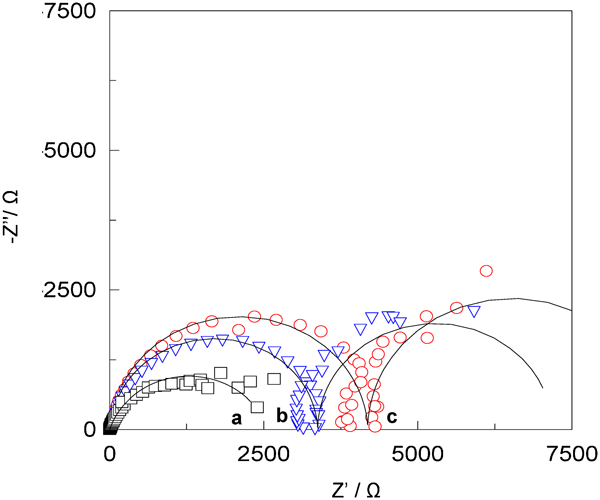
Nyquist diagrams of a Al, b Al/PPy and c Al/copolymer electrodes after 4 h of exposure in 3·5% NaCl solution: solid lines represent fitted results
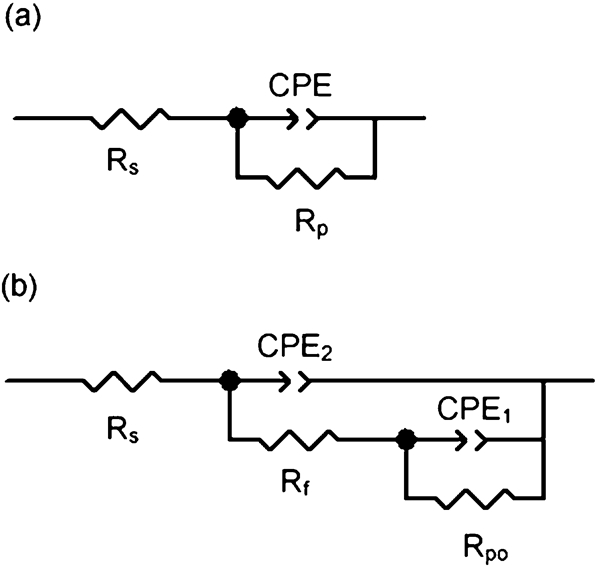
Schematic representation of equivalent electrical circuit diagrams suggested for electrode/solution interfaces
Electrochemical parameters for EIS data

In Fig. 7, R s is the solution resistance, the CPE (or CPE1) is equal to electrical double layer capacitance formed at the substrate/solution interface, R f is the film resistance, R po is the pore resistance and CPE2 is the film capacitance. It can be clearly seen that fitted curves are quite well in agreement with experimental data (Fig. 6). The data from Table 3 show that the capacitance values of Al were higher than those of polymer coated samples. This could be explained by the total interface area between the underlying metal and corrosive solution.38,53,54 The capacitance values of the copolymer coated Al were the lowest. This was evidence for lower porosity.9,10,55 Figure 8 shows anodic polarisation curves for all samples after 4 h immersion time. It reveals that the polymer coatings were successful at protecting Al in chloride containing aggressive medium. These coatings encouraged the development of a more stable passive film.5–7,33,36 The copolymer coated Al electrode supported much lower current values at more anodic potentials (Fig. 8).
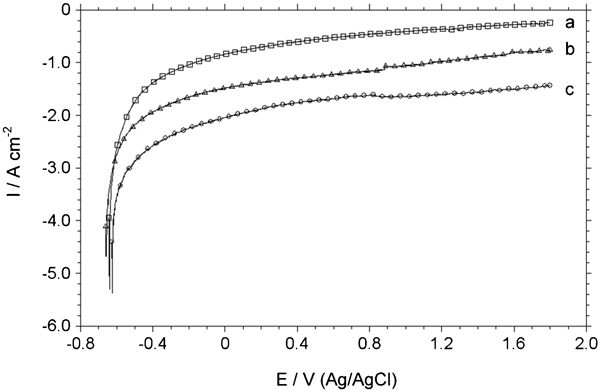
Anodic polarisation curves a Al, b Al/PPy and c Al/copolymer electrodes recorded after 4 h of exposure in 3·5% NaCl solution: scan rate was 4 mV s−1
Quantum theoretical calculations
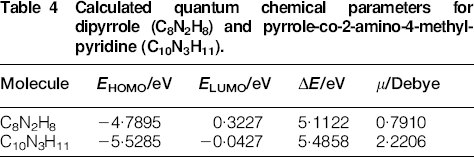
The quantum theoretical calculations enable the definition of a large number of molecular quantities characterising the reactivity, stability, optimised shape and binding properties of a complete molecule as well as of molecular fragments and substituents.56–62 Geometric structures and electronic properties of molecules have been calculated by density functional theory method using B3LYP level and 6-311++G (d,p) basis set. Figures 9 and 10 illustrate optimised molecular structures and HOMO. Figure 9 shows optimised molecular structures of dipyrrole with atomic Mulliken charge values (Fig. 9a) and HOMO (Fig. 9b) orbital. The N atoms (5N and 14N) have highest negative Mulliken charge, which is −0·701, so these atoms can be suitable places for adsorption onto surface (Fig. 9). The π bonding electrons are delocalised; this phenomenon provides conductivity to molecule. Figure 10 shows optimised molecular structures of pyrrole-co-2-amino-4-methyl-pyridine with atomic Mulliken charge values (Fig. 10a) and HOMO (Fig. 10b) orbital. The 13N atom has highest negative Mulliken charge, which is −0·857, and pyridine ring has delocalised π electrons, so molecule can be directly adsorbed at the surface on the basis of donor–acceptor interactions between π electrons of pyridine ring, non-bounding lone pair of 13N atom and vacant orbitals of aluminium atoms (Fig. 10). Especially, HOMO orbitals of this molecule are placed around the 13N atom. Furthermore, the calculated parameters such as E HOMO, E LUMO, energy gap ΔE (between E HOMO and E LUMO) and the dipole moment μ of the molecules give evidence on the adsorption ability of molecules. The parameters were given in Table 4. The main differences between these molecules are the E HOMO and E LUMO values. The higher E HOMO value of the molecule indicates the higher inhibition efficiency, and the lower E LUMO value of the molecule indicates the greater adsorption ability and better corrosion inhibition properties are expected. 59 It has been reported that excellent corrosion properties are usually obtained using organic compounds that not only offer electrons to unoccupied orbitals of the metal but also accept free electrons from the metal by using its antibond orbitals to form stable chelates.56–59 Indeed, this behaviour is observed in pyrrole-co-2-amino-4-methyl-pyridine molecule with higher E HOMO, and lower E LUMO values give higher inhibition efficiencies. In addition, the energy gap ΔE is a parameter that with a smaller value causes higher inhibition efficiencies of the molecule. In Table 4, both molecules have the closer ΔE values. Table 4 shows a higher dipole moment for pyrrole-co-2-amino-4-methyl-pyridine in comparison to dipyrrole. The increase in the dipole moment can lead to increase in inhibition, which could be related to the dipole–dipole interaction of molecules and metal surface.59–61
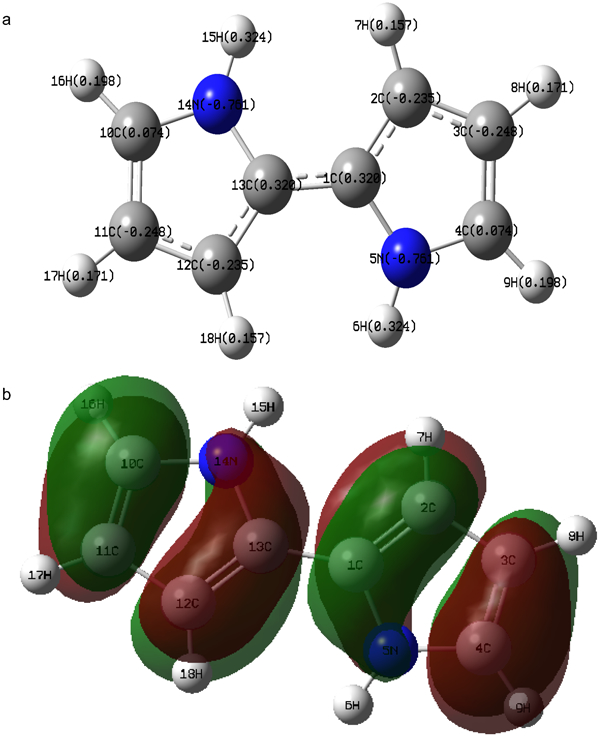
Optimised molecular structures of dipyrrole with a atomic Mulliken charge values and b HOMO orbital
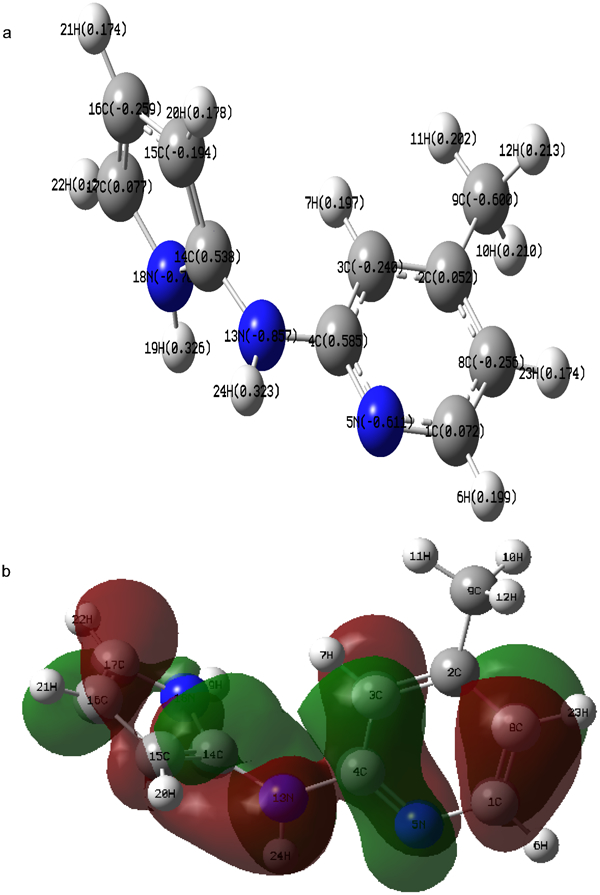
Optimised molecular structures of pyrrole-co-2-amino-4-methyl-pyridine with a atomic Mulliken charge values and b HOMO orbital
Calculated quantum chemical parameters for dipyrrole (C8N2H8) and pyrrole-co-2-amino-4-methyl-pyridine (C10N3H11).
Conclusions
The poly(pyrrole-co-2-amino-4-methyl-pyridine) film has been synthesised on 7075 aluminium (Al) substrate from aqueous oxalic acid solution by employing cyclic voltammetry technique. The following points can be underlined:
The characterisation investigations have revealed that the new, original copolymer synthesised successfully.
The SEM has shown that the copolymer film had a diverse structure that consisted of smooth and compact morphology. It was homogenously covering the Al surface, without any crack or defect.
The conductivity measurements have proven that the copolymer film had better conductivity when compared to PPy film.
The GPC analysis showed that the copolymer has 1·37 times higher molecular weight than PPy. The monomer ratio in the synthesis solution was 1∶1, but the copolymer did not get the equal monomer ratio in the chain.
The electrochemical measurements realised for corrosion behaviour of this coating on Al indicated higher protection ability.
The theoretical experiments support the experimental data.
Footnotes
Acknowledgements
The authors are greatly thankful to the Council of Higher Education (YOK), Çukurova University research fund (grant no. FEF2010BAP6) and The Scientific and Technical Research Council of Turkey (TUBITAK) and the University of Manchester Institute of Science and Technology, Corrosion and Protection Centre.