






Abstract
This paper reports our investigation on the corrosion resistance and corrosion behaviour of Fe–6·5 wt-%Si atomised powders. Results showed that corrosion resistance was strongly related to powder sizes. When powder sizes were <38 μm, they showed excellent corrosion resistance compared with the larger ones. Analysis suggested that most of the corrosion started from corrosion pits when the powder sizes were >53 μm. Weaker corrosion resistance can be explained by severe Si content heterogeneity and more grain boundaries in the larger sizes atomised powders.
Introduction
Fe–6·5 wt-%Si alloy is considered as an excellent soft magnetic material for its high permeability, high saturation magnetic induction, high electric resistivity, low magnetostriction and low coercive force.1 Among various fabrication methods for Fe–6·5 wt-%Si, powder metallurgy has many advantages, such as the low cost, the high production rate and the near net shape capacity. In addition, more important is that powder metallurgy can avoid the brittleness problem of high silicon Fe–Si alloy. Thus, high silicon Fe–Si components produced by powder metallurgy for electric power and telecommunication attracted great interest for research.2 – 4
During the application of components for electric power and telecommunication, Fe–Si alloys are usually subject to corrosion.5 Surface qualities of magnetic powders are crucial to the magnetic properties and the performance of powder metallurgy parts, which are also affected by surface corrosion of powders. Therefore, it is necessary to understand corrosion resistance and behaviour of magnetic powders. This paper reports our studies of the corrosion behaviour of Fe–6·5 wt-%Si atomised powders.
Experimental
Fe–6·5 wt-%Si alloy powders were prepared by high pressure gas atomisation. The starting materials were made of iron and silicon with purity of 99·9 wt-%. The experimental set-up was described in our previous article.6 The as atomised powders were sieved by mechanical grading, and the powders with diameter ranges of 0-38, 53-63 and 105-150 μm were chosen for examination, named nos. 1, 2 and –3 respectively. A 10%HNO3+C2H5OH solution was used to study the corrosion behaviour of Fe–6·5 wt-%Si powders. Morphology of etched powders was examined by a scanning electron microscope (SEM, Apollo-300 and HITACHI SU-1510 operated at 15·00 kV).
Results and discussion
Corrosion resistance
Figure 1a shows the morphology of no. 1 powders after it was immersed in a 10%HNO3+C2H5OH solution for 10 min. No obvious corrosion occurred on the surface of the atomised powders, and their shape remained spherical or nearly spherical, as shown in Fig. 1b. It was concluded that the powders with diameters <38 μm were good in corrosion resistance to the 10%HNO3+C2H5OH solution.
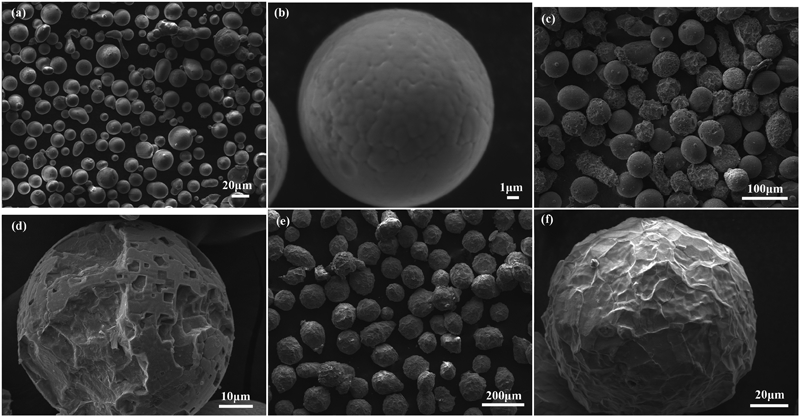
a, b 0-38 μm; c, d 53-63 μm; e, f 105-150 μm
For the powders with diameter ranges of 53-63 μm, corrosion occurred on the surfaces of some powders after they were immersed in a 10%HNO3+C2H5OH solution for 10 min, as shown in Fig. 1c. Figure 1d demonstrated the various pit sizes found on the surface of no. 2 powders. In addition, the surface of powders revealed large etched cavities. It was concluded that the corrosion resistance of no. 2 powders was poorer than that of no. 1 powders.
Figure 1e showed the surface morphology of no. 3 powders after it was immersed for 10 min in a 10%HNO3+C2H5OH solution. Images (SEM) showed that the original atomised surfaces of all powders were completely etched away (Fig. 1f). The images indicated that the corrosion resistance of the powders with diameters between 105 and 150 μm was the worst among the three groups.
The experimental results demonstrated that corrosion resistance was strongly related to the powder sizes. In addition, the corrosion resistance decreased with the increase in powder size. It was surprising that the small powders with high specific area had a higher corrosion resistance. In order to find the reasons for the increased corrosion resistance of the smaller powders, the corrosion behaviour of the atomised Fe–6·5 wt-%Si powders was closely examined.
Corrosion behaviour
In the experiments, nearly no corrosion occurred on the surfaces of powders no. 1, and the original surfaces of powders no. 3 were completely removed by the etchant. It was difficult to study the corrosion behaviour of these powders. Thus, powders no. 2 (Fig. 1c and d) with diameters between 53 and 63 μm were examined in more detail.
Figure 2 was the etched morphology of some Fe–6·5 wt-%Si powders with diameter ranges of 53-63 μm. The figure showed there were two kinds of etched morphologies on the surfaces of these powders after they were immersed in a 10%HNO3+C2H5OH solution. One was regular etched pits marked by letter A in Fig. 2a and b, and the other was irregular etched cavities related to microstructure marked by letter B in Fig. 2c and d. These etched morphologies can be attributed to two corrosion behaviours, pitting and intergranular corrosion.
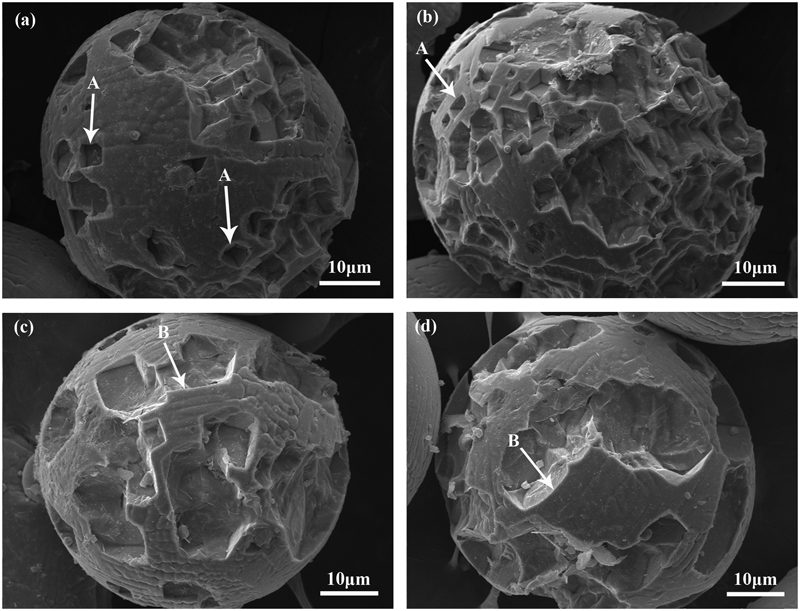
a, b regular etched pits marked by letter A; c, d irregular etched cavities marked by letter B
The regular etched morphologies marked by letter A in Fig. 2, such as square and corner cutting triangle, are attributed to pitting. Figure 3a represented a high magnification of the pits. It was reported that the corrosion preferentially took place in low indicates lattice planes.7 That is to say, there is the difference of corrosion rate between (100) planes and other crystal planes in the {100} crystal system. Therefore, the materials are etched layer by layer in the {100} planes, which gives rise to the formation of the regular etched morphologies on the surfaces of atomised Fe–6·5%Si powders.
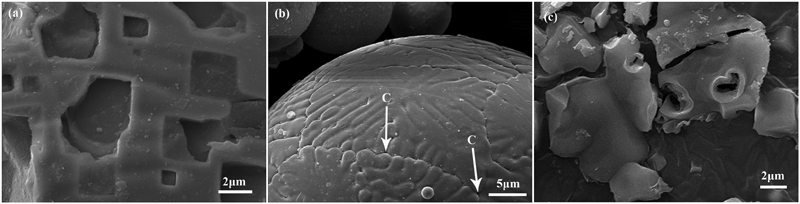
a pits on surface of powder, b shrinkage cavity at grain boundaries and c pieces fall down from powders
The other form of detailed corrosion was intergranular corrosion, which was related to microstructure. The main reason is that grain boundaries are preferentially corroded due to shrinkage cavity, dislocation and the electronic structure.8 The shrinkage cavity marked by letter C in Fig. 3b always formed at the grain boundaries of atomised powders due to solidification shrinkage. It made the reagent easy to attack and erode grain boundaries. Some pieces were observed in the etchant after corrosion as shown in Fig. 3c, which fell down from the powders. It is the phenomenon corresponding to the intergranular corrosion behaviour.
Discussion
According to the results above, the pitting and the intergranular corrosion are two major types of corrosion behaviours in the atomised Fe–6·5 wt-%Si powders. During high pressure gas atomisation of Fe–6·5 wt-%Si powders, the solidification process of droplets is related to the droplet size. With the decrease in droplet diameter, the specific surface area of the droplet increases sharply and leads to the higher cooling rates. The average grain size and the grain number of the powders both decrease with the decrease in the powder size.9 Segregation of the element Si in larger powder sizes is more severe due to lower cooling rate and larger grain size.
Pits usually nucleate in the positions where there exist the microscopic defects, impurities and enrichment or depletion of alloy elements. During the solidification of atomised droplets, the segregation of the element Si results in lower silicon content inside the grains than that in grain boundaries. The corrosion resistance of iron steels is related to Si content, and the Fe–Si alloy with lower Si content has a poorer corrosion resistance.10 The depletion of Si element inside the grains made it become the starting corrosion sites of pitting, as shown in Fig. 4. For the larger particles, the segregation of Si was more severe due to their larger grains. Moreover, the shrinkage cavity was also more severe, which made intergranular corrosion easy to occur. Thus, larger powder sizes showed much lower corrosion resistance compared with the smaller ones.
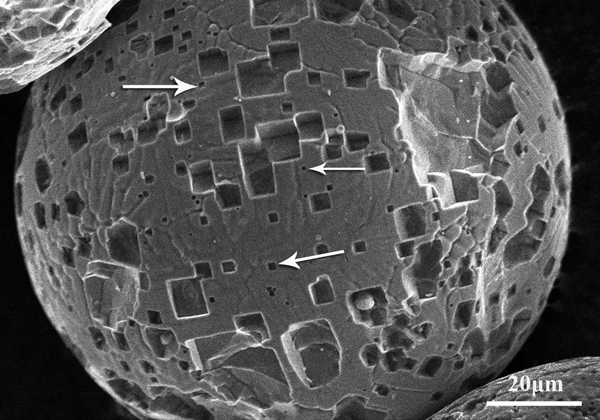
Pits as corrosion initiation locations on larger grained powders
Figure 5 shows the morphology of the powders nos. 2 and 3, whose surface was completely etched away, and the sketch of their intercrystalline corrosion behaviour. Although the average grain size of powders no. 3 was greater than that of powders no. 2, the average grain number of powders no. 3 was also very great. Thus, the ratio of grain size to powder size was very small for powders no. 3, which made their shape remain spherical or nearly spherical after their surface was completely etched away, as shown in Fig. 5a and c. However, the powders no. 2 became to be an irregular shape due to the larger ratio as shown in Fig. 5b and d. This phenomenon also suggested that the lower corrosion resistance of large particles also resulted from their more grain boundaries.
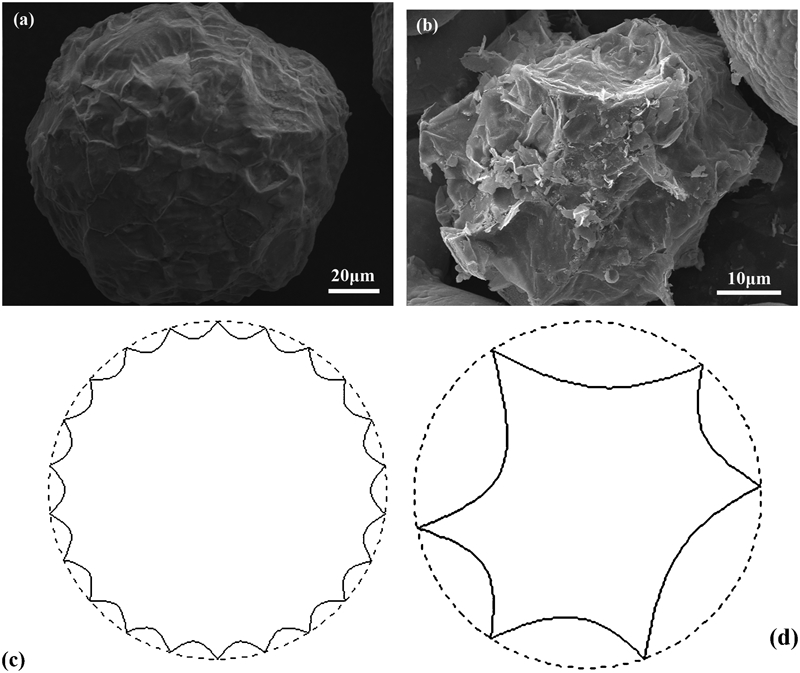
a, c 105-150 μm; b, d 53-63 μm
Conclusions
Experimental results of this work showed that corrosion resistance of atomised Fe–6·5 wt-%Si powders was strongly related to the powder sizes. Powders no. 1 demonstrated better corrosion resistance compared to the powders nos. 2 and 3. Pitting and intercrystalline corrosion were the major corrosion behaviours in atomised Fe–6·5 wt-%Si powders. Weaker corrosion resistance can be attributed to Si content heterogeneity and more grain boundaries.
Footnotes
Acknowledgements
This work was financially supported by the China National Natural Science Foundation (grant no. 51074104), the China National Basic Research Development Project (973 Program, grant no. 2010CB630802), the Shanghai Science and Technology Development Funds (grant no. 12QA1401200) and the Fund of the State Key Laboratory of Solidification Processing in NWPU (grant no. SKLSP201222). Scanning electron microscopy was made in the Instrumental Analysis & Research Center of Shanghai University. We expressed our sincere thanks for their support.