







Abstract
The effect of phase transformation on the corrosion behaviour of Zn–22Al (wt-%) alloys immersed in NaCl solution (3·5 wt-%) at room temperature was investigated. As cast Zn–22Al alloys were isothermally heated at 300 and 250°C (the eutectoid point is 277°C) respectively and then cooled by various rates. Isothermally heated below the eutectoid point, the corrosion resistance of the alloys increased with the decreasing cooling rate. However, when the isothermal heating temperature was above the eutectoid point, the corrosion resistance of Zn–22Al alloys increased with the increasing cooling rate. It can be attributed to the existence of α 2 phase, which may lead to smaller potential difference between the microgalvanic cells.
Introduction
Zinc–aluminium based alloys have been widely used in industry instead of brass and cast iron, because of their excellent mechanical properties and significant cost advantages.1–3 However, the corrosion resistance of Zn–Al alloys is lower than that of brass and cast iron.4–9 That limits the further application of Zn–Al alloys. During the past two decades, many approaches have been taken to improve the corrosion resistance of Zn–Al alloys: addition of elements,10–12 heat treatments12,13 and surface coating.13–16
The corrosion mechanisms of zinc based alloys have been studied under various environments, such as atmosphere,17,18 acid rain 19 and sea waters. 20 A layer of corrosion products that consists mainly of ZnO and Zn(OH)2 is usually formed on the surface of the zinc based alloys in the initial stages of corrosion. The changes in the pH value and the ion concentration can lead to the formation of other corrosion products of various basic salts.
It is well known that heat treatment is a way to modify the microstructure of alloys, and that the microstructure can affect the mechanical and corrosion behaviours. Low temperature annealing can improve intergranular corrosion resistance as a result of the optimised grain boundary character. 21 High temperature heat treatment may lead to phase transformation, which affects the element distribution and the grain morphology. Recently, more and more reports have focused on the influence of the heat treatments on the corrosion resistance of alloys.22–33
In the family of Zn–Al alloys, many investigations have focused on the eutectoid Zn–22Al (wt-%) alloys owing to its superplastic behaviours.34–36 The eutectoid phase transformation from suspensive Zn rich α 2 (fcc) phase to equilibrium Al rich α 1 phase and Zn rich η phase (Fig. 1), 37 which is accompanied by the redistribution of aluminium and the morphology evolution from granular to lamellar grains, has an important impact on the mechanical properties of Zn–22Al alloys.
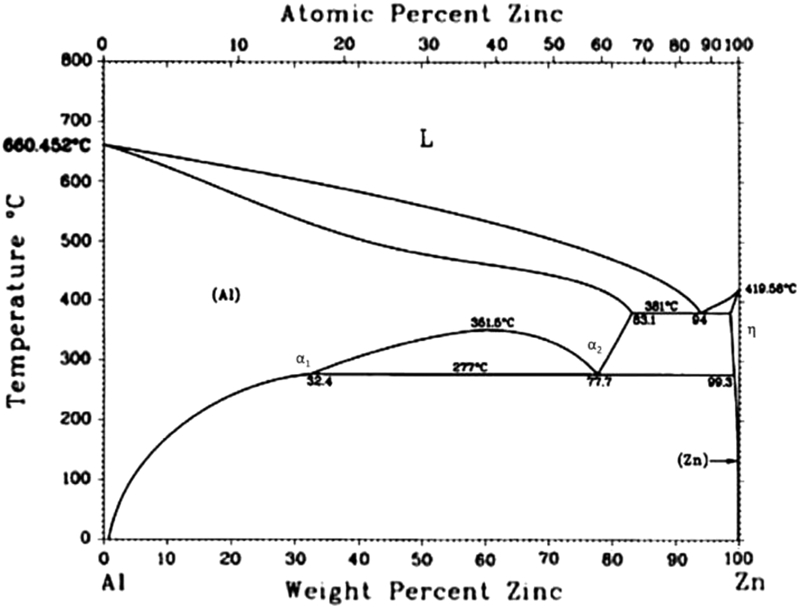
Zn–Al binary phase diagram
A classical model of Devillers described the corrosion mechanism of Zn–Al alloys in neutral solution (Fig. 2). 38 The electrode potential of the Zn rich phase is higher than that of the Al rich phase, because the electrode potential of zinc is higher than that of aluminium. Microgalvanic cells are formed in the phase boundaries, which cause the intergranular electrochemical corrosion. The Al rich phase is the anode, and the Zn rich phase is the cathode. The Al rich phase is prior to be corroded. It can be seen that the phase structure plays an important role in the corrosion behaviour of Zn–Al alloys.
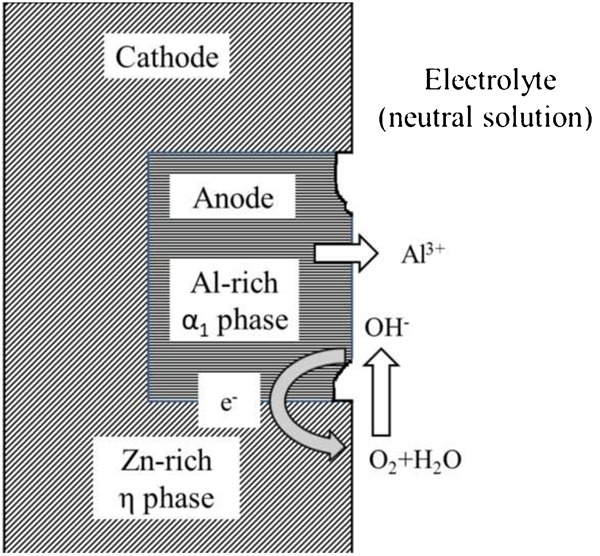
Schematic image of classical model of Devillers
In this work, we reported the influence of the phase transformation on the corrosion behaviour of Zn–22Al alloys. The effect of the heating temperature and the cooling rate on the corrosion behaviour of Zn–22Al alloys was studied. The existence of the Zn rich α 2 phase may lead to smaller potential differences between the microgalvanic cells, resulting in higher corrosion resistance of Zn–22Al alloys. The work can be beneficial to the wider application of the superplastic alloys.
Experimental
Materials and heat treatment
The Zn–22Al specimens were prepared by melting the corresponding amounts of Zn (99·99% purity) and Al (99·90% purity) in a medium frequency induction melting furnace. The ingots were obtained by casting the melt into a steel mold.
After casting, the specimens were subjected to two groups of heat treatments. The first group was isothermally heated at 300°C for 10 h and then cooled by water, air and furnace respectively. For comparison, the second group was isothermally heated at 250°C for 10 h and then cooled by water, air and furnace respectively.
Immersion test
The Zn–22Al specimens were cut into cuboids (10×10×6 mm) for immersion test. Before the immersion, the specimens were ground using progressively finer abrasive SiC paper (600, 800, 1000, 1500 and 2000 grit), cleaned with acetone and distilled water, and dried in the air. The original weight and the surface area S were measured. After that, the specimens were immersed in NaCl (3·5 wt-%) solution at room temperature for 1-20 days. After each immersion, the specimens were rinsed with distilled water in an ultrasonic bath for 15 min to remove the corrosion products. The specimens were reweighted to determine their mass loss in the immersion.
Electrochemical polarisation measurements
Polarisation measurements were carried out at room temperature in NaCl (3·5 wt-%) solutions by using a PGSTAT302 (AutoLab) electrochemical workstation. A platinum electrode was used as the counter electrode, and a saturated calomel electrode (SCE) as the reference electrode. The heat treated Zn–22Al specimens were used as the working electrode (WE) with an exposed surface area of 1·0 cm2. The working electrodes were rinsed with ethanol and distilled water before test. The open circuit potential (OCP) of working electrodes was measured for 15 min before application of electrochemical techniques. The scanning rate was 1 mV s−1.
Microstructure characterisation
The morphologies of the Zn–22Al specimens were observed by a scanning electron microscope (Hitachi S-4800 field emission microscope), combined with an energy dispersive spectrometer (EDS). The corrosion products were characterised by X-ray diffraction (XRD; D8 Advance X-ray diffractometer).
Results
Microstructures of specimens
Figure 3 shows the microstructures of Zn–22Al alloys versus different heat treatments: isothermally heated at 250°C for 10 h and then cooled in water (Fig. 3a), air (Fig. 3b) and furnace (Fig. 3c) respectively, and isothermally heated at 300°C for 10 h and then cooled in water (Fig. 3d), air (Fig. 3e) and furnace (Fig. 3f) respectively.
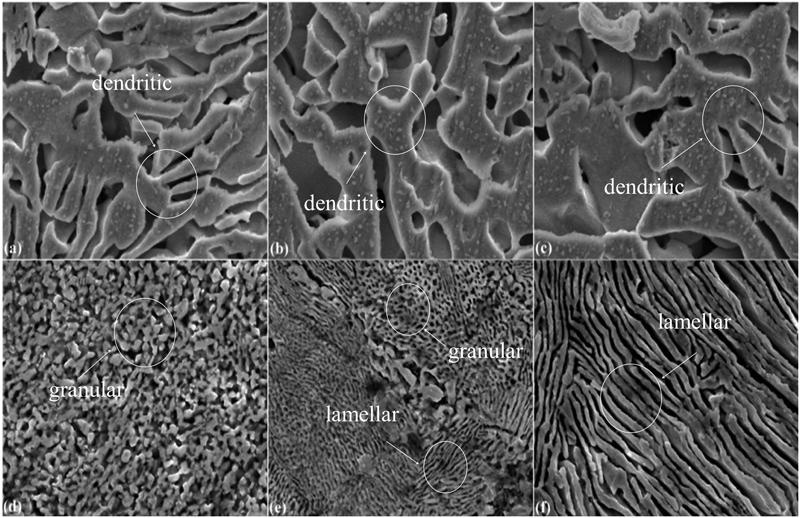
Microstructures (SEM) of Zn–22Al alloys versus different heat treatments
For the specimens isothermally heated at 250°C for 10 h and then cooled, a dendritic microstructure was formed. For the specimens isothermally heated at 300°C for 10 h and then cooled, the microstructure changed from granule to lamella with the decreasing cooling rate.
According to the Zn–Al phase diagram, a eutectoid phase transformation takes place at 277°C: α 2→α 1+η. The α 2 phase is an equilibrium Zn rich phase at high temperature with a face centred cubic lattice. The α 1 phase is an equilibrium Al rich phase at room temperature, which has almost same lattice parameters with the α 2 phase. The η phase is an equilibrium Zn rich phase at room temperature, which has the close packed hexagonal lattice.
Isothermally heated at 250°C (below the eutectoid point 277°C) for 10 h, the Zn–22Al specimens show a dendritic microstructure consistant with the equilibrium α 1+η phases (Fig. 2a–c). The equilibrium values of the volume fraction of the phases should obey the lever rule. The cooling rate does not affect the volume fraction of the phases.
Isothermally heated at 300°C (above the eutectoid point 277°C) for 10 h, a phase transformation takes place in the Zn–22Al specimens: α 1+η→α 2. In subsequent cooling process, a part of the α 2 phase decomposes into the α 1+η phases according to the cooling rate. In our prior work, the three phases were identified by the transmission electron microscope (TEM), and their volume fractions were measured. 39 The remaining α 2 phase which has not decomposed in the rapid cooling can be found in the granular structures. However, there are only α 1+η phases in the lamellar structures (Fig. 4).
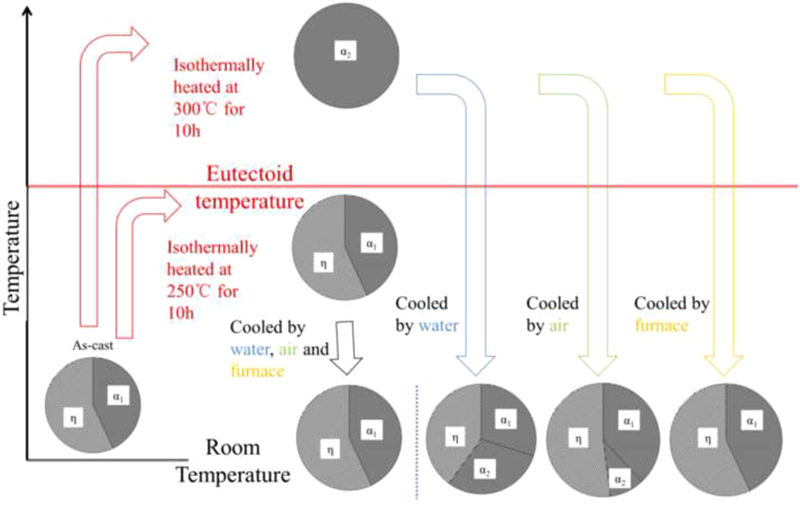
Schematic image of effect of isothermal heating temperature and cooling rate on phase composition of Zn–22Al alloys
Immersion test
The weight loss and the corrosion rate of the specimens are described as follows
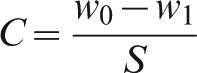
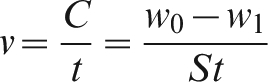
Figure 5 shows the corrosion rates of the heat treated Zn–22Al specimens immersed in the NaCl (3·5 wt-%) solutions. The corrosion rates of all the specimens decreased with the extended immersion time. For the specimens isothermally heated at 250°C for 10 h and then cooled, the corrosion rate of slowly cooled alloys was smaller (shown in Fig. 5a). For the specimens isothermally heated at 300°C, the corrosion rate of slowly cooled alloys was larger (shown in Fig. 5b).
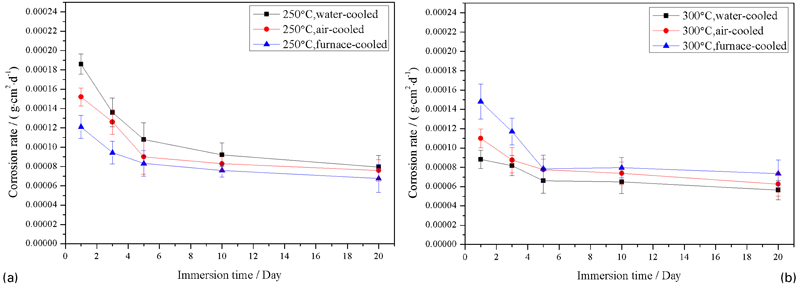
Corrosion rates of heat treated Zn–22Al specimens after immersion in NaCl (3·5 wt-%) solutions for 20 days
Electrochemical polarisation measurements
Figure 6 shows the polarisation curves of the heat treated Zn–22Al specimens in the NaCl (3·5 wt-%) solutions. Based on the polarisation curves, the corrosion currents I corr and the corrosion potential E corr of the specimens can be obtained by the Tafel extrapolation method (Table 1). It can be found that the changes in the isothermal temperature and the cooling rate did not have much impact on the corrosion currents of the specimen. However, after isothermally heated below or above the eutectoid temperature, the influence of the cooling rate on the corrosion potentials of the specimens showed opposite tendencies.
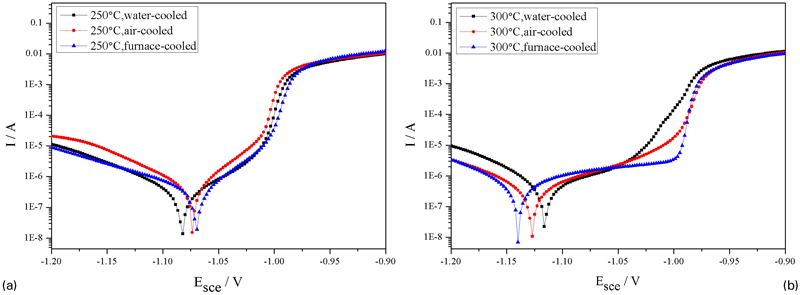
Polarisation curves of heat treated Zn–22Al specimens in NaCl (3·5 wt-%) solutions
Results of polarisation tests of specimens
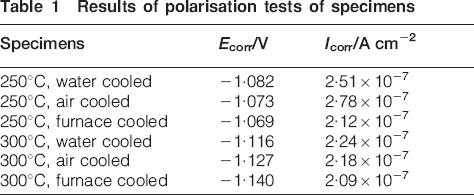
For specimens isothermally heated at 250°C for 10 h and then cooled, the corrosion potentials increased with the increasing cooling rate. The rapid cooled specimens were more prior to be corroded. For the specimens isothermally heated at 300°C for 10 h and then cooled, the corrosion potentials decreased with the increasing cooling rate. The slowly cooled specimens were more prior to be corroded.
Corrosion products
After the immersion test, the surface of the specimens was covered with white powdered corrosion products. A part of the corrosion products was precipitated in the test solution. The sample was subjected to ultrasonic cleaning and the solution was filtered to collect the corrosion products. Figure 7 shows the XRD patterns of the corrosion products on the surface of the heat treated Zn–22Al specimens after immersion in the NaCl (3·5 wt-%) solutions for 20 days. It can be seen that the corrosion products in all of the specimens were almost the same composition. The characteristic peaks of Zn and ZnO can be easily identified. The characteristic peaks of zinc aluminium carbonate hydroxide hydrate were also observed. According to the previous studies, a reaction began when the Al3+ concentration increased and reached a threshold value8,20

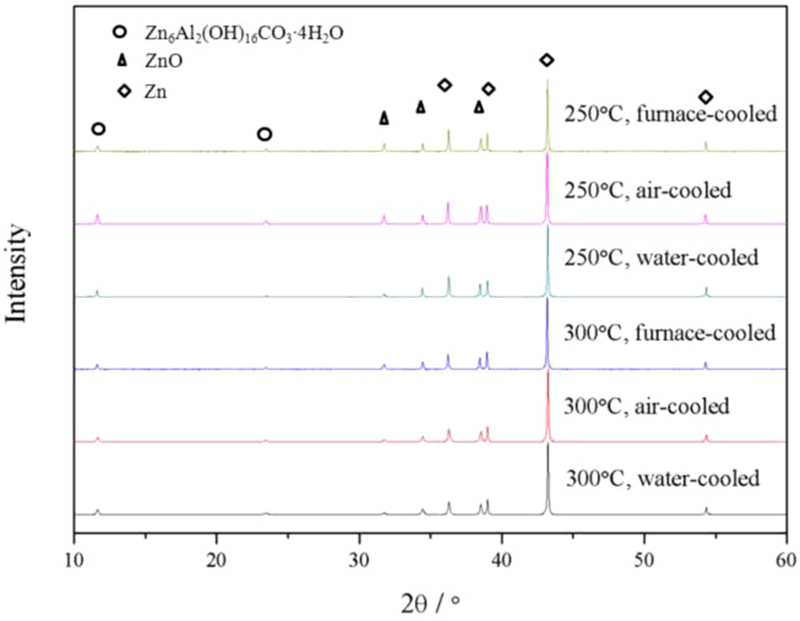
Corrosion products (XRD) on surface of heat treated Zn–22Al specimens after immersion in NaCl (3·5 wt-%) solutions for 20 days
Corrosion morphologies
Figure 8 shows the SEM images of the heat treated Zn–22Al specimens immersed in the NaCl (3·5 wt-%) solutions for 10 days. The surface of the specimens was covered with a white layer of corrosion products. The corrosion products showed a porous structure. Tiny pores can be found in the layer of the corrosion products.
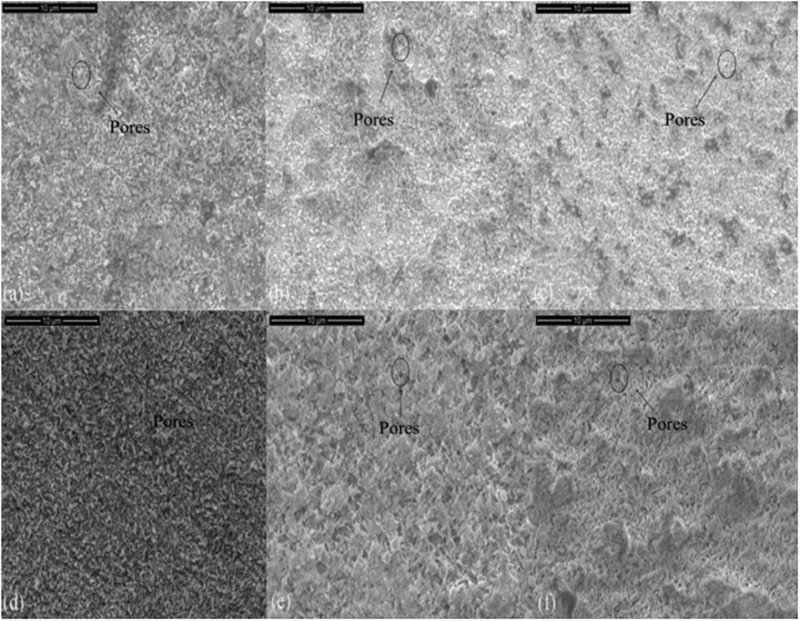
Images (SEM) of heat treated Zn–22Al specimens immersed in NaCl (3·5 wt-%) solutions for 10 days
Figure 9 shows the SEM images of the heat treated Zn–22Al specimens that the corrosion products had been removed. For specimens isothermally heated at 250°C for 10 h and then cooled, more cracks were found in the rapid cooled specimens. However, for specimens isothermally heated at 300°C for 10 h and then cooled, more cracks were found in the slowly cooled specimens. The corrosion cracks appeared in the interfaces of the Al rich phase and the Zn rich phase.
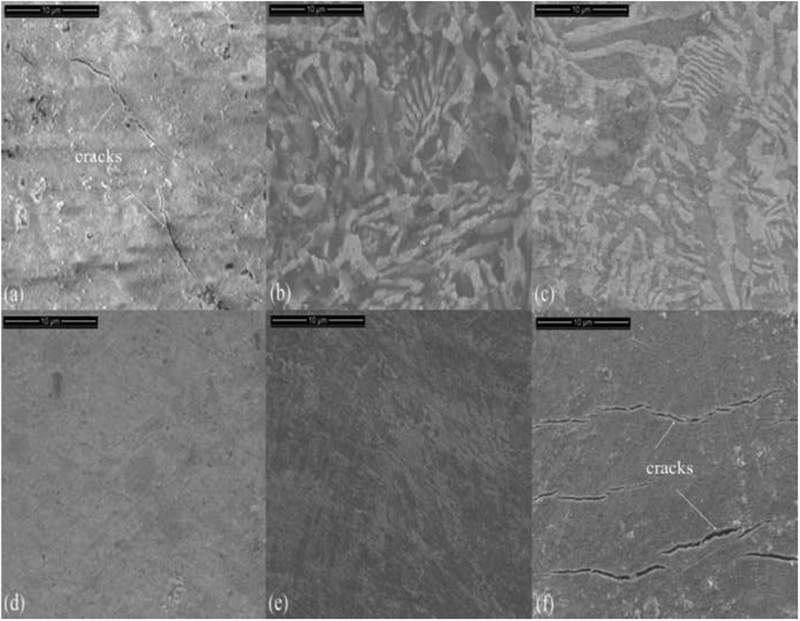
Images (SEM) of heat treated Zn–22Al specimens immersed in NaCl (3·5 wt-%) solutions for 10 days without corrosion products
Figure 10 shows the cross-sectional morphologies of the heat treated Zn–22Al specimens immersed in the NaCl (3·5 wt-%) solutions for 10 days. No significant corrosion product film was found on the surfaces of the specimens. The corrosion products were supposed to be detached easily from the specimens. For the specimens isothermally heated at 250°C for 10 h and then cooled, the surface was smoother with the decreasing cooling rate. However, the specimens isothermally heated at 300°C showed an opposite trend.
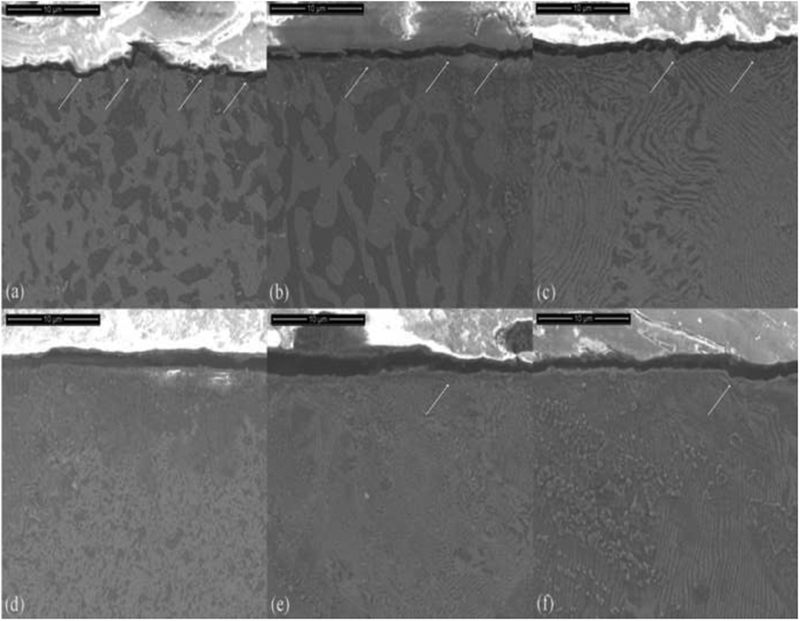
Images (SEM) of cross-sections of heat treated Zn–22Al specimens immersed in NaCl (3·5 wt-%) solutions for 10 days
Corrosion kinetics
The corrosion kinetics of the superplastic Zn–22Al alloys in the NaCl (3·5 wt-%) solutions can be described as
40
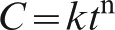
The relationship of C and t can be written as

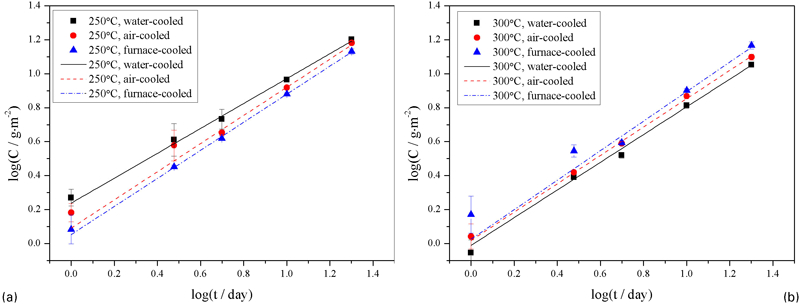
Linear curves of log corrosion loss of heat treated Zn–22Al specimens versus log immersion time in NaCl (3·5 wt-%) solutions
Values of corrosion kinetic parameters of specimens
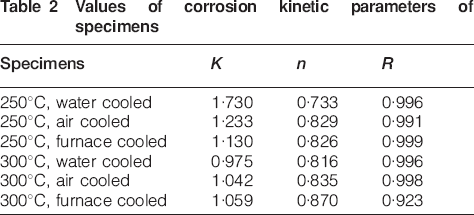
As shown in Table 2, the values of the corrosion kinetic parameter n of all the heat treated Zn–22Al specimens were >0·5. It indicated that the corrosion products were non-protective. The value of the corrosion kinetic parameter K describes the initial corrosion rate. For the specimens isothermally heated at 250°C for 10 h and then cooled, the initial corrosion rate decreased with the decreasing cooling rate. However, the specimens isothermally heated at 300°C showed an opposite trend. The initial corrosion rate increased with the decreasing cooling rate.
Discussion
Based on the results mentioned before, heat treatments can lead to opposite effects on the corrosion behaviour of Zn–22Al alloys. For the specimens isothermally heated at 250°C (below the eutectoid point 277°C) for 10 h and then cooled, the corrosion resistance increases with the decreasing cooling rate. That can be explained by the reduction in the stress, defects and element segregation. 41 However, for the specimens isothermally heated at 300°C (above the eutectoid point 277°C) for 10 h and then cooled, the corrosion resistance increases with the increasing cooling rate. It suggests that the phase transformation plays an important role in the opposite corrosion behaviour of Zn–22Al alloys.
As mentioned before, for the specimens isothermally heated above the eutectoid point, the remaining α 2 phase can be obtained by rapid cooling. Because the elemental composition of the α 2 phase (78 wt-%Zn and 22 wt-%Al) is in between the α 1 phase (approximate to pure Al) and the η phase (approximate to pure Zn), the electrode potential of the α 2 phase is in between them, too. Therefore, the potential differences between the α 2 phase and the α 1+η phases (Eη–Eα 2 and Eα 2−Eα 1) are smaller than that of the α 1 phase and the η phase (Eη−Eα 1).
The intergranular corrosion of Zn–Al alloys in neutral solution is attributed to the microgalvanic cells formed by the phases. Because the potential differences between the microgalvanic cells formed by the α 2 phase and the α 1+η phases are smaller than those of the α 1 phase and the η phase, the corrosion resistance of specimens containing a part of the α 2 phase is higher than that of the specimens that only consist of the α 1+η phases.
For specimens isothermally heated at 300°C (above the eutectoid point 277°C) for 10 h and then cooled, more α 2 phase can be obtained by more rapid cooling. It may cause smaller potential differences between the microgalvanic cells, which can lead to higher corrosion resistance of the specimens.
Conclusion
The influences of heat treatments on the microstructure and the corrosion resistance of Zn–22Al alloys were investigated. The corrosion behaviour of heat treated Zn–22Al alloys immersed in the NaCl (3·5 wt-%) solutions was studied.
For specimens isothermally heated below the eutectoid point for 10 h and then cooled, the corrosion resistance increases with the decreasing cooling rate, which can be explained by the reduction in the stress, defects and element segregation.
The corrosion behaviour of Zn–22Al alloys shows an opposite trend when the isothermal temperature is above the eutectoid point. More α 2 phase can be obtained by more rapid cooling. That may cause smaller potential differences between the microgalvanic cells, which may lead to higher corrosion resistance of the specimens.
Footnotes
Acknowledgements
This work was financially supported by three foundations in China (2009BAE71B05, 2009A31004 and 2012A610057).