







Abstract
Nuclear fuel cladding for pressurised water reactors is commonly manufactured with zirconium alloys. The M5 alloy is a relatively new cladding material for in-reactor used with enhanced performance compared to traditional zircaloys. In this work, the influence of temperature on the corrosion resistance and semiconducting properties of the passive film formed on the M5 alloy in a borate buffer solution has been evaluated. The electrochemical behaviour of the zirconium alloy was assessed by potentiodynamic polarisation tests, electrochemical impedance spectroscopy and Mott–Schottky plots. The results indicated that the corrosion resistance of the M5 alloy decreased with temperature due to the formation of a less stable and more defective passive film. The Mott–Schottky approach used in combination with polarisation tests and impedance measurements was effective to reveal the protective state of the passive film on the M5 alloy.
Introduction
Zirconium alloys are the state of the art materials for nuclear fuel claddings in pressurised water reactors (PWRs) due to a suitable combination of properties such as corrosion and creep resistances and low neutron absorption cross-section. 1 Zr–Nb alloys are preferred over traditional zircaloys due to performance enhancement regarding corrosion resistance and hydrogen pickup. 2 The development of this new class of zirconium alloys is pursued by materials scientists in order to meet increasing demands of the nuclear industry for high burnup fuels. 3 The traditional example of these so called advanced zirconium alloys is the M5 alloy. It consists of a Zr–Nb–O alloy that is currently employed as nuclear fuel cladding and structural components for nuclear core applications 4 in PWRs. Attractive properties of the M5 alloy derive from controlled chemical composition and microstructure during manufacturing. The absence of tin increases corrosion resistance with respect to traditional zircaloys, and the fully recrystallised state leads to enhanced creep resistance for in-reactor use. 5
Corrosion of fuel claddings is an important technological issue in the nuclear industry. Chen et al. 6 state that corrosion can lead to uniform thinning of fuel cladding and also to localised attack. Cox 7 discusses several in-reactor corrosion mechanisms of zirconium alloys and pointed that the stability of the oxide film on the surface of the metallic substrate is closely related to the corrosion rate during operation. In this regard, the metal/oxide interface has been found to play an important role in the corrosion processes of Zr–Nb alloys. 8 The stability of the oxide film can be affected by the niobium content in the alloy and also by annealing treatments during manufacturing of engineering components due to microstructural changes induced by different thermal cycles. 9
The protective character of oxide films against corrosion can be assessed by their semiconducting properties. It is well known that passive layers on metallic surfaces behave as semiconductors. Corrosion phenomena are strongly related to the semiconductive properties of these films. Mott–Schottky approach applies well to characterise the semiconductive behaviour of oxide films in contact with an electrolyte and has been widely employed to study the stability of passive layers on stainless steels, titanium, aluminium and magnesium alloys.10–14 The predominance of the type of point defects in the passive film accounts for a p-type or n-type semiconductor behaviour. Thus, when cation vacancies are in excess, the passive film generally behaves as a p-type semiconductor, whereas anion vacancies or cation interstitials lead to n-type behaviour. 15 The concentration and distribution of these defects within the passive film determine its stability and influence the corrosion resistance of the underlying metallic substrate. 16
Corrosion damage of zirconium alloys is related to operating temperatures. 3 Although temperature has been also recognised as an important parameter for other passive metals in aqueous solutions,17,18 studies devoted to Zr–Nb alloys are scarce in the literature. The main goal of the present work was to investigate the formation and growth of passive film in M5 zirconium alloy. In order to meet this goal, the Mott–Schottky approach was used to assess the concentration of point defects within the passive film formed under different temperatures in a phosphate buffered solution. This electrolyte was selected to provide a stable passive layer, giving the basis for the understanding of fundamental aspects of passivity in the zirconium alloy. Corrosion tests were also carried out to provide a complete characterisation of the M5 electrochemical behaviour at each testing temperature.
Experimental
The material used in this work was a tube cladding made of M5 zirconium alloy (nomical composition: 0.8-1.2 wt-% Nb, 1100-1700 ppm O, < 350 ppm S, bal. Zr). Samples were cut from the tube cladding in cylindrical pieces (1 cm long). Next, the samples were connected to a copper wire using a conductive adhesive. Then, the samples were embedded in cold curing epoxy resin, leaving an area of ∼0.3 cm2 to be exposed to the electrolyte. Before the electrochemical tests, the samples were ground with SiC abrasive paper and polished with diamond paste.
The electrolyte for all electrochemical measurements was a buffer solution of composition H3BO3 (0.05 M) + Na2B4O7.10H2O (0.075 M) and pH 9.2. The advantage of choosing this electrolyte for the measurements is the stable condition of the oxide film formed on the metallic surface, allowing for reliable assessment of its semiconducting properties. 19 The tests were performed at room temperature and at 40, 60 and 90°C using an Autolab PGSTAT 100 potentiostat/galvanostat. The experimental arrangement was composed of a conventional three-electrode cell with a platinum wire as the counter-electrode, saturated calomel electrode (SCE) as reference and the M5 alloy as the working electrode. All potentials mentioned in the text are given related to the SCE.
Two sets of experiments have been performed. In the first one, the open circuit potential (OCP) was monitored for 1800 s. Next, the sample was potentiodynamically polarised from − 300 mV versus the OCP up to +1.0 V. In the second one, the OCP was also monitored for 1800 s. Next, electrochemical impedance spectroscopy (EIS) measurements were performed at the OCP in the frequency range from 100 kHz to 10 mHz with an acquisition rate of 10 points per decade and an amplitude of the perturbation signal of ± 10 mV (rms). In the next step, capacitance measurements were carried out using the Mott–Schottky approach at a fixed frequency of 1 kHz. The samples were polarised in the cathodic direction in successive steps of 50 mV from − 1.0 V up to − 2.0 V. Three different samples were tested at each condition.
Results and discussion
Potentiodynamic polarisation curves
Potentiodynamic polarisation curves of the M5 alloy immersed in H3BO3 (0.05 M) + Na2B4O7.10H2O (0.075 M) and pH 9.2 at different temperatures are shown in Fig. 1. The corrosion potential (E corr) and corrosion current densities (i corr) were determined from these curves using the Tafel extrapolation method. The results are presented in Table 1. Passive current densities (i pass) are also displayed in Table 1.
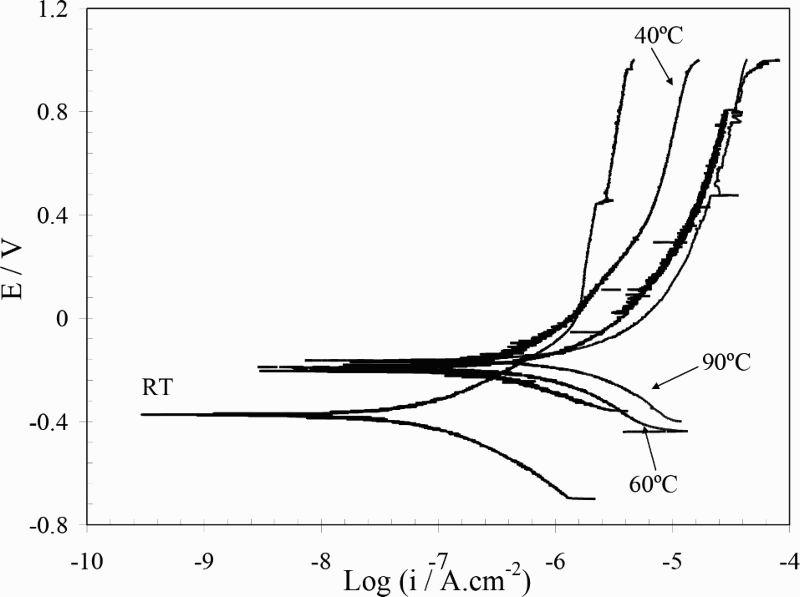
Potentiodynamic polarisation curves of M5 alloy immersed in H3BO3 (0.05 M) + Na2B4O7.10H2O (0.075 M) and pH 9.2 at different temperatures
Electrochemical parameters determined from potentiodynamic polarisation curves shown in Fig. 1
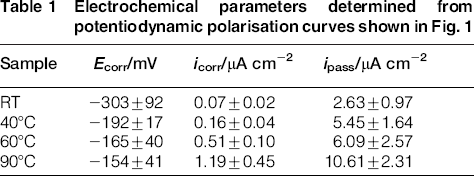
The polarisation curves show a similar trend at all temperatures, with the material reaching a stable passive condition above the corrosion potential. No breakdown potential could be perceived. Notwithstanding, some marked differences can be perceived. The corrosion potential increases with temperature. This behaviour has been observed for passive metals.20,21 Temperature also affected the values of i corr, which were shown to increase as the temperature rises. These two effects derive from the enhancement of the cathodic reactions in the surface of the electrode with temperature. The shift of the polarisation to higher potentials and current densities with increasing temperatures is clearly seen in Fig. 1. Similar behaviour has been reported for stainless steels in aqueous solutions. 22
The variations of E corr and i corr point to a reduction of the passive character of the oxide film formed on the surface of the M5 alloy with temperature. Thus, the anodic dissolution process is also affected by temperature. This can be promptly envisaged by considering the passive current densities displayed in Table 1. There is a steep increase of the passive current density with temperature, suggesting also that the growth of the passive film is enhanced at higher temperatures. 20 Moreover, the passive range shortens at higher temperatures, as denoted by the smaller difference between the final potential (1.0 V) and E corr. Literature indicates that passive films that formed at lower temperatures are less defective and have higher resistance to breakdown than those formed at higher temperatures. 23 The results obtained in the present work confirm this trend and reveal that the corrosion resistance of M5 alloy can be adversely affected by temperature.
Electrochemical impedance spectroscopy
EIS spectra of the M5 alloy obtained in H3BO3 (0.05 M) + Na2B4O7.10H2O (0.075 M) and pH 9.2 at different temperatures are shown in Fig. 2. Nyquist plots (Fig. 2a) show a capacitive loop that becomes more flattened with increasing temperatures. The radius of the capacitive loop was severely affected by temperature. It is well known that the diameter of the capacitive loop is directly related to the polarisation resistance of the passive film, thus reflecting its corrosion resistance.24,25 Following this reasoning, the highest corrosion resistance was observed at room temperature. A small decrease of the radius of the capacitive loop was observed up to 40°C. This trend was markedly intensified at 60°C and especially at 90°C. The plot obtained at 90°C present a very small radius compared to the other temperatures so that it is badly resolved in Fig. 2a. In order to more clearly distinguish between this condition and the others, the inset in Fig. 2a shows the Nyquist plots with an expanded scale, evidencing the small capacitive loop obtained at 90°C.
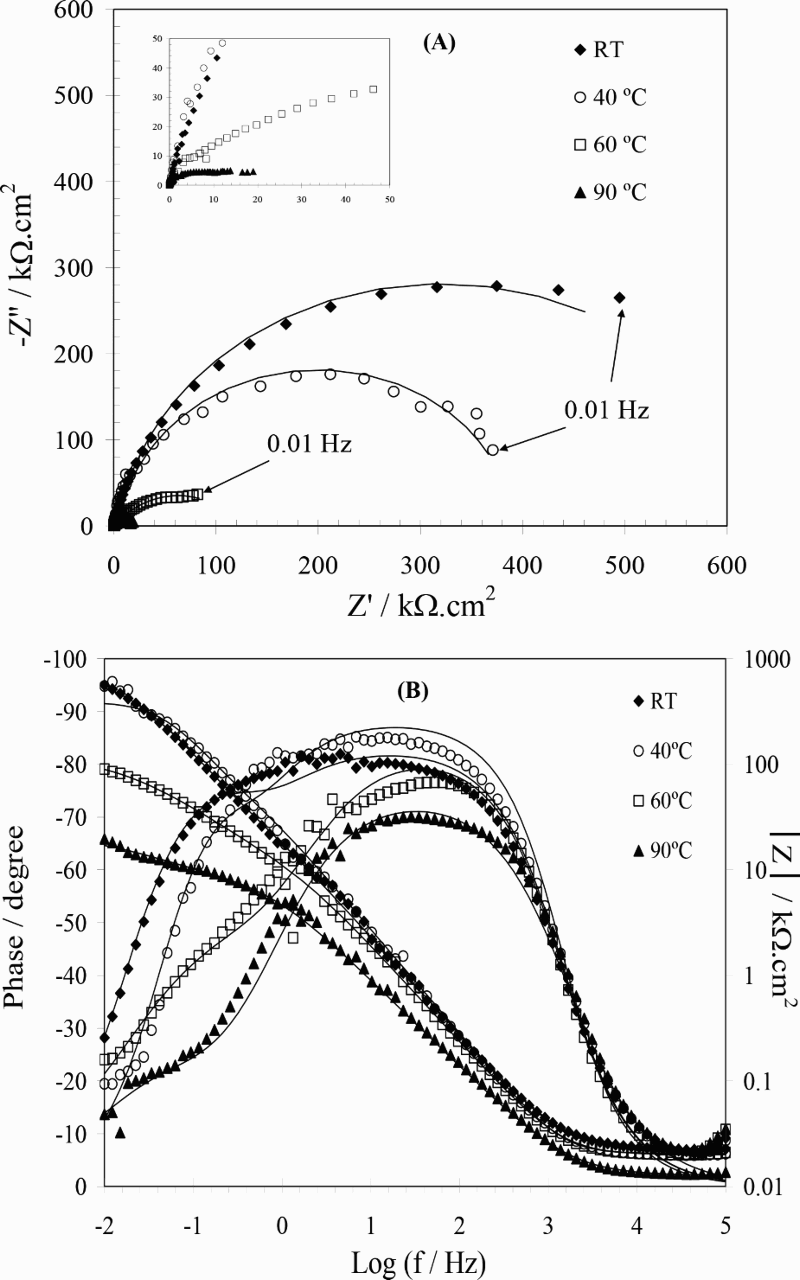
EIS spectra of M5 alloy immersed in H3BO3 (0.05 M) + Na2B4O7.10H2O (0.075 M) and pH 9.2 at different temperatures: a Nyquist plots; b bode plots; solid lines, fitted data
Bode plots (Fig. 2b) obtained at room temperature and at 40°C are typical of passive metals exhibiting high impedance modulus and capacitive behaviour with phase angles close to − 90°.26,27 The impedances are progressively lower for increasing temperatures, reaching its minimum at 90°C. Similarly, phase plots present an extended plateau ranging from the high frequency to the medium frequency domain, denoting the capacitive character of the electrode surface with angles close to − 90°. In the low frequency region of the spectra, there is a steep decrease of the phase angles that can be related to charge transfer reactions at the metal/passive film interface. The plateau in the medium frequency domain was narrower for the plots acquired at 60 and 90°C. The decrease of phase angles is shifted to frequencies as high as 10 Hz at 60 and 90°C, suggesting that charge transfer reactions are facilitated at these temperatures. Additionally, the peak phases are more distant from − 90°, deviating from the typical pure capacitive behaviour.
The qualitative analysis of the impedance spectra points to a decrease of the protective character of the passive formed at the surface of the M5 alloy as the temperature increases, in agreement with the results obtained with the potentiodynamic polarisation tests described in the ‘Potentiodynamic polarisation curves’ section. Fitting of EIS experimental data with equivalent electrical circuits (EECs) is a useful procedure to give a more quantitative analysis of the events occurring at the electrode. Hence, interpretation of the EIS results was complemented by fitting the experimental data with the EEC shown in Fig. 3. This circuit is typically employed to model the electrochemical response of metals that develop passive films in aqueous solutions, presenting two time constants.28,29 Constant phase elements (CPEs) were used instead of pure capacitors in order to represent the deviation from the pure capacitive behaviour as observed in the Bode phase plots of Fig. 2b. The impedance of a CPE (Z CPE) is given according to equation (1), where ω is the angular frequency, j − 2 = − 1 is the imaginary number and n is the exponent of the CPE. For an ideal capacitor, n = 1 and for an ideal resistor n = 0. When 0.5 < n < 1, the CPE describes frequency dispersion arising from local heterogeneities in the electrode.
27

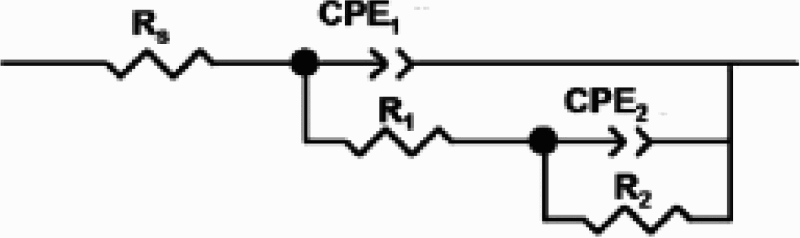
Equivalent circuit used to fit EIS experimental data
Equivalent circuit parameters obtained by fitting EIS experimental data with EEC shown in Fig. 3

The variation of R 1 indicates that the resistance of the oxide film is severely affected by temperature, sharply decreasing when the temperature was increased up to 90°C. The capacitances of the oxide film (CPE1) increased with temperature. This effect can be related to an increase of film defects with temperature. These results can be associated with those obtained with the polarisation tests (Fig. 1). As discussed in the ‘Potentiodynamic polarisation curves’ section the values of passive current density (i pass) increased with temperature, as well as the values of corrosion current density (i corr) and corrosion potential (E corr). Such variations are related to a less stable passive film that grows faster as the temperature increases. Consequently, this rapidly grown passive film would be less protective and more defective. The variations of R 1 and CPE1 agree well with this reasoning, confirming the results obtained with the polarisation tests.
The second time constant models the electrochemical response at the metal/passive film interface at the defects of the passive layer. The high value of R 2 indicates the high corrosion resistance of the M5 alloy at room temperature. In the same way, the low value of CPE2 suggests that the area exposed to the electrolyte is small at this condition and the passive film has few defects. 30 However, this protective state is not sustained as temperature increases. R 2 shows a steep decrease as temperature reaches 40°C, reaching its minimum at 90°C. The values of CPE2 increased sharply with temperature, presenting an increment of two orders of magnitude at 90°C when compared to the room temperature result. It is also interesting to note the deviation of the n 2 values from the pure capacitive behaviour (n = 1) with temperature, suggesting the increased heterogeneity of the electrochemical interface.
The variations of R 2 and CPE2 with temperature reveal the less protective nature of the passive film formed on the surface of the M5 alloy above room temperature. These results are of great relevance to the engineering applications of this material, since temperatures can reach >300°C depending on its intended in-reactor use. 31 The defective nature of the passive film can be assessed by the variation of its semiconducting properties based on the Mott–Schottky approach. The next section deals with this interpretation, discussing the correlation between the semiconducting properties of the passive film and the corrosion tests carried out by potentiodynamic polarisation and EIS measurements.
Semiconducting properties of passive film
According to the Mott–Schottky theory, the capacitance (C ) of passive films that formed on metals varies the applied potential and can be described according to equation (2), where C SC is the capacitance of the space charge layer of the oxide film (semiconductor) and C H is the Helmholtz capacitance.
32



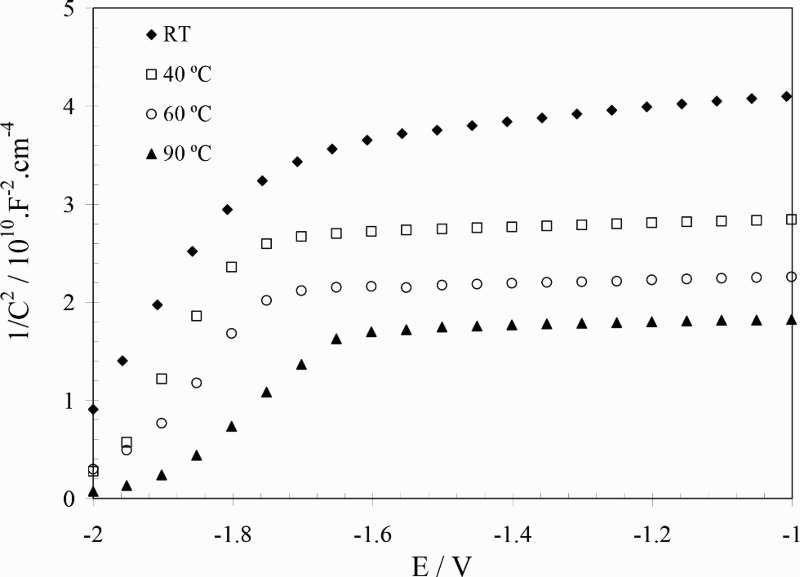
Mott–Schottky plots of M5 alloy immersed in H3BO3 (0.05 M) + Na2B4O7.10H2O (0.075 M) and pH 9.2 at different temperatures
The donor density (N d) in the passive film has been determined from the slope of linear regions of the Mott–Schottky plots. The results are presented in Table 3. The magnitude of N d was ∼1019 cm− 3 independently of the testing temperature. Highly disordered passive films are reported to present doping densities in the range 1020–1021 cm− 3.39,40 In this respect, the films formed on the M5 alloy can be considered relatively little disordered due to the low concentration of defects. However, the results displayed in Table 3 indicate that these films became more defective with temperature, since N d gradually increased from room temperature to 90°C. The formation of a more disordered passive film at progressively higher temperatures is consistent with the results obtained from the potentiodynamic polarisation curves and EIS spectra. Therefore, it is possible to infer that the formation of disordered passive films leads to high passive current densities and are indicative of the growth velocity of the oxide layer. Electrochemical evaluation by polarisation tests and Mott–Schottky plots proved to be a valuable tool to identify this tendency and to evaluate the stability of the passive film on the M5 alloy.
Donor densities (N d) for M5 alloy immersed in H3BO3 (0.05 M) + Na2B4O7.10H2O (0.075 M) and pH 9.2 at different temperatures

Conclusions
The effect of temperature on the corrosion resistance and semiconducting properties of the passive film formed on the M5 alloy has been evaluated. Potentiodynamic polarisation tests indicated that the corrosion potential, corrosion current density and passive current density increased with temperature, therefore suggesting the formation of a less stable and rapidly grown passive layer at high temperatures. EIS spectra revealed that the electrochemical response of the passive film could be successfully modelled by an equivalent circuit consisting of two time constants. The resistance of the oxide film decreased with temperature and its capacitance increased, supporting the results obtained with the polarisation tests. The passive films presented an n-type semiconductive behaviour according to Mott–Schottky plots. The donor density increased with temperature, showing that the passive film became more defective at high temperatures and, therefore, more prone to corrosion attack, confirming the results obtained by EIS measurements and polarisation tests. The results obtained in the present work show that the overall electrochemical behaviour of the M5 alloy is adversely affected by temperature. The formation of a more disordered passive film at higher temperatures accounts for the loss of stability of the passive film.
Footnotes
Acknowledgement
The authors gratefully acknowledge Indústrias Nucleares do Brasil (INB) for kindly providing the M5 alloy used in this work.