







Abstract
The inhibitive action and adsorption behaviour of pomegranate leave extract (PGLE) on corrosion of carbon steel in 1M HCl solution at 293-333 K was investigated through chemical (weight loss measurements), electrochemical (potentiodynamic polarisation) and surface analysis [Fourier transform infrared (FTIR) and X-ray diffraction (XRD)] methods. Results obtained shows that the adsorption of PGLE molecules on the C steel surface obeyed the Langmuir adsorption isotherm and acts as mixed type inhibitor for C steel in 1M HCl with anodic as its dominant inhibitor at high concentration. The inhibitory property of the extract was discussed in terms of the mechanism by which its components adsorb onto the C steel surface. Activation energy of corrosion and other thermodynamic parameters such as standard free energy, standard enthalpy and standard entropy of the adsorption process as well as FTIR and XRD examinations of the electrode surface revealed that the corrosion inhibition of C steel in 1M HCl in the presence of PGLE is mainly controlled by the physical adsorption process.
Introduction
Carbon steel (C steel) has been extensively used in a wide range of industrial applications for different purposes under different conditions due to its low cost and easy availability. Hydrochloric acid is generally used as ‘pickling acids’ for C steel. Its function is to remove undesirable oxide coatings and corrosion products. Hence, the study of C steel corrosion and its inhibition in HCl medium is of recent interest and gaining greater importance in the field of engineering and industries involving electrochemical process. Inhibitors used in acid treatment solutions significantly reduce the overall and local pickling attack and the hydrogen absorption of steel strips. A number of organic compounds containing polar functions in their molecules have been reported as effective corrosion inhibitors for C steel in HCl media.1–5 In modern life, scientific and technological advancement paid much attention to safety, sanitation and health of the environment. The toxic nature and high cost of organic acid inhibitors have necessitated research activity in recent time toward finding alternative acid corrosion inhibitors. The interest in naturally occurring substances stems from the fact that they are non-toxic, biodegradable, cheap and readily available in plenty. Various parts of plants, e.g. seeds, fruit and leaves, were extracted and used as corrosion inhibitors.6–12 Punica granatum, commonly known as pomegranate, is native from the Himalayas in northern India to Iran but has been cultivated and naturalised since ancient times over the entire Mediterranean region. It is also found in more arid regions of Southeast Asia, the East Indies and tropical Africa. It is reported to be a rich source of anthocyanins (delphinidin, cyaniding and pelargonidin), phenolic compounds (including hydrolysable tannins such as punicalin, pedunculagin, punicalagin, gallagic and ellagic acid) and organic acids alleged to be responsible for its medicinal properties.13,14 However, the chemical composition of pomegranate varies widely depending on the part of the plant and its locations.15,16 A survey of literature revealed that there are few reports on the corrosion behaviour of C steel in the presence of pomegranate extracts. Earlier, Saleh et al. 17,18 studied the effect of various naturally occurring substances, among which are pomegranate juice and peel extract, on the dissolution of steel in HCl solutions using weight loss and thermometric techniques. Quraishi et al. 19 investigated several plant products as corrosion inhibitors and found that pomegranate shell gave adequate protection for steel in 3%NaCl. Recently, work has been emphasised on the use of pomegranate peel as corrosion inhibitor for mild steel and brass in acidic solutions.20,21 The satisfactory result obtained by peel and juice of pomegranate as corrosion inhibitors for mild steel in acidic media has prompted us to test other parts of the plant that has not yet been studied. The chemical components of pomegranate leaves have been reported to contain glycosides of apigenin, a flavone with progestinic 22 and anxiolytic 23 properties. The fresh leaves extract of pomegranate has been found to be associated with free radical scavenging activity. 24 Ellagic acid, another major ellagitannin present in the leaves, showed antioxidant and anti-inflammatory properties.25,26 Apigenin, a flavone, and punicalgin, an ellagitanin, also present in the leaves of pomegranate have been known to exhibit anti-inflammatory actions. 27 Although pomegranate and its constituents have been implicated in many different biological activities, there is no study investigating the corrosion inhibition of its leaves extracts on the corrosion inhibition of steel in acidic media. Therefore, this investigation describes for the first time the performance of leaves extract of pomegranate on mild steel corrosion in 1M HCl using chemical and electrochemical techniques. Inhibited metallic surface was also examined by Fourier transform infrared (FTIR) and X-ray diffraction (XRD) to establish the corrosion inhibitive property of this part of pomegranate extract in HCl solution.
Experimental
Preparation of plant extract
Hundred grams of pomegranate leaves was refluxed in 250 mL double distilled water for 3 h. The refluxed solutions were filtered to remove any contamination. Thereafter, the solution was evaporated to ∼50 mL dark brown residues using a rotary evaporator, dried in vacuum drying oven at 60°C until complete dryness (∼3 days). The stock solution of pomegranate leaves extract (PGLE) was prepared by weight from the collected solid residue and was expressed in terms of grams per litre.
Metal specimens
Corrosion tests were performed on carbon steel specimens of the following percentage composition (weight per cent): Fe–0.21C–0.38Si–0.09P–0.05Mn–0.05S–0.01Al. For the gravimetric and electrochemical measurements, pretreatment of the surface of specimens was carried out by grinding with paper of 600-1200 grit, rinsing with bidistilled water, ultrasonic degreasing in ethanol and drying at room temperature before use.
Aggressive solution
The aggressive solution used was made of analytical reagent grade HCl. A 1M solution of the acid was prepared using bidistilled water. The concentration range of PGLE used to study the corrosion inhibition properties was 0.2-1 mg L− 1.
Methods
Weight loss measurements
Gravimetric experiments were carried out in a glass vessel containing 250 mL of various concentrations of HCl solutions without and with the inhibitor. After immersion in acidic solution for 2 h at 298 K, the carbon steel specimens of size (2.5 × 1.0 × 0.06 cm) were taken out, washed with bristle brush under running water in order to remove the corrosion product, dried with a hot air steam and reweighed accurately. Each experiment was repeated at least three times to ensure reproducibility, and average weight loss was noted. All the aggressive acid solutions were open to air.
Potentiodynamic polarisation measurements
Polarisation experiments were carried out in a conventional three-electrode cell with a platinum counter electrode and saturated calomel electrode (SCE) coupled to a fine Luggin capillary as the reference electrode. The working electrode was in the form of a square cut from the C steel with exposed surface area of 1 cm2. Before measurement, the working electrode was polished mechanically, washed with acetone, rinsed several times with bidistilled water and dried. The freshly polished electrode was immersed in test solution at open circuit potential for 2 h until a steady state was reached. Polarisation curves for different concentrations of the inhibitor were recorded with Amel potentiostat (model 2053) from cathodic potential of − 0.250 V(SCE) to an anodic potential of +0.250 V(SCE) with respect to the open circuit potential at a sweep rate of 10 mV mn− 1 in aerated condition at 298 K to make the conditions identical to weight loss measurements. The effect of temperature of 293-333 K on the polarisation curves both in the presence of 1 g L− 1 PGLE as well as in its absence were also recorded to observe the temperature dependence of inhibition effect and calculate the activation energy of inhibitor adsorption to C steel.
Solution analysis
The amount of iron dissolved from both unprotected and protected samples after immersion in acidic solution for 2 h at 298 K was determined using a fully automated, computer controlled atomic absorption spectrometer (model 908; GBC-Australia) and using air–acetylene flame. Three independent probes with a blank probe were analysed for each of the samples examined.
Surface analysis
The surface of the metal specimens after polarisation measurements in the absence and presence of PGLE was analysed by FTIR and XRD. The infrared spectrum was obtained as KBr pellets on a Bruker Tensor-27 spectrophotometer, while the examination of the C steel electrode surface was performed using XRD (model: XRD-Bruker D8 Advance).
Results and discussion
Weight loss measurements
Corrosion rates of C steel were calculated by considering the total affected sample area and immersion times. After the corrosion process, the test solutions were subjected to atomic absorption spectroscopy analyses to determine the quantity of metal ion dissolved from the metal surface. The corrosion rates of C steel and the inhibition efficiency values W and E (%) were determined as follows28,29

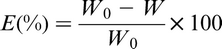
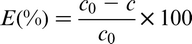
The weight loss method of monitoring corrosion rate and inhibition efficiency is useful because of its simple application and high reliability. For this study, the reproducibility of experimental data is determined by the value of standard deviation. At every inhibitor concentration, the standard deviation values for both weight loss and corrosion rate were within 10 and 5%, which indicates that the reproducibility of results obtained for triplicate determination is very precise. Table 1 gives the results of weight loss and atomic absorption spectroscopy for mild steel in 1M HCl in the absence and presence of different concentrations of PGLE at 298 K. As seen in Table 1, the C steel corrosion is reduced by the presence of PGLE in 1M HCl at all concentrations used in this study, since there is a general decrease in the original weight of steel and in the amount of dissolved iron at the end of the corrosion monitoring process. This may be ascribed to the adsorption of phytochemical constituents of the extract on the C steel surface resulting in the blocking of the reaction sites and protection of the C steel surface from the attack of the corrosion active ions in the acid medium. It has also been observed that the rate of iron dissolution decreases gradually with increasing inhibitor concentration, and the degree of inhibition depends on the concentration of PGLE. This behaviour can be explained by the formation of the more resistant and adherent protective film on the C steel surface. The inhibition efficiency increased with the increase in concentration from 0.2 to 1 g L− 1 of PGLE. It should be noted that the inhibition efficiency was estimated to be 64% even at extremely low concentration (0.2 g L− 1) and reaches 91% at a concentration of 1 g L− 1. Such remarkable performances may be due to the fact that PGLE contains a mixture of various organic compounds containing oxygen (flavones glycosides) as well as nitrogen (piperidine alkaloids), which is probably a consequence of the presence of various adsorption active centres being able to act synergistically to form a polymeric complex.30,31
Corrosion parameters for C steel with different concentrations of PGLE in 1M HCl solution at 298 K obtained from gravimetric measurement and atomic absorption spectroscopy*
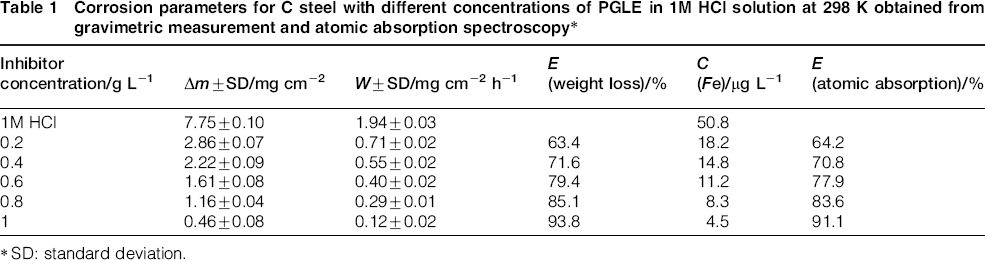
SD: standard deviation.
Electrochemical measurements
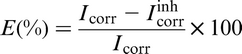
The nature of the inhibition process has been established on the basis of polarisation measurements. Figure 1 represents the kinetics of the anodic and cathodic reactions occurring on C steel electrodes in 1M HCl solutions without and with different PGLE concentrations at 298 K. The corrosion inhibition efficiency E (%) was evaluated from the measured Icorr values obtained from Tafel polarisation method using the relationship
32
 and
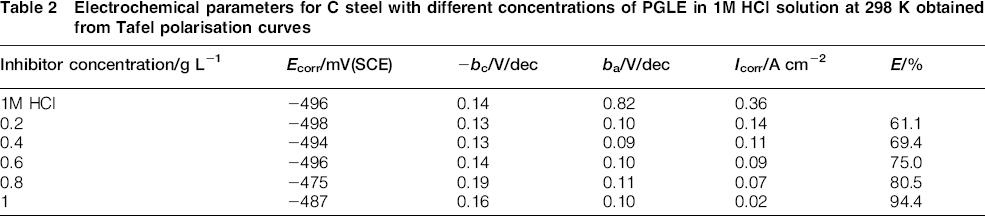
and  are the corrosion current densities without and with the addition of various concentration of the inhibitor at 298 K. Values of all electrochemical corrosion kinetic parameters such as corrosion potential Ecorr, cathodic and anodic Tafel slopes bc and ba and corrosion current density Icorr attained by extrapolation of Tafel lines, as well as inhibitor efficiency, are listed in Table 2. From Fig. 1, it is clear that both the anodic metal dissolution and cathodic hydrogen evolution reactions were inhibited after the addition of PGLE to the aggressive medium. The inhibitions of these reactions are more pronounced with the increasing inhibitor concentration, while the corrosion potential values shifted slightly to more positive direction. Therefore, it could be concluded that PGLE can be classified as mixed type inhibitors but dominantly act as an anodic inhibitor at high concentration for C steel in 1M HCl.
33
The decrease in current density with increasing concentration of PGLE indicates that this compound is adsorbed on the metal surface, and hence, inhibition occurs. This can be explained on the basis that adsorbed inhibitor may form a surface film that acts as a physical barrier to restrict diffusion of ions to or from the electrode surface and hence retard the corrosion process.34,35 Further inspection of Fig. 1 reveals that cathodic current potential curves give rise to parallel Tafel lines, indicating that the hydrogen evolution reaction is activation controlled and the reduction of H+ ions at the C steel surface occurs mainly through a charge transfer mechanism.
36
In agreement with the numerous studies in the literature.37,38 the inhibiting action of the plant extract was due to the adsorption of their organic compounds onto the metal surface and/or by covering the surface with layers of their complex or chelate precipitate with metal ions. The inhibition performance of the plant extract applied in this study is ascribed to the presence in its various compositions of complex organic species, which contained several sites (such as sulphur, nitrogen and oxygen) and/or aromatic ring in their molecular structure that could act as centres for its adsorption on the C steel surface.
are the corrosion current densities without and with the addition of various concentration of the inhibitor at 298 K. Values of all electrochemical corrosion kinetic parameters such as corrosion potential Ecorr, cathodic and anodic Tafel slopes bc and ba and corrosion current density Icorr attained by extrapolation of Tafel lines, as well as inhibitor efficiency, are listed in Table 2. From Fig. 1, it is clear that both the anodic metal dissolution and cathodic hydrogen evolution reactions were inhibited after the addition of PGLE to the aggressive medium. The inhibitions of these reactions are more pronounced with the increasing inhibitor concentration, while the corrosion potential values shifted slightly to more positive direction. Therefore, it could be concluded that PGLE can be classified as mixed type inhibitors but dominantly act as an anodic inhibitor at high concentration for C steel in 1M HCl.
33
The decrease in current density with increasing concentration of PGLE indicates that this compound is adsorbed on the metal surface, and hence, inhibition occurs. This can be explained on the basis that adsorbed inhibitor may form a surface film that acts as a physical barrier to restrict diffusion of ions to or from the electrode surface and hence retard the corrosion process.34,35 Further inspection of Fig. 1 reveals that cathodic current potential curves give rise to parallel Tafel lines, indicating that the hydrogen evolution reaction is activation controlled and the reduction of H+ ions at the C steel surface occurs mainly through a charge transfer mechanism.
36
In agreement with the numerous studies in the literature.37,38 the inhibiting action of the plant extract was due to the adsorption of their organic compounds onto the metal surface and/or by covering the surface with layers of their complex or chelate precipitate with metal ions. The inhibition performance of the plant extract applied in this study is ascribed to the presence in its various compositions of complex organic species, which contained several sites (such as sulphur, nitrogen and oxygen) and/or aromatic ring in their molecular structure that could act as centres for its adsorption on the C steel surface.
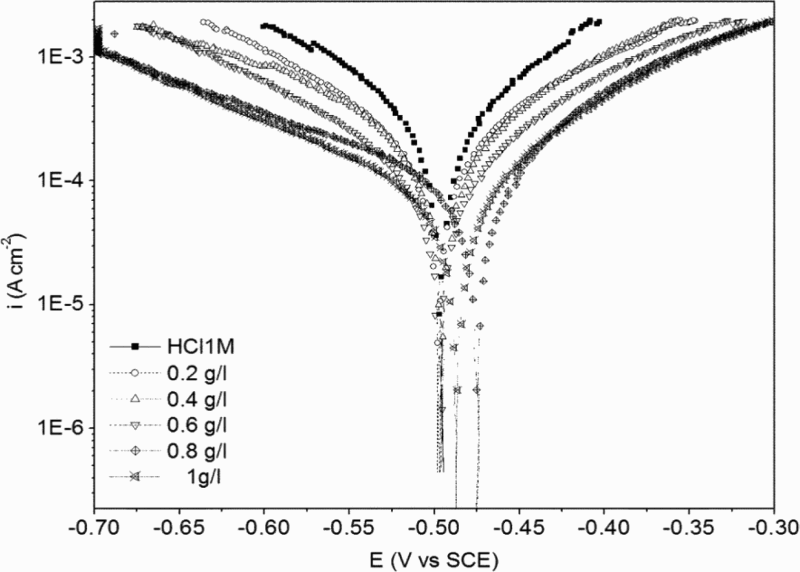
Potentiodynamic polarisation curves of C steel in 1M HCl in absence and in presence of different concentrations of PGLE at 298 K
Electrochemical parameters for C steel with different concentrations of PGLE in 1M HCl solution at 298 K obtained from Tafel polarisation curves
Effect of temperature
Temperature is an important parameter in studies on metal dissolution. Many parameters that influence corrosion in acid solutions can vary with temperature. The corrosion rate in acid solutions, for example, increases exponentially with a temperature increase because the hydrogen evolution overpotential decreases.
38
Analysis of the temperature dependence of inhibition efficiency as well as comparison of corrosion activation energies in the absence and presence of inhibitor may give some insights into the possible mechanism of inhibition adsorption.
39
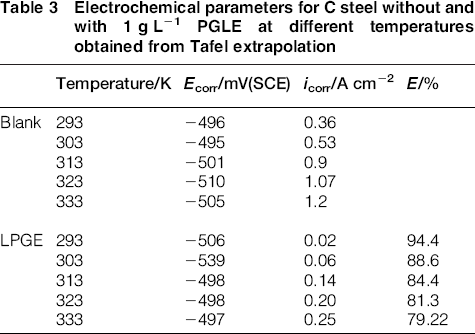
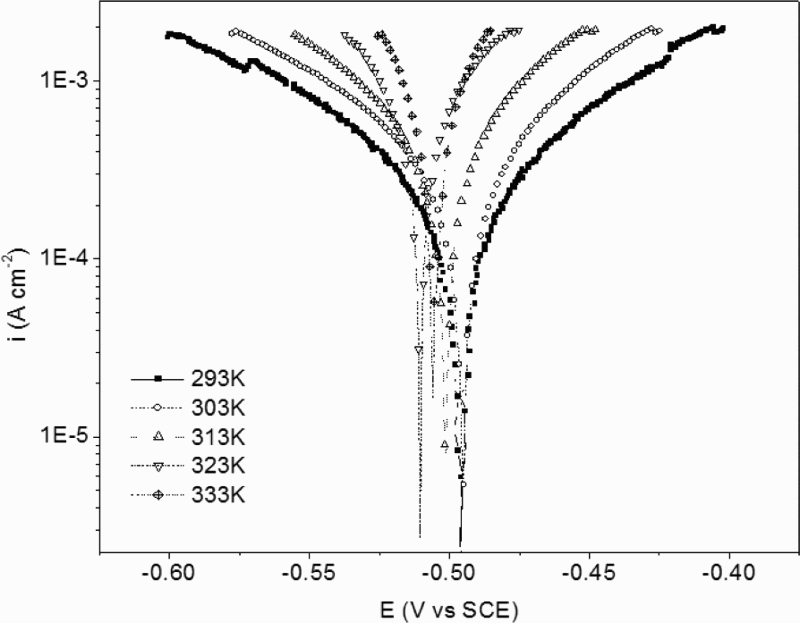
Polarisation curves for C steel in 1M HCl in the absence and presence of 1 g L− 1 PGLE in the temperature range of 293-333 K are shown in Figs. 2 and 3. Electrochemical parameters for the corrosion process as obtained from the Tafel analysis method are reported in Table 3. It can be seen that the current density in the presence of inhibitor are always much less than that of without inhibitor. This indicates that PGLE acts as an efficient inhibitor in the range of temperature studied. The efficiency of PGLE depends on the temperature and decreases with the rise in temperature, which confirms that the corrosion inhibition might be caused by the adsorption of the organic components of PGLE onto the steel surface and higher temperatures might cause their desorption from the steel surface. This can be due to the decrease in the strength of adsorption process at higher temperatures, suggesting that physical adsorption may be the type of adsorption of PGLE on the sample surfaces.
40
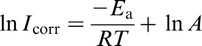
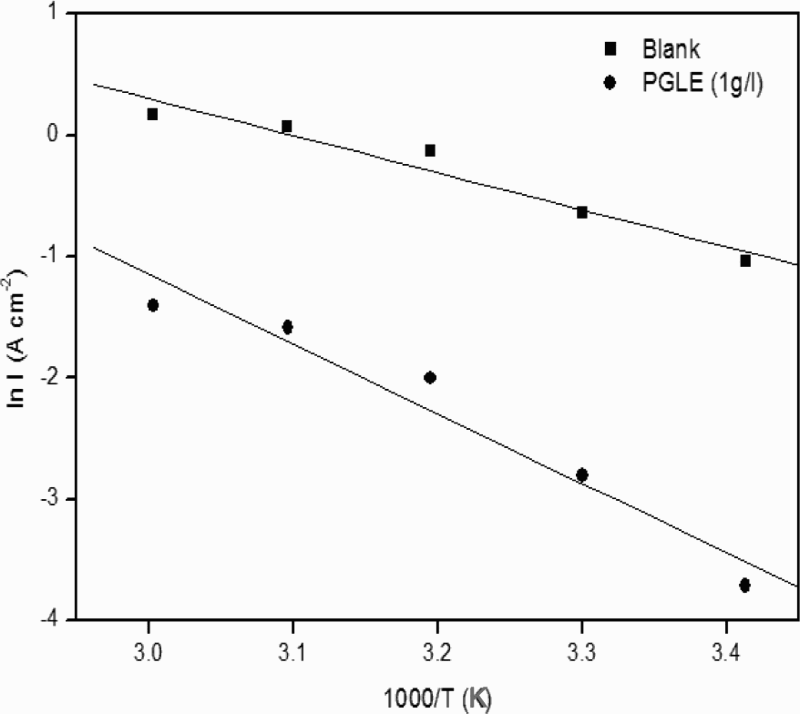
According to the Arrhenius equation, the apparent activation energy Ea for the corrosion process can be determined from slope of ln Icorr against 1/T
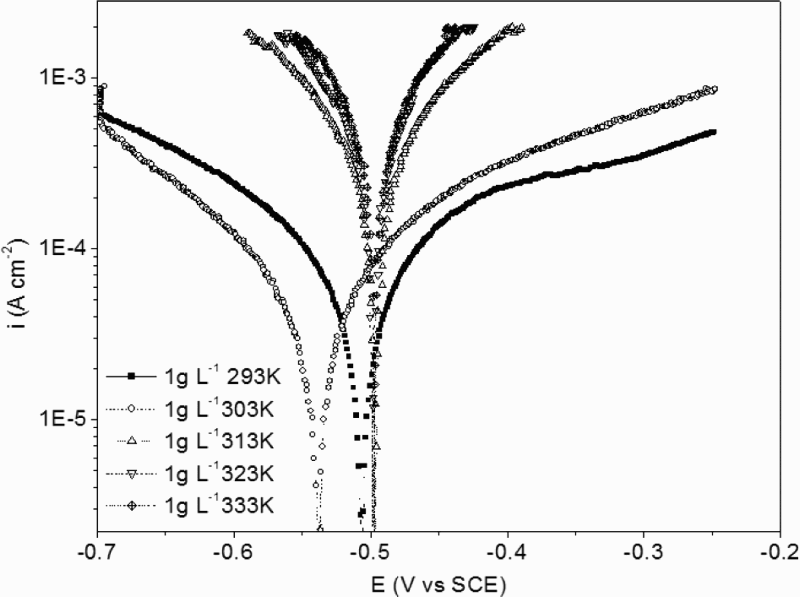
Effect of temperature on polarisation curves of C steel in 1M HCl
Effect of temperature on polarisation curves of C steel in 1M HCl+1 g L− 1 PGLE
Electrochemical parameters for C steel without and with 1 g L− 1 PGLE at different temperatures obtained from Tafel extrapolation
Where E a and  represents the apparent activation energies for the corrosion in the absence and presence of PGLE respectively, R is the universal gas constant, T is the absolute temperature and A is the pre-exponential factor.
Figure 4 shows the Arrhenius plot for the free and inhibited solution, and it is found that the regression coefficients are very close to 1, which means that the linear relationship between ln Icorr and 1000/T is good. The corresponding apparent activation energies for the corrosion in the absence and presence of PGLE were calculated from the slopes of Arrhenius plots and are respectively E a = 25.433 kJ mol− 1 and  = 47.855 kJ mol− 1.
Arrhenius plot related to corrosion rate of C steel for free and inhibited solution
The increase in the activation energies in the presence of inhibitor is attributed to an appreciable decrease in the adsorption process of the inhibitor on the metal surface with increase in temperature and corresponding increase in the reaction rate because of the greater area of the metal that is exposed to acid. 41 A decrease in inhibition efficiency with rise in temperature, with analogous increase in corrosion activation energy in the presence of inhibitor compared to its absence, is good evidence for the physisorption mechanism of PGLE on the C steel surface. 42
Activation parameters of corrosion process
An alternative formulation of the Arrhenius equation is
41

Figure 5 shows a plot of ln(Icorr/T) as a function of 1000/T for the free and inhibited solution. Straight lines were obtained with a slope of − ΔH a/R and an intercept of ln(R/Nh)+ΔS a/R from which the values of ΔH a and ΔS a were calculated for the blank and PGLE. The values of the activation enthalpy (H a were 22.834 and 45.201 kJ mol− 1, and the values of the activation entropy (S a were − 117.446 and − 119.808 J mol− 1 K− 1 for the blank and extract respectively. The positive signs of ΔH a reflect the endothermic nature of the C steel dissolution process, suggesting that the dissolution of mild steel is slow in the presence of the inhibitor.
43
One can notice that the values of ΔH a and E a are nearly the same and are higher in the presence of inhibitor than in a blank solution, indicating that the energy barrier of the corrosion reaction increased in the presence of the inhibitor without changing the mechanism of dissolution.
44
The values of E a are larger than the analogous values of ΔH a, indicating that the corrosion process must involve a gaseous reaction, simply the hydrogen evolution reaction, associated with a decrease in the total reaction volume. Moreover, the value of the difference E a − ΔH a is ∼2.66 kJ mol− 1, which is approximately equal to the value of RT (2.76 kJ mol− 1) that permits to verify the known thermodynamic reaction between the E a and ΔH a as given by equation (7), which indicated that the corrosion process is a unimolecular reaction45,46

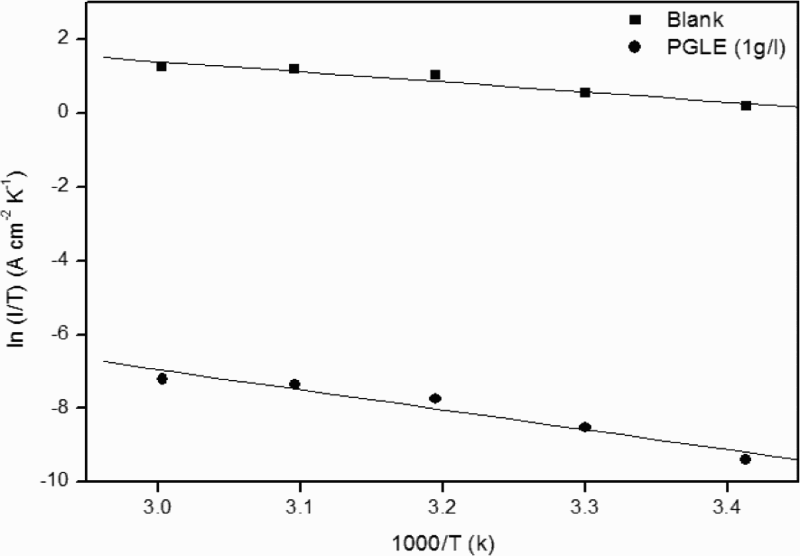
Plot of ln (Icorr/T) as function of 1000/T for free and inhibited solution
The entropy of activation ΔS a was negative both in the absence and in the presence of inhibitor, implying that the activated complex represented the rate determining step with respect to association rather than the dissociation step. This implies that a decrease in disorder occurred when proceeding from the reactants to the activated complex. 47 This observation is in agreement with the findings of other workers.47–49
Adsorption isotherm
In agreement with the numerous studies in the literature, the effective inhibition components in the plant inhibitors are usually organic molecules, and their inhibiting action was due to their adsorption onto the metal surface and/or by covering the surface with layers of their complex or chelate precipitate with metal ions. Generally, their adsorption is attributed to the presence of nucleophilic atoms (such as phosphorous, sulphur, nitrogen and oxygen) and triple bond or aromatic ring in their molecular structure. One of the most convenient ways of expressing adsorption quantitatively is by applying an adsorption isotherm that gives the relationship between the coverage of an interface with an adsorbed species (the amount adsorbed) and the concentration of the species in solution. This allows the inhibition efficiency to be expressed as a function of the inhibitor concentration at a constant temperature. The fractional surface coverage θ can be easily determined from polarisation and weight loss measurements by the ratio E (%)/100.37,40 In order to acquire a better understanding of the adsorption mode of the corrosion inhibitor on the surface of the C steel, the data obtained from the two different techniques were tested with several adsorption isotherm including Langmuir, Temkin, Frumkin and Freundluich. Best fit of a correlation between surface coverage θ and concentration of inhibitor Cinh in electrolyte was obtained with the Langmuir adsorption isotherm, which is given by28,37
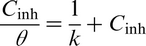
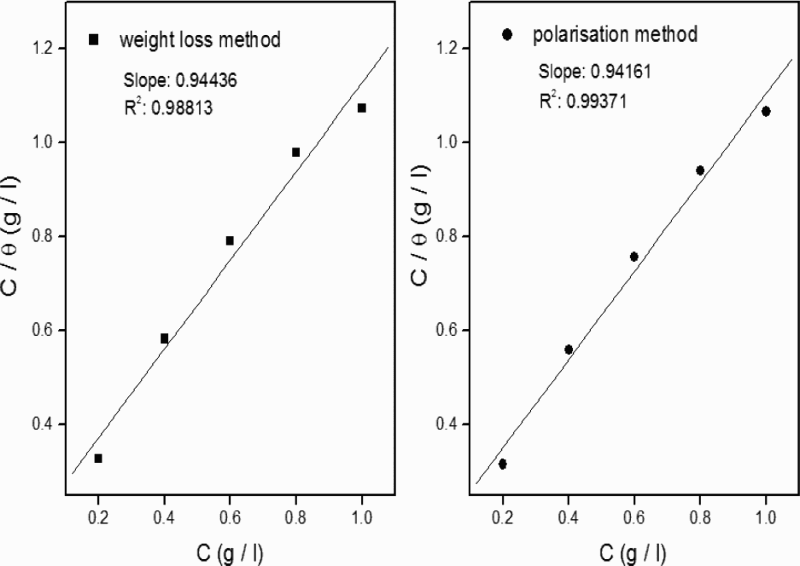
Curves fitting of corrosion data for C steel in 1M HCl at 298 K for inhibited solution according to Langmuir isotherm adsorption determined from polarisation and weight loss measurements
Thermodynamic parameters of corrosion process
The fundamental thermodynamic functions are very important to explain the adsorption phenomenon of inhibitor molecules. Using the obtained adsorption coefficients, the heat of adsorption, free energy of adsorption and adsorption entropy can be calculated. From the intercept of the straight line of C/θ axis, one can calculate K ads, which is related to the standard free energy of adsorption ΔG ads, as given by equation (8)
50

The calculated values of free energy of adsorption obtained from the different methods used (polarisation and weight loss measurements) were in good agreement and were found to be − 21.254 and − 20.953 kJ mol− 1 respectively. The negative values of ΔG ads suggest the spontaneity of the adsorption process and stability of the adsorbed layer on the metal surface, as well as a strong interaction between the PGLE molecules and the metal surface. 51 Generally, the values of ΔG ads around or less than − 20 kJ mol− 1 are associated with the electrostatic interaction between charged molecules and the charged metal surface (physisorption), while those around or higher than − 40 kJ mol− 1 mean charge sharing or transfer from the inhibitor molecules to the metal surface to form a coordinate type of metal bond (chemisorption). In the present case, the values of ΔG ads are around − 20 kJ mol− 1, which means that the absorption of PGLE on the C steel surface belongs to the physisorption, and the adsorptive film has an electrostatic character. 52 Moreover, the decrease in inhibition efficiency with the increase in temperature may support that the adsorption of PGLE on the C steel surface is physical in nature.
The Langmuir adsorption isotherm may be expressed by equation (9)
53
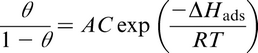
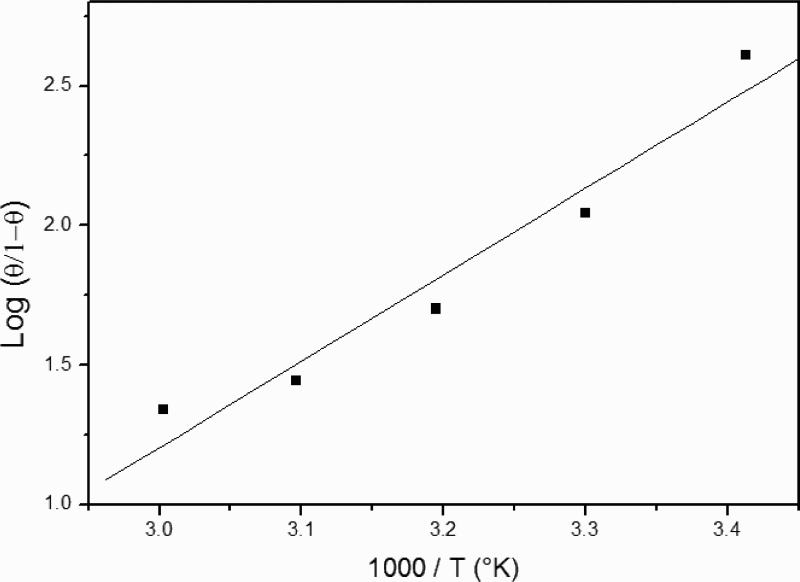
Plot of ln [θ/(1 − θ)] versus 1/T at constant additive concentration (1 g L− 1) of PGLE
The entropy of PGLE adsorption ΔS ads can be calculated using the relation

From equation (10), we obtained negative (ΔS ads) values as − 15.3 J mol− 1 K− 1. The negative value of (ΔS ads) might be explained as follows: before the adsorption of inhibitor onto the C steel surface, PGLE molecules might freely move in the bulk solution, but with the progress in the adsorption process, PGLE molecules were adsorbed in orderly fashion onto the C steel surface, resulting in a decrease in entropy. 53 In general, adsorption produces a certain order in the system, giving negative entropy. This is the case with the adsorption of many plant extracts56,57 and is what we found for PGLE adsorption on the C steel surface.
Fourier transform infrared spectroscopy analysis
It is well established that FTIR analysis permits spectrophotometric observation of the adsorbent surface in the range of 400-4000 cm− 1 and serves as a direct means for the identification of functional groups on the surface. Since PGLE contained organic compounds, and these organic compounds were adsorbed on the metal surface providing protection against corrosion. Thus, FTIR analyses of metal surface can be useful for predicting whether organic inhibitors are adsorbed or not adsorbed on the metal surface. 56 Fig. 8 shows FTIR spectra of the film layer formed on the C steel surface in 1M HCl, with and without 1 g L− 1 PGLE (A and B), as well as that of PGLE alone (C). The FTIR spectrum of the PGLE showed the major absorption bands at 3378 and 1732 cm− 1, which correspond to –OH stretching of phenolic group and carboxyl group respectively. Further, the absorption bands at 1618 and 1452 cm− 1 were due to the presence of aromatic –C = C– bond in the extract. The other absorbance bands at 2933 and 1060 cm− 1 indicate the presence of –CH2 and C–O. 59 Earlier researchers have reported the presence of ellagitannins, flavones and cyslitol carboxylic acids in PGLE. 27 The presence of absorption bands due to –OH stretching of phenolic group and –COOH group vouched for the same. The FTIR spectrum of the film layer formed on the C steel surface in 1M HCl without PGLE showed absorption peaks between 472 and 1024 cm− 1, corresponding to the corrosion products of ferric hydroxide and magnetite. It can be noted that the presence of γ-FeOOH, α-FeOOH, δ-FeOOH and α-Fe3O4 is confirmed by the appearance of peaks at 1024 cm− 1 (γ-FeOOH), 884 cm− 1 (α-FeOOH), 472 cm− 1 (δ-FeOOH) and 579 cm− 1 (α-Fe3O4). The bands at 1635 and at 3432 cm− 1 correspond to the water adsorption.60,61 From Fig. 8, it is evident that the spectrum curve obtained for the film layer formed on the C steel surface in 1M HCl in the presence and absence of PGLE are almost super imposable and suggest iron oxide to be the major constituent. In other words, peaks that correspond to each other in the same frequency are obtained (Fig. 8, A and B). Distinctive characteristic peaks in PGLE spectra disappeared completely. According to this conclusion, PGLE is adsorbed physically on the metal surface. 62
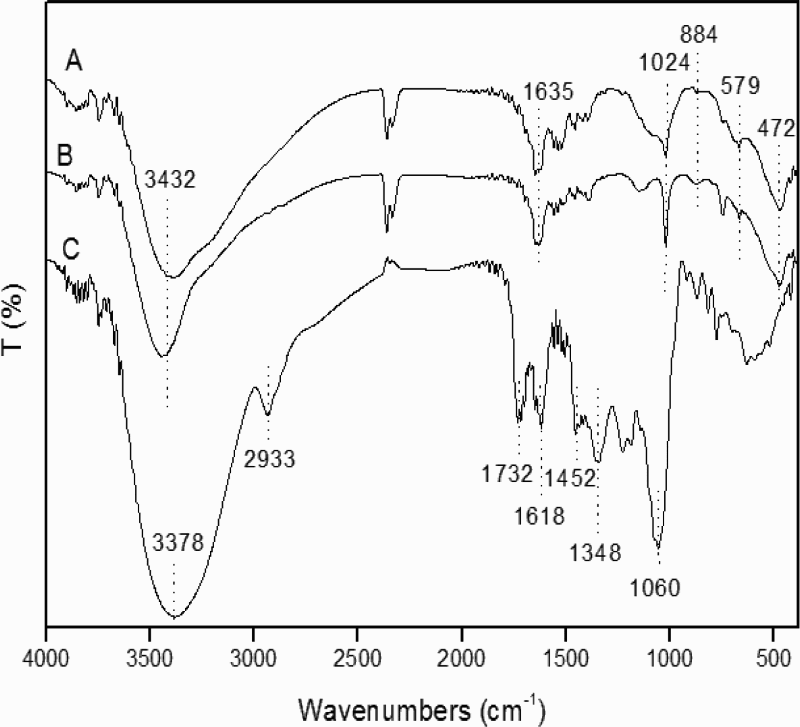
Fourier transform infrared spectra of film layer formed on C steel surface in 1M HCl, with and without 1 g L− 1 PGLE (A and B) as well as that of PGLE alone (C)
X-ray diffraction analysis
X-ray diffraction is one of the most versatile techniques for materials characterisation. This is an excellent tool for compound identification when a material has atomic scale periodicity or crystallinity. Consequently, the XRD method must be effective for in situ analysis of constituent species in corrosion products formed by reaction with aqueous solution. This prompts us to systematically carry out in situ XRD analysis of corrosion products formed on the C steel electrode surface under various conditions. Figure 9 (A and B) shows the detail of XRD data corresponding to the phases presents in the corrosion products formed on the C steel electrode surface exposed to aqueous HCl solution in the presence and in the absence of PGLE. In the absence of inhibitor, the XRD pattern shows that the C steel electrode surface was mainly composed of F3O4 (magnetite), FOOH (goethite), F2O3 (hematite) and Fe (matrix), which frequently appears as corrosion products. The XRD pattern obtained from the C steel electrode surface in the presence of PGLE is fundamentally similar to that obtained for corrosion products formed on the C steel electrode surface without inhibitor. The pattern did not show any sign of film or complex layer formation on the C steel electrode surface. From this fact, it can be drawn that inhibitor (PGLE) is potentially adsorbed on the C steel surface through physisorption instead of forming a protective barrier type complex layer by chemisorption. The FTIR examination of C steel electrode surface and the ΔG ads and ΔH ads values that are obtained from the Langmuir adsorption isotherm also supports this result.
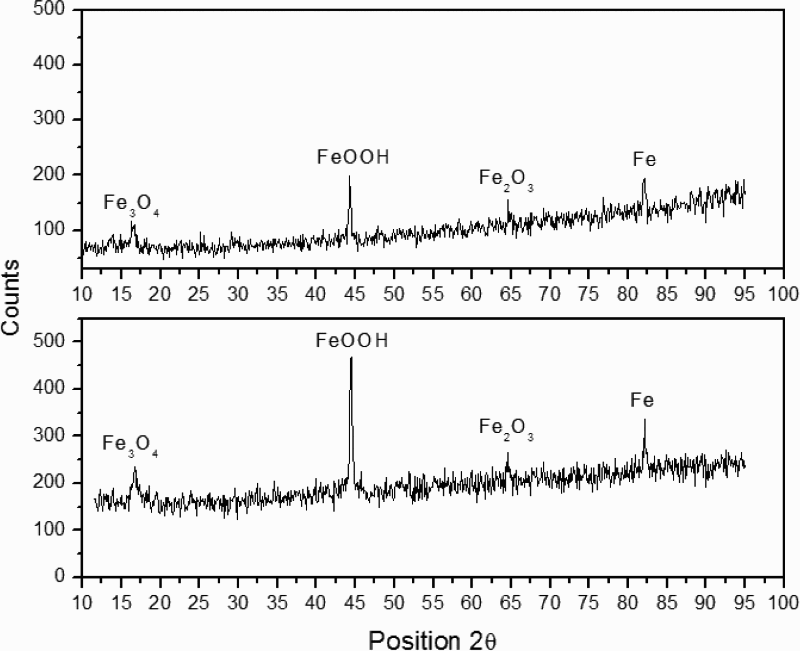
X-ray diffraction pattern of phases present in corrosion products formed on C steel electrode surface exposed to aqueous HCl solution in presence and in absence of PGLE
Conclusions
In this study, corrosion inhibition efficiency of PGLE on carbon steel in 1M HCl medium was determined by weight loss, polarisation, FTIR spectroscopy and XRD analysis. Results evidenced that this green inhibitor showed excellent performance (more than 80% at 1 g L− 1) against corrosion of C steel in 1M HCl in the temperature range of 293-333 K. Polarisation curves recording has shown that the addition of PGLE acts as a mixed type inhibitor with anodic as its dominant inhibitor at high concentration. The inhibition efficiency measured through weight loss test and Tafel polarisation is in reasonable agreement. The adsorption of PGLE molecules on the C steel surface was found to obey the Langmuir adsorption isotherm. On the basis of activation energy, free energy of adsorption and the experimentally observed increase in inhibition at low temperatures, a spontaneous and physically adsorption process is proposed for the inhibitory action of PGLE. The FTIR and XRD examination of the C steel electrode surface also support this result.