







Abstract
The oxidation behaviour of transition metal diboride ceramics is reviewed with emphasis on the performance of zirconium diboride and hafnium diboride. First, the oxidation behaviour of nominally pure diborides is discussed, focusing on the transition to linear mass gain kinetics at temperatures above ∼1100°C. Next, the use of SiC and other additives that produce silica based scales when oxidised is reviewed. These additives improve oxidation protection due to the formation/stability of the outer layer of borosilicate glass that acts as a barrier to diffusion of oxygen to the substrate. However, elevated temperatures (>1650°C) and/or the combination of aerodynamic flow, high heat flux and reactive atmosphere associated with hypersonic flight destabilises the outer oxide and decreases oxidation protection. Other additives that affect the composition and structure of the crystalline oxide scale without forming an outer glassy layer are a promising approach to improving oxidation behaviour of diborides. These additives require further research to understand the mechanisms of improved protection and further optimise the protective behaviour. While the oxidation of ultra-high temperature diborides has been studied for many years, several possible areas for future research are identified.
Introduction
Ultra-high temperature ceramics (UHTCs) are a family of materials that include a number of borides, carbides and nitrides of early transition metals.1 One criterion that has been used to define this family of materials is a melting temperature of 3000°C or higher, although other criteria such as the ability for continuous use at temperatures above 1600°C can also be used. From this broader family of materials, the refractory diborides, and more specifically ZrB2 and HfB2, exhibit an unusual combination of ceramic-like strength (500 MPa or higher at room temperature) 2 2,3 and elastic modulus (∼500 GPa at room temperature)4 with metal-like electrical (∼107 S m−1) and thermal (>60 W m−1 K−1) conductivities.5 Some of the relevant physical properties of ZrB2 and HfB2 are summarised in Table 1. 6 6,7 Based on their combination of properties, ZrB2 and HfB2 are candidates for applications ranging from high temperature electrodes, cutting tools and molten metal containment to microelectronic buffer layers.8 – 13 While transition metal diboride compounds have been studied for over 100 years,14 it was not until the 1940s and 50s that the first significant processing–structure–property studies were reported. 15 15,16 Through the 1960s and early 1970s, ZrB2 and HfB2 emerged as candidates for a variety of aerospace applications, which resulted in significant research efforts in both the US and the former Soviet Union.17 – 19 During the past 15 years, these compounds have been the subject of renewed attention for aerospace applications related to hypersonic flight, rocket propulsion and atmospheric re-entry.20 – 23 In particular, the refractory diborides possess a combination of strength at elevated temperatures and thermal conductivity that provides improved thermal shock performance in high heat flux conditions compared to other ceramics.24 – 26 As a result of their desirable properties, ZrB2 and HfB2 are candidates for components on future hypersonic vehicles that undergo intense aerodynamic heating such as leading and trailing edges or engine cowl inlets.27 – 30
Overview of physical properties of ZrB2 and HfB2
The US Space Shuttle Orbiter has been the only reusable atmospheric re-entry vehicle for the past 30 years. The Shuttle employs a blunt edge design to mitigate the intense heat associated with atmospheric re-entry.31 As shown schematically in Fig. 1a , the blunt surfaces produce a shock wave ahead of the vehicle that deflects some of the heat away from the surface by transferring much of the kinetic energy to the air behind the vehicle rather than the leading edges or other vehicle surfaces.32 The combination of re-entry trajectory and vehicle design limits the maximum surface temperatures on the nose cap and leading edges to ∼1650°C, but reduces the maneuverability and cross-range of the Shuttle. In contrast, hypersonic vehicles which employ sharp leading edge designs increase maneuverability and cross-range.33 Increased maneuverability requires laminar flow across the control surfaces, which, in turn, necessitates the use of sharp leading edges. Although the maximum surface temperatures depend on factors including speed and radius of curvature,34 temperatures in excess of 2000°C are predicted for sharp leading edges of most hypersonic vehicles due to the high heat flux impinging directly on the sharp tip.35 As a result of the heat flux at the sharp tip, heat must be conducted away from the tip and through the leading edge so that it can either be dissipated by reradiation from cooler surfaces away from the leading edges (Fig. 1b ) or transferred internally to a more complex, active cooling system.36 The surface temperatures encountered by sharp leading edges or as other potential applications mean that oxidation resistance is a critical property of the refractory diborides.37
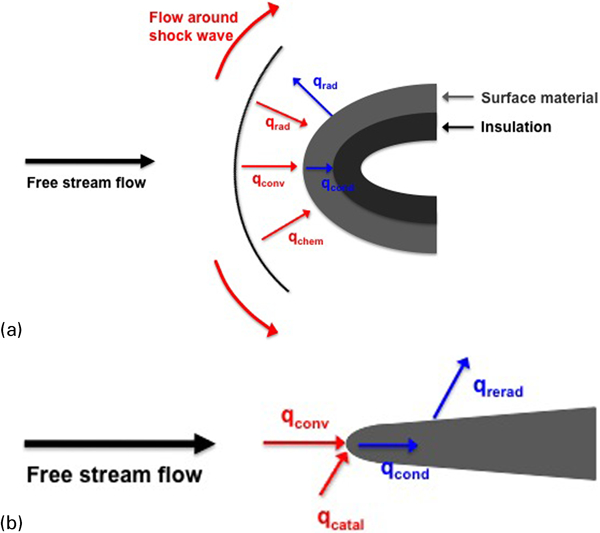
Notional representations of leading edges of hypersonic aerospace vehicles with a blunt and b sharp leading edges showing the effects that lead to heating by convective flow to the surface q conv, radiation through the boundary layer q rad, chemical reactions in the boundary layer q chem and surface catalysis q catal with heat dissipation by conduction away from the surface q cond and reradiation q rerad
Historical studies concluded that the relative oxidation resistances of ZrB2 and HfB2 were superior to those of other transition metal diborides.38 Hence, studies focused on aerospace applications have concentrated on these materials as will this review. The purpose of this paper is to critically review historical and recent research related to the oxidation behaviour of ultra-high temperature diboride ceramics with emphasis on ZrB2 and HfB2.
Oxidation of transition metal diborides
Zirconium and hafnium diborides undergo stoichiometric oxidation according to reactions (1) and (2).39 The expressions for the change in standard state Gibbs' free energy with reaction (▵G°rxn) were calculated for the temperature range from room temperature (∼25°C or 300 K) to ∼2000°C (2275 K) using data from the standard reference tables40 (reaction (1)) and thermodynamic software (reaction (2)).41 

Both ZrB2 and HfB2 exhibit mass gain kinetics consistent with diffusion limited processes in the low temperature regime. The upper limit of this regime depends on factors such as external pressure, oxygen partial pressure and gas flowrate, but is generally considered to be between 1100 and 1200°C in static air. Below the transition temperature, a protective oxide scale forms on the surface of ZrB2 and HfB2 and both ceramics show parabolic trends for mass gain, scale thickness and oxygen consumption as a function of time. 39 39,42 Historical43 and current (Fig. 2a ) analyses of cross-sections of oxidised specimens reveal a two layer oxide scale that consists of an outer layer of glassy B2O3 and an inner layer that contains porous ZrO2 with the pores filled by glassy B2O3. More recently, Parthasarathy et al. 44 – 46 developed an oxidation model for TiB2, ZrB2 and HfB2 showing that the oxidation rate is limited by the diffusion of oxygen through B2O3 (i.e. transport of oxygen through ZrO2 is negligible). Based on the combination of historical and recent experimental and modelling results, diborides exhibit passive oxidation behaviour with the formation of a protective oxide scale in the low temperature regime.
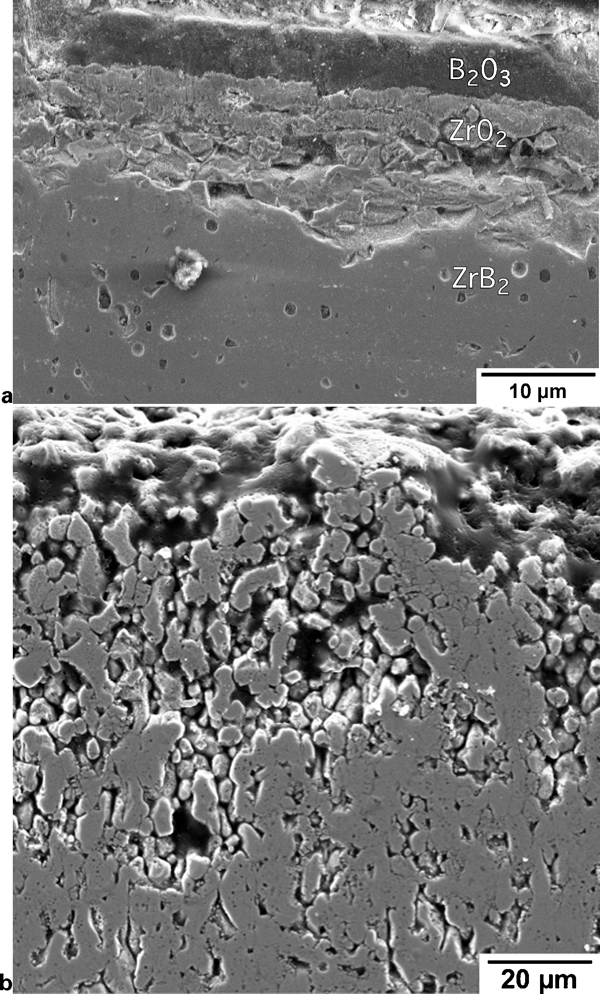
Cross-section images of oxide scale on nominally pure ZrB2 oxidised in air at a 900°C for 8 h (oxide layer thickness, ∼10 μm) and b 1500°C for 2 h (oxide layer thickness, ∼400 μm)
In the high temperature regime (i.e. above ∼1200°C), the oxidation behaviour of the diborides changes.42,47 – 49 Microstructural analysis (previous 43 43,50 and Fig. 2b ) reveals that loss of protection for ZrB2 coincides with evaporation of B2O3 from the oxide scale. Thermodynamic models that employ either volatility diagrams 37 37,51 or kinetic models, such as the one proposed by Parthasarathy et al.,44 support the evaporation of B2O3 as the cause of the transition. Thermodynamic models predict vapour pressures of the various gaseous boron oxides that form as a function of external conditions such as temperature, oxygen partial pressure, etc. As shown in Fig. 3, B2O3 (g) is the predominant vapour species formed by evaporation of B2O3 in air at 1500°C. Although B2O3 volatilises over a wide range of conditions, changes in the partial pressure of oxygen in the external atmosphere (shown on diagram) or temperature at which oxidation occurs (shown in volatility diagrams in Ref. 51) affect the predominant species in the vapour phase. HfB2 exhibits the best oxidation resistance of the diborides over this temperature range because the oxide layer that remains after B2O3 evaporation has a more equiaxed microstructure, which gives it greater resistance to oxygen transport.39 Although ZrB2 is inferior to HfB2, both have significantly better oxidation protection than other diborides such as TiB2, TaB2 and NbB2.1
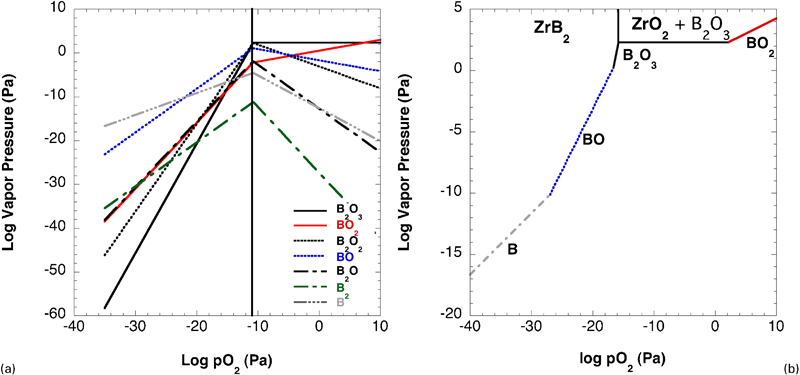
a vapour pressure of various B–O species as function of oxygen partial pressure at 1500°C and b ZrB2 volatility diagram based on calculations described in Ref. 51
Direct comparisons of historical and recent oxidation results for nominally pure diborides is difficult due to lack of convention in reporting results. Whereas historical studies have used a combination of mass gain, scale thickness, parabolic rate constant and oxygen uptake as a function of temperature and time, more recent studies have focused on thermal gravimetric analysis (TGA) to measure mass gain as a function of temperature and/or time. In addition, differences in oxidation temperature and time also complicate direct comparison, but Table 2 provides an overview of some historical and recent reports.52 Where direct comparisons are possible for nominally phase-pure diborides, the trends are consistent, but the quantitative values do not agree. For example, Tripp and Graham49 reported a mass gain of 3·3 mg cm−2 for pure ZrB2 heated to 1300°C for 2 h, which is in the linear kinetic region. For comparison, Opeka et al. 53 reported a mass gain of 9·8 mg cm−2 for the same oxidation conditions. No obvious differences in density, composition or microstructure can be identified as the cause of the difference in mass gain. Based on the model of Parthasarathy et al.,44 small changes in the fraction of porosity in the ZrO2 have a significant effect on the oxidation rate. Trace impurities in the diborides are one potential cause of the differences in oxidation behaviour, an idea that is discussed in more detail in the sections that follow.
Summary of historical and recent oxidation results for nominally pure ZrB2 and HfB2 ceramics
As mentioned above, research related to aerospace applications has focused on ZrB2 and HfB2. However, because of the technological importance of TiB2 in a number of applications, several studies, including Parthasarathy’s modelling reports,44 have examined the oxidation resistance of TiB2. 50 50,54 Only the historical studies performed by Manlabs examined the oxidation resistance of other nominally phase-pure diborides in detail,55 although one recent report discussed the oxidation resistance of TaB2.56 By TGA, nominally phase-pure TaB2 gained ∼20 mg cm−2 when heated to 1500°C compared to ∼6·5 mg cm−2 for nominally phase-pure ZrB2 heated under the same conditions. This study did not provide new insight into the behaviour, but served to reinforce previous conclusions about the increased relative oxidation rates of other diborides.
Furnace oxidation studies, such as those described above, do not reproduce conditions that are representative of extreme environments such as the aerothermal heating encountered during hypersonic flight. While the conclusions of these studies provide insight into oxidation mechanisms and may be useful for screening candidate materials, hypersonic flight produces higher heat fluxes, dissociated gaseous species and gas flowrates that cannot be duplicated in typical laboratory furnaces.1 Specialised facilities such as arc heaters,57 plasma wind tunnels58 and inductively coupled plasma facilities59 have been developed to test materials in more realistic environments. Only a limited number of published papers have reported the behaviour of nominally phase-pure diborides in environments relevant to hypersonic flight. For surface temperatures reaching up to ∼2500°C (no heat flux reported), oxide scale thicknesses on ZrB2 reached ∼250 μm in 1800 s (30 min).60 For comparison, the same material had an oxide scale ∼2·5 mm (2500 μm) thick after furnace oxidation at ∼2000°C for 1800 s (30 min). The harsher conditions of the arc heater may have resulted in a thinner scale due to loss of material by evaporation and/or flowoff of the surface during testing. However, the limited number of experimental studies do not allow for strong conclusions to be drawn about the behaviour of the material. Further, it could be concluded that the more severe conditions encountered during arc heater testing may promote the formation of an oxide scale (ZrO2 or HfO2) having a higher density that is more protective than the scale formed in static laboratory furnace tests.
Oxidation of diboride ceramics containing SiC
The relatively poor oxidation resistance of nominally phase-pure diborides at temperatures above ∼1200°C motivated researchers to investigate a number of approaches to improving oxidation resistance including solid solution additions, synthesising ternary diboride compositions and adding second phases.61 The most promising approach was found to be the addition of SiC as a second phase, which reduced the thickness of the oxide scale across a wide temperature range when compared to either a pure diboride or pure SiC (Fig. 4). 61 61,62 The improved oxidation resistance was attributed to the formation of a stable borosilicate glass layer on the surface of the oxidised ceramics.43 Since this pioneering work, research on oxidation resistant ZrB2 and HfB2 based compositions with silica scale forming additions has resulted in a significantly larger body of work on SiC containing materials than other systems. The rest of this section discusses recent progress on the most common approach for improving the oxidation behaviour of diboride ceramics, which is the addition of SiC.
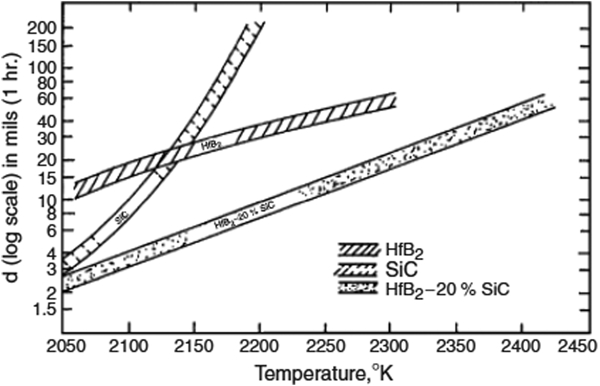
Comparison of mass gain as function of temperature for 1 h oxidation in air for HfB2, SiC and HfB2–SiC (reprinted with permission from Ref. 61, copyright 1968, The Metallurgical Society of AIME): note that 1 mil≈25 μm
Several groups have studied the effects of SiC additions on the behaviour of diborides when exposed to air at elevated temperatures. The reported behaviour is summarised in Table 3 and discussed in more detail below. Below ∼600°C, exposure of diboride based ceramics to air or oxygen results in no significant mass gain,63 which indicates that oxygen transport through the native oxide layer is negligible in this temperature regime. As the temperature increases to ∼1100°C, cumulative mass gains on the order of 1–2 mg cm−2 have been observed by TGA, 64 64,65 indicating oxygen transport through the oxide layer becomes more rapid. For temperatures less than ∼1100°C, mass gain measurements showed that the oxidation behaviour of SiC containing diborides was not affected by the SiC additions. Examination of the oxide scale revealed that ZrB2 or HfB2 oxidised preferentially at these temperatures, which produced an oxide scale containing B2O3, ZrO2 or HfO2, and leaving the SiC mainly unoxidised.66
Summary of oxidation behaviour of SiC containing ZrB2 and HfB2 ceramics
As the temperature increases to 1100°C and above, B2O3 evaporation becomes significant and SiC begins to oxidise. The formation of borosilicate glass in this temperature regime results in parabolic mass gain kinetics with parabolic rate constants in the range of 10−8–10−6 kg2 m−4 s−1, as reported by several authors.66 – 68 Hence, oxidation at temperatures accessible in typical laboratory furnaces with air atmospheres or TGA equipment (i.e. up to ∼1600°C) is consistent with the formation of a protective oxide layer composed of borosilicate glass, a conclusion that has also been supported by computational modeling. 69 69,70 After furnace oxidation at temperatures between 1100 and 1600°C, the formation of a SiC depleted region has been observed by some researchers (Fig. 5a ), 38 43 64 66 38,43,64,66,67 but not by others (Fig. 5b ). 63 71 63,71,72 In this temperature regime, the oxide scale consists of an outer layer of borosilicate glass, a layer of mixed ZrO2 and SiO2, a partially oxidised layer, and the underlying unoxidised ceramic. This structure was shown most distinctly in ZrB2–SiC that underwent cyclic oxidation at 1627°C (Fig. 6).66 The depletion of SiC from the partially oxidised layer has been attributed to active oxidation of SiC due to the oxygen activity gradient through the outer layer of dense glassy oxide.73 Without SiC depletion, the partially oxidised layer can consist of either ZrO2 or a graded structure consisting of ZrO2 closer to the outer surface and ZrB2 closer to the unoxidised material. For SiC depletion, either type of partially oxidised layer would then also contain voids corresponding to the places where SiC particles were present in the original material. No study has yet addressed the reasons that SiC depletion has been observed in some materials, but not others; however, a combination of compositional and microstructural factors likely control the microstructure that develops in the oxide scale (i.e. SiC depletion or not). For example, assuming that SiC depletion relies on active oxidation of SiC, then depletion could only occur when the SiC particles formed an interconnected three-dimensional network.
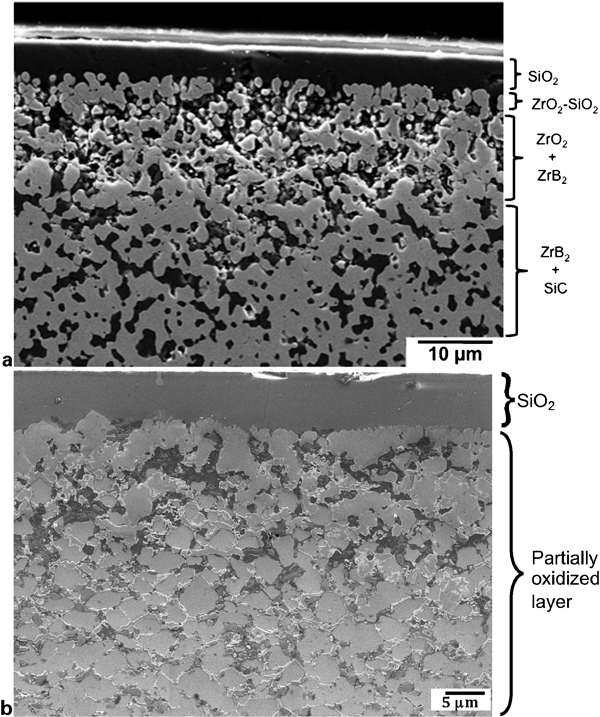
Scanning electron micrographs of oxidised diboride ceramics containing SiC, a ZrB2–SiC oxidised at 1500°C showing partial SiC depletion (reprinted with permission from Ref. 64, copyright 2007, Elsevier) and b the outer and intermediate layers on HfB2–SiC oxidised at 1350°C showing no SiC depletion (reprinted with permission from Ref. 63, copyright 2003, The Electrochemical Society)
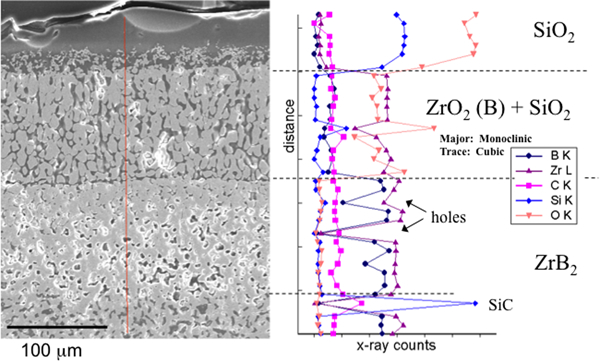
The layered structure that developed on ZrB2–SiC oxidised by heating to 1627°C for 10 cycles. The oxide scale consists of an outer layer of SiO2, a layer of ZrO2 and SiO2, and a layer of SiC depleted ZrB2 on top of unreacted ZrB2–SiC (reprinted from Ref. 66 with permission, copyright 2001, The American Ceramic Society; all rights reserved)
Far fewer studies have examined the oxidation behaviour of diboride materials at temperatures beyond ∼1600°C. Research from the 1960s and 70s evaluated oxidation behaviour up to ∼2200°C,61 but more recent studies have typically been limited to ∼1600°C. Thermodynamic analysis predicted loss of protection of the oxide scale at temperatures above 1600°C due to gas pressure beneath the scale causing bubbles/voids in the scale,37 which was later confirmed by in situ observations of oxidising ZrB2–SiC.74 Although bubble formation was predicted to occur at temperatures as low as 1450°C for oxidation times of >6 h, the incubation period required before bubble nucleation was much lower at 1600°C and above, decreasing from ∼1 h at 1600°C to nearly instantaneous at 1650°C.74 Pushing temperatures to 1800°C and above causes bubble formation and eventual loss of the glassy oxide along with coarsening of the crystalline oxide and voids.75 – 77 In this temperature regime, oxidation behaviour is determined by the microstructure of the crystalline oxide (ZrO2 or HfO2) present on the surface.75
In addition to furnace oxidation and TGA studies that have been used to determine oxide layer thicknesses and mass gains as functions of time and/or temperature, recent progress has been made in the use of real time observations of growing oxide layers. Because diborides are electrically conductive, direct heating of specimens is possible using conventional furnace power supply and control systems. 74 74,78 Direct heating allows observation of the specimen surface during oxidation, which has led to discoveries related to liquid convection and oxide particle transport during oxidation. 79 79,80 Notably, this technique has led to the identification of zirconia rich nodules that grow up and through the liquid oxide (Fig. 7). The presence of these nodules has provided insight into potential causes for the variability in thicknesses of the outer glassy oxide and underlying partially oxidised regions noted by some authors. 68 81 68,81,82
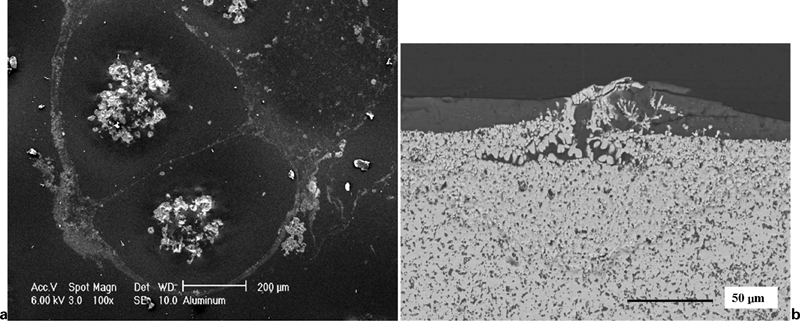
Images of ZrB2–SiC after oxidation at 1550°C showing a lighter coloured ZrO2 rich nodules protruding through the darker glassy surface oxide layer (reprinted from Ref. 74 with permission, copyright 2010, The Journal of the European Ceramic Society) and b the cross-section of a lighter coloured ZrO2 rich nodule extending through the outer glassy oxide layer (reprinted from Ref. 79 with permission, copyright 2007, The Journal of the American Ceramic Society)
The external atmosphere has a strong effect on the oxidation behaviour of diboride based ceramics. Because of proposed applications in propulsion systems, the effect of water vapour was examined on the oxidation behaviour of HfB2 and ZrB2 ceramics.83 The oxidation rates of the UHTCs were comparable in stagnant air and an atmosphere of 90% water vapour and 10% oxygen. However, the UHTCs showed significant degradation in flowing water vapour due to silica volatilisation.83 In addition, the effect of oxygen partial pressure has been evaluated in historical and recent studies. 61 75 61,75,84 At oxygen partial pressures ranging from pure oxygen (1 atm or 101 325 Pa) to ∼20 Pa, the scale thickness and mass gains appear comparable. 68 68,75 However, oxidation at an oxygen partial pressure of ∼10−10 Pa at 1500°C resulted in active oxidation of SiC along with conversion of the ZrB2 to ZrO2 with the loss of B2O3 by evaporation.84 The latter experiment verified thermodynamic predictions regarding the mechanism of SiC depletion by active oxidation that was proposed based on experimental observations and thermodynamic calculations. 66 66,73
Other additives have been used in combination with SiC to further improve the oxidation resistance of refractory diborides. Opila investigated the addition of TaSi2 to ZrB2–SiC and HfB2–SiC ceramics and found improved oxidation resistance in ZrB2–SiC at 1627°C, but degraded performance at higher temperatures.85 The addition of TaSi2 did not affect the oxidation behaviour of HfB2–SiC.85 Talmy et al. 37 studied the addition of 10 mol.-% CrB2, TiB2, NbB2, VB2 or TaB2 to ZrB2–SiC and showed that the additives increased resistance to oxidation (Fig. 8). The authors reported that the outer glassy layer underwent phase separation due to the high cation field strength of the transition metal additives, which improved the oxidation resistance of the resulting ceramics by increasing the viscosity and decreasing the oxygen diffusivity through the oxide scale that formed on the surface of the diboride ceramic.37 More recent studies have revealed that addition of TaB2 and/or TaSi2 to ZrB2–SiC modified the morphology of ZrO2 in the oxide scale produced at temperatures up to 1500°C. 86 86,87 For additions of a few mole per cent (e.g. 3·3 mol.-%), the oxide scale had grains with a more equiaxed shape which increased retention of the borosilicate glass and improved oxidation resistance.86 For higher contents of Ta based compounds, the additions appeared to promote coarsening of the crystalline phases in the oxide scale and the formation of ZrO2 dendrites that penetrated the outer glassy layer, both of which degraded oxidation protection.87 Complementing the use of Ta based additives, the oxidation behaviour of TaB2–SiC has also been examined, with TGA studies revealing that TaB2 containing 20 vol.-%SiC gained ∼3·0 mg cm−2 when heated to 1450°C,88 compared to ∼2·5 mg cm−2 for ZrB2 containing 20 vol.-%SiC heated under nominally the same conditions.65 LaB6 was also identified as a beneficial additive to ZrB2–SiC based on its ability to act as a modifier for the ZrO2, which stabilised the formation of the tetragonal phase.89 Finally, the use of nitride additives as sintering aids has been shown to lead to rupture of the oxide scale and loss of protective behaviour at temperatures as low as 1400°C.72 These studies have demonstrated that additives affect the oxidation behaviour of diboride–SiC ceramics by altering the structure of the crystalline oxide and/or glassy layers in the oxide scale. However, additional research is needed to determine the mechanisms by which additives affect the structure of the oxide scale along with the impact on transport of oxygen and/or gaseous oxidation products through the scale.
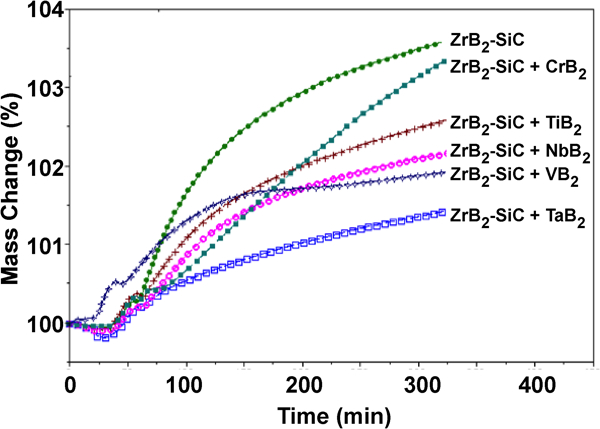
Comparison of mass gains for nominally pure ZrB2–SiC with ZrB2–SiC ceramics containing other transition metal diboride additives (reprinted from Ref. 37 with permission, copyright 2004, The Journal of the Materials Science)
Arc heater or similar testing of SiC containing diborides has been much more extensive than for the nominally phase-pure diborides. Testing has revealed two regimes of behaviour:
a low temperature regime in which a glassy oxide is maintained on the specimen surface
a high temperature regime in which the specimen surface is primarily crystalline oxide.
These regimes are discussed in more detail below.
The low temperature regime is defined by surface temperatures less than ∼1600°C. Generally, this condition results for cold wall heat fluxes that are less than ∼300 W cm−2. However, the transition between the two regimes depends on test conditions such as stagnation pressure, gas flowrate, composition of the atmosphere, surface catalytic efficiency of the specimen, sample geometry, etc. Therefore, the real heat flux experienced by the specimen during testing is not known, leaving the surface temperature as the only measureable parameter to denote the transition. When a glassy surface layer is present, diboride based UHTCs exhibit behaviour consistent with non-catalytic surfaces, which reduces surface heating due to recombination of dissociated gas species.90 Analysis of time dependent evolution of gaseous species from ZrB2–SiC in a plasmatron revealed that boron based species volatilised during the initial stages of exposure, but were not present after ∼150 s of exposure at a heat flux of ∼120 W cm−2.91 The results point to diboride based ceramics showing similar evolution of structure during arc jet exposure as in furnace oxidation studies in which ZrB2 oxidises at lower temperatures producing a B2O3 rich scale, which volatilises at higher temperatures leaving a scale that is primarily SiO2.64 Based on thermodynamic calculations, the presence of monatomic oxygen appears to increase the driving force for oxidation of SiC, but does not have a significant effect on volatility of the resulting SiO2 rich surface oxide.92 The presence of small volume fractions of additions such as AlN does not appear to have an adverse effect on the arc jet performance of diboride ceramics when the glassy surface layer is present.93 However, comparison of HfB2–SiC compositions produced by conventional hot pressing and spark plasma sintering revealed that the size and distribution of the SiC particle inclusions affected arc heater performance.94 For ceramics with equal volume fractions, SiC particles that were smaller and more uniformly distributed led to the formation of thinner glassy surface layers for similar testing conditions. The conclusion was that the distribution of SiC particles affected the rate at which the glassy layer formed, with finer SiC particles distributed uniformly producing a thin, but protective layer more quickly and, therefore, improving the overall oxidation performance of the ceramic.94 Based on the studies discussed above, behaviour of diboride–SiC ceramics in the low temperature regime is controlled by the presence of a glassy surface layer, which is similar to the behaviour reported for furnace oxidation studies at temperatures of ∼1600°C. Hence, conclusions drawn from furnace oxidation may be applicable to the arc jet behaviour of diboride based UHTCs at heat fluxes of ∼300 W cm−2 or lower.
At higher heat fluxes, those that produce surface temperatures above 1600°C, the behaviour of diboride based ceramics changes (Fig. 9). At heat fluxes of more than ∼300 W cm−2, the glassy surface layers are removed, which leaves a surface covered with crystalline oxide (i.e. ZrO2 for ZrB2 based ceramics and HfO2 for HfB2 based ceramics). In addition, the formation of a SiC depleted region is reported after testing at these conditions, but test articles appear to maintain their dimensional stability (i.e. no significant recession or deformation).95 Testing at a heat flux of ∼350 W cm−2 in the same facility produced surface temperatures of ∼1800°C after 600 s on ZrB2–SiC,65 but ∼2360°C after 600 s on HfB2–SiC.57 The higher surface temperature for HfB2–SiC was attributed to a higher catalycity of HfO2 and the lower thermal conductivity of the HfO2 surface oxide compared to HfB2,57 although the authors pointed to the need for more extensive and comprehensive testing as their conclusions were based on a limited number of specimens. Unlike testing at lower heat fluxes, which showed little dependence on the presence of additives, testing of ZrB2–SiC containing either TaSi2 85 or AlN,93 showed that significant mass loss and recession occurred at conditions that did not result in either mass loss or recession for ZrB2–SiC without other additives. Finally, a coordinated effort was used to select promising candidates using screening studies and then evaluate the effect of fabrication procedures, shape and other factors on performance.58,90,96 – 99 The analysis showed that at moderate heat fluxes that produced surface temperatures of ∼1800°C, both sharp and blunt test models maintained their shape during exposure and that the degree of SiC depletion depended on the local specimen geometry.58 Going beyond the ‘moderate’ regime to heat fluxes >500 W cm−2 led to significant mass losses and surface recession.93 Although enough testing has been reported in the open technical literature to identify trends in surface temperatures, recession and shape stability, a focused and coordinated research effort is needed to identify fundamental aspects of composition, microstructure and properties that control behaviour of diboride based UHTCs in arc heater testing.
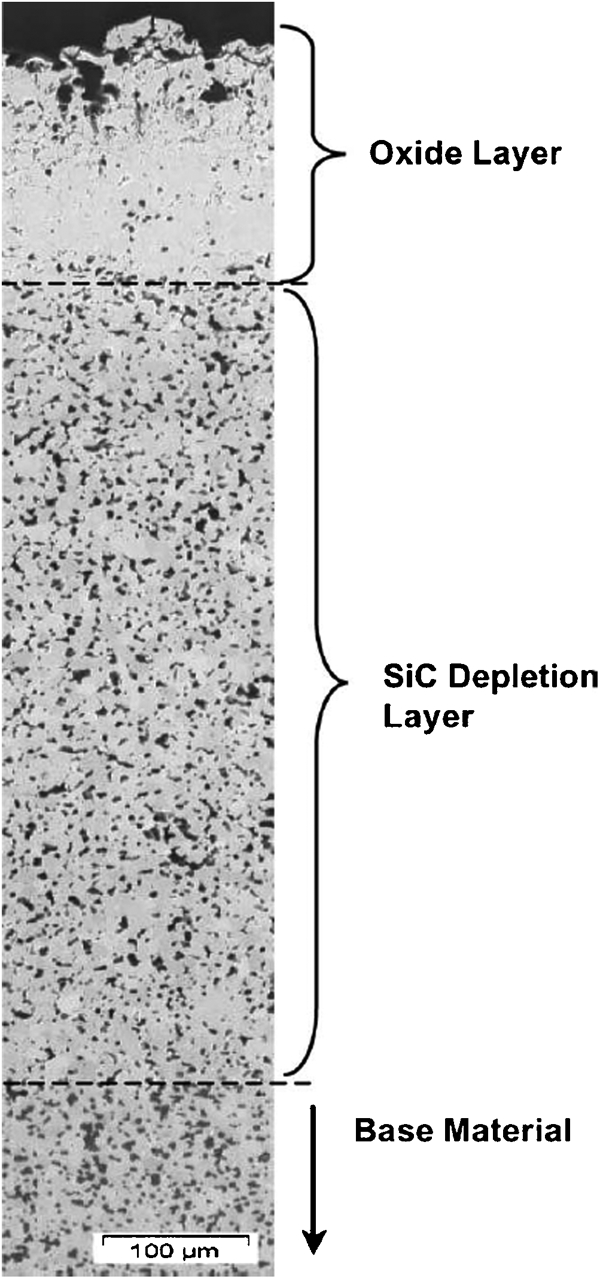
Composite image of HfB2–SiC ceramic after arc heater testing at heat flux of ∼350 W cm−2 showing crystalline ZrO2 surface layer, SiC depleted layer and underlying ceramic (reprinted from Ref. 57 with permission, copyright 2004, The Journal of the Materials Science)
Other approaches to improving oxidation resistance
Diboride based ceramics with SiC additions have been researched extensively, but silicides and other Si containing additives also produce a glassy silica rich surface layer during oxidation. Hence, other additives provide improvements in oxidation protection similar to SiC. Of particular note is an extensive body of work on the processing, microstructure and properties of MoSi2 containing UHTCs has been generated by Monteverde and co-workers at the Institute for Science and Technology of Ceramics (an Italian government laboratory in Faenza, Italy); researchers there add MoSi2 to promote the pressureless sintering of ZrB2, HfB2 and carbide UHTCs.100 – 102 Like SiC additions, MoSi2 is present as a second phase in the final microstructure and produces a SiO2 rich outer oxide layer for oxidation at temperature above 1200°C.103 The glassy surface oxide protects the underlying ceramic from oxidation and results in parabolic mass gain kinetics.103 Table 4 compares mass gain and parabolic rate constants for ZrB2 ceramics containing either 20 vol.-%SiC or 20vol.-%MoSi2, which shows that the rate constants were similar, but the mass gain was ∼6·5 mg cm−2 for the MoSi2 containing ceramic compared to ∼3·0 mg cm2 for ZrB2–SiC. The higher mass gain for ZrB2–MoSi2 was attributed to retention of Mo in the oxide scale as compared to SiC, which releases carbon as CO during oxidation.103 Therefore, added mass gain may not be an indication of more severe oxidation. Based on these results, silicide additions, without SiC, are a promising alternative that may alleviate issues associated with formation of a porous SiC depleted region as has been observed for SiC containing diborides.
Comparison of oxidation behaviour of ZrB2 containing 20 vol.-%SiC or 20 vol.-%MoSi2
*By TGA up to 1400°C.
In addition to MoSi2, other silicides have also been examined as additives to improve oxidation resistance of diboride ceramics. As with SiC and MoSi2, additions of other silicides also produce a silica rich surface scale when oxidised. The oxidation behaviour of HfB2–TaSi2 was found to be similar to that of diborides with MoSi2 additions for temperatures up to ∼1900°C.104 The addition of 1 wt-%ZrSi2 did not alter the oxidation behaviour of ZrB2, but larger additions results in parabolic mass gain kinetics at 1200°C.105 For ZrB2 containing 15 wt-%ZrSi2 (∼18 vol.-%) the mass gain was 2·2 mg cm−2 after 2 h at 1200°C. Talmy et al. investigated the oxidation behaviour of ZrB2 containing several different silica scale formers including Ta5Si3, Si3N4 and TaSi2. 106 106,107 For Ta5Si3 additions, the best oxidation resistance was produced for additions of ∼4 mol.-% (15 vol.-%), which resulted in mass gains of ∼5 mg cm−2 after 2 h at 1200°C.106 For additions in this range, the Ta5Si3 dissolved into the ZrB2 matrix to form a solid solution. More important than the magnitude of the mass gains, these compositions exhibited parabolic mass gain kinetics with the formation of a silica rich outer scale.106 On their own, Si3N4 additions of ∼35 vol.-% were needed to provide oxidation protection equivalent to ∼25 vol.-%SiC at temperatures up to 1400°C.107 However, the addition of 20 vol.-%Si3N4 with 10 mol.-% of either CrB2 or TaB2 to ZrB2 resulted in mass gains that were comparable to ZrB2–SiC at temperatures up to 1400°C.107 The addition of the transition metal borides to ZrB2–Si3N4 modified the composition of the crystalline oxide scale and resulted in phase separation of the glassy outer layer as had been observed for the addition of transition metal borides to ZrB2–SiC by the same research group.37 The results of these studies reinforce the conclusions drawn earlier that further research is needed to understand the function of additives on the development of oxide scales as well as the relative importance of the glassy surface scale and the underlying crystalline oxide in the overall oxidation protection of diboride based UHTCs.
Building on the previous point, the oxidation resistance of refractory diborides can be improved with additives that modify the structure of the crystalline oxide scale without forming glassy oxides. The oxidation resistance of ZrB2 ceramics containing up to 8 mol.-%W has been investigated. 52 52,108 The presence of W dissolved into the ZrB2 matrix was found to reduce both mass gain and oxide scale thickness compared to nominally pure ZrB2 at 1500 and 1600°C. For example, the mass gain after exposure to 1600°C for 2 h was ∼15 mg cm−2 for nominally pure ZrB2, but decreased to ∼8 mg cm−2 for ZrB2 containing 4 mol.-%WC.52 The improved oxidation resistance was attributed to the formation of a ZrO2 scale with a crystalline, equiaxed microstructure and retention of a combination of WO3 and B2O3 in the scale.108 Further, mass gain kinetics appeared to be parabolic at 1500 and 1600°C. 52 52,108 Hence, oxidation behaviour can be improved solely by manipulating the morphology of the crystalline phase in the oxide scale whereas most studies have focused on the effect of the outer glassy layer.
Summary and outlook
This paper has reviewed historic and recent reports of the oxidation behaviour of ultra-high temperature diboride ceramics. Both ZrB2 and HfB2 undergo stoichiometric oxidation. In the absence of additives, the oxide scale that forms at temperatures below ∼1100°C is protective leading to parabolic mass gain kinetics. Modelling supports the conclusion that oxygen diffusion through the liquid B2O3 is the rate limiting step. At higher temperatures, the B2O3 evaporates, leaving a non-protective porous ZrO2 or HfO2 scale and leading to rapid, linear mass gain kinetics. The addition of SiC is the most common method used to improve the oxidation behaviour of the diborides. The presence of SiC extends the temperature range over which a protective glassy oxide is present by promoting the formation of a silica containing amorphous oxide layer. The resulting scale has a complex layered structure that consists of: an outer borosilicate glassy layer, which provides oxidation protection; a layer that contains crystalline ZrO2 or HfO2 plus amorphous borosilicate glass; and a partially oxidised layer that contains porous crystalline ZrO2 or HfO2 and/or a SiC depleted diboride layer. The outer borosilicate glassy layer is stable to temperatures of 1600°C or higher. In situ observations revealed the formation of bubbles followed by scale rupture, confirming thermodynamic predictions that oxidation protection would be lost at elevated temperatures due to gas pressure behind the scale. Arc heater testing has shown that the ZrO2 layer can densify and become protective at extreme conditions that simulate hypersonic flight or atmospheric re-entry. The oxidation protection of diborides can also be improved by the addition of other silica scale forming compounds including MoSi2, Si3N4, and Ta5Si3. Although none of these compounds alone provides protection equivalent to the addition of SiC, the protection can be improved by compounds such as other transition metal diborides that form solid solutions with the ZrB2 or HfB2 matrix, which can lead to changes in the morphology of the oxide scale such as phase separation of the borosilicate glass. Finally, the oxidation protection of ultra-high temperature diborides was improved without the use of silica scale formers such as SiC or MoSi2 through the use of additives that affected the morphology of the crystalline oxide scale.
Reviewing published research on diboride oxidation has provided a perspective on needs for future research. As noted at several points in the text, past research has focused largely on the composition, thickness, and thermal stability of the outer borosilicate glassy/liquid layer. The addition of SiC particles to ultra-high temperature diborides produces a borosilicate layer that is stable up to at least 1600°C. The glassy oxide layer acts as an oxygen diffusion barrier and provides passive oxidation with parabolic mass gain kinetics. However, the formation of an outer glassy layer also has some negative impacts on performance of diboride based UHTCs. For example, some authors have noted SiC depletion beneath the outer glassy layer, which produces significant porosity in the underlying ceramic and may have an adverse effect on the performance of the ceramic in extreme environments. In addition, the presence of SiC leads to the development of residual stresses in the ceramic due to the mismatch in thermal expansion coefficients between SiC and the matrix (ZrB2 or HfB2). These stresses can have a negative impact on the thermal cycling behaviour and thermal stability of the diborides.
Manipulating the microstructure and, possibly, the composition of the crystalline oxide layer holds promise for improving the oxidation behaviour of diboride UHTCs. The use of additives such as W and transition metal diborides that form solid solutions with the ultra-high temperature diborides improves oxidation protection of ultra-high temperature diborides without forming an outer SiO2 layer. Further research is needed to understand the mechanism(s) by which these additions improve oxidation behaviour, which could lead to optimisation of oxidation protection using this approach. Additives that alter the structure of the crystalline oxide layer may also provide improved oxidation behaviour in the extreme environments associated with hypersonic flight and atmospheric re-entry since ZrO2 and HfO2 are more stable than the glassy oxides that provide protection for SiC containing materials at intermediate temperatures. The modification of the crystalline oxide scale is a promising approach that could produce further gains in oxidation protection. Another possible avenue of future research is the development of engineered surface structures to enhance oxidation protection. All of the reports discussed in this review allowed the surface oxide to develop naturally. In contrast, improved oxidation protection may be possible by designing a layered surface structure that would provide oxidation protection while minimising adverse effects due to chemical or mechanical incompatibility. So, although the oxidation behaviour of ultra-high temperature diborides has been studied for many years, further research may lead to greater understanding of oxidation mechanisms, better control of microstructure development in the layered oxide scale, and improved oxidation behaviour for this class of materials.
Footnotes
Acknowledgements
Research on UHTCs at Missouri University of Science and Technology has been supported by a number of grants over the years. Currently, UHTC research is supported through the US Air Force Office of Scientific Research/NASA National Hypersonic Science Center for Materials and Structures (grant no. FA9550-09-1-0477), the US National Science Foundation (grant no. DMR-0906584), and the US Air Force Office of Scientific Research (grant no. FA9550-09-1-0168). The authors wish to thank graduate student Ms Maryam Kazemzadeh Dehdashti, who provided the SEM images in  . In addition, the authors are thankful for the contributions of Shi C. Zhang and former graduate students Alireza Rezaie and Adam Chamberlain.