







Abstract
The micropackaging of chemical compounds in a small and precisely defined quantity, which can be encased, stored, is essential for response to a specific chemical, biological or physical trigger in a controllable manner is one of the premier challenges in the development of delivery systems. In this review, the authors discuss the application of layer-by-layer (LbL) assemblies of macromolecules for micropackaging and controlled release of various types of cargo. The LbL assembly method provides unique opportunities by incorporation of different functional and responsive layer constituents tailored into one entity. Micron and submicron sized capsules made on colloidal templates are used for biomolecule encapsulation and enable time- and site-specific release when triggered by pH, temperature, specific enzymes, mechanic load, light, ultrasound, or magnetic field. In comparison to individual capsules, the authors discuss the recently introduced micropackaging approach involving cargo loading into arrays of microchambers, made by a combination of imprinting technology and LbL assembly. In conclusion, the authors summarise advantages and fabrication obstacles for micropackaging in capsules and microchambers and discuss already existing as well as potential future applications.
Introduction to polyelectrolyte layer-by-layer assembly
Ideally, micropackaging and delivery systems for chemical and biomedical applications have to be easy to fabricate and possess multiple functionalities for more efficient transport of cargo to designated locations in vivo and in vitro, i.e. high storage capacity, protection for encapsulated substances, targetted delivery and controlled release mechanisms. On top of that, long-time blood circulation is of particular importance for drug delivery in vivo. A variety of techniques are under development to address these requirements. They comprise liposomes, drug eluting coatings, polymer-based systems with adhered active molecules, block-co-polymer micelles or polymersomes, degradable organic micro- and nanoparticles, and core/shell systems. 1–3
Another promising example of a smart micropackaging and drug delivery system is provided by layer-by-layer (LbL) assemblies of macromolecules shaped as films or shells. Originating from works published by Decher, Möhwald, Lvov, Rubner, Hammond, et al. 4–11 in the early nineties, LbL assemblies were utilised with a variety of macromolecules, including biological materials, e.g. proteins and DNA (Fig. 1). Their formation is based on entropy-driven reactions of oppositely charged polyelectrolytes or hydrogen bonding between non-ionogenic macromolecules, as well as short-range hydrophobic interactions and specific recognition. Taking LbL assembly of polyelectrolytes as an example, the construction process starts with a polyanion layer deposited on a positively charged surface followed by adsorption of a polycation reversing the surface charge. Consecutive adsorption of oppositely charged polymers results in formation of a stable polycation/polyanion complex in each cycle. Ultimately, a multilayer film is achieved, whose thickness can range from a few nanometres to several microns depending on the polyelectrolytes involved, the number of deposition cycles and the medium conditions. Multilayers possessing different surface charge and composition can be prepared by varying the charge density on each polyelectrolyte. The most popular polyelectrolytes used in LbL assemblies as polycations include poly(ethylene imine) (PEI), poly(allyl amine hydrochloride) (PAH), poly(L-lysine) (PLL), chitosan, gelatin B, amino-dextran, and protamine sulphate. They can be combined with a variety of polyanions such as those formed from poly(4-styrene sulphonate), sodium salt (PSS), poly(acrylic acid) (PAA), dextran sulphate, carboxymethyl cellulose, sodium alginate, hyaluronic acid, gelatin A, chondroitin, heparin.
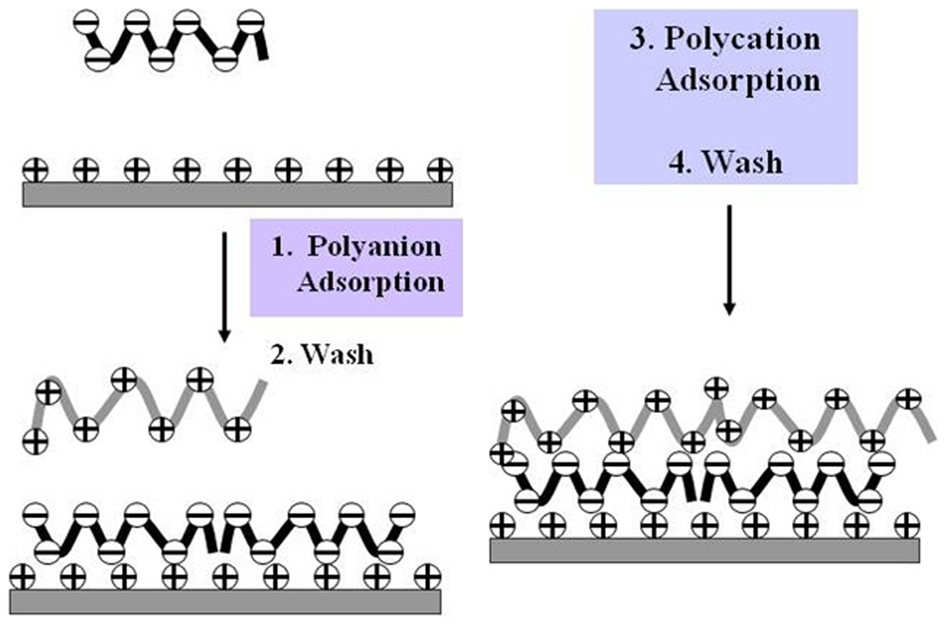
Layer-by-layer (LbL) assembly of charged polyelectrolytes on surfaces
At present, LbL assembly is widely used to produce functional biocompatible coatings and ultrathin free-standing films.
A drug delivery platform can be devised by incorporating layers of drug particles into LbL assemblies. Drug release is then triggered upon decomposition of the film by a specific stimulus, such as variation of pH, temperature or redox potential, illumination by light, or enzymatic degradation. 9 Some of the assemblies may incorporate pre-fabricated tiny containers with drugs, thus making hierarchical nanosystems. Layer-by-layer assemblies releasing an overall drug content of 1–5 wt-% over a span of 1–100 hours have already been applied as coatings on bone implants or skin patches. 9
In 1997–1998, an approach to fabricate nano-engineered capsules was introduced by a group at the Max Planck Institute of Colloids and Interfaces. 7,8 The method is based on the LbL assembly of oppositely charged macromolecules on colloidal particles. When the template particles are dissolved or decomposed, the multilayer assembly remains as an ensemble of empty shells. The shells’ diameter is pre-determined by that of the colloid template and can be chosen within the range of 50 nm to tens of microns. The shells’ thickness is determined by the number of deposited layers and usually lies within a size range of a few nanometres. These multilayer shells can be made of a variety of different macromolecules, such as synthetic and natural polyelectrolytes, lipids, and multivalent dyes. Hence, the construction is extremely modular with regards to tailoring the composition of the shells. Each of the constituents brings its own functionality to the multilayer shells. For instance, by making the shell’s outermost layer a polymer which contains reactive groups, such as amino groups or carboxylic groups, one can then further modify its surface with specific ligands, reporter groups, or other moieties for targetted drug delivery. Weak polyelectrolytes are obvious candidates to form pH-sensitive capsules, which can be reversibly loaded and unloaded with drugs in response to pH changes.
Embedding inorganic particles within multilayer shells enables additional functionality: clay sheets make them more rigid; metal and metal oxide nanoparticles make the shells susceptible to light and magnetic field. 12,13 A comparison between polymer multilayer capsules and alternative delivery systems 14,15 reveals the most outstanding feature of the multilayer capsules: the ability to tailor different properties in one entity thus creating novel multifunctional materials for in vivo and in vitro micropackaging applications (Fig. 2).
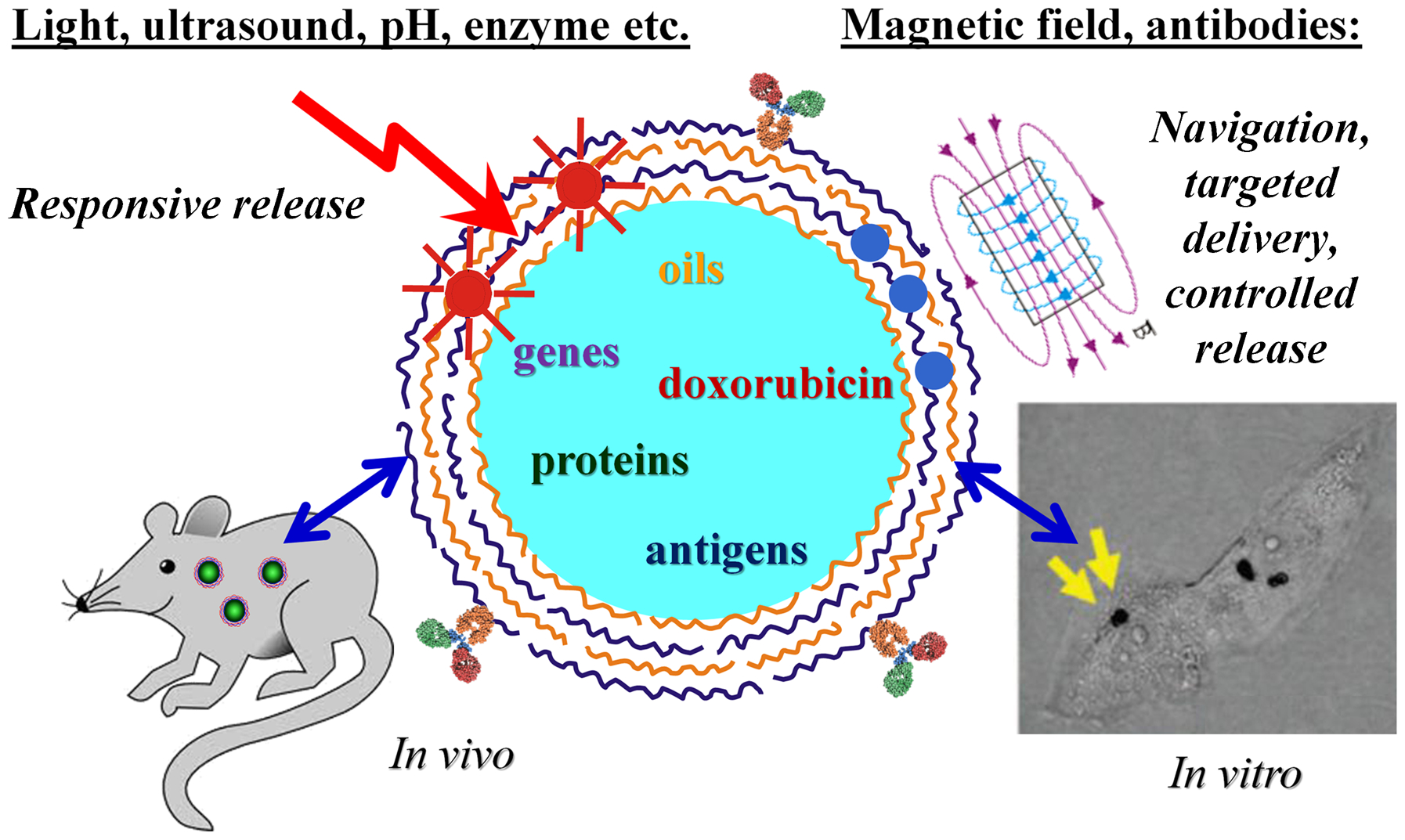
Multifunctional capsules made upon Layer-by-layer (LbL) assembly and loaded with drugs show various functions tailored into one entity. Magnetic nanoparticles and antibodies drive the capsule macroscopically into a specific region both in vivo and in vitro. Light and ultrasound susceptible nanoparticles provide release in response to the corresponding stimuli. Biodegradable shells are destroyed by enzymes
This review focuses on the fabrication of smart and versatile delivery systems by micropackaging bioactive molecules inside LbL assemblies made in the form of individual shells, which are dispersed in a continuous phase or an array of microchambers sealed by the solid support. The authors describe methods for tailoring different functionalities within one entity, altering capsule mechanical properties, and controlling the delivery and release of encapsulated molecules by various triggering events. 16,17 The authors also discuss scientific and industrial areas which can potentially employ LbL assemblies as delivery microcontainers, microreactors, or sensing elements. 18
Encapsulation of biologically active molecules
Encapsulation strategies
The unique features of LbL-assembled polymer shells such as: a flexible geometry, controlled dimensions, and selective, tunable permeability towards molecular payload enable the encapsulation of a variety of different biologically active molecules, among which are proteins, polysaccharides, nucleic acids, drugs, as well as larger species including cells and microorganisms. Significant advances in the development of capsules of this type have enabled the efficient loading of molecular cargo, capsule guidance, and a variety of release mechanisms, including: tunable spontaneous diffusion of cargo, responsiveness to pH and chemicals, and remote on-demand rupturing of the shells triggered by physical stimuli such as light, magnetic field and ultrasound. 19,20 The active development of LbL capsules for anticancer therapy, gene delivery, and delivery of vaccines has been catalysed by the proven evidence of capsules’ endocytosis by living cells. 21 The aim of this section is to give an overview on polymer multilayer encapsulation and delivery of the main classes of bioactive species, discussing the most favourable encapsulation routines and additional measures undertaken to preserve activity of the biomolecules.
The ultimate goal of any encapsulation process is the effective incorporation of a species and the provision of a release mechanism without compromising bioactivity. Therefore, the encapsulation routine must be carefully determined for each particular bioactive compound, considering its physical and chemical properties, as well as stability. The molecular payload can be incorporated in a number of ways: as a multilayer film building block, infiltrated inside capsules, pre-loaded in sacrificial porous templates, or used as a template for LbL assembly in a form of aggregates, or microparticles (Fig. 3). In agreement with the basic principle of multilayer film assembly, bioactive species can be introduced in a capsule shell during a process of alternate complexation with complementary macromolecules or species. 8,22,23 In another approach, alternation of medium conditions such as pH, ionic strength, temperature, solvent polarity, redox potential or the presence of specific chemicals can significantly increase permeability of the multilayer shells to molecular payloads, enabling their infiltration through the polymer network driven by the concentration gradient. 24–33 The main concern of this loading method is that polymer multilayer assemblies often require drastic changes of medium conditions to become permeable, and that these changes can compromise the activity of the biomolecules. In a more gentle approach, bioactive molecules diffuse through intact LbL shells towards an oppositely charged matrix pre-loaded into capsules. Such a matrix can be in the form of stable proteins and polymers, 34 oligomer residues of melamine formaldehyde, 35–37 or polystyrene 38 sacrificial templates. A hydrogel network is a good alternative matrix for subsequent encapsulation of bioactive species into polymer multilayer shells. 39–41
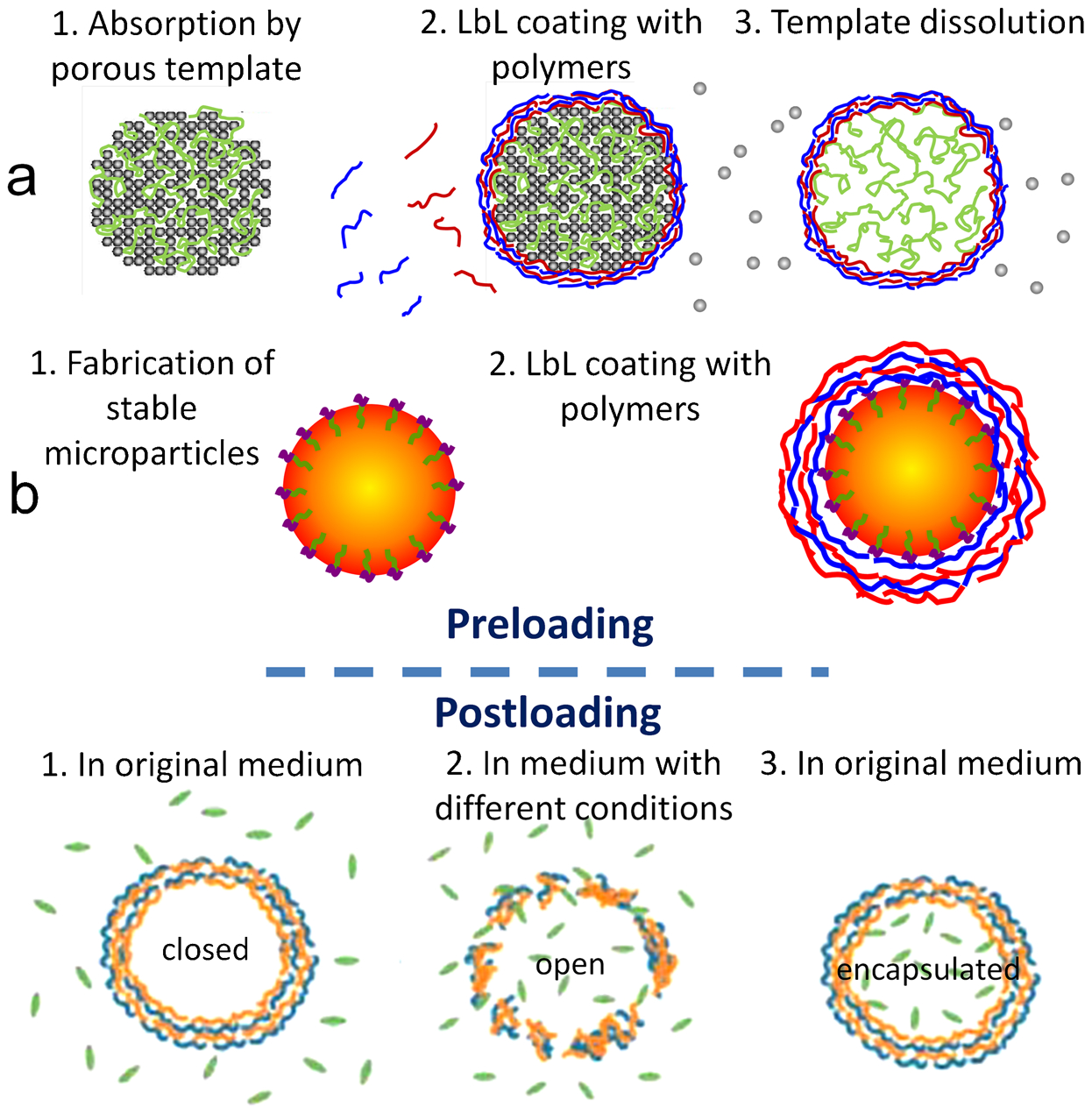
Schematic representation of different approaches of capsule loading. Pre-loading of active species (top): assisted by a porous inorganic template a, microparticle of cargo species is used as a template for LbL assembly b. Post-loading of a microcapsule by changing of medium conditions (bottom)
Porous micron- and submicron-sized CaCO3 42–46 and mesoporous silica microparticles are widely used sacrificial templates in pre-loading the LbL-assembled capsules with macromolecules. These templates, pre-saturated with active molecules of interest, are subsequently subjected to polymer multilayer coating and later template removal through dissolution by an appropriate solvent or chemical decomposition.
Encapsulation of polysaccharides
Polysaccharides possessing electrical charge are widely applied in LbL assembly of capsules designed for biomedical, cosmetic and food applications. The most popular cationic polysaccharide, chitosan, is actively used in alternation with various negatively charged polysaccharides, such as hyaluronic acid, alginic acid, carrageenan, 47 dextrans, proteins at pH above their isoelectric point, and negatively charged polyaminoacids.
Supported polysaccharide multilayer films are being designed and extensively tested for applications related to tissue engineering. 48–50 LbL coatings made of polysaccharides have emerged as a powerful tool for the immobilisation of biomolecular drugs with preserved bioactivity, enabling their use in surface-mediated drug delivery. For instance, hyaluronic acid/heparin LbL assemblies on cardiovascular stents made of stainless steel exhibited anticoagulant activity and further improved haemocompatibility of the stents by providing prolonged release of incorporated model immunosuppressant. 51 Hyaluronic acid/chitosan polyelectrolyte multilayer coatings on titanium bone implants demonstrated high antibacterial efficiency and promoted osteoblast functions by surface-immobilised cell-adhesive arginine–glycine–aspartic acid (RGD). 52 Hyaluronic acid/chitosan polysaccharide LbL assemblies incorporating DNA can be successfully used in surface-mediated gene transfection. 53 Hammond’s group has extensively investigated controlled delivery and release of various bioactive species directly incorporated into polymer multilayer films, i.e. delivery of aminoglycoside antibiotic gentamicin by hydrolytically cleavable LbL assemblies on titanium bone implants. 54
Biocompatible, biodegradable and low cytotoxic polysaccharide multilayer capsules have been fabricated for delivery of secreting therapeutics (such as insulin and dopamine), 36,55 anti-inflammatory 56 and anticancer drugs, 34,57,58 as well as for cell encapsulation and culturing. 59,60 Self-rupturing polymer multilayer capsules assembled on dextran-based hydrogels for spontaneous encapsulation and controlled release of biomolecules were achieved by De Geest et al. 41,61
Controlled release delivery has been demonstrated for capsules with LbL shells assembled on the microbeads of alginate gels pre-loaded with anti-inflammatory drugs, 62 and proteins. 63 The release rate from such kind of capsules can be influenced by initial content of the active compounds, the type of multilayer shell, and a combination of different ratios of LbL-coated and uncoated microbeads.
In a series of publications, McShane and coworkers reported on the use of alginate hydrogels in the development of glucose enzymatic optical biosensors. Enzymatic activity of glucose oxidase encapsulated in LbL-coated microbeads of calcium alginate by an emulsion–conjugation technique did not drop significantly over 4 weeks. 64 In the most recent developments, mesoporous alginate–silica particles were used instead of calcium alginate hydrogel. 65,66
The examples mentioned above show the role of various polysaccharides as multilayer film constituents and an absorbing matrix for spontaneous encapsulation of bioactive molecules. Dextran molecules with chains of varying lengths are among the most popular model drugs encapsulated in polymer multilayer microcapsules. With the extensive use of dextrans, important aspects of the LbL encapsulation process such as encapsulation efficiency and shell permeability have been studied 24,26,41,45,67–69 (Fig. 4).
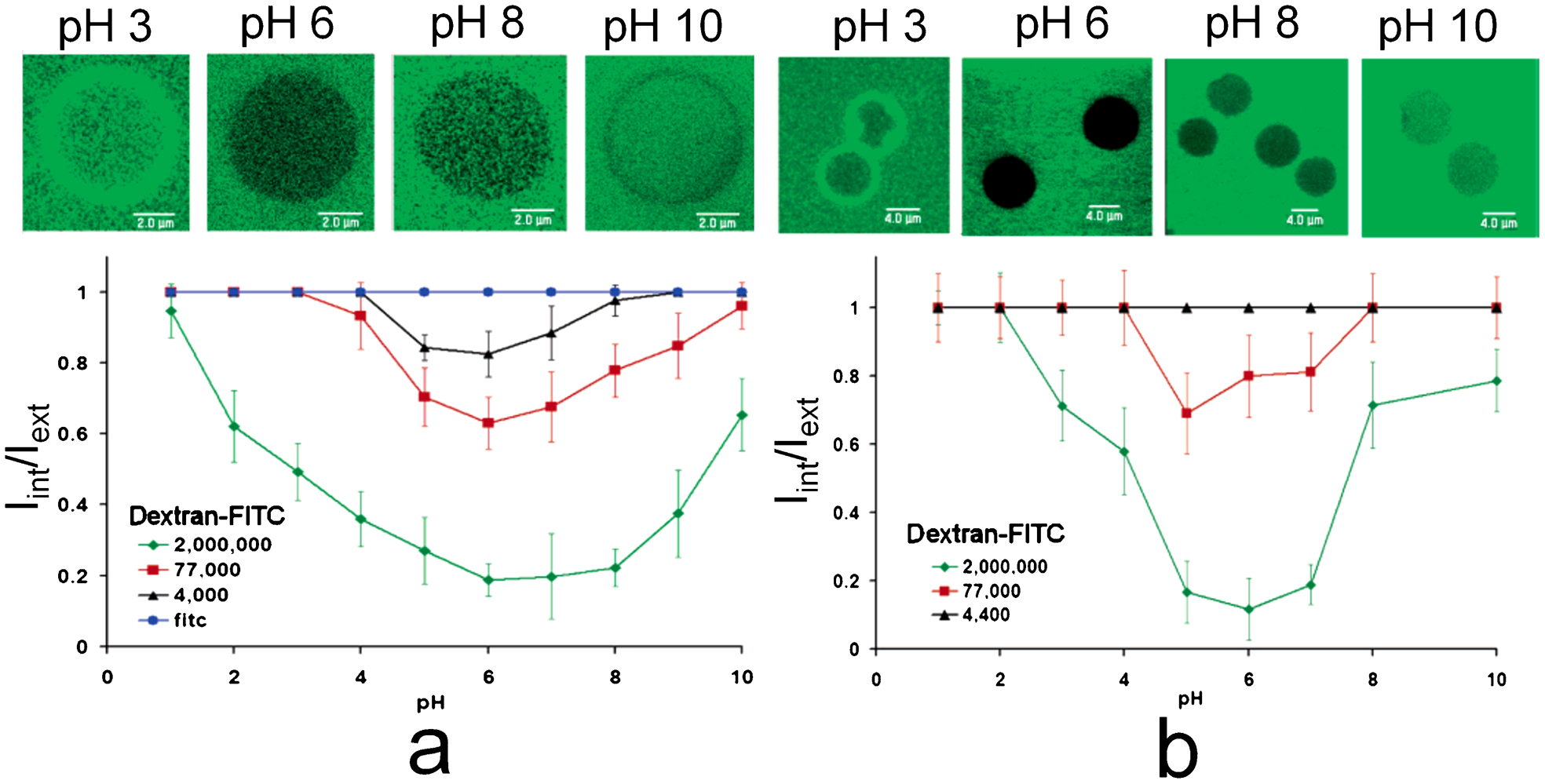
Ratio of fluorescence intensities emitted by capsule interiors (I int) and surrounding solution (I ext) 10 min after mixing capsules and solutions of FITC–dextran of different molecular weights. a (tannic acid/poly(diallyl dimethyl ammonium chloride)5 (TA/PDADMAC)5 capsules; the upper row shows confocal images of the capsules in dextran-77000 at different pH. b tannic acid/poly(allyl amine hydrochloride)5 (TA/PAH)5 capsules; the upper row shows confocal images of the capsules in dextran-2000000 at different pH 67
Encapsulation of proteins
Proteins perform a broad array of functions within living organisms. In fact, protein functions are significantly more diverse than those of other biopolymers such as nucleic acids and polysaccharides. Protein drugs are increasingly becoming a key component of modern medical care. Most protein- and peptide-based therapeutics, however, have poor stability in vivo and in vitro or are unable to penetrate cell membranes because of their large size, that unsurprisingly makes them popular active compounds for delivery by smart encapsulating system.
Proteins possess ionisable chemical groups of different kinds such as carboxylic groups of aspartic acid and glutamic acid; amine groups (ϵ-amine group of lysine, CNH(NH2) group of arginine, and imidazole functional group of histidine) and therefore they can been used in LbL assembly as macromolecular cations or anions depending on the pH of a medium. Two-dimensional LbL assemblies have shown advantages for surface-mediated controlled delivery of growth factors and antimicrobial agents at wound sites. 70–72 Tannins are known to precipitate proteins from solution by forming intermolecular hydrogen bonds and by hydrophobic interactions; stable capsules composed of proteins and tannins have been reported. 73
Infiltration into polymer multilayer shells can be a successful encapsulation strategy for proteins and enzymes which are stable at extreme conditions. For instance, urease was encapsulated in PSS/PAH multilayer shells in a 1 : 1 ethanol/water mixture. 27 The solvent-induced formation of pores in the shells was reversible, so that the enzyme was retained by the shell after washing out the ethanol. In the case of urease, the presence of ethanol had a minor negative effect on its enzymatic activity, which was found to be lower than the activity of free urease in an aqueous solution. Alpha-chymotrypsin was determined to retain a high activity after pH-induced encapsulation in PSS/PAH multilayer shells. 35 Proteins can also be included in polymer multilayer shells in a form of LbL-coated aggregates. 74,75
Growth factors exhibit optimal proliferative efficacy within a certain concentration range. Moreover, they can completely lose bioactivity if exposed to significant changes in pH, temperature, and/or ionic strength. Encapsulation in polymer multilayer microcapsules becomes a good solution to address both issues of tunable release 76 and reliable protection. 77 Itoh et al. have demonstrated capsule preparation via LbL assembly of chitosan and dextran sulphate followed by post-loading with FGF2 at pH 8, when the multilayer shells have a relatively high permeability for the protein. 78 In another report, TGF-β1 was post-loaded into heparin-containing polyelectrolyte multilayer capsules. 79 She et al. exploited CaCO3 porous templates for loading PARG/DS shells with FGF2 protected by heparin and BSA. 77 FGF2-loaded capsules delivery to L929 cells stimulated cell proliferation 10–30% more efficiently than free FGF2. Capsules were also characterised by the high affinity to the cells’ surface (Fig. 5), which could create a higher local concentration of FGF2, enabling more effective utilisation of FGF2 by the cells.
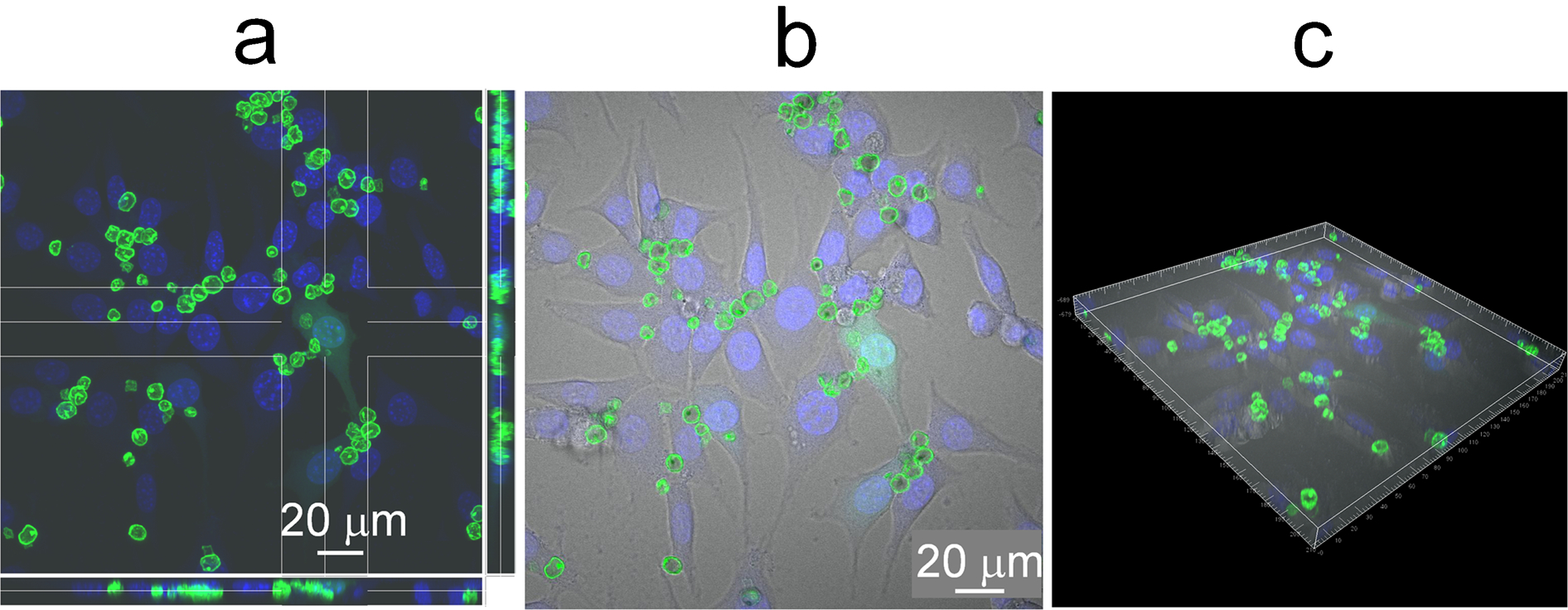
CLSM images of L929 cells incubated with FITC–BSA-loaded (Dex/PAr)3 microcapsules: a Cross-section fluorescence image with z-axis fluorescence projection at the cross-plane displayed (windows at the bottom and on the right), scale-bar: 20 μm. b Overlap of fluorescence mode and bright-field mode, scale-bar: 20 μm. c 3D fluorescence image from the top view, frame length, and width: 210 μm; height: 13 μm 77
The use of LbL-assembled capsules for delivery of protein-based vaccines and general aspects of interactions between capsules and the immune system have been extensively reviewed elsewhere. 80 In vivo studies pointed out that polymer multilayer capsules exhibited dramatically lower levels of toxicity when compared to their soluble constituents and were relatively well tolerated by mucosal tissue and cutis. 80,81 Capsules were efficiently internalised by antigen presenting cells and promoted presentation of encapsulated model antigens by dendritic cells to T cells both in vitro and in vivo, opening perspectives for the delivery of clinically relevant antigens. 82–86
Proteins can be involved in specific recognition events, such as those occurring in avidin–biotin or antibody–antigen complexation, and play a major role in targetted delivery of polymer multilayer microcapsules to cells. 87–89 Antibodies can be attached to capsule surface through adsorption, 87,88 covalent bonding, 89 or click chemistry. 90
The achievements in biofunctionalisation and development of stimuli-responsive controlled release mechanisms open up an avenue for application of capsules in immune-mediated cancer therapy. However, a recent in vitro study discovered that the role of the antibody was to enhance accumulation of capsules on the cell surface rather than promote endocytosis. 91 This observation may provide evidence that other tools for capsule targetting (e.g. navigation by magnetic field) have good prospects for both in vivo and in vitro delivery of anticancer drugs and therapeutics. 92
Encapsulation of nucleic acids
Developments in gene therapy are targetting to treat a large variety of inherited and chronic diseases, including cancer, AIDS, neurological disorders such as Parkinson’s disease and Alzheimer’s disease, and cardiovascular disorders. 93–95 Inside the living cells, nucleic acids are subjected to enzymatic cleaving and degradation in acidic environment of endosomes and generally need extra protection on a way to their target, which is the cell nucleus in case of DNA and cytoplasm in case of RNA. Replication-deficient viral particles can pack and effectively deliver genes but may be toxic and cause a strong immune response. 96 Polymeric and liposomal particles are also capable of cell transfection, but none of the above mentioned compositions are as effective as the viral delivery systems. 97–101 Moreover, problems of quality control and inherent pharmacological properties of some polymers (such as hypocholesterolemia induced by chitosans) make some polymeric delivery systems unfavourable for human use. 102,103 Templated polymer multilayer capsules composed of polysaccharides and polyaminoacids are known to be intercellularly degradable and less cytotoxic than corresponding free polymers. 80,86,104 At the same time, they can offer much higher capacity for molecular cargo than liposomes. These features allow the consideration of capsules as prospective gene delivery vehicles.
Nucleic acids are natural polyanions and have been used as multilayer film constituents since the LbL technique was introduced. 105 Moreover, specific interactions such as DNA/spermidine binding were utilised to achieve LbL films and capsules. 106,107 These assemblies are salt-responsive since a high concentration of salt destroys the DNA/spermidine complex. NeutrAvidin–biotin interaction was also exploited to assemble capsules of biotin-labelled DNA and NeutrAvidin. 108 The Donath group was the first to report on successful delivery of functional DNA into cells by polymer multilayer capsules, where plasmid DNA encoded for enhanced green fluorescent protein and discosoma species red fluorescent protein was incorporated within multilayer of dextran sulphate and protamine. 109 Transfection of Chinese hamster ovary cells (CHO-K1) by siRNA layers alternating with those of PEI on the surface of gold nanoparticles was observed by enhanced green fluorescent protein expression. 110 Multilayer films can be composed of oligonucleotides by hybridisation of complementary blocks (for example, polyA–polyT, polyG–CT). 111,112
Poly(4-styrene sulphonate)/poly(allyl amine hydrochloride) multilayer films showed some permeability towards DNA molecules of different lengths, as investigated by the molecular beacon approach. 113 However, nucleic acids are quite vulnerable to the medium conditions and will degrade at temperature or pH conditions associated with increased polymer multilayer permeability. Therefore, the use of a standard post-loading approach is considered to be problematic. Kreft et al. suggested a unique strategy to post-load erythrocyte-templated capsules by drying them from a solution containing double-stranded DNA. 114
Great advantages are seen by using CaCO3 templates to achieve multiple cargo loading. Thus, by simultaneous encapsulation of DNA and Pronase, controlled release of DNA was demonstrated. 115 Mesoporous silica microparticles modified with amino groups were used to absorb oppositely charged molecules of short-length DNA and oligonucleotides. Layer-by-layer microcapsules were then formed followed by disulphide cross-linking of shells and dissolution of the silica template. 116–118
Encapsulation of oils and poorly water soluble drugs
Similar to water soluble molecules, non-polar compounds can be pre- and post-loaded in polymer multilayer capsules (Fig. 3). Post-loading of decane by five step solvent exchange was first demonstrated by Moya et al. 119 Later, a similar approach was used for encapsulation of doxorubicin and 5-fluorouracil solubilised in oleic acid by Sivakumar et al. 120 and loading of a microchamber array with sunflower oil by Kiryukhin et al. 121 On one hand, a significant advantage of the post-loading approach is the controlled size and dispersity of microparticles as these parameters are pre-determined by the solid templates used for capsule formation. On the other hand, post-loading of oils in polymer multilayer capsules is a material and time consuming process and often results in low encapsulation efficiency. Moreover, the shell must be physically robust enough to withstand multiple solvent exchanges and a number of centrifugation cycles.
Layer-by-layer coating of primary stabilised oil droplets dispersed in the water phase appears to be a straightforward and versatile method to fabricate oil-loaded capsules. The McClement’s group pioneered oil encapsulation in two to three layered shells. 122,123 Later Grigoriev et al. 124 were the first who reported on multilayer shell assembly over oil microdroplets followed by Wackerbarth et al. 125 and Szczepanowicz et al. 126 Primary stabilisation of oil droplets is performed by placing a layer of ionic amphiphilic molecules at the water/oil interface providing a core microparticle with a certain density of surface charge. Proteins, 125,127,128 cationic 124,129 and anionic 123 lipids, and amphiphilic polymers 129 were used in fabrication of polymer multilayer microcapsules templated on oil microdroplets.
Encapsulation in polymer multilayer shells improves stability of oil microdroplets towards coalescence, and slows down the speed of both gravitational separation
128
and lipid peroxidation. Elsewhere, Klinkesorn et al. proposed strong pro-oxidant effect of endogenous transition metals naturally present in oils, surfactants, and/or water.
123
Indeed, utilisation of the cation screening effect of cationic emulsifiers or multilayer shells terminated by a cationic layer affected the oxidative degradation to some extent.
130–132
A layer of tannic acid (TA), used as a metal scavenger, sandwiched between two layers of poly(
Encapsulation of anticancer drugs
Several anticancer drugs are water soluble compounds with low molecular weight; therefore additional measures have to be used to retain them inside the polymer multilayer shells which are generally permeable for compounds with a molecular weight smaller than 5 kDa.
133
Doxorubicin and/or daunorubicin were spontaneously encapsulated by residual melamine formaldehyde/PSS complex
134
and multilayer capsules pre-loaded with oppositely charged low molecular weight dextran sulphate,
135
PSS,
136
carboxymethyl cellulose,
137
or gelated BSA.
138
In the last example, the pH-dependent charge of BSA enabled pH-controlled release of the encapsulated drug. Doxorubicin hydrochloride was conjugated to alkyne-functionalised poly(
Various approaches have been developed for LbL encapsulation of hydrophobic anticancer drugs. Doxorubicin and 5-fluorouracil were solubilised in oleic acid and loaded via solvent exchange method. 120 Thierry et al. 142 described an LbL assembly consisting of chitosan coupled to hyaluronic acid chemically modified by grafting paclitaxel through a labile succinate ester linkage. In the same spirit, the Picart group reported on capsules composed of chemically modified derivative of hyaluronic acid (alkylamino hydrazide) containing hydrophobic nanocavities subsequently coupled with either PLL or quaternised chitosan as polycations. Paclitaxel showed high affinity to alkylated hyaluronic acid and thus was entrapped by shells. 58,143 Vodouhe et al. demonstrated that multilayer assemblies of unmodified PLL and hyaluronic acid can also serve as drug reservoirs loaded with a finely tuned dose of paclitaxel. 144 Paclitaxel nanoparticles prepared by a modified nanoprecipitation technique and LbL-coated with PAH/PSS shells showed induced cell cycle arrest in the G2/M phase after 24 and 48 h of incubation with a human breast carcinoma cell line, MCF-7. 145
Cell viability studies comprehensively reviewed by Yan et al. demonstrated enhanced cytotoxicity of anticancer drugs delivered by LbL capsules in comparison to that induced by free drugs. 21 Recent achievements in targetted delivery of microcapsules 91,92 reveal their great potential to be used as delivery vehicles for anticancer drugs aiming to minimise damaging effect on normal tissues while having an increased efficiency in the elimination of cancer cells.
Capsules as containers for chemical reactions
Size-selective permeability of polymer multilayer shells opens up the opportunity to explore them as spatially confined containers for chemical reactions.
Radtchenko et al. suggested in situ synthesis of Fe2O3 inside the polyelectrolyte multilayer shells made of PSS/PAH. 146 The actual method exploits the pH gradient across the shells created by a pre-encapsulated polybase. Thus, the pH inside the capsule appears to be more alkaline than that outside. If such capsules are immersed into a solution of iron salt, insoluble hydroxide starts to precipitate exclusively within the capsule interior. For instance, the encapsulation of poly(allyl amine) at a concentration of 0·1M induced a gradient of 1·8 pH units, sufficient enough to provide for the formation of Fe(OH)3 inside the capsule, while later on the iron hydroxide restructured into Fe2O3. A slightly modified routine involved incubation of the poly(allyl amine)-loaded capsules in an Me(SO4) x (Me = Fe, Co, Zn, Mn) containing medium, which resulted in the synthesis of magnetic ferrites and magnetite. 12,147 Another example is selective crystallisation of various dyes inside the PSS/PAH microcapsules achieved via step-wise changing of the physicochemical properties of the media. 148,149
Kreft et al.
150
and Antipina et al.
151
demonstrated the use of microcapsules as spatially confined containers for resorufin formation catalysed by glucose oxidase (GOD) and horseradish peroxidase (POD). A schematic representation of the process for patterned capsules immobilised on a film is shown in Fig. 6. Loading of the enzymes was performed by exploiting the pH-changeable permeability of PSS/PAH shells towards macromolecules whereas molecules of a substrate (β-
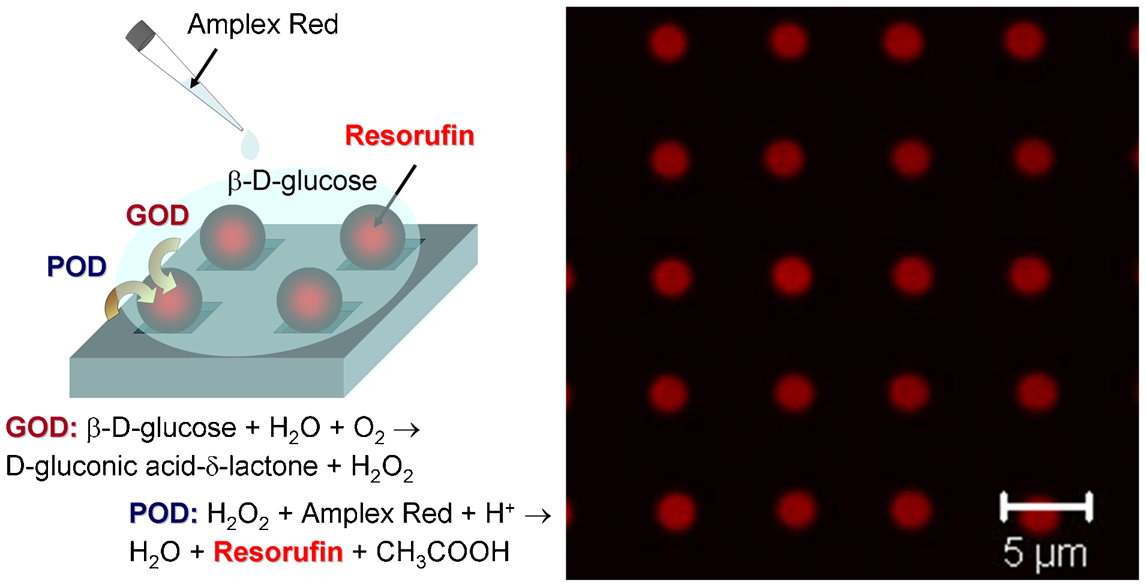
Formation of resorufin in cavities of supported layer-by-layer (LbL)-assembled microcapsules 151
Release from polyelectrolyte multilayer capsules
The release of encapsulated cargo at a desired site and time interval represents another important step in the drug delivery process. Indeed, it is this functionality that controls the dose and speed of drug delivery. As such, controlling the permeability of capsules’ shells to induce release is one of the key tasks in the area of micropackaging. 152–154
As it can be seen from Fig. 7, chemical, physical and biological release triggers are available. 152 This chapter gives brief descriptions of a number of different approaches within each respective area. However, it is important to highlight, that LbL assemblies can be simultaneously modified with several groups of functional elements, thus possessing several options for controlled release of their content.
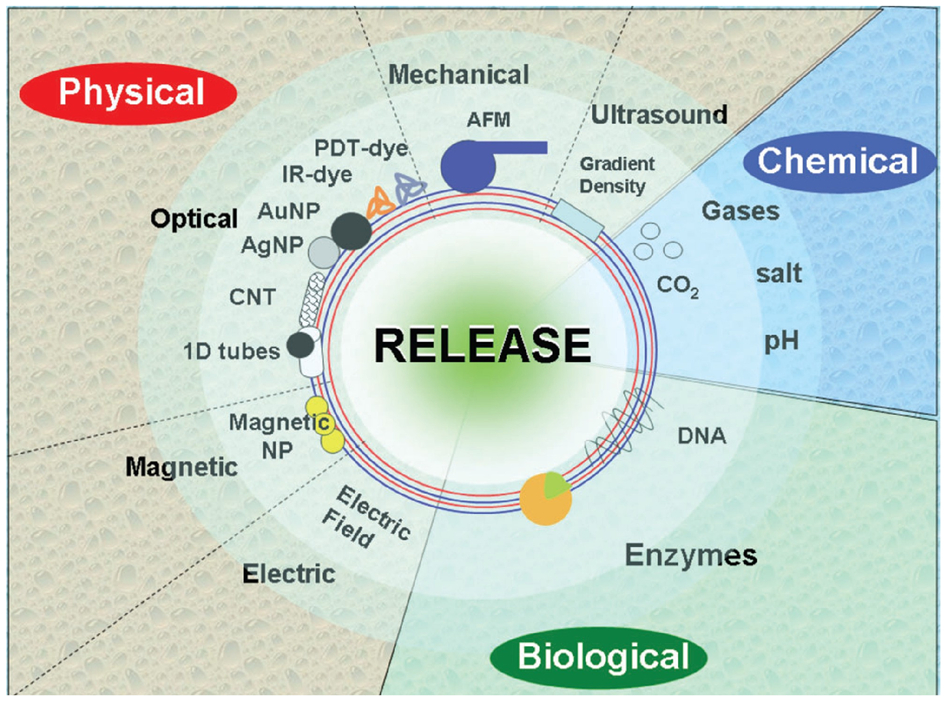
Schematic representation of release methods divided according to their respective area. Reproduced from Ref. 152 by permission of The Royal Society of Chemistry
Chemical triggers
pH
pH is a parameter which affects the permeability of multilayer capsules made of weak polyelectrolytes. Variation of the pH results in accumulation of additional charges (upon protonation of weak polybases or deprotonation of weak polyacids) inside the multilayer, and repulsion between these formed charged groups causes the capsules’ expansion, the formation of pores in the shells and a resultant increase of their permeability. Up to some point, this process is reversible, but extremely high or low pH affects the integrity of microcapsules that could trigger burst release of a payload. 155 Poly(allyl amine hydrochloride), poly(acrylic acid), and poly(methacrylic acid) (PMAA) are typical examples of weak polyelectrolytes actively used for fabrication of pH-responsive capsules. 155 In addition, so-called ‘click-chemistry’ can be applied to assemble capsules and therefore control their permeability. 139
Extensive studies were conducted on polyelectrolyte multilayer capsules, whose shells were composed of PAA/poly(vinyl alcohol) (PVA), 156 chondroitin sulphate/PLL, 157 PAA/PVP or PMAA/PVP, 158 and poly(ethylenoxide) (PEO)/PVP. 159 Burke et al. reported the preparation of multilayered PLL/hyaluronic acid films showing pH-responsive properties. 160 It was also reported that the permeability of PAH/PMAA shells switched reversibly due to shrinking/swelling upon adjusting pH in the range between 2 and 11. 155
In another report, the permeability of capsules fabricated using PVP, poly(N-vinyl caprolactam) or poly(N-isopropyl acrylamide) was monitored by the diffusion of FITC-labelled dextran and was shown to be pH-dependant. 161 pH is one of the parameters that can dramatically affect the thickness and swellability of polysaccharide-based multilayer films. 162 pH-responsive shells can be assembled on cells and used to regulate their activities. 163 pH-induced swelling and the increase of the shells’ thickness were recently reported for silk ionomer capsules. 164 Further improvement of pH-dependant permeability control can be achieved by incorporating a cross-linker into the shell of microcapsules. 165 pH was also reported to be the factor driving release from polymer stereocomplex capsules. 166
Ionic strength and solvents
Increasing the ionic strength of an aqueous continuous phase where microcapsules are dispersed induces screening of the electrostatic interactions between polyelectrolytes within the multilayer. Therefore, this principle can be applied to affect the capsules’ permeability and initiate the release of a payload. 153,167 This effect was quantified by measuring the diffusion of dyes or fluorescently labelled polymers through the shells. It was found that the permeability coefficient has a strong non-linear behaviour.
An interesting phenomenon can be observed if one polymer in the polyelectrolyte pair possesses hydrophobic groups as, for example, PSS. In this case, the high ionic strength weakens the interaction between the charged groups, resulting in shrinkage of capsules. Gao et al. have recently reported encapsulation and release of dextran by changing the permeability of PSS/poly(diallyl dimethyl ammonium chloride) (PDADMAC) capsules. 168 The salt-induced capsule fusion has been observed for (PDADMAC/PSS)4 capsules during evaporation of NaCl-containing solution. The phenomenon was explained by changes in the polyelectrolytes conformation from relatively extended to coiled as the salt solution was getting more and more concentrated. Owing to the hydrophobic interactions, the polyelectrolytes entangle, which prevents their statistical distribution in a capsule membrane. Capsule fusion allows for the application of polymer multilayer capsules in intracellular delivery, gene transfection and fabrication of artificial cells. 169–170
Organic solvents also can be used for affecting the permeability. Lvov et al. encapsulated urease into the PSS/PAH shells using a 1 : 1 ethanol/water mixture. 171 In the ethanol/water continuous phase, capsules became porous and their permeability towards urease increased. The solvent-induced pore formation was observed to be reversible, so that enzyme was retained by the membrane after washing out of ethanol. Further research of the effect of solvents on polyelectrolyte multilayer capsules revealed that they can also be used for controlled release of hydrophobic actives. 172 It can be noted that salt- and solvent-responsive capsules can be applied in chemical industries, but their applicability in biological milieu is rather limited.
Electrochemical and electrical triggers
Electrical and electrochemical-responsive capsules have good prospectives in micromechanical and biomedical applications. 173 The effect of these stimuli on LbL shell permeability is actively investigated. 174,175 An applied electric field induces the influx of low molecular counterions and increases the osmotic pressure. Sensing is another area where applicability of such stimuli is impactful. 176 Electrocatalysis was recently reported as a potential application area for LbL assemblies: all-metal mesoporous platinum/palladium films have been fabricated via LbL electrochemical deposition; 177 in another approach, alternating layers of gold nanoparticles and PAH were used in the build-up process of LbL shells. 178
Physical triggers
Temperature
The use of temperature to change the permeability of LbL assemblies is one example of a physical trigger. Indeed, shrinking or swelling of LbL-assembled microcapsules using thermal treatment was shown by Köhler et al. 179
Subjected to elevated temperatures, multilayer films assembled on solid templates exhibit almost no changes in thickness. 180 On the contrary, free multilayer films assembled at water/air interface shrink if heated in the presence of water, pointing to the fact that water content is an important parameter in this process. 181 Heat treatment induces significant changes in the permeability of hollow multilayer shells as they are completely surrounded by water. 182 It was also reported that not only capsules, but also block-co-polymers, micelles, nanogels, and core-shell nanoparticles are affected by such stimuli.
Enhanced mobility of polymers in multilayer shells is achieved upon an increase of the temperature above the glass transition temperature, T g, of the polyelectrolyte complex. At this point, the temperature increase provides enough energy to overcome the threshold needed for polymeric film rearrangement. First, the polymers become mobile, and then either shrinking or expansion takes place. The shrinking is accompanied by the stiffening of the walls. It was shown that upon heating of (PDADMAC/PSS)4 microcapsules, reorganisation of the polyelectrolyte layers took place, leading to a denser structure. 183 The shrinking, which is mostly used for encapsulation, can be adjusted through the proper choice of polyelectrolyte multilayers. It should be noted that better understanding of polymer mobility and interdiffusion is essential not only for the capsules build-up, but also for triggered release of a payload. 184
Temperature is an important trigger for the encapsulation and release of biologically active molecules but it seldom finds applications for intracellular and in vivo-controlled release of drugs since temperature is nearly constant at physiological conditions. Therefore, remote triggers or stimuli based on external fields become relevant. 185
Ultrasound
Ultrasonic waves have been used for a large number of applications, 186 including burst release from LbL capsules upon their rupture by high power ultrasonic waves. 187 It was shown, for instance, that capsules with denser, nanoparticle-enhanced shells were even more sensitive to ultrasound. The biggest challenge in this area is the necessity to reduce the intensity of ultrasound, eventually approaching the level allowed in medicine. This low level rupturing was achieved for liposomes when adsorbed on the surface of larger LbL capsules. 188
Magnetic fields
One of the main applications of LbL shells with incorporated magnetic nanoparticles is targetted delivery directed by external magnetic fields. The work of Lvov et al. has demonstrated that an alternating magnetic field also affects the permeability of shells if they contain aggregates of nanoparticles. 189 Cobalt nanoparticles were incorporated into PSS/PAH multilayer shells during the build-up process. Permeability of the shells to dextran molecules was negligible at this point, but increased substantially after applying alternating electromagnetic fields for 30 min at frequencies of around 100–300 Hz, thus initiating the release.
Release from magneto-responsive capsules made of polyelectrolytes, lipid layers and magnetic nanoparticles was also demonstrated by Katagiri and coworkers. 190 In that case, the release was attributed to a phase transition of the lipid membrane caused by the localised heating of Fe3O4 nanoparticles under an alternating magnetic field. Simultaneous functionalisation of LbL shells by magnetic and noble metal nanoparticles 191 opens opportunities to use multiple triggers for release activation.
Mechanical deformation
Mechanical stress has been prevalently used for probing stiffness and mechanical properties of the LbL shells. In this area, several structural 192 and mechanical 193,194 characterisation techniques have been developed. The necessity to study mechanical stability of LbL shells was pushed by the challenges discovered upon applying them for intracellular uptake, 195 i.e. extensive deformability of shells and losses of loaded molecules upon delivery. Stiffening of the shells can be achieved by incorporation of gold nanoparticles or carbon nanotubes. 196 Hence, at first, the mechanical properties of LbL shells have been studied in order to improve their strength, but mechanical pressure or stimulus can be also used to trigger the release.
Several regimes of mechanical deformations have been reported. It is possible to induce release by gently pressing on an LbL shell, which subsequently recover its shape once the pressure is released. This phenomenon is associated with elastic (completely reversible) deformation of the shells. Another type of release is achieved by plastic deformation: pressing and disrupting the shells, as shown schematically in Fig. 8a .
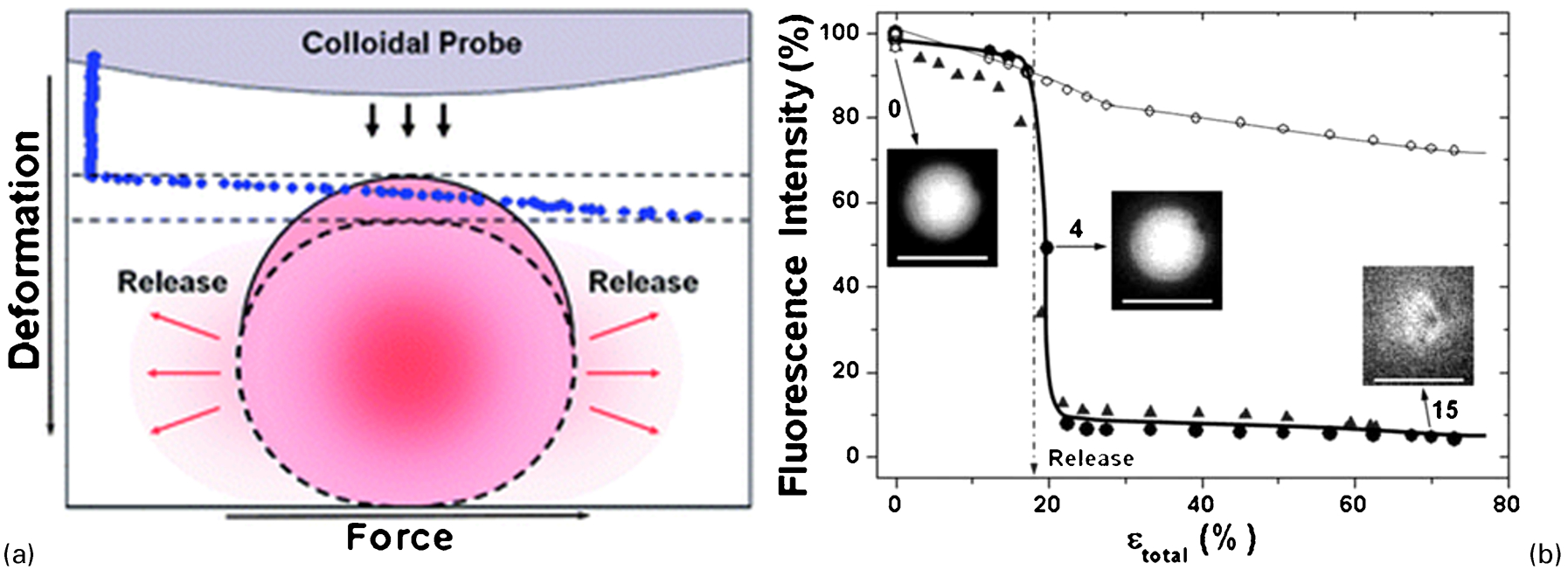
a Push force-curve on a typical capsule. Simple schematics of the capsule before contact with the colloidal probe and at maximum deformation are shown. b Average fluorescence intensity from a typical microcapsule subjected to mechanical deformation (filled circles) and a control microcapsule not subjected to mechanical deformation (open circles) calculated from images taken after each push–pull cycle as a function of total capsule deformation. The dashed–dotted line indicates the threshold total deformation (18%) beyond which release is triggered. Reproduced from Ref. 197 by permission of The Royal Society of Chemistry
The best way to study the type of release was reported by combining atomic force microscope with fluorescence microscope. 197 Monitoring the encapsulated fluorescent molecules permits one to visualise the release and measure the plastic deformation thresholds. For PSS/PDADMAC shells comprised of eight layers, the release was induced at levels above 18% of their relative deformation (Fig. 8b ). The plastic deformation of the shells was found to start at a relative deformation of 20%. A recent study of the mechanical deformation of LbL shells assembled on calcium carbonate templates revealed the complex nature of the polymeric matrix formed on these porous microparticles, but it was still possible to estimate the forces required for initiation of the release from the shells comprising a different number of layers. 198
Laser light
Laser light is another physical stimulus which permits remote release of encapsulated materials. 20 For biomedical applications, the choice of wavelength is important since the light should be minimally absorbed by cells and a tissue. Lasers working in the near infra-red (NIR) region of the optical spectrum meet this requirement. 199 Layer-by-layer shells with incorporated nanoparticles of noble metals were reported previously to be light-addressable, 200,201 the cause of their rupture was explained by the localised heating of nanoparticles irradiated within their absorption bands. The control over concentration can be made by controlling patchiness of microcapsules 202 while control over concentration and aggregation state of nanoparticles in the shells can be made by polymers or adsorption conditions. 203 On one hand, these steps allow for enhancement of the absorption in the NIR region, making LbL shells sensitive to this light. While on the other hand, they permit localisation of heat and minimisation of potential side effects. Release from polymer multilayer capsules upon laser irradiation has been the subject of several reports. 204,205 In addition to inducing release, laser light has been also used for encapsulation. 206 The encapsulation was attributed to rearrangements of the polymers and changes in the permeability of LbL shells following the exposure to light. The effectiveness of optical encapsulation was shown to increase with increasing irradiation time. 207
Some more advanced forms of release include controllable release, 208 which has been demonstrated for polyelectrolyte multilayer capsules. Upon stopping the irradiation, the heat is no longer generated and the polymeric multilayer returns to the so-called ‘glassy’ (or immobile) state and become impermeable. Wavelength-selective release has been also shown with the incorporation of metal nanorods in the multilayer shells. 209 Erokhina et al. used bacteriorhodopsin incorporated in LbL shells as a light harvesting protein to initiate proton pumping. 210 Upon exposure to light, a drop in pH increases the shells permeability due to the formation of pores and initiates the release of an encapsulated fluorescent dye. Other interesting method of light-induced release from LbL shells uses an approach once developed for photodynamic therapy. 211
Intracellular delivery has always been recognised as an important application area for polymer multilayer capsules. 212 Cells can uptake capsules by spontaneous phagocytosis or by electroporation which was shown to work even for micron-sized capsules. Thermally shrunk LbL shells were shown to be strong enough to withstand the pressure of cells upon incorporation. Palankar et al. investigated antigen presentation on major histocompatibility complex (MHC) class I molecules. 213 Multilayer capsules loaded with peptides were incorporated by the Vero and CHO cells followed by their controlled rupturing with a NIR laser pulse and release of peptides directly inside the cells. Cells were then stained with the monoclonal antibody Y3, which binds to the peptide–protein complex (H-2Kb). To the best of our knowledge, the above experiments are the first evidence of controllable intracellular release, and they have already been very useful for monitoring the immune system response.
Remote release of encapsulated materials with NIR laser light was recently reported in neurons. 214 The localised heating of the LbL shells containing a low amount of nanoparticles incorporated into the LbL shells is highly localised and was confirmed to not adversely affect the cells viability.
Enzymes as release triggers
Biological stimuli represent very attractive means of releasing encapsulated materials. In such cases, the release is controlled by enzymes.
215
Release of oligonucleotide sequences has been demonstrated from microcapsules assembled by the polycation-free method.
116
A significant advantage of such a method includes high retention of encapsulated molecules, while disadvantages are associated with difficulties in molecules delivery. In 2006, De Geest et al. demonstrated enzymatic degradation of LbL shells made of poly(
Currently, research is under way to investigate the influence of novel molecules and enzymes 216 and to achieve control over the release rate 217,218 varying the thickness of multilayer shell and/or concentration of pronase, e.g. to govern the release rate of non-pronase dependent biologically important compounds such as DNA. 115 Specific degradation of collagen-containing multilayer capsules was demonstrated by metalloproteinases (MMP enzymes). Monitoring of capsule degradation was facilitated in situ by X-ray fluorescence from capsules containing gold nanoparticles. 219 Degradation of microcapsules was monitored using UV–Vis spectroscopy as demonstrated by Orozco et al. 220 Itoh et al. constructed dextran sulphate/chitosan microcapsules responsive to chitosanase. 221 A potential disadvantage of these capsules is that chitosanase is not present in mammalian cells. Biomarkers have also been used to induce release from polymer multilayer capsules. 222 The release of labelled transferrin from disulphide cross-linked polymer capsules made of PVP and PMAA functionalised with cysteamine was demonstrated by Caruso and coworkers by the addition of dithiothreitol (DTT). 223 Such an approach has a potential for a variety of diverse applications in vivo.
The biggest advantage of enzyme-degradable capsules in living systems is that no external trigger is required for their opening. 224 Thus biodegradable microcapsules are expected to have a great influence on drug delivery in vivo and in vitro.
Microchamber arrays
Site-specific release of chemical compounds in small and precisely defined quantities is another challenge in the development of delivery systems. So far, the most common approach exploits microelectromechanical systems (MEMS) such as micro-pumps, valves or electrochemically dissolving caps which electronically trigger the release of a desired component from an array of micro-reservoirs. 225–228 Such systems provide precise temporal and spatial control over the release process; however, they require external components like a power supply and a piping. The size scale of MEMS is usually on the order of tens of microns and above. Recently Kiryukhin et al. have reported the method to fabricate a patterned array of standing, hollow microchambers made of trigger-responsive polyelectrolyte multilayer films, 121,229,230 a schematic of the process is shown in Fig. 9.
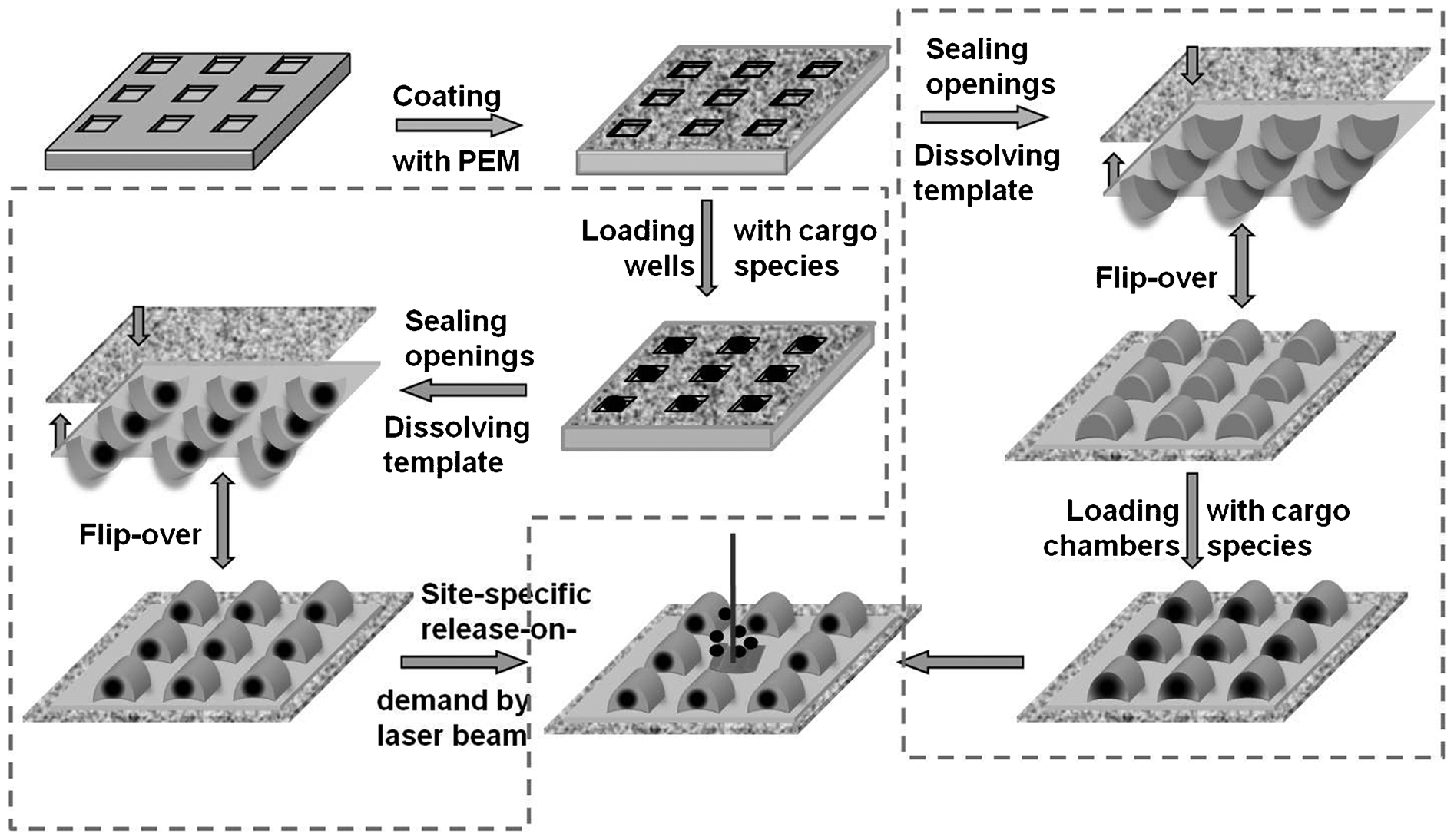
Schematic illustration of PEM microchambers fabrication, their loading with cargo species and site-specific release-on-demand 230
First, an array of micro-wells of pre-determined size, shape and arrangement is fabricated on a sacrificial template. Second, a PEM film is deposited via LbL assembly of oppositely charged polyelectrolytes. At this point, the coated microwells could be filled with a cargo of choice by a number of the techniques developed for solid particles or liquids. 121,230–232 Proper sealing of the loaded microwells on a support is crucial for effective storing of the cargo and preventing leakage. This can be achieved upon the pressure-induced adhesion towards a support pre-coated with another multilayer film. 233 Mechanical pulling-out or dissolving of the sacrificial template leaves a patterned array of standing microchambers loaded with the cargo. Alternatively, an array of hollow microchambers could be fabricated first and then post-loaded with a cargo. 121,230 Remote rupture of selected chambers enables programmed release-on-demand of the cargo and could be utilised in a variety of applications, such as the delivery of drugs, the release of bioactive cocktails for biochemical studies on a single cell level, etc. It can be achieved using focussed laser radiation at a wavelength within the plasmon absorption band of gold nanoparticles, which were incorporated in the chamber shell upon LbL assembly. 230
Below the authors consider each of the steps leading to the patterned PEM microcompartments in more details.
LbL assembly of the PEMs in confined geometries
Even deposition of polyelectrolytes both on the outer surface of a sacrificial template and on the inner surface of imprinted microwells is crucial for successful fabrication of the microchambers. The following factors can cause detrimental non-uniformity of the film thickness.
A thinner PEM film is formed inside the wells if:
there is poor wetting of these wells with polyelectrolyte solutions
the size of the wells is smaller than the dimensions of polyelectrolyte coils and the physical exclusion of polyelectrolytes occurs
there is a depletion of polyelectrolyte concentration across the wells from the surface to the bottom due to electrostatic interaction between polyelectrolyte coils and charged surfaces confining the wells, or due to slow diffusion of coils into the wells.
On the contrary, a thicker PEM film is formed inside the wells if:
non-adsorbed polyelectrolytes are incompletely drained out of the wells during the washing steps.
In practice, special precautions should be made to avoid air bubbles from being trapped inside the wells, e.g. by applying the ultrasound prior to LbL assembly. Using polyelectrolyte solutions of high ionic strength helps to overcome the surface charge-induced depletion of PE concentration due to electrostatic screening. Also the time of the polyelectrolyte adsorption step as well as the time and number of the washing steps should be chosen properly.
Loading the PEM-coated wells with a cargo
A cargo, e.g. microparticles, could be introduced into the PEM-coated wells exploiting the template-assisted self-assembly of colloids developed by Xia et al. 232 As the rear front of an aqueous dispersion of colloid particles moves slowly in a 50 μm-thick layer confined between the substrate with an array of wells and the glass above, the capillary forces drag colloid particles across the surface until they are physically trapped by the wells. Figure 10 shows SEM images of MF colloidal particles entrapped in the microwells of different geometries pre-coated with PAH/PSS multilayer film. The maximal number of particles in a well depends on the ratio of its dimensions to the diameter of the particles.
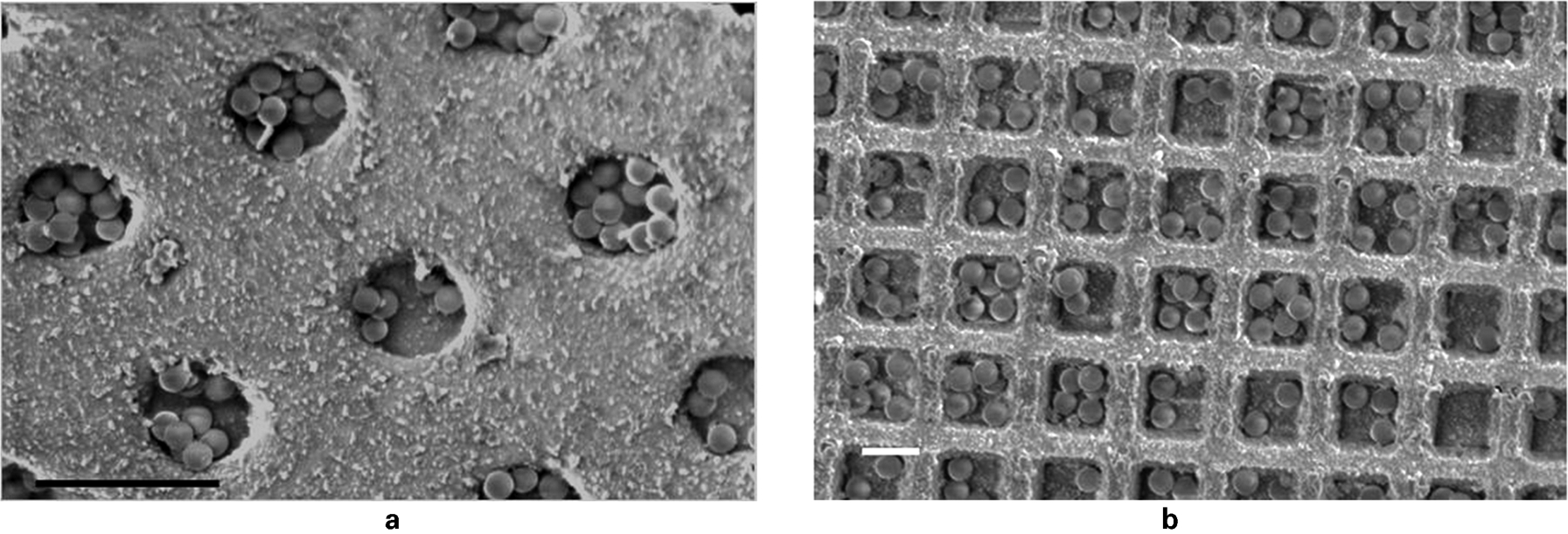
SEM images of MF particles trapped in the poly(4-styrene sulphonate)–poly(allyl amine hydrochloride)40 (PSS–PAH)40-coated wells of different patterns. Mean size of MF particles was 2·20 a and 4·88 μm b. Scale bars of SEM images are 10 μm 230
This approach can be very versatile once porous particles with the adsorbed molecules of interest are applied. If the number of such particles housed in one chamber is large enough (D well≫D particle), one can control the ratio between different components in a chamber by simply mixing several types of particles each carrying one component. Thus, specific biochemical cocktails or enzymatic mixtures for cascade reactions can be achieved.
Sealing and transfer of microchambers array
Conventional adhesives unfortunately require organic solvents and/or thermal treatments, which might be harmful for delicate cargo. In addition, it is typically difficult to apply a uniform nanometre thick adhesive that will seal the microwells without penetrating inside. One way is to coat a support with adhesive PSS–PDADMAC multilayer film and press it towards a PAH/PSS-coated template having colloidal particles entrapped in the microwells. Applied pressure induces adhesion between both multilayers with the tensile bond strength as high as 3·5 MPa. 233 A much weaker tensile bond strength of 0·35 MPa between PAH–PSS multilayer and the template (PMMA) ensures adhesive break at this interface and allows an easy pulling off of the PMMA template that leaves behind a patterned array of standing microchambers sealed towards a support, as shown in Fig. 11.
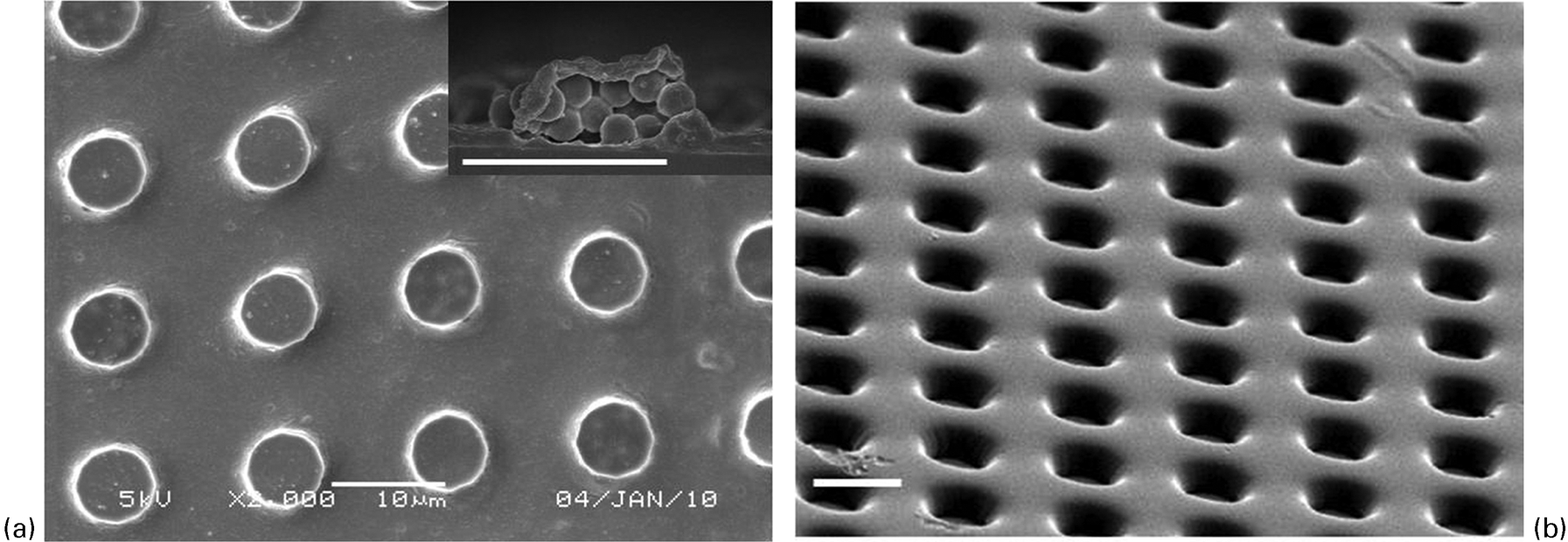
SEM images of surfaces after the adhesive tensile break: poly(4-styrene sulphonate)–poly(allyl amine hydrochloride)40 (PSS–PAH)40 film with array of microchambers loaded with 2·20 μm MF particles remains sealed towards a poly(4-styrene sulphonate)-poly(diallyl dimethyl ammonium chloride)8 (PSS–PDADMAC)8-coated silicon wafer (a), while PMMA substrate with array of microwells is pulling out (b). Inset shows the cross-sections of corresponding microchambers. All scale bars: 10 μm 230,233
This method has several advantages if compared to the conventional dissolving of a template: it does not require organic solvents; the imprinted template remains undamaged and can be recycled for fabrication of further samples thus making the process of free-standing microchamber arrays fabrication sustainable with reduced efforts.
The condition to retain structural shape of the standing chambers puts additional requirements on the mechanical properties of PEM shells. It was found that chambers demonstrate ground collapse with their roofs contacting the underlying support or lateral collapse (for chambers with high aspect ratio) if made of shells that are thinner than a certain critical value (see Fig. 12). 121,229 On the contrary, stable and standing chambers are formed if thicker shells are used.
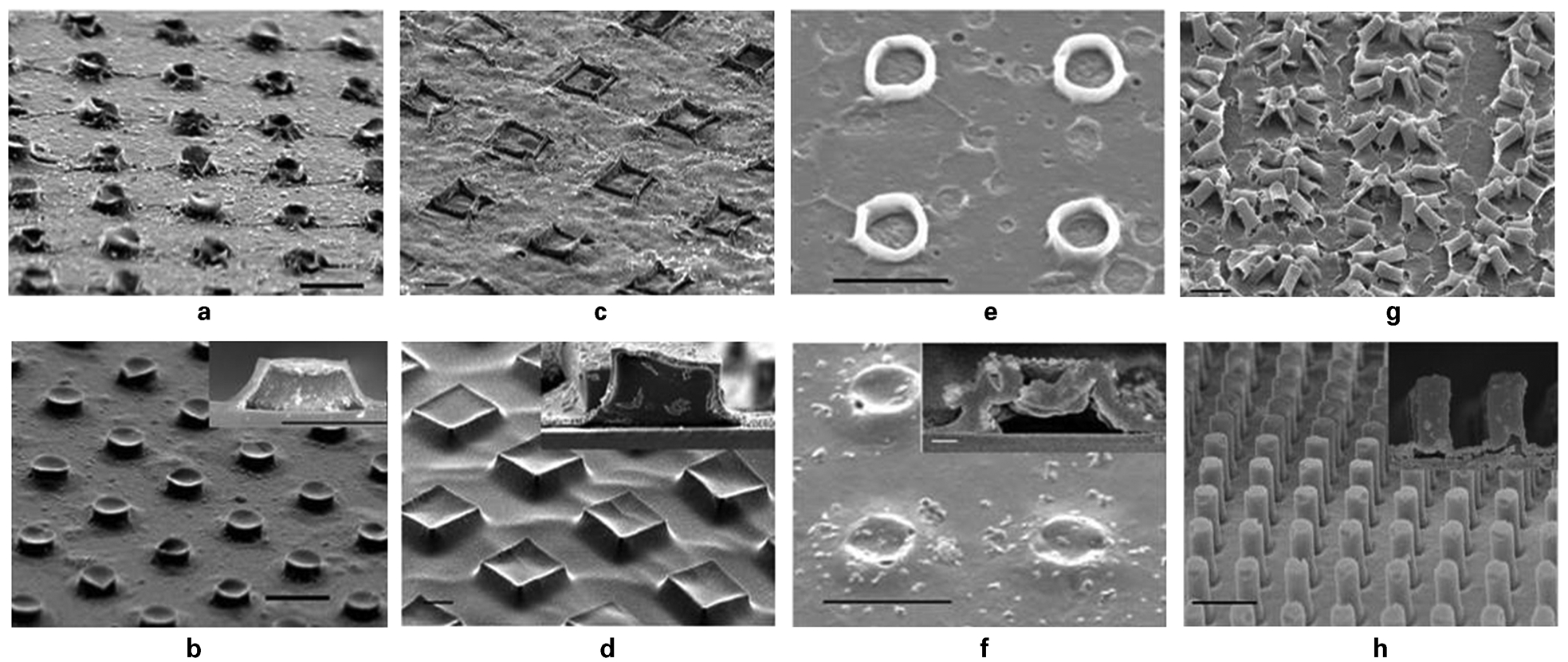
SEM images of microchambers of different geometries made of poly(allyl amine hydrochloride)–poly(4-styrene sulphonate) (PAH–PSS) a–d, g, h and poly(diallyl dimethyl ammonium chloride)–poly(4-styrene sulphonate) (PDADMAC–PSS) e, f multilayers. Thickness of the PEM film is ∼200 a, g, 300 h, 400 b, c, e, 750 d, and 550 nm f. All scale bars: 10 μm 121,229
The critical thickness of a cylindrical shell could be estimated using Euler’s model of critical stress to describe collapse of chambers and assuming adhesive contact of chamber’s roof with a support as the major mechanism responsible for collapse:
121
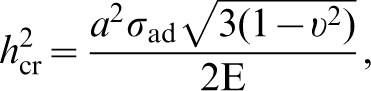
Thus, by varying the templates, one can fabricate standing arrays of mechanically stable hollow/loaded microchambers with different sizes, shapes and patterns sealed towards a support; some are shown in Figs. 12 and 13.
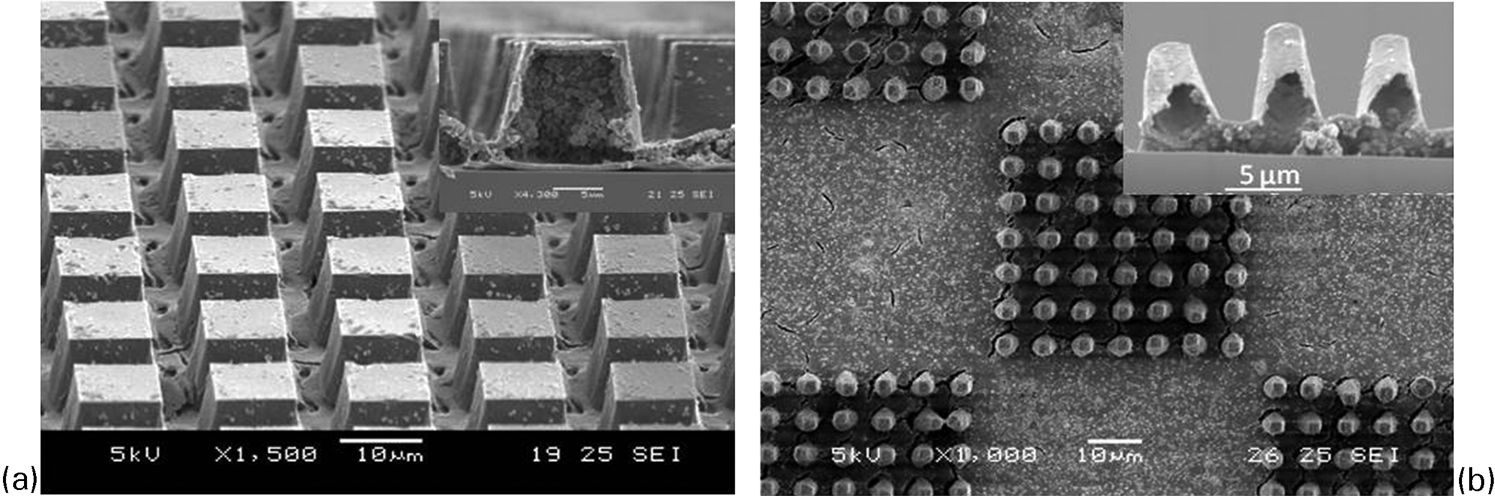
SEM images of microchambers of different geometries and patterns made of poly(allyl amine hydrochloride)–poly(4-styrene sulphonate) (PAH–PSS) multilayers. Thickness of the PEM film is ∼750 a and 400 b nm
Post-loading the hollow microchambers through the shells
Alternatively, an array of hollow microchambers could be fabricated first and then post-loaded with a cargo, e.g. by the solvent-exchange method. The method was developed to load water-dispersed PEM capsules with oils using an intermediate solvent such as ethanol or acetone compatible with both water and oil phases. 119 There is no need for water-miscible solvents as in this case microchambers are first formed after the template dissolution and are already filled with toluene. As an example sunflower oil can be directly applied over the toluene-filled PEM chambers for 1 hour. Then excess oil is washed out with toluene and the sample is allowed to dry. Composite Confocal Raman Microscopy images containing information from both oil (red) and PEM (green) bands demonstrate that oil droplets are specifically located inside the PEM chambers and completely fill them (Fig. 14a,b ). 121
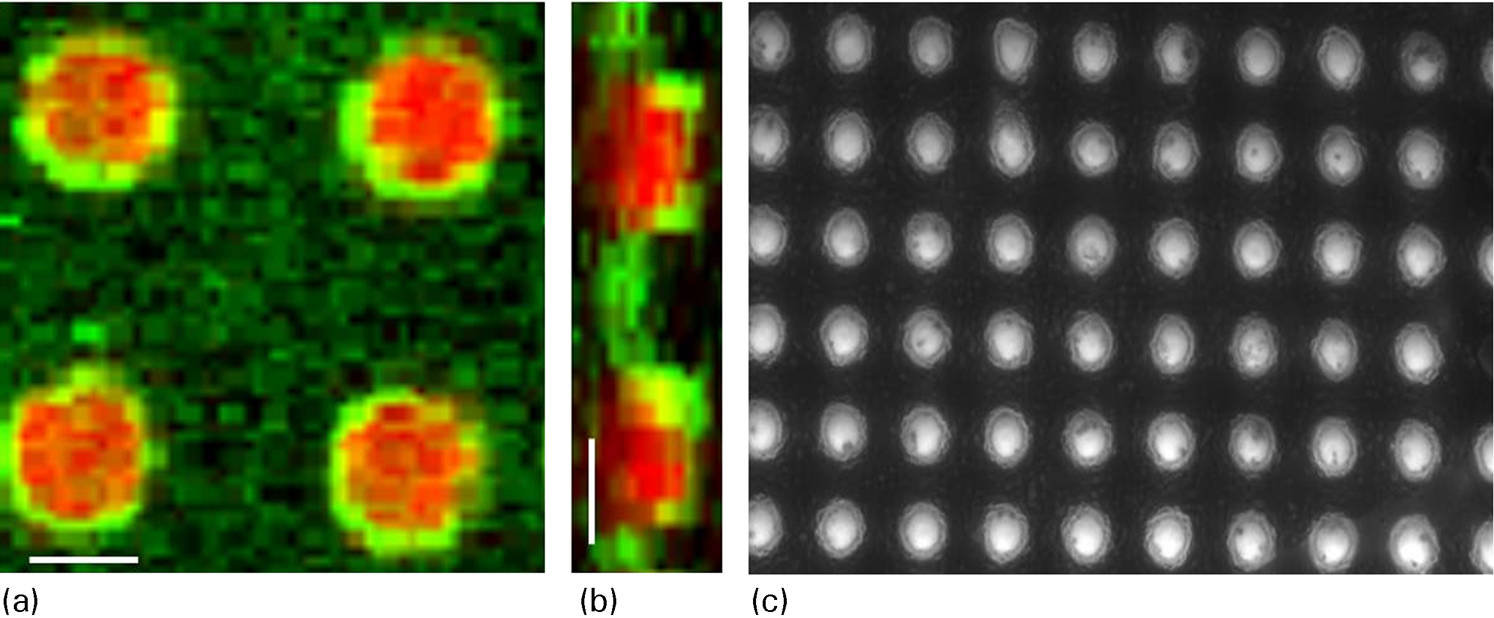
Confocal Raman microscope images of chambers filled with oil: top view a and cross-section b. Colour code of the image: red = oil (1660 cm−1 band is assigned to double bond, C = C stretching); green = PEM (1604 cm−1 band is assigned to C–C stretching in the aromatic ring of PSS). All scale bars: 5 μm. 121 Fluorescent microscope image of chambers loaded with an oil-based solution of 3,4,9,10-tetra-(hectoxy-carbonyl)-perylene c 230
The method can be easily modified to load chambers with oil-soluble staff like a perylene derivative which displays green fluorescence. 230 Corresponding fluorescent microscope images are shown in Fig. 14c . Thus, diffusion of the dye molecules was not hindered by the microchambers’ shells which are much thicker compared to PEM capsules. Post-loading of the microchambers could be extended to a variety of different cargo, exploiting tunable permeability of PEM films by a number of triggers, e.g. pH, ionic strength, redox potential etc. 19 However, the feasibility of the techniques developed for PEM capsules should be verified each time.
Light-triggered release of a cargo from selected microchambers
Remote rupture of individual chambers was achieved using focussed laser radiation. 230 Incorporation of metal nanoparticles in a PEM shell makes it sensitive towards irradiation within the plasmon absorption band of these nanoparticles. The energy of absorbed light dissipates as heat, resulting in a highly localised temperature increase that destroys the surrounding ∼400 nm thick PEM film in the same way as it was shown previously for few nm thick PEM capsules. 202,236,237 Entrapped MF particles were released from selected chambers by focussed 532 nm light, the second harmonic of a pulsed Nd-YAG laser (see Fig. 15). The microchambers are filled with water as particles undergo Brownian motion inside the chambers without leaving it. Once the selected chamber is affected with a laser pulse, the multilayer cap bursts followed by the release of the previously accommodated particles. Meanwhile, neighbouring chambers remain undamaged.
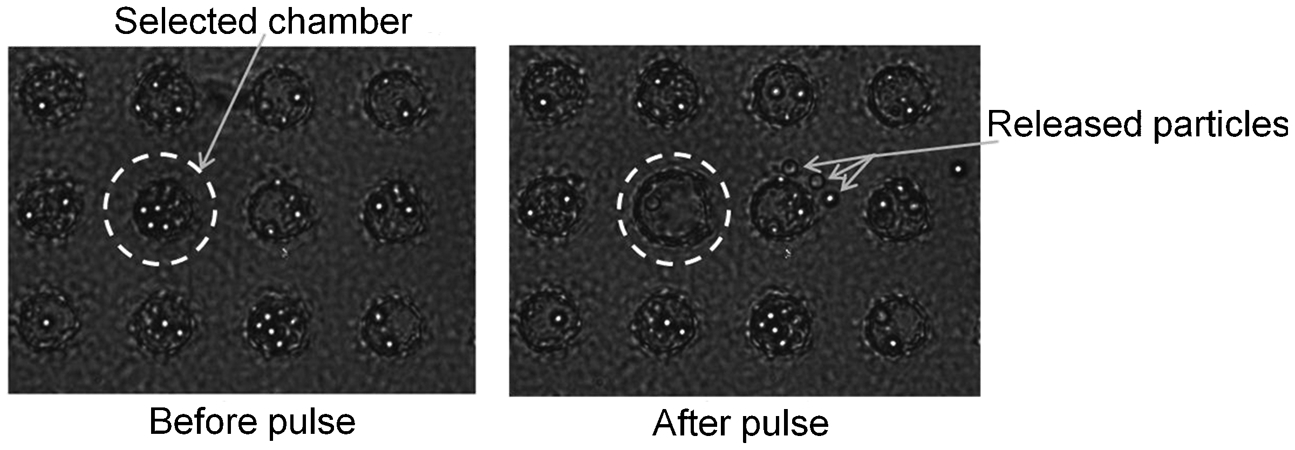
Optical microscope images showing release of MF particles into water by opening a specific chamber with focussed laser radiation 230
Conclusion
Over the past two decades, intensive studies on the LbL assembly have allowed many challenges in surface modification and fabrication of functional thin films to be overcome. Layer-by-layer assembly on templates of different geometries have enabled a novel class of micropackaging containers made of functional multilayer shells, referred here as capsules and chambers. Employed as delivery systems, these containers reveal a unique opportunity to combine multiple functionalities in one entity. For instance, one capsule can achieve several objectives, such as protection, targetted delivery, triggered and site specific release. Physical and chemical properties of polymers involved in the assembly as well as the shell thickness pre-define the permeability of the containers. Making the LbL assemblies of pH-, sugar- or enzyme-responsive polymers allows for the controlled, triggered release of a payload under the influence of the corresponding chemical or biological stimuli. Capsules responsive to remote physical triggers, such as light, ultrasound or magnetic field, are prospective candidates for targetted delivery in a wide range of applications. Indeed, an opportunity to remotely change the (bio)-chemical composition in spatially confined specific areas and at a specific time is impactful for catalysis, biotechnology, and cell and tissue engineering.
In this review, the authors described the fabrication, loading and controlled delivery and release options for two different LbL engineered micropackaging systems with regard to geometry of used templates. Capsules formed on a surface of sacrificial colloidal organic or inorganic microparticles have been well known for about 15 years. A relatively new micropackaging system is a microchamber array formed on the imprinted surfaces of sacrificial templates, as first published by Kiryukhin et al in 2011. Apparently, a microchamber array may be considered as a regular 2D version of a suspension of capsules. Resent advances in nanolithography such as roll-to-roll imprinting together with automated LbL deposition open up a possibility to scale up the fabrication of microchamber arrays. The array of polymer multilayer microchambers is a unique system with regard to time and site specific release of a precisely controlled amount of a payload, which can be especially advantageous for ‘static’ applications, such as implant coatings and bioscaffolds.
Layer-by-layer encapsulation of large molecules has been well developed. However, a lot of interesting applications are anticipated in areas requiring delivery of small water soluble molecules. Microchamber arrays will possibly offer some advantages with regard to the capture of low molecular weight compounds, as their fabrication process can involve hydrophobic polymers and organic solvents. Loading of microchambers with a cargo seems to be rather straightforward and might face fewer obstacles due to the relative ease of handling the macroscopic surfaces.
Having both micropackaging systems at hand, the choice now is mainly pre-determined by the application requirements. Capsules have no viable alternative where 3D delivery is needed, but they could not compete with microchamber arrays in the case of surface-mediated delivery. In the coming years the authors anticipate active development of encapsulation strategies for both types of systems with high attention paid to the delivery of small water soluble molecular cargo including volatiles and fragrances. 238
Current research activities on LbL assemblies are mainly directed towards intracellular delivery and in vivo applications. So far, the most successful application of LbL capsules in vivo is the delivery of model vaccines, 81–86 where degradation of the capsule and mild inflammation response was documented. Further exciting developments are foreseen in emerging areas of biosensors and theranostics. 239
The authors suppose that applicable areas for LbL-assembled micropackaging systems will broaden in the near future and also involve personal care and functional food products. The outstanding versatility of LbL films in terms of geometry, integrity and payload will certainly keep attracting the attention of researchers from various fields and result in many fascinating developments.
Footnotes
Acknowledgements
Authors express their sincere thanks to Professor K. Elizabeth Tanner (University of Glasgow) and Dr. E. L. Williams (Institute of Materials Research and Engineering, A*STAR, Singapore) for critically reading the manuscript and making valuable comments. Andre G. Skirtach thanks FWO for support. Please check whether the edits made to the ‘Acknowledgment’ section are fine.