







Abstract
The demand for light-weighting in transport and consumer electronics has seen rapid growth in the commercial usage of magnesium (Mg). The major use of Mg is now in cast Mg products, as opposed to the use of Mg as an alloying element in other alloy systems and there is an emerging market of wrought Mg products and biomedical Mg components – such that the past two decades have seen a significant number of new Mg-alloys reported. None-the-less, the corrosion of Mg alloys continues to be a challenge facing engineers seeking weight reductions by deployment of Mg. Herein, authors review the influence of alloying on the corrosion of Mg-alloys, with particular emphasis on the underlying electrochemical kinetics that dictate the ultimate corrosion rate. Such a review focusing on the chemistry–corrosion link, both in depth and in a holistic approach, is lacking. As such the authors do not describe aspects such as high-temperature oxidation or cracking, but focus on delivering the state-of-the-art with regards to alloying influences on corrosion kinetics. It has been demonstrated that Mg itself will not be thermodynamically passive in environments of pH<11, regardless of the extent and type of alloying and hence corrosion kinetics require unique attention. Authors consolidate the presentation to include essentially all commercially available alloys and in excess of 350 custom alloys with wide variations in composition; in addition to reviewing the range of intermetallic compounds and impurities that form in such alloys systems. An update is also given regarding mechanistic advances and the role of grain size on corrosion of Mg. A wider understanding of the role of chemical effects upon corrosion of Mg is both timely and serves to highlight metallurgical approaches towards kinetically retarding the corrosion problem. The latter is of key relevance to next generation lightweight alloys and rational design of wrought Mg and bio-Mg.
Introduction
Magnesium (Mg) has the lowest density (1·74 g cm−3) of the engineering metals. 1 Mg consumption is growing in many industrial applications in the present era of light-weighting, 2,3 which is important for energy and fuel savings, reduced emissions, emerging biomedical applications, and user satisfaction of portable electronics. Mg and its alloys are machinable, die castable, non-magnetic and offer vibration and shock adsorption ability. However, the two persistent limitations that have restricted wider Mg use include limited room temperature ductility and high corrosion rates in aqueous environments. The former issue, ductility, is undergoing significant research in the mechanical metallurgy domain, and the latter is still an area of active present research.
Mg and its alloys rapidly form a surface oxide/hydroxide layer in moist conditions. 4 The high negative free energy of formation ensures such a layer forms rapidly, however, this surface layer does not offer suitable corrosion protection (as say, an oxide layer does to Al or Cr) on the basis of:
The oxide/hydroxide layer is soluble in most aqueous environments, and environments of high humidity. The primitive E–pH diagram for Mg is seen in Fig. 1 (neglecting hydride formation 5 ). Mg readily dissolves to form Mg2+, and the corresponding cathodic reaction is the hydrogen evolution reaction (this terminology is interchangeable with ‘water reduction’, because when water is reduced, hydrogen evolves). It is observed that Mg is prone to dissolution over a wide pH range extending from −2 to 10·5 and only in highly alkaline conditions, magnesium hydroxide is insoluble and hence protective (i.e. a passive film). Mg completely loses its integrity in acidic conditions or in the presence of chloride, bromide, and sulphate ions, thereby placing some practical limits on widespread Mg use 6 to alkaline conditions or situations where suitable coating systems may be implemented.
Mg surface layers only incompletely cover the metal surface and are highly defective arising from a Pilling–Bedworth ratio <1; meaning the ratio of the volume of the surface oxide/hydroxide to the underlying (hexagonal) metal is not suited for complete coverage. 7
The highly electronegative potential of Mg and its alloys renders Mg-alloys prone to galvanic and microgalvanic corrosion (i.e. internal corrosion between the micro-constituents of the alloy), along with the possibility of corrosion in deaerated environments; because oxygen is not required for the cathodic water reduction reaction that predominates at such negative potentials.
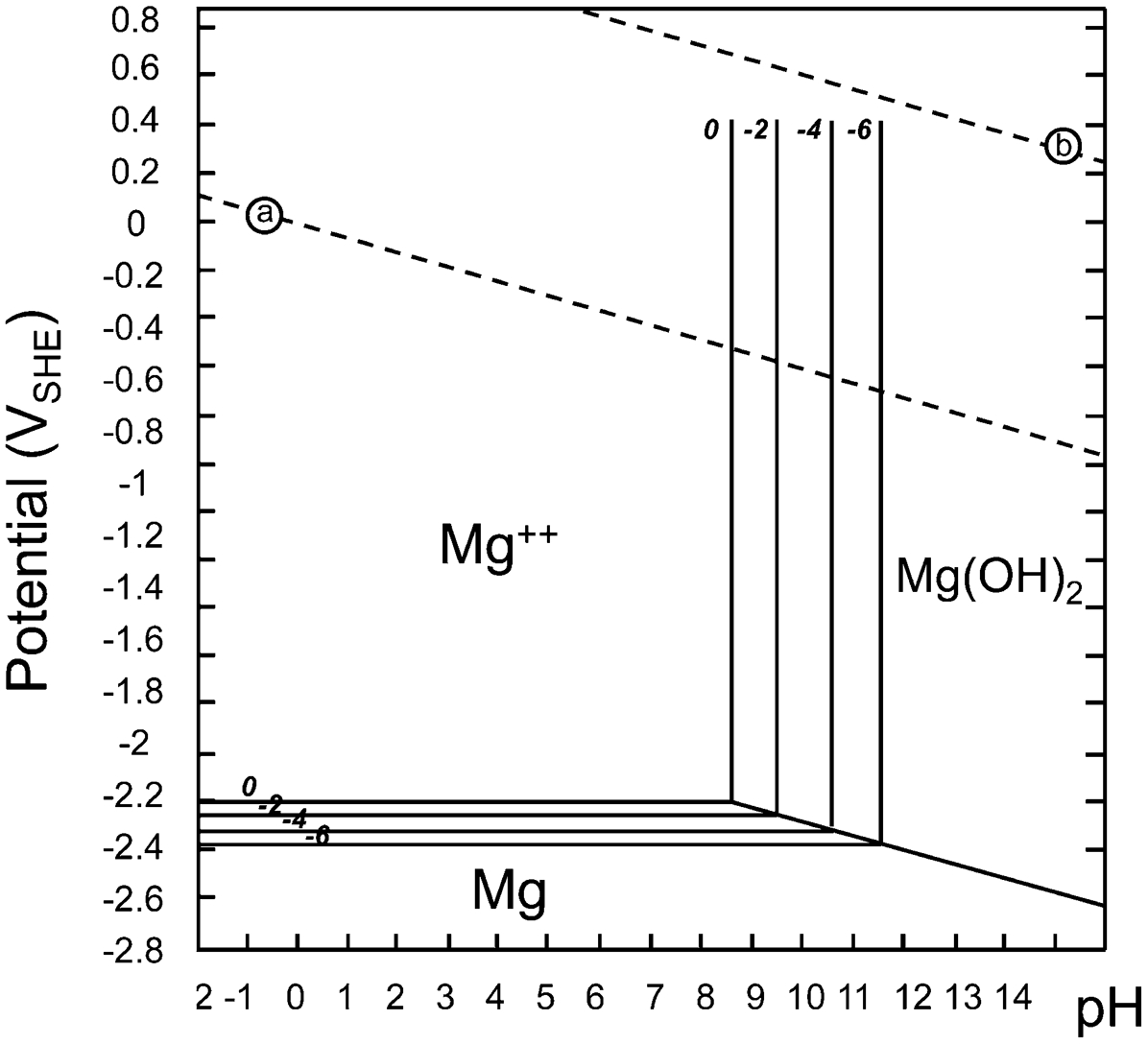
Labels 0, −2, −4, and −6 are the log of soluble ion activity for the indicated lines, and labels a and b show conditions of stability for water and its decomposition products, hydrogen and oxygen respectively. Hydride formation has been neglected. 5
As a result, thermodynamic stability of Mg is not considered to be the key issue in determination of Mg alloy corrosion, with the kinetics of corrosion determining the ultimate corrosion rate. This review will thus focus on the factors that determine, and the extent to which they dictate, the kinetics of corrosion.
The introduction of various alloying elements into Mg can improve some vital mechanical properties and thus extend the range of potential engineering applications, however, this has an attendant influence on the corrosion of Mg. In regards to Mg-alloys, the main factors in controlling corrosion rate are chemical composition and microstructure, hence appropriate attention is given to the development of Mg microstructures in this review. The solid solubility of elemental additions in Mg will dictate the presence of any second phases or impurity particles. More so than in other commercial metal systems, the solid solubility of an alloying element is a key factor in determining its effect on the properties of Mg; as the majority of elements have either no solubility, or very limited solubility in Mg. This is an interesting scenario, as there are concomitantly a large number of elements that will not form intermetallics with Mg, such that when added to Mg a phase separation occurs to produce two pure metals (i.e. Mg and Fe in the case of the Mg–Fe system). 9 The solid solubility depends on factors such as relative atomic size, valency and electronegativity as well as similarity in crystal structure. A certain liquid solubility is required to form a homogenous solution at the alloying temperature.
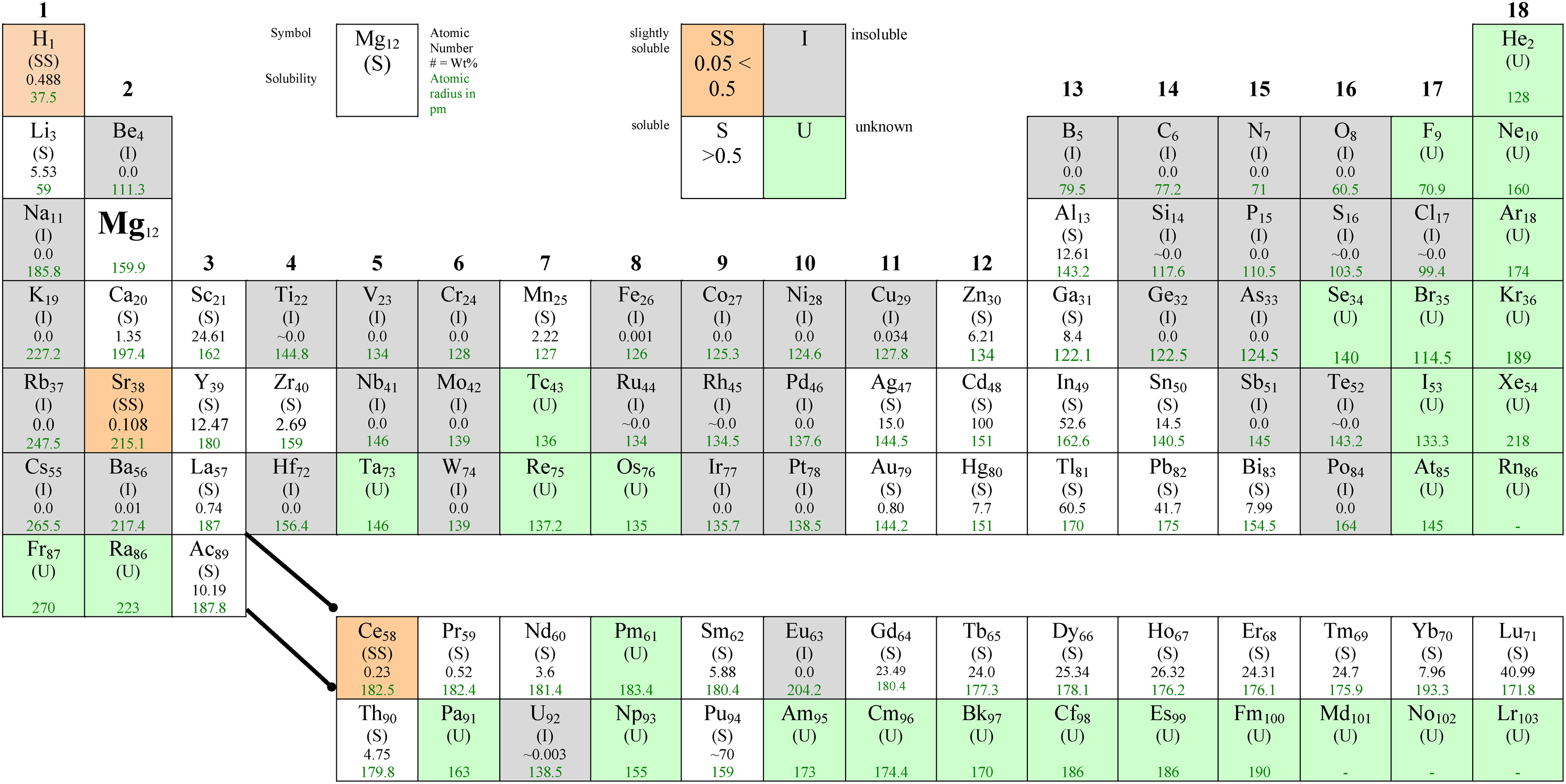
Table 1 summarises maximum solid solubility values in Mg based on binary systems 9–13 and categorising elements according to their solubility. The elements shown in white cells represent elements with solid solubility (i.e. to levels >0·5 wc), the elements shaded in orange are defined as slightly soluble (0·05–0·5 wt-%) and those in grey are insoluble (i.e. <0·05 wt-%). Several elements also have an unknown solubility (green shading). The table also provides the values of the atomic radius of the elements for general information. A convenient way of thinking about the insolubility of elements in Mg is to define the following three scenarios:
Complete and full insolubility: Here no solid solution is formed and no Mg-intermetallic forms with the particular alloying element. This situation is typical of Fe, Mo and Nb. When such elements are present, they form second pure metal phases, with no mutual solubility. This situation causes dramatic corrosion. 14–17
No solubility, but the formation of a Mg-intermetallic: This is typically what is seen with Si (and Cu, Co, Ni). In such cases an Mg2X (where X = Si, Cu, Co, Ni) intermetallic will form. These compounds have no room temperature solubility and thus the retention of a homogenous (single phase) microstructure is not possible. Elements that form the Mg2X intermetallic are often very problematic from a corrosion perspective, as they enhance the cathodic reaction because of the large exchange current density of metals such as Cu and Ni. 18 Special attention is nominally given to exclude Si from commercially produced pure Mg.
Some solubility with no Mg-intermetallic: It is possible for elements such as Zr. In such cases, the alloying element will enter the solid solution to a limited extent, after which any further alloying will result in a separate, pure phase of the element. Again, such phases are problematic from a corrosion perspective. 19,20
The limited solubility of most elements in crystalline Mg results in only minimal changes to the electrochemical potential of the Mg (α) phase. As such, the majority of Mg-alloys have a potential in the close vicinity of about −1·55 VSCE, and essentially all are below −1·4 VSCE. 21 During open circuit exposure, the difference in electrochemical characteristics between the Mg matrix (α) phase and any second phase (be it a precipitate or impurity/insoluble particle) can be defined as the local current density sustained between microstructural constituents at the iso-potential of the alloy. These locally sustained current densities dictate whether any microgalvanic coupling contributes to corrosion or not.
To orient the reader with the typical microstructures observed in Mg alloys, a selection of alloy microstructures are seen in Fig. 2 for alloys with increasing alloy content. What is generally observed is that increasing alloy content leads to a rapid increase in the volume fraction of second phase. The extent and influence of the second phase will depend on the element added and its relative solid solubility. The variation in the volume fraction of second phase is evident in the examples seen in Fig. 2 with microgalvanic corrosion in Mg-alloys almost exclusively explained by the accelerated cathodic activity which arises from intermetallic particles (IMPs) able to support higher reduction reaction kinetics compared to pure Mg. 16 The fact that most elements have a greater efficiency at supporting the cathodic reaction stems from Mg having a low exchange current density, which is a physical characteristic of Mg itself. Consequently, IMPs with higher catalytic activity result in enhanced anodic dissolution of the Mg matrix. One well documented exception to this was reported by Kirkland, who indicated that Mg2Ca has a more negative electrode potential, such that it would be anodically polarised in the Mg matrix and undergoes extremely high dissolution rates at the expense of Mg. 22 The magnitude of the effect of IMPs on acceleration of anodic or cathodic kinetics depends on their respective chemistry (and hence electrochemistry) and volume fraction, so that the larger the volume fraction of IMPs in the alloy, the greater the impact on increasing the corrosion rate of the alloy. 23,24 The presence of impurities (which is the generic name given to insoluble elements) such as Fe, Ni, and Cu alters corrosion rates dramatically, even in the ppm range. 25,26 For example, islands of pure Fe or pure Cu in the matrix of Mg create a mixed potential that assures the Mg is polarised anodically (dissolves) and the pure insoluble elements can sustain the cathodic reaction at very high rates, as they are significantly polarised from their nominal corrosion potential values (often by >1 V).
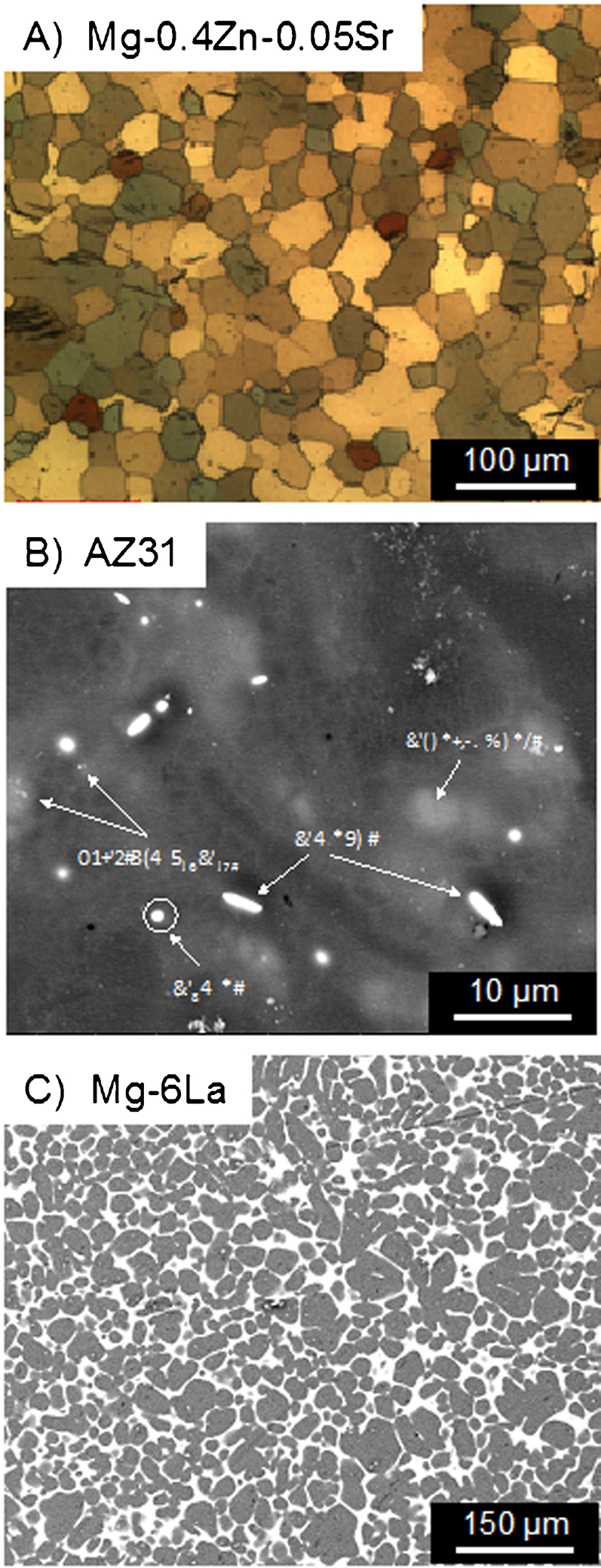
Typical Mg-alloy microstructures, all compositions given in wt-% a Mg–0·4Zn–0·05Sr in the rolled condition. This alloy has alloying additions below the respective solubility limits and is a solid solution alloy with uniform matrix composition. The image is an optical micrograph following etching in glycol solution. 27 ; b AZ31 (Al–3Al–1Zn–0·4Mn) as sectioned from an extruded ingot. Backscattered electron imaging indicates that this is close to a solid solution alloy, however, as the Al content is approaching the solubility limit and solute enrichment is observed, together with fine second phase particles. This alloy also includes constituent AlxMn particles, typical of scenarios with Mn additions; c Mg–6La as high-pressure die cast. Backscattered electron imaging reveals that the addition of La well above the solubility limit results in a large volume fraction of Mg12La phase. 28
Arguably, the biggest single contribution to date with respect to moderating the corrosion rate of commercial Mg is the ‘scavenging’ ability of Mn in conjunction with Al. 25,29 By virtue of Mn additions to the Mg–Al systems, Fe is sequestered in an AlMnFe intermetallic, and hence the extent of microgalvanic coupling is dramatically reduced. 14 The moderation of corrosion/scavenging effect in Al-free alloys remains largely unknown and is an area of current research 20 which will be significant in the development of creep resistant (i.e. Al-free) Mg-alloys.
Corrosion kinetics of Mg-alloys
Corrosion of Mg-alloys is a kinetic issue, which will depend on the alloy composition, together with the component design (i.e. if welded or joined) and environmental factors (such as pH, [Cl−] and temperature). 30,31
The half-cell reactions for Mg corrosion are given in equations (1) and (2). Reaction (1) is Mg dissolution that produces electrons consumed at the cathode (2) resulting in generation of hydrogen gas. As will be described in the subsequent section, this process can be sustained during anodic polarisation of Mg
32


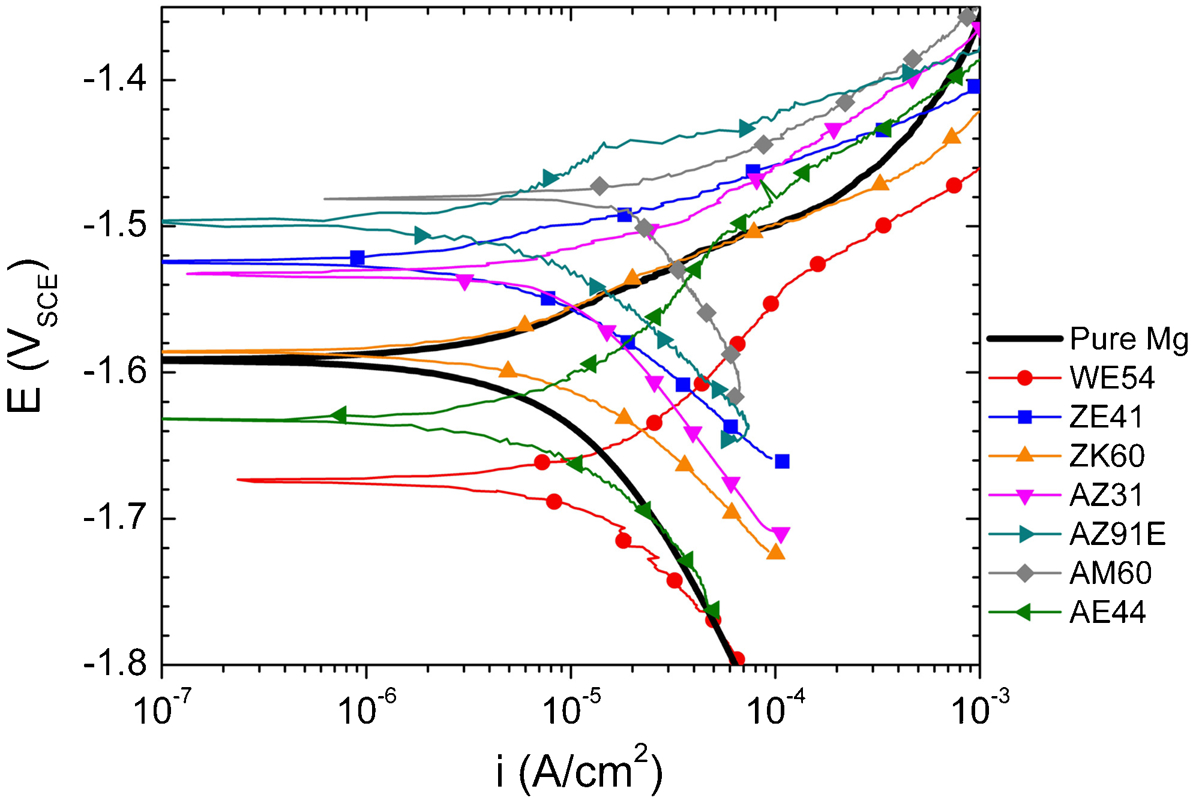
Generally, the potentiodynamic polarisation response provides information about the relative rates of the anodic and cathodic kinetics for different alloys. The method can also provide an instantaneous corrosion rate (termed the corrosion current density i corr) as approximated by a Tafel-type fit, usually from the cathodic polarisation data. This has been verified as a reasonable approximation to the corrosion rate as it relates to the rate obtained from other methods. 36 However, of key relevance here is that the polarisation technique, in spite of not being a long term predictor of corrosion rates owing to its instant nature, is an important tool in rationalising alloy behaviour as it is the most effective at providing information on the effect of a particular element on anodic or/and cathodic reaction rates. An archetypal demonstration of this was provided by Kirkland, who revealed that Mg–10Zn ( wt-%) and Mg–5Ca ( wt-%) show the same corrosion rates from mass loss tests, however, the origin of corrosion rates could only be ascertained from polarisation testing, which revealed that Zn enhanced cathodic kinetics (with little influence on anodic kinetics), while Ca enhanced anodic kinetics (with little influence on cathodic kinetics). 37
In Fig. 3, the representative polarisation curve for pure Mg is seen as a thick dark line. It is immediately obvious that there is a range of movements in the relative anodic and cathodic curves depending on the respective alloying additions. One striking feature, however, is that most of the commercial alloys have significantly more rapid cathodic kinetics than pure Mg, with the exception of WE54 and AE44, which both contain appreciable rare earth (RE) additions, yielding similar cathodic kinetics to pure Mg. Other features to note include that AM60, AZ31, AZ91 and ZE41 showed lower anodic kinetics than pure Mg, while AE44 and WE54 showed enhanced anodic kinetics relative to pure Mg.
These simple descriptions are being made to orient the reader with the form and signatures in such data, while the effects are treated in a holistic treatise further below.
The data in Fig. 3 provide the classic manifestations for Mg-corrosion kinetics, which includes
Elements that shift the anodic branch to lower rates nominally do so by solid solution doping, which is efficiently achieved by Al and Zn. However, this is countered by a corresponding increase in the cathodic kinetics. Both of these kinetic changes lead to ennobled E corr values.
Significant alloying additions (which in comparison to other metallurgical systems can in fact be modest) will lead to second phase development and hence, nominally more rapid cathodic kinetics (and hence corrosion rates).
It can be seen that Al-containing Mg-alloys tend to show the lowest anodic kinetics and the fastest cathodic kinetics.
Significant alloying with RE elements can reduce the E corr and enhance anodic kinetics on the basis that REs are themselves ‘active’ elements.
Common alloying additions do not result in lower cathodic kinetics being imparted to Mg. Even REs tend to serve as local cathodes under free corrosion conditions. 38
Alloying additions nominally only alter E corr within a window of ∼100 mV. This, however, does not mean that corrosion rates cannot be spread over several orders of magnitude (as reported in the literature 39 ) since large changes in kinetics can be achieved on the basis that Mg is ‘weakly polarisable’. This means that only small changes in potential can result in large deviations of current (owing to a very low anodic Tafel slope in Mg systems, as opposed to say, passivating systems).
In relation to the aforementioned alloys (Fig. 3), there is ample information in the literature concerning the microstructures developed, 40–47 and hence our main focus herein is to present their corrosion kinetics in respect to the main microstructural constituents. Mechanical properties will not be covered herein, however, the authors note that the group of high(er) strength Mg-alloys (AE44, WE54, and ZK60) possess the presence of precipitates including Al11RE3, Al10RE2Mn7, Al2RE, 47 MgxREy, 44 and MgZn2, 48 with improved mechanical properties at the expense of reduced corrosion performance. 49 Taking the finite commercial alloys as examples, the microstructural, and hence electrochemical, heterogeneity requires the quantification of microstructure as a requisite effort in the rationalisation of corrosion performance.
Before discussing the unique effect of specific elements, a set of polarisation curves depicting the corrosion kinetics of selected experimental alloys is shown in Fig. 4. The selection of the data in Fig. 4 was deliberate, to indicate instances where anodic reaction rates can be rather markedly increased. This phenomenon occurs for two reasons. The first (Mg–Ca) is when the alloying element is more reactive (in terms of dissolution kinetics) than Mg, which is the case when Ca is alloyed with Mg. 22 The second is when an alloying element triggers ‘anodic activation’. This is the case for Mg–Sn. The anodic ‘activation’ is a terminology used for elements that are able to disproportionally enhance anodic kinetics, when this phenomenon may not be expected on the basis that the alloying element is (in its pure form) less active than Mg. This phenomenon is common to Al alloys with heavy metals such as Pb and Sn, which are nominally low melting point elements that segregate to the surface disrupting the surface film and allowing dissolution en masse. The phenomenon is also observed in Mg (Fig. 4) and occurs with Sn (also with Pb, Sb, and Zr as discussed below). However, this phenomenon has not been studied in detail, perhaps because of the fact that it has no commercial relevance to date. Ironically, however, the low melting point elements that lead to anodic activation in Mg are also part of the family of (few) elements that have lower cathodic kinetics than Mg (Pb, Sn, and Sb have a low exchange current density, which is a physical property of each element 18 ). Unfortunately, the phenomenon of slowing cathodic reaction kinetics (evident in Fig. 5 for the Mg–Sn alloy) is overwhelmed by the anodic activation for reported alloys to date.
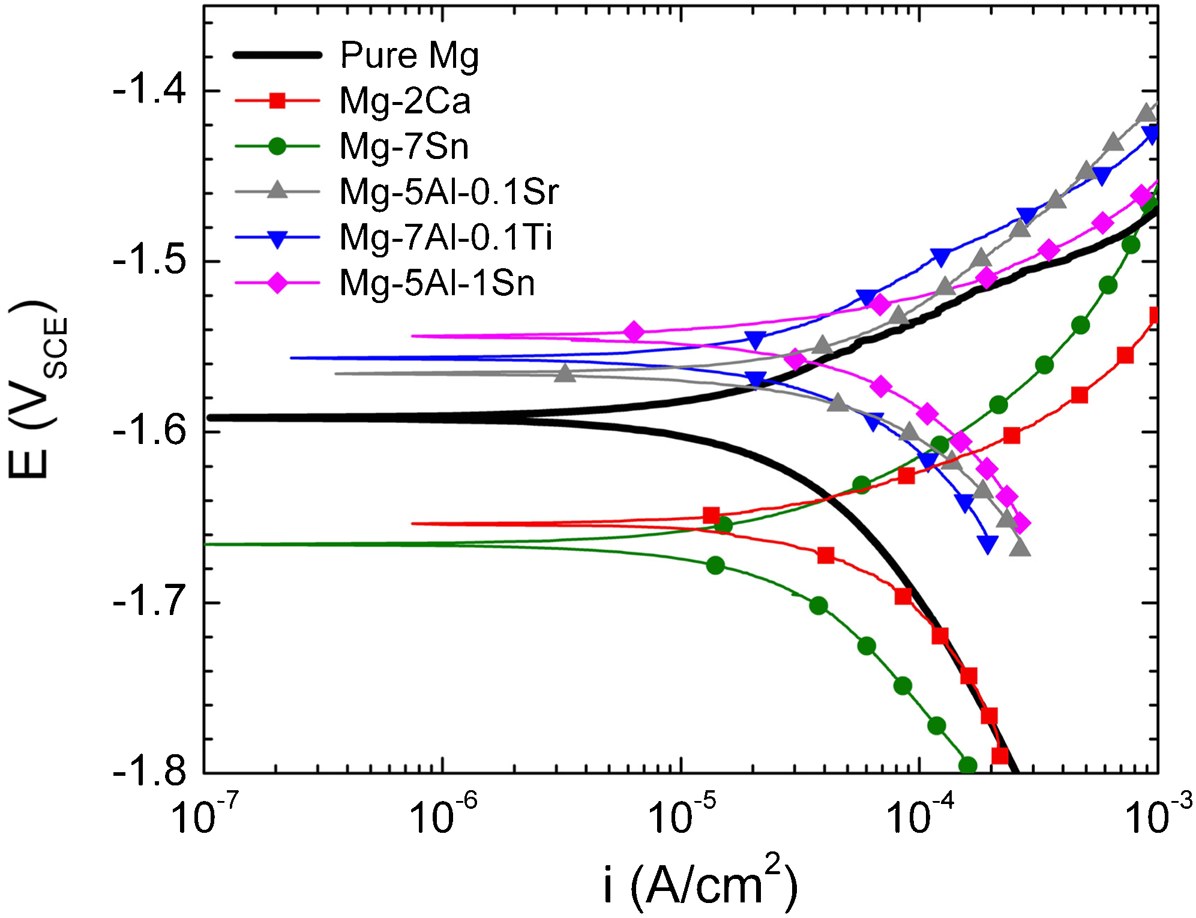
Typical potentiodynamic polarisation response of selected experimental Mg-alloys. The alloy composition is denoted in the plot, while the pure Mg was 99·9% purity 50
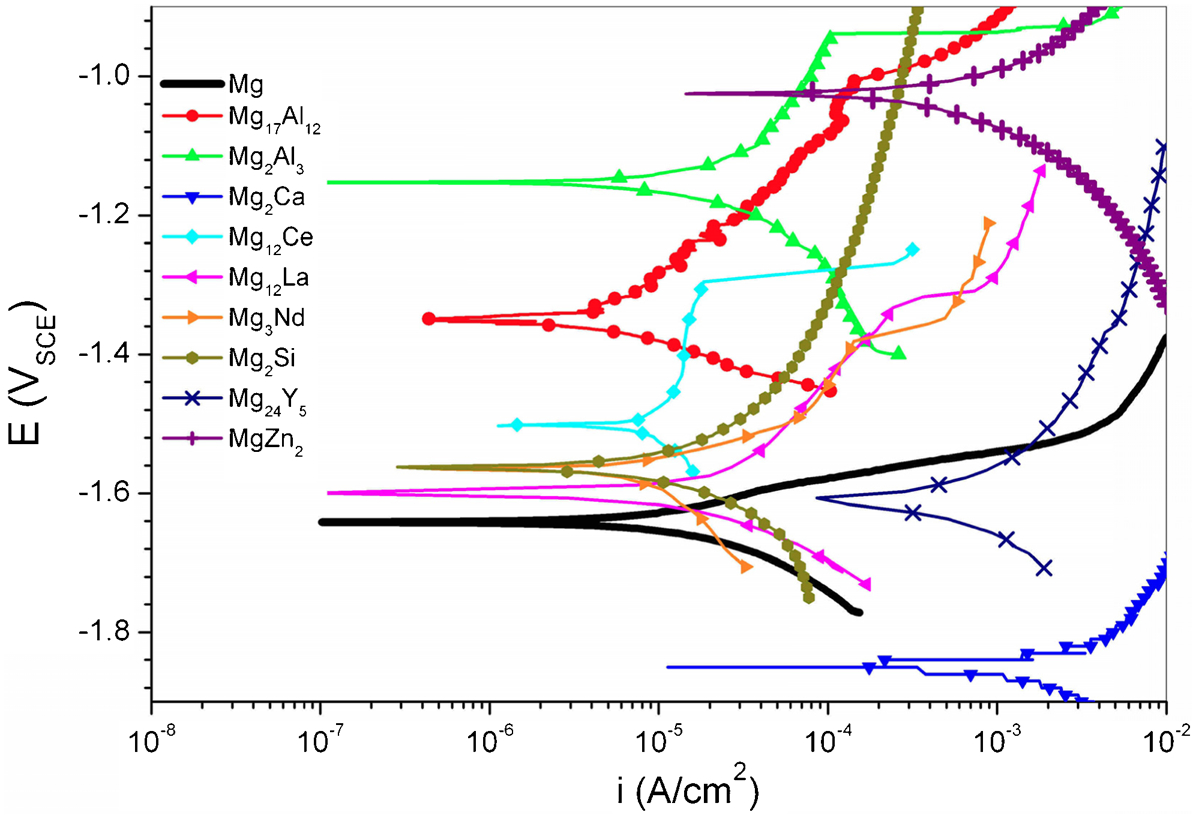
Potentiodynamic polarisation curves for intermetallic phase present in, and common to, the Mg-alloys systems. Date presented along with pure Mg for comparison (40 ppm by wt. Fe), in 0·1M NaCl. From Ref. 16
In the other examples provided that include ternary additions to Mg–Al alloys, the overriding manifestation is the enhanced cathodic kinetics imparted by Al, while any beneficial effects in reduced anodic kinetics are not significant for the cases presented.
In order to provide a synopsis of the electrochemical kinetics of constituents and precipitates which can populate Mg-alloys, a selection of potentiodynamic curves collected by Südholz 16 is presented for a finite number of Mg-based intermetallics (Fig. 5). Such data are not inclusive of the entire spectrum of possible Mg-based intermetallics, as the collection of such data necessitates the production of sufficiently large intermetallics for interrogation via micro-electrochemical testing. 23,51,52 What is observed from Fig. 5 is that the IMPs are nominally noble with respect to Mg, with the exception of Mg2Ca. This, therefore, indicates that such intermetallics, if in an Mg matrix, will be polarised cathodically, and will remain cathodically protected at the expense of matrix dissolution. Of most interest and importance, however, is that the rates of reaction on the different intermetallics are distinctly different, and hence the chemical entity of the intermetallic is of great significance to the ultimate corrosion rate of the alloy, which they occupy. Authors emphasise the salient, but key point, that it is the kinetics of reaction on intermetallics that relate to their potency to support localised corrosion, and not the relative potential variation from Mg. Potential difference does not necessarily translate to kinetic effects, as seen in Fig. 5. Unfortunately, such a consolidated presentation of intermetallic electrochemistry does not exist for a range of environments (i.e. pH or [Cl−]), with only reportage in 0·1M NaCl to date.
In that vein, it is noted that the majority of reports for Mg corrosion exist in near-neutral chloride environments. This is considered to be reasonable on the basis that most atmospheric exposures can be approximated by dilute chloride solutions. The most common electrolytes appear to be 0·1 and 0·6M (i.e. 3·5 wt-%) NaCl. Some exceptions include works in more dilute electrolytes 53 and recent work in concentrated chloride electrolytes on the basis that drying aerosol droplets will lead to [Cl−] between 1·0 and 5·0M. 54 Other environments in which testing has been conducted include sulphate solutions 53,55 and solutions saturated with Mg(OH)2. 56 Additionally, in the field of Mg as candidates for bioresorbable implants, testing is executed in a variety of physiological environments and temperatures. 57 The pH dependence of pure Mg corrosion has been recently extensively covered by Ralston, 58 and readers are directed to that dedicated work, while the focus in this review remains on alloying effects.
Focusing on the electrolyte for which the most data have been reported for a variety of alloys (0·1M NaCl), Fig. 6 represents the experimental data collected and reported over the past decade for a range of Mg-alloys, commercial and experimental, as subdivided by basic chemistry. This compilation includes data from 108 alloys and was limited to literature in which the combination of electrochemically determined corrosion current and gravimetrically determined corrosion rate was reported. Confining the representation to such alloys was deliberate so that the readers could ascertain (i) the relative corrosion rates seen in Mg alloys in units to which they can compare their own data, be it corrosion current or mass loss rate, (ii) to indicate that there is a correlation between tests, in that generally, alloys with a high corrosion current density will also have a high rate of mass loss, and (iii) to indicate the spread of corrosion rates which may arise as a function of alloying.
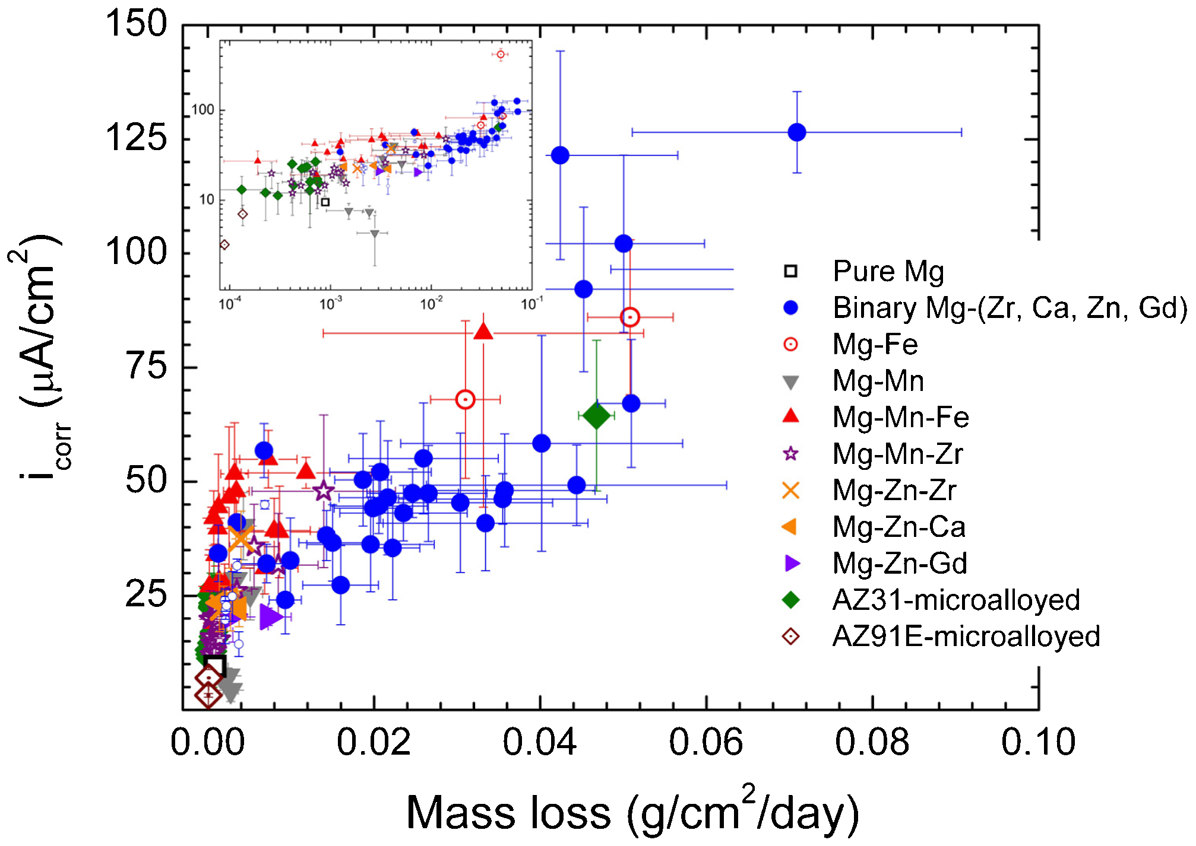
Corrosion rate expressed as corrosion current density (i corr) v mass loss rate (mass loss determined from 1 day exposure in 0·1M NaCl). Inset shows same data, with logarithmic axes. Data from Refs. 16,17,19,27,28,33–35,59,60
This latter point merits some comment, as the authors can observe differences in over an order of magnitude in both the corrosion current density and mass loss rate. This spread is rather remarkable, and is perhaps even unique to Mg, in that alloying can have such a marked influence on corrosion kinetics for the same environment. A large spread of corrosion rates was also shown in selected alloys tested in physiological media, 39 however, the authors note that the present data (Fig. 6) only report results for 0·1M NaCl at room temperature. To orient readers, the authors note that low corrosion rates (typical of passivating systems, including Al-alloys) are nominally ∼1 μA cm−2; noting that the reported rates for the Mg alloys presented are much higher than this. Regarding the practical measurement and the measurement execution for quantifying of Mg corrosion electrochemically, gravimetrically or volumetrically (i.e. via hydrogen collection), a study by King et al. abridges and highlights recent developments. 54 Elaboration of the effects seen in Fig. 6 are rationalised from the descriptions of unique additions in “Influence of alloy composition on corrosion of Mg-alloys” section.
Update on the mechanistic aspects of Mg corrosion
The mechanism of Mg corrosion is a topic that has been studied throughout the past century. 53,61–68 While the corrosion of Mg is a process occurring at open circuit, it is of contextual relevance to mention that Mg displays a phenomenon known as the ‘negative difference effect’ (NDE). The so-called NDE describes the phenomenon by which the amount of hydrogen evolved from an Mg electrode increases as the electrode potential is polarised anodically to more noble potentials. This is counter-intuitive to conventional electrochemical wisdom on the basis that increasingly anodic polarisation should result in lower rates of the cathodic reaction (which is responsible for the evolution of hydrogen as per equation (2)).
Somewhat controversially, in one study, the origin of this phenomenon was proposed by Petty 63 to be a result of the formation of unipositive Mg (Mg+), which was later popularised by Atrens and co-workers, 65,66,69,70 who purported that superfluous hydrogen arises from a chemical reaction of Mg+ with water at some unknown distance from the metal surface. The claims by Atrens and co-workers have led to somewhat of a nuanced understanding of Mg dissolution processes, largely as the proposed Mg+ theory has no reasonable proof of its existence 66,70–74 and most recently the Petty experiments were refuted. 75 While the imagined existence of Mg+ has captured attention and consumed scientific effort, it has no influence on the content of this review.
At the time of writing this review, a large number of publications have emerged that provide significant detail regarding the mechanisms of Mg dissolution as well as physical descriptions of the NDE. Of those studies, the use of inductively coupled plasma atomic emission spectroelectrochemistry (AESEC) definitively demonstrated that Mg dissolution occurs with an n = 2 stoichiometry (i.e. Mg2+) in both sulphate and chloride solutions. 53 This observation was recently validated in an independent study using on-line mass spectroscopy. 76 The results of AESEC testing are seen in Fig. 7, which show excellent agreement between applied current and the Mg2+ dissolution current. This echoes the classic notions put forth by James and Straumanis, 64 albeit with modern analytical support. With the Mg valency accounted for, the notion of superfluous hydrogen evolution during anodic polarisation (i.e. a parasitic cathodic reaction) was proposed by Frankel 67 to be the result of the cathodic reaction being catalysed by Mg dissolution, which is consistent with the classic works noting enhanced ‘reducing ability’ 17 and has also recently shown by scanning vibrating electrode (SVET) measurements. 32 The atomistic origins of this enhanced catalytic activity are the goal of active studies. 77 It is, however, emphasised, that the alloying effects described herein are not dependent on the elucidation of the origins of enhanced catalytic activity in a first order sense, and hence this section will not be elaborated further in the present review.
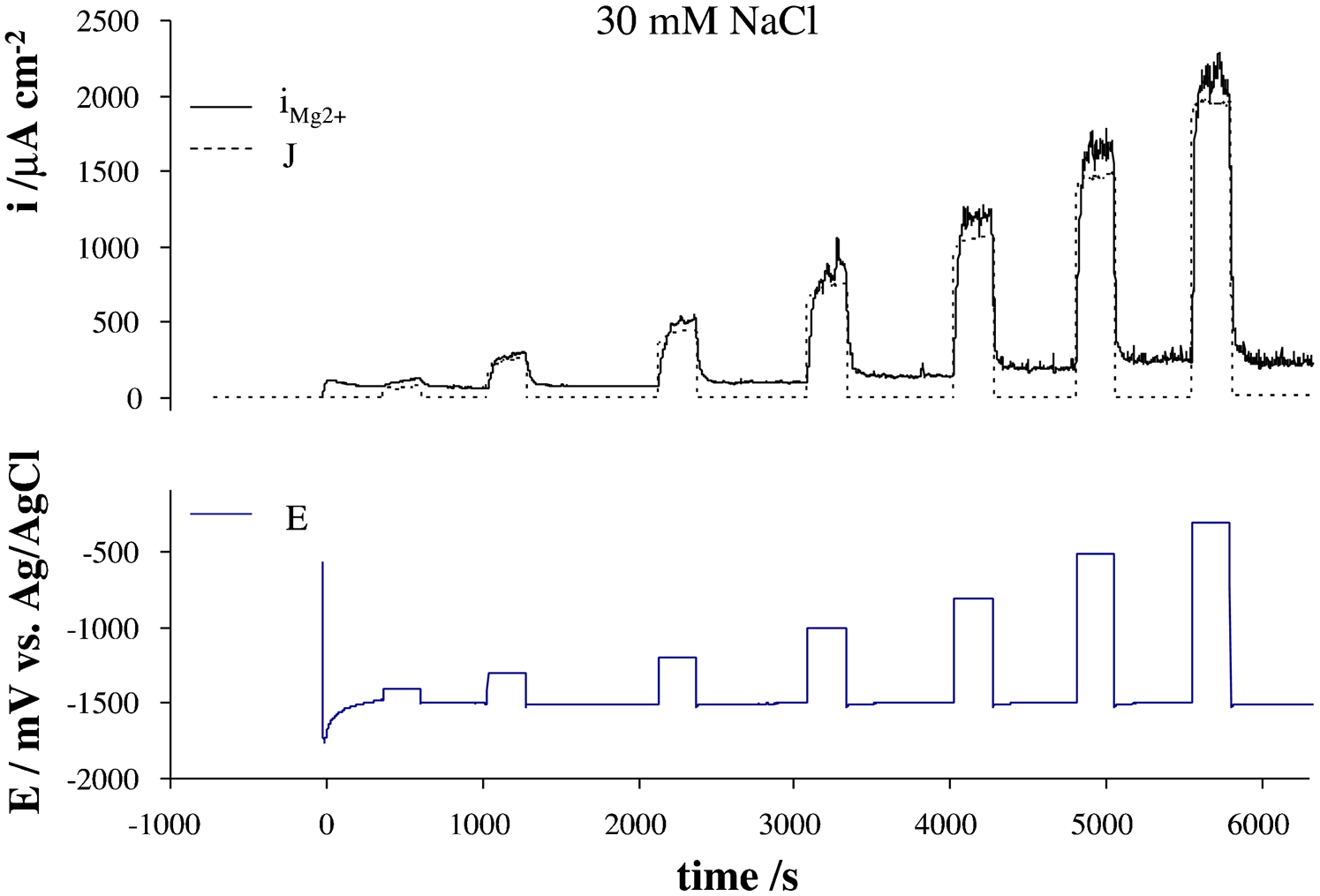
Upper plot shows the ICP-AES signal registered (i Mg2+) together with current signal (j), along with the signal from different potential steps in the lower plot. The applied potential steps from left to right, are −1·4, −1·3, −1·2, −1·0, −0·8, −0·5, and −0·3 V (Ag/AgCl) applied each time for 240 s in 30mM NaCl electrolyte. From Ref. 53
Influence of alloy composition on corrosion of Mg-alloys
An attempt has been made to present an abridged summary of the influence of specific elements upon the corrosion kinetics of Mg. In many cases, the effect of an element is over and above that of an existing system (i.e. the effect of Mn, on say, the Mg–Al system). However, such scenarios are described in words and the relevant references provided in order to yield a unique consolidation of information not available elsewhere.
Aluminium (Al)
Al is the most common addition to Mg, by virtue that it is (relatively) cheap, light, soluble, and considerably improves strength of Mg (i.e. from ∼70 to ∼250 MPa). 78 Additions of Al below the solubility limit tend to reduce the anodic kinetics of Mg. The addition of Al to Mg ennobles the corrosion potential, with Mg–Al alloys tending to be ennobled by ∼100 mVSCE compared to pure Mg, in Cl− environments. 65,66,79–81 The Mg–Al alloys nominally have the lowest corrosion rates of the commercial Mg-alloys, 13 particularly AZ31 (Fig. 6), which gives an optimum balance between physical and corrosion properties for Mg-alloys to date. Although Al is soluble to ∼12 wt-% in Mg, this is dependent on temperature, and the room temperature solubility is much lower, with alloys richer in Al than AZ31 showing the presence of β-phase (Mg17Al12). The extent of β-phase will depend on the time–temperature history of the alloy, with the relative proportion of β-phase for the same given composition also varying rather widely depending on alloy cooling rate or subsequent heat treatment (i.e. whether sand-cast, die cast, or high-pressure die cast). 82–92 Above ∼3 wt-%, Al additions tend to enhance the cathodic reaction, which although further 93 ennobles E corr, is associated with an increase in corrosion rate. In open circuit conditions, β-phase serves as a local cathode. As such, cathodic kinetics of the following alloys increase in the order of AZ31<AZ61<AZ91≤AM60. Al has been reported to increase the susceptibility to stress corrosion cracking in cases where β-phase exists in appreciable fractions. 78 It is also noted that the AZ alloy system undergoes solid-state phase changes at moderate temperatures, and hence its utility in more demanding modern applications is leading to the proliferation of Al-free Mg alloys.
Silver (Ag)
The effect of Ag additions on the corrosion of Mg was studied by Hanawalt more than 70 years ago, who suggested a tolerance limit for Ag in Mg to be ∼0·5 wt-%. 15 Above this concentration the mass loss rate increased monotonically from ∼1 mg cm−2 day−1 for 1 wt-% Ag, to ∼12 mg cm−2 day−1 for 5 wt-% Ag. In contrast, the effect of Ag on accelerating the corrosion of Mg is therefore as dramatic as that as Ca on Mg. 15 In more complex alloys, however, lower level quaternary additions of Ag (to <∼2 wt-%) in the Mg–RE–Zr family of alloys are reported, because Ag improves the age hardening response and thus provides substantial increment in strength. 13 However, it is prudent to note at this point that although Ag has been added to the high strength Mg alloy family (which can be considered ultra high strength when considering specific strength), this has not been an alloy design with corrosion considerations in mind. None the less, addition of elements such as Ag that have the ability to modify nucleation/precipitation is an avenue that can be exploited. For example, trace additions of Ag (∼0·1 wt-%) to AZ91 were recently shown to stimulate an interaction between Ag and the Mg17Al12 phase, providing an increment in hardness without any significant loss of corrosion properties, i.e. a slight increase in cathodic kinetics is counterbalanced by decrease in anodic kinetics. 33 High concentrations of Ag led to increased corrosion rate because of co-formation Mg4Ag precipitates that can stimulate microgralvanic corrosion. 34,94 In addition, micro-additions of Ag (<0·5 wt-%) to Mg–Zn–Ca systems facilitate grain refinement and in cast and wrought alloys. 95
Arsenic (As)
The effect of As on Mg corrosion was explored on the basis of the potential to kinetically limit the cathodic reaction, with As known to be a cathodic ‘poison’ preventing hydrogen recombination 96 and restricting the completion of the reaction in equation (2). The metallurgical influence of As has been recently reported by Birbilis et al., 97 whereby relatively small additions of sparingly soluble As (∼0·37 wt-%) result in formation of Mg3As2 phase. In spite of this second phase presence, a decrease in Mg corrosion rate (five times lower than that of pure Mg) was determined by simultaneous hydrogen collection and 7 day mass loss tests, as well as lower cathodic kinetics determined by potentiodynamic polarisation. The reduction in corrosion rates was associated with the ability of As to slow down the cathodic reaction rate of pure Mg.
Bismuth (Bi)
The addition of Bi to Mg–Al alloys has the effect of refining Mg17Al12 and is accompanied by co-formation of needle-shaped Mg3Bi2 particles, even for Bi concentrations below the solubility limit. 98 When added to AZ91, Südholz reported that the presence of Mg3Bi2 ennobles the corrosion potential of the alloy 34 and is shown to bring about the acceleration of both the anodic and cathodic reactions rates. 99 In spite of the negative influence on corrosion, Bi-containing particles seem to have a positive effect on enhancing tensile and creep properties via restricting grain boundary sliding. 100
Calcium (Ca)
In the binary context, Ca additions in low levels (less than 0·35 wt-%) are essentially inert. 101 In general, however, Ca additions dramatically increase corrosion rates in Mg when added near to, or above the solubility limit (of ∼1·35 wt-%). Ca-containing Mg alloys result in exceptionally high corrosion rates. According to Hanawalt, the mass loss rate of Mg–Ca binary alloys increases from ∼1 mg cm−2 day−1 for 0·5 wt-% Ca to about 6 mg cm−2 day−1 for 5 wt-% Ca. This is almost six times higher than the corrosion rate of Mg–5 wt-% Al. 15 In addition to possessing the highest corrosion rates of any candidates for structural alloys ever reported, Ca-containing Mg alloys dissolve to yield a voluminous corrosion product that is insoluble. 39 Owing to the biocompatibility of Ca, however (along with Zn), Mg–Zn–Ca alloys are being explored as potential biomaterials. 22 More recently, very low levels of functional Ca additions are being explored in Al-free Mg-alloys, 102 in attempt to exploit the fact that Ca is one of the few soluble elements in Mg. Provided that Ca concentrations are kept below the solubility limit to avoid Mg2Ca formation, the corrosion rate will not sharply accelerate, while solid solutions of Mg–Ca can display appreciable ductility. 103–105
Copper (Cu)
The addition of Cu to Mg and Mg-alloys is generally avoided because of the insolubility of Cu, and the resultant formation of Cu islands in the microstructure. Cu is highly detrimental for corrosion, 78 rationalised on the basis that Cu has a high exchange current density, and hence an efficient cathode. The tolerance limit of 0·1 wt-% was established by Hanawalt, however, the limit is sharply reduced to 0·01 wt-% when Al and Mn are present in the alloy composition. 15 When added to AZ series alloys it forms an Mg–Al–Cu–Zn phase, which is also a relatively strong local cathode resulting in local corrosion. 106 In general, Cu is avoided in the production of Mg-alloys, with measures in place to avoid Cu contamination and pick-up. Unfortunately, from a corrosion perspective, Cu is, however, a popular element in the formation of Mg metallic glasses, 107 where the influence of Cu on the resultant corrosion mechanism has been described as incongruent dissolution and discussed further below.
Cerium (Ce)
When added as a binary addition (i.e. Mg–Ce) the formation of Mg12Ce occurs in increasing volume fraction with Ce additions, which can monotonically accelerate corrosion by enhancing cathodic kinetics. 24 In spite of the chemical reactivity of Ce, Mg12Ce is more noble than Mg, and Mg12Ce sustains the cathodic reaction at higher rates than Mg over the range of potentials typical of Mg-alloys. On the other hand, Ce additions to Al-containing Mg-alloys can refine microstructure by formation of Al4Ce or Al11Ce3 intermetallics. 108,109 These compounds are, however, more deleterious for corrosion than Mg12Ce. Rare earth elements are typically not combined with Al-containing Mg alloys, with the exception of the commercial alloy AE44. In the more modern wrought series of Mg alloys, RE and Al are not combined, because of the ease of formation of AlxREy compounds that reduce alloy ductility. Some reports suggest that Ce contributes to the surface film and stabilises Mg hydroxide. 110 Südholz, however, revealed via XPS analysis that RE elements were not seen to dope the surface oxide of Mg–Al alloys. 28 The notion of oxide modification of Mg-alloys is an area of mixed reports, and one that is an open question. Irrespectively, elements with thermodynamic ability to replace Mg-oxides/hydroxide generally do not offer a wider window of passivity than Mg. 111
Erbium (Er)
In favour of more cost effective RE elements, Er has not been well studied in Mg. In one study, however, Er, when added in 2–3 wt-%, was found to decrease corrosion rates in Mg–2 to 3Al (wt-%) alloys compared to commercial AM60 [nominal Mg–6Al–0·13Mn (wt-%)] when tested in borate buffer solution. 112 The assumption was made that Er facilitates an apparently enhanced protective effectiveness to the surface oxide giving rise to what was described as a pseudo-passivation effect by incorporation of Er into the Mg(OH)2. However, there is still a lack of evidence to support this assumption. Furthermore, the testing of Mg in a buffer is likely to impose an unrealistic scenario of surface film evolution, which is nominally influenced by natural surface alkalinisation.
Iron (Fe)
Fe is the most common impurity in Mg-alloys. Fe contamination can be present because of the quality the starting ‘pure’ Mg as well as because ofpickup from the casting process. Owing to its low solubility in Mg (∼0·001 wt-%) Fe largely remains in its pure (body centred cubic) form. To date, the literature reports a number of tolerance limits for Fe, which is nominally restricted to as low a level as economically feasible. 13,113 The notion of an Fe tolerance limit dates back several decades, where the proposed limit of 150 ppm by weight was commonly accepted. 114,115 Recent works have focused more specifically on the role of Fe, as its ability to be scavenged by sequestration to AlMnFe particle formation is not possible in emerging Al-free Mg alloys. 17 The role of thermal history on the Fe tolerance limit has also been recently discussed on the basis of calculated phase diagrams. 116,117 The experimental validation and robustness of the related thermodynamic databases for Mg–Fe remain open questions without further empirical work, particularly because it was seen that calculated phase predictions can vary from the structures characterised by electron microscopy. 17
Gadolinium (Gd)
Of the elements that Mg may be alloyed with, Gd is unique on the basis that it has high solubility (>10 wt-%) in Mg, forming binary Mg–Gd solid solutions over a wide range of compositions. Such solid solutions can be used as a basis for further loading of the matrix with solute elements – in the case of wrought Mg alloys, or for carefully controlled precipitation processes in the family of Gd-containing precipitation-hardened Mg-alloys. 118–121 In regards to this latter class of alloys, corrosion characterisation remains scarce. The addition of Gd in Mg–Al alloys results in the precipitation of Al2Gd and Al–Mn–Gd phases that consumes Al and reduces the volume fraction of Mg17Al12 phase. 122 These phases may contribute to a minor decrease in the total rate of cathodic reaction. 123 This tendency is commonly observed for Mg–Al alloys modified with REs. However, the effect of Gd is more complex because it leads to more heterogeneous microstructures and diminished Al content in the Mg matrix. Therefore long term corrosion tests show a greater corrosion for Mg-alloys containing Gd. 124 Other studies have also indicated that the influence of Gd on corrosion is generally defined as detrimental. 125
Mercury (Hg)
Alloying with Hg is nominally only reserved for the production of high voltage anode materials for sea water batteries. 126 The Mg3Hg phase can form in binary Mg–Hg alloy at concentrations of Hg at around 4–6 wt-%. 126,127 Thermomechanical processing of Mg–Hg alloys can promote the redissolution of Mg3Hg into the Mg matrix, which subsequently retards microgalvanic corrosion and thus lowers corrosion rates. 128 Feng compared the electrochemical response of Mg–5Hg (wt-%) and Mg–6Hg (wt-%) in 3·5% NaCl solution, and concluded that Hg accelerates anodic reaction rates and leads to very negative corrosion potentials (E corr, Mg–5Hg∼−2·3 VSCE), in fact representing the most negative corrosion potential reported of any Mg alloys. This was concomitant with high corrosion rates with i corr of Mg–5Hg being ∼27 mA cm−2, compared to ∼20 μA cm−2 for pure Mg. 127 The role of Hg in structural Mg alloys has not been explored.
Holmium (Ho)
The limited research to date regarding Ho has suggested that a Ho addition of 0·24 and 0·44 wt-% can decrease the rate of corrosion in an Mg–Al alloy (AZ91D) by decreasing the volume fraction of Mg17Al12 owing to the formation of Ho-containing intermetallic phases with Al. In one study, inspection of the reported data indicate a minor decrease in the cathodic reaction rate, along with as much as 10 times lower mass loss rates compared to that of the base Mg–Al alloy. 129 This, however, is likely to lead to decrease in alloy strength and may be manifest as the same outcome as lowering of the alloy Al content. It has been posited that Ho presumably contributes to more uniform and compact layer of corrosion product because of the higher content of Al present in the surface film; however, more evidence is needed to support such assertions.
Lanthanum (La)
As a binary addition, La forms the Mg12La phase 24 when added above its solubility limit. This phase is a more efficient cathode than pure Mg leading to an overall increase in corrosion rates (from 10 to 30 μA cm−2 at concentrations varying from ∼0·5 to ∼3 wt-% La). 28 However, as an elemental addition to Mg–Al alloys, La modifies the alloy microstructure (in a manner analogous to Ce), forming needle-like Al–La compounds and alters Mg17Al12 from discontinuous to continuous with a fine polygonal-shape. 130,131 Liu et al. reported a drop in corrosion rate (i corr) of AZ91 from ∼603 to ∼3 μA cm−2 in 3·5% NaCl solution when 0·5 wt-% of La was added. This phenomenon was attributed to a refined microstructure and allegedly more protective corrosion product film. It should be noted, however, that the reported i corr of the base AZ91 was much higher than any other reports for AZ91; while the evidence for any La in the surface film was also not provided. In a separate study, Südholz also tested the effect of 0·3 wt-% of La on corrosion rate of AZ91E. In that study, however, the reduction in the i corr value was only by 0·3 μA cm−2 (from 7 μA cm−2 of AZ91E to 6·7 μA cm−2 of AZ91E–0·3La). 28 It is generally observed that any excess addition of La, above the solubility limit, reduces corrosion resistance because coarse Al–La precipitation in Mg–Al alloys. 130,132 In the context of Mg–RE earth alloys, containing only Mg and REs, the presence of La in concert with Ce and Nd will lead to a different morphology and microchemistry of the second phase; transitioning from a lamellar eutectic to a divorced eutectic. 133 The relative proportions of La, Ce and Nd are important in the ultimate corrosion rate, as depicted in a combined electrochemical and microstructural study. 133 It was determined that Nd is less detrimental than La (or Ce) on the corrosion of Mg.
Lithium (Li)
Mg–Li alloys because of their ultra-lightweight and superplastic behaviour remain promising materials for many critical engineering applications, 134 in spite of limited use to date. The microstructure of binary Mg–Li alloys depending on the Li content may consist of either a single hexagonal α (HCP) phase, at 0–5·7 wt-% Li; two phase – α and body-centred β (HCP and BCC) at 5·7–10·3 wt-% Li; or a single β (BCC) phase at Li concentrations greater than 10·3 wt-%. 135,136 Therefore, high additions of Li (>10·3 wt-%) can produce a uniform β phase that is cubic. Li is the only researched element able to impart a change in the crystal structure, which has major implications for ductility. Early work by Frost in 1955 and a later published report from Battelle in 1964 indicate superior corrosion resistance of binary Mg–11Li alloy compared to the alloys with lower Li content, for example, the mass loss rate of the alloys measured in 3% NaCl solution (at 35°C) over 8 days was Mg–2Li (4·92)>Mg–4Li (4·44)>Mg–9·3Li (0·77)>Mg–11Li (0·57), mg cm−2 day−1. 135,137 The greater corrosion resistance of Mg–11Li alloy was attributed to the BCC structure. More recent studies have also validated aspects of the early research by reporting that Li additions below the bcc transition increase the corrosion rate of Mg (from 19 μA cm−2 for pure Mg to 45 μA cm−2 for Mg–8Li 138 ). Li was also seen to increase the corrosion rate of an Mg-alloy, from 12 mg cm−2 h−1 for AZ80 to about 200 mg cm−2 h−1 for AZ80–1·95Li. 139 In addition, over long exposure periods the corrosion rates of Mg–Li alloys are more likely to remain constant or decrease much more slowly in contrast to AZ31 for instance, for which corrosion rate decreases with time. 135,138 Although some information on the effect of Li on bulk Mg corrosion exists, there is still a gap in regards to electrochemical effect of Li on corrosion kinetics of Mg and its alloys.
Manganese (Mn)
The influence of Mn additions on Mg has been studied in detail as far back as almost a century. 15,25 Its role is therefore well characterised and generally well understood. As a binary addition to Mg, Mn has been reported to show no significant effect on corrosion rate at concentrations up to ∼5 wt-%. 15 Mn is essentially always added to the Mg–Al and Mg–Al–Zn systems (i.e. the commodity Mg-alloys). Compounds such as Al8Mn5, Al6Mn or Al4Mn are formed, and the addition of Mn helps to reduce corrosion rate via the incorporation of lowly soluble metals in Al–Mn intermetallic phases. The classic example of this behaviour is the incorporation of Fe into Al–Mn–Fe. 140
It has been reported that the amount of Mn to effectively mitigate the effect of Fe must be in the range that satisfies the maximum Fe/Mn ratio of 0·032, whereas greater ratios will sharply increase corrosion rates. 6 Although Mn is known to improve corrosion resistance, a low ratio between Al/Mn leads to higher cathodic potency. Therefore corrosion rate gradually increases with an increase in Mn content, 25,141 independent of the Fe sequestration aspect of Mn. More recently, the work of Gandel et al. reports the corrosion behaviour of Mg–Mn binary alloys where the corrosion rate i corr reduces from 40 to about 22 μA cm−2 in 0·1M NaCl with Mn content ranging from 0·2 to 2 wt-%, respectively. 20 The role of Mn additions in Al-free (wrought Mg alloy) systems is likely to be a productive avenue of future work. Of such works, Mn has been recently observed to ‘encapsulate’ Fe in Al-free magnesium alloys, 20 which is a very positive result on the basis that Mn may remain an effective sequestration tool for Fe even in the absence of Al.
Neodymium (Nd)
In binary Mg–Nd alloys, the Mg3Nd phase is formed. 24 Mg3Nd is a more efficient cathode than pure Mg and therefore serves as a local cathode leading to continually increased cathodic kinetics (and hence corrosion rates) with an increase in Nd content. 28 It is noted that the increase in corrosion arising from Nd is less than that arising from Ce or La. This is an important point, as the Mg3Nd phase also possesses a much higher atomic per cent of RE than either Mg12Ce or Mg12La, which are the phases that form in the case of the latter. From a corrosion standpoint, if RE elements are preferable in isolation, Nd is thus the most suitable; unfortunately, however, Nd is also the most expensive of the common REs and its concentration is therefore often limited. In AZ and AM alloys, Nd forms an Al–Nd phase as well as replacing the Al–Mn phase with an Al–Mn–Nd intermetallic compound. 142 Nd was noted to improve corrosion resistance of Mg–Al alloys by minimising the effect of galvanic coupling that exists in Nd-free AZ or AM alloys. 143 In addition, Nd was reported to be beneficial in contributing into formation of protective surface oxide film consisting of Mg and RE, 132 however, this is one of many such claims that requires further investigation. The replacement of, or contribution to, more robust surface films is a common claim in many Mg-corrosion studies, however, the finding is often speculative and ultimately not proven. As with Ce and La, the influence of Nd on Mg–RE alloys was captured in a recent combined study. 133
Lead (Pb)
In the binary context, Pb was historically reported to be quite inert to Mg and not detrimental for corrosion when added up to 5 wt-%. 15 Generally, Pb is added to Mg for production of anode materials, with the AP65 alloy having a nominal composition of 5 wt-% Pb serving as a common example. 144 The addition of Pb to structural Mg alloys has not been explored, perhaps on the basis that Pb has a significantly higher density than Mg (logically negating the light-weighting opportunities).
However, generally speaking the effect of Pb on corrosion of Mg-alloys has received contradictory reports overall. On one hand, Pb was reported to allegedly modify the microstructure of AZ series alloys by means of refining and a more homogenous distribution of Mg17Al12. 145–147 Another example of the beneficial effect of Pb was found in Mg–10Al–12Si alloys, where the additions of 0·2, 0·5 and 1 wt-% of Pb led to lower cathodic reaction rates and subsequently resulted in a reduction of mass loss rate from 1 g cm−2 day−1 for 0 wt-% of Pb to 0·4 g cm−2 day−1 with 1 wt.% Pb. 145 In contrast to this, works have suggested that low levels of Pb (≤0·5 wt.%) to AZ91 stimulated more rapid corrosion rates, with the i corr of Mg-alloys (from 9 μA cm−2 of AZ91E to 20 μA cm−2 of AZ91–0·5Pb). 34 This finding is consistent with what was reported earlier by Hanawalt, i.e. addition of Pb to Mg–Al–Mn system results in higher corrosion rates (exceeding 0·2 mg cm−2 day−1 at ∼0·1 wt-% Pb and 0·001 wt-% Fe) because of complex interactions between Pb and inherent Fe impurity. 15 Pb additions are not common in structural Mg alloys, and its role in Mg-alloy corrosion is not well established, in spite of its use in sacrificial Mg anodes.
Praseodymium (Pr)
In Mg–Al alloys, the addition of Pr leads to the formation of Al2Pr in preference to Mg17Al12. Increasing Pr loading results in grain size reduction concomitant with an increase in the volume fraction of secondary phases. 146 Salt spray testing has indicated that corrosion was reduced with increased Pr concentration from 1 wt-% to maximum of 4 wt-% in a base Mg–4Al–0·4Mn alloy. However, there are few corroborating reports of the role of Pr in Mg alloy corrosion, and of the limited works, there are some unfounded claims that relate to ‘compactness’ of the corrosion product layer increasing with Pr content and an improvement in corrosion resistance attributed to the potential of Al–Pr phases to passivate over the wide range of pH. 148 Such aspects would need further validation by independent methods.
Antimony (Sb)
Owing to the insolubility of antimony (Sb) in Mg, second phase formation is expected, and the second phase will appear in a large volume fraction. It was seen that the rod-shaped Mg3Sb2 compound forms along grain boundaries when Sb was added to AZ91. 34 As an example, alloying of AZ91 with 0·5 wt-% Sb leads to a significantly faster cathodic reaction rate and results in increased overall corrosion rate by ∼50%. 34,149 The limited work to date clearly indicates that Sb has also been noted to have negative effect on the corrosion resistance of the AZ91D, 99 where 0·4 wt-% Sb was reported to increase the alloy corrosion rate from 8·6 to 19·91 mm year−1. Sb, however, is a known cathodic poison, and based on the recent findings on the poisoning effect of As, 97 the revisiting of Sb presents an avenue of future work.
Scandium (Sc)
The effect of Sc on corrosion properties of Mg and its alloys is yet to be fully explored, however, the information available to date reports that Sc additions to AZ91 alloys refine microstructure through the formation of the Al3Sc compound that suppresses Mg17Al12 phase formation. 150 Sc has also been noted to comparatively retard cathodic kinetics, resulting in the reduction of the corrosion rate of AZ91E in 0·1M NaCl from ∼8 μA cm−2 to 2 μA cm−2 at 0·1 wt-% of Sc. In contrast, a higher Sc content was shown to not be as effective. 34 Sc is an extremely expensive metal (>US$100 g−1), which significantly limits its wider use, and therefore few studies exist. The comparatively low catalytic activity of the Al3Sc compound in isolation was reported by Cavanaugh. 151
Silicon (Si)
There exist commercial Mg–Si alloys, the most common of which are AS21 and AS41 with Si additions of ∼1 wt-%. Si additions to Mg result in formation of magnesium silicide (Mg2Si) intermetallics. Depending on the shape and distribution of this intermetallic, it may have a minor or major influence on enhancing the corrosion rates of the commercial AS alloys. A recent report has revealed that Mg2Si acts as a local cathode in Mg alloy AS31 and thus promotes the dissolution of surrounding matrix. 152 Fine and evenly distributed polygonal-shaped Mg2Si was reported to be more inert to corrosion of AZ91 alloy compared to coarse Chinese script-like Mg2Si. 149 It is however, important to mention that Si has an adverse effect on corrosion in the presence of Fe contamination, 15,113 which was recognised early in the twentieth century. As such, besides the AS series of alloys which are used in some automotive applications, 153 Si is not a typical alloying element in Mg alloys and its level in commercial purity Mg is very carefully controlled.
Samarium (Sm)
Samarium is known to be beneficial in improving the mechanical properties in binary Mg alloys, 154 however, there is a limited number of studies regarding the effect of Sm on corrosion of Mg. Wu and co-workers reported that additions of about 1 wt-% Sm to AZ92 led to formation of an Al–Mn–Sm and Al–Sm phase, along with a more refined β (Mg17Al12) phase, accompanied with a decrease in the β volume fraction which contributed to decreased corrosion rate of AZ92 by ∼40% in 3·5% NaCl. 155 Moreover Sm has also been reported to refine the microstructure of Mg–Al–RE alloys and somewhat decrease the mass loss rate from 2·6 to 1·95 mm year−1 in 3·5% NaCl when added at 0·5 wt-%. 156
Tin (Sn)
Tin has a tendency to form Mg2Sn along grain boundaries. The volume fraction of Mg2Sn increases with Sn content. 157 As Sn has a low exchange current density it does not enhance cathodic kinetics, but leads to a significant increase in anodic activity – akin to the notion of anodic activation – which Sn also imposes when added to Al. 158 The anodic activation phenomena in Mg alloys is not understood nor studied at the nano-scale to date. In the work of Wang et al., additions of 1–3 wt-% Sn to AP65 alloy decreased the corrosion potential of the alloys by about 120 mV in 3·5% NaCl and increased the i corr from 6·31×10−4 to 7·9×10−1 mA cm−2 at 1–3 wt-% Sn. 159 This is synonymous with anodic activation. In an early study, binary additions of Sn to Mg were reported to be negligible for corrosion for concentrations up to as high as 5 wt-% Sn. 15 It is therefore worthwhile to mention that some misinterpretations of the role of Sn in Mg binary alloys exist. For instance, the recent report by Ha suggested that Sn increases cathodic reaction rates and thus increases hydrogen evolution rate which in turn promotes passivity in Mg–Sn alloys (2–8 wt-% of Sn added). 160 This effect was not demonstrated by the presence of a passive region or a passive current density. As such, the effect of Sn appears to be more deleterious in alloyed Mg, than pure Mg, either alone, or depending on the interaction of Sn with the elements present in the Mg alloy. More specifically, the experimental alloy of Mg–5Al–1Sn exhibits the i corr value of about 51 μA cm−2 in comparison to i corr of Mg–7Sn that is about 27 μA cm−2 in 0·1M NaCl. 50 The mechanism of anodic activation is not understood, but its manifestation has been depicted rather markedly in Fig. 4 for the example of heavy Sn loadings.
Strontium (Sr)
Strontium has low solid solubility in Mg (∼0·1 wt-%) and in binary context forms Mg17Sr2 along grain boundaries. 27 Sr significantly increases cathodic reaction rates and corrosion potentials of Mg that results in high overall corrosion rates. Xia reported the corrosion rate (i corr) of commercially pure Mg of about 20 μA cm−2 in contrast to 38 and 60 μA cm−2 when 0·2 and 2 wt-% of Sr, respectively, were added. 27 In the Mg–Al–Zn system, when added above solubility limit, Sr decreases grain size forming the and binary eutectic Al4Sr, 148 Mg17Sr2 and Mg2Sr. These particles lower the volume fraction of Mg17Al12 and homogenise its distribution. 161 Sr is reported to improve corrosion resistance of AZ91 by a purported retardation of anodic activity concomitant with an increase in corrosion potential (E corr) by about 150 mV and reducing the i corr by ∼50%. 162 This agrees with results by Fan where the additions of up to 2 wt-% Sr led to ennoblement of E corr by ∼80 mVSCE and decrease in the i corr of AZ91D alloy from about 24 to 12 μA cm−2. 163 More so, the recent study by Xia reveals an increased cathodic reaction rates and ennoblement of corrosion potential of binary Mg–2Sr alloy compared to pure magnesium (E corr, Mg––2Sr = −1·64 VSCE, E corr, Mg = −1·725 VSCE). 27 Subsequently the i corr of Mg–2Sr increased from 21 of pure Mg to 58 μA cm−2, whereas the i corr of Mg–0·2Sr increased to 38 μA cm−2.
Titanium (Ti)
The literature indicates that Ti has so far only been added to AZ91 alloys. As a result, the effect of Ti on other alloy systems is not known. However, it is reported that Ti addition in AZ91 alloy, progressively improves corrosion performance (to the reported maximum values of 0·8 wt-% Ti). This effect of Ti is associated with (1) changes in morphology and distribution of β phase from coarse and semi-continuous to fine, uniform and rodlike, and (2) an increase of Al in the solid solution of α-phase. 164 Südholz tested the effect of 0·1 wt-% Ti addition to AZ91E in 0·1M NaCl and found that although anodic activity was slightly increased in the presence of Ti, the cathodic reaction rate was somewhat decreased. However, this did not have a significant impact on the overall corrosion rate i corr. 34
Candan and co-workers measured the corrosion potential and corrosion rate of AZ91 alloy with 0·2, 0·3, 0·4, 0·5 wt-% Ti additions in 3·5% NaCl solution, and reported somewhat unrealistic corrosion potential values (E corr) and corrosion current densities (i corr) for commercial and alloyed AZ91 alloys (i.e. E corr, AZ91 = −0·821 VSCE and E corr, AZ91–0·5Ti = −0·980 VSCE, i corr, AZ91 = 153 μA cm−2 and i corr, AZ91–0·5Ti = 43 μA cm−2). 165 Such high potentials are synonymous with potentials in which the cathodic reaction would be oxygen reduction, and not water reduction – and cannot be realistic or relied upon. The corrosion potential of AZ91 alloy is typically around −1·5 VSCE.
Yttrium (Y)
In binary Mg–Y alloys, Y additions monotonically increase corrosion rate because of the increasing volume fraction of Mg24Y5 and a concomitant enhancement of cathodic kinetics. 166 An increase in corrosion rates reported from 17 to 65 μA cm−2 when 2–18 wt-% Y was added to Mg. Y as an elemental addition to AZ series alloys forms Al2Y phase, refines α (Mg) grains and contributes to a lower fraction of, and more homogeneous distribution of β (Mg17Al12). As a result, the corrosion properties of AZ91 have been reported to improve with Y additions ranging from 0 to 0·8 wt-%; 167 the mass loss rate of AZ91 dropping from 7·5 mg cm−2 day−1 to about 0·5 mg cm−2 day−1 at 0·8 wt-% Y. This was not mechanistically analysed in detail by the authors, however, the electrochemical response showed slightly slower cathodic reaction rates. The improvement in corrosion was mainly because of the refined microstructure, and a change in the morphology of the Mg17Al12 phase from continuous to discontinuously dispersed with a concomitant decrease in its volume fraction. 168 However, in contrast, with heavier loadings of Y, the work of Südholz indicated a significant increase in corrosion when 2 wt-% Y was added to AZ91E (an increase in i corr from 8 μA cm−2 at 0 wt-% Y to about 60 μA cm−2 at 2 wt-% Y in 0·1M NaCl). 34 The notion that Y is problematic for pure Mg, along with its ability to serve as a local cathode, 16 has resulted in the conclusion that Y is deleterious to the corrosion of Mg. That said, however, the high solubility of Y in Mg has resulted in increased use in the modern age hardenable alloys, such that Y is a major component of the commercial alloys WE54 and WE43. In addition, the magnetron co-sputter deposited non-equilibrium thin film Mg–22 at-% Y alloy was reported to exhibit the lowest corrosion rate (i corr = 0·9 μA cm−2) in 0·1M NaCl (pH 12) compared to commercial purity Mg and bulk WE43 alloy. 169 This significant reduction in corrosion rate was attributed to passivity enhancement by Y via incorporation in the surface film, and also because of this method of alloy fabrication not resulting in formation of MgxYy phase and Y remaining in solid solution. 169 Physical vapour deposition (PVD) techniques are both challenging and not up-scalable, but have been able to reveal comparatively corrosion resistant Mg-based thin film alloys and coatings, 170 indicating how important microstructural heterogeneity (and retention of solid solutions) can be in limiting the kinetics of corrosion, 171 unfortunately this requires specialist fabrication due to the limited solubility of metals in Mg prepared by conventional casting.
Zinc (Zn)
Zinc is the second most frequently used alloying element in Mg alloy production after Al. In the binary context, Zn forms MgxZny phases (depending on precise composition) that provide and age hardening response. 27,172,173 However, this phase serves as a local cathode to the Mg matrix and has been reported to be responsible for overall increase in corrosion rates due to accelerated cathodic reaction rates 22,88,174 when present in concentrations above ∼1 wt-%. Although Hanawalt established a threshold limit for Zn of up to 2·5 wt-% in his early study in 1941, 15 Kirkland reported a substantial increase in corrosion rates when Zn concentration rises from 1 to 3 wt-%. 22 In addition, increasing the Zn content has been shown to lead to a higher susceptibility to stress corrosion cracking. 175 Zinc is often used in combination with Mg–Al and Mg–Zr–(RE) alloys and hence the role of Zn in synergy with other elements has been described along with those specific elements.
Zirconium (Zr)
Zirconium has low solubility in Mg and does not form intermetallic phases with Mg. 176 Zr is added to Mg because of its potent ability to refine the grain size of Mg alloys, improving both the casting quality and mechanical properties of Mg. Usually Zr is added to Zn- and RE-containing alloys such as ZE and ZK series alloys. Corrosion of these alloys is generally more rapid than the AZ (Al–Zn) class of alloys. It has been reported that corrosion resistance may be improved by heat treatment, 13 while there are even reports that Zr addition up to 0·42 wt-% may have positive influence (i.e. decrease) corrosion of Mg-alloys. 177 However, of the systematic studies to date, they have indicated that Zr is rather detrimental for Mg corrosion. 20,178 A systematic study of Zr additions was also able to indicate that the assertions made regarding the role of Zr in higher order (multi-element) alloys, is difficult to ascertain – as the corrosion response may be dictated or overwhelmed by the role of the other elements (present in a much higher proportion).
There are reports that suggest Zr can purify Mg-alloys by combining with Fe to form Fe2Zr which settles to the bottom of the melt (by gravity) resulting in higher purity castings. This potential beneficial effect, however, was also recently described by Gandel, who revealed that overall, the influence of Zr on corrosion was by in large negative and unique. 20 It was indicated (from carefully prepared binary alloys) that Zr imparted an ‘activation’ effect where it could accelerate the anodic reaction by destabilising the surface film. This led to rapid general dissolution rates corroborated by SEM. Furthermore, the ratio of soluble to insoluble Zr was also a key factor (as following the limited solubility in the Mg matrix, any excess Zr phase separates to form pure Zr). While a potent grain refiner, Zr content should be balanced so as to not be deleterious to corrosion. Zr is nominally not added to Mg–Al alloys as it combines with Al to form an Al3Zr intermetallic that negates the grain refining effect of Zr. Even in commercial Zr-containing alloys such as ZE41, the presence of Zr particles was seen by electron microscopy to be responsible for the accumulation of corrosion damage. 179,180 Neil and co-researchers proposed the corrosion mechanism of ZE41 that initiates with localised attack of the regions beside Mg7Zn3RE intermetallic, followed by deep attack at Zr-rich regions.
Other elements (Au, B, Ba, Be, Cd, Co, Eu, Ga, Ge, In, Nb, Ni, Se, Tb, Th, V)
Boron as a trace addition to AZ series alloys from 0·008 to 0·032 wt-% provides significant grain refinement, which is attributed to the presence of AlB2 particles that serve as Mg grain nucleation sites. 181 Studies suggest that B improves the fluidity and die casting properties of AZ alloys, 182 however, the presence of 0·05–0·2 wt-% B in AZ31 and AZ91E alloys leads to higher corrosion rates by a factor of about 2 34,183 compared to the B-free base alloy.
Barium has been noted to improve the age hardening response of Mg–Zn alloys, with dispersed particles of Mg7Zn2Ba forming within grains and at grain boundaries. 184 Ba has, however, been shown to have an adverse effect on corrosion properties of AZ91. The only corrosion study related to Ba additions to date indicates the addition of 0·1 wt-% Ba to AZ91E, 34 increased corrosion rates increased by ∼50%, concomitant with a decrease in E corr of ∼25 mVSCE.
Beryllium has an ability to control melt oxidation of Mg during melting, casting or welding. 185,186 However, because of its low solubility and effective grain coarsening effect, the addition of Be is nominally restricted to the parts per million range (∼<30 ppm). 78 In addition, there are significant safety risks with Be such that it is not presently commercially viable.
Cadmium additions to Mg have not been widely explored, however, an early report suggests that additions of Cd up to 5 wt-% do not have a detrimental effect on corrosion. 15 More recently, a study by Xu indicated decreased corrosion rates with Cd additions, concomitant with a reduced corrosion potential of ∼20 mV when 2·04 wt-% Cd was added to Mg. Hydrogen evolution measurements showing Mg–Cd lowered corrosion rate three times (3·44 mm year−1 with 0 wt-% Cd v 1·06 mm year−1 at 2·04 wt-% Cd). 187 In a separate study by Südholz, the addition of 0·2 wt-% Cd to an AZ91E+0·2Au alloy resulted in a lower overall corrosion current density compared with similar alloys including AZ91E+0·05Au and AZ91E+0·001Au (i corr, AZ91E–0·2Au–0·2Cd = 3·1 μA cm−2; i corr, AZ91E–0·05Au = 5 μA cm−2; i corr, AZ91E–0·001Au = 13 μA cm−2). 34 In the binary context, addition of Cd may also improve tensile strength and provides an increment in elongation. 187 As Cd is 100% soluble in Mg it does not form any intermetallic compounds and as a binary addition to Mg, is perhaps in no way detrimental to corrosion performance; unfortunately, however, Cd is hazardous to human health and its widespread use as an alloying element in Mg will remain unlikely. 188
Cobalt is mainly used as an alloying addition in the production of lightweight load sensitive materials with sensory properties, allowing for on-line monitoring of mechanical forces applied to components made of Mg–Co. 189 Co has no solid solubility in Mg and forms intermetallic compounds of the types Co2Mg and Mg2–Cox in binary Mg–Co alloys. Micro-additions of Co (∼0·1 wt-%) result in extremely high corrosion rates of Mg, with the corrosion rates being comparable to those Mg alloys loaded with common impurities such as Fe, Ni. 15 In the early study of Hanawalt, the tolerance limit of Mg for Co was reported to be 0·017 wt-%, the concentrations exceeding this limit drastically increase corrosion rate of Mg. 15 More recently, Co additions have also been studied in the pursuit of ultra high strength Mg alloys. 190 Such alloys have been largely based on the Mg–Zn system with both heavy and complex multi-alloying to stimulate heterogeneous microstructures. Co-containing Mg alloys display among the highest corrosion potentials of any Mg alloys ever reported, owing to the significant enhancement of cathodic kinetics that Co imposes. As such, the more noble potential values are linked with very high rates of corrosion. For Mg–8Zn–1Co, an E corr of −1419 mVSCE and i corr 194 μA cm−2 were recorded. This i corr is about 20 times more rapid than AZ31. The same alloy with 0·02 wt-% Ti added, resulted in a decrease of i corr to ∼70 μA cm−2, which is the same i corr measured in the case of more Zn, in a Mg–10Zn–1Co alloy. Finally, the lowest i corr recorded for a Co-containing alloy was in Mg–8Zn–1Co–0·5Ag–0·3Ca, with an i corr of 47 μA cm−2 and retention of an ennobled potential of about −1416 mVSCE. These are comparatively higher i corr values, than all the commercial Mg alloys as measured under similar conditions.
Dysprosium assists grain refinement and solid solution strengthening in Mg–Dy binary alloys, while it enhances compression and tensile properties to ZK alloys when added below the solubility limit. 191–193 As Dy has a high maximum solid solubility in Mg (25·34 wt-% 9 ), it largely dissolves in the Mg matrix with only low concentrations departing the matrix in precipitation of second phases, which increases in volume fraction with an increase in Dy content. It is reported that corrosion of Mg–Dy binary alloys is of the filiform-type and localised, and the corrosion rate does not notably increase or decrease with differing Dy contents between 5 and 20 wt-%. 194 Although the Mg–Dy system appears to be promising for research on the basis that Dy is not studied in complex alloy systems, Dy did not appear to adversely influence corrosion, while Dy has excellent promise for improvement of mechanical properties due to age-hardening; however, Dy is a rather heavy and expensive metal to be used industrially. 195
Gallium as a binary addition forms rod-shaped Mg5Ga2 along grain boundaries. 196 Mg–Ga alloys were found to have good ductility and owing to a good response to aging, show substantial increases in tensile strength compared to pure Mg (i.e. UTS = 180·1 MPa, TYS = 107·4 MPa, ϵ = 8·2% for Mg–2 wt-% Ga). 196 However, the low melting point of Ga (27°C), its relative rarity, and the embrittlement risk to Al-alloys posed by Ga makes such additions unsuitable for commercial structural alloy use. On the other hand, Ga has been pursued as an alloying addition in Mg–Hg alloys that are used as a material for sea water batteries. Low concentrations of Ga (1 wt-%) show a reduction of the anodic reaction rate (which is increased owing to the Hg) improving the overall corrosion resistance of the Mg–5Hg system (i corr, Mg–5Hg = 26·98 mA cm−2, i corr, Mg–5Hg–1Ga = 2·34 mA cm−2). 127
Germanium forms rod-shaped Mg2Ge precipitates in Mg binary alloys and can effectively refine the grain size of Mg. 197 Of the few corrosion studies regarding Ge additions, it was seen that additions of 0·5–2 wt-% Ge in Mg increase the cathodic kinetics accompanied by an ennoblement of E corr by about 100 mV. Ge was observed to suppress the anodic reaction rates and thereby reduce the overall corrosion rate when tested in 3·5% NaCl. 198 The lowest overall corrosion rate (relative to pure Mg) was achieved at 1·5 wt-% Ge, claimed to be an order of magnitude lower than that of Mg. The explanation for this reduction in corrosion rate was given as being a result of the finer grain structure that promoted more uniform corrosion product film formation, 198 however, such a mechanism is in need of further validation.
Gold because of its relatively high cost has not received much attention as an alloying element for Mg. The literature review shows that the trace amount of gold in AZ91E alloy can improve creep response, 199 with only small increases in corrosion current density with 0·001, 0·05, 0·1 wt-% Ag added (AZ91E∼6 μA cm−2, AZ91E–0·001Au∼8 μA cm−2, AZ91E–0·05Au∼5 μA cm−2, AZ91E–0·1Au∼12 μA cm−2). 34
Indium additions were studied several decades ago by Hiroki, who reported the corrosion of Mg–47 at-% In both dry and humid environments. 200 Although the corrosion was not measured either electrochemically or by mass loss, a negative effect of In on accelerated corrosion of Mg was established. According to the proposed mechanism, the Mg–In alloy surface immediately oxidises once exposed to dry air. MgO film forms on the surface and it contains isolated In. As the melting point of In is very low (156·6°C) the In crystals continue to grow at room temperature. These crystals were posited to induce the stress in the corrosion product film that subsequently results in the film breakdown. In humid environment (30°C, 70% RH), the corrosion product was composed of the mixture of Mg(OH)2 and isolated In crystals. The isolated In is purported to serve as a local cathode to Mg. The role of In is in need of further research, particularly at lower alloy loadings and non-binary systems.
Lutetium: The influence of Lu on Mg or Mg-alloys has not been explored yet. The recent study by Samaniego is the only report on the effect of Lu on Mg-alloys. In particular the low level of Lu (0·21 wt-%) was added to AZ31 alloy. Lutetium incorporates into Al–Mn constituent particle, however, this does not change the Volta potential of these particles. Lu was found to reduce the corrosion rates of AZ31 in the as-cast condition. This was achieved by reducing the cathodic kinetics of Mg. The overall corrosion rate was therefore decreased from 12·3 to 7·25 μA cm−2, the mass loss rate from 0·36 to 0·14 mg cm−2 per day. XPS analysis showed no appreciable amount of Lu on the alloy surface implying that Lu does not promote a more protective corrosion film. Although Lu seems to have a positive effect on corrosion resistance of AZ31 alloy, it negatively resulted in larger grain structure of this alloy leading to an increase in grain size from 100 to 700 μm. 201
Molybdenum is not a typical elemental addition into Mg because of its insolubility. However, low-level additions of Mo to AZ91E (0·1 wt-% Mo), studied by Südholz, indicated that microalloying with Mo leads to a significant increase (about a factor of 10) in the corrosion current density values i corr. 34
Nickel is regarded as an impurity in Mg alloys and has an adverse effect on corrosion. A tolerance limit of only 0·0005 wt-% Ni is reported for Mg. 15,78
Niobium is not a common alloying addition for Mg. Nb is not soluble in Mg and its alloying would only be possible via methods such as magnetron sputtering, limiting its utility to that of thin films. One attempt has been made to add Nb to Mg composites. 202
Palladium has recently been explored as an alloying addition to heavily alloyed versions of biodegradable Mg–Ca–Zn alloys. 203,204 Pd additions (∼2, 6 at-%) to Mg–Zn–Ca amorphous alloys were reported to retard the anodic reaction rate in simulated body fluid. However, given the insolubility of Pd and its high exchange current density, this effect is concomitant with enhanced cathodic activity leading to higher corrosion current densities (i corr, Mg–23Zn–5Ca = 1·7 mA cm−2; i corr, Mg–23Zn–5Ca–2Pd = 2·1 mA cm−2; i corr, Mg–23Zn–5Ca–6Pd = 2·7 mA cm−2203), however, it should be noted that the baseline corrosion current density of the Mg–23Zn–5Ca alloy is very high to begin with, at least an order of magnitude higher than that of pure Mg in the same solution. 39
Selenium has not been widely used in Mg alloy production, likely because of its toxicity. A study conducted by Südholz indicates that small amount of Se (0·1 wt-%) in AZ91 alloy can reduce the corrosion current density values (i corr) from ∼8 to 2 μA cm−2. 34 The solubility of Se in Mg is unknown, and its use in conventional alloy production is hazardous.
Terbium has a high solubility in Mg (24 wt-%), however, the use of Tb in Mg alloys is not widespread. Binary Mg–Tb alloys show a good age hardening response and the hardness values increase with an increase of Tb concentration (up to 93 HB at 20 wt-% Tb). 205 One study by Neubert suggested that Tb has a deleterious effect on corrosion of a Mg–4Tb-2·5Nd alloy. 206 That study reported accelerated cathodic kinetics with addition of 4 wt-% Tb and higher overall corrosion rate in 300 ppm NaCl solution compared to WE43 (where i corr, Mg–4Tb–2·5Nd∼7·4 μA cm−2 and i corr, WE43∼2. μA cm−2).
Thorium is the most effective elemental addition for imparting high-temperature strength and creep resistance up to 350°C. In addition, it improves casting and welding properties. Unfortunately, because of the radioactive nature of thorium, it is not commercially viable, 113 and the influence of Th on corrosion is not widely reported.
Vanadium in the context of influencing corrosion of Mg or Mg alloys is yet to be reported. However, V-containing Mg-alloys have been studied, with trace additions indicating notable grain refinement for both Mg–Zn 207 and Mg–Al alloy systems. 208 In the AZ series alloys, V forms Al3V phase that apparently results in high grain boundary density and refines grains and the distribution of β-phase (Mg17Al12).
Consolidation of alloying effects
Following the descriptive interpretations of the influence of alloying elements above, an attempt has been made to graphically present the information for quantification of the kinetic effects upon corrosion. Based on processing of the literature to date, and the interpretation of data therein, it is possible to extract the electrochemical effect of the elements in a holistic sense. Figure 8 shows a schematic of the polarisation curve of Mg and the relative influence of alloying elements on anodic and cathodic kinetics.
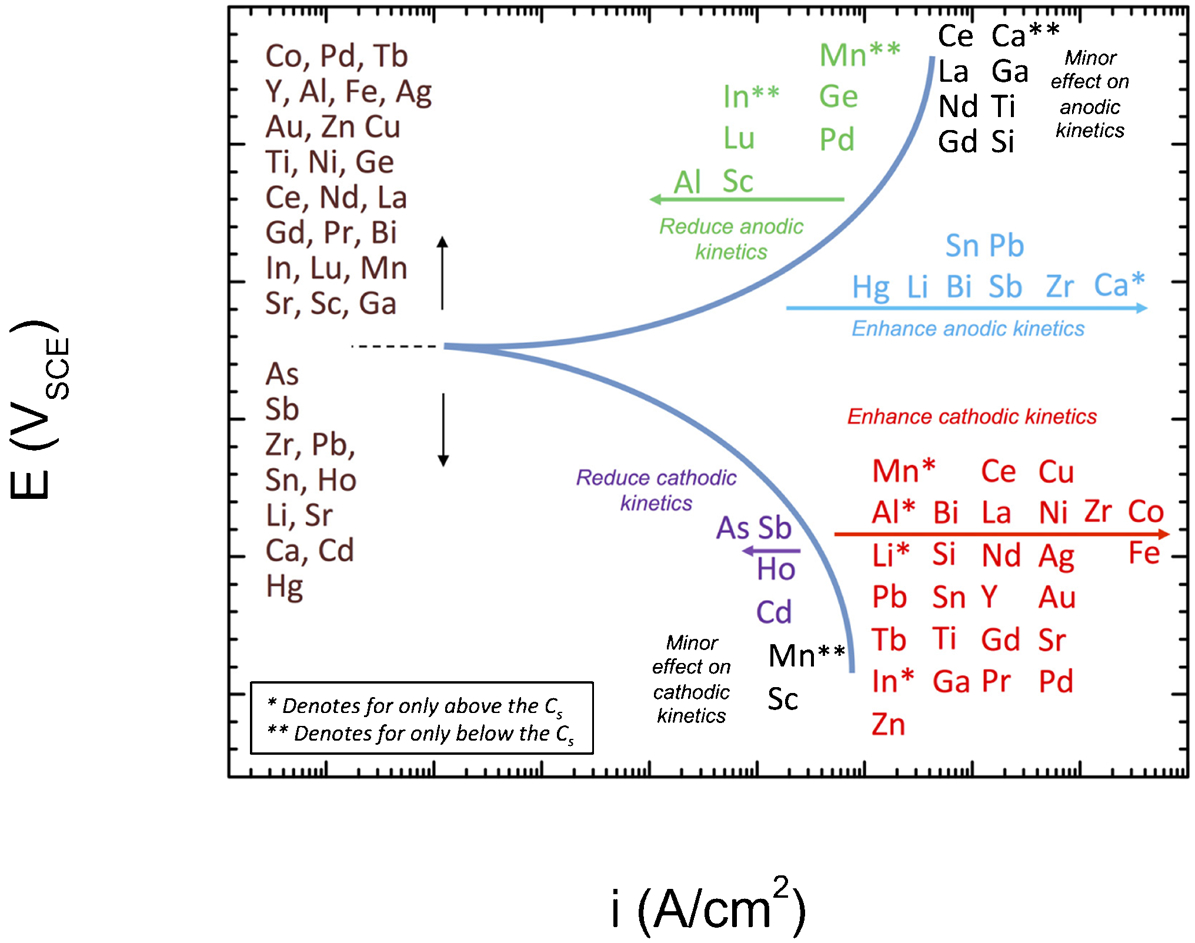
Schematic representation of the electrochemical impact of alloying elements studied (data extracted from the papers cited in “Influence of alloy composition on corrosion of Mg-alloys” section). Plot depicts the ability of alloying additions to modify anodic or cathodic kinetics (or both), leading to changes in the resultant corrosion rate (i corr), along with changes in corrosion potential (E corr). C S represents the solid solubility
The interpretation of Fig. 8 can be made on the basis of the relative movement of cathodic and anodic branches of polarisation curve. The distance associated with the relative movement (along the length of the schematic arrow) is a representation of how significant the effect is. The information in Fig. 8 is a valuable map as far as corrosion engineering is concerned, as the authors emphasise that the issue of Mg corrosion is one of the kinetics, and the map in Fig. 8 provides an attempt at consolidating this notion. The figure has been constructed by using the polarisation and interpretable data extracted from the literature as summarised by the reference list accompanying this review. Some of the most significant observations included in Fig. 8 are briefly summarised below:
Al retards anodic dissolution rates when added below or at the effective solubility limit. This effect becomes overwhelmed when the Al content exceeds the effective solubility limit (the word effective is used, because the solubility is time–temperature and processing dependent), forming Al-rich zones and Al-containing intermetallics that enhance cathodic reaction rates.
The addition of Mn below the solubility limit to pure Mg has a minor effect on decreasing the cathodic reaction rates, the additions exceeding the solubility limit (2·22 wt-%) have the opposite effect and facilitate cathodic activity, 25,59 while in multi-element alloys (i.e. other than pure Mg), Mn can segregate to elements such as Al forming local cathodes.
Elements including Li and Ca are more electrochemically active than Mg so that when alloyed with Mg, and either present in the solid solution or in IMPs, increase the rate of anodic reaction 39,139 (albeit for Li the effect is inhibited for Li>∼11 wt-% when the alloy crystal structure changes).
Elements such as Sn, Pb and Zr are seen to promote anodic activation, such that they enhance the rate of the anodic reaction in a disproportionate manner (which may also not be predicted on the basis that they are much noble elements than Mg).
Zr, Ag, and Au increase cathodic kinetics.
Ti shows a positive effect on suppressing the rate of cathodic reaction in Mg alloys with relatively high Al content (e.g. AZ91) 34,164 when added in low concentrations (i.e. ≪1 wt-%). In a binary sense, Ti has no functional role.
Fe, Ni and Cu are the most common impurities in Mg-alloys because of their insolubility. As local cathodes, they are heavily polarised at the potential of Mg alloys and dramatically accelerate cathodic kinetics. 16,115,209 Reported threshold limits for these elements include 170 ppm for Fe, ∼1000 ppm for Cu and 5 ppm for Ni and Co. 15 Co is exceptionally efficient at enhancing cathodic kinetics.
RE (Ce, La, Nd, Gd) and Y in binary Mg alloys lead to increased corrosion potential concomitant with monotonically increasing cathodic kinetics that translate to higher overall corrosion rates. Lu, a heavy RE element, has been suggested to have a minor influence in decreasing anodic kinetics. 201
Minor additions of As (the only reported addition being 0·37 wt-% 97 ) can significantly decrease the corrosion rate of Mg by suppression of cathodic kinetics.
To also provide a summary of the reported corrosion potentials of binary, ternary, most common commercial magnesium alloys (as well as some commercial alloys with minor elemental additions) a non-exhaustive galvanic series for Mg-alloys has been compiled and presented in Tables 3 and 4. It is seen that the upper values of corrosion potentials are in the vicinity of approximately −1·4 VSCE, while activating elements can result in potentials below −2 VSCE. The important distinction is made here that alloys with more noble potentials are nominally more noble because of increased cathodic kinetics, and hence the more noble potentials do not correspond to decreased rates of corrosion.
Grain size and microstructural influences on the corrosion of Mg-alloys
Grain refinement is an effective way to improve the strength of Mg and Mg-alloys. Governed by the Hall–Petch relationship, the room temperature tensile strength of Mg and alloys is inversely proportional to the square root of grain size according to
212,213

Grain size has been shown to be a factor in controlling the overall electrochemical response of Mg and its alloys. A number of studies have shown the effect of grain size on corrosion rate of Mg and Mg-alloys. 219–222 From the electrochemical point of view, the reduction in grain size gives an increase in grain boundary density that impacts dissolution and passivation phenomena. 58 As a result, this leads to findings of decreased 220,221 or increased 223,224 corrosion, which can, however, be understood and rationalised on the basis of the role of environment and summarised by Ralston, who provided a constitutive relationship for the rate of corrosion as a function of grain size. 225 It was noted that any processing route and elemental additions might impart physical or chemical changes to the material in addition to intentional grain size modification. More so, the nature of the environment or electrolyte will further impact corrosion response. 225 There exist some reports that grain-refinement treatment appeared to allow the Mg surface to possess a more pseudo-protective (hydr)oxide layer, so that to withstand large scale breakdown more effectively than coarse grained Mg in dilute NaCl electrolytes, 220,221,226 however, this mechanism is yet to be proven.
Figure 9a illustrates the relationship between corrosion rate and grain size in pure Mg, revealing a trend with corrosion rate and the square root of grain size. This improvement in corrosion performance with finer grained Mg was initially reported by Op't Hoog 227 who studied Mg specimens processed via equal channel angular pressing (ECAP), a form of severe plastic deformation. It was noted that in 0·1M NaCl, the anodic reaction kinetics were reduced with the decrease in grain size.
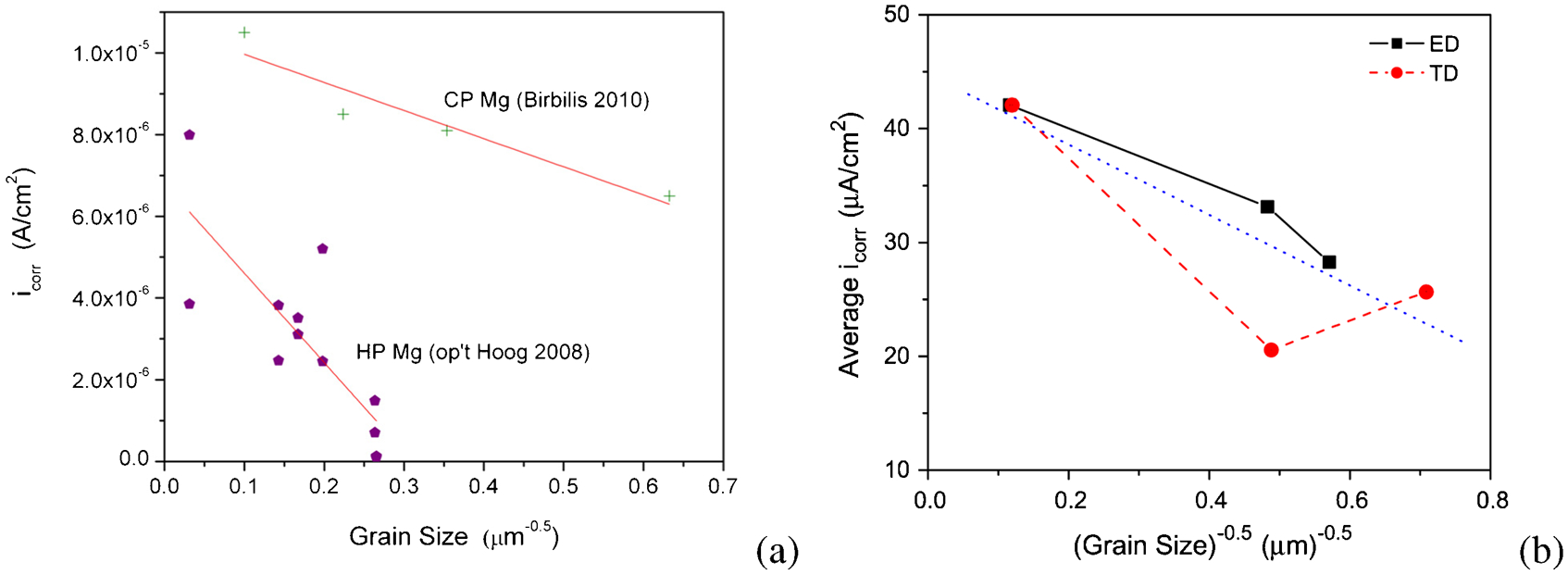
In terms of Mg-alloys, Argade et al. reported almost four times lower corrosion rates during immersion of an ultra fine grained Mg–Y–RE alloy compared to a coarse grained specimen in 3·5% NaCl. 222 In the case of ZK60, the grain size–corrosion relationship is shown in Fig. 9b for specimens that were processed by a combination of extrusion and ECAP. The data in Fig. 9b correspond to different specimen orientations with respect to the extrusion direction, revealing a relationship whereby corrosion rate decreased with grain size−0·5. In regards to the grain size-corrosion rate relationship of ZK60, Orlov et al. reported that the grain refinement of ZK60 via ECAP had the greatest impact upon anodic reaction kinetics, while chemical redistribution effects had a greater effect on cathodic reaction kinetics. 219
The example in the work of Orlov indicates a very important aspect in regards to the corresponding chemical alterations, which are a consequence of grain refinement, and important in the case of alloys/commercial materials; thus the authors feel this point merits some comment. In Fig. 10, the original ZK60 microstructure is observed, along with the corresponding damage morphology (via optical profilometry) following immersion in 0·1M NaCl. The continued refinement of the grain structure, along with the attendant chemical redistribution, shows that solute can be redissolved into the matrix, with associated ramifications (in this case, beneficial) for the subsequent damage morphology. Following the extrusion+ECAP process, the solute homogenisation leads to less localised corrosion, significantly lower corrosion rates, and higher strengths. 219 A similar observation was also made in Al-alloys, 228 and therefore the deformation processing of Mg-alloys represents an avenue of future potential.
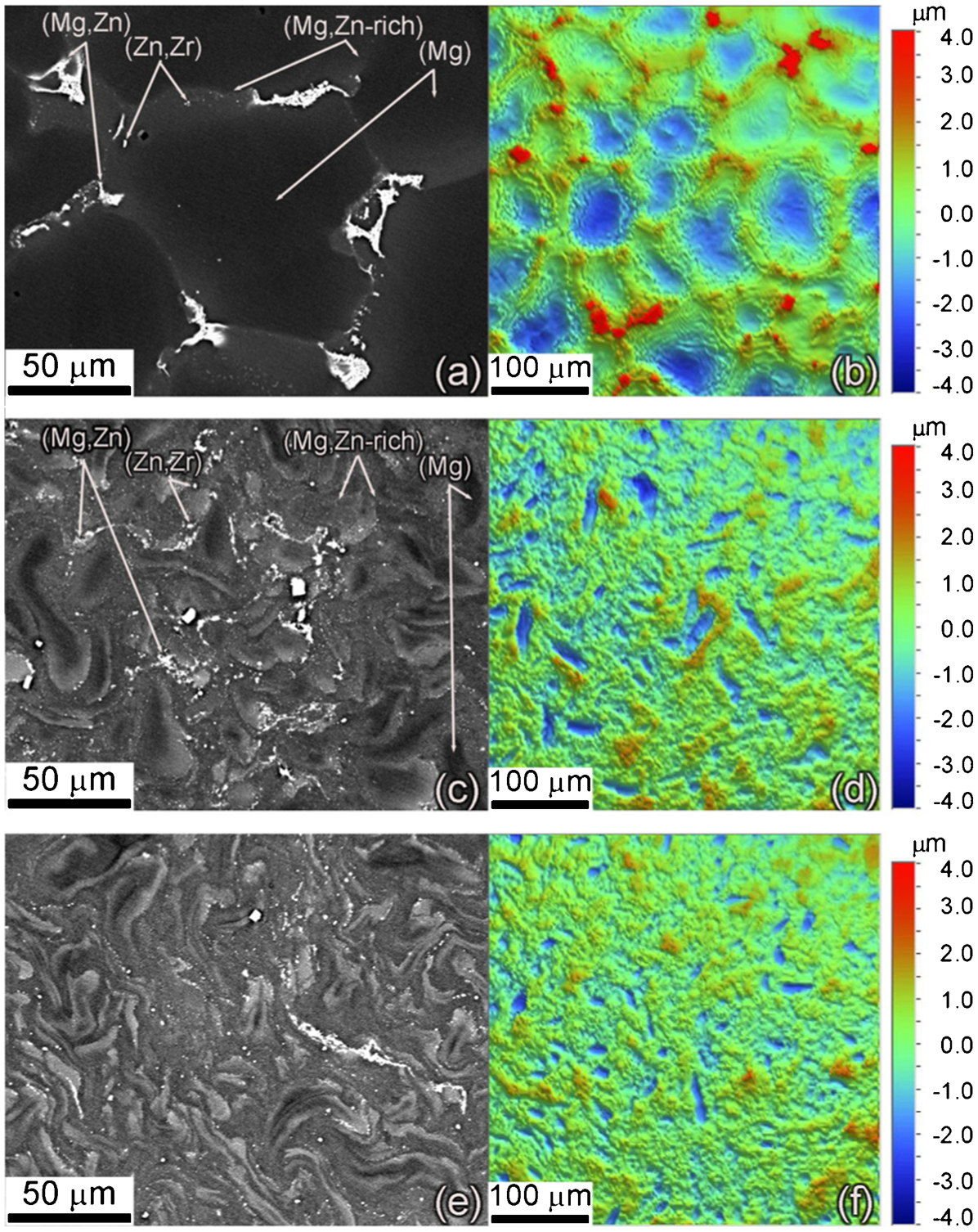
Back scattered SEM images (a, c, e) of polished specimens and the corresponding optical profilometry images following 330 min of exposure to 0·1M NaCl for ZK60: Each micrograph corresponds to different extents of processing and imaged on the ND–TD plane for a and b initial, unprocessed condition; c and d intermediate, extrusion processed condition; and e and f the extrusion+ECAP processed condition 219
Therefore, for a given alloy system, grain size effects are of relevance and can effectively reduce the rate of corrosion. This is one route for perhaps improving the corrosion resistance of the same alloy within a finite window; however, the distinction of ‘finite’ is made, because in general, the influence of changing the chemistry of an alloy will contribute over and above the effect of changing its grain size and solute distribution – which should be obvious from the preceding section. This is also evident on the basis that a wide spread of corrosion rates was observed for say, AZ91 with minor alloying additions, 34,39 i.e. many orders of magnitude, while a range of grain sizes and solute redistribution may only influence corrosion rate over a much smaller range of values.
Following on from the grain size effect, the emergence of Mg-based bulk metallic glasses (BMGs) is rapidly evolving. 229–232 Bulk metallic glasses are a unique family of metal alloys that exhibit no crystalline or long-range ordered structure. It is because of this inherent structure that BMG possess several unique properties when compared to their crystalline counterparts, such as high strengths, high elastic limits, and glass transition phenomena. 233,234 The criteria for a BMG are that it can be produced to be at least 1 mm in thickness, and in the vast majority of cases this can only be produced by rapid solidification.
While much curiosity surrounded the corrosion performance of Mg-BMGs following a report of outstanding corrosion resistance, 235 some peculiarities in that study suggest that the corrosion performance of Mg-BMGs may not in fact be so promising. 107,236–238 A review of the current state of understanding of the corrosion behaviour of BMGs was given by Scully et al., 239 who raised critical issues that serve as a framework for interpreting the electrochemical response of BMGs. It was also noted in that review, 239 in many cases metallic glasses in fact do not exhibit superior corrosion resistance to that of a crystallised metal of similar composition, and that this is highly dependent on the context and exposure environment. In the context of Mg-BMGs, the ‘glass forming’ elements tend to be either significantly more reactive (i.e. Ca) or significantly more noble (i.e. Cu), with other elements (at least one other) required to result in glass formation. 240–242 Such a combination of elements in addition to Mg (which nominally is present in no more that 70 at-% due to the requirement of ‘glass forming element’ loading), is a scenario that is likely to lead to incongruent dissolution. This implies that the least noble elements will preferentially dissolve at the alloy potential, with the outcome of leaving behind a porous surface (akin to dealloying). This has been classically demonstrated for two Mg-BMGs 107 (in addition to Ca-BMGs 237 ).
To benchmark the corrosion of Mg-BMGs, Fig. 11 reveals the corrosion rates of two Mg-BMGs (Mg65Cu25Y10 and Mg70Zn25Ca5), measured by polarisation testing, and as a function of approximate crystallinity. The variation in crystallinity was achieved by heat treatment as determined from DSC measurements and reported by Zhou. 107 What is interesting to note from Fig. 11 are three key points: (i) the Mg-BMGs do not necessarily show a lower corrosion rate than common crystalline alloys, (ii) increasing crystallinity tends to increase corrosion rates, ascribed to increased microstructural heterogeneity, and (iii) the morphology of corrosion is altered based on the evolving microstructure during devitrification. This latter point is rather vivid and was included to show an obvious demonstration of selective and incongruent dissolution, which is a form of dissolution that is likely (to a greater or lesser degree) in operation during the dissolution of all Mg-alloys (be they crystalline or amorphous).
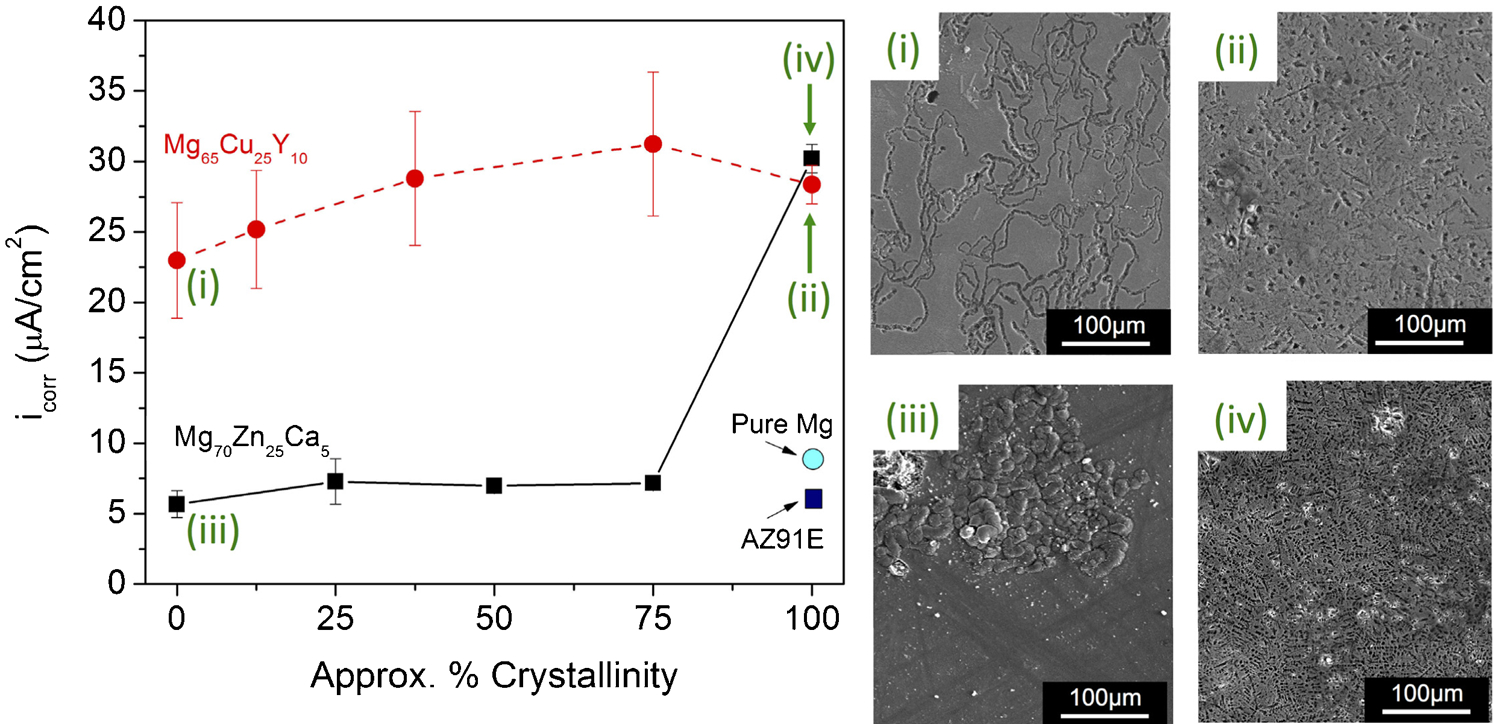
(left) Corrosion rates as a function of approximate crystallinity for two Mg-based bulk metallic glass (BMGs), Mg65Cu25Y10 and Mg70Zn25Ca5 measured from potentiodymamic polarisation testing in 0·1M NaCl. The 0% crystallinity designated the fully amorphous condition, while the increase in crystallinity to the fully devitrified state was achieved by heat treatment. (right) corresponding SEM micrographs from specimens denoted on the left plot following 12 h immersion in 0·1M NaCl. It is observed that Mg65Cu25Y10 in the fully amorphous condition (i) undergoes filiform-like corrosion, while in the fully crystalline form, undergoes localised corrosion (ii) that is driven by the chemical entity of microstructural features (active particle dissolution). In the amorphous condition, Mg70Zn25Ca5 is rather uniformly attacked (iii), forming ‘blisters’, while in the crystalline condition (iv) undergoes localised corrosion that is driven by the chemical entity of microstructural features (active particle dissolution). The figure is adapted from Ref. 107
From a mechanistic perspective, it is noted that because of the heavy alloying additions in Mg-BMGs and because of the notion that most other elements have a higher exchange current density than pure Mg, then the corrosion kinetics of such alloys are nominally under cathodic control. This is further validated by not only the work of Zhou, but also from a recent study by Wang, 243 who revealed that the electrochemical response during devitrification is dominated by changes in the cathodic reaction. This is an important point, because many works in the corrosion of BMGs (generally) give little, to no, emphasis on the cathodic reaction. None the less, the interest in Mg-BMGs is likely to continue, as the applications (touted to be consumer electronics and luxury products) and research into the area expands. 244
Prospects and aspects for retarding the corrosion kinetics of Mg-alloys
The review herein has intentionally framed the Mg-corrosion issue as one of the kinetics. The review has also avoided the aspect of coatings (covered in Refs. 245,246), rather focusing on the corrosion metallurgy. It is prudent to assume, at least in the near term that thermodynamic approaches to retarding the corrosion of Mg remain elusive. As a consequence, the framework for utility of Mg must factor in the control of corrosion kinetics. The consequence of kinetics is manifest in all the potential utilisations of Mg alloys, as kinetics will influence:
The aggressiveness (or lack of aggressiveness) of any galvanic couple scenarios;
Localised dissolution from microstructural heterogeneity, which can perhaps continue to be used to advantage in the coating pretreatment of Mg-alloys, whereby surfaces can be homogenised on the basis of acid–alkaline steps to selectively remove and passivate Mg-alloy surfaces (and subsequently conversion or electro/electroless coated); 247,248 and
Any attempts to slow the rate of Mg corrosion from alloy design.
In regard to this last point, the authors believe that this merits elaboration in the context of the extended industrial application of Mg alloys . Kinetic restriction of corrosion may be achieved by:
(a) Careful selection of bulk alloy chemistry and alloy system. This requires an all-round knowledge of the alloy application, including mechanical and environmental envelope. However, one example may be that an equivalent strength target can be met by using Mg–Zn or Mg–Ca alloys. However, the former possesses at much lower rates of corrosion. 22 Naturally, alloy selection steps are complex if components are to be extruded, or high-pressure die cast; nonetheless, bulk alloy compositions can be readily assessed on the basis of Fig. 8.
(b) Alloying for the purposes of altering corrosion kinetics. For example, specifically altering alloy chemistry by (micro- or low level) alloying with additions is one approach that has not been vigorously pursued to date. In this context, the aim would be to make an alteration to an alloy composition that has been designed for a specific property portfolio with the goal of reducing the kinetic rate of dissolution while not altering this portfolio of properties.
There are some examples of this approach in the literature, albeit not part of systematic studies. The influence of microalloying additions to AZ91 was shown by Südholz 34 and the beneficial effects of low-level RE additions to AZ91E alloys were shown to be beneficial in reducing corrosion rates when added in 0·1 wt-% (Ce, Y). 132,143 Another example is the microalloying addition of 0·1 wt-% Ag to AZ91, which was able to segregate to the Mg17Al12 phase, reducing the size fraction and altering the number density to lead to an increase in hardness with no increased corrosion rate.
Furthermore, although not tested in a complex alloy system, the additions of As have been shown to reduce cathodic kinetics. 97 Such additions, however, may not be industrially feasible because of obvious toxicity, but reveal the opportunity for similar cathodic poisons to be explored.
The selection of microalloying additions, while previously may have been wholly empirical, can nowadays be rationalised in a desktop manner by the utility of CALPHAD (calculated phase diagrams) and packages such as Thermocalc and Pandat (Pandat, Madison, WI, USA Thermocalc, Stockholm, Sweden). While the CALPHAD approach delivers equilibrium phase diagrams (for the elements with which calculations are possible to date), it can provide an important insight into the solubility of elements in Mg systems of a higher order than binary alloys, and information regarding segregation of elements. For example, the solubility of some elements can decrease dramatically in the presence of a third element. A classic example is perhaps the addition of RE elements. In Mg alone, REs have considerable solubility (see Table 1), however, in the presence of Al (in the Mg–Al system), AlXREy phases form immediately. Such design aspects can be screened using CALPHAD.
If possible to realise, alloying with soluble elements that remain in solution is desirable in order to retain a homogeneous microstructure. Also, grain refining is another factor in realising higher strength and ductility in Mg-alloys, given their high Hall–Petch coefficient. 249–252 The increase strength derived from grain refinement may be offset with a reduction in microstructural heterogeneity if the extent of alloying can be decreased. As such, for a comparable strength, grain refinement in itself, and in the alloying modification it subsequently allows, may contribute to lower corrosion kinetics. In regards to grain refiners, additions of soluble In, Bi, and Sc, as well as the well documented addition of sparingly soluble Zr, can reduce grain size in cast Mg alloys. 98,253–257 Caution needs to be exercised to not add too much of such elements, which can contribute to enhanced corrosion rates when present beyond low levels. Another factor controlling ductility and strength of Mg alloys is texture. 258,259 It is, however, still not well understood what role the texture plays in terms of corrosion performance of Mg alloys. Although work exists relating texture to corrosion, 260,261 the variation with minor changes in texture across a bulk alloy is likely to not be an overwhelming factor in contrast to chemical addition.
There are a number of papers that report alloying elements may contribute to more robust surface oxide/hydroxide layers. 142,232,262 However, quantitative evidence for the presence of dopant elements in the surface Mg(OH)2 layers has not yet been definitively proven. For example, it is unknown if elements detected in the surface layers of Mg arise as a result of (hydr)oxide doping or because of noble metal enrichment and a presence in the metallic form (i.e. the other elements are the effect, not the cause of enrichment, having arisen from higher surface concentrations from incongruent dissolution itself). The latter notion was recently supported and shown by FIB-TEM measurements revealing that surface Al-enrichment was in the form of metallic Al 263,264 – which arose as a result of accompanying corrosion. As such, alloying elements at the surface of Mg most likely arise as the result of corrosion, as opposed to restricting corrosion. If possible, however, to dope the surface (hydr)oxide, the doping elements would require a wider range of stability, i.e. form a more passive film over wider pH range than Mg.
(c) Thermomechanical processing in order to modify local alloy chemistry via phase redistribution, and re-solutionising has been shown to be an effective means for optimising a property portfolio that includes reduced rates of corrosion. In addition, thermomechanical processing may also provide further favourable properties by texture modification, grain size reduction, and subsequent further grain refinement because of dynamic recrystallisation. 265–268 Severe plastic deformation (SPD), in particular, is gaining popularity in the study of wrought Mg alloys. 269 The effect of SPD (Severe Plastic Deformation) on corrosion is intrinsically connected to the produced microstructure, which is temperature sensitive – and therefore needs to be considered individually for a particular alloy composition. In addition, parameters such as die geometry, angle, and the speed of processing will dictate the level of strain a material receives as well as the presence of the defects (voids, cracks) and a universal recipe for successful SPD is not, and likely will not be, established.
Summary
This review has presented the influence of alloying elements on the corrosion kinetics of magnesium, drawing widely from the literature to include data from a large number of commercial and custom alloys.
A deliberately holistic approach was taken, to provide a comprehensive understanding of the effects of alloy chemistry, and hence electrochemistry, in dictating the ultimate corrosion kinetics.
To this end, the electrochemical effect of alloying elements was summarised according to the relative influence upon anodic and cathodic kinetics, and the extent to which such kinetics are catalysed or suppressed by the addition of a particular element. This was graphically depicted via an overlay upon a polarisation schematic. Such a presentation provides a comprehensive foundation for understanding Mg-corrosion kinetics, also providing a platform for understanding more complex alloy corrosion, and rationale for alloying considerations.
In addition to the chemical influence of alloying elements, attention is given to the important fact that the presence of second (or third) phases in the microstructure, along with their relative volume fraction, will also contribute to corrosion kinetics. These factors were addressed by reporting a consolidated table with solubility of elements in Mg, as well as presenting typical microstructures for Mg alloys and a galvanic series for a range of both the common and atypical Mg alloys.
The notions related to alloy design, the influence of alloy processing, and the prospects for amorphous Mg-alloys and conventional Mg-alloys with reduced corrosion rates were touched upon herein. Opportunities to improve the corrosion resistance of Mg alloys may primarily lie with elements and processing that retard cathodic kinetics through poisoning the HER reaction, minimising IMP formation and solid solution additions that lower anodic kinetics. Secondary effects may be produced by grain refinement or texture weakening. Metallic glasses have not been promising to date owing the detrimental effects of transition metals, but are less well explored with corrosion resistance as a chief goal in mind.
Footnotes
Acknowledgement
A very special thanks and gratitude to Emeritus Prof. Barry Muddle, and thanks to Dr Mark Gibson and Dr Colleen Bettles for advice and support. Dr Kevin Ralston is thanked for assistance in the initial assessment of solubility information. Authors also acknowledge and thank those who assisted in providing data for review and consolidated analysis, along with discussion and assistance in analysis: X. Xia, A. Thornton, D.S. Gandel, H-Y. Yang, M.K. Cavanaugh, X.B. Chen, A.D. Südholz, N.T. Kirkland, K.D. Ralston, X. Zhou, N. Stanford and J-F. Nie. Proof reading and suggestions from J.P. Labukas, V.H. Hammond and B.E. Placzankis from the US Army Research Laboratory (Aberdeen, MD, USA) are also gratefully acknowledged.