






Abstract
For technological applications, zirconia is commonly blended with other oxides to stabilise the tetragonal and/or cubic phases at low temperature, being yttria the most frequently added dopant. It is generally desirable to obtain highly dense ceramics while maintaining grain sizes in the nanoscale ( < 100 nm). Small grains contribute to stabilise the tetragonal phase and to improve the toughness and flexural strength. Moreover, a higher ionic conductivity for cubic zirconia electrolytes is achieved with smaller grain size and lower thickness of the intergranular regions. The sintering onset temperatures required for nanometric particles are significantly reduced when compared to conventional micrometric powders. However, densification is generally accompanied by an undesirable grain coarsening. A Ramp and Hold Sintering (RHS) is the simplest densification schedule, consisting of heating up to the peak temperature followed by a holding time at that temperature. Another approach, called Two-Step Sintering (TSS) is based on the principle that the activation energy for grain growth is lower than the activation energy of densification. The key elements in this method are heating up to a high temperature to achieve a density >75% Theoretical Density (TD) to render the pores unstable, and then cooling down rapidly to a lower temperature to finish sintering and hinder grain growth. Alternatively, considerable efforts have been made in increasing the heating rate and/or reducing the hold time at the peak temperature during sintering cycles in processes that are generally referred to as ‘Fast Firing’ (FF) or ‘rapid sintering’. This review summarises the attempts in the literature for obtaining dense monolithic nanocrystalline Yttria-Stabilized Zirconia (YSZ) ceramics by pressureless sintering schedules carried out in conventional furnaces. RHS, FF and TSS schedules are reported only from YSZ as starting powders, i.e. without the aid of any additional dopant or grain growth inhibitor. For the sake of comparison, the discussion is focused mainly on YSZ nanoceramics with final densities >99% TD and average grain size < 100 nm. Powder and shaping effects on microstructure and properties of bulk nanoceramics are discussed. A comparison among sintering approaches is then made taking into account the microstructural development of the nanostructures and some key properties of the products.
Introduction
Pure zirconia (ZrO2) has a monoclinic structure at room temperature and pressure. With increasing temperature, the material transforms to a tetragonal polymorph at 1170°C, and then to a cubic fluorite structure at 2370°C before melting at around 2680°C. 1 Since the phase transitions are coupled with significant density changes, for technological applications it is common to blend ZrO2 with other oxides to stabilise the tetragonal and/or cubic phases at low temperature. Stabilising oxides include magnesia (MgO), calcia (CaO), ceria (Ce2O3), and yttria (Y2O3), being the latter the most frequent dopant used for zirconia-based systems. 2,3
The wide range of applications for zirconia-based ceramics lies on their unique properties, 4 particularly on the mechanical performance of the partially stabilised tetragonal phase and the ionic conductivity of the fully stabilised cubic phase. Tetragonal Zirconia Polycrystals (TZP), 5 generally stabilised with 3 mol% yttria (3YSZ), display high fracture toughness suitable for structural applications such as cutting tools, valve guides, extrusion dies, and abrasive tools. On the other hand, cubic zirconia stabilised with 8 mol% yttria (8YSZ) is widely chosen as the electrolyte in Solid Oxide Fuel Cells (SOFC) and in commercial oxygen sensors. 6 Regardless of the application, there are strong relationships between powder characteristics and processing conditions and the final microstructure and properties of the ceramic. Therefore, obtaining optimal microstructure in the end product starts with a powder selection and conditioning.
It is generally desirable to obtain highly dense ceramics while maintaining grain sizes in the nanoscale regime, i.e., < 100 nm. 7 Small grains contribute to stabilise the tetragonal phase and to improve the toughness and flexural strength. 8 Moreover, a higher ionic conductivity for cubic zirconia electrolytes is achieved with smaller grain size and lower thickness of the intergranular regions. 9 Utilising nanoparticles as starting materials is therefore a primary requirement, but this brings difficulties during processing because of the high reactivity of nanoparticles and succeptibility to agglomerations and contaminations.
The sintering onset temperatures required for nanometric particles have been reported to be in the range of 0·2–0·3 of the absolute melting point (T m), a significant reduction when compared to 0·5–0·8 T m for conventional micrometric powders. 10,11 This outcome has many potential benefits, including the avoidance of parallel phase transformations and interfacial reactions, the elimination of the need for sintering aids, and the opportunity to produce composites with materials incompatible with high sintering temperatures, such as low-melting point metals. However, in general, densification is accompanied by (an undesirable) grain coarsening. 12 Success in avoiding grain growth is related to control of the competition between densification and grain growth, something that is extremely difficult because the driving forces for both are proportional to the reciprocal grain size and hence comparable in magnitude. 13
The processing of nanopowders to produce dense pieces of zirconia while retaining the nanometric grains ( < 100 nm) has been investigated by different approaches. 14 For instance, dopants have been added to zirconia to modify diffusion coefficients and mechanisms, control grain boundary migration and hence grain growth, 15 or to enhance densification by lowering temperature and time of sintering, as reported for alumina-doped zirconia. 16 However, dopants not necessarily combine enhanced densification and inhibited grain growth; that is, dopants that inhibit grain growth typically also affects similarly densification. Moreover, even small amounts of dopants may deteriorate the ionic conductivity of YSZ electrolytes, due to decrease of the specific conductivity of the grain boundary, as reported for silica impurities segregated in YSZ. 17
On the other hand, since longer soaking times at peak temperatures in conventional Ramp and Hold Sintering (RHS) often leads to grain growth, some alternative approaches have been suggested to control it based on processing methods and conditions without modification of the system's chemistry. Microwave (MW) sintering exploits the tendency of a dielectric material to couple with the microwaves and consequentially generating heat within the sample. The technique generally uses a frequency of 2·45 GHz resulting in relatively high heating rates leading to uniform grained microstructures. 18 Spark Plasma Sintering (SPS) simultaneously applies pulsed electrical current and pressure directly on the sample producing densification at relatively lower temperatures and shorter times. 19 Flash Sintering (FS) employs an electric field during minutes or even seconds at temperatures well below the usual temperature required for attaining full density through selective Joule heating. 20 These and more conventional assisted-sintering methods, such as Hot Pressing (HP), Hot Isostatic Pressing (HIP) or Sinter-Forging (SF), might be used to inhibit grain coarsening while inducing densification. 12 These are efficient techniques widespreadly used in powder metallurgically manufactured products, but constraints in terms of shape or size for HIP or SF of ceramic components can make them less attractive as compared to pressureless methods. That is, non-conventional processes comprise assisted techniques, either by applying pressure (HP, HIP, SF) or some kind of electromagnetic radiation (MW, SPS, FS), and eventually combined or hybrid effects. In all those techniques, special furnaces with pressure and/or power control are needed, along with other setting parameters. The related equipment is usually intermittent, and does not permit a broad variation of pieces being sintered in terms of shape and size.
Pressureless sintering is most commonly known by the simplest one-step firing schedule, comprising a heating up ramp to the peak temperature followed by a single holding time at that temperature, and a cooling ramp back to room temperature. Multiple ramps and/or holds are eventually needed before the maximum temperature is reached in order to eliminate gaseous species from decomposition of inorganic or organic substances (in particular for large components), 21 which are present as additives or impurities. During cooling, different ramps and/or holds may also be necessary, in this case owing to the presence of phases that are subject to transformation and may cause residual stresses. 22
In addition to common ramp and hold schedules, numerous pressureless sintering methods using conventional furnaces have been mentioned in the literature. One of the earliest attempts to optimise firing schedules was the Rate-Controlled Sintering (RCS), 23 which uses the monitoring of densification to establish the heating schedules. The main approach of RCS is to maintain the pore channels open by extending the intermediate stage of sintering so that grain growth can be effectively hindered and pore removal through grain boundary can continue up to values of 90% Theoretical Density (TD). 24 Nevertheless, RCS requires extensive information about grain growth and densification rate so that an adequate sintering schedule can be found.
Many sintering processes have been referred to as ‘two-step’ or ‘two-stage’ sintering, 25 meaning that a dwell time at an intermediate temperature was held before the peak temperature was reached. 26 One of the most curious concepts of Two-Step Sintering (TSS) was introduced in 2000, 27 which is based on the principle that the activation energy for grain growth is lower than the activation energy of densification. The key elements in this method are heating up to a high temperature to achieve a density >75% TD to render the pores unstable, and then cooling down rapidly to a lower temperature to finish sintering and hinder grain growth. 28,29
Considerable efforts have been made in increasing the heating rate and/or reducing the hold time at the peak temperature during sintering cycles in processes that are generally referred to as ‘fast firing’ or ‘rapid sintering’. 30 Fast Firing (FF) can be performed either in conventional furnaces (electric or fuel-based) or in non-conventional furnaces applying an electromagnetic radiation or field. The latter approaches are also usually known as Field Assisted Sintering Techniques (FAST), which may be further divided into many denominations depending on the source of power employed. 31
This review will summarise the attempts in the literature for obtaining dense monolithic nanocrystalline YSZ ceramics by pressureless sintering schedules carried out in conventional furnaces. RHS, FF and TSS schedules will be reported only from YSZ as starting powders, i.e. without the aid of any additional dopant or grain growth inhibitor. For the sake of comparison, the discussion is focused mainly on YSZ nanoceramics with final densities >99% TD and average grain size < 100 nm. Powder and shaping effects on microstructure and properties of bulk nanoceramics are discussed. A comparison among sintering approaches is then made taking into account the microstructural development of the nanostructures and some key properties of the products. Note that, while non-conventional processes, such as pressure- and radiation-assisted methods are beyond the scope of this review, they will eventually come up in discussion when directly compared to conventional procedures applied to the same starting material.
Powder synthesis
Zirconia is typically commercially produced by chlorination, lime fusion, or alkali oxide decomposition of zircon (ZrO2·SiO2). Chlorination is the most common method, in which zircon is directly chlorinated in an electric arc furnace with carbon at temperatures ranging from 800 to 1200°C according to the reaction:
32

Yttria-stabilised zirconia nanopowders are typically commercially obtained by coprecipitation of hydroxides from an yttrium and zirconium chlorides solution. The hydroxide is precipitated with a base, dried, calcined and milled to obtain crystalline YSZ nanoparticles. 33 Nanosizes are feasible in this process due to the usage of highly supersaturated solutions during the precipitation of the hydroxides, enabling small nuclei consistently with predictions from the theory of homogeneous nucleation.
Table 1 presents some characteristics of commercially available YSZ nanopowders that have been used as starting materials for obtaining sintered nanocrystalline zirconia ceramics.
Typical properties of selected commercial yttria-stabilised zirconia (YSZ) nanopowders and sintered bodies
(a) uniaxially pressed at 70 MPa. (b) sintered at 1450°C. (c) uniaxially pressed at 70 MPa and sintered at 1350°C. (d) uniaxially pressed at 70 MPa and sintered at 1450°C.
Alternatively to commercial powders, numerous methods for preparation of nanocrystalline particles are available at the research laboratory scale. 41–44 The most common are liquid phase techniques, also known as wet-chemical synthesis, such as Pechini method, 45 combustion synthesis, 46 and gel precipitation using either alkoxides, chloride or sulphate solutions. 47–49 Those processes require modest capital investment and enable the production of relatively large quantities of high purity zirconia powders of very fine particle size. However, the as-synthesised wet-chemical zirconia powders are typically amorphous due to the low processing temperatures that hinder crystallisation, requiring further calcination, which may lead to hard agglomerates.
Gas phase processes such as inert-gas condensation, 50 laser ablation, 51 spray pyrolysis, 52 microwave plasma, 53 and chemical vapour synthesis 54 have been used for the production of nanocrystalline zirconia particles. Those methods generate loosely agglomerated powders with controlled size distribution and a low degree of impurities. Nevertheless, the gas phase processes usually required sophisticated equipment and are therefore more cost-intensive.
Table 2 compiles a number of synthesis methods reported in the literature and some characteristics of the obtained YSZ nanopowders. Because it is virtually impossible to summarise all existing data available in the literature, the selected processes are those that yield powders with enhanced features from the sintering perspective, that is, high purity, optimal size distribution, and minimal agglomeration. Note that caution must be exercised when comparing the particle sizes from the different methods, because different techniques have been used to access those. XRD values refer to crystallite size and are typically smaller than direct measurements through microscopy (TEM or SEM) and indirect estimates from specific surface area values (BET). Whenever reported, the sizes from different measuring techniques are included for the same powder, because a direct comparison between, for instance, BET estimation of sizes and XRD crystallite sizes, can be used as an indirect evidence of the state of agglomeration, and/or the amount of grain boundaries (solid-solid interfaces) in the studied nanopowder. A brief description of the synthesis methods and powder characteristics follows in each case.
Selected synthesis and processing parameters of yttria-stabilised zirconia (YSZ) nanopowders
(a) average by XRD (crystallite). (b) average by SEM/TEM. (c) average by BET.
Maca and co-workers 37,55 prepared zirconia nanopowders ( < 10 nm) containing 1·5 and 3 mol% of yttria by sol-gel from a solution of zirconium propoxide and yttrium nitrate in presence of ammonia. The obtained product was washed with water and ethanol. After drying, the precipitate was calcined in air at 450°C for 5 h, resulting in particles with 8 nm (from BET) and 10 nm (from XRD). The fact that those numbers are close suggests small degree of agglomeration. Feng et al. 56 synthesised 2·8YSZ from ZrOCl2·8H2O and Y(NO3)3 also by a sol-gel process. A solution of ethanol and deionised water was used as a reaction medium, and hexamethelenetetramine (HMTA) as a precipitating agent. The pH was adjusted with H2NO3 to about 2–3, hydroxypropylcellulose (HPC) added, and the solution heated at 75°C. The pH value was then set to 9–10 using NH4OH. The precipitate was centrifuged and rinsed with deionised water until free of Cl − ions. The centrifuged powder was then put in butanol and treated through an azeotropic process to remove the water. The powder was dried at 120°C for 5 h. Finally, the synthesised powder was calcined at 750°C for 1 h. The particle size of the powder ranged between 16 and 28 nm.
Feng et al. 57 also produced 3YSZ powder by a hydrothermal reaction carried out in an alumina tube placed in an autoclave under 60 MPa. Zr(OH)4 containing 3 mol% Y2O3 was used as precursor to which eventually KF, KOH, HBr, or K2CO3 was added as mineraliser. Different temperatures (200, 300, and 350°C) and times (4, 12, and 24 h) were tested and the smallest particle size (∼13 nm) was synthesised using 200°C for 4 h using no mineraliser.
Vasylkiv and Sakka 58 synthesised 3YSZ nanopowder from zirconium oxychloride, ytrrium oxide (dissolved in hydrochloric acid), ammonia solution and urea. A gel of yttrium–zirconium hydroxide was submitted to hydrothermal treatment at 150°C for different times to allow precipitation. After washing with water and ethanol, ultrasonication was applied for deagglomeration of the particles. Finally, the powders were calcined at 450–900°C for 1–6 h. Nanoparticles with average size of 10 nm and specific surface area of 167 m2 g − 1 (47 m2 g − 1 after calcination) could be obtained from this method. Zych and Haberko 59 also prepared 3YSZ nanopowder ( < 9 nm) using a similar hydrothermal method, but using a solution of ZrOCl2 and YCl3 with ammonia as precursors. The gel was washed with water, and hydrothermally treated at 250°C for 4 h under water vapour pressure. The particles obtained ranged from 8 to 9 nm, with only a small degree of agglomeration.
Mayo and co-workers 60,61 synthetised nanocrystalline YSZ powders from chloride salts by coprecipitation. The size of crystallites could be controlled by setting the reaction pH. At pH 12·5, agglomerate-free 13 nm YSZ particles were produced, after washing the precipitated powder in ethanol. Durán et al. 62 obtained 3YSZ powders with a narrow size distribution and particle size < 10 nm by mixing organic and inorganic precursors. Yttrium nitrate and zirconium tetrabutoxide were mixed in isopropanol and coprecipitated with ammonia solution at pH >9. The obtained powder was washed with water and isopropanol, dried at 60°C for several days and then calcined at 450–500°C for 1–5 h. The calcined powders were dried and milled for 2 h in isopropanol with zirconia balls, dried at 120°C overnight and then granulated. 63,64 Durán et al. 73 modified this procedure by adding a suspension of 2-propanol containing 10 wt-% 3YSZ seed nanoparticles to the precursor solution. The particles were crystallised in a higher rate at lower temperature range of 320–375°C, when compared to the unseeded YSZ powders. The particles produced were in the range of 6–10 nm.
Mæland et al. 65 produced 4YSZ nanopowders by a modified sol-gel method, using ZrCl4 and Y(NO3)3·6H2O as precursors. Pectin, sucrose and nitric acid were used as additives. After drying, the gels were calcined at 700°C for 12 h, and milled in ethanol for 120 h, dried in air at room temperature, and then mortared by hand for 1 h. The obtained particles presented a relatively narrow size distribution around a mean size of ∼20 nm.
By using the Pechini method (also known as polymeric precursor), Lena et al. 66 prepared 4·5YSZ by dissolving ZrOCl2 8H2O and Y(NO3)3·6H2O in ethylene glycol and citric acid while stirring for about 30 min at 80°C. Polyesterification was induced to obtain resins that were further held at 105°C for 24 h to remove excess water. The resin was then calcined at 600°C for 2 h to allow oxidation and convertion to oxide nanoparticles and finally ground in an agate mortar to break large agglomerates. Similarly, Laberty-Robert et al. 67 synthesised nanocrystalline powders of 8YSZ by a sol-gel method. A citrate solution was prepared by dissolving ZrCl4 and Y(NO3)3·6H2O in citric acid. After homogenisation, ethylene glycol was added to promote polyesterification at 80°C under stirring. The formed gel was then dried at 180°C overnight, and calcined at 400°C in air. Particles with about 50 nm and narrow size distribution were obtained. Li et al. 68 obtained 8YSZ powder by a sol-gel method, as initially reported by Laberty-Robert et al., 45 but using ZrOCl2·8H2O and Y2O3 as starting materials. An yttrium nitrate solution was prepared by dissolving Y2O3 into hot nitric acid. Y(NO3)3 and ZrOCl2·8H2O solutions were mixed in a stoichiometric ratio, followed by the addition of citric acid and ethylene glycol at 70°C until the gelation was completed. Then the gel was dried at 110°C and calcined at 600°C to burn off the organics and allow crystallisation of the oxide nanoparticles. The 8YSZ produced powder presented an average particle size of 18 nm.
ZrOCl2·8H2O and Y2O3 were used by Ghosh et al. 69 as starting materials to obtain 8YSZ by coprecipitation. A solution of yttrium nitrate was mixed with ZrOCl2·8H2O and then added at pH 9 to NH4OH, (NH4)2SO4, and polyethylene glycol (PEG) at 60°C. The sediment was washed with ammoniac water and with ethanol. The precipitate was dried in vacuum at 85°C for 30 h, ground in a planetary ball mill for 20 min (at 200 rpm) and calcined at 800°C for 3 h. The particles obtained presented an average size of 22 nm.
Nanocrystalline 8YSZ was produced by Mazaheri et al. 70–72 via glycine-nitrate process in a muffle furnace using ZrO(NO3)2·6H2O and Y(NO3)3·6H2O as sources of oxidants. In order to break the foamy agglomerates, the as-synthesised nanocrystalline agglomerates were ground in a planetary ball mill. The milling was conducted in isopropanol medium using zirconia balls at rotational speed of 200 rpm. The milled powder was dried in air at 60°C for 24 h. The size of the milled powders was estimated to be around 15–33 nm.
A discussion on the effect of powder characteristics on the microstructural development in YSZ nanoceramics is presented in Powder characteristics Section.
Shaping techniques
The shaping method plays an important role on the final density and grain size of nanoceramics as it defines particle–particle contact areas and particles packing density. As well known, the forming techniques may be divided into dry, such as uniaxial or isostatic pressing; plastic, e.g. extrusion and injection moulding; and wet shaping methods, such as slip, tape or gel casting, also referred to as colloidal processing. 74
At least one shaping technique of each main group has been reported in the literature for manufacturing green bodies of YSZ from nanosized powders towards obtaining nanocrystalline sintered bodies and will be discussed in this review. Additives have eventually been reported, such as dispersants, plasticisers and/or binders, particularly for wet shaping methods. Paper discussing sintering aids (or grain growth inhibitors) are out of the scope of this review paper and will not be addressed here.
Important manufacturing steps in pre-forming techniques, such as controlled formation of agglomerates from powders (by granulation) or from slurries (by spray drying) or even press filtering, which are usual in industrial contexts, are not commonly mentioned in the laboratory experiments that we will be discussing here. Heat (or eventually surface) treatment before firing is relatively common, such as drying (at temperatures around 100°C) and debinding of organic additives, or volatilisation of gas entrapped species (at temperatures over 500°C). Thermal pre- or post-treatments related to the firing session itself (mostly in the same furnace or oven) are discussed in detail in the following Section.
Mazaheri et al. 71 determined the compressibility curve of 8YSZ nanoparticles by uniaxially pressing the powder in a steel cylindrical die (10 mm diameter) at pressures from 100 to 800 MPa. Fig. 1 shows the change of green and fired density of the samples as a function of the applied pressure for samples sintered at 1500°C, with a heating rate of 5°C min − 1 without holding at the peak temperature. Both densities increased for higher compaction pressures and reached a flat plateau for pressures above 600 MPa. A green density increase from 36 to 48% TD was achieved by increasing the applied pressure from 100 to 800 MPa. A linear relationship was observed: the higher the green density, the greater the sintered density. The authors attributed this to the smaller size of the pores in the highly dense green bodies which could be more easily removed during sintering. Similar findings were reported by Ferkel and Hellmig 75 and Gaudon et al. 52
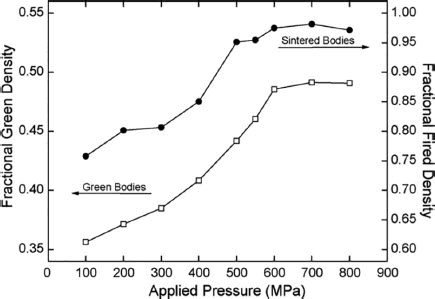
Effect of applied pressure on relative green and fired density of nanocrystalline 8 mol% yttria-stabilised zirconia (8YSZ) sintered at 1500°C 71
The compacting features of powders are strongly impacted by their characteristics, such as particle shape and size, size distribution, and state of agglomeration. 76 This last is particularly important in when sintering nanoparticles, as they are more prone to form both weak and strong agglomerates due to their inherent higher surface reactivity, having a strong impact in the final green density of bodies. That is, the mechanism of consolidation of ceramic powders in a rigid die is comprised of: 14 (a) sliding and rearrangement of the particles; (b) fragmentation of brittle grains, and (c) elastic deformation of bulk compacted powders. At the early stage of compaction, restacking of the particles and rearrangement of the agglomerates dominated the mechanism of consolidation of the nanopowder. Further pressure rise leads to breakage of the weak agglomerates formed during the die filling. 75 In order to achieve higher density, extremely high pressure (∼2·8 GPa) might be needed to break the hard agglomerates, as described recently by Rufner et al. 77
Binner et al. 34 have shown that the key factor for the production of high density, nanostructured green bodies by die pressing is the production of soft granules that flow well but which crush during pressing. They produced high flowability, granulated nanopowders via spray freeze drying when a combustible additive was incorporated. Homogeneous, 54% TD bodies were obtained at pressures as low as 250 MPa.
Groot-Zevert et al. 47 showed that in the case of YSZ agglomerated powders, there was a turning point or yield pressure (P y) in the plot of the relative green density versus the logarithm of the applied pressure. The curve might be divided into two separated parts with an interception at P y that was called ‘agglomerate strength’. After compaction at a pressure of around P y, those agglomerates were gradually fragmented and then rearranged at lower pressures. Durán et al. 64 applied this method to determine the agglomeration strength of 3YSZ nanopowder produced via coprecipitation. They showed that the powder agglomeration in this case corresponded to a strength of 32 MPa, as seen in Fig. 2.
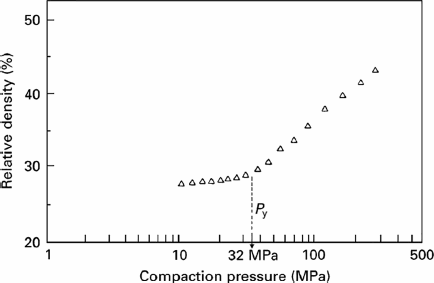
Compressibility behaviour of nanocrystalline 3 mol% yttria-stabilised zirconia (3YSZ) powder with a turning point (P y) referring to the agglomeration strength 64
A homogenous highly packed green body may reduce the required temperature and/or time for densification. Durán et al., 62 e.g. have used isostatic press to obtain dense YSZ nanostructured ceramics by conventional sintering at temperatures as low as 1070°C. To achieve this, highly loosely agglomerated nanoparticles were obtained by milling coprecipitated powders using isopropanol. Liu 78 produced nanosized (85 nm) 3YSZ aqueous suspensions at pH 6·5 containing 5–40 vol.-% solids and 3·38 wt-% polyelectrolyte dispersant. The suspensions were cast onto a plaster mould to form green compacts. Green densities of 40–52% TD were achieved, leading to >99·5% TD sintered bodies (Fig. 3) after sintering at 1500°C. The green density of the compacts is inversely correlated with the average pore size, as shown in Fig. 4, with the solid percentages indicated in the parentheses.
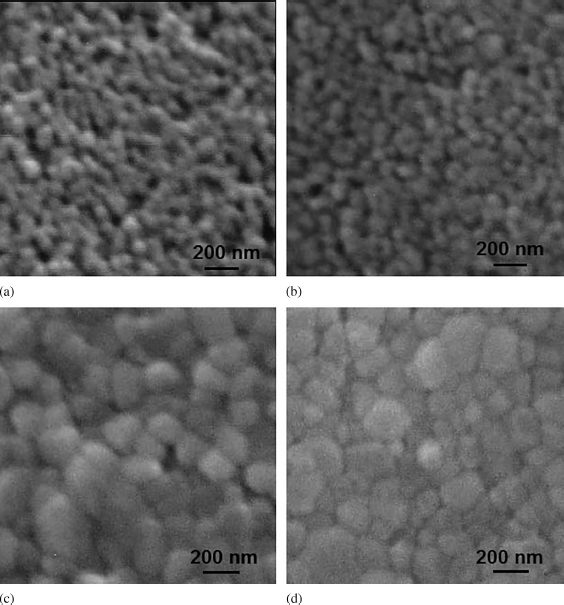
(a) 5 vol.-% solids (b) 40 vol.-% solids; and after sintering at 1500°C (c) 5 vol.-% solids (d) 40 vol.-% solids 78
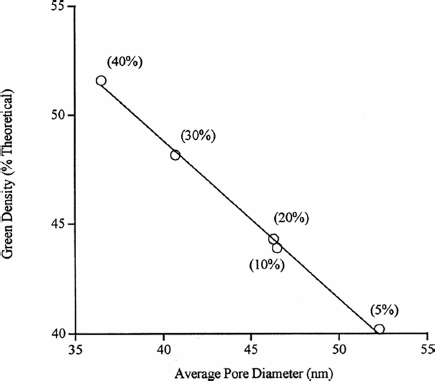
Green density as a function of the average pore size in slip cast green 3 mol% yttria-stabilised zirconia (3YSZ) compacts. Solid concentrations of casting slips are in parentheses 78
Schwarz and Guillon 79 used pressure filtration to obtain 8YSZ compacts and compared this colloidal processing to dry pressing. Fig. 5 shows that pores in the pressure filtrated green body have a very narrow and monomodal size distribution. They are in the same range of the powder particles (below 30 nm) and not larger than 80 nm. Dry pressing of the powder leads to pores as big as 1–2 μm and a much wider bimodal pore size distribution. The green density of the dry pressed samples only reached 40% TD compared to ∼50% TD for the pressure filtrated ones. When both compacts were submitted to the same TSS/SPS sintering procedure at 1150°C (2 min) and 1050°C (5 h), a final density of 93·6% was reached by dry pressed samples and 97·9% TD for bodies shaped by pressure filtration. Moreover, for the same heating schedule, the average grain size was 1·68 μm and 190 nm for dry pressed and pressure filtrated specimens, respectively.
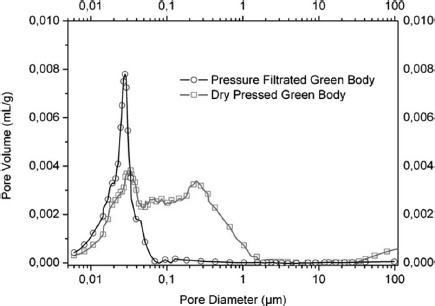
Pore size distribution of pressure filtrated and dry pressed 8 mol% yttria-stabilised zirconia (8YSZ) green bodies 79
Table 3 summarises process parameters for shaping YSZ nanopowders into green bodies that resulted in nanocrystalline ceramics after sintering in conventional furnaces. The most frequent shaping techniques used are Uniaxial Pressing (UP) and/or Cold Isostatic Pressing (CIP). The influence of compacting pressure on the green density has been an object of numerous studies. Characteristics of the powder, properties of additives and pressing parameters must be tailored to achieve densities around 50% TD after shaping (sometimes measured after drying). Nevertheless, colloidal processing has showed to yield higher green densities with narrower pore size distribution and lower mean pore size. Details on those processes are given below.
Shaping processes of yttria-stabilised zirconia (YSZ) green bodies from nanopowders
(a) average by XRD (crystallite). (b) average by SEM/TEM. (c) average by BET. (d) cylinder or disc (diameter [ × thickness]). (e) geometrically.
Vasylkiv and Sakka 58 prepared aqueous suspensions of 25 vol.-% YSZ nanopowders by adding 5 wt-% ammonium polycarboxylate as dispersant (ALON A-6114, Toaghosei) which were slip cast and then cold isostatically pressed at 400 MPa. The green densities after slip casting and subsequent cold isostatic pressing (CIP) were 46 and 52% TD, respectively.
Binner and co-workers 34,35,80,81 prepared YSZ green bodies from commercial nanosuspensions (∼5 vol.-% solids) by colloidal processing. In a typical procedure, 80 tetra methyl ammonium hydroxide (TMAH) was used to adjust pH to ∼11 and 3 wt-% and triammonium citrate (TAC) was added as dispersant. The suspensions were concentrated to ∼20 vol.-% solids by evaporation at 60°C, and then slip cast into plaster of Paris moulds. The cast samples were left under room conditions (20–25°C, 50–60% relative humidity) to dry for up to 120 h.
Zych and Haberko 59 consolidated 3YSZ suspensions by pressure filtration. The suspensions of ∼5 vol.-% solids were forced by a steel piston of 30 mm diameter through a ceramic filter covered with filter paper. Pressure was increased up to 5 MPa, and kept constant until no water leakage was observed. The samples were then dried up in a desiccator over silica gel. The filter-pressed bodies showed monomodal pore size distribution with a mean pore size around 10 nm.
Pradhan and Kapur 82 prepared aqueous slurries of 27 vol.-% solids from commercial 3YSZ (IM3Y, Inframat) with sucrose and ammonium polymethacrylate (NH4-PMA, molecular weight 10 000–15 000, from Vanderbilt). Aggregates were removed either by high energy milling or preferably by centrifugation (10,000 rpm for 15 min). Colloidal suspensions were consolidated by applying pressure of 300 kPa in a scale pressure consolidation rig. 84 Compacts were dried at room temperature. Green densities of 47% TD were achieved.
Additionally, some plastic processing techniques have been used to shape YSZ nanopowders, but the final nanocrystalline nature was not maintained after sintering. Injection-moulded feedstock was prepared by Lee 85 from a mixture of commercial 3YSZ powder and organic binders (polyvinyl butanol and dibutyl phthalate in ethanol) with solid contents from 75 to 82 wt-%. Extruded pellets (cylinders of 3 mm in diameter and 2–4 mm in length) were injection moulded by Arburg 270M with an injection pressure of 680 bar at 140°C. Yu et al. 86 used commercial 3YSZ with average size 50 nm, which was first heat treated to 150°C for 20 h before mixing for de-agglomeration. Feedstock with 82 wt-% solid content was then prepared in double planetary mixer under vacuum for 1 h at 150°C and 30 rpm. A mini tensile bar (17 mm long × 1·2 mm thick) was injection moulded in a Battenfeld micro moulding machine.
A discussion on the effect of packing and pore size distribution resulting from different processing and shaping techniques on the microstructural development in YSZ nanoceramics is presented in Packing and pore size distribution Section.
Sintering schedules in conventional furnaces
In this Section, conventional techniques employed for sintering nanocrystalline YSZ ceramics are presented. Under the concept of ‘conventional’, it is understood that common furnaces, mostly resistive, are used to carry out the sintering schedule at ambient pressure and air atmosphere. In this case, solely the manipulation of temperature vs. time curves leads to the desired densification profile and tailored microstructure.
A further discussion on the effect of sintering schedules on the densification and grain growth in YSZ nanoceramics is presented in Densification and grain growth Section 5.3.
Ramp and hold sintering
The most common sintering schedule in a conventional furnace is simply heating up the sample to the desired peak temperature at a constant rate (ramp) and maintaining it at this temperature for a specific period of time (hold). Typical heating rates range from 2 to 10°C min − 1, and peak temperatures from 1000 to 1400°C with holding times from 30 min to 80 h. Several authors have reported on conventional pressureless RHS of YSZ nanopowders. Nevertheless, the most of them achieved nanoceramics with densities below 99% TD; when denser bodies were produced, a significant grain growth was observed, as described in the next paragraphs.
Theunissen et al. 87 obtained 97% TD nanoceramics from 3YSZ powders prepared by gel precipitation with a mean grain size of 60 nm after sintering at 1050°C for 7 h. Boutz et al. 88 produced 96% TD YSZ nanoceramics from hydrothermally synthetised powders with a grain size of ∼95 nm after sintering at 1050°C for 5 h. Sagel-Ransijn et al. 89 synthesised YSZ by coprecipitation and obtained specimens with 96% TD and an average grain size between 120 and 130 nm after sintering at 1070°C for 10 h. In another work from the same group, 90 YSZ sintered bodies with 98% TD and a grain size of 180 nm were produced from hydrothermal nanopowders. Li et al. 91 sintered 3YSZ with 98% TD and an average grain size of 90 nm from nanoparticles obtained by heating of alcohol-aqueous salt solutions. Liu 78 sintered 3YSZ compacts at 1500°C with nearly full density and grain size of 140 nm in average, after a proper colloidal processing control of a commercial powder. Boulch et al. 92 and Djurado et al. 93 prepared spray-pyrolysed nanometric 2·5YSZ powders (∼6 nm) that lead to 70 nm primary crystallites after sintering at 1500°C for 2 h with densities around 96% TD, though. Similar results were obtained by the same group 94 for zirconia doped with other rare-earth elements. Tadokoro and Muccillo 95 prepared 3YSZ by coprecipitation and obtained specimens with 99·5% TD and an average grain size of 130 nm after sintering at 1200°C for 5 h. Gaudon et al. 52 produced 8YSZ bodies with grain sizes in the range of 50–200 nm up to 97% TD after sintering at 1400°C during 5 h from nanopowders obtained by spray pyrolysis (5–6 nm for powders processed at 600°C and 15–20 nm at 1100°C). Benavente et al. 96 obtained dense nanostructured 3YSZ compacts by slip casting of binary mixtures of commercial powders. Green densities reached 57% TD but final densities were not reported. Homogeneous microstructure was obtained after sintering at temperatures of 1300°C with the average grain size of 160 nm.
A few works have succeeded to achieve highly dense, nanocrystalline YSZ bodies through RHS. Table 4 summarises processing and sintering parameters for YSZ nanoceramics with minimum final densities of 99% TD. A sintering elapsed time is included, which was calculated from the heating ramp (time necessary for the sample to heat up from room temperature to the peak temperature) and hold period (dwell time at peak temperature). Moreover, a grain growth factor was obtained from the ratio of the grain size of the sintered body and the crystallite size of the starting powder.
Processing parameters and properties of highly dense nanocrystalline yttria-stabilised zirconia (YSZ) ceramics obtained by conventional ramp and hold sintering (RHS)
(a) average by XRD (crystallite). (b) average by SEM/TEM. (c) average by BET. (d) cylinder or disc (diameter [ × thickness]). (e) geometrically. (f) selected values (higher %theoretical density (TD) and/or smaller grain size). (g) time including ramp and hold. (h) Archimedes method.
Maca et al. 55 prepared zirconia (1·5 and 3YSZ) with particle size < 10 nm by a sol-gel synthesis. Isostatically pressed green bodies presented pore radii < 5 nm. After pressureless sintering at 1100°C, the bodies reached density of ∼99% TD and grain size < 80 nm. The sintering activation energy of zirconia nanoceramics was 237 kJ mol − 1, less than the half the value measured for submicrometric zirconia (550 kJ mol − 1). Later, Trunec and Maca 37 compared three commercially available 3YSZ nanopowders to a self-synthesised sol-gel powder. Ceramic green bodies were prepared by CIP at pressures of 300–1000 MPa. Only homogeneous green bodies with pores < 10 nm could be sintered into bodies (>99% TD) to keep the grain sizes < 100 nm.
Mayo and co-workers 60,61 produced nanocrystalline 3YSZ from dry pressed coprecipitated powders (starting size 13 nm). The pore sizes of the green compacts were ∼5 nm and no interagglomerate pores were detected. Samples were sintered at 1050°C for 5 h with starting green density of 58% TD to achieve 99·9% TD with an average grain size of 85 nm.
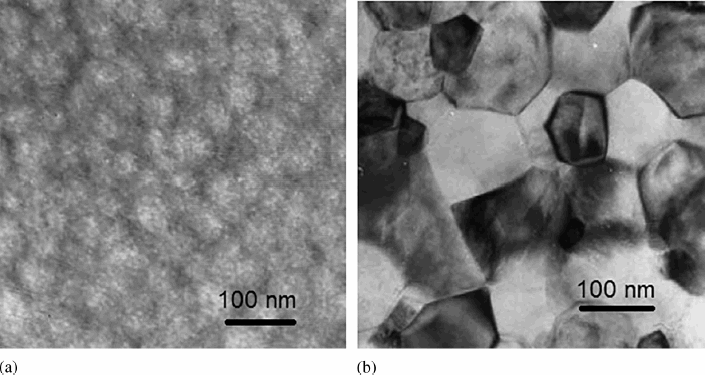
Durán et al. 62 prepared a 3YSZ powder by coprecipitation with a crystallite size of ∼9 nm, which was cold isostatically pressed (43% TD) into compacts with a pore of ∼6 nm and narrow pore size distribution. Compacts were sintered at 1150°C for 4 h or at 1200°C for 20 min hold times to obtain fully dense ceramics with a grain size < 100 nm. From a constant-rate heating sintering, at least three densification steps could be established. A first step, comprising a particle rearrangement, was detected up to ∼800°C with activation energy of 130 ± 40 kJ mol − 1. A second step, in which rapid densification occurs ( ≥ 95% TD) with slow grain growth, took place between 800 and 1180°C with an activation energy of ∼300 kJ mol − 1, which was well correlated to grain boundary diffusion. Finally, a third densification step was considered to exist above 1180°C in which almost fully dense Y-TZP ceramics were achieved, in which grain growth is enhanced. Later, the same group obtained 99·9% TD with a grain size of 72 nm after 2 h holding time at 1070°C. 63 When a temperature limit of 1000°C was used, the same samples took 80–100 h to reach full density, and the grain sizes remained below 100 nm (Fig. 6). 64 Finally, when nanocrystalline 3YSZ powders synthesised by seeding-assisted chemical coprecipitation were used, nearly full dense sintered bodies were obtained at 1050°C for 5 h with a grain size < 100 nm. 73
Vasylkiv and Sakka 58 produced nanosized 3YSZ powder (∼10 nm) by hydrothermal precipitation, which was slip cast and pressed by CIP. Sintering at 1150°C for 60 h resulted in a nanograined (∼95 nm) ∼99% dense ceramic body. Later Vasylkiv et al. 97 extended the investigation to 1·5–3YSZ and Y-TZP nanocomposites with 1–5 wt-% alumina also produced by colloidal processing. Bulk 3YSZ with an average grain size of 112 nm was shown to reach a hardness of 12·2 GPa and a fracture toughness of 9·3 MPa m1/2. An alumina/zirconia nanocomposite with an average grain size of 94 nm was obtained with increased hardness of 16·2 GPa. Nanograined YSZ ceramics with a reduced yttria-stabiliser content were shown to reach fracture toughness of ∼14 MPa m1/2 (2YSZ) and ∼12·5 MPa m1/2 (1·5YSZ).
Zych and Haberko 59 prepared green compacts by filter pressing of a nanopowder (∼8 nm) and sintered 30 min at 1200°C resulting in 99·9% TD dense, 3YSZ with mean grain size of ∼100 nm. Pradhan and Kapur 82 also attained nanograined fully dense 3YSZ from commercial nanopowders by colloidal processing. Aggregates were removed by centrifugation. Organics were eliminated by heating in steps from 100°C to 400°C with 30 min soaking at each temperature. Samples were sintered at 5°C min − 1 up to 1200°C for 30–240 min resulting in full dense nanograined YSZ ceramics ( < 100 nm). Sintered ceramics exhibited Vickers hardness of 12·8 GPa as compared to 10·8 GPa for those produced from aggregated powders.
Finally, it is worth mentioning that a transparent, fully dense ZrO2 ceramic with a grain size of 60 nm was obtained by Srdic et al. 54 by sintering under vacuum at temperature as low as 950°C from nanocrystalline powder (∼5 nm) synthesised by the chemical vapour method. Nevertheless, this achievement was not included in Table 4, since it is a pure, undoped zirconia and the sintering was not performed at room pressure.
In summary, slow heating schedules in RHS have the desirable characteristics of simple setup, complex shapes handling, and low cost. However, densification rate is slow and a long time is needed to achieve highly dense bodies, which subsequently leads to grain growth. The most successful approaches, where densities above 99% TD were achieved and grain sizes are below 100 nm, rely on effective powder processing to eliminate agglomeration and allow homogenous green bodies. Low temperatures of calcination to avoid strong powder aggregation associated with milling with organic solvents to break agglomerates and an optimal compaction to induce small and homogenously dispersed porosities in the green body are therefore key elements in RHS to maintain grain sizes in the nanosized range. Other approaches to improve the performance of RHS for nanoparticles include adding sintering aids that form liquid phase at lower temperatures, or modifying the sintering schedule (for instance to FF or TSS cycles). The first option is out of the scope of this work. The second approach will be further discussed.
Fast firing
The objective of FF is to increase the densification rate in detriment to the coarsening rate by rapidly approaching the sintering temperature. Because coarsening mechanisms (e.g. surface diffusion and vapour transport) usually prevail over densification mechanisms (e.g. lattice and grain-boundary diffusion) at lower temperatures, it has been suggested that rapid heating to higher temperatures can be beneficial to achieve high density allied to fine grain size. 98 In this case, the shorter time spent at lower temperatures serves to reduce the extent of coarsening, while densification is activated at high temperature conditions, resulting in high densities and fine microstructures. This mechanism is expected to be even more important when dealing with nanoparticles as the starting materials simply owing to the large surface areas of the powders, which tend to benefit surface diffusion and sample evaporation (this last due to the increased vapour pressure).
The conventional FF entails the quick insertion of a green body in and out of a preheated oven at the peak temperature and is arguably the simplest way to perform rapid densification. 99 This technique has been employed since the 1970s to sinter both traditional 100 and advanced ceramics 98 and proven compatible to laboratory and industrial scale furnaces. 101,102 Fast firing of ceramics has been successfully accomplished in continuous zone-sintering furnaces and in intermittent resistive box or tube furnaces. Recently, a commercial bottom-loaded, box furnace has been traded as ‘the world's fastest sintering furnace’, which was specially designed for sintering zirconia dental restorations in a total cycle of 10 min. 103
In a typical laboratory box furnace schedule for FF designed to achieve nearly fully dense YSZ, the furnace is preheated at the peak temperature and the green body is rapidly moved into the hot zone. According to a numerical simulation performed for fast-fired alumina, the temperature field as a function of time for a middle cut of the compact is shown in Fig. 7. 104 Considering a ceramic green bar (20 × 20 × 100 mm) placed into a furnace at 1500°C, the compact's centre takes about 120 s to reach 98% of the furnace temperature. Owing to the elevated temperature difference between the centre of the body and the furnace, the sample heating occurs under non-isothermal conditions as shown by the isotherms. The higher the temperature difference between the centre of the body and the furnace, the higher the energy transferred to the body. Thus, at the beginning of the process, with the insertion of the body at room temperature into the hot furnace, the heat rate is at its maximum. The radiative heat transfer is higher than the convective as expected due to the high temperature of the furnace and the low ?ow velocities inside the furnace. Radiation exchanges counts for more than 95% of the total heat rate transfer through the process.
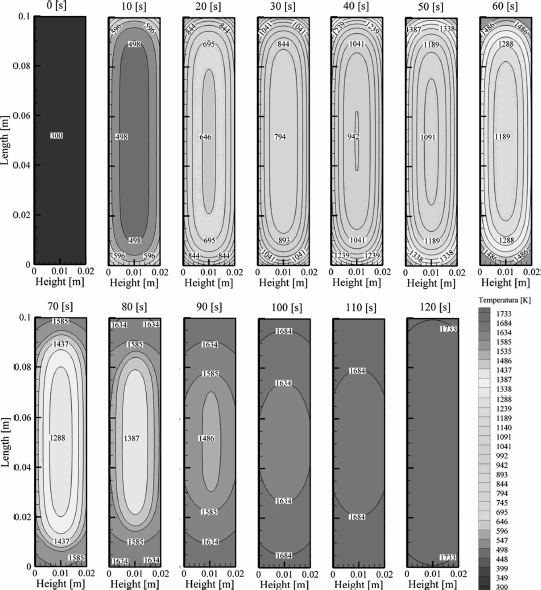
Temperature field on the middle plane of a fast-fired ceramic body 104
The thermal gradient inside the sample can therefore cause cracking problems during FF. That is, due to sintering, the outer regions of the sample will shrink faster than the inner regions, creating an internal stress that can lead to cracks and which will persist till the gradient of temperature vanishes. Note that even if cracks are not observed, large samples may present different microstructures when comparing outer and inner regions. Of course, materials with low thermal expansions and higher heat conductivity will be more suitable for FF.
The benefits of FF have encouraged applications of this technique to many advanced ceramics. Successfully fast-fired products have been reported for alumina, 105–107 ceria, 108 ferrites, 109,110 barium titanate, 111,112 indium tin oxide (ITO), 113 lead iron niobate (PFN), 114 lead magnesium niobate (PMN), 115 lead zirconate titanate (PZT), 116 yttrium aluminium garnet (YAG), 117 as well as composites, 118,119 and glass ceramics. 120,121
It is worth noting that some firing schedules referred to in the literature as ‘FF’ or ‘rapid sintering’ should not be strictly considered ‘fast’. That is, in some cases, although the heating rate is relatively high (e.g. 200°C min − 1), it lies much below the highest rate reported for this process (∼500°C min − 1); in other cases, although the rates are that high, the corresponding holding times at the top temperature are relatively long (e.g. 1 h) as compared to 1 min used in some cases. In addition, the cooling rate, or the time spent for the sintered products to reach room temperature, has received likewise much less attention. This longer runs disable most of the benefits of FF in terms of retaining grain growth and energy savings, making it more similar to RHS in many senses.
In the case of FF specifically on YSZ nanoceramics, only a few works have been reported in the literature. Table 5 presents a summary of the results from FF studies utilising nanosized powders and where densities of the final product are above 99% TD. The sintering elapsed times might be used as a criterion to evaluate how ‘fast’ the firing actually is.
Processing parameters and properties of dense nanocrystalline yttria-stabilised zirconia (YSZ) ceramics obtained by conventional fast firing (FF)
(a) average by XRD (crystallite). (b) average by TEM/SEM. (c) cylinder or disc (diameter [ × thickness]). (d) geometrically; (e) selected values (higher TD and/or smaller grain size). (f) time including ramp and hold. (g) conventional ramp and hold (RHS) for comparison. (h) microwave (MW) for comparison. (i) Archimedes method.
Feng et al. 56 used a hydrothermal processing to synthesise nanoscale and monodispersed 3YSZ powder with an equiaxed shape and an average particle size of ∼15 nm. The bulk density by FF at 1200°C for 1 min was 99·2% TD with a grain size of ∼90 nm. When fired at 1300°C for 1 min, the density was 99·7% TD with a grain size of ∼150 nm. In a second series of experiments, 57 a 22 nm, non-agglomerated ZrO2+2·8 mol% Y2O3 powder was synthesised, pressed at 100 MPa and rapidly heated at 500–1300°C min − 1. The fast-fired samples yielded a bulk density 99·8% TD and a grain size of ∼100 nm. However, the disc shape specimens were very thin and the homogeneity of the final density was not shown.
Kim and Kim 83 performed rapid sintering experiments at varying heating rates comparing a tube furnace to a microwave to elucidate the factors that hinder the densification of commercial zirconia powders. Three commercial YSZ nanopowders were used: tetragonal (3 mol% Y2O3), and cubic (6·6 and 8 mol% Y2O3). Compacts were first calcined at 600°C for 4 h and then sintered at 1430°C for 1 h. For those conditions, rapid heating resulted in the decrease of sintered densities in all three powders. The limited densification was attributed to entrapped gases caused by residual chlorine in the zirconia powders made by the chloride process. 122 In a second experimental run, the compacts were previously calcined at 1100°C for 1 h, and then sintered at 1430°C for 1 h. In this case, ∼99% TD were obtained for all three fast-fired YSZ powders. Kim and Kim 123 also investigated the pore shrinkage behaviour during FF of 3YSZ powders. At temperatures above 1200°C, it was proposed that all the pores became unstable due to the grain growth and then started to shrink and disappear. No data on grain growth was presented, though. The more pronounced effect of rapid heating on the pore size distributions is that no pore growth was observed. Pores of smaller sizes rapidly shrunk and disappeared, and pores of larger sizes also started to shrink during FF.
Moreover, Qiu et al. 124 synthesised 3YSZ nanopowder by coprecipitation and produced dense fine-grained ceramics either by RHS (heating rate of 3°C min − 1 to 1250°C, and hold for 30 min) or by FF (500°C min − 1 for both heating and cooling rates with 2 min hold). The samples presented 99·5% TD and ∼200 nm grain size, or 97·5% TD and ∼120 nm grain size, respectively for the slow and fast sintering schedules, suggesting that grain growth could not be separated from the densification at the final stage of sintering.
Interestingly, Chen and Mayo 125 developed a similar work on nanocrystalline 3YSZ, which although presented an opposite trend. In this case, two starting nanopowders were used: one synthesised by coprecipitation and a commercial product. The powders were uniaxially (5 MPa) and isostatically pressed (250–300 MPa) to compacts with 47–50% TD and then pressureless sintered in air. The heating rates ranged from 2 to 200°C min − 1. In the case of the highest rate, the samples were preheated in a box furnace and then pushed manually into a tube furnace to the peak temperature area with a dwell time of 4 min. The results showed that the heating rates had virtually no effect on the densification or grain growth of 3YSZ powder compacts. Nevertheless, the heating rates were considered only up to 200°C min − 1 and the pretreatment carried out (500°C for 4 h) might have not been enough to vaporise impurities entrapped in the compact.
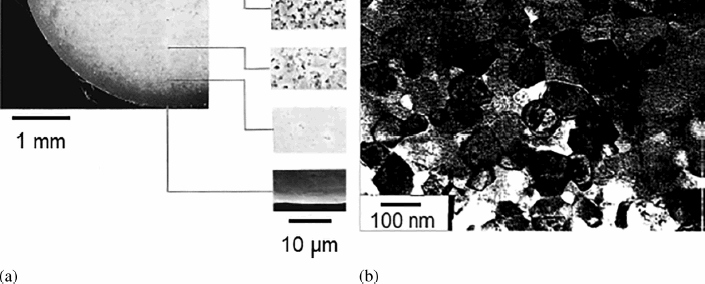
Chen and Mayo 125 discussed the problem concerning the gradient of densification induced by the high heating rates. Figure 8a shows SEM micrographs of a 3YSZ nanocrystalline sample partially sintered by heating at 20°C min − 1 to 1300°C and held for 2 h. A differential densification can be seen where the surface of the sample is nearly dense, while there is increasing porosity when approaching the sample centre. While the authors suggest that the dense shell could constrain the interior, decreasing densification, other works have shown that this is not the case for very fast heating rates. For instance, Fig. 8b shows a TEM micrograph of a 2·8YSZ nanocrystalline sample fully sintered by FF at 500°C min − 1 to 1300°C and held for 1 min with a grain size of about 100 nm. This suggests that particle packing and agglomeration control are key elements to avoid the observed constrained sintering. Nevertheless, FF is certainly more suitable for processing of small or thin walled articles. When this method is applied to large parts, a thermal gradient is more likely expected to develop between the surface and the core of the sample, subsequently retarding the densification of the interior of the body. 12
Though FF is still considered a technologically powerful tool for YSZ densification, being used in orthodontic prosthesis in-office manufacturing, data collected in Table 5 suggests a significant grain growth is still observed when high densities are of interest. This is because grain growth is always present and with high motilities due to the high temperatures of processing. To go around this, FF for very short times has been used as a starting point to another process to achieve dense nanograined samples, as described in the next Section.
Two-step sintering
Two-step sintering (TSS) is a thermal schedule that has been proposed to promote high densification of ceramics with hindered grain growth. The key features in this method are: exposing the sample to a temperature (T 1) enough to activate densification mechanisms and allow sample to achieve >75% TD; and lower the temperature of about 100–150°C (T 2) to induce densification with minimal grain growth. 27 The limited grain growth during the second step in TSS while densification continues has been attributed to a grain boundary network pinned by triple-point junctions that have higher activation energy for migration than the grain boundaries. 81 Thus the feasibility of densification without grain growth was thought to rely on the suppression of grain-boundary migration while keeping grain-boundary diffusion active. Fig. 9 presents a typical TSS curve compared to a conventional RHS cycle or one-step sintering.
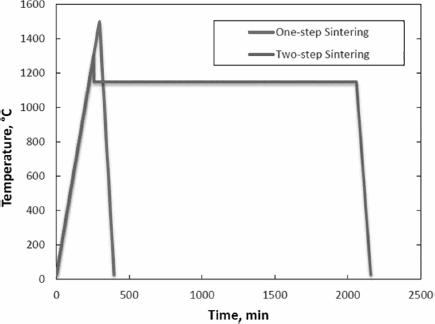
Typical furnace schedule for two-step sintering (TSS) of near fully dense yttria-stabilized zirconia (YSZ) compared to conventional ramp and hold sintering (RHS)
Wang et al. 28 suggested a ‘kinetic window’ separating grain-boundary diffusion and grain-boundary migration. At temperatures above the kinetic window, grain growth occurs for which the driving force diminishes as the grain size increases. At temperatures below the kinetic window, sintering is exhausted before full density is achieved. Thus, TSS can be used to reach TD >98% by exploiting this kinetic window. Once the critical density at T 1 is reached, the lower temperature hold at T 2 will place samples within the ‘kinetic window.’ When conditions for TSS fall below this point, values of TD >96% cannot be achieved even if a starting density of 70% is obtained at T 1, as grain growth may still be suppressed but densification will be exhausted. Above the ‘kinetic window,’ grain growth is likely to occur. 27
Two-step sintering has been efficiently used to fabricate various dense advanced ceramics such as Y2O3, 27,28 SiC, 126 Al2O3, 127 BaTiO3, 29,128 ZnO, 129,130 lead titanates, 131,132 and alkaline niobates. 133,134 A typical TSS schedule is usually performed in conventional resistive furnaces, but some two-step experiments in alternative techniques such as microwave sintering have been reported.
It has been reported that the grain growth can be retarded and full density can be achieved by using TSS schedules for nanocrystalline ceramics as well. According to the original TSS schedule proposed by Chen and Wang, 27 fully dense Mg-doped Y2O3 was obtained by TSS at 1000°C for 20 h, after reaching 76% TD in an initial sintering at 1080°C. In this case, starting powders of 10 nm were used and a final dense ceramic grain size of 60 nm was reached.
Numerous authors have reported on TSS of zirconia nanopowders. In most cases, however, neither the densities obtained were >99% TD nor the nanocrystalline nature of the green body was preserved. 135 Lee 85 used 3YSZ commercial powder, which was injection-moulded and sintered at 1500°C (T 1), held for 5 min, and then rapidly cooled down and maintained at 1300°C (T 2) for 10 h. The final density of the two-step sample was 99% TD, but the average grain sizes reached 590 nm. Yu et al. 86 applied TSS (T 1 = 1100–1500°C for 6 min; T 2 = 900–1000°C for 1 h) for injection-moulded 3YSZ parts. The sintered specimens presented a grain size of ∼500 nm and density from 94–99% TD. Chen et al. 136 sintered a nanosized 3YSZ powder at 1200°C for 1 min and then at 1050°C for 35 h, and reached a relative density of ∼98% TD and a grain size of 100 nm. Xiong et al. 137 applied TSS in the consolidation of 3YSZ commercial nanopowder. Relative densities of 97% TD and grain sizes of ∼170 nm were obtained by RHS (1250°C for 1 h) and TSS (T 1 = 1275°C for 1 min, T 2 = 1150°C for 30 h). Mazaheri et al. 39 obtained nearly fully dense 3YSZ compacts (∼99% TD) with an average grain size of 110 nm after sintering at 1300°C (T 1) and 1150°C (T 2) for 30 h. Suárez et al. 138 sintered slip-cast 3YSZ bodies with 99·9% TD and an average grain size of 125 nm after an optimised TSS schedule (T 1 = 1300°C for 1 min, T 2 = 1200°C for 15 h).
Mæland et al. 65 sintered 4YSZ nanoparticles using a modified TSS proposed by Han. 139 The optimised schedule (T 1 = 1400°C; T 2 = 1300°C for 20 h) corresponded to 96% TD and a grain size of 200 nm. Lena et al. 66 submitted a 4·5YSZ powder synthesised by the Pechini method to a TSS schedule with heating rate of 8°C min − 1 to 1550°C (T 1), cooling rate of 50°C min − 1 to T 2 : 1300°C (2 h), 1300°C (10 h) or 1400°C (2 h). The highest density (97% TD) was observed for samples treated at 1400°C (T 2) for 2 h, which showed a submicrometric grain size.
Laberty-Robert et al. 67 obtained 98% TD 8YSZ bodies from nanocrystalline powders by TSS (T 1 = 1500°C; T 2 = 1450°C for 4–20 h) with grain sizes from 1 to 5 μm, though. Han 139 employed a modified TSS to sinter 8YSZ tapes from synthesised nanopowders (10–15 nm). The temperature was raised up to 1400°C, and then decreased to 1250–1300°C for 10–20 h. Samples with grain sizes in the range of 100–400 nm and 99% TD were obtained. Ghosh et al. 69 obtained 8YSZ ceramics with 97% TD after a TSS schedule (T 1 = 1125°C for 3 h; T 2 = 1090°C for 20 h). However, the grain size ranged from 150 to 220 nm. Durá and López de la Torre 140 sintered 8YSZ by TSS (T 1 = 950–1150°C; T 2 = 750–950°C) resulting in grain sizes ∼150 nm and densities up to 92% TD. Mazaheri et al. 70,71 employed TSS to consolidate nanocrystalline 8YSZ. The optimised schedule (T 1 = 1250°C; T 2 = 1050°C for 20 h) corresponded to 97% TD and 295 nm. 72 Muccillo and Muccillo 141 obtained sintered 8YSZ specimens with >97% TD and grain size of 580 nm by TSS (T 1 = 1330°C; T 2 = 1230°C for 20 h).
Table 6 summarises in the processing parameters for successfully obtaining >90% TD nanocrystalline YSZ ceramics through TSS. Some studies compare different sintering techniques to TSS and their data are also included. Interestingly, only compositions up to 3 mol% yttria-doped zirconia could be successfully transformed into nanocrystalline materials. This will be further discussed in the next Section on microstructural development.
Processing parameters and properties of dense nanocrystalline yttria-stabilised zirconia (YSZ) ceramics obtained by two-step sintering (TSS)
(a) average by XRD (crystallite). (b) average by TEM/SEM. (c) cylinder or disc (diameter [ × thickness]). (d) bar (length [ × width] × thickness). (e) geometrically. (f) selected values (higher TD and/or smaller grain size). (g) time including heating ramp and hold at T 1. (h) conventional ramp and hold (RHS) for comparison. (i) microwave (MW) for comparison. (j) Archimedes method.
Paul et al. 80 investigated the influence of grain size and yttria content on the hydrothermal aging behaviour of YSZ nanoceramics for biomedical applications. Slip cast green bodies were heated at 10°C min − 1 to 1150°C (T 1) for 6 s and then cooled down to 1050°C (T 2) where the samples were held for up to 10 h. When compared to a dry pressed commercial 3YSZ powder which was conventionally sintered (1500°C, 2 h), the TSS samples achieved nearly full densification with very limited grain growth. The nanostructured sample (Nano-3YSZ with < 100 nm grain size) did not exhibit degradation under hydrothermal aging, whereas submicrometric 3YSZ samples underwent severe degradation.
Binner and Vaidhyanathan 81 prepared 3YSZ green bodies by die pressing (∼50% TD) and slip casting (∼55% TD), which were sintered using both a RHS and a TSS approach. The conventionally sintered samples were heated at 7°C min − 1 to 900–1150°C and held for up to 8 h. The TSS samples were heated at 7°C min − 1 to 1150°C and immediately cooled down to 1000–1050°C for holding periods of up to 30 h. Both radiant and hybrid-microwave/radiant furnaces were used in either dry or wet processed samples. While densities >98% TD were achievable with all procedures, an average grain size below 100 nm could only be obtained when applying TSS, being the smallest size achieved when using the hybrid heating. That is, the bulk of the grain growth observed using this approach occurred during heating to T 1. With radiant heating, 7°C min − 1, the final average grain sizes were 95–100 nm; with the hybrid heating, 20°C min − 1, grain sizes were in the range of 70–80 nm for die pressed samples and ∼65 nm for the more homogeneous slip cast samples.
Santacruz et al. 35 produced 3YSZ slip cast bodies from commercial nanosuspensions. After the removal of the organic dispersants at 500°C for 2 h, the green samples were sintered in an electrical furnace by TSS. This involved heating the samples to 1150°C at 20°C min − 1 and holding them for 1 min before the temperature was reduced to 1000°C, and then holding at this temperature for 5 or 10 h. Figure 10 shows the nanostructures of the TSS sintered samples: 99% TD ceramics were obtained with an average and uniform grain size of 80 and 90 nm after 5 and 10 h of soaking time (Fig. 10a and b , respectively).
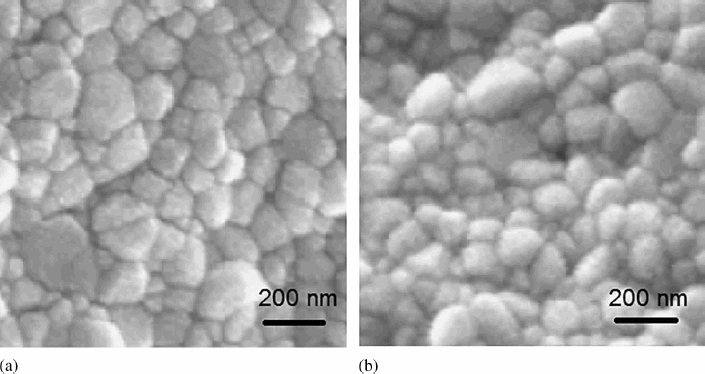
FEG-SEM micrographs of three yttria-stabilised zirconia (3YSZ) nanocrystalline samples prepared by TSS (T 1 = 1150°C; T 2 = 1000°C at with soaking times at T 2 of: (a) 5 h, and (b) 10 h 35 )
In a further work, Binner et al. 34 prepared 1·5, 2 and 3YSZ green bodies by die pressing (∼54% TD) and slip casting (∼52% TD), using TSS by hybrid (microwave/conventional) heating. The optimum sintering conditions of 6 s at 1150°C (T 1) followed by 3 h at 10501C (T 2) for the 3YSZ slip-cast bodies yielded densities of >99·5% TD and a final mean grain size of < 65 nm. However, for 1·5YSZ and 2YSZ, it was found that the TSS cycle needed modification to allow for the variation in yttria content. In general, the lower the yttria level, the less demanding the sintering conditions required, which was attributed to the influence and magnitude of the associated grain-growth process.
In summary, TSS schedules may retard the grain growth of YSZ. Similarly to FF, a very short heating cycle up to the maximum sintering temperature (T 1) is first applied. However, differently from FF, TSS needs a dwell time of at least 3 h at the lower temperature (T 2) for complete densification, even when a microwave furnace is used instead of a conventional one.
Microstructural development in YSZ nanoceramics
Meaningful comparison to assess the effect of different conventional sintering techniques on the microstructural development and consequent properties of nanocrystalline ceramics is not a straightforward task. This is because details during processing, from synthesis to densification, can affect significantly the final microstructure, as seen in a few examples in the past Sections. For instance, the starting powders, either commercial or synthesised, can have different particle shape and impurities. This complicates any direct comparison between densification studies even when the starting powders have similar grain sizes. Moreover, in many cases powders are subject to mechanical, chemical or heat treatments before or after shaping. The high reactivity of nanoparticles also complicates the scenario as surface contaminations and/or different agglomeration states can exist depending on the processing environment. Packing features, which depend upon the forming medium (dry, plastic, or liquid), additives and pressure applied, also affect microstructural evolution on the top of the sintering parameters (temperature, time, heating and cooling rates, heat flow, and atmosphere, just to mention some).
It is clear though that obtaining YSZ nanoceramics in conventional furnaces requires specific characteristics of the starting powder, a convenient packing and pore size distribution, and tailored densification and grain growth parameters during sintering. In this Section, those requirements are described after a collective analysis of the available literature information.
Powder characteristics
Nanopowders are normally synthesised at low temperatures or from non-equilibrium processes, which can lead to metastable particles of different phases of the desired material. 60 After synthesis, removal of organics and phase transformation to stable structures are typically needed. However, those processes are usually accompanied by microstructural changes, which might be detrimental to the final sintered product. For instance, decomposition or phase transformation may induce volume changes and introduce substantial amount of porosity and cause poor densification during sintering. 12 When prolonged sintering is used to remove pores, grain coarsening may set in.
Particle size distribution is another critical element affecting microstructural evolution during densification of nanoparticles. That is, nanopowders may present wide particle size distribution with some particles even reaching submicron sizes. A few large particles do not affect the packing density substantially but may lead to abnormal grain growth during sintering. 142 On the other hand, very narrow distributions are also not desirable, as packing efficiency is decreased because of the high frictional force between nanoparticles, 12 making more difficult to achieve high green densities needed for enhanced densification.
While nanoparticles have inherent high surface areas, theoretically enabling a high driving force for densification, the very same high reactivity may induce agglomerations and aggregations, or even partial sintering, before densification starts, creating undesirable heterogeneities and/or limiting densification. 143 While soft agglomerates do not affect significantly densification behaviour, hard agglomerates, formed typically during powder synthesis or pre-treatments at moderate temperatures, can strongly affect sintering. In those cases, as it is sometimes impractical to break hard agglomerates even when making usage of highly energetic treatments, agglomerate sizes (and hence the interagglomerate pore size) rather than the nanoparticles size are typically expected to govern the densification of compacts. When agglomeration causes loss of contacts in a particle packing before sintering, a poorly packed region can mature into a critical defect. 12
Regarding specifically the fabrication of YSZ nanocrystalline ceramics, the most successful starting nanopowders employed are those synthesised by sol-gel, 55 hydrothermal, 59 or coprecipitation routes. 63 In those cases, powders with a narrow pore size distribution and particle sizes < 10 nm were obtained (small soft agglomerates), comparing to commercial powders which usually present crystallite sizes >20 nm and particle sizes in the range of 40–75 nm. 38,82 When commercial powders are used, even a low grain growth factor during sintering (∼5 times) may lead to crystalline ceramics out of the nanometric range.
Packing and pore size distribution
Agglomerated powders are typically difficult to densify because the packing of large agglomerates leaves behind large and interagglomerate pores. In this way, no matter how small the crystallites inside the agglomerate are, the size of the agglomerate dictates the size of the interagglomerate pores and, ultimately, the densification behaviour of the ceramic. 144
When compacted, a powder composed of agglomerates contains both small intercrystallite pores and large interagglomerate pores. The latter pores require long sintering times and/or high sintering temperatures to be eliminated, which are conditions typically associated with grain growth. On the other hand, the very same interagglomerate pores, show slow shrinkage kinetics, and therefore are usually the last pores remaining in the ceramic during final-stage sintering. As such, they act as pinning sites preventing grain boundary movement, and their spacing ultimately determines the final sintered grain size. 60
Trunec and Maca 37 showed the importance of green body microstructure for the pressureless RHS of YSZ nanoparticles. A detailed investigation of pore size evolution during sintering indicated that dense nanocrystalline zirconia ceramics could be prepared only with a ceramic green body with both small pores and a homogeneous structure. Inhomogeneous green bodies, even with small pores, prevented the densification due to local shrinkage and subsequent pore growth. Therefore, zirconia nanoparticle compacts with the required microstructure (maximum pore size 5–10 nm, homogeneous structure) were densified by pressureless sintering at 1100°C into dense nanocrystalline bodies (diameter 20 mm, thickness 4 mm) with a relative density higher than 99% and a grain size of about 85 nm.
Densification and grain growth
The success of heating schedules in controlling the microstructural evolution of ceramics during sintering comes from the fact that the different mass flow mechanisms occurring at high temperatures will show distinct activation energies. Therefore, specific mechanisms can be activated while others can be suppressed in order to achieve desirable properties (microstructures) of the final product. 145 The main competitive processes are densification and grain growth, this last being of course undesirable for attaining nanograined structures.
In general, nanoparticles show low sintering activation energy. For instance, the densification activation energy itself of nanosized YSZ (237 kJ mol − 1) is about 50% lower than that of submicron YSZ. 55 On the other hand, the activation energy for grain growth in nanoparticles is also much lower than that in micrometric particles (e.g. ∼20 kJ mol − 1 for ZnO nanoparticles, which is one order of magnitude lower than the activation energy of densification for this material). 146 For nanosized YSZ particles, the reported energy activation for grain growth was even lower (∼5 kJ mol − 1 for 8, 9 and 10YSZ). 147
Maca et al. 148 analysed the influence of sintering schedules (TSS and RHS) on the final microstructure of commercial 3YSZ and 8YSZ powders. The results showed that the efficiency of TSS was more dependent on crystal structure than on particle size and green body microstructure. For tetragonal 3YSZ, both TSS (T 1 = 1305°C, T 2 = 1275°C, t 2 = 10 h) and RHS (1405°C, no dwell time) reached a density of ∼99% TD and a grain size of 160–170 nm. On the other hand, TSS (T 1 = 1440°C, T 2 = 1290°C, t 2 = 15 h) was more successful in sintering cubic 8YSZ when compared to RHS (1530°C for 1 h). Nevertheless, for a density of ∼99·3% TD, relatively large grain sizes from 3·0 μm for RHS and 1·3 μm for TSS were produced for 8YSZ ceramics.
Lourenço et al. 135 proposed a method to optimise TSS schedules of commercial nanopowders (3YSZ and 8YSZ) that combines predictions of the sintering kinetics with Taguchi fractional experimental plans. The controlled processing parameters were T 1, T 2, time at T 2 (t 2), and the cooling rate between T 1 and T 2. Dense 3YSZ was obtained with an average grain size of ∼100 nm under the conditions T 1 = 1320°C, T 2 = 1250°C, t 2 = 12 h and 20°C min − 1. Grain growth is inhibited to a lesser extent for 8YSZ, with the smallest average grain size of 450 nm obtained for T 1 = 1320°C, T 2 = 1270°C, t 2 = 12 h and 20°C min − 1.
In both cases, 8YSZ is notably harder to densify at reasonably low grain sizes when compared to 3YSZ. The reason may be on local phase transitions of the partially stabilised 3YSZ that can increase reactivity and pin boundary from growing, or certainly different levels of impurities in each sample (such as traces of alumina). Nevertheless, TSS schedules were applied with relative success to hinder grain growth in cubic zirconia ceramics; less success was reported for hexagonal alumina and no significant effect of refining the microstructure of sintered body was recorded in the case of tetragonal zirconia ceramics subjected to TSS. 148 In that particular study, it was suggested that the grain growth factor was lower for increasing ceramic crystal symmetry, which can be linked to interfacial energies and grain growth driving forces and activation energies.
A further investigation on the effect of zirconia phase structure (monoclinic, tetragonal and cubic) on the sintering behaviour of zirconia nanopowders (∼13 nm) was performed by Trunec et al. 149 Green bodies compacted by CIP were densified by pressureless RHS at a heating rate of 5°C min − 1 up to 1150°C with no dwell at the peak temperature. In this case, for highly dense bodies (99% TD), tetragonal 1·5YSZ and cubic 8YSZ presented respective mean grain sizes of 170 and 180 nm, whereas monoclinic pure zirconia exhibited a more difficult densification and coarser microstructure (∼570 nm). The similarity between the tetragonal and cubic phases is remarkable and contrasts with TSS results. However, caution should be exercised when direct comparing those results as they start with different nanopowders.
Indeed, the distinct densification behaviour for samples with different yttrium contents can be related to the defect concentration, nature, evolution during the densification routine, and particularities of the defect interactions at the nanoscale. While these are typically difficult parameters to quantify, recently positron annihilation spectroscopy (PAS) has been proposed as a non-destructive investigation technique that can shed some light into this hypothesis. 150 For instance, PAS has been used for estimating the mean grain size from conventional positron lifetime technique 151 and displaying trends in microstructure evolution which take place during sintering of YSZ ceramics at different temperatures. 152
Earlier studies on the control of grain growth during sintering of YSZ have also shown that a transient stage of abnormal grain growth, which is determined by the microstructural situation after compaction, occurs in the non-isothermal temperature range, between 1100 and 1200°C. 142 In order to maintain the nanocrystalline nature of YSZ ceramics produced from nanograined powders, the stage of abnormal grain growth should be kept as short as possible. In this regard, FF schedules seem to be a promising method to reach fine-grained, dense YSZ ceramics.
Conclusions
Despite the numerous works on activated densification methods (such as FS and SPS) to obtain nanograined dense YSZ, heating schedules performed in conventional resistive furnaces have been also successfully employed to sinter nanocrystalline YSZ ceramics. In this regard, energy effective sintering cycles are arguably the best option to achieve a desired dense nanograined microstructure in a technologically and economically affordable way. In this paper, a collection of available data in the literature on sintering of YSZ nanoparticles was presented, and the reasons why only a few reports describe obtaining fully dense and nanocrystalline structured final ceramic products (>99% TD) were discussed. In all successful cases, a combination of powder characteristics, forming techniques and firing schedules contributed to maintain the nanostructure throughout the ceramic processing.
Both commercial and self-made YSZ nanopowders have been reported as starting materials, the latter yielding most frequently better results due to a fine tuned synthesis control. This control refers not only to crystallite sizes, but also to agglomerate states, since agglomerated powders rarely produce nanocrystalline grain sizes in a sintered product. For YSZ, successful breakage of agglomerates can be performed by introducing milling with isopropanol, but efficiency of the procedure depends on how strong agglomerates are, given that hard agglomerates are unlikely to be broken even using high-energy milling. Another critical point in synthesis and powder processing before firing is eliminating deleterious ions, particularly chlorides, which negatively affect sintering. Sequential washes have been proposed as successful strategies.
Even with suitable powder in hand, a consequent challenge to produce nanograined dense YSZ ceramics by using conventional methods is obtaining a high green density, with adequate distribution of pores and homogeneity. Colloidal processing in various times reported to show particularly suitability, and when directly compared to uniaxial or isostatic pressing, slip or pressure casting procedures produced more homogeneous and dense green bodies.
In general, though, even when bulk YSZ nanoceramics were obtained with the optimal processing combinations, the produced specimens are relatively small (usually with a diameter < 30 mm and a thickness of 1–15 mm). This is probably the reason why there are so few reports describing the overall mechanical properties of bulk nanocrystalline zirconia ceramics. However, it is feasible to exploit commercially those reports to fabricate small bodies, such as medical and dental prosthesis and ceramic screws, but one of the most challenging goals is still the fabrication of large bodies with the expected properties of nanocrystalline ceramics.
Acknowledgements
The support of Brazilian agencies CAPES and CNPq is gratefully acknowledged. National Science Foundation DMR 1055504 and U.S. Department of Energy BES ER46795 are acknowledged for funding RHRC.