







Abstract
The combined influence of prior plastic strain in austenite and applied stress in the course of the transformation on the crystallographic texture of bainitic steel was studied. The experimental data were obtained using electron back scatter diffraction and analysed using two methodologically different approaches. It was concluded that the plastic deformation of parent austenite grains could suppress variant selection in bainite despite maintaining an externally applied load throughout the bainitic transformation.
Introduction
Bainite forms in steels by transformation of the parent austenite, induced by a homogeneous plastic deformation, which does not require diffusion.1 – 4 Hence, bainitic transformation and ordinary plastic deformation are similar. For instance, in both cases, certain crystallographic planes and directions (i.e. variants) are favoured. The favouring of certain variants over others is known as ‘variant selection’. The crystallography of each plate of bainite can be described in terms of a mathematically connected set of habit planes, orientation relationships with the parent austenite and shape deformation.5 The interaction between the applied stress and the transformation can be treated by adding a mechanical driving force G MECH to the chemical term G CHEM, which would be the driving force for the transformation even in the absence of applied stress.
Hase et al. studied the effect of applied compressive stresses on bainite start temperature and variant selection in a carbide free bainitic steel.6 The work showed that the applied compressive stress of ∼200 MPa raised the transformation start temperature and led to the microstructural alignment of the bainite sheaves. The optical micrographs clearly confirmed that the majority of bainite sheaves were formed on the planes of maximum shear stress (i.e. 45° angle to the applied compressive load), and the higher the applied load, the higher the abundance of aligned sheaves. Visual examination of the electron back scatter diffraction (EBSD) maps revealed that certain crystallographic orientations were favoured within some large regions containing parallel bainite sheaves, indicating the presence of a strong variant selection. No quantitative assessment of the variant selection was carried out in the work of Hase et al.
In more recent work, Shirzadi et al. investigated the influence of plastic strain alone (i.e. without any applied stress during the transformation) on the crystallographic orientation of bainitic.7 They found no strong variant selection in bainitic steel, which transformed from a plastically deformed austenite to bainite under zero applied load. This was in contrast with Bokros and Parker’s work on a single crystal austenite, in which a strong variant selection in martensite was observed due to the prior plastic deformation of the parent austenite.8 It is possible that the complexity of slip systems in the polycrystalline steel used by Shirzadi et al., where multiple slip systems must operate in order to maintain continuity, led to the lack of strong variant selection. Whereas in Bokros and Parkers’ work, the observed variant selection occurred because of the anisotropic nature of the dislocation debris in the austenite single crystal.
The purpose of the present work is to study the combined influence of prior plastic strain in the parent austenite and applied stress in the course of the transformation on the crystallographic texture of bainite.
Crystallographic orientation in steels
The room temperature microstructure and texture of steel mostly depend on its composition, thermomechanical history and initial crystallographic orientation of the parent austenite at elevated temperature before its transformation to a low temperature phase, e.g. ferrite or martensite. When austenite transforms to ferrite by a reconstructive mechanism, the product phase nucleates heterogeneously at austenite grain boundaries. Although a reproducible, low energy orientation relationship is expected to exist between the ferrite and that of the parent austenite grains, it is possible that the ferrite simultaneously adopts this orientation with more than one austenite grain. On the other hand, in displacive transformations, the crystal structure of the parent austenite is deformed into that of the product without the need for any diffusion. In displacive transformations, the coordinated movements of atoms cannot be sustained across the grain boundaries. Hence, it is reasonable to assume that the product is confined to the parent grain with which it has an orientation relationship.9
In the case of displacive transformations, such as martensite and bainite (some crystallographers argue that formation of bainite is also a reconstructive transformation since it requires breaking up the atomic bonds and limited amount of diffusion), certain sets of the orientation relationship, shape deformation and habit planes can be defined using the theory of martensitic transformation. Such transformation is dominated by strain energy due to the shape deformation; therefore, many of the crystallographic variables cannot be varied independently.10 Hence, having assumed that the product phase grows in the same parent crystal in which it nucleates, the texture of the final phase can be predicted once the orientations of the parent crystals are known.11
In order to study and predict the evolving textures in polycrystalline steels, the original crystallographic orientation of austenite has to be known. Various simulation techniques and experimental methods are used to determine the texture of retained austenite.12 – 15 For instance, advanced X-ray and neutron diffraction methods can be used to determine the texture of the parent austenite at 950°C before its transformation to low temperature phases.16
Determining variant selection
In this work, two methodologically different approaches were used to investigate the presence (or lack) of the variant selection in a bainitic sample, which was formed under a compressive stress from a plastically deformed parent austenite. In the first approach, ARPGE software was used to reconstruct the orientation of the parent austenite grains followed by a statistical analysis of the bainite texture. 17 17,18 The second approach relies on microtexture development within individual austenite grains as a function of the direction of the applied compressive stress. The microtexture of the grains could be illustrated and compared using the corresponding pole figures. The details of the second approach are given elsewhere.7
Statistical approach
The ARPGE software is capable of determining the crystallographic orientation of austenite grains using the EBSD data acquired from the room temperature phase (i.e. bainite) and without requiring any experimental data on the parent austenite grains. 17 17,18
The reconstruction of the parent austenite is performed by taking the following steps:
checking if the experimental misorientations between the bcc grains are close to theoretical misorientations (i.e. operators)
checking if the composition of the operators corresponds the theory (groupoid composition)
deducing the indexes of the variants
calculating the orientation of the parent austenite grains (see Ref. 18 for more details).
Finally, the global pole figures corresponding to the texture of the parent grains are drawn, and the frequencies of the detected variants and used operators are represented on columnar charts. If the frequencies of variant indexes and/or operators between neighbouring grains are high, then one can conclude that variant selection has most likely occurred. The flow chart in Fig. 1 shows the procedure used to determine whether variant selection occurred in the sample studied in this work.
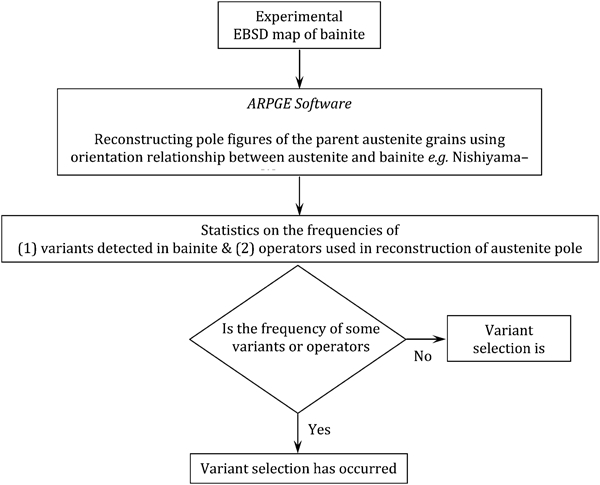
Procedure of analysing variant selection in fully bainitic steel using EBSD data
Microtexture approach
This method used representative examples of the orientations of bainite within four individual austenite grains. The phenomenological theory of martensite crystallography gives a complete description of the mathematical connection between the orientation relationship, the habit plane and the shape deformation for each plate that forms by a displacive transformation. The most common application of this theory is in martensitic transformations, but it applies equally well to bainite in steels.19 Using the crystallographic set needed to describe each plate of bainite,20 the measured orientation of the austenite grain and a knowledge of the applied stress, it is possible to calculate which of the 24 possible crystallographic variants is/are favoured by the applied stress (see Ref. 7 for more details).
Experimental
The chemical composition of the steel used in this work was 0·79C–1·56Si–1·98Mn–0·002P–1·01Al–0·24Mo–1·01Cr–1·51Co (wt-%). This is the same alloy used by Hase et al. 6 to study bainite growth in a fully annealed austenite under the influence of an externally applied load and also by Shirzadi et al.,7 who studied the texture in bainite, which formed from plastically deformed austenite under no load.
Cylindrical specimens of 8 mm diameter and 12 mm length were prepared for the experiments, which were carried out using an adapted thermomechanical simulator Thermecmastor Z. Details of this equipment were published elsewhere,21 but the thermomechanical procedure used in this work is illustrated in Fig. 2.
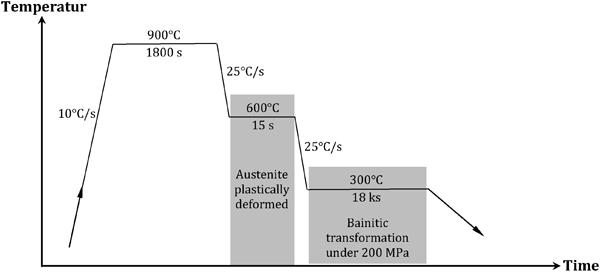
Thermomechanical processing cycle and formation of bainite from plastically deformed austenite during isothermal transformation under 200 MPa compressive stress at 300°C for 5 h
Axial compression of cylindrical samples results in a barreling effect and a heterogeneous distribution of plastic strain when there is friction between the sample and the platens which apply compressive force. Finite element method (FEM) calculations were carried out using an assumed friction coefficient of 0·2 in order to simulate the barreling effect and determine the strain where the EBDS data were collected. The constitutive equations used in the FEM to represent the deformation of the cylindrical sample are from another steel 0·15C–0·45Mn (wt-%), so the results here are indicative.7 Figure 3 shows that the calculated compressive strain in the centre of the sample, where the orientation imaging experiments (EBSD) were conducted, is greater than the overall longitudinal deformation of ∼10%.
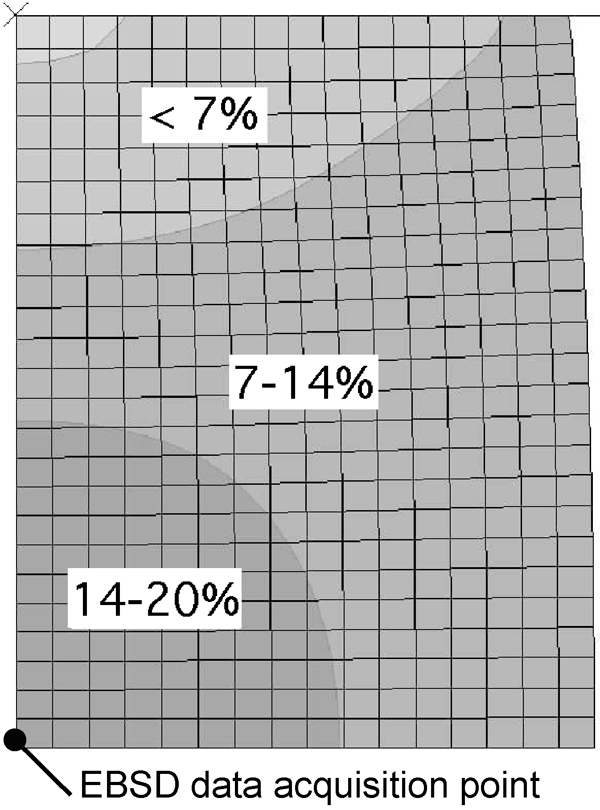
Analysis (FEM) used to estimate axial compressive strains in various parts of test sample: diagram represents quarter section of cylindrical samples with ∼10% longitudinal strain7
The bainitic sample was sectioned, mechanically ground and polished using colloidal silica suspension. Crystallographic data were generated by electron backscatter diffraction (EBSD) using a CamScan scanning electron microscope at a magnification of ×500 with a step size of 0·5 μm. Orientation data were acquired from the centre of the sample where the plastic strain was estimated to be ∼20% (see Figure 3 Figs. 3 and 4). Subsequent EBSD maps were generated using HKL’s technology CHANNEL5 software.
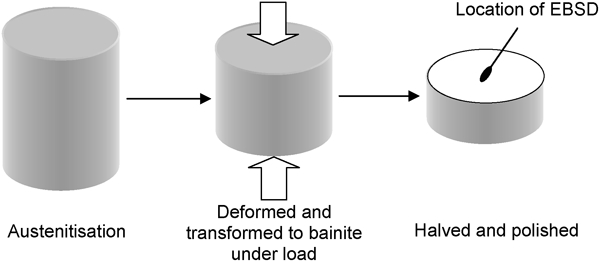
Location of EBSD on bainite sample studied in this work
Results and discussion
Statistical approach
Figure 5 shows the parent austenite grains reconstructed from the experimental EBSD map of bainitic grains as well as the corresponding pole figures for eight selected grains. The computer program also indexed the bainitic grains in each identified austenitic grain with numbers from 1 to 12. Each indexing number corresponds to a certain variant, as defined by the Nishiyama–Wasserman orientation relationship. As an example, some of the indexed bainite grains are shown in Fig. 6. Finally, the computer program provided the frequency of the operators used in the reconstruction of parent austenite grains as well as the statistics on the occurrence of all 12 possible variants.
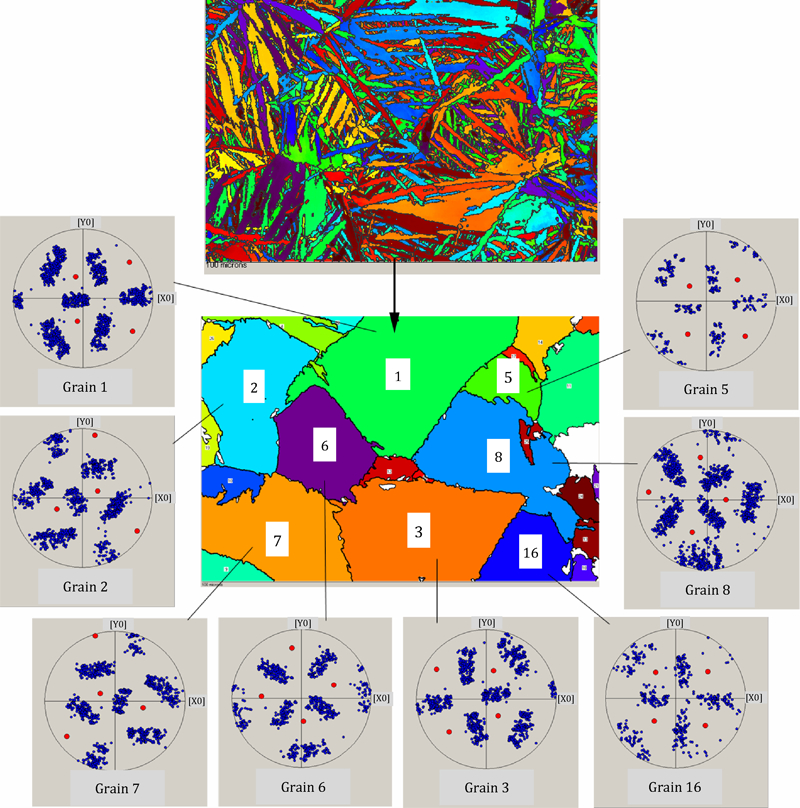
Experimentally acquired EBSD map of bainitic grains (top) and outcome of ARPGE software that was used to reconstruct austenitic grains (middle): pole figures of 〈111〉 directions show crystallographic orientations of bainite (blue in online version and black in printed) and superimposed orientations of corresponding reconstructed austenite (red in online version and grey in printed version)
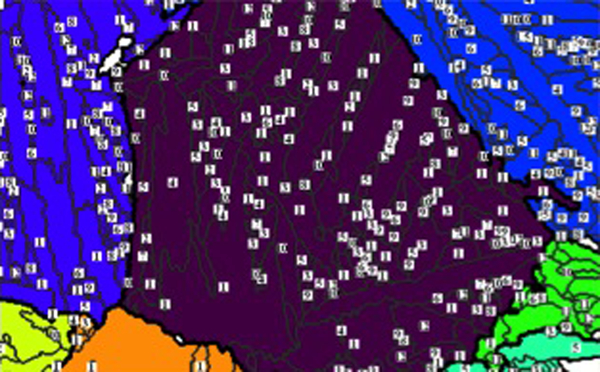
Variants in each bainitic grains were determined and indexed according to 12 Nishiyama–Wasserman orientation relationship
The statistic charts in Fig. 7 show that all six operators are present; only operator 2 (misorientation of 19·4° around [100] axis) is less frequent. Such a low frequency has already been observed in undeformed steels18 and therefore cannot be attributed to plastic deformation, which occurred due to the bainitic transformation. Therefore, it was concluded that the presence of variant selection was unlikely in the sample examined in this work.
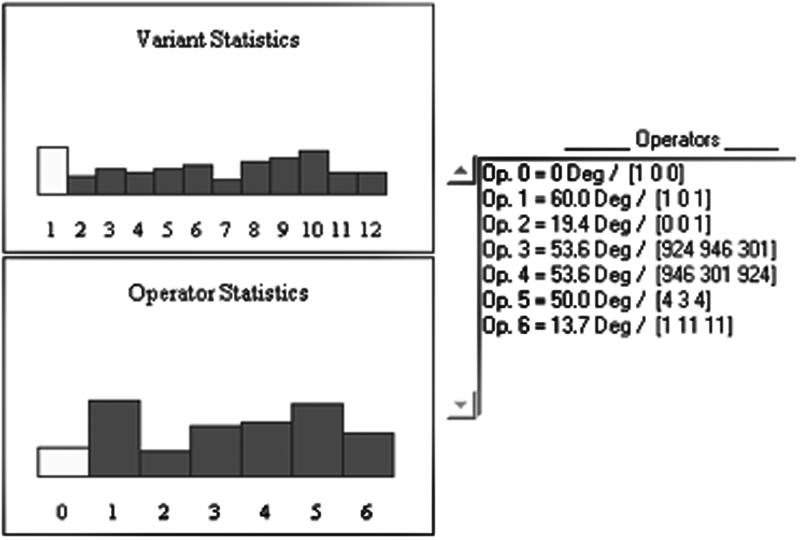
Statistic charts on variant indexes and operators deduced from reconstruction of grains shown in Fig. 5
Microtexture approach
The crystallographic textures of four grains were determined using the experimental data acquired by the EBSD method and demonstrated in the form of pole figures. Taking into account the direction of applied load and the crystallographic orientation of parent austenite, the (100) pole figures of the ferrite were calculated for 24 variants. The calculation of pole figures was repeated for eight variants with the highest positive formation energies. Figure 8 shows the measured and calculated pole figures of ferrite as well as the measured pole figures of four parent austenite grains (i.e. retained austenite).
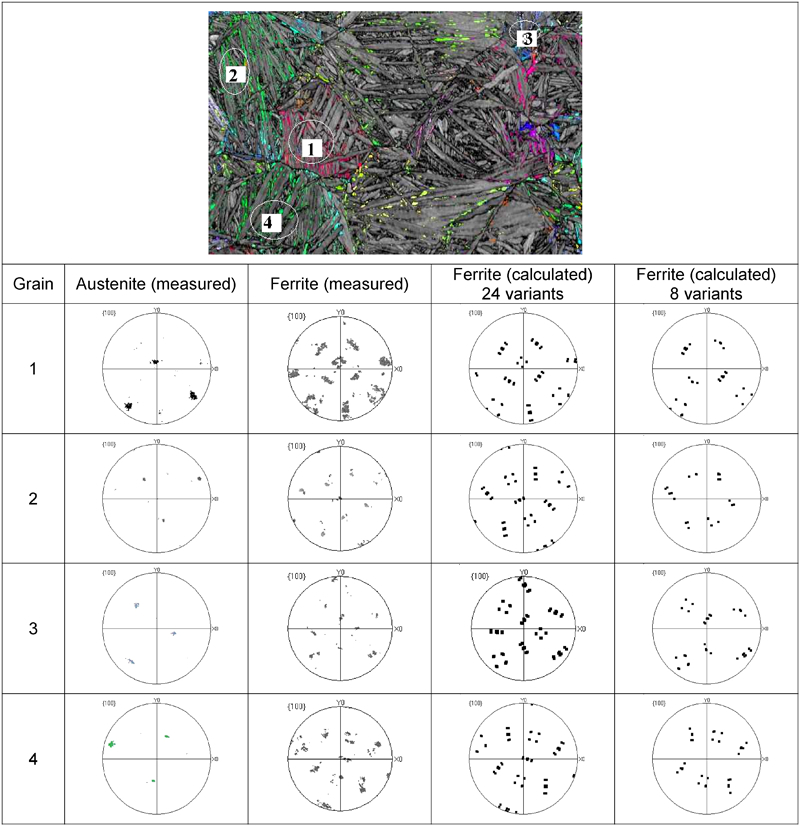
Pole figures of four grains in bainitic sample transformed from plastically deformed austenite under 200 MPa show no strong evidence of variant selection
Having compared the measured and calculated pole figures of grains 1, 2 and 4, it was concluded that variant selection did not occur in these grains. This is because all 24 variants are present in the measured pole figures, i.e. the eight variants with the highest positive energies are not prevailing. The measured pole figure of grain 3 indicates that some variant selection might have occurred in that grain. However, the measured pole figures of grain 3 do not match with the pole figures of the eight high energy variants.
Both approaches used in this work showed that very limited, if any, variant selection has occurred in the bainitic sample, which was formed from a plastically deformed parent austenite, despite the presence of an external compressive stress (200 MPa) throughout the phase transformation stage.
Conclusions
The combined effect of stress and strain on the crystallographic orientation of bainite was studied using experimental data (EBSD) and two methodologically different approaches. Given the outcome of this work and the results of previous work on the same steel, 6 6,7 it is concluded that the plastic deformation of parent austenite grains suppresses variant selection in bainitic steel. In addition, maintaining an externally applied load during the bainitic transformation does not lead to variant selection. This could be due to the uniform distribution and, hence, isotropic nature of the dislocation debris in the deformed grains of the polycrystalline austenite. It must be emphasised that the outcome of this work does not contradict the results reported by Hase et al.,6 in which strong variant selections were observed when transforming undeformed polycrystalline austenite to bainite under an applied load.
Footnotes
This paper is part of a special issue on ‘UK: China Steel’