







Abstract
An experimental study with respect to the influence of electric current pulse (ECP) on the solidification structure of molten silicon steel was investigated with a copper mould designed to simulate the twin roll casting process. The experimental results showed that the application of ECP can increase the proportion of equiaxed grains up to 67·5%. The mechanism of exerting ECP is also discussed. It can be confirmed that the application of ECP on twin roll casting could effectively improve the solidification structure of silicon steel strip.
Introduction
Silicon steels are widely used in electronic and electric power applications, especially as transformer magnetic cores because of their excellent magnetic properties. Twin roll casting (TRC) has been attracting the attention of steel manufacturers for their significant cost and potential metallurgical advantages. Rapid solidification in the TRC of silicon steel can increase the solid solubility of silicon, which improves the soft magnetic properties.1
The TRC is characterised by its rapid solidification and simple strip formation process. Zapuskalov2 assumed that there are three typical sequential stages of strip formation in the TRC process, as shown in Fig. 1. Guthrie et al. 3 and Tavares et al. 4 investigated the variations in interfacial heat flux in the process and found that the heat flux during the initial contact of liquid steel with the rolls was initially low, rising to maximum values halfway down the sump of liquid steel, but then diminishing towards zero as the strip approached the roll nip, as shown in Fig. 2. The heat transfer rate can affect the solidification structure of the strip.
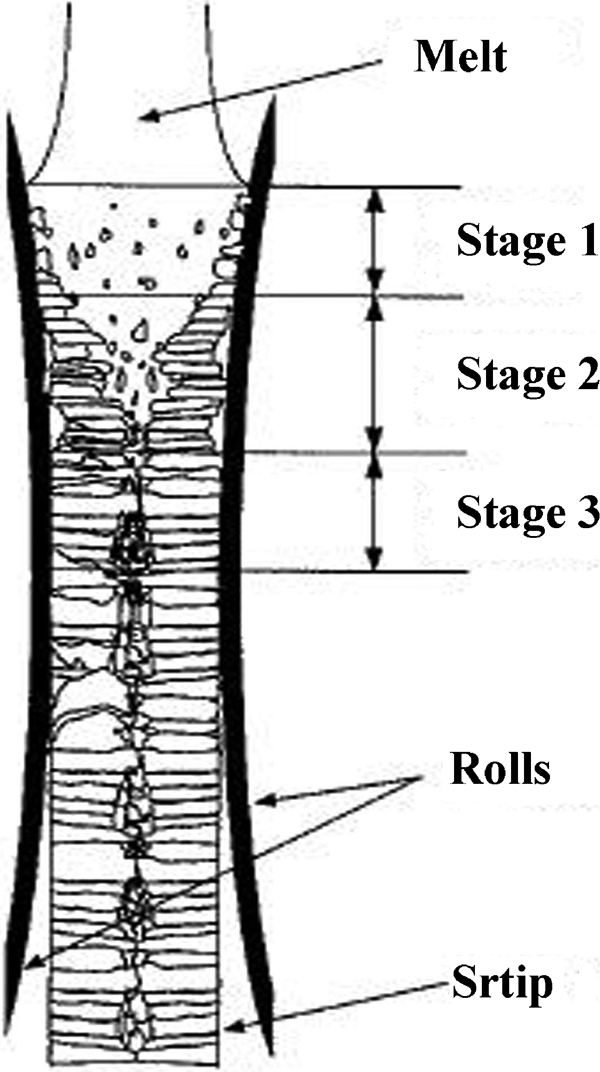
Three stages of TRC strip formation between rolls2
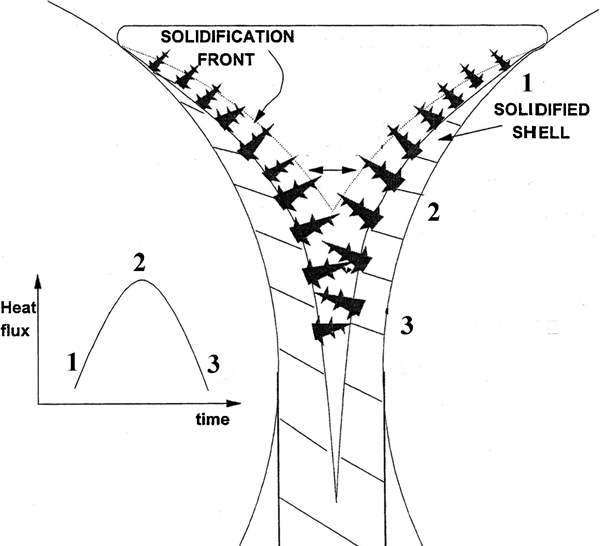
Heat flux variation in TRC3
Zapuskalov5 has also investigated the solidification structure of 4·5 wt-%Si steel strip in TRC and found the developed columnar crystals in the longitudinal direction of the strip. The developed columnar grains in the silicon steel strip usually result in corrugation defects and variations in thickness and flatness. Additionally, it is accepted that the machinability can be improved by increasing the proportion of the equiaxed structure. Therefore, one of the most effective ways to eliminate the defects is to enlarge the equiaxed grain zone during the casting process.
Recently, electromagnetic processing of materials has been widely used to improve the solidification structure and mechanical properties of materials.6,7 The application of electric current pulse (ECP) was suggested to be an effective method to improve the casting quality of metal.8 – 11 Zhai and co-workers12 – 16 found that the solidification structure was modified from large columnar crystals to equiaxed grains when applying ECP to pure Al. The mechanism of ECP on the solidification structure of metals has been investigated widely, and the technique of utilising it has been highly mature for application in industrial production.12,13 However, most studies and applications were focused on mould casting, and little research about ECP on solidification during continuous casting has been reported.
The purpose of the current work is to evaluate the effects of ECP on the increase in equiaxed zone of silicon steel in a wedge copper mould and thus to analyse the possibility of using ECP on the TRC process. If an increase in equiaxed zone in the TRC strip by employing ECP during TRC process becomes possible, then this may be a feasible approach to obviate the corrugated defect of the silicon steel strip in the rolling stage.
Experimental
It is well known that the twin roll caster is complex and costly. Moreover, it is too large for a laboratory. Taking these factors into account, the experiments were performed with a copper mould designed to simulate the solidification conditions of stage 1 in the TRC process, as shown in Fig. 3. Two copper plates are fixed in dry sand, and the side dams are made of stainless steel sheets, and together, they form a wedge shaped mould. The liquid pool in the wedge mould was similar to the triangular liquid pool of TRC if omitting the flow of the molten pool.
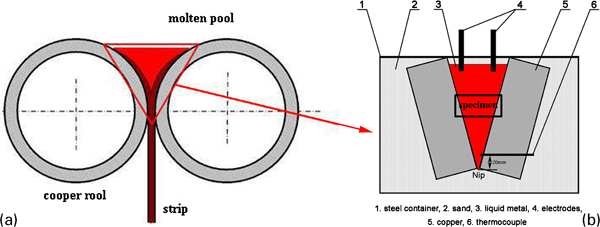
Schematic sketch of experimental set-up
The experimental equipment consists of an induction furnace, an ECP generator, a wedge copper mould and a temperature measurement apparatus. A pulse generator with a capacity of 15F i μF was employed with a pulse discharge frequency of 0–10H i Hz, and the peak value of ECP was regulated between 0 and 15K i A. F i, K i and H i are known constants that represent the parameter factors of the equipment.
The ECP parameters were regulated by a digital oscillograph; the wave shape has been given earlier.15 In order to provide similar cooling conditions when comparing ECP with non-ECP, two electrodes (1Cr18Ni9Ti) were also inserted into the mould of the untreated sample. The electric pulse current was imposed on the molten pool as soon as the melt was poured into the copper mould.
Silicon steel was melted in an induction furnace and superheated to 1650°C (the liquidus temperature is ∼1520°C). After holding at 1650°C for 15 min, the molten metal was poured into the copper mould in <8 s. Under the same cooling conditions, three samples were subjected to ECP treatments, while another was untreated for comparison. The ECP treatment lasted for 3 min 40 s with parallel electrodes.
The temperature of the melt was monitored by a double platinum–rhodium thermocouple (B type) with a tip diameter of ∼0·3 mm, which was connected to a computer. The position of the thermocouple is shown in Fig. 3. The chemical composition of silicon steel is Fe–2·18Si–0·25Al–0·31Mn–0·0092C–0·0047N (wt-%). After cooling, the specimens were cut longitudinally along the central plane for metallographic examination, which was marked with a square, as shown in Fig. 3b . The specimens were polished and etched by an appropriate reagent (saturated picric acid solution) for metallographic examination. The microstructures of the specimens were examined using an optical microscope, and the rate of the equiaxed zone was measured by an image processing software.
Results and discussion
Effect of ECP on solidification structure of silicon steel in copper mould
The cooling curve of the sample without ECP treatment is shown in Fig. 4. Detailed analysis of the temperature versus time curve showed that the average cooling rate between 1520 and 1480°C was 108·5°C s−1. Generally, the range of cooling rate in the TRC is about 102–103°C s−1,17,18 but the cooling rates were measured in the chill surface, namely, very close to the copper rolls. It needs to be emphasised that in this study, the position of the thermocouple tip is in the centre of the liquid steel in wedge mould, as shown in Fig. 3, so the recorded cooling rate is on the low side in this paper.
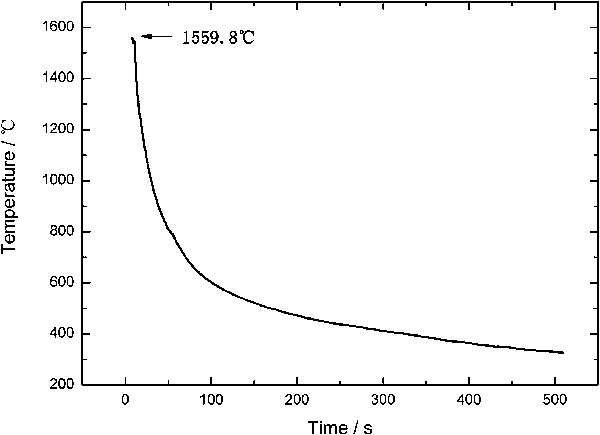
Cooling curve of silicon steel without ECP treatment
Figure 5 shows the solidification structure of silicon steel without ECP treatment. Because of the strong cooling provided by the copper mould, it can be seen that the developed columnar dendrites dominated the whole sample. Figure 5b and c shows the amplified images from Fig. 5a , which reveal developed columnar dendrites with strong preferential crystallographic orientation. Because of the high cooling rate during solidification, the columnar grains grew from the mould surface towards each other in a direction opposite to that of the maximum heat flow, and the primary dendrite arms were very developed, and the second dendrite arms had limited growth.
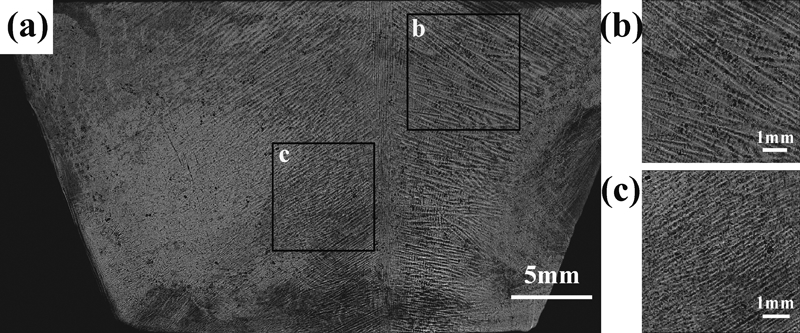
Solidification structures of silicon steel without ECP treatment
In order to clarify the effect of ECP on the solidification of liquid silicon steel in the molten pool, experiments were performed by applying an electric pulse current into the molten metal. Figure 6 illustrates the solidification structure of silicon steel treated by ECP with a constant discharge frequency (10H i Hz) and three different ECP peak values (5, 10 and 15K i A).
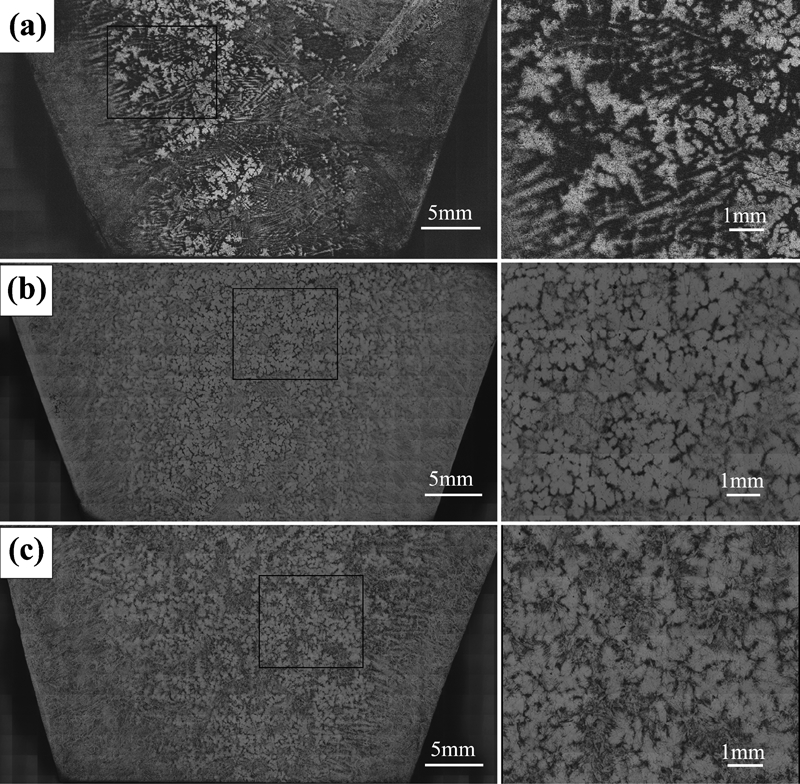
Effect of ECP on solidification structures of silicon steel
It is clear that the solidification structure of the samples can be divided into equiaxed and columnar grain regions. The equiaxed grains formed in front of the columnar grain, and the area of equiaxed grain was enlarged significantly for samples with ECP treatment compared with the sample without ECP treatment, as shown in Fig. 5. Under the same cooling condition, once ECP was exerted in the solidification process, the solidification structure is almost entirely equiaxed grains, as shown in Fig. 6.
According to the classic solidification theory of Kurz and Fisher,19 it can be concluded that columnar grains grew opposite to the heat flux preferentially, and at the end of columnar grains, some crystal nuclei formed and became equiaxed grains. Compared with the specimens without ECP treatment, as shown in Fig. 5, the columnar dendrites were blocked, and the proportion of equiaxed grain zone increased significantly, as shown in Fig. 6b . The proportions of equiaxed grains with different ECP treatments are presented in Fig. 7. The amount of equiaxed grains of the specimens with 10K i A ECP peak value increased most significantly up to 67·5%.
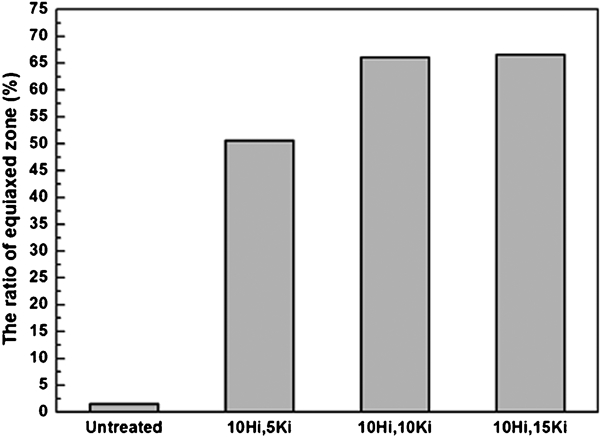
Amount of equiaxed zone of silicon steel with ECP treatment
A mechanism of ECP treatment is schematically illustrated in Fig. 8(a). According to classical heterogeneous nucleation theory,20 the nucleation rate is 
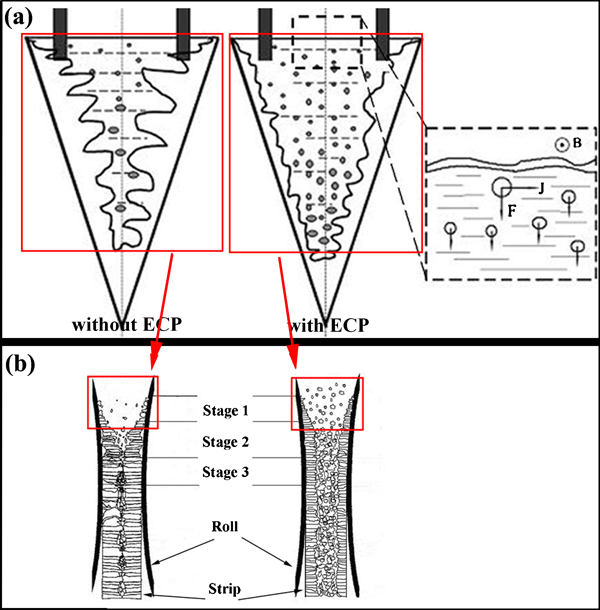
Schematic illustration of solidification in copper mould (a) mechanism of ECP treatment in copper mould; (b) ECP treatment in the first stage of solidification of TRC
After the molten metal was poured into the mould, a small undercooling is generated near the pool surface, leading to the formation of a thin solidified shell. Moreover, the skin effect is induced by ECP from this outer surface, and an induction pulse magnetic field is induced in the melt. The intense agitation generated by the electromagnetic force makes these nuclei dissociate from the top surface of the melt, causing stronger impingement ahead of the columnar grains. Thus, the periodic electromagnetic force of ECP (
The columnar to equiaxed transition was suggested to be caused by a pile-up of equiaxed crystals, which blocked the growth of the columnar grains.24,25
Analysis on possibility of ECP applied to TRC process
According to Zapuskalov’s proposal, in the first stage, nucleation and growth of crystals occur due to the undercooling of the melt and the subsequently formed solidification shell. The ECP with parallel electrodes can be applied in stage 1, namely the liquid pool.
The assembly of the twin roll caster is very compact,26 but there is a space between the tundish and rolls; therefore, the parallel electrodes can insert into the liquid pool from the top of the rolls conveniently, so the application of ECP on the TRC with parallel electrodes is reasonable. In the TRC, the liquid surface has little fluctuation because the liquid metal is injected through the submerged entry nozzle. Liquid steel was poured into the roll gap and lost its superheat before reaching the meniscus region. The solidification started once the liquid steel contacted the roll surface, and the liquid pool always exists in the TRC process, so the ECP treatment can be exerted in the whole process.
As shown in Fig. 8, the authors’ experiments with a copper mould simulated the first stage of solidification in the TRC process.
According to the result of Guthrie shown in Fig. 2, the heat flux of the TRC increased in position 2 (halfway down the sump of liquid steel), and the region corresponds to stage 2 shown in Fig. 1. This means that the cooling intensity in this region is much stronger than the former stage. Consequently, the dissociated nuclei generated by ECP on the solidification of the previous stage (stage 1) can be retained in the following stages, aiding the formation of equiaxed crystals near the columnar front. Because the silicon steel TRC strips are semiproducts, which require some post-treatment, especially the roll process, the increase in equiaxed grain zone can obviate the corrugated defect of the silicon steel strip in the following roll stage, thereby alleviating the final quality of the final silicon steel products.
It should be noted that this work has examined only the solidification structure transformation under given parameters, and not withstanding this limitation, this study does suggest that the increase in equiaxed grain area could be obtained in TRC by exerting ECP. In particular, the theoretical description of the ECP action mechanism and the initial formation of nuclei generated by ECP need further research attention.
Conclusions
A significant increase in equiaxed grain area was obtained by applying ECP treatment on liquid silicon steel in a copper mould.
The periodic electromagnetic force induced in the melt near the solidified shell makes the dissociated nuclei fall off, increasing the proportion of equiaxed grains. The amount of equiaxed grains of the specimens with 10K i A ECP peak value and 15H i Hz discharging frequency increased up to 67·5%.
The cooling intensity permits the equiaxed nuclei that have fallen off to remain in the following stages; thus, it is suggested that the increase in equiaxed grain area could be obtained in TRC using ECP.
Footnotes
Acknowledgements
The authors are grateful to the financial supports from the National Basic Research Development Project of China (973 Project, project no. 2010CB630802) and the Science and Technology Commission of Shanghai Municipality (grant no. 07DZ11003).