







Abstract
In heat recovery non-recovery coke ovens, the volatile gases generated are burnt, and the heat generated is used for cokemaking. The extra heat, along with the flue gases, is utilised in boilers for power generation. JSW Steel has 1·2 Mtpa non-recovery coke ovens to meet the coke requirement of blast furnaces. Until now, very limited work has been carried out on heat distribution in non-recovery coke ovens. In this work, the heat distribution in non-recovery coke ovens is studied to determine the variables influencing the flue gas temperature and thereby power generation. A mathematical model has been developed to predict the power generation using functional group, depolymerisation, vaporisation and cross-linking for non-recovery coke ovens at JSW Steel. Gas generation, heat generation, power generation and total heat distribution are calculated using the model. The present paper details the study on heat distribution, thereby various factors affecting the power generation, and also quantifies the effect of coal quality in particular volatile matter on gas generation, flue gas temperature and power generation.
Introduction
In non-recovery cokemaking, during carbonisation, volatile matter (VM) is decomposed and burnt above the coal bed with air, releasing a huge amount of energy. This energy is used as the heat source for carbonisation, and any extra heat left in the flue gases is used for power generation. The amount of energy released depends on the volatile gases generated, which in turn depends on the quality of coal and VM. The kinetics of devolatilisation is quite complex and depends on the structure of the coal. Coal consists of large matrix of aromatic clusters connected by aliphatic bridges and some weekly bonded components.1 When coal is heated, the weak chemical bonds undergo cleavage, resulting in the release of lighter gases (CO, CO2, H2O and CH4) and heavier hydrocarbons. Fragments with low molecular weight come out as tar, while heavier fragments reside in coal and reattach to the lattice. Tar has no definite chemical formula and has a distribution of molecular weights. The amount of various constituents formed during pyrolysis depends on the rank of coal and the heating rate. The tar generation increases with rank.
The rates and type of volatile gas generated during coal pyrolysis are most commonly calculated by functional group, depolymerisation, vaporisation and cross-linking (FG-DVC), and FLASHCHAIN models. To calculate the amount of gases produced due to coal pyrolysis is simpler using the FG-DVC model and is widely used. Similar model calculations had been adopted at JSW to study the amount of flue gases and heat flux generated during the carbonisation process in non-recovery coke ovens. The quantification helps in process control and predicts the power generation from the flue gases. For the model calculation, calculation of gas amount and heat distribution is of more importance than the kinetics of devolatilisation. The present paper discusses the principle of the FG-FVC model, the model calculation adopted in non-recovery coke ovens and the prediction of gas amount, flue gas temperature and power generation.
Non-recovery coke ovens at JSW Steel
JSW Steel is a 7·0 Mtpa integrated steel plant with three blast furnaces and two corex units. The coke requirement for the ironmaking units is met by 1·2 Mtpa heat recovery non-recovery coke ovens and 1·5 Mtpa byproduct recovery coke ovens. The details of non-recovery coke ovens and the dimensions of coal cakes produced from a vibrocompacting unit are given in Table 1.
Non-recovery ovens at JSW Steel Ltd
Principle of FG-DVC
The FG-DVC model is most widely used for the calculation of pyrolysis kinetics. It requires the structural parameters of coal to calculate the rate of gas release during pyrolysis. These parameters are not available for most coals and difficult to determine and so are often estimated from the values of reference or library coals using two-dimensional interpolation. The library coals are those coals for which all the properties are known using field ion mass spectrometry. In this method, O/C and H/C molar ratios are taken as indicators of rank. The O/C and H/C ratios of library coals used for the study with coal ratios and mass fractions of light gases evolved based on field ion mass spectroscopy are shown in Table 2.
Library coals used for FG-DVC calculation
The elemental ratios of these coals are plotted to form a two-dimensional triangular network. The elemental ratios of an unknown coal or coal blend are plotted in the diagram to find out in which triangle it falls, and then its parameters are estimated by two-dimensional linear interpolation as per the finite element method.2 This method of estimating the structural properties of unknown coal or coal blend is well proven and used to predict the fraction of light gases during pyrolysis. Zhao3 used this method for estimating the structural parameters of unknown coal. Genetti4 showed that the method used by Zhao is applicable to predict light gases during pyrolysis based on library coal data.
Model and computation method
A mathematical model has been developed to predict the power generation using the above equations for the non-recovery coke ovens at JSW Steel. The gas, heat and power generation and the total heat distribution are calculated using the model. Figure 1 shows the various inputs and outputs of the model.
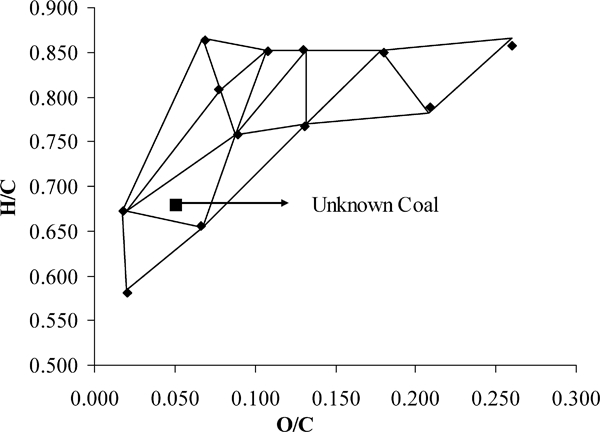
van Krevelen diagram showing library coal nodal points
The accuracy of the model results depends on the accuracy of coal analysis (both approximate and ultimate), coal charged per hour, coking period, specific heat of coals, conductivity of bricks, radiation and convection taken for calculation, accuracy of assumptions (such as tar composition as C20H25), etc.
Computation method
Let p be the parameter which has to be determined for an unknown coal and p i, where i = 1, and N are the corresponding parameters of the N reference coals. Here, 12 coals with varying H/C and O/C ratios have been plotted to form a triangular mesh in the van Krevelen diagram shown in Fig. 2. Here, each node in Fig. 2 represents a library coal.
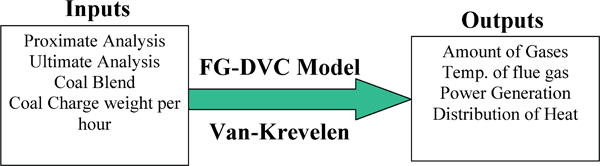
Inputs and outputs of model
If an unknown coal is in the triangular element J whose three nodal points are J
1, J
2 and J
3, then the unknown parameter p is calculated as


Using the above three equations through interpolation, the percentage of light gases generated on coal pyrolysis is calculated.
Mass balance
The coal chemistry varies based on the rank, and the amount of gases generated on pyrolysis has to be calculated. The gases generated are light gases, tar (assumed as C20H25), ammonia and hydrogen. Tar has no fixed molecular weight and is generally assumed that the average formula is C20H25. The amounts of these four unknowns are calculated using four mass balance equations of volatile carbon, nitrogen, oxygen and hydrogen. The light gases comprise H2O, CO, CO2, CH4 and C2H6. Volatile carbon is the difference between total and fixed carbon. It is assumed that all volatile carbon, hydrogen, oxygen and 50% nitrogen go out as VM during pyrolysis.2,4,5,6 Similarly though high VM helps in improve power generation, but will reduce the coke yield and adversely affect the coke quality7,8. All the hydrogen and oxygen are present in VM and get released during devolatilisation. By the end of the devolatilisation process, half of the original nitrogen in the coal stays in the char, while the other half escapes mostly as ammonia into tar and very little as HCN. About 50% of volatile nitrogen gets evolved as NH3. The nitrogen present in VM is as aromatic hydrocarbons and requires high temperatures for cracking.
Nitrogen balance



Using the amount of gases, the heat generated on combustion is calculated using the combustion equations given below





Heat for cokemaking
The heat required for cokemaking consists of the heat required for the removal of moisture in coals and the heat required for heating the coal to 1050°C or its final temperature.
Heat losses during cokemaking
The heat losses consists of radiation losses from oven, radiation losses in flue gas tunnel from oven to power plant and heat losses during charging.
Power generation calculation
After removing the heat required for cokemaking and various losses from the combustion energy of gases, the energy required for power is known. From the net energy available based on the boiler capacity, the power generation can be known. In the present model, the energy required for generating 1 kWh is 2600 kcal including heat losses in boiler
Validation and discussion
Validation of model
The model has been validated offline for 12 different coal blends used in non-recovery cokemaking. The model has been validated with the predicted power generation values against the average actual power generation values during the period for each blend. The predicted values are in good agreement with the actual values. Figure 3 shows the predicted versus actual power generation using the model. The R 2 = 0·91 shows a strong relation between predicted and actual values, and the model may be used to predict the power generation.
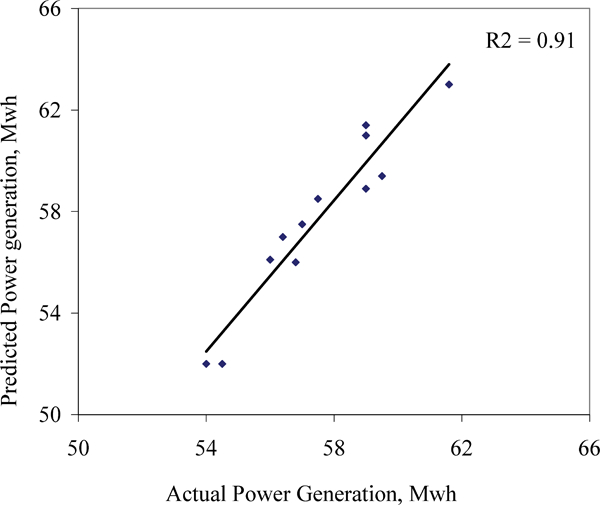
Predicted versus actual power generation
Results and discussion
The model has been used for predicting the flue gas temperature, flue gas generation and power generation, with varying VMs. The overall heat distribution during the coking process has been evaluated. Table 3 shows the various parameters predicted from the model.
Model results for various coal/coal blends used at JSW Steel
It can be observed from Table 3 that for a VM of 21·5–27·5% in the coal/coal blend, the power generation varies between 52 and 63 MWh, the gas generation varies between 4·4 and 5·2 t per tonne of coal and the flue gas temperature varies between 844 and 921°C. High H/C and O/C ratios help in the high gas generation and thereby result in more power.
Figures 4–6 show the influence of VM on gas generation, flue gas temperature and power generation. It can be observed that under the normal operating range of VM, for every 1% increase in VM, the temperature of flue gas increases by ∼13°C, the amount of gas increases by ∼0·145 t per tonne of coal and the power generation increases by 1·04 MWh.
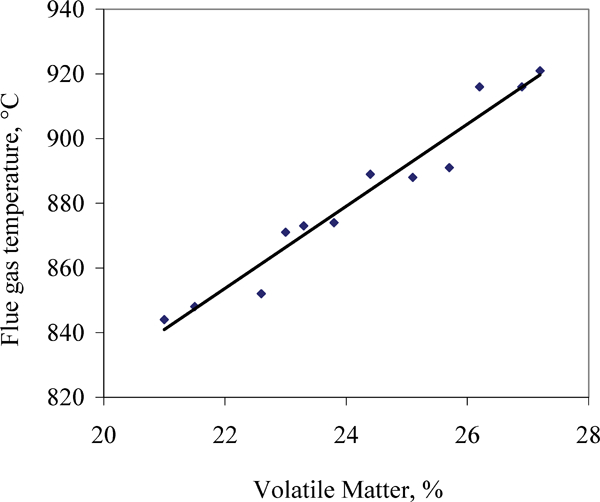
Influence of VM on temperature of flue gases generated from non-recovery ovens
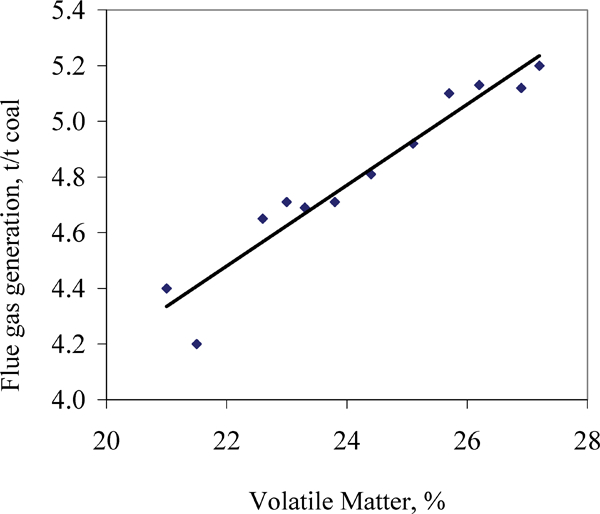
Influence of VM on total gas generation from non-recovery ovens
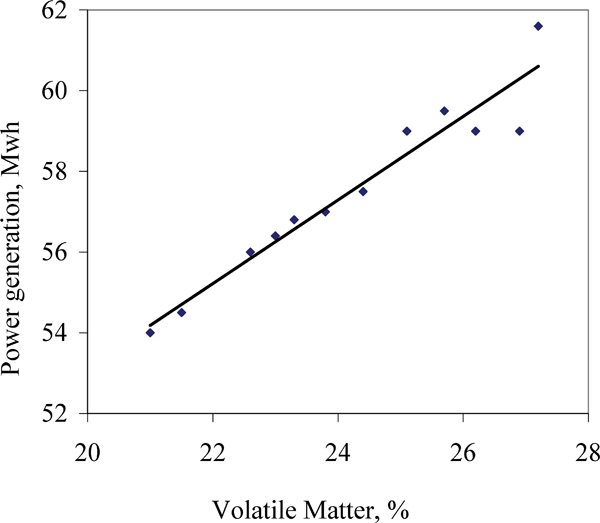
Influence of VM on power generation from non-recovery ovens
Figure 7 gives the distribution of heat generated in the ovens. It can be observed that ∼37% of the heat is utilised for the cokemaking process. The heat required for removing moisture from coal during carbonisation is ∼12%. The lower the moisture, the higher the power generation will be, but the bulk density of coal cake from stamping/vibrocompacting will be lower.5 Hence, moisture should be optimized to ∼10%. Similarly, although a high VM improves the power generation, it will reduce the coke yield and adversely affect the coke quality. 6 6,7 In non-recovery coke ovens, only the amount of VM in the blend is considered for cokemaking and not the chemistry and type of gases generated from it. The model is used for every change in blend to determine the difference between actual and predicted power generation. In cases of a difference of more than 10%, the process parameters, such as damper openings, volatile gases, moisture, heat losses during charging, heat losses during pushing and radiation losses through any leakages, are controlled. In addition, the model helps in changing the process parameters as per the blend VM, chemistry of VM and type of gases generated based on the model prediction.
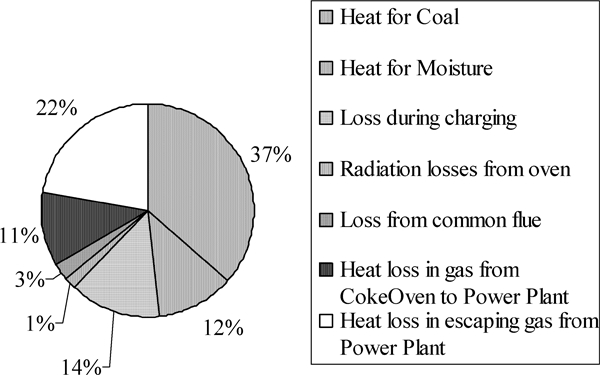
Distribution of heat in non-recovery ovens other than power generation
Conclusions
The FG-DVC is the most commonly used model for predicting the chemistry of gases in coal pyrolysis/gasification. The coal VM along with the H/C and O/C ratios influences the pyrolysis, i.e. the amount of gas and heat generation. The model has been used for predicting flue gas generation, flue gas temperature and power generation in heat recovery non-recovery coke ovens. The model calculation indicated that for every 1% increase in VM, the temperature of flue gas increases by 13°C, the amount of gas increases by ∼0·145 t per tonne of coal and the power generation increases by 1·04 MWh. Although a high VM helps to increase the power generation, it decreases the coke yield and deteriorates the coke quality.
The FG-DVC model was also used for calculating the heat distribution in cokemaking in non-recovery coke ovens. The model calculation indicated that ∼37% of the heat is utilised for cokemaking and 12% for removing moisture from coal during carbonisation. The heat distribution has helped to optimise the moisture at ∼10% for better heat utilisation and to achieve cake bulk density. The model helps in optimising the process parameters based on the predicted power generation for a particular blend.