






Abstract
Electric arc furnace dust was reduced by graphite powder under microwave irradiation. After Zn was removed as a vapour, Fe was successfully recovered as a metal drop after 300 s microwave irradiation (2·45 GHz, 1·7 kW). The maximum temperature and heating rate increased with increasing carbon equivalent C eq (the mole ratio of carbon/oxygen to reduce ZnFe2O4 and ZnO, yielding CO gas). The maximum recovery ratio of Fe (0·87) was obtained when C eq = 1. A glassy slag phase, with environmentally harmful elements fixed within, was obtained by SiO2 addition. However, with increasing SiO2 addition, the recovery ratio of Fe decreased. It was considered that the heat generated on the surface of the graphite was partially used to increase the temperature of the added SiO2, and the duration at the maximum temperature decreased with increasing SiO2 addition. Consequently, the optimised condition for the reduction of electric arc furnace dust was obtained with addition of 6% graphite and 2·4%SiO2 powders under microwave irradiation for 300 s.
Introduction
Electric arc furnace (EAF) dust contains high contents of valuable metallic components such as Zn (∼20 wt-%) and Fe (∼25 wt-%). The London Metal Exchange price of zinc has gradually increased, and reached ˜$24 000/ton in 2011. Market price of pig iron also considerably increased, up to $560/ton in 2011.
In Korea, ∼315 000 tons of EAF dust was generated in 2009. 1 1,2 Generation of EAF dust has gradually increased as galvanising steels are more commonly used in automobiles. Electric arc furnace dust is classified as hazardous waste, so that its utilisation is restricted. It is currently used as asphalt concrete filler in Korea, but this may cause environmental pollution problems.
In order to recover Zn from EAF dust, several processes have been developed.3 – 6 Among them, the most effective process is the Waelz process, which has almost 75% of the total EAF treatment process.7 It, however, has problems in high energy consumption due to 4–6 h retention time, as well as environmental pollutions from clinker.7 Other alternative processes such as hydrometallurgy and plasma processes still have environmental and/or economic problems.
As an alternative, the microwave process can be considered as a potential onsite recycling process to recover valuable elements from various steelmaking byproducts.7 – 16 Regarding EAF dust, Nishioka et al. first examined the reduction of the Fe2O3–ZnO mixture under microwave irradiation.8 Later, Saidi and Azari investigated the reduction of ZnO under microwave irradiation,9 and Kim et al. re-estimated the reduction kinetics of ZnO under microwave irradiation.10 Recently, Lee et al. 11 and Sun et al. 7 7,12 successfully recovered Zn and Fe from the EAF dust under microwave irradiation in 15–30 min. Zn was recovered as metallic Zn powders.7 The microwave process was considered as a very attractive alternative to recover Zn from EAF dust due to the fast reaction and the relatively high grade of metallic Zn. In the previous research, however, Fe was recovered as fine particles (∼100 μm), which were difficult to be separated from the residue. 7 7,11 Therefore, additional improvement of the microwave process was requested. In this paper, a technical breakthrough for the easy separation of the reduced Fe and the prevention of the elution of hazardous elements from residue is suggested.
Experimental
Samples
The EAF dust used in the experiments was provided by Dongkuk Steel Company. The dust was dried in an oven at 673 K for 24 h and then kept in a desiccator before experiments. Figure 1a shows the phase constituents of the dust examined with X-ray diffraction (XRD; D/Max-2500V; Rigaku). The dust was mainly composed of ZnFe2O4 (spinel–franklinite) and ZnO (zincite). The chemical composition was analysed with inductively coupled plasma–atomic emission spectrometry (138 Ultrace; Jobin Yvon). The SiO2 content was measured using the gravimetric method. The EAF dust used in the present study has a chemical composition of 0·20Al–2·74Ca–25·17Fe–2·42K–1·75Mg–1·88Na–1·10Pb–0·23Cr–0·65S–20·17Zn–2·75Si (wt-%). Figure 2 shows the scanning electron microscopy (SEM) image of the EAF dust. The SEM-EDX analysis revealed that the EAF dust was composed of two different particles: spinel–franklinite (ZnFe2O4, 0·5–2 μm) and zincite (ZnO, <0·5 μm). From the EDX analysis, it was found that the mole ratio of Fe/(Zn+Fe) of spinel was 0·73, while that of zincite was 0·09, which were respectively shown as dashed lines (a) and (b) in Fig. 3. Considering the average composition of the EAF dusts [line (c)], it was considered that the majority of the EAF dusts were spinel.
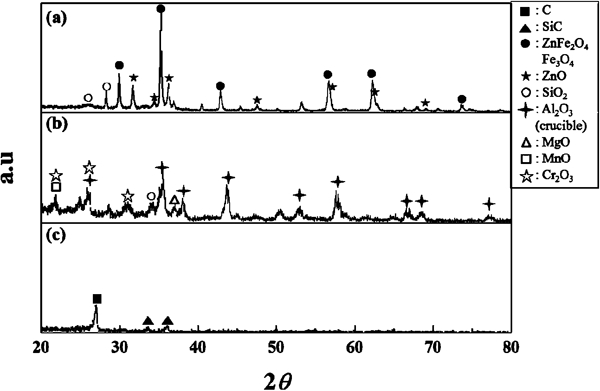
X-ray diffraction analysis results
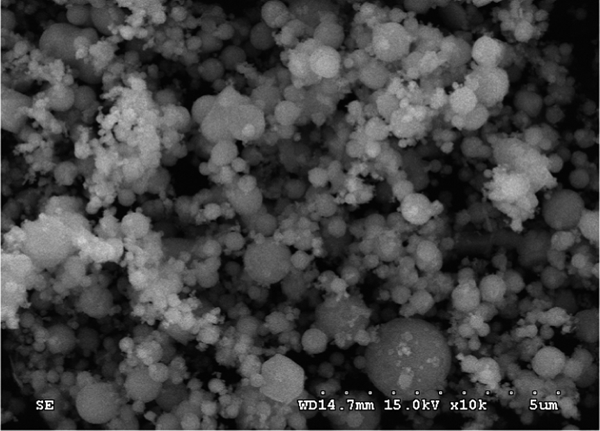
Images (SEM) of EAF dust composed of spinel (ZnFe2O4, 0·5–2 μm) and zincite (ZnO, <0·5 μm) particles

Fe–Zn–O phase diagram at
Synthetic graphite (>99% purity, <20 μm; Sigma-Aldrich) was used as the reducing agent and heating source and was kept in a dry oven at 373 K before experiments. SiO2 (Extra Pure grade; Junsei Chemical Co., Ltd) was added to reduce the melting point of the remaining slag. According to the chemical analysis of the EAF dust, CaO–MgO–SiO2 (at a fixed MgO/CaO ratio of 1·05) slag was expected to be obtained, and the amount of SiO2 addition was determined from the CaO(MgO)1·05–SiO2 pseudobinary phase diagram in Fig. 4.
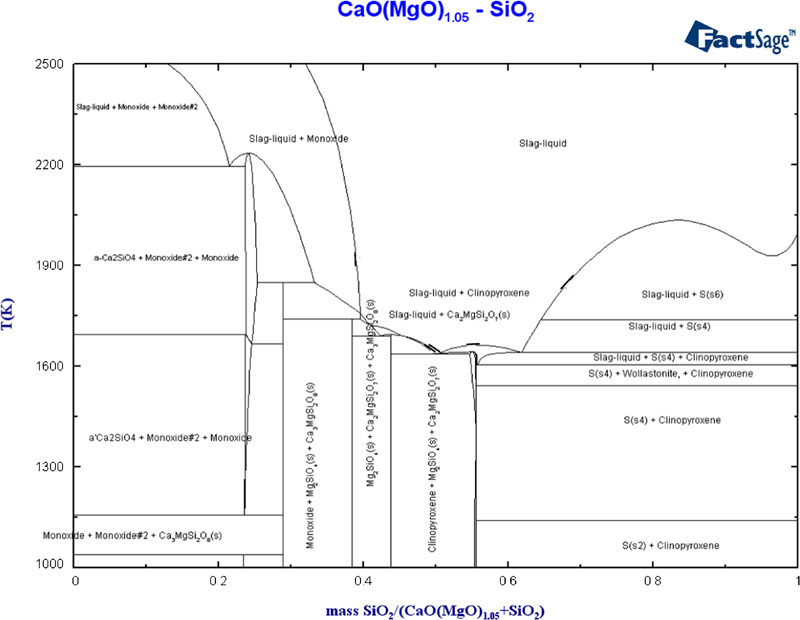
CaO(MgO)1·05–SiO2 pseudobinary phase diagram (The phase diagram was calculated with FactSageTM Ver. 6·2)
Experimental procedure
Figure 5 shows a schematic diagram of the experimental apparatus. A commercial microwave oven (MM-344 L, 2·45 GHz, 1·7 kW; LG) was used as the reaction furnace. Five grams of the EAF dust was well mixed with the graphite powder (0·59 g-C/C eq in the present experimental set-up) using a mortar and pestle, and then put in an alumina crucible (outer diameter, 39 mm; inner diameter, 36 mm; height, 29 mm), which was placed in the alumina refractory block and positioned at the centre of the microwave furnace. For microwave irradiation heating of the sample, the irradiation time should be set as short as possible to save energy. Figure 6 shows the recovery ratio of Fe {the recovery ratio of Fe is defined as (weight of reduced metal)×(1–[wt-%C]/100)/(weight of Fe in the original EAF dust)} as a function of time. When the microwave irradiation time was too short (for example 240 s), Fe recovery was not so successful. Therefore, the optimum microwave irradiation time was determined as 300 s based on the experimental results. During the experiments, the temperature was monitored using a two colour pyrometer (IR-HZH2, temperature range, 873–2273 K; CHINO) through a hole on the upper part of the refractory block. After the experiments, the sample was allowed to cool in the microwave furnace. The metallic particles were easily separated from the slag and weighed with a balance with a resolution of 10 mg. Moreover, the carbon concentration in the metallic particle was analysed using a C/S analyser (C/S-300; LECO). The residual slag in the crucible was subjected to XRD analysis.
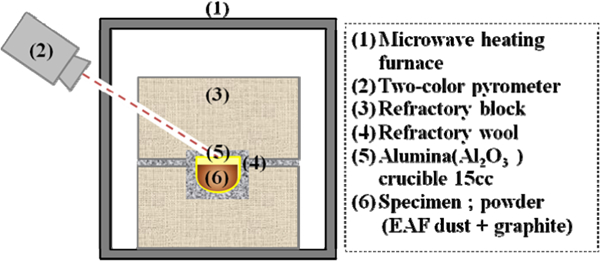
Schematic illustration of microwave heating furnace
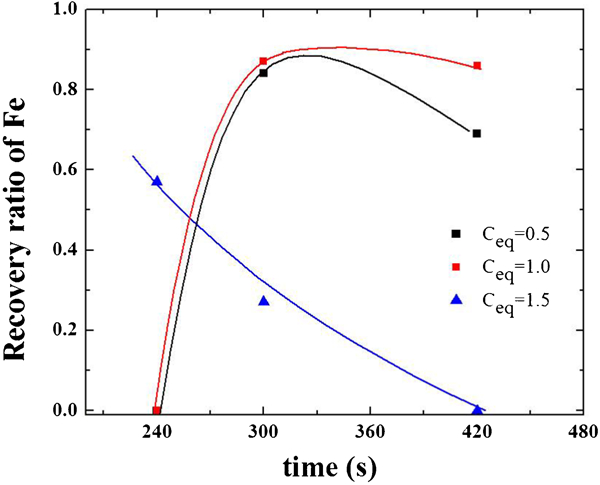
Changes of recovery ratio of Fe as function of time
Results and discussion
Effectiveness of microwave process
Figure 7 shows the metal drop obtained from the microwave processing. The carbon equivalent C eq (the mole ratio of carbon/oxygen to reduce ZnFe2O4 and ZnO, yielding CO gas) was set at 1·00 and the microwave irradiation time at 300 s. A single metal drop of 1·18 g containing 2·77 wt-% carbon was obtained from the experiment. From the SEM image of the cross-section of a metal drop, non-metallic inclusion was not found (Fig. 8). Moreover, from the EDX analysis, no Zn peak but only Fe peak was investigated (owing to relatively low content and sensitivity of carbon, it was not detected from EDX analysis, but confirmed from LECO analysis). Figure 1b shows the XRD analysis of the slag after the experiment. The slag was not separated from the crucible, so that some parts of the crucible and slag were crushed and examined together. The Zn, ZnO and ZnFe2O4 peaks could not be observed in the XRD results due to the evaporation of the reduced Zn. Accordingly, it was accepted that Zn was fully removed as a vapour, as found in the previous studies,7,10 – 12 and Fe was recovered as a single metal drop. Consequently, the recovery ratio of Fe was estimated to be 0·87.
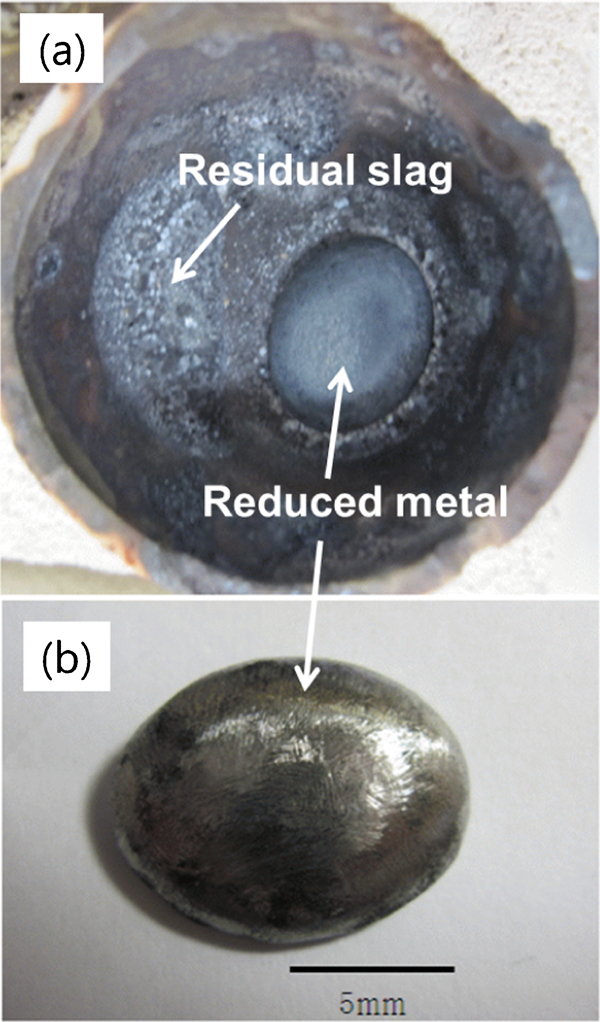
Pictures of metal drop obtained from microwave processing
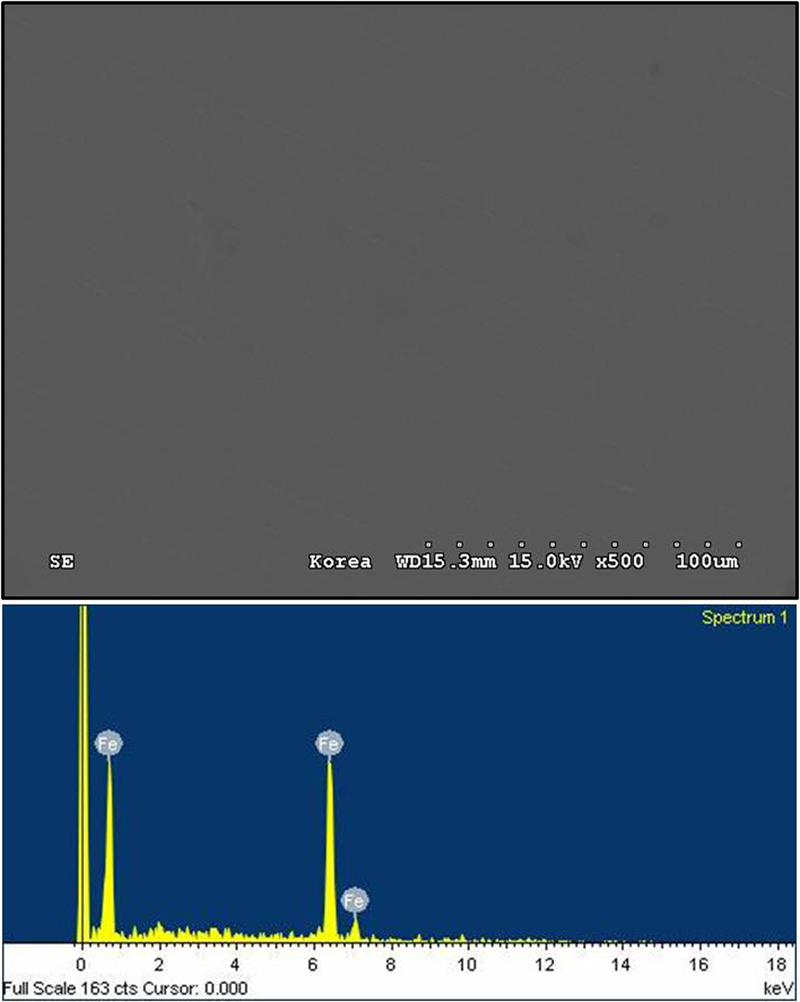
Images (SEM) and EDX analysis result of cross-section of metal drop in Fig. 7
Effect of carbon equivalent C eq
Figure 9 shows the temperature profile of the EAF dust at C eq values of 0·50, 1·00, 1·50, 1·75 and 2·00, when the microwave irradiation time was set as 300 s. Owing to the microwave characteristic of selective heating, the monitored temperatures were scattered and considered average values of the samples. As C eq increased, both the heating rate and the maximum temperature increased. When C eq = 2·00, the temperature rose up to ∼2000 K in 200 s. These experimental results suggested that the graphite played a principal role in increasing the temperature. Graphite particles are known to absorb microwave energy in both electric and magnetic fields.17 Figure 10 shows the maximum temperatures with respect to C eq. The maximum temperature linearly increased with increasing C eq over the experimental range of 0·50–2·00.
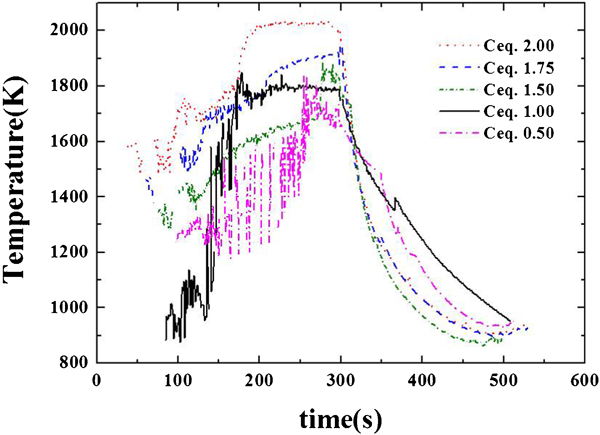
Temperature profile of EAF dust with carbon under microwave irradiation
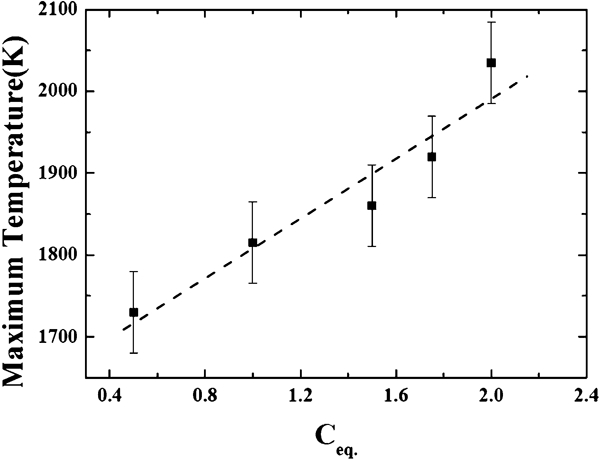
Maximum temperatures obtained by 300 s microwave irradiation
The recovery ratio R of Fe slightly increased with increasing C
eq. R values were 0·84 at C
eq = 0·50 and 0·87 at C
eq = 1·00, but then decreased with further increase in C
eq (Fig. 11). The reductions of ZnFe2O4 and ZnO by solid carbon are given by equations (1)–(3)


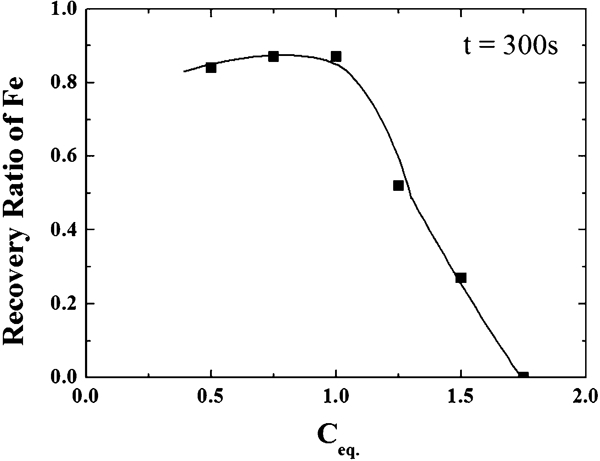
Recovery ratio of Fe with respect to C eq
Since the present reaction time was much shorter than in the previous researches, the reactions happened to occur at much higher temperatures than in the previous works. Once reactions (1) and (2) started to occur, step chemical reactions (4)–(6) might occur via gas phase mass transfer


It is also noteworthy that as C eq increased from 0·5 to 1·0, the recovery ratio of Fe did not change considerably. Moreover, the recovery ratio of Fe dramatically decreased with further increasing C eq. As C eq increased, the surface area of graphite as well as the maximum temperature increased. Therefore, at high C eq, the reduction was faster and the reduced iron was exposed to atmosphere for a longer time at a much higher temperature. Once the reduction was almost completed, the remaining graphite powder would be oxidised. When all the graphite was consumed, the oxidation of the reduced iron could happen during cooling. For a detailed process design, further study on cooling behaviour is required in the future study.
Effect of silica addition
In order to prevent the elution of environmentally harmful elements from the residue, it is very important to make a molten slag during the process. In the present study, SiO2 addition was examined to fix those environmental harmful elements in the slag. Figure 12 shows the effect of SiO2 addition (0·12, 0·20 and 0·50 g) on the temperature profile of the sample. The carbon equivalent was 1·00, and the microwave irradiation time was 300 s. The maximum temperature remained almost constant regardless of the amount of SiO2 addition, but the heating rate decreased with increasing SiO2 content. It was considered that the heat generated on the surface of the graphite was partially used to increase the temperature of the added SiO2. Consequently, the duration at the maximum temperature decreased with increasing SiO2 addition. The recovery ratio of Fe gradually decreased consequently with increasing SiO2 concentration from a maximum of 0·90 at 0·12 g of SiO2, as shown in Fig. 13.
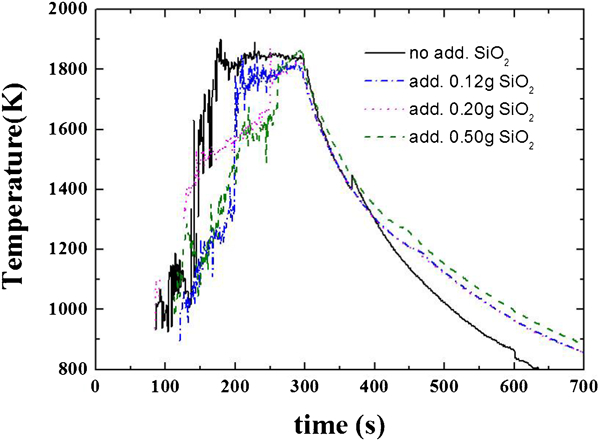
Effect of SiO2 addition on temperature profile of sample: amounts of SiO2 addition were 0·12, 0·20 and 0·50 g
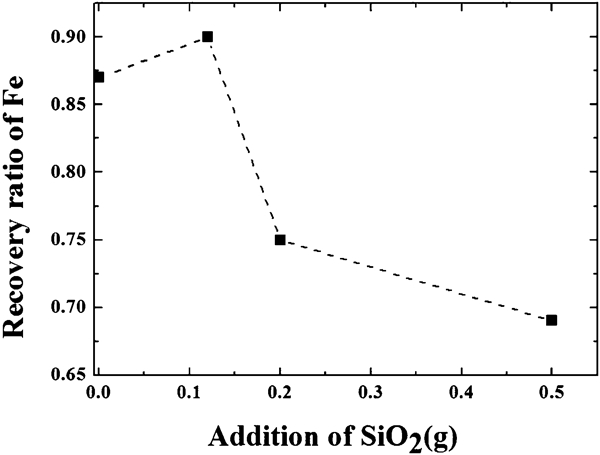
Recovery ratio of Fe as function of SiO2 addition
Figure 1c shows the XRD results of the slag with 0·12 g SiO2. In this experiment, the slag sample was clearly separated from the alumina crucible, and no crystalline peak was observed, except for carbon and silicon carbide, which might have been formed during the reduction. It was considered that the melting point was decreased down to the eutectic temperature of 1643 K mostly due to the addition of 0·12 g of SiO2 (Fig. 3) and the glassy slag was obtained. Consequently, the microwave irradiation for 300 s on 5·00 g of EAF dust with addition of 0·3 g (6%) of graphite and 0·12 g (2·4%) of SiO2 facilitated the effective reduction of Zn as a vapour and Fe as a single metal drop while ensuring that the remaining slag was not noxious.
Conclusions
The reduction behaviour of the EAF dust by graphite under microwave irradiation was investigated. With increasing C eq, both the heating rate and the maximum temperature increased. Microwave irradiation for 300 s on 5·00 g of EAF dust with 0·12 g of SiO2 and 0·3 g of graphite enabled the effective reduction of Zn as a vapour and Fe as a single metal drop, while ensuring that the remaining slag was not noxious.
Footnotes
Acknowledgements
This work was supported by the Resource Development R&D Program under the Ministry of Knowledge Economy, Korea. The authors wish to express their gratitude to Dongkuk Steelmaking Company for providing EAF dust samples.