







Abstract
Modelling the transport phenomena in tundishes has been a vast area of research for the last three decades. Many papers have been published and are available in the literature on this subject. The basics of modelling involve a similarity criterion between the model and the full scale prototype and are well documented in major textbooks. However, the similarity criteria are different for different cases. For example, for fluid flow in a tundish, the Re and Fr similarity is considered, whereas for heat transfer, the Pr and Pe number similarity should be considered. Numerous other examples can be cited. It is really important to know which similarity criteria should be used for a particular case. In this paper, a new dimensionless number Gu has been proposed when dealing with the modelling of inclusions separating out in a tundish. All dimensionless numbers can be represented as a ratio of two characteristic time scales, and this fact is highlighted in the present paper.
List of symbols
Bond number
drag coefficient
diameter of the particle, m
discrete phase modelling
additional acceleration, m s−2
additional acceleration force, N
buoyancy force, N
drag force, N
Froude number
acceleration due to gravity, m s−2
Guthrie number
mass of the particle, kg
Peclet number
Prandtl number
Reynolds number
residual ratio of inclusions
Schimdt number
nominal residence time
tundish Richardson number
fluid velocity, m s−1
particle velocity, m s−1
Stokes rise velocity, m s−1
Weber number
viscosity of the fluid, kg m−1 s−1
density, kg m−3
Introduction
In the continuous casting of steel, the modern day tundish is designed to provide the maximum opportunity for carrying out various metallurgical operations, such as inclusion separation, alloy trimming and thermal and chemical homogenisations. Thus, significant efforts have been made by technologists around the globe for the last three decades to improve the potential of the continuous casting tundish as a steel refining vessel. Mazumdar and Guthrie,1 in 1999, concluded that numerous experimental and theoretical studies had been carried out using both aqueous models and industrial units to investigate various transport phenomena of relevance to continuous casting tundish systems. Extensive mathematical modelling of fluid flow and transport phenomena and the concurrent validation of mathematical model predictions against laboratory, as well as plant scale experimental data, indicate that a reasonably accurate mathematical framework now exists for effective tundish design and process analysis. Chattopadhyay et al.,2 in 2010, concluded that much more work had been carried out since then in the further development of physical and mathematical models for studying fluid flow patterns in the tundish at low temperature and for studying the effects of flow control devices, evaluating mean residence time distributions and inclusion removal. When modelling these highly coupled complex transport phenomena, it is very important to maintain correct similarity criteria between high temperature reality and room temperature conditions. To that end, many dimensionless numbers have been identified and their relevance accepted. In this paper, the importance of dimensionless numbers will be discussed, and a new dimensionless grouping, i.e. the Guthrie Gu number, will be introduced for modelling inclusion behaviour in tundishes. This number is needed for assessing inclusion removal in a given tundish configuration.
Importance of dimensionless numbers
Dimensional analysis is a very important tool for researchers in the field of transport phenomena. Its major purpose is to give certain information about the relations that hold between measurable quantities associated with various transport phenomena.3 The advantages of dimensional analysis are manifold. It is quick, guiding the researcher towards efficient experimental procedures and modelling criteria. Similarly, it is helpful in writing down transport equations and their subsequent solution. However, the major disadvantage is that it requires previous knowledge on the part of the experimenter, so that they can decide efficiently which factors are important and which can be neglected.
It should be noted that if the same forms of dimensionless differential equations apply to two or more such metallurgical operations and if an equivalence of the dimensionless quantity of interest (i.e. velocity, temperature, concentration, etc.) also exists between them, then either becomes a faithful representation of the other. This is the general statement of the need for similarity between a model and a prototype. It essentially requires that there be constant ratios between corresponding quantities.3
The objective of a physical modeller is to achieve geometrical, mechanical, thermal and chemical states of similarity between the model and the prototype. His/her objective is achievable provided certain criteria are met. These criteria are that ratios of like quantities (forces, heat flows and mass flows) should correspond, on a point to point basis, within the physical domains of interest. The problem is that, in practice, not all ratios of corresponding quantities of interest can be satisfied simultaneously. It is then up to the skill and experience of the modeller to decide which are the most important criteria requiring their attention.
When modelling melt flows under isothermal conditions in small scale models, it is generally preferred to maintain Froude number Fr similarity. This is because fluid flows in tundishes are Froude dominated, and in small scale models, it is impossible to achieve both Reynolds Re and Fr similarities. Guthrie and Isac4 have mentioned the advantages of using a full scale model tundish given the fact that both Re and Fr similarities can then be satisfied simultaneously.
Nonetheless, for non-isothermal modelling, a modified form of the Froude number should be used, this representing the inverse ratio of inertial forces to differences in buoyancy forces. Damle and Sahai5 called this the tundish Richardson number Tu. Tu denotes the ratio of buoyancy forces to the inertial forces and is expressed as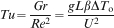

Recently, a new dimensionless number has gained wider importance in modelling an upper phase slag. It is the Bond number, notated as Bo. This is a dimensionless number expressing the ratio of body forces (often gravitational or buoyancy) to surface tension forces
Definition of dimensionless numbers
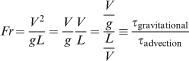
Dimensionless numbers can be defined according to the convenience of the researcher. For example, the Reynolds number is a ratio of inertial forces to viscous forces. However, it can also be defined as a ratio of two characteristic time scales


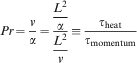
Similarly, for the Schimdt number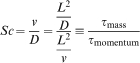
New dimensionless number for modelling inclusion removal
A number of researchers have reported on steel cleanliness and simulated the removal of non-metallic inclusions in water models using hollow glass microspheres that were either uncoated or coated with vinyl silane (non-wetting) or by polyethylene particles generally in the size range of 20–150 μm. These particles were either added continuously to the incoming water or were added as a pulse injection.
Professor Guthrie, along with his graduate students and researchers at McGill University, has performed a lot of work, modelling and measuring inclusions in molten metals. Tanaka and Guthrie,9 in 1985, reported on the modelling of steel cleanliness within an aqueous tundish using an aqueous inclusion sensor. Doutre and Guthri10 developed an inclusion sensor for molten aluminium (liquid metal cleanliness analyser, or LiMCA Al), while Nakajima and Guthrie11 developed an inclusion sensor (LiMCA Fe) or ESZpas, which could be used in liquid steel. Joo and Guthrie12 – 19 contributed greatly to characterising inclusion behaviour in model and real tundishes. They developed an in-house code, METFLO 3D, which could model numerically fluid flow, heat transfer and inclusion floatation. Their numerical predictions were in good agreement with aqueous model experiments on a full scale water model tundish on which an aqueous particle sensor was used to calculate continuously the number of inclusions coming out of the strands. In their reported work Joo and Guthrie also reported that flow control devices could play a major role in enhancing steel cleanliness, especially for the intermediate (50 μm) to larger (120 μm) inclusions. In addition, they also mentioned the fact that the presence of thermal convection can generate secondary recirculating flows in a tundish, with increased fluid motions near the exit nozzles. These flows reduce separation efficiencies for inclusions. Another aspect they studied was an optimum tundish design which could result in better steel cleanliness and efficient inclusion removal.
Sankaranarayanan and Guthrie20,21 mentioned that the diameter ratio of the outlet nozzle to the ladle diameter is important, and this ratio and the critical height for vortex formation are proportional. For a constant ratio of outlet diameter to ladle diameter, the critical height becomes larger with higher initial bath heights for central draining. Understanding vortex mechanisms is useful when designing simple and efficient devices to break down vortex flows during steel draining, even at very low metal residuals within the ladle or tundish. Sankaranarayanan and Guthrie22 also reported on vortex suppression regarding steel cleanliness and developed the vortex buster. Yamanoglu et al. 23 investigated powder injection in aqueous systems with an online particle detection system. Through this method, they made both quantitative estimates and qualitative conclusions on gas particle disengagement distance, liquid particle jet diameter, jet cone angle and particle dispersion and distribution.
Carozza et al. 24 reported on the further development of a LiMCA probe for liquid magnesium and also presented the concept of a concentric steel tube probe. Li and Guthrie25 performed theoretical studies on the motion of particles in current carrying liquid metals flowing in a circular pipe. Li and Guthrie26 also reported on particle discrimination in water based LiMCA systems. They developed a mathematical model to predict the motion of particles in the aqueous LiMCA system. Li and Guthrie27 – 29 investigated the in situ detection of inclusions in liquid metals in relation to the LiMCA system for molten aluminium. Wang et al. 30 – 32 reported on numerical studies on the in situ measurement of inclusions in liquid steel using an electric sensing zone. They also developed a multiphase model to describe the behaviour of inclusions in LiMCA systems.
Chattopadhyay et al. 33,34 performed two- and three-dimensional mathematical modelling to study the effect of inert gas shrouding on fluid flow patterns and slag behaviour in a four-strand delta shaped tundish. They concluded that the higher the volume fraction of gas injected, the larger the area of the exposed ‘eye’ around the ladle shroud. The primary reason for the formation of the exposed ‘eye’ was the strong reversed flows around the shroud. Owing to inert gas shrouding, a rising column of gas bubbles was formed, which was responsible for creating the reversed flows. In the water model experiments, the bubble diameters ranged between 3·5 and 6 mm, depending on the gas flowrate. The higher the gas flowrate, the larger the bubble diameter. The mathematical predictions corresponded well with the physical experiments. The alignment of the ladle shroud is a very important parameter and was studied by the authors35,36 in great detail. They evaluated the slag entrainment phenomena during a ladle change operation under a biased shroud condition of 6° and compared the results with those when the ladle shroud was aligned completely. Significant differences were observed in the results. A lot more slag is entrained in the strands located in the direction of the bias. The primary reason for this is that there is more turbulence in one half of the tundish, and this causes preferentially more slag disruptions in that half, leading to more slag entrainment.
Several techniques have been used for analysing the number and sizes of the particles in the water leaving the model tundish and entering the moulds. These have included weighing the particles or observing them under a microscope after filtration and the use of an online electric sensing zone technique (e.g. a Coulter counter, or equivalent) for determining the size and number density of the particles. The non-metallic inclusions in steel are lighter than molten steel and thus tend to rise up to the surface. For the inclusion size range existing in tundishes, it may be assumed that the inclusions rise at their Stokes velocity.6 The expression for Stokes rise velocity can be obtained easily by balancing the drag force and the net buoyancy force acting on the inclusion, i.e.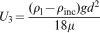
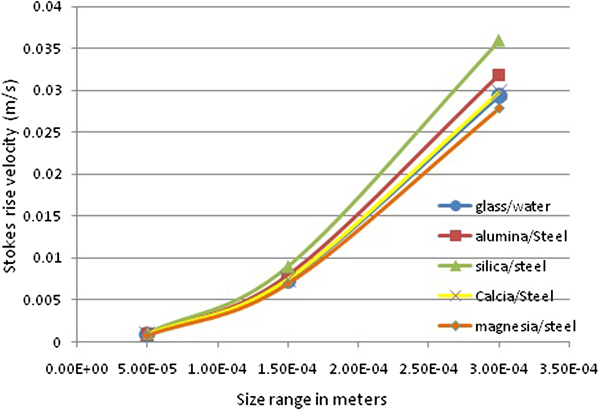
Stokes rise velocity as function of inclusion size
Properties of considered inclusions
Densities of water and liquid steel
The closest system to the water model is calcium oxide inclusions in steel; the others are also fairly close. However, inclusions are often binary or ternary systems of the above oxides, and then it is difficult to find an exact analogue. Another important point is that inclusions do not rise straight up; they tend to follow the flow before floating to the surface of the steel. Therefore, the time taken by the inclusion to float out cannot be calculated by computing the Stokes rise velocity. The inclusion float out time depends greatly on the size of the tundish, i.e. the residence time of the tundish. Therefore, the Stokes rise velocity similarity criterion does not model the role of different tundish designs and must be corrected when modelling in small scale tundishes. Thus, it is beneficial to find a dimensionless number that incorporates the residence time of the fluid and the particles within the tundish.
A number of researchers have modelled inclusions using linear low density poly ethylene, which has a density of 920 kg m−3. Such experiments totally contradict the similarity criteria requirements, but are still useful if interpreted correctly.
From the above discussion, it is clear that the modelling of inclusion removal has been performed by a number of researchers, but that a more specific similarity criterion is required. It will need to be more general and to be applicable to a wide range of inclusion types and sizes as well as hold well in both full and reduced scale models. In this regard, it should be noted that the residence time of a fluid element within a tundish has a major effect on inclusion removal.
In the section on ‘Definition of dimensionless numbers’, it is already shown that dimensionless numbers can be represented as a ratio of two characteristic time scales. Keeping this in mind, it is useful to consider the ratio of the residence time of the tundish to the inclusion float out time as a key similarity criterion for modelling inclusion removal. This ratio is a dimensionless number, and we would like to name it the Guthrie number Gu in honour of Professor Guthrie of McGill University, who has worked in this area of research for many years.37 Experiments carried out at the McGill Metals Processing Centre's (MMPC's) full scale water model tundish have proved directly the usefulness of the Guthrie number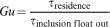
Thus, in a sense, a larger Gu number indicates a better tundish operation in that it is an indication that most of the inclusions will float out before entering the moulds. In other words, a higher Gu means a lower RRI. The definition of RRI is given in the subsequent section on mathematical modelling. If there is a larger tundish by volume, it will have a much higher nominal residence time, and so it is better for inclusion removal; all the other things being similar. Therefore, it is good to have a very large tundish for better inclusion removal, and this is indeed a current trend in large steel companies. Figure 2 shows the variation of Gu −1 with the nominal residence time of a tundish, assuming all the other parameters (namely, inclusion float out time and liquid inflow rate) remain constant. Here, the inclusion float out time is assumed to be unity. This does not affect the nature of the plot and is only a scaling factor.
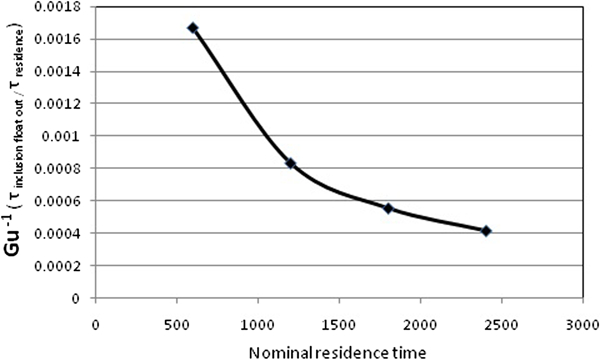
Inverse of Guthrie number Gu −1 as function of nominal residence time of tundish
When different types of inclusions are considered, the Gu similarity criterion will help researchers model them more easily. An average float out time of all the inclusions can be considered and then divided by the residence time of the particular tundish. This makes more sense because then the predictions from the water model will be more general, and it also does not require that the inclusions be in the Stokes velocity regime.
Mathematical modelling
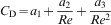
Mathematical modelling ‘2D’ was performed for a four-strand billet caster tundish to see the relation between Gu and RRI and also the variation of Gu with inclusion size range. ANSYS 12 was used to perform all the mathematical simulations. Systems of hollow glass microspheres in water, alumina inclusions in liquid steel and silica inclusions in liquid steel were considered in the size range of 50–300 μm. The tundish was the same for all three cases, and hence, when evaluating Gu, the nominal residence times were the same for all three cases. Along with the standard K–ϵ turbulence model, the DPM was used where inclusions were tracked in a Lagrangian frame. The equations involved in the DPM38 are enlisted below


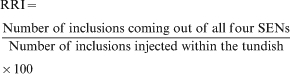

Values of inclusion float out times and Gu for different types and size ranges of inclusions
It is seen that a higher Gu corresponds to a lower RRI (Fig. 3). Here, RRI refers to the total number of inclusions coming out of all four strands. Similarly, with an increasing size of inclusions, the Gu number increases (Fig. 4). There is a small deviation in the trend for the 300 μm glass spheres in water. This deviation is because the inclusion float out time is 13·768 s. Had the inclusion float out time been 14 s, it would be a perfect straight line as the other systems and is represented by the bold dashed line in the graphs. Therefore, basically, this is not a big deviation. One important observation is that all three systems behave similarly. Thus, the Gu number can be an efficient similarity criteria for modelling inclusion removal in different tundishes.
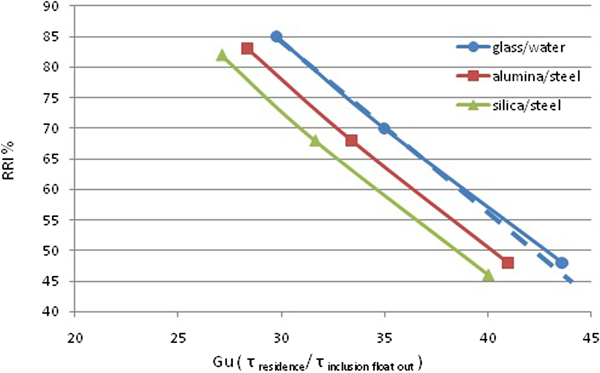
Residual ratio of inclusions as function of Guthrie number Gu
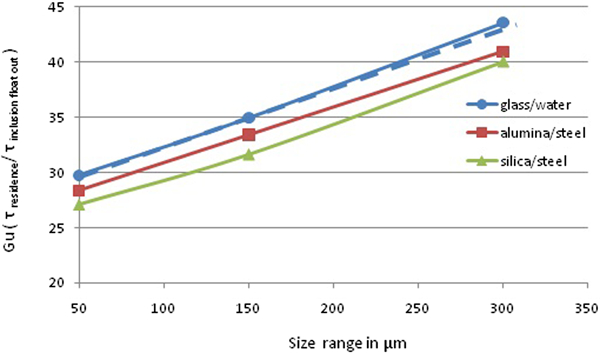
Guthrie number Gu as function of inclusion size
For bigger particles (700–2000 μm) such as liquid slag droplets, or inclusion agglomerates, the float out times are in the order of 5–7 s. Thus, the value of the Gu reaches almost 100 in this particular type of tundish. In reality, these big particles float out easily from the liquid steel bath and correspond well with a high Gu.
In all the above discussions, the nominal residence time was considered for calculating the Gu. However, even in the same tundish, the mean residence can be increased by the insertion of flow modifiers or by gas bubbling. In this way, the Gu will increase even more and will imply a better tundish operation.
Conclusions
Dimensionless numbers are very important in process modelling, and a good understanding of them is required to make correct predictions. It should be noted that dimensionless numbers can be defined in different ways. In a dynamic sense, they can also be represented as a ratio of two characteristic time scales, and this is a novel concept. In most modelling cases, all of the similarity criteria cannot be satisfied simultaneously. It is then up to the modeller, and his/her experience, to choose the particular similarity criteria judiciously. The existing similarity criteria like Re, Fr, Tu, etc. are just necessary conditions to design the model but are not sufficient to provide information on steel quality. A higher value of the Gu number indicates a better tundish operation in terms of liquid metal cleanliness, whereas Re or Fr numbers cannot provide this information. For modelling inclusion removal in a tundish, the Stokes velocity similarity criterion is effective, but it has certain drawbacks. It is limited to the size of the tundish and the type of inclusion. On the other hand, the Gu number represents the ratio of times and is valid for all kinds of inclusions while taking into account the residence time of the tundish.