







Abstract
A steel mill is a large logistical hub, with raw materials and energy as input and steel plus some other materials as output. The vocabulary to designate the latter is fuzzy and changing, and it depends on who speaks about them: co-products, byproducts, residues, waste, emissions, pollutants, discharge, etc., are used in different contexts. This profusion of names echoes the conceptual hurdles that block the way when numbers have to be attributed to the co-products, related to either environmental footprints or economic values, especially if both are mixed. The paper focuses on the example of blast furnace slag, which is sold to the cement industry in large quantities as a substitute to clinker. The practice is a lively example of an industrial ecology synergy between two economic sectors: both sectors, collectively, decrease their environmental footprints in terms of energy consumption, greenhouse gas emissions, resource depletion, etc., in an unambiguous way. Many issues arise, however, when exact figures have to be worked out to allocate a footprint to each partner in the synergy. Life cycle assessment seems like a good candidate to do that job, but from a practical standpoint, the method can be implemented in so many versions and flavours that the answers end up in a series of very different figures, which confuse rather than clarify the issue. What is argued here is that these difficulties are due to the fact that the underlying problems are not yet solved, and that it is naive to ask a technology like life cycle assessment to solve issues related to the allocation of the cost of the climate change externality to commodity materials like cement and steel. Unsolved problems are due to the uncertainties related to this process. Until these issues are cleared, it is proposed either to focus mainly on the synergistic benefits of the cooperation between the two sectors or to accept different estimates of the footprint of the co-products in the two sectors. This example is a typical case in point related to what we have called the collision between the ecosphere and the anthroposphere.
When ecosphere and anthroposphere collide
The world is like a large deck of cards that gets reshuffled at various scales, temporalities and volumes, over and over again. Each card represents one of the 100 plus elements of the Mendeleev table. The dealers are called cosmology, planetology, physics, chemistry, biology and, more recently, industry.
The metaphor of a deck of cards stresses that elements are being recycled continuously and that the world operates as a system defined by a set of rules. This gets expressed in different ways when different scientific communities speak of ecology, of biological metabolism, of urban metabolism or, more simply, of reuse and recycling. The metaphor also posits a dealer, who is the guardian of the rules under which the system operates. In the realm of physical science, this role is played by thermodynamics, in biology by evolution and in human societies, where the anthropological and biophysical spheres intersect, by technology and economics.
The storyline that the game follows is not simply one of increasing entropy, which would explain that elements are brought back to their lowest avatar in terms of energy content, like carbon oxidised into carbon dioxide or hydrocarbons into water. In other words, the system does not simply return to equilibrium by minimising its Gibbs free energy. The planet, indeed, is not a closed system as it receives energy in very large quantities from the sun and, to a lesser extent, from its molten core: this energy brought in from the outside can reverse the trend towards lower free energy.
There are two mechanisms that have been driving this particular part of the plot:
on the one hand, biology has created organisms that can redirect elements upward on the free energy scale, under natural conditions of temperature through the use of organic catalysers called enzymes: in the Paleoproterozoic period, cyanobacteria, also called blue algae, created the present oxygen rich atmosphere by reducing the CO2 that was then prevalent. Today, photosynthesis continues as the main mechanism for autotrophic plants to produce their cells and then serve as food to heterotrophic animals, thus forming part of what is now called the carbon cycle
on the other hand, in the anthroposphere, the industry is doing something similar using temperature (chemistry, metallurgy and materials production) and catalysers (chemistry) as the main facilitators.
Anthroposphere and its tight connection to economics
It is interesting to note that economics enters the rules of the game rather late in the history of the planet, i.e. only when society reaches a historical level of complexity; physics and chemistry ruled for eons when the planet was being shaped by geological forces, and only today, that is since only a few thousands of years, has mankind started to introduce a new organising principle based on economics, trade and the exchange of money. The scale at which this happens, compared to that of the planet, is fairly modest, namely intermediary, mesoscale, and so are the volumes involved, i.e. industrial volumes as compared to geological or geographical ones. Economics operates at the scale of mankind’s activities, not of the planet or of the universe, at least mostly and until recently (global issues like the destruction of the ozone layer, climate change, the drop in biodiversity, the rarefaction of usable water and the increased scarcity of natural resources are rapidly changing this benign statement)!
Industry is an activity of society where elements from the physical world (nature) are used to produce artefacts based on materials that are out of equilibrium with the natural world [there is no free aluminium or magnesium, or silicon, etc., in the natural world on Earth and not much free iron either in the physical world (that is on Earth); similarly, there is no cement, nor plastics, etc.]. Maintaining this gradient requires energy and particularly work, which is also called exergy, and this translates into human work and thus into economic value.1 Iron for example is scavenged from ores, mainly oxides, produced when the heavy elements at the core of the planet combined with lighter ones, centrifuged and floated up to the shell of the planet, and then concentrated by geological forces into deposits worthy of mining. The chemical reduction of Fe2O3 into the metallic element Fe is carried out by the steel industry, which uses coal for doing so; steel is then shaped and turned into tools, by intermediate industries, which are then used to make artefacts, also made of steel or of other materials.2
In these processes, which combine both natural and anthropogenic steps, the creation of exergy by industry is based on the separation of some ‘useful’ element, like iron, and on the discarding of ‘less useful’ ones in residues, waste, byproducts or co-products; they can take the form of dust, slag, sludge, oily scales, tailings or pollutants in air, water or soil. The processes also generate end-of-life products, which can be reused, recycled (like scrap) or not (thus going to landfills, or dispersed through oxidation or non-recovery) [note, incidentally, that recovery is not a single step process, nor a first time around success: a stock of residues is systematically produced (stock and flow model, the preferred model of MFA), which can be recovered sooner, in a recycling process, or later, in an urban mining scheme].
Usefulness in this sense is an economic criterion. There is more value in ‘useful’ elements or more generally materials than in residues, because the first ones are needed, wanted by society making them rare, while the others are just a burden that has to be relieved of at some cost.
Residues are not simply a burden, and some have changed status a long time ago, while others have been doing it more recently due to the drive towards materials recycling and to more knowledge and technology being introduced at this level.
Giving a value to residues transforms them into an end-of-waste co-product or byproduct, rather synonymous words, although the latter one carries a worst connoted meaning. It also internalises the environment related externality that they represent into the market economy.
The construction of this value can originate from various internalisation drivers:
it can originate from regulation or legislation based rules that for example put limitations or bans on land filling and make reuse or recycling compulsory, fully (100%) or in part.3 The economic value is more or less clear, depending on whether the penalty for not complying is quantified or not
it can be related to a tax or to another mechanism that creates a value, like for example the emission trading system for CO2
it can be related to a secondary raw material market, like the scrap or the blast furnace (BF) slag markets, which operate on their own according to rules that are those of the market economy, with different flavours for different co-products
standards and methodologies can also help push in the direction of internalisation by creating conditions favourable to that transformation. The use of life cycle assessment (LCA), which the EU Commission likes to call life cycle thinking (LCT), is one such important methodology, which has become a necessary language to speak about products and byproducts. This is true also of similar methodologies, like the carbon footprint, which attributes a carbon (actually a CO2) value to goods; a monetary value can be induced from the carbon footprint
finally, at the level of the description of the anthropogenic world in codes, laws and regulations, a legal framework of concepts has been defined, which tries to take all of the above onboard from a higher level rationale. The recent discussion related to the ‘end of waste’ directive has shown that this is not a simple matter, and that the area is still under construction.
All of these mechanisms weave a tight relationship between the physical world of chemical elements, molecules and materials and the more abstract world of economy: they help organise the intersection between the ecosphere and the anthroposphere. This makes it difficult, however, to establish a clear cut distinction between physical and economic approaches as categories like co-products and waste for example are defined in terms of both their physical and economic features: a slag that the cement industry can use is a co-product, while a slag that is land filled is a waste; even though it might very well be the same slag from a physical point of view! This is also the cause of some ambiguities, sometimes of incoherencies or contradictions, and this makes the development of concepts in this multicultural–multidisciplinary area challenging.
This disciplinary crossing between the worlds of hard and soft sciences and of physics and industry may create ambiguities and sometimes confusion because of paradoxes that arise in dealing with these issues in everyday life. There are many ways to write the storyline and not all of them are fully coherent!
In addition, beware because paradoxes that are not resolved satisfactorily lead to rebound effects, which may turn out to be perverse!
Cement and steel: virtuous example of industrial ecology
To illustrate this discussion and flesh it out beyond these abstract considerations, I will tell the story of cement and steel, two of the three most important materials in the world (the third is wood) in terms of volume and thus of their ubiquity in human artefacts and in the logistical part of the economy. These two materials entertain connections at the level of their production phases, following the rationale of industrial ecology. 4 4,5
Cement and steel are made from natural, primary raw materials at high temperature in large industrial reactors, such as a cement kiln or a BF and an oxygen converter. Primary cement and primary steel are not connected during their production phase.
Cements are artificially prepared compounds of lime, silica, alumina, sometimes magnesia, i.e. of oxides of highly electronegative metals, usually prepared from carbonates in a high temperature process that releases CO2 during the calcination process. Steels are alloys made of almost pure iron, which are produced by reducing iron ores, mostly iron oxides, at high temperature using coal (carbon) as a reducing agent: the chemical reaction produces CO2. Both materials are produced in very large quantities, more than a billion tons per year, and the chemistry on which their production is based requires a lot of specific energy. Tons times specific energy makes the sectors that produce them ‘energy intensive’ industries and, in parallel, large industrial emitters of CO2 from large individual sources. In both cases, CO2 originates both for the ‘combustion’ of fossil fuels and from chemical reactions very different from oxidation.
Steel production generates slags, which are compounds of lime, silica, alumina and magnesia, in large quantities (300–400 kg t−1 of steel). They concentrate the elements of the ore that are not alloyed in the steel and that did not leave the process line as gases or dust. The closeness of the composition of slags to that of cement is such that some of these slags can serve as secondary raw material for making cement; it should be understood that some of the additions made in the BF go beyond the requirements of ironmaking and are meant to adjust the composition to the needs of cement making. This slag is usually mixed with clinker at the final stage of cement production, i.e. beyond the high temperature kiln stage.
This creates a synergy between cement and steel industries, which has been organised at an industrial level: BF slag is recovered when taped and quenched in water to produce granulated slag. It exhibits an amorphous structure, which is required for direct addition to clinker after grinding. Of course, the amount of BF slag treated in this manner depends on local market conditions. This is probably the most important example of an industrial ecology connection between two industrial sectors in terms of volume. This is also a clear example of how a byproduct of the steel industry avoids the status of waste and becomes a co-product.
All of these have good connotations and take part in the virtuous reshuffling of our initial deck of cards. The practice is pointed out as virtuous in industrial ecology classes and matches the rules related to waste, particularly the waste hierarchy rule and the 3, 4 or 5-R rules.
When one looks at the economics of the connection and at the manner in which environmental externalities, such as climate change, can be brought into the picture, the matter becomes more complex, and the ambiguity mentioned before in general terms comes to the front.
The economic picture is fairly simple. The steel mills sell their granulated slag to cement makers. There is a market for slag, which decides on the market price of that commodity. That price is close to the cost of clinker, and it incorporates a transport ‘allowance’ from a small distance around the cement plant, i.e. in the order of 100 km. There is a lively commercial dimension to this market, and other secondary raw materials, like fly ash from coal based power plants, can compete with BF slag as additives to clinker. The price of slag is very much constrained by the price of cement.
One should also factor in the fact that bulk slag can be sold as roadbed material, for which the natural materials are stones from a quarry: granulated slag is a more sophisticated product than bulk slag; its market value is higher and commensurate with the extra cost of granulation.
Now, let us bring in CO2 issues into the argument.
Primary processes have their own CO2 emissions, which are well known. It is intuitively obvious that implementing a synergy between the two activities using BF slag for substituting clinker will decrease energy consumption and CO2 emissions, globally. It will also decrease the total investment in the two activities, i.e. steel and cement production, and probably cut operating costs. However, this kind of intuition needs to be checked and validated.
A method to describe the synergy in terms of energy and CO2 is LCA, which is widely accepted and one towards which the practitioner will turn spontaneously. As soon as LCA is selected as the analytical method, then a premise is accepted that issues are discussed in relation to a functional unit, in this case 1 ton of BF slag, but other options are possible (see further). We will come back later on these key assumptions, which are often taken for granted, seem convenient, but are not necessary, and do not necessarily provide the ‘best’ answer to our questioning.
There are several ways of implementing LCA, and this plurality of options is actually related to the complexity of what is to be accomplished.
The first level of complexity is due to the fact that creating such a synergy means that various scenarios have to be compared. This is due to the fact that decision making has to be modelled, not simply carry out mass and energy balances around engineering systems.
An approach using economic allocations is possible, but this introduces another level of complexity, as this is equivalent to looking for a solution to internalise the cost of CO2 into the economic system. This is an even larger challenge, as the price of CO2 may be as low as 0 €/t, if one deals with emissions comprised in the quotas that the major energy intensive industries have received for free until now, to 15 €/t at today’s market price and reach much higher values in the future, from ‘reasonable ones’ at say 50 €/t to very high projections that some long term economic models deliver, such as 400 €/t.6 These figures can play havoc with the market prices of commodities like steel or cement and may exceed profit margins by an order of magnitude!
The numerical example that will be used is given in Table 1. It is derived from two former publications, the data of which might need a small update, but this is not performed here as the objective is to make a point, not to establish definitive figures.
Main features of steel, slag and cement assumptions used in calculations
Let us present the options offered by the LCA methodology and ask the patience of the reader, who is being taken through a long argument in a kind of fractal reality:
at the onset, the functional unit needs to be defined clearly. For a steel producer, it would seem natural to choose a steel product, with slag as a byproduct. Steel has also the duty to generate life cycle inventory data, which will be used as a basis for these LCA exercises, a task that is carried out by its trade association, worldsteel.7 However, one could also imagine considering slag as the functional unit (the option retained until now in this paper), or cement using slag as a raw material, or some more complex system. Note, incidentally, that the concept of functional unit can become somewhat fuzzy when toggling between these various options, and that the purpose of the present discussion is not necessarily to use LCA methodology exclusively to solve the issue at hand but to tackle something that is broader than a usual LCA problem
then, a first set of options is called ‘allocation’: a value of impact, in this case CO2, is attributed, technical term ‘allocated’, to the slag
a second set of options consists of extending the scope of analysis by introducing a wider system into the discussion to bring it closer to reality, according to a method called ‘system expansion’
a third set of options consists of discussing explicitly scenarios that will take place due to the use of slag in the cement industry. This is called ‘consequential LCA’
one may discuss the same issues related to a slightly different functional unit, like a ton of steel, or a ton of cement rather than the ton of slag that has been considered until now
finally, the approach may get rid of LCA conventions altogether and propose something different and original, based on a more basic application of the industrial ecology concept, i.e. on the intuition to which we referred above.
One should also keep in mind that slag is not the only byproduct of the BF, as that reactor is also a coal gasifier, producing top gas, used downstream in the steel mill or sent to a power plant to make electricity. There are other byproducts, like dust and chemicals in the coke oven plant (like naphthalene), etc.
The allocation method itself offers many suboptions, depending on which specific allocation method is used (note that normalisation, as in ISO 14040, where the LCA methodology is defined, leaves this selection of method open to the free will and personal expertise of the practitioner, which is not necessarily helping solve a particularly complex problem to which there are many solutions; these solutions will be related to his cultural background and his professional network).
The first method, i.e. ‘weight allocation’, is related to weight/mass: 1 t of hot metal is produced alongside 0·25 t of slag, and the CO2 emissions can be allocated proportionally to these respective masses. This means that the specific allocation (also called CO2 factor or CO2 intensity factor) 

The second method, i.e. ‘economic allocation’, is related to economic value, usually price: assuming 800 €/tsteel and 20 €/tslag, then the sales associated with 1 ton of steel is 805 €/t. This translates into 0·0013 
The third method, i.e. ‘physical or physicochemical allocation’, is related to a physical analysis of the co-production of slag and hot metal. Note that this is the preferred option in ISO 14040/44. There are again several ways of doing this, just like there are several ways of modelling the operation of a complex chemical reactor such as a BF:
the method followed in Ref. 4 is based on a full fledged physical chemistry and process engineering model of the BF and calculates how much CO2 is generated due the production of an extra marginal amount of slag. This is probably what chemical engineers would present as the method that describes most accurately the cost to pay for producing a clinker substitute in a BF. The answer is 1·24 
another method, requiring less expertise in analysing the BF process, consists of allocating emissions according to the energy distribution between hot metal and slag in the BF. The reason why this is called physical allocation is fairly clear. The answer then is 0·54 
the fourth method is to consider slag as a waste and, therefore, as a fatal production of a BF. Practically speaking, this is not quite what happens in the real world, as the charge of the BF (its burden) is adjusted in order to make the slag match the requirements of the cement industry in terms of composition. In this case, the allocation is nil, i.e. 0·00 
‘System expansion’ consists of introducing the cement industry into the picture by saying that the slag will displace cement made from conventional sources, in this case made without slag. The production of cement generates between 0·78 and 0·91 

Now let us try to propose a ‘consequential LCA approach’. This is entering into prospective methodologies or foresight studies, and this opens up another Pandora’s box and another fractal dimension in the analysis: again, many options are possible, and a path would have to be chosen among them!
The question to answer now is the following: what happens in the real economic world when the steel sector makes 1 ton of slag available on the market as a clinker substitute? Here are some reasonable options:
the cement industry buys the product and indeed uses it as a clinker substitute by reducing its own production of clinker (consequential 1). This is similar to the system expansion case discussed above. Of course, a full consequential LCA would have to take onboard the upstream emissions of cement making, which has not been performed in the example here, of quarries for limestone, fossil fuels, electricity, etc.
the cement industry buys the product but somehow manages to sell more cement to the market. Thus, no replacement is taking place. The total amount of emissions related to the cement sector increases (consequential 2)
the cement sector strikes a commercial deal with the steel sector and replaces fly ash by slag, thus turning fly ash into the waste that is usually considered to be its status, and the power sector bears unequivocally the full burden of its emissions.
These results have been put together in Fig. 1 to show how confusing the issue may appear to anyone who starts looking for a fair way out of the methodological difficulties that have been raised. An LCA practitioner will probably choose the option that fits best the standpoint he has taken when he launched his study. It will be different if he has a mandate from the steel or the cement industry, or if he represents stakeholders mainly interested in climate change, etc.
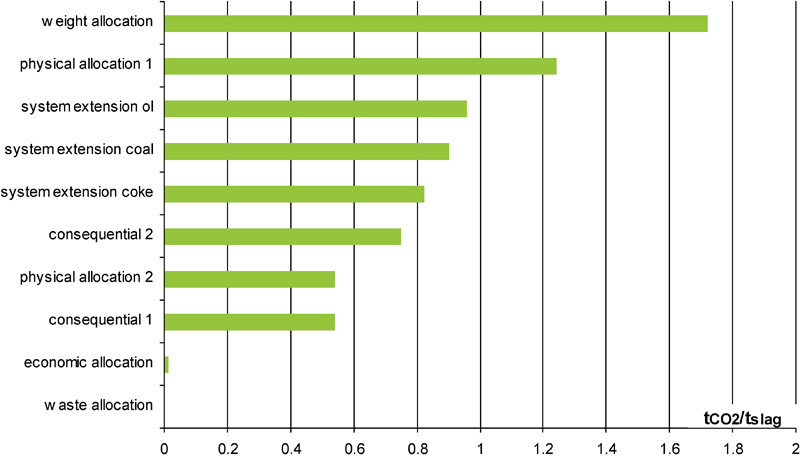
Various estimates of CO2 burden of BF slag according to ISO 14040 accepted methods8
What would be a best practice that could be recommended to all of these characters?
All the figures are related to slag on the assumption that an LCA of slag is being performed.
One may, however, carry out the discussion from the standpoint of steel, for example a functional unit made of 1 ton of crude steel: the slag allocation, whichever would be chosen, would be removed from the allocation of steel, and thus, the 2·11 

This value has no relevance, hic et nunc, to an economic value. The emission trading system is based on actual physical emissions and does not incorporate a deduction (credit) for slag. On the other hand, steel needs to publish life cycle inventories (LCIs), which are used by product designers and other stakeholders, like LCA practitioners. In this LCA context, it makes sense to take a credit for slag except that any of the previous methods is in principle possible. The steel sector might prefer the highest value, i.e. the one related to the weight allocation, but, if it does, it might find it difficult to sell its slag, as it would burden the cement above its replacement value. This is typically a commercial issue if the sector chooses what it pleases. On the other hand, CO2 emissions are calculated because of global warming. The physics of emissions, real ones or avoided ones, is important; thus, the physical method emissions would probably be best, but a comparison with what is avoided (the present emissions of the cement sector, assuming substitution) would probably also be of interest in a kind of system expansion: 0·91 


From the standpoint of cement, the last figure is relevant, although the practice until now has been for the sector to claim that slag, fly ash and carbon ‘waste’ are CO2 free. Hence, this leaves room for discussions and possibly negotiations.
If one steps away from the concept of a functional unit, which narrows down the discussion to commercial and possibly parochial issues, and look at the industrial ecology synergistic system that the steel mill (4 Mt/year) and the cement kiln (1·5 Mt/year) constitute (historically, cement making was part of an integrated steel mill, which also systematically included its own power plant, at least in most places in Europe), then a slightly different picture arises. Without synergy, the system emits 9·8 M


If the savings are allocated to steel, then the amount of CO2 avoided is 0·24 

Now, of course, this discussion is somewhat byzantine as it only focuses on subtle ways of doing an LCA. The issue for both sectors involved is somewhat more practical, as the image of their material is at stake and also material choices.
In the longer term, if climate policies become more demanding, as will most probably happen, then these CO2 figures will be translated in monetary terms. As already pointed out, this would be a major paradigm shift in terms of the value of basic materials, particularly of cement, but also of steel. Until this is acknowledged by the materials sectors, it is very difficult to carry out CO2 allocation on the sole strength of LCT! Because LCT is very fuzzy in this area! In addition, because the issues go far beyond the scope of a standard LCA, and, therefore, the occasion of providing LCI may be a good reason for forcing the issue and looking for solutions, LCT and LCA methodologies do not offer any light to navigate through this long term strategic issue!
Methodological conclusions
The discussion that has been carried out here for BF slag can, in principle, be extended to all byproducts.
It can also be used in a wider context, like the comparison between materials such as metals and cement, and materials that have a double status, as materials and as energy sources, such as wood or plastics. The concepts of ‘closed loop’ and ‘open loop’ have been used in such a context, but not without ambiguities, and we feel that the approach outlined here would be more fruitful in this particular case.
The case of biofuels would also benefit from such an approach and possibly many other complex cases, where the direct, almost brutal application of LCA methodology does not work satisfactorily, as it leaves too many options open that are left for the practitioners to solve as they see fit. Complexity should be addressed as such and not through avoidance behaviour!
This discussion is also shedding light on how to use LCA ‘properly’.9
The LCA was designed initially as a management tool to give environmental insight for decision making related to consumer products, which are mass produced. Thus, it usually compares two scenarios and makes suggestions on the most preferable one; it is best used as a tool for designing new products or new solutions. However, LCA is used more and more often as a marketing tool to show the advantages of one solution against the assumed disadvantages of a competing one. It is also used in more ambitious decision making, especially societal ones (as a basis of a carbon footprint for example). When the LCA is called upon to sort out the difficulties related to the internalisation of the CO2 externality into cement or steel prices, then, clearly, it is used beyond its scope.
The LCA is the child of physics [by establishing mass (global, per chemical species, per elements, etc.) and energy budgets] and of accounting (by tracking down these physical fluxes with a very high level of detail, and, apparently at least, of accuracy). Because it is defined by standards, it is not bound by the law of physics. Speaking practically, a system expansion does not conserve energy and matter.10 This is a difficulty that easily leads to rebound effects if the method is used in too general a context. There are also many other reasons for rebound effects.11
Another distortion in the use of LCA is to focus exclusively on CO2 or greenhouse gas emissions. LCA claims universality, and the tradeoff is implication in the modelling of the real world. LCA is multicriteria. It provides a full picture of the global environmental footprint of the functional unit, not simply of the carbon footprint.
Conclusions
The steel industry is not only producing steel, it also delivers secondary raw materials and other byproducts to other sectors.
Slags are the largest output in terms of volume (one-third of the mass of steel produced).
However, there are also metal bearing residues, such as home scrap, mill scale and dusts, some of which are used internally in the steel mill, while others are sold to other industries.
Carbon bearing residues, like BF sludge.
Gases that can be burned as fuels, produced by coke oven batteries, BFs and oxygen converters, produce high temperature heat or electricity.
In addition, many other things like chemicals or district heat.
Byproducts and co-products usually command low prices in their markets, because they retain the image of a waste, which they are not. Legislation and practice are slowly changing their image, though, and the scarcity of raw materials adds to the trend, especially when this causes prices to increase. With higher prices, more preparation of the co-products is possible in order to turn them into true and sophisticated secondary raw materials.
Beyond their economic value, these co-products have a ‘sustainability value’ related to the fact that they avoid using primary raw materials and often involve less preparation, i.e. less process steps in the client industries, and, thus, exhibit a smaller overall ecological footprint.
We have dealt with this issue in the particular case of BF slag, which is both a large volume example of existing commercial connections between the steel and the cement sectors and a clear case where this industrial ecology synergy can indeed bring significant energy savings and cuts in CO2 emissions. This is intuitive, and this is true. It shows particularly clearly when one compares the two sectors as separate entities or as synergistic ones: the coupling of a large integrated steel mill with a large cement kiln saves 0·24 t of CO2 per ton of steel produced or 0·64 t ton−1 of cement produced.
It is, however, difficult to allocate CO2 shared in this manner to any of the two sectors, because beyond the apparent win–win strategy, there are issues due to the fact that CO2 will very soon command prices that may rise to very high levels, so high actually that the price of cement, and to a lesser extent of steel, may change radically. With this perspective, it is not so simple to choose the proper allocation method, especially since the method which seems most appropriate for doing this, i.e. LCA, is actually not capable of doing it in a unique and thus fair manner: LCA has not been developed to make such strategic decisions.
This is a serious methodological difficulty, which leads to serious practical hurdles in areas where slag is discussed. There are several ways out of this conundrum.
In the long term, the problem will necessarily find a solution in line with the internalisation of the externality cost of CO2 in materials and energy markets.
In the short term, it is probably naive to believe that a single solution can be found that does not displease one or the other sector involved. Therefore, living with different LCIs in different networks or communities might be a solution: after all, LCA has not yet made up its mind on other serious and disturbing issues, like accounting for end of life or for materials recycling. Moreover, society has entered a post-modern world, the definition of which is that of a world where several temporalities coexist:12 the analysis of this renewed complexity should not be left to soft/subtle scientists, like sociologists or literary critics, but has to be taken onboard in applying sustainability tools when difficult issues, like that of the sustainability footprint of co-products, come to the front.
The ‘best’ allocation method, if the criteria for defining ‘best’ relates to how well it describes real physical emissions, is certainly a physical allocation. Weight allocations are not fair to the user of the co-product, because it is almost always of a lesser value than the main product. Price allocation is not fair either for the opposite reason that it dumps cheap secondary raw material on the market.
Going back to the planetwide picture from which this paper started, it is clear that the collision between the anthroposphere and the ecosphere is under way: the noise and the furore of the clash are all around us! Climate change is the most obvious of the consequences of this ‘cosmic’ event, but one should also be wary of the loss of biodiversity or of the threat to water resources. Since economics mediates between the two worlds, the consequence of this shock is an eruption of environmental issues in the economic sphere, the econosphere. This is happening slowly, but irreversibly, like a catastrophe movie shown in slow motion: a price of externalities is being introduced in the system, except that the scenario is not yet written fully, and that its timeline is fuzzy: this introduces the kind of uncertainty that the economy and business dislike most.
To make things more complex, not only environmental externalities but also social ones are entering the stage.13 In the middle or long terms, it means that more synergies will develop between sectors, that the amount of waste will dwindle, and that byproducts will be used more extensively as secondary raw materials.
The transition may be confusing as the set is not fully reorganised in terms of tools and methodologies in particular to yet let the new show run smoothly.
One may also wonder at the distinction between products, co-products, byproducts, residues and waste, which has been introduced in the fields of law and regulation (the ‘legislosphere’ or the ‘regulatosphere’?) to solve important international trade issues in an opportunistic way. Nature does not abide with these different concepts related to the anthroposphere and the technosphere; it might just touch upon the subject through the concept of ecotoxicity, with the important caveat that, of course, all waste is not toxic! All outputs from an industrial process have, in the long run, the same fate of going back eventually to the environment, directly or after being used by consumers or by an industry, at some end-of-life or after one or several steps of recycling. They may go back in their chemical form or transformed into other compounds. The anthroposphere is thus giving back these products to the ecosphere after borrowing them for a while.
Footnotes
Acknowledgements
The author thanks J.-M. Delbecq, J. Bollen, M. Chiappini and J.-S. Thomas of ArcelorMittal for enlightening discussions on the topics of this paper.