







Abstract
Laboratory casts of titanium stabilised and titanium–vanadium dual stabilised ultralow carbon (ULC) steel have been assessed to determine their strain aging properties. A retarding effect on strain aging resulting from vanadium microalloying addition in Ti–V ULC strip steels is identified, and the activation energies for strain aging in Ti stabilised and Ti–V stabilised ULC steels are shown to differ.
Introduction
There is increasing legislative pressure on the automotive industry to reduce vehicular emissions and improve fuel economy. One possible response to this challenge is to reduce vehicular mass, particularly the mass of the body in white. This can be achieved through material substitution, and one area offering possible weight savings is the use of bake hardenable (BH) strip steel exterior applications such as outer door skins and body panels.
Bake hardenable steels possess a yield strength that can be improved after forming through a heat treatment operation, typically the paint curing cycle at 170°C for 20 min in commercial automotive manufacturing. The chemistry and processing routes of the steels are tailored to ideally leave between 5 and 15 wt ppm of free carbon on solution.1 At elevated temperatures, this free carbon will rapidly diffuse to dislocation cores under a drift velocity caused by the interaction between the dislocation stress fields and the misfit stress of the interstitial carbon atoms.2 On arrival at the dislocation cores, the carbon atoms pin them in place, increasing the stress required to initiate glide and thus the yield strength of the material.
While the potential of bake hardening grades using titanium and niobium additions has long been exploited, 3 3,4 less work has been performed with regard to bake hardening products using combined additions of titanium and vanadium.5 – 7 Historically, vanadium additions have been found to have a retarding affect on strain aging, as noted by Baird with reference to rimming steels and Rashid working with high strength low alloy steel grades.8 – 10 More recent attempts to prove this effect conclusively with reference to BH steels have disagreed, 5 5,6 but there is an existing patent held with regard to a non-aging batch annealed grade using vanadium additions for this purpose.11 It is the aim of this body of work to assess the retarding effect of vanadium additions in Ti–V ultralow carbon (ULC) strip steels with regard to the strain aging of ULC strip steel.
Concept
In the following work, isochronal aging responses are developed to identify the contribution of vanadium to the strain aging of microalloyed steels, and the activation energy for strain aging is determined. Experimental grades have been designed using MT-DATA thermodynamic modelling software such that a variable population of free interstitial carbon atoms (FICAs) can be achieved via precipitate dissolution during annealing. By varying the annealing cycle, the number of FICAs has been varied, and isochronal accelerated aging profiles have been built up, where the aging response is considered as a function of aging time and free carbon content at a constant temperature.
Following this exercise, isothermal aging responses were determined at lower temperatures, over a time period considered comparable, accepting Hundy’s equation12

Experimental
Steel 1 is stabilised using only titanium, while steel 2 contains significant vanadium in addition to the titanium stabilisation. Both grades have been hot rolled to 5 mm from 50 mm flats with a finishing temperature of 920°C, water cooled to the coiling temperature of 700°C and then cooled to room temperature at 29°C h−1 to simulate coiling. The steels were then given an 80% multipass cold reduction, giving a nominal gauge of 1 mm. Table 1
Compositions of experimental grades
Accepting that total stabilisation can be achieved using a Ti addition equal to Ti = 4C+3·42N+1·5S,13 steel 1 should be close to fully stabilised, containing 1·6 wt ppm of free interstitial carbon under equilibrium conditions, while steel 2 should be fully stabilised, with 17 wt ppm of free carbon tied up as TiC and 23 wt ppm of carbon as VC. The Composition of the experimental Steels studied is provided in Table 1.
Experimental
Samples were annealed as 200×100 mm panels under a nitrogen atmosphere in an infrared furnace to liberate the controlled quantities of free carbon based on equilibrium precipitate solubility as predicted using MT-DATA thermodynamic modelling software. In all the annealing cycles, the temperature was ramped up to the soak temperature over 45 s and then held for 60 s with a temperature stability of ±5°C, as measured using an attached k type thermocouple. Following annealing, the panels were quenched to 40°C using nitrogen gas cooling with a flowrate over the sample surface of 2000 L min−1, giving an initial quench rate of 70°C s−1. The samples were then stored in a freezer before testing.
The mechanical properties were determined through tensile testing of samples having a 50 mm parallel gauge length in accordance with BS EN 10002 using a Zwick 1474 tensile testing machine containing a 100 kN load cell.
The free carbon in the solution was determined using internal friction methods. Samples were mounted in a Vibran forced torsional pendulum, operating at room temperature with frequency varying in the range of 0·01–10 Hz.14 – 16,24-25 The samples were held at room temperature for 1 h before testing to normalise the temperature, and result plots were deconvoluted using the Solver feature of Microsoft Excel as the sum of multiple Debye type peaks.
The bake hardening response was determined as 5%BH. Tensile coupons having a 50 mm parallel gauge length were prestrained to 5%, then furnace aged at 170°C for 20 min to simulate the industrial paint curing operation17 and air cooled to room temperature. Following aging, the tensile coupons were tested to failure, and the 5%BH was taken as the difference between the R
m achieved during prestraining and the R
e
l following aging. Accelerated aging response was determined as above, with furnace aging taking place at lower temperatures as required. Plots of aging response against time were fitted using the Johnson–Mehl–Avrami–Kolmogorov equation
Results
Table 2 shows the free carbon in solution for each of the experimental grades at the annealing conditions investigated as determined by averaging a minimum of three separate consecutive cycles produced by the torsional pendulum.
Free interstitial carbon following annealing in experimental grades
Figure 1 Figures 1 and 2 show the individual aging responses (i.e. aging increase) of the experimental steels following annealing. Across the four conditions, the aging response is seen to increase with increasing carbon content from 25 MPa yield point increase at 4·7 wt ppm free carbon up to 37 MPa at 9·8 wt ppm. The fitted Johnson–Mehl–Avrami–Kolmogorov curves follow the trends in the averaged data, and while the accuracy of standard deviation as a measure of scatter is low for small data sets, the fits are typically within one standard deviation of the mean.
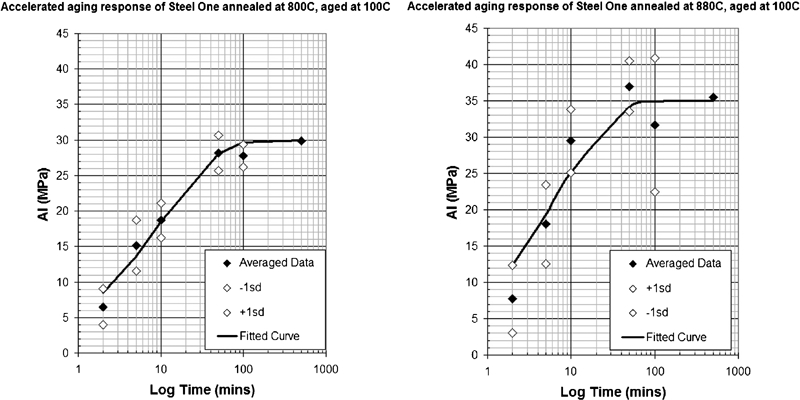
Aging response of steel 1 (titanium stabilised) aged at 100°C following 5% prestrain for times of up to 500 min containing 5·5 wt ppm free carbon with 10·3 μm grain size (left) and 9·8 wt ppm free carbon with 11·5 μm grain size (right)
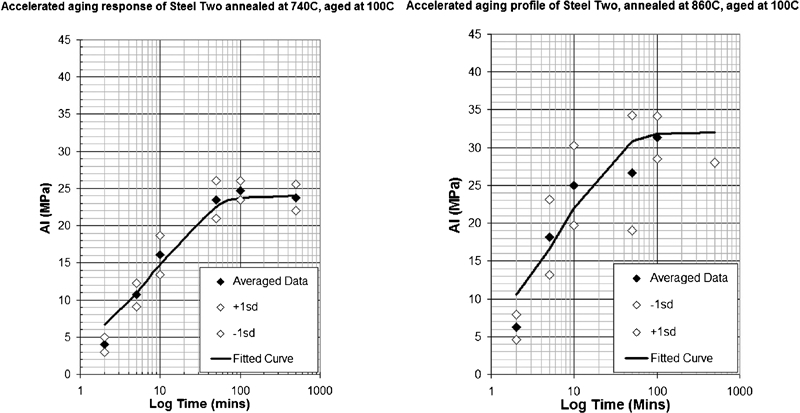
Aging response of steel 2 (titanium–vanadium dual stabilised) aged at 100°C following 5% prestrain for times of up to 500 min containing 4·7 wt ppm free carbon with 9·4 μm grain size (left) and 8 wt ppm free carbon with 13·5 μm grain size (right)
Figure 3 shows a series of isochronal aging plots developed from Figure 1 Figs. 1 and 2. Over the time range of 2–5 min, steel 2, which was dual stabilised with titanium and vanadium, can be seen to have a lower aging response for an equivalent level of free carbon when compared with steel 1, which was stabilised using only titanium. This effect is most pronounced at lower carbon levels (by extrapolation, 10–15% at 5 wt ppm free carbon) and negligible at higher carbon levels.
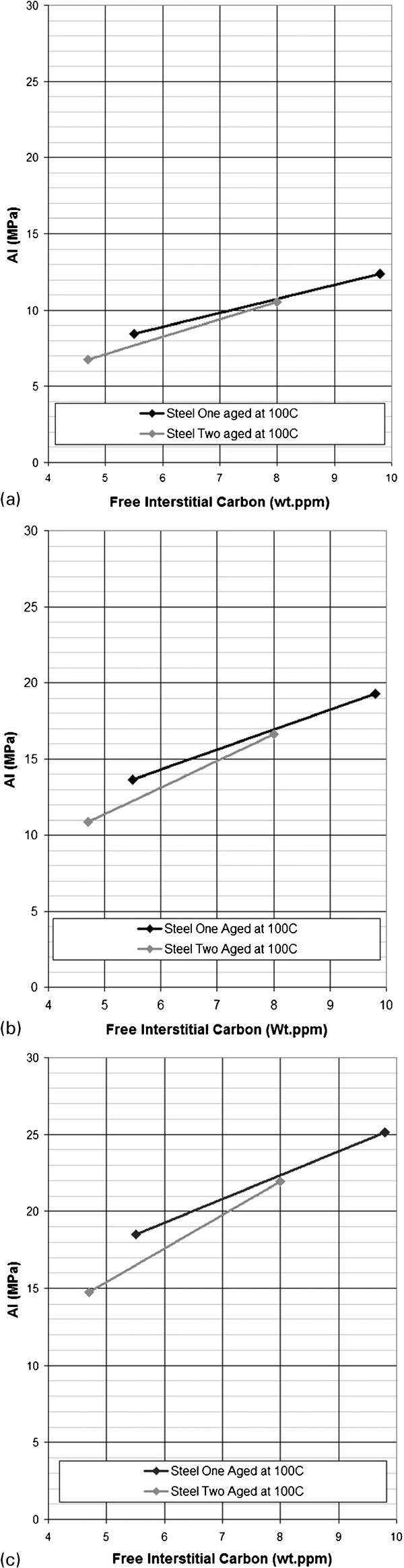
Isochronal aging plots developed from data in Figure 1 Figs. 1 and 2 showing relative aging response of steel 1 (titanium stabilised) and steel 2 (titanium–vanadium dual stabilised) as function of their free interstitial carbon content after a 2 min, b 5 min and c 10 min
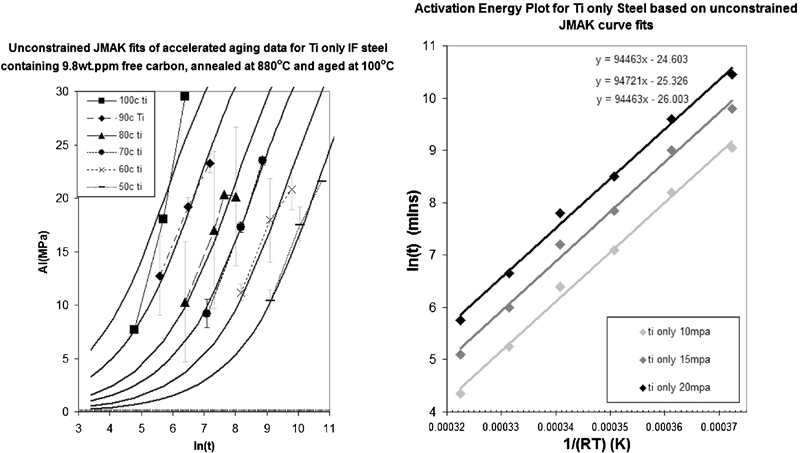
Isothermal aging response of steel 1 (titanium stabilised) containing 9·8 wt ppm free carbon with grain size of 11·5 μm aged at temperatures of 50, 60, 70, 80, 90 and 100°C (left) and linear plots of log time required to develop given aging response against reciprocal of aging temperature for steel 1 containing 9·8 wt ppm free carbon with grain size of 11·5 μm (right)
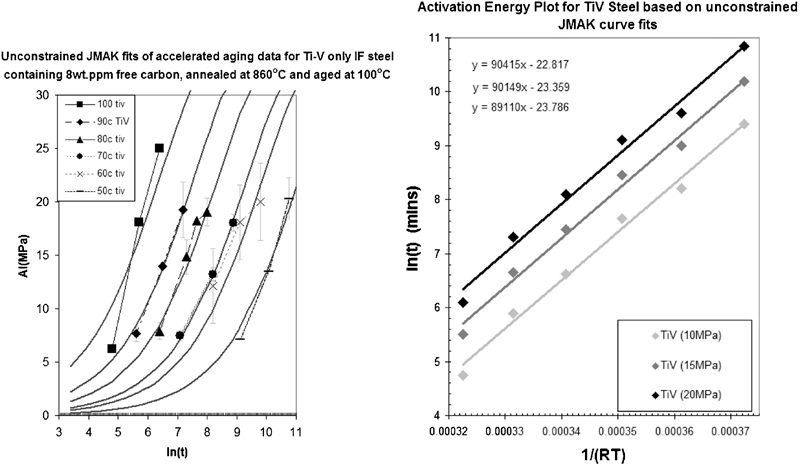
Isothermal aging response of steel 2 (titanium–vanadium dual stabilised) containing 8 wt ppm free carbon with grain size of 13·5 μm aged at temperatures of 50, 60, 70, 80, 90 and 100°C (left) and linear plots of log time required to develop given aging response against reciprocal of aging temperature for steel 2 containing 8 wt ppm free carbon with grain size of 13·5 μm (right)
Discussion
Figures 4 and 5 show the titanium vanadium steel to have a lower aging response than the titanium only steel at low carbon contents and elevated temperatures. The Arrhenius evaluation of the activation energy does not feature the dog-leg that has previously been reported by Tanikawa et al. 18 and De et al. 19 at 77°C (1/RT = 3·44×10−4), so it is reasonable to relate the aging at elevated temperatures with equivalent aging rates at ambient temperatures; the uniformity in the aging response at times considered equivalent using Hundy’s equation12 also supports this supposition.
There is some disagreement over the extent to which the grain size affects the aging responses in bake hardening steels; in an extensive study, Baker found no evidence of grain size effects on strain aging.20 Messien and Leroy21 and Hanai et al. 22 both identified a reduction in aging response with increasing grain size, which would result in a 5–7% decrease in aging response over the ranges of 9·7–10·3 and 11·5–13·5 μm, though the overall aging responses reported in those studies as a function of carbon content were significantly higher than those observed here.
While grain size effects, if present, could account for a part of the reduction in aging response, the extreme effect, being on the order of 10% reduction in yield strength increase, is in excess of their observations. In addition, consideration of the developed activation energies for strain aging in the two steels shows a difference: describing aging as a thermally activated process using an Arrhenius type equation, the titanium–vanadium dual stabilised steel displays a lower activation energy (90 kJ mol−1 cf. 95 kJ mol−1) and a lower pre-exponential term than the titanium only; while in isolation, the lower activation energy would tend to accelerate the process, and the combined factors result in a reduced aging response. The difference in kinetic parameters between the aging of the two steels suggests that the processes occurring are in fact functionally different.
It has been proposed by Rashid10 that coherent vanadium carbides in the iron lattice may interact with FICAs, or dipole interactions between substitutional vanadium atoms and interstitial carbon atoms may occur, reducing the net rate of carbon diffusion to dislocation cores. Vanadium carbide precipitates have been shown to nucleate on pre-existing TiN particles in Ti–V dual stabilised steels and have been identified through TEM with a size range from 20 to 200 nm.23 Further work is required on the steel grades studied within this paper to identify the size and dispersion of any VC or V0·88C precipitates present following heat treatment.
At lower carbon contents, a greater retarding effect was observed as a result of the vanadium addition than was the case at higher carbon levels. Accepting that the retarding effect observed is the result of an interaction between FICAs and VC precipitates within the steel, it is possible that a fraction of the carbon population becomes tied to VC precipitates until a saturation point is reached. At low carbon levels, the decrease in free interstitial carbon might be sufficient to offset the decreased activation energy observed, giving a lower overall aging response, while at higher carbon levels, the remaining free carbon following saturation is sufficient, when coupled with the observed reduction in activation energy, to promote an equivalent, or potentially increased, aging response.
Conclusions
Results have been presented showing that, at low carbon levels, vanadium additions in Ti–V alloyed ULC strip steels can be used to suppress the rates of strain aging in ULC microalloyed steel product. The Arrhenius kinetics for the formation of Cottrell atmospheres differ in the presence of a significant vanadium microalloying contribution, showing that the process occurring is functionally different to that in a purely titanium microalloyed steel.
Consequently, there appears to be a potential for the development of Ti–V non-aging bake hardening products through the control of the annealing cycle to introduce free carbon into the solution via precipitate dissolution and then control the subsequent reprecipitation to give a favourable bake hardening response with retarded reduced aging tendency.