







Abstract
The viscosities of CaO–SiO2–7MgO–TiO2–12Al2O3 (wt-%) slags (CaO/SiO2 = 0·5–0·9, wt-% TiO2 = 15–30) were investigated to promote understanding of the effect of TiO2 and basicity (CaO/SiO2) on the viscous behaviour of slags containing TiO2. In practice, these experimental results are significant for the blast furnace (BF) processing of vanadium–titanium magnetite ore and for controlling the selective crystallisation of Ti bearing BF slags. The slag viscosity was found to decrease with increasing TiO2 content at a fixed basicity. The degree of viscosity decrease with increasing TiO2 content diminishes in the slag with higher basicity or higher TiO2 content. An increase in the basicity lowers the viscosity of slags. The apparent activation energy of viscous flow of slags decreased with additions of TiO2 and increasing basicity. The Urbain model was empirically modified based on the present experimental data, which can be used to predict not only quinary Ti bearing slags but also quaternary and low Ti bearing slags.
Introduction
China is rich in titanium resources, and 95% of them exist as vanadium–titanium magnetite ore.1 Generally, there are two metallurgical processes, i.e. blast furnace (BF) ironmaking and electric furnace process, which are adopted to extract metal from the vanadium–titanium magnetite ore. In the BF process, most of the Ti component is concentrated into the BF slag (Ti-BF slag) (22–25%TiO2).1 – 3 During this process, the viscosity of slag containing TiO2 is an important parameter that influences the gas permeability, the ability to tap the slag from the reactor, the efficiency of separation of slag from metal, the extent of slag foaming, etc.4 The viscosity of the BF slag has a wide range, depending on the temperature and slag composition. In previous works, numerous viscosity measurements have been carried out for binary, ternary and quaternary slags;5 – 13 however, the viscosity of Ti bearing slag was measured comparatively less, and the measurements were mainly focused on the low TiO2 (<10 wt-%) containing slags.14 – 17 Thus, viscosity measurements for Ti bearing slags are required to enhance the performance of the BF process of vanadium–titanium magnetite ore reduction.
Additionally, China has accumulated >70 million tonnes of Ti-BF slag, and it is still increasing at a rate of >3 million tonnes every year.1 – 3 Because of the dispersed distribution of the Ti component in various mineral phases, with very fine grains (<10 μm) and complex interfacial combinations, it is difficult to efficiently recover the Ti component through traditional separation processes, such as flotation separation, melting reduction and hydrometallurgy. 1 1,3 Li et al. 18 and Zhang et al. 3 proposed that selective precipitation was the most promising method to recover the Ti component from the Ti bearing slag. In this method, Ti bearing BF slags were modified and cooled down in a controllable cooling rate to enrich the Ti component into anosovite or perovskite, and these Ti enriched phases were separated using the gravity separation method. The selective precipitation of slags is determined by many variables, such as chemical composition, cooling rate, transport mechanism for both mass and heat and interfacial kinetics.19 Among these variables, the transport phenomenon has a decisive effect on the precipitation event, which is mainly controlled by the viscosity of the slag. However, to the knowledge of the present authors, the viscosity containing high TiO2 content has not been systematically studied so far. From above, it is necessary to measure the viscosity of slags containing high TiO2 content and to create a suitable viscosity model for Ti bearing slags at a wide range of temperatures.
In the present study, CaO–SiO2–7MgO–TiO2–12Al2O3 (wt-%) quinary slag systems with varying basicity and TiO2 content were designed based on the industrial BF slags from Panzhihua Iron & Steel Corporation (as shown in Table 1).20 The viscosities of these slags were then measured. Based on these experimental data, a model suitable for predicting the viscosity of Ti bearing slags was proposed.
Chemical composition of BF slag from Panzhihua Iron and Steel Corporation20
Experimental
Preparation of materials
The materials used in the present work are listed in Table 2. The samples were prepared by mixing analytical reagent grade chemicals of CaO, SiO2, MgO, TiO2 and Al2O3. The slags were designed as shown in Table 3. The basicity was set as 0·5, 0·7 and 0·9 respectively. TiO2 was fixed at 15, 20, 25 and 30 wt-% respectively. The mixtures, ∼160 g for each sample, were premelted in a vertical tubular furnace (GSL-06-16LA; Precondar) for 30 min at 1773 K. The liquid slag was subsequently quenched and crushed for further examination. The chemical compositions of the slag samples were analysed before the experiment by X-ray fluorescence (XRF) spectroscopy (S4-Explorer; Bruker) to confirm the composition. The results are also included in Table 3. It can be seen that the measured values are very close to the designed chemical compositions.
Oxides used in present study
Experimental compositions and measured values from present experiment
Apparatus and procedure
The experimental apparatus for viscosity measurement is shown in Fig. 1. The Brookfield digital viscometer head was connected to the working spindle by an alumina shaft. The crucible and spindle used in the experiments were made of molybdenum in order to prevent slag contamination. The dimensions of the Mo crucible and spindle are listed in Table 4. An electric resistance furnace with MoSi2 heating elements was employed for viscosity measurements. The temperature was monitored by the Pt–10Rh/Pt thermocouple, which was positioned below the crucible. It should be mentioned that the temperature was carefully measured to obtain the zone of constant temperature before the viscosity measurement, and the crucible and thermocouple were seated at this zone during the experiments. The viscometer was calibrated using standard oil of known viscosity at room temperature.
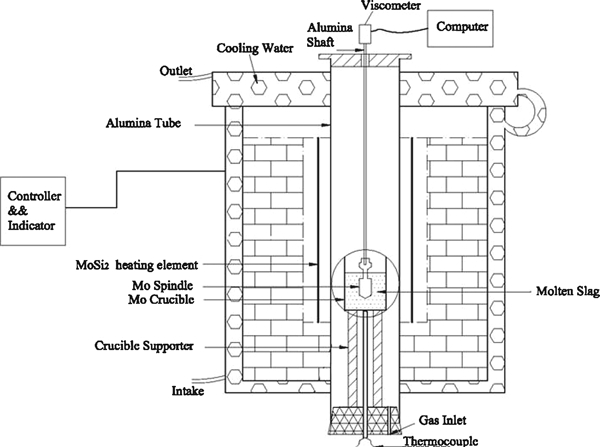
Experimental apparatus for measurement of slag viscosity
Dimensions of each component adapted in present study
The slag (140 g) was held in a Mo crucible. The Mo crucible containing the slag sample was placed in the reaction chamber of the resistance furnace. Argon gas (0·1 NL min−1) was flown into the reaction chamber to prevent the oxidation of the crucible and the spindle. The furnace was heated to 1823 K at the rate of 5 K min−1 and held for >100 min to completely melt the slag and stabilise the temperature before the viscosity measurement. Each measurement was performed during the cooling cycle with an equilibration time of 30 min at each temperature to ensure sufficient thermal equilibration within the liquid slag. Three different rotating speeds (150, 175 and 200 rev min−1) were employed at each temperature to ensure that the viscosity was independent of the rotating speed. It should be mentioned that the variation in the viscosity values due to the changes in the rotation speeds was <3%. The average value was adopted as the viscosity value in the present experiment. The XRF analysis of the slag after the experiment was also explored for slag no. 1, and it was found that there was no pick-up of Mo elements during the experiment.
Results and discussion
Viscosity of CaO–SiO2–MgO–TiO2–Al2O3 slags
In order to confirm the reproducibility of viscosity measurements, a repeated experiment for sample no. 1 was carried out. Figure 2 shows the comparative results. It can be noted that the experimental results matched very well, and the deviation is relatively small (<2%). Considering the experimental uncertainties usually associated with viscosity measurement, the method of measurement of viscosity was credible. In the present study, the effects of basicity and TiO2 content on the viscosity of the CaO–SiO2–MgO–TiO2–Al2O3 quinary slag system were investigated based on this method.
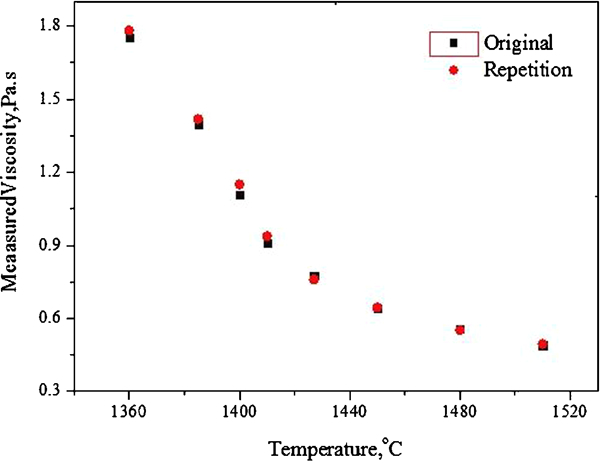
Comparison of viscosity changes between original experiment and repeated result for sample 1
The results of the viscosity measurements are presented in Table 5. The viscosity data in this table are the average values obtained using three different rotation speeds. The deviation of the experimental data from the mean value is <3% for all the measurements. In Table 5, a clear trend, as expected, was observed, i.e. the viscosity is increasing with decreasing temperature.
Measured viscosity values of various Ti bearing slags
Effect of TiO2 on viscosity of Ti bearing slags
Figure 3 shows the effect of TiO2 on the viscous behaviour of CaO–SiO2–7MgO–TiO2–12Al2O3 (wt-%) quinary slags with varying basicity, where the TiO2 content was varied between 15 and 30 wt-% at each basicity that increases from 0·5 to 0·9. It can be noted that the slag viscosity decreases with increasing TiO2 content at each basicity. This is consistent with previous works, 8 14 8,14,15 although the chemical compositions are different. Saito et al. 8 have investigated the effect of TiO2 on the viscosity of 40CaO–40SiO2–20Al2O3 (wt-%) slags. The viscosity of these quaternary slags decreased with an increase in the content of additive TiO2. Shankar et al. 14 studied the viscosities of CaO–SiO2–MgO–Al2O3 and CaO–SiO2–MgO–Al2O3–TiO2 slag systems. They found that at high basicity (∼0·8), the slag viscosity decreased with a small amount of TiO2 (∼2 wt-%) addition in the slag. Handfield et al. 15 also investigated the influence of TiO2 addition and temperature (1573–1873 K) on BF type slags containing 1–1·2 wt-%TiO2 in both homogeneous liquid melts and slag melts containing solid particles. These measurements showed that TiO2 reduces the viscosity of slags at a given temperature. It can therefore be concluded from the above results that TiO2 may decrease the viscosity of the slag melt.
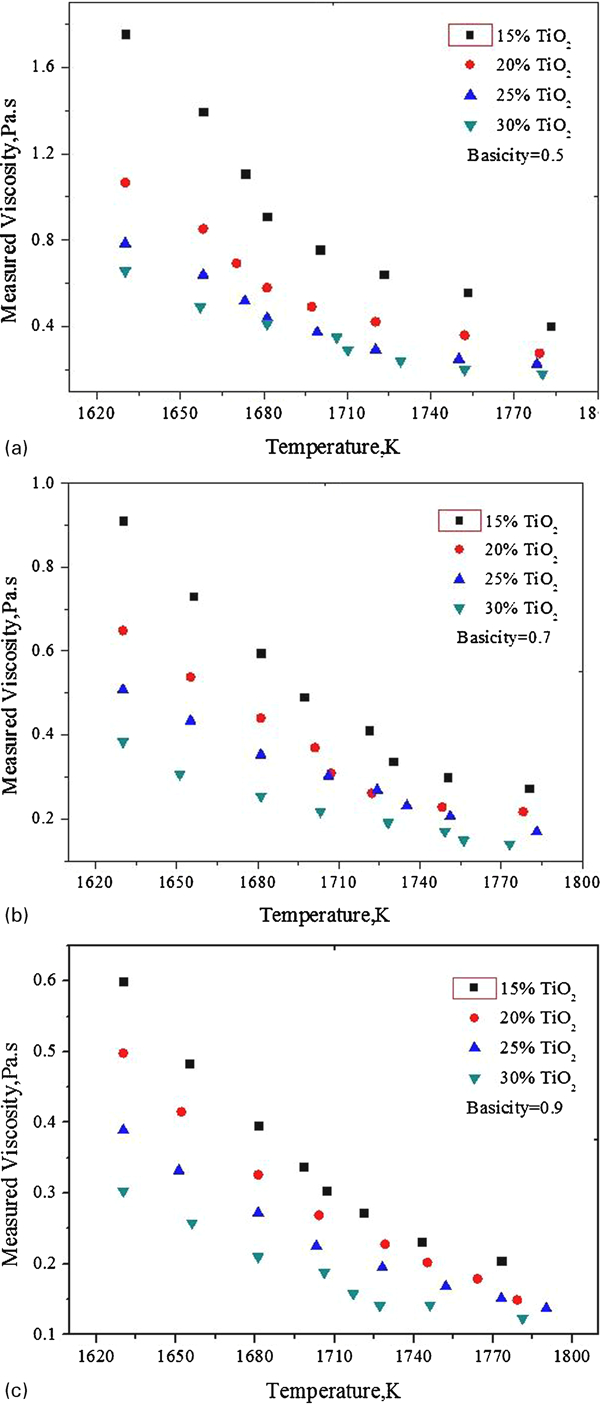
Viscosity of CaO–SiO2–7MgO–TiO2–12Al2O3 (wt-%) system as function of TiO2 concentration from 1793 to 1623 K with a basicity = 0·5, b basicity = 0·7 and c basicity = 0·9
The temperature dependence of the viscosity is usually expressed by Weymann–Frenkel’s equation
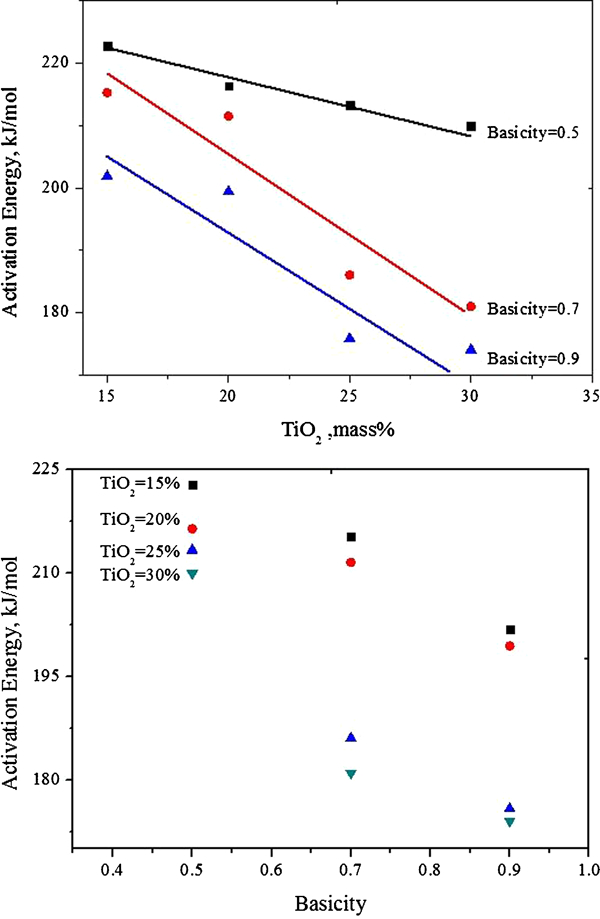
Effect of a TiO2 concentration and b basicity on apparent activation energy of viscous flow of slags
Figure 5 shows the viscosity of slag as a function of basicity and TiO2 content at 1630 and 1681 K respectively. The slag viscosity decreases by increasing the TiO2 content at a given temperature. It is observed that the degree of viscosity decrease with increasing TiO2 addition diminishes with increasing basicity, which is similar to a basic oxide component acting upon a network modifier in the slag melt.21 As the basic components in the slag melt exceed the acidic components, the network of molten slag has already been depolymerised into simpler complexes. Under this condition, further addition of the basic component (such as TiO2) has a limited effect on the viscosity. This phenomenon was also investigated by previous works. 16 16,17 Sommerville and Bell16 reported that TiO2 lowers the viscosity of CaO–SiO2–MgO–Al2O3–TiO2 slag, and the degree of viscosity decrease is lower at higher basicity. Morinaga et al. 17 investigated the viscosity of the CaO–SiO2–TiO2 system, and they suggested that the effect of TiO2 in lowering the viscosity should be greater at lower basicity levels. Although it needs more evidence to verify whether this behaviour is relevant to the basic property of TiO2, yet it is sure that the effect of TiO2 in lowering the viscosity decreases with increasing basicity of the slag. In Fig. 5, it can also be noted that the viscosity decrease diminishes with increasing TiO2 content.
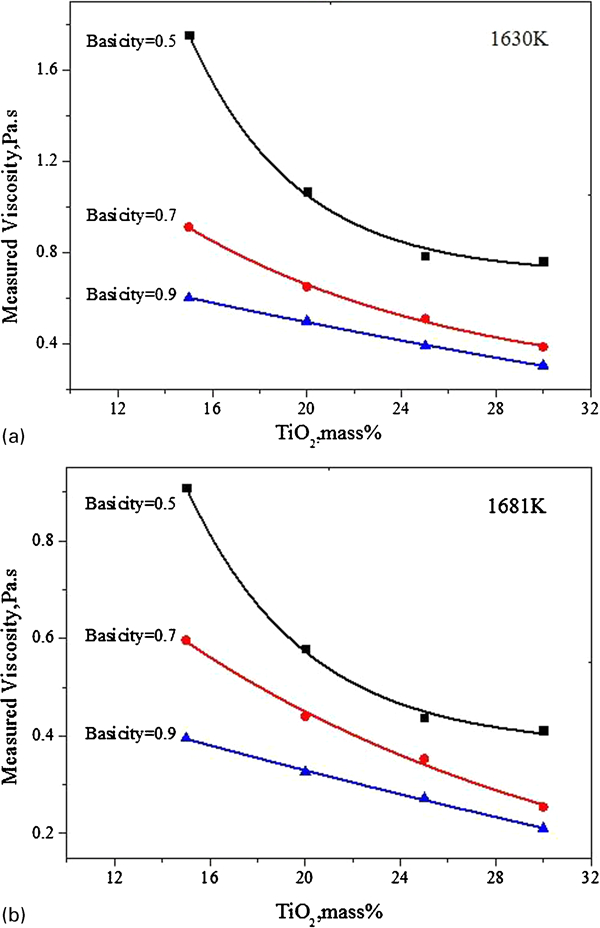
Effect of TiO2 concentration on viscosity of CaO–SiO2–7MgO–TiO2–12Al2O3 (wt-%) at a 1630 K and b 1681 K
Effect of basicity on viscosity
Figure 4b
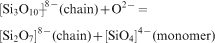
shows the apparent activation energy for viscous flow versus basicity. It was found that the apparent activation energy decreased with increasing basicity, suggesting that the structural units for viscous flow of slags become smaller and simpler with increasing basicity. In general, it is well known that an increase in basicity results in the decrease in slag viscosity because the silicate structure changes from a three-dimensional network to chains or rings as basic oxides (such as MgO and CaO) increase. For example, the depolymerisation reaction of [Si3O9]6− ring units is described by the following equations9


Estimation of viscosity
A number of models for predicting the viscosity of metallurgical slags have been developed in the past, such as Riboud,22 Urbain,22 NPL23 and Iida et al.
24 These theoretical models are generally classified into four types, i.e. statistical mechanical theory, hard sphere theory, theory of corresponding states and semiempirical and empirical models. Among these models, the semiempirical and empirical models have been widely developed over the past decades, which are generally expressed in the form of the Arrhenius equation or Weymann–Frenkel’s equation (equation (1)). The estimated viscosities of slags containing TiO2 have been evaluated using these various models, such as Riboud and Urbain models, which are suitable for the prediction of viscosity of slags containing TiO2. It should be pointed out that these two models are based on Weymann–Frenkel’s equation, and TiO2 was treated as network former in the Riboud model, while TiO2 was treated as network modifier in the Urbain model. Thus, the efforts in the present study were focused predominantly on the above two models. Figure 6 shows the comparison of the experimental data with the viscosities calculated by Riboud and Urbain models. As indicated, the agreements between the estimated viscosities by the aforementioned models and measured values show a large discrepancy. The prediction model proposed by Urbain was observed to predict a consistent trend for the slag containing different TiO2 contents, which may be due to that TiO2 was classified as a modifier (basic oxide). This is consistent with the previous analysis, as shown in the section on ‘Effect of TiO2 on viscosity of Ti bearing slags’. It should be pointed out that the Urbain model is based on the CaO–Al2O3–SiO2 system, which is generally given by the following equation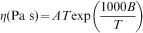

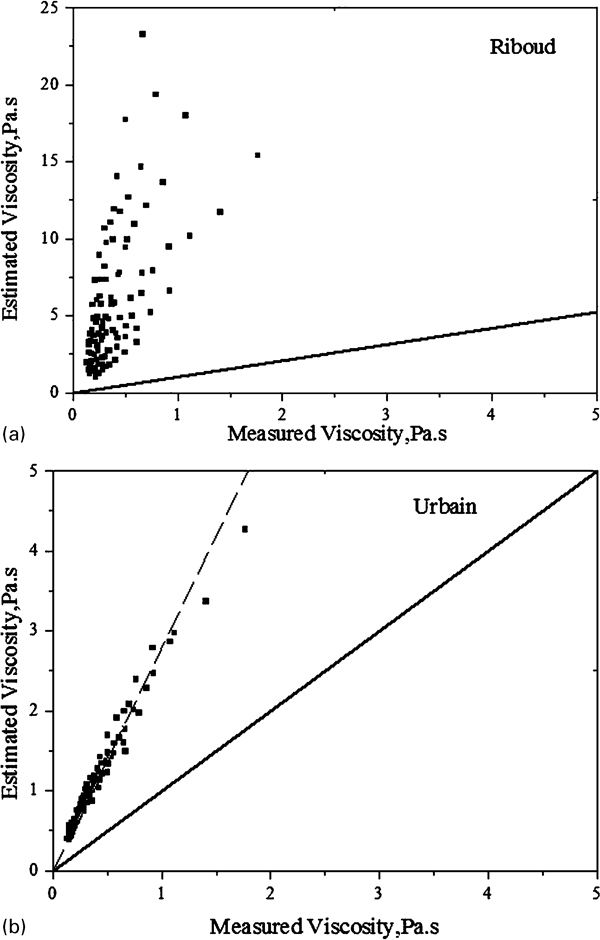
Viscosity estimated by models as function of measured viscosity
glass formers 
modifiers 
amphoterics 
The normalised values of 








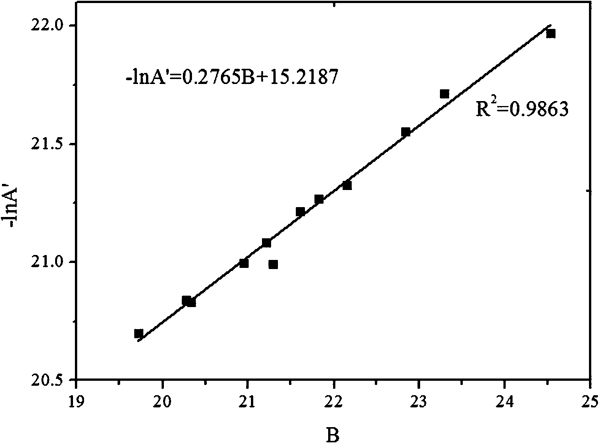
Relationship between −ln A and B of modified Urbain model
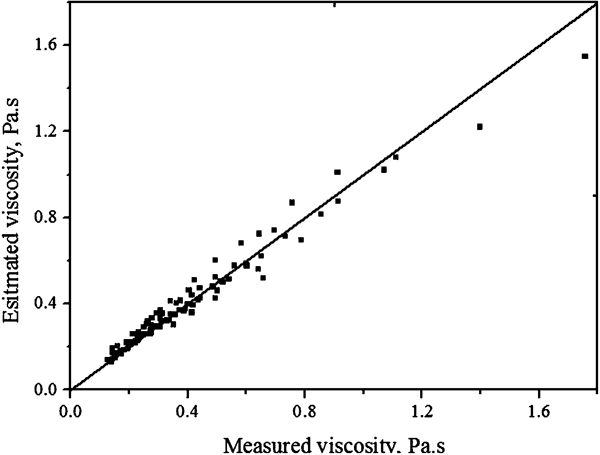
Viscosity estimated by modified Urbain model as function of measured viscosity
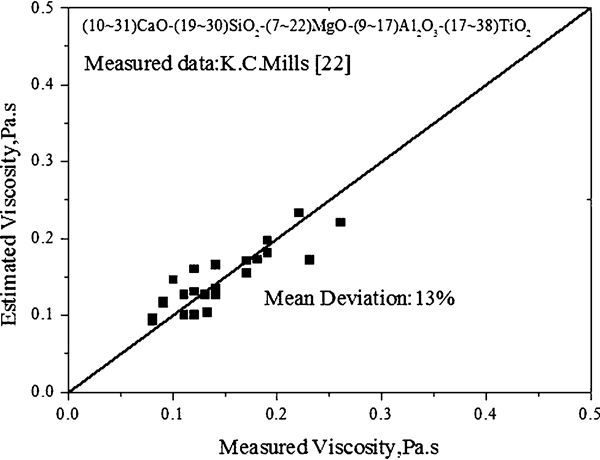
Viscosity estimated by modified Urbain model as function of measured viscosity
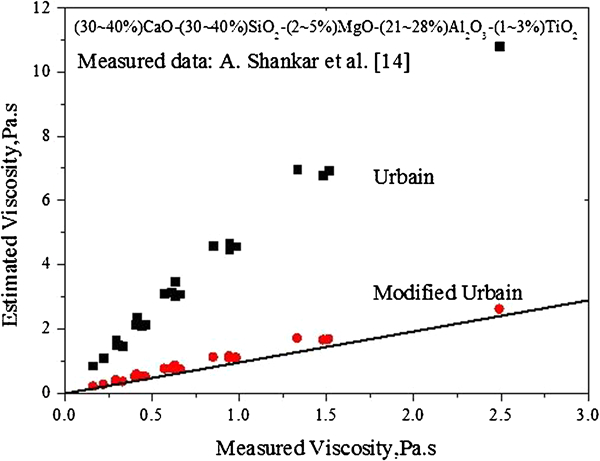
Viscosity estimated by modified Urbain model as function of measured viscosity
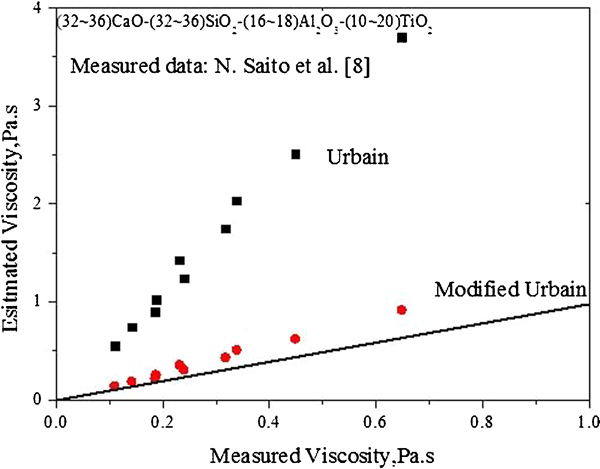
Viscosity estimated by modified Urbain model as function of measured viscosity
Conclusions
The influences of TiO2 and basicity on the viscosity of CaO–SiO2–MgO–Al2O3–TiO2 slag system were investigated using the rotating method, and the Urbain model was modified based on the present experimental results to predict the viscosity of Ti bearing slags. The obtained results are summarised as follows.
The viscosities of these quinary slags decreased with an increase in TiO2 content. The effect of TiO2 on the viscosity diminishes in the slag with a higher basicity. The viscosity was also found to decrease with increasing basicity of slags.
TiO2 may primarily act as a basic oxide and decreases the viscosity of the slag melts in the present slag system.
The modified Urbain model based on the present experimental data can predict Ti bearing BF slags in a wide component range, including low Ti bearing slags and quaternary slags.
Footnotes
Acknowledgements
The authors would like to thank Dr Y. Y. Zhang and L. M. Hou for their help during the viscosity measurements. Financial supports from the National Natural Science Foundation of China (grant no. 50902003), the National Basic Research Program (programme no. 2007CB613608) and the Key Projects in the National Science and Technology Pillar Program (programme no. 2010BAE00316) are gratefully acknowledged.