







Abstract
In the first part of the present study, the relation between the dimension free critical capillary number Ca* and the material number Λ are introduced as a stability criteria for slag entrainment at the steel/slag interface. With the knowledge of thermophysical properties of the immiscible liquids in contact, critical values of Ca* for slag entrainment as a function of Λ could be estimated. The interfacial tension was investigated at 1823 K for carbon and Cr–Ni steels in contact with ternary slags containing CaO, SiO2, Al2O3, MgO and TiO2 using the drop weight method. The apparent interfacial tension of CaO–SiO2–TiO2 slag systems in contact with Cr–Ni steel decreases with increasing TiO2 content and was found to be influenced by interfacial area change during droplet formation at the capillary exit, slag composition and reactions at the steel/slag interface. Minimum values of interfacial tension, observed during measurements, increase the possibility for slag entrainment in the continuous casting mould.
Introduction
The entrainment of liquid mould slag in the liquid melt pool, caused by an instability of the steel/slag interface, is a source for non-metallic inclusions and reducing product quality.1, 2 The stability of a liquid/liquid interface is related to thermophysical properties like density (density of the continuous phase ρ c and density of the dispersed phase ρ d respectively), viscosity (viscosity of the continuous phase η c and viscosity of the dispersed phase η d respectively) and interfacial tension σ, of the phases in contact.3 The capillary number Ca as a function of η d /η c is a well studied stability criteria for the break-up of a droplet surrounded by a second fluid (ratio ρ c /ρ d = 1).4, 5 Increasing the Ca up to its critical value Ca* results in droplet break-up producing two or more smaller droplets. The Ca number is inversely proportional to the interfacial tension and, hence, directly affected by this property.
Various high temperature methods are available to measure interfacial tension between steel and slag.6 Depending on the method used, the values obtained have to be discussed either as equilibrium or non-equilibrium values. In industrial processes, mainly non-equilibrium conditions exist.
In the present work, dimensionless relations are used to describe the stability of a liquid/liquid interface.7 The interfacial tension as a key parameter for the stability of a fluid interface was investigated at 1823 K for low alloyed carbon and Cr–Ni steels in contact with ternary slag systems containing CaO, SiO2, Al2O3, MgO and TiO2 using the drop weight method.
Experimental
Experimental procedure
The entrainment of droplets of upper liquid in the lower one was investigated in room temperature experiments using water, and different silicon oils, to simulate a liquid/liquid interface. The experiments were performed in a Plexiglas container, and the relative velocity near the interface was generated with a rotating roller 10 mm below the interface. The development of the interface shape and the production of droplets were recorded using a high speed camera and particle image velocimetry.8
To measure σ between liquid steel and liquid slag, the drop weight method was used.9 The apparatus (see Fig. 1) used in the present study consists of a furnace, an alumina crucible with a capillary tube for molten steel (14 g) and a graphite crucible for liquid slag (35 g), a high precision balance and control unit. The measurements were conducted under argon atmosphere (argon ⩾99·999 vol.-%).
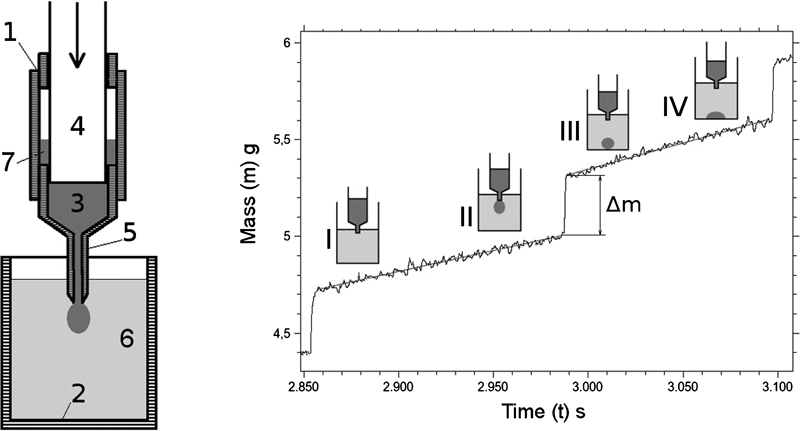
Left: Schematic of apparatus used for interfacial tension measurements: (1) alumina crucible, (2) graphite crucible, (3) liquid metal, (4) alumina cylinder, (5) capillary tube ZrO2, (6) liquid slag, (7) copper sealing, Right: weight change versus time during formation and detachment of droplet (I) and (II) droplet growth (III) weight change due to droplet detachment (IV) formation of next droplet (▵m used for calculation of interfacial tension)
Using a ceramic device (4), a droplet of liquid metal (3) is formed at the end of a capillary tube (5), which is dipped into liquid slag (6). If equilibrium between the gravitational force F
g, the interfacial tension force F
ift and the buoyancy force F
b is exceeded, the droplet drops. The weight m of the drop detached from the capillary correlates with σ between the two liquids. Figure 1b
shows a typical weight change during formation and detachment of the metal droplet in liquid slag. The weight change after droplet detachment is related to interfacial tension σ by equation (1)10,
11



In the literature,12, 14 droplet frequencies smaller than one per minute have been used for estimation of surface tension σ. In order to ensure the droplet formation in equilibrium in these experiments, σ was measured as a function of volumetric metal flow V. A high precision step motor was used to change V between 25 and 75 μm3 min−1 resulting in time differences between detachments of two droplets of 200–70 s. In the range of V = 25–75 μm3 min−1, σ is independent of V. In the present work, this range was used to realise droplet formation with respect to capillary corrosion.
After the capillary is immersed in the slag, corrosion processes start, so by ensuring a steady metal flow in the capillary, the effect of corrosion on droplet formation can be diminished. Corrosion leads to an increase of r depending on slag composition and contact time t. The contact time was therefore limited to several minutes.
Experimental materials
In room temperature experiments, pure water and silicon oils with viscosities between 0·0006 and 0·4850 kg m−1 s−1 were used as reported previously.8 The interfacial tension between these oils and water varied in a very small range.
Two types of steel were used for the measurements, a low alloyed carbon steel ST1 and Cr–Ni steel, ST2 (see Table 1). The slag samples were prepared by melting powder mixtures consisting of measured quantities of its components in a graphite crucible. The compositions of the slags used are listed in Table 2 (see Chapter 3).
Composition of investigated steels
Composition of investigated slags and measured interfacial tension (average values of six droplets for each experiment) between steel and slag at 1823 K
Results and discussion
Stability criterion for slag entrainment
Two stratified immiscible liquids of different densities ρ
d (density of upper liquid) and ρ
c (density of lower liquid) with ρ
d
<ρ
c, form a liquid–liquid interface. In static equilibrium, the state of the stress at the interface can be described by the Young–Laplace equation (4)15
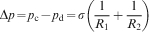
The capillary number is defined as Ca * = u crit. ηcσ −1 when material properties are given, and the material number is defined as the ratio of kinematic viscosities Λ = ν d/ν c of the two liquid phases. These dimension free numbers represent a stability criterion for a liquid/liquid interface exposed to a shear stress.
The break-up of droplets of one fluid surrounded by another with a density ratio ρ
c/ρ
d equal to 1·0 is a function of Ca and viscosity ratio η
d
/η
c describing a stability criterion for stable and unstable droplets.16 For steel–slag systems, the density ratio ρ
c/ρ
d is 2·5, and this value should be taken into consideration. Model investigations with varying properties of immiscible fluids were conducted in order to describe the relation between Ca
* and the Λ for liquid–liquid systems of varying properties without mass transfer.17,
18 Using the Froude–Weber similarity criterion,19 the measured critical velocities u
crit. were related to the conditions near the steel/slag interface in the industrial continuous casting mould. Equation (5) presents the developed relation between Ca* and Λ for entrainment of the upper phase from a liquid/liquid interface.8

Slag/metal interfacial tension
In the present study, the interfacial tension σ at 1823 K between low alloyed carbon and stainless Cr–Ni steel and liquid slags was investigated with respect to the effect of slag composition and, therefore, the impact on the stability of the steel/slag interface due to slag entrainment.
The average value of the interfacial tension according to the first six droplets was evaluated as apparent interfacial tension. The values of interfacial tension between low alloyed steel ST1 and ternary slags for different slag basicities (CaO/SiO2) are shown in Table 2. It is seen that the value of σ increases with increasing slag basicity (B1–B4). This tendency is similar to values published for liquid Fe–C in contact with CaO–SiO2–Al2O3 slags.20
With increasing slag basicity, the sulphur adsorption at the steel/slag interface decreases, leading to higher values of σ. The interfacial tensions for the investigated slags (CaO/SiO2 = 0·7) in contact with ST2 are between ∼800 and 880 mN m−1 at different TiO2 contents and for ST1 steel between 993 and 1064 mN m−1 depending on slag basicity. Both steel–slag systems have to be evaluated separately because of the different contents of sulphur and alloying elements in steels and different compositions of slags. A decreasing effect of chromium and nickel on σ for Fe melts in contact with CaO–SiO2–Al2O3 was reported by Sun et al. 21 X-ray sessile drop measurements22 of σ between steel (22Cr–5Ni) and a commercial mould flux 35SiO2–31CaO–2·3MgO–6Al2O3–11Na2O–4F was estimated to be 870 mN m−1. These values are similar to ST2 in contact with ternary slags (CaO/SiO2 = 0·7) in the present study (compare Table 2).
Compared to the basic mixture G, the addition of Al2O3 (A1 and A2) decreases σ between Cr–Ni steel and ternary slag (compare Table 2). This follows the trend for alumina additions to slags in the system CaO–SiO2–Al2O3, which causes a slight decrease in slag surface tension.23 The droplet formation for ST2 in contact with slag A1 was observed to be very unstable, resulting in a high standard deviation of the measured σ values.
Increasing the MgO content of a CaO–SiO2 slag up to 10% results in a slight decrease in σ. A sharp decrease in interfacial tension between molten iron and CaO–SiO2–MgO–Al2O3 was reported by Park et al. 24 for more than 20%MgO addition. The decrease was related to solid MgO particles accumulated around the interface. In this case, there are two liquid phases separated by a solid phase. However, in the present study, the compositions studied are far away from MgO saturation, and consequently, the formation of solid particles can be excluded.
Sharan and Cramb25 measured σ for a Fe–20 wt-%Ni alloy in contact with a CaO–SiO2–TiO2 slag with increasing TiO2 content at 1823 K. An addition of 10%TiO2 resulted in a decrease of σ to 1089 mN m−1. The average σ values of the interfacial tension in the present study for ST2 in contact with T1 and T2 are 836 and 803 mN m−1; however, the minimum σ values are much smaller (compare Fig. 3 and Table 3).
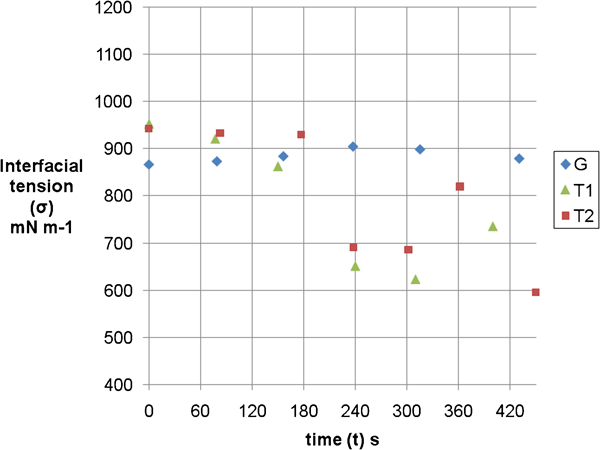
Comparison of interfacial tension as function of time for droplet generation of ST2 in contact with CaO–SiO2 slag and increasing TiO2 content; t = 0 is equal to first detached droplet
Calculated values of density,28 viscosity29 and lowest measured interfacial tension values of investigated steel–slag systems at T = 1823 K; values of Λ are calculated using published relation30 at 1823 K for steel density and viscosity (0·005 Pa s);31 Ca values calculated from measured material properties with u = 0·3 m s−1 and critical Ca* values calculated using equation (5)
In Fig. 3, the interfacial tension σ is plotted as a function of time for the generation of one droplet within the first six for CrNi steel ST2. The interfacial tension remains constant up to 420 s droplet generation time in contact with SiO2–CaO slag and decreases with high TiO2 slag content. The drop by ∼200 mN m−1 occurs after 200 s. At droplet generation time higher than 300 s, the deviation in the measured values increases strongly. This change of the interfacial tension with TiO2 content and with contact time indicates the running reactions between both phases. Gradients of element concentration on both sides of a steel/slag interface are reported by different authors, which indicate the exchange reactions. 26 26,27
Mass transfer at steel/slag interface
Gaye et al. 32 listed a number of reactions among liquid, metal and slag causing a drastic decrease in σ. They observed a progressive lowering of interfacial tension when metal and slag were brought into contact, followed by recovery of high σ. In most cases, the reactions corresponded to reduction of the slag with strong deoxidisers dissolved in the metal phase. Oxygen from SiO2 oxidises Cr, Mn from liquid Cr–Ni steel.33 For the steel–slag system ST2-G, droplet formation is not influenced by the reactions mentioned above, explaining the stable behaviour of σ as a function of time (see Fig. 3). For V<75 μm3 min−1, the reactions at the interface may occur, but the equilibrium during growth of the interfacial area is not disturbed. However, an increasing TiO2 content in the slag leads to a destabilisation of droplet formation. For the Cr–Ni steel in contact with CaO–SiO2–TiO2 slags containing more than 3%TiO2, the reactions taking place at the interface and the resulting concentration gradients lead to non-equilibrium conditions during the growth of the droplet. X-ray sessile drop measurements of liquid Fe immersed in a CaO–Al2O3–SiO2 slag indicated that after 60 min. the equilibrium σ values were reached.25 In the present study, the droplet formation time was in the range of 70–200 s, and hence, the measured interfacial tensions are considered as non-equilibrium values.
Looking to the stability criteria for droplet separation, the values of the capillary and material number were calculated using measured and estimated properties. Assuming a metal flow velocity of u = 0·3 m s−1 in the vicinity of the steel/slag interface in the industrial casting mould,34 the estimated Ca values are in the range of 1·8–2·4×10−3. These values are lower compared to the critical values of Ca* calculated applying equation (5). Under these conditions, the steel/slag interface should be stable, and slag entrainment should not occur.
However, reactions at the steel/slag interface would cause a local decrease of interfacial tension.35, 36 A decrease in σ below 0·4 N m−1 would raise the corresponding Ca number to the critical value, and the interface becomes unstable, leading to slag entrainment.
Error of estimation
Before the experiment, the capillary radius r was measured. Experimental uncertainty analysis was conducted using u(m) = 0·005 g, u(r) = 0·005 mm and u(V) = 5 mm3. For m = 0·4 g, r = 0·615 mm and V = 77 mm3, the systematic error u(σ) was calculated to be ±15 mN m−1. Considering the systematic and random values, the error is assumed to be 5% (±50–80 mN m−1) of the absolute value. For the investigated slag systems (CaO/SiO2 = 0·7–1·1), it is possible to assume a linear increase in r with 0·05 mm for the first 600 s starting with the first contact with liquid slag.
Conclusions
The Ca number as a function of Λ was introduced as a stability criterion for droplet break-up at a liquid/liquid interface. Decreasing interfacial tension increases the value of the Ca number and decreases the stability of the interface. Therefore, this controlling parameter was experimentally estimated for different slag and steel compositions. The drop weight method was used to measure the interfacial tension. The interfacial tension of carbon steel increases with increasing slag basicity from 996 to 1064 mN m−1. The interfacial tension of Cr–Ni steel in contact with CaO–SiO2 slags with CaO/SiO2 = 0·7 was found to be 884 mN m−1. MgO and Al2O3 additions up to 10% cause a slight decrease in σ. The values of σ for Cr–Ni steel in contact with a CaO–SiO2–TiO2 slag decreases with increasing TiO2 content, and droplet formation becomes unstable. The error of the estimation was calculated to be ∼5% of the absolute value.
The Ca numbers of the investigated steel–slag systems were estimated to be in the range of 1·8–2·4×10−3, and therefore, slag entrainment should not appear under these conditions.
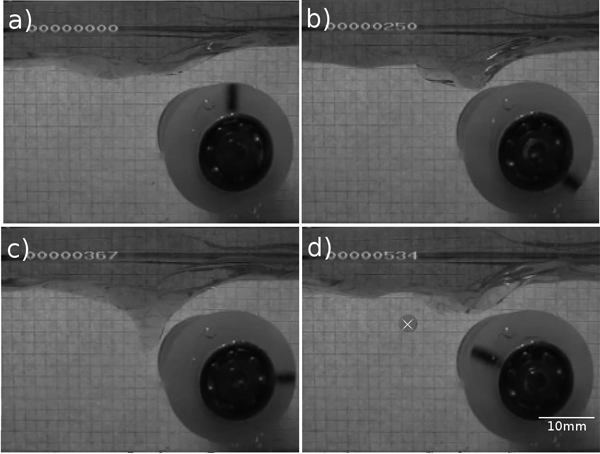
Drolet separation from upper liquid by increasing Ca number via increasing velocity near interface, a throught c deformation of interface due to increasing rotation rate of the roller, d droplet detachment at critical rotation rate
Footnotes
Acknowledgements
Parts of this research were supported by the DFG (German Research Foundation) research funding organisation under project no. 051201019. This is gratefully acknowledged. The author also wishes to thank Mr D. Dorogokuplia for performing the measurements.
This article is part of a special issue on: Sustainable high temperature metallurgical processes and engineering materials recycling techniques