







Abstract
Network Rail is involved in a number of initiatives to reduce rolling contact fatigue (RCF) crack initiation on wheels and rails on the GB network. One of these is the trial of premium grade rail materials to determine whether they provide enhanced resistance to RCF crack initiation. The sites where trials have been undertaken have been selected to comprise a range of track and traffic conditions, and were regularly monitored. This paper describes the results from one of these trial sites, on a tight radius curve, where it was found that the risk of RCF actually increased with the use of premium grade rail. It is shown that, although this was initially considered surprising, it is consistent with the current understanding of the mechanisms of RCF initiation. This demonstrates that premium grade rail steels may not always be the best solution to prevent track damage and that careful consideration of the track geometry, operating conditions and traffic should be taken when considering the most appropriate rail grade to select for use at a given location.
Introduction
In the UK a number of studies 1–3 have employed detailed site investigations coupled with vehicle dynamics simulations of vehicles running over those sites to correlate predicted wheel/rail interaction forces with observed locations of rail surface damage. This has increased understanding of the forces and mechanisms responsible for different forms of rolling contact fatigue (RCF) damage and resulted in the development of a model to predict RCF. This model utilises the frictional energy (referred to as Tγ, the product of the tangential creep forces and creepages in the contact patch) which is dissipated as a vehicle steers around a curve or track alignment variations, and is illustrated in Fig. 1. The shape of the damage function reflects the competing damage mechanisms of wear and crack growth due to the forces in the contact patch. 4 At low rates of frictional energy dissipation the forces are below the fatigue threshold for the material so no damage develops; on curves where higher levels of energy dissipation occur RCF cracks can form by a ratchetting process; 4 and at very high levels of energy dissipation the rate of removal of material from the surface due to wear exceeds that due to ratchetting damage so the net effect is a reduction in RCF crack initiation risk, denoted by a negative slope to the damage function.
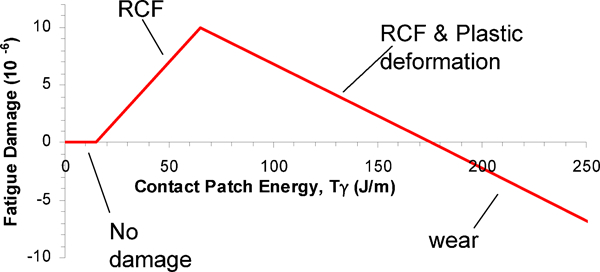
Rolling contact fatigue crack initiation model showing how the risk of crack initiation varies with frictional energy T γ dissipated in the contact patch
In most curving situations the tangential forces generated in the contact patch are as depicted in Fig. 2a . The leading wheelset has moved laterally towards the outside of the curve and generates an angle of attack (AOA) to the rail. Owing to the small difference in rolling radii between the left and right wheels that this causes longitudinal forces are generated in the contact patches on the left and right wheels and act in opposite directions to each other. These are the forces which act to steer the wheelset round the curve. The forces on the leading wheelset are nearly always greater than those on the trailing wheelset of each bogie, and in most situations where RCF is generated it is the forces on the leading wheelset of each bogie which are above the fatigue threshold, whereas the forces on the trailing wheelset are below the threshold, as shown in Fig. 2b . This difference in forces between the leading and trailing wheelset is characteristic of curving behaviour for most bogies. 4
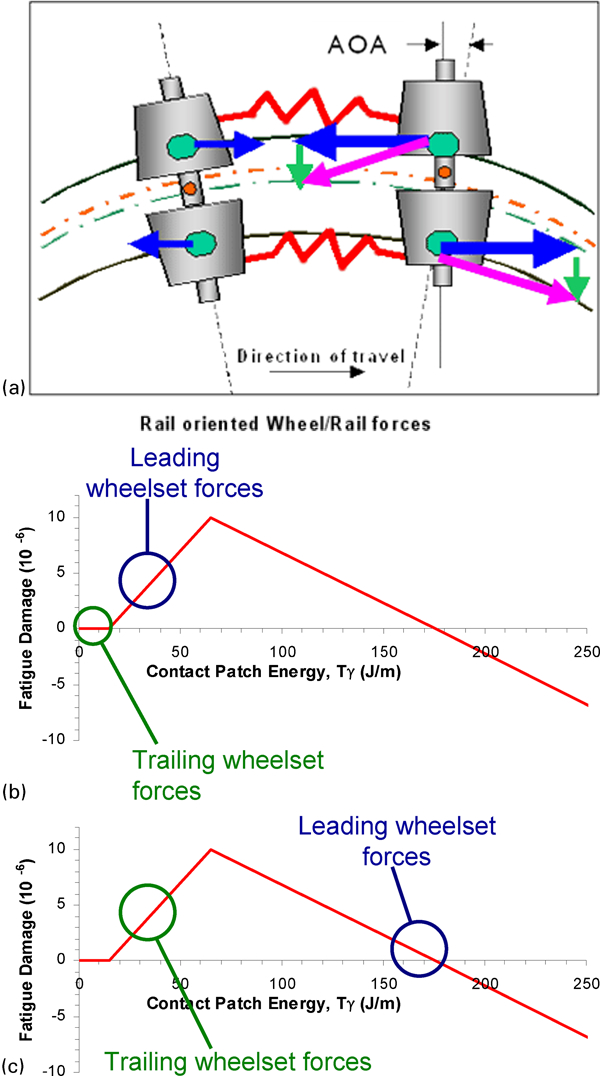
a direction and relative magnitude of forces on each wheel in typical curving situation; b resulting contact patch energy on moderate radius curve where RCF is generated on high rail; c resulting contact patch energy on tight radius curve where low rail RCF is generated
On tight radius curves the longitudinal and lateral forces generated in the contact patch increase on both wheelsets, but the leading wheelset still generates the highest forces as it needs to do more work to steer the bogie round the curve. In this case the forces causing damage are often as depicted in Fig. 2c : the forces on the trailing wheelset are now above the fatigue threshold, causing RCF to form but the forces from the leading wheelset are much higher and, according to the RCF model in Fig. 1, are more likely to be causing wear than crack initiation. In such situations it is usually the low rail of the curve which experiences most damage. The appearance of this type of damage, of which typical examples are shown in Fig. 3, is caused by the combined effect of the trailing wheelset causing RCF initiation and the leading wheelset applying larger forces which generate plastic deformation and wear, resulting in spalling of material from the rail head around the crack-like defects. 5
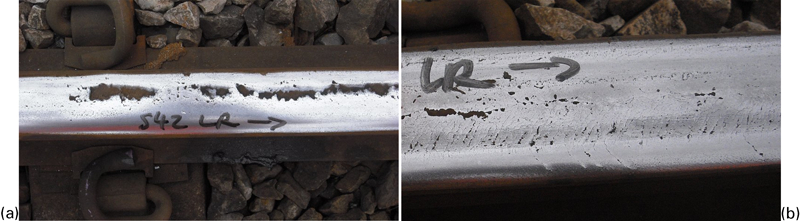
a plastic flow and spalling on surface of field side of rail; b spalling around RCF cracks on gauge shoulder
Premium grade rail site trials
One of the initiatives currently being trialled on the GB network to reduce RCF is the use of premium grade rail steels to improve the resistance to crack initiation of rail material under the action of the forces which it is required to support. Although laboratory tests can be undertaken to demonstrate the improved resistance of such materials to wear and fatigue under small-scale rolling contact conditions, they cannot replicate the in-service performance where the loads, contact and operating conditions are more varied from those which can be generated during testing in a laboratory environment. Network Rail therefore initiated a controlled series of in-service trials of premium grade rail materials, at a number of sites, to test the performance of the material under a range of track geometries and traffic conditions.
One of the trial sites was a 250 m radius curve which experienced an equal mix (by tonnage) of relatively lightweight passenger diesel multiple unit and laden freight traffic. The low rail of the curve had a history of extensive spalling of material from the rail head, as shown in Fig. 3, and was subject to regular grinding to remove the damage and restore the profile. This rail had a typical service life of 5 years before requiring replacement, the profile also experiencing a severe degree of flattening and plastic flow to the field side during this time, as shown in Fig. 4. The high rail of the curve had no history of wear or RCF and the gauge face of the rail was protected from wear by a lubricator located in the entry transition to the curve.
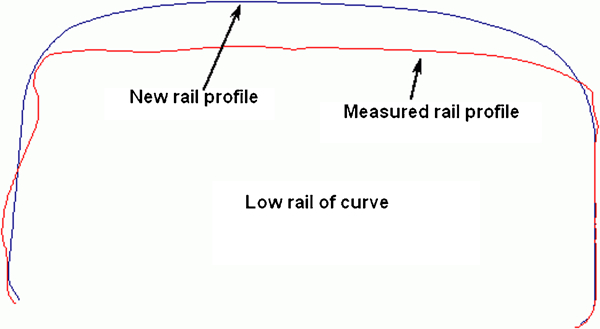
Comparison of rail profiles of normal grade rail from low rail of curve, after 5 years in service, showing extent of flattening and plastic deformation that rail has experienced
As part of the trial both rails in the curve were replaced with a premium grade material, except for a short section on the low rail of the curve, which contained an insulated bolted joint and which was renewed with normal grade rail. This section of rail provided a useful direct comparison of the performance of the two materials as they would both be subject to identical traffic conditions.
Regular monitoring of the curve was undertaken to observe and measure the development of any wear and damage. However, it quickly became evident that, although the premium grade rail was providing improved performance on the low rail of the curve, this was not true on the high rail.
Low rail performance
After only a relatively short time in traffic the performance of the premium grade rail on the low rail showed a marked improvement over the section of normal grade material in the curve. Following 9 months of traffic there was clearly more plastic deformation of the normal grade rail, as shown in Fig. 5. Figure 5a shows that the running surface of the normal grade rail is wider than that on the premium grade rail due to plastic deformation of the rail towards the field side, which is also evident when comparing the rail profiles (Fig. 5b ), illustrating the enhanced ability of the premium grade rail to resist the high lateral forces imposed on this particular curve.
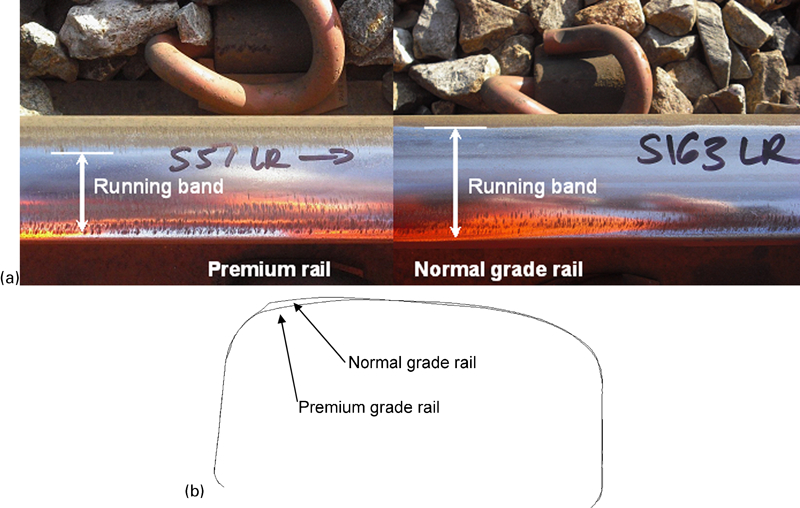
Comparison of plastic deformation of normal and premium grade materials on low rail of curve after 9 months in service showing a wider running surface exhibited with normal grade rail due to plastic flow it has experienced and which is evident in b change in rail profile
The section of normal grade rail had also started to develop RCF and spalling, as shown in Fig. 6a , while the premium grade rail did not (Fig. 6b ). Grinding marks on the rail head, from grinding which took place soon after installation, were still visible on the premium grade material but not on the normal grade, indicating the enhanced resistance to wear of the premium grade rail material.
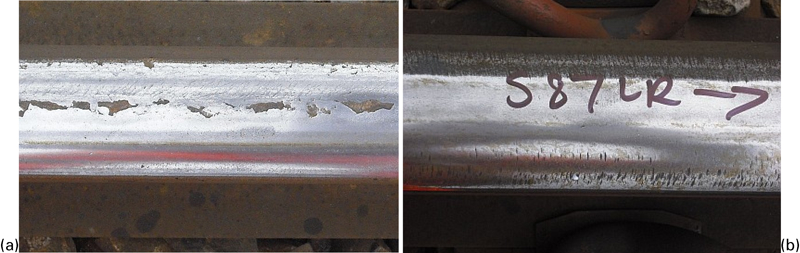
a section of normal grade rail which exhibits RCF and spalling on field side, and where grinding marks have worn away; b premium grade rail which exhibits no evidence of RCF and grinding marks still clearly visible on gauge corner
High rail performance
The high rail of the curve, relatively rapidly after installation, started to exhibit RCF cracks on the gauge corner of the rail, as shown in Fig. 7. Rolling contact fatigue had not been a problem on this curve previously, so it was not anticipated that it would be a problem with premium grade rail. It was also observed that the RCF developed very low on the gauge corner of the rail rather than further towards the gauge shoulder area where RCF usually appears on normal grade rail. Comparison of the rail profile shapes with those measured on the normal grade rail before installation of the premium grade rail (Fig. 7b ) showed that there was very little difference in shape between the two, indicating that there was not a significant difference between the contact conditions for the two rail materials that could explain an increase in wheel/rail forces that might lead to the initiation of RCF.
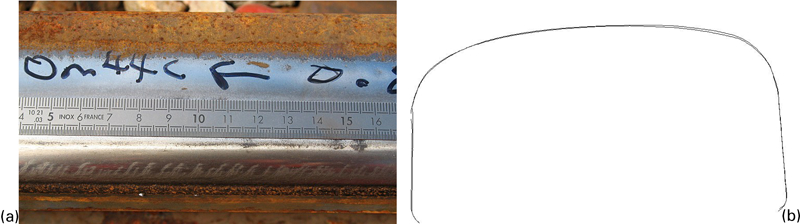
a formation of RCF on gauge corner of rail; b comparison of rail profiles showing very little difference between those of normal and premium grade materials
Although use of a premium grade rail had shown a significant benefit in reduced wear and damage on the low rail of this curve, even after only a short period in service, its use on the high rail had introduced a damage mechanism which had not previously been a problem.
Discussion
Although the premium grade rail was found to perform significantly better on the low rail of the curve with improved resistance to plastic deformation and RCF, offering an improvement in rail life and a reduction in maintenance costs, its performance on the high rail was quickly observed to be worse than that of normal grade rail. An explanation for this reduction in performance for the high rail of the curve was obtained by considering the RCF damage function, shown in Fig. 1, and the forces generated in the wheel/rail contact patch.
The damage function (Fig. 1) is a property of the rail material, describing its propensity to initiate RCF cracks as different tangential forces are applied within the contact patch. Use of premium grade rails therefore requires the development of a new damage function. Figure 8 shows two versions of the damage function: one developed for use with normal grade rail material and a second, developed from theoretical consideration of the differences between the material properties of the normal and premium grade rails, as a proposed function for premium grade rail. The validation of this form of the function from the data collected during the site trials is an important part of the project as it allows the identification of the conditions under which premium grade rails offer the biggest benefit over normal grade rails.
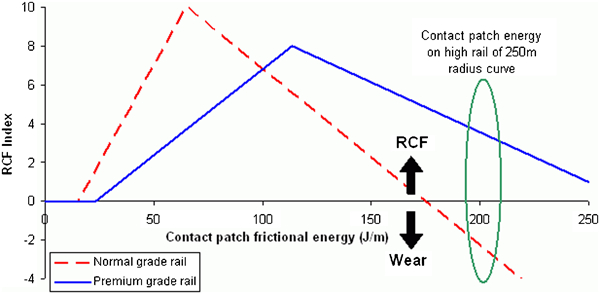
Comparison of damage functions for normal and premium grade rails showing that under high contact patch forces, use of premium grade rails can cause damage mechanism to change from one of wear, on normal grade rail, to RCF on premium grade rail
Considering the behaviour of the vehicles running over this curve, Fig. 8 shows that the wheel/rail steering forces are above the point of transition from RCF to wear damage for normal grade rail. Therefore, wear is the dominant damage mechanism on normal grade rail on the high rail, and this is mitigated with the lubricator installed on the entry transition to the curve. However, the damage function for premium rail steel in Fig. 8 shows that the transition between RCF and wear now occurs at contact patch forces which are higher than those being experienced on this curve, and the damage function for the premium grade rail predicts that RCF cracks can still be initiated under these contact patch forces. The damage mechanism on this curve has therefore changed from wear to RCF with the change of rail material, which requires different maintenance strategies. This also helps explain why RCF develops so far down the gauge corner towards the gauge face of the rail on the premium grade rail: RCF develops with higher contact patch forces than normal grade rail, and those forces are only generated further down the gauge corner of the rail where the rolling radius difference between the two wheels on an axle, and therefore the creep forces in the contact patch, are higher.
Using the differences between the two damage functions shown in Fig. 8 it is possible to identify the circumstances where premium grade rail steels will be of benefit in reducing rail damage, helping to set rail grade selection criteria. This is illustrated in Fig. 9 which highlights the regions where the RCF damage function is below or above that for normal grade rail. Also shown on the graph are the approximate radii of curves where particular magnitudes of contact patch energy are generated, and therefore associating curve radii with RCF damage. These curve radii can only be considered approximate since the actual forces generated, and therefore the propensity to initiate RCF, will depend on the suspension characteristics of the vehicles, the wheel and rail profiles at the site, and the operating cant deficiency of the vehicles on the curve. However, it is possible to identify that there will be a range of curves (A in Fig. 9) where the use of premium rail steels will eliminate RCF because the forces are below the fatigue threshold of the premium grade rail but above that of normal grade rail. There will also be a region (B) where, although RCF will still initiate in premium grade rails it will develop slower than in normal grade rails, a region (C) where premium grade rails may initiate RCF faster than normal grade rails, and (D) where, as observed on this trial site, RCF is initiated where it will not be a problem for normal grade rails.
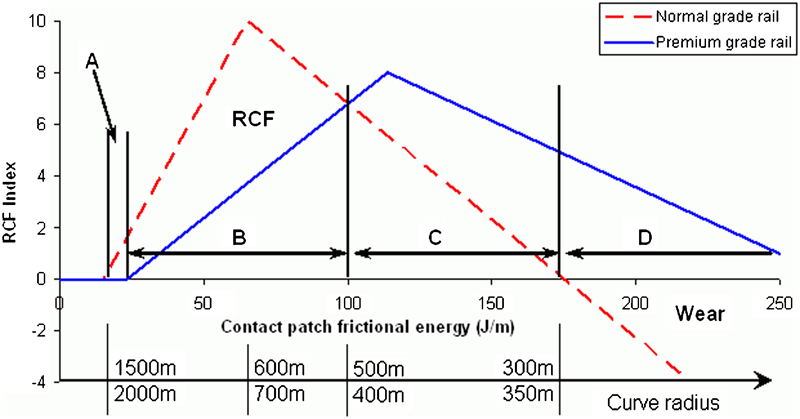
A: premium grade rail will eliminate RCF; B: premium grade rail will reduce RCF; C: premium grade rail may initiate faster than normal; D: RCF will be problem on premium grade rail
Conclusions
Premium grade rails are currently being trialled on a number of sites on the GB network. At one of the sites, on a tight radius curve, the use of the material has greatly improved the rail life and eased the management of the rail on the low rail of the curve, but has introduced RCF onto the high rail, where it has not previously been a problem.
This phenomenon can be explained by considering the differences between the RCF crack initiation and wear characteristics of the two materials, and identify the range of conditions where premium grade rails may perform worse than normal grade rail materials in terms of RCF resistance.
This has illustrated that premium grade rails are not a solution to all RCF problems, but allows the range of curves where they will be of benefit to be identified, allowing infrastructure managers to select the most appropriate grade of material for a particular curve geometry and traffic mix.