







Abstract
A model for density calculation of multicomponent slags was developed in the present work. This model is an extension of a previous model proposed by the present author. Density values of molten slags were calculated from molar volume values, which were calculated from molar volume of pure component and mixing molar volume. Mixing molar volume is correlated to differences between reciprocals of optical basicities of network forming oxides and those of network modifying oxides. Charge compensation for AIO4 5− was taken into consideration explicitly. An increase in molar volume due to Al coordination shift from sixfold to fourfold was modelled by defining molar volume of a hypothetical state of alumina in fourfold coordination in the present work. Density values of M2O–SiO2 (M = Na, K), CaO–Na2O–SiO2, MgO–Na2O–SiO2, Al2O3–CaO–SiO2, Al2O3–Na2O–SiO2 and Al2O3–CaO–MgO–SiO2 system were calculated by employing the present model. Comparisons between calculated and experimental values in literature were also made. The calculated values are in good agreement with experimental data with a mean deviation within 2%. The present work also showed that the addition of network modifying oxide with high optical basicity values would lead to a remarkable negative deviation of molar volume from ideal mixing, which could be interpreted by considering larger Si–O shortening caused by metal cations with lower electronegativity. In addition, the positive deviation for metal oxide and alumina join was also well explained in terms of molar volume increase due to Al coordination change in the present work.
Introduction
As one of the important properties of metallurgical molten slag, the density of the slag has many effects on metallurgical processes, e.g. metal–slag separation, foaming, etc. Accurate density values of molten slag are required in momentum, heat and mass transfer simulations for metallurgical processes. Knowledge of slag density is also essential to the understanding of slag structure, due to its sensitivity to structural changes. Despite the importance from a theoretical and practical aspect, experimental data for slag density are still very scarce due to many difficulties at high temperature measurements.
Models for density calculation of slag could be very useful tools to provide density values for users. Many attempts have been made to model the density of molten slag through years. 1–7 Molar volume, the reciprocal of density, is a fundamental thermochemical property and often employed to construct models for density calculation. A most quoted additive method proposed by Bottinga and Weil 1 calculates density from molar volume by employing partial molar volume of different components. In their first paper, Bottinger and Weil considered an ideal mixing of different components and used constant partial molar volumes for one component. Later, they considered further partial molar volumes of alumina–silica liquids to be composition dependent in their modified model. 2 A model in which partial molar volumes of Al2O3 and SiO2 are polynomial functions of composition was proposed by Mills and Keen 3 for density calculations of multicomponent slags. Although certain success in providing calculated data within 2% had been achieved, these models are only based on mathematical regression analysis, and structural information of slags was not taken into consideration explicitly.
The deviation from ideal mixing for molar volume has been realised by many researchers and excess or mixing molar volume has been employed to model density of silicate melts. A non-ideal model (SC) for CaO–Al2O3–SiO2, MgO–Al2O3–SiO2 and CaO–MgO–Al2O3–SiO2 melts involving an excess volume term between SiO2 and CaO was proposed by Courtial and Dingwell 4,5 and led the calculation of the liquid’s molar volume within 0·5% of uncertainties, except for Ca and Al rich compositions. Persson et al. 6 developed a model to calculated density based on correlation between relative integral molar enthalpy of mixing and mixing molar volume. The comparison between calculated and measured values showed good agreement. A method to calculate density of slag from mixing molar volumes, which is calculated using optical basicity through combining Toop–Samis thermodynamic model 7 with the method by Ottonello et al., 8 was proposed by the present author. 9 The densities of some binary MO–SiO2 (MO is divalent metal oxide) and some ternary silicate slags MO–M’O–SiO2 have been calculated using this approach to get a good agreement with experimental data. However, this model was limited in calculation of narrow kinds of silicate slags within CaO–FeO–MgO–MnO–SiO2 system and cannot be applied to calculate density of aluminosilicate slags.
An extended model to calculate density of slags containing alkali oxide and/or alumina will be presented in this work. A relationship between deviation from ideal mixing for molar volume and differences between reciprocals of optical basicity of network forming oxides and those of network modifying oxides will be established. Charge compensation of 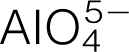
Model description
Density values of slags ρ were directly related to molar volumes according to following equation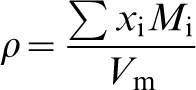
Molar volume of slag can be calculated from molar volume of pure components and molar volume of mixing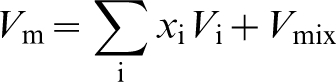
In a previous work,
9
a correlation between mixing molar volume with integral Gibbs free energy of mixing ΔG
mix were adopted as follows
A thermodynamic model proposed by Toop and Samis
7
was employed to calculate values of ΔG
mix. It was assumed in the Toop–Samis model that three types of oxygen exist in silicate melts,
10
bridge oxygen O0, non-bridge oxygen O− and free oxygen O−2 and the three oxygens are in a chemical equilibrium as follows
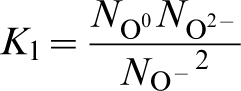


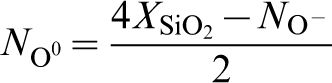




Ottonello et al.
8
correlate the equilibrium constant K
1 to optical basicity Λ
11
and obtain the following equation


Integral Gibbs free energy of mixing for binary silicate is calculated by the following equation

The optical basicity values 11 adopted in the present work were shown in Table 1. Optical basicity values for various oxides are well accepted, except values for some transition metal oxides. Direct measurement of optical basicity using UV spectroscopy cannot be performed on transition metal oxide due to strong UV absorption of these oxides. Optical basicity values can be calculated using Pauling electronegativities. 12 Some researchers also derived optical basicities of transition metal oxide according to sulphide capacities, and obtained quite different optical basicity values from those calculated by electronegativities. In the present work, optical basicity values calculated from Pauling electronegativities were adopted. It was found that these optical basicity values would provide a good fitting to molar volume deviation from ideal mixing for binary silicate. 9 Especially for slag systems containing transition metal oxide, theoretical optical basicity values from electronegativities could provide a much better measurement on deviation from ideal mixing than values from sulphide capacity. For example, theoretical values for FeO from electronegativities is 0·51, then according to equations (8)–(10), mixing molar volume for FeO–SiO2 is much weaker than that for CaO–SiO2 (because of large optical basicity values of CaO (1)), which is in line with experimental data. In contrast, optical basicity value for FeO from sulphide capacity equals to 1, which would provide apparent wrong prediction that the same departure from ideal mixing for FeO–SiO2 as CaO–SiO2 system. The possible reason for that optical basicity values from electronegativities could have very good performance on prediction of mixing molar volume could be due to that there is a good correlation between electronegativities of metal cations and length of Si–O bonds, which will be discussed in detail in the section of results and discussion. Besides, these theoretical values were successfully applied to correlating phosphorous capacities with optical basicity 13 and also provided a good description on scales of mixing Gibbs free energy according to work by Ottonello et al. 8
Optical basicity Λ values for various components
The method described above had been applied to calculate density of binary and ternary silicate melts and a good performance has been achieved. However, there exist some inherent difficulties when the method is extended to slag systems containing alumina. Application of equation (8) requires the classification of different oxides into network formers and modifiers. Alumina is a typical amphoteric oxide, which may act either as network former or network modifier. The structure role of Al2O3 in the aluminosilicate slag system has received large attention during many years.
14
It has been widely accepted that aluminium has a strong preference for tetrahedral coordination in aluminosilicate melts. 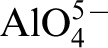

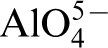
In the present work, charge compensation of metal cation on 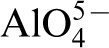
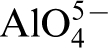
Molar volume of slag is a direct measure of atomic packing density. It is naturally considered that coordination shift of aluminium from six to four in aluminosilicate should bring corresponding change of molar volume. Very early experimental density data measured by Safford and Silverman 15 for the series Na2O–CaO–SiO2 glasses with Al2O3 added had provided clear evidence for change of molar volume due to coordination shift. Their data indicated that most aluminium is in tetrahedral coordination because partial molar volume for Al2O3 in glasses is much greater than that of corundum (in octahedral coordination).
Pure alumina which is not charge compensated and assumed to be in octahedral coordination could be denoted by Al(VI)2O3. A hypothetical state of alumina that is in tetrahedral coordination, denoted by Al(IV)2O3, could be defined in the present work for modelling of molar volume change due to coordination shift. The molar volume of Al(VI)2O3 could be obtained by experimental data for pure molten alumina, whilst molar volume of Al(IV)2O3 could be seen as a parameter that can be optimised by experimental data for molar volume of aluminosilicate slag.
The density of ternary silicate was calculated by assuming ideal intermixing of binary silicates according to method proposed by Richardson
16
in our previous work. However, this method can only be applied to silicate slag free of Al2O3. In the present work, molar volumes of multicomponent slags are calculated from molar volumes of pure components and molar volume of mixing, and molar volume of mixing values are directly calculated according to equation (10). It should be mentioned that 

Base on above analysis, the following formulas for molar volume calculation were obtained for the A2/v1O–B2/v1O–Al2O3–SiO2 system (where A2/v1O and B2/v2O are two network modifier. v1, v2 is valency of A, B respectively).
If X(A2/v1O)+X(B2/v1O)>x(Al2O3), we have


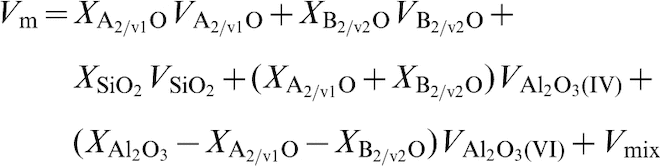
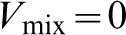
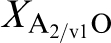
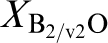


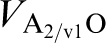
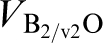

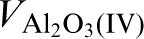
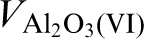
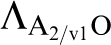
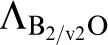


Molar volumes of pure components are assumed to be linear functions of temperature as V = V 0+αT.Temperature dependence of molar volume for SiO2 was obtained by linear fitting of density data for SiO2 due to Bacon et al. 17 Experimental data for density of CaO cannot be found in literature due to its high melting point. A large discrepancy for experimental density of FeO was found in literature data, which mainly stems from existence of some Fe3+ or iron. Hara et al. 18 measured density values of CaO–Fe2O3–FeO system and found that linear equations could describe density values in this system. Molar volumes of CaO and FeO were extrapolated from their equations. Due to the lack of experimental data, partial molar volumes of MnO, K2O and Na2O given by Mill and Keen 3 are adopted for the present model. Density data for Al2O3 due to Mitin and Nagibin 19 were employed to generate a temperature dependence of molar volume for Al(VI)2O3. The partial molar volume of MgO proposed by Bottinger and Weil 1 was adopted. Temperature dependences of molar volumes for different components were summarised in Table 2.
Temperature dependences of density for pure components (V = V 0+αT)
Results and discussion
The present model has been applied to calculate molar volume of many slag systems from binary to quaternary systems. In order to have a quantitative comparison between calculated and experimental values, mean deviation Δ between calculated and experimental values is defined according to following equation
In our previous work, 9 density values of binary systems as CaO–SiO2, FeO–SiO2, MnO–SiO2 and MgO–SiO2 were calculated and good agreement was achieved. Different λ values for different binary systems were employed. In the present work, a constant λ = 0·025 value was used to calculate density of these binary systems. Figure 1 shows the comparison between calculated and experimental values 4,20–23 for CaO–SiO2, FeO–SiO2, MnO–SiO2 and MgO–SiO2 systems. It can be seen from the figure that the calculated values agree also well with measured values. This indicates that a constant λ value is sufficient to describe deviation of molar volume from ideal mixing. It can be also seen from the figure that CaO–SiO2 system has most a significant deviation from ideal mixing for molar volume. In contrast, FeO–SiO2 and MnO–SiO2 system only have very slight departure.
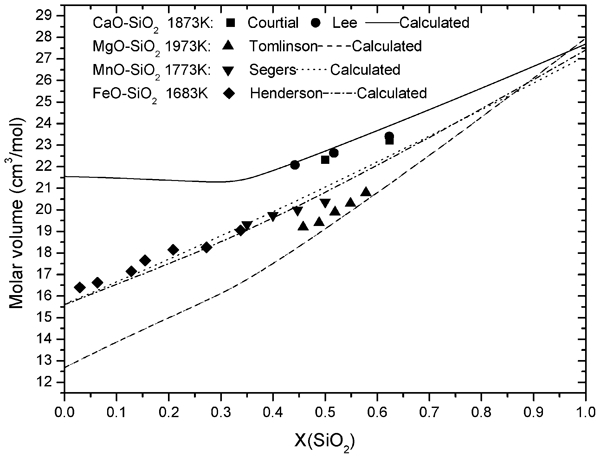
Comparisons between calculated and experimental values for CaO–SiO2, MgO–SiO2, MnO–SiO2 and FeO–SiO2 systems
Density values for some alkali silicate system, Na2O–SiO2 and K2O–SiO2 systems, were calculated using the present model. Calculated values were compared with measured values by Bockris et al. 24 As shown in Figure 2 Figs. 2 and 3, the values calculated by the present model are in good agreement with experiments. A significant departure from ideal mixing for molar volume of these systems could be also found from Figure 2 Figs. 2 and 3.
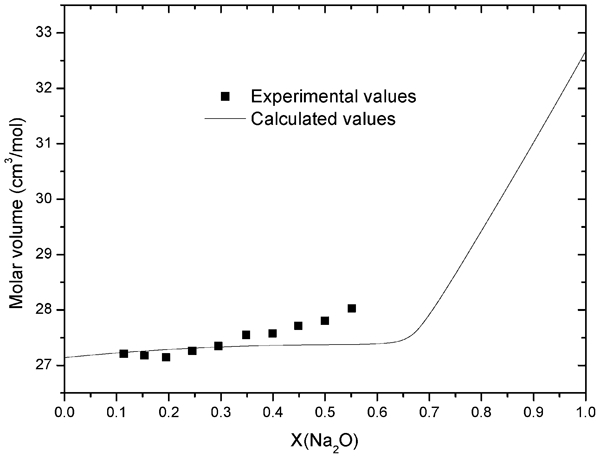
Comparisons between calculated and experimental values for Na2O–SiO2 system at 1673 K
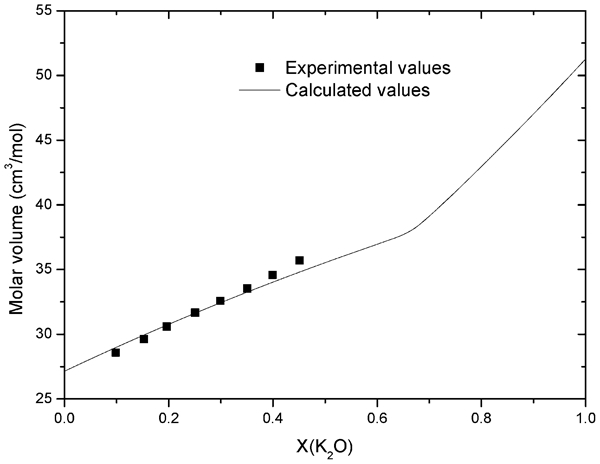
Comparisons between calculated and experimental values for K2O–SiO2 system at 1673 K
The present model was also applied to calculate the density of some alkaline earth oxide and alkaline oxide mixed silicate as CaO–Na2O–SiO2 and MgO–Na2O–SiO2 system. As shown in Figure 4 Figs. 4 and 5, the values calculated by the present model are in good agreement with experimental values. 25 The mean deviation between the calculated and experimental values is 1·2%. The values calculated by assuming ideal mixing are also shown in Figure 4 Figs. 4 and 5. It can be seen that the assumption of ideal mixing would bring larger errors for calculation.
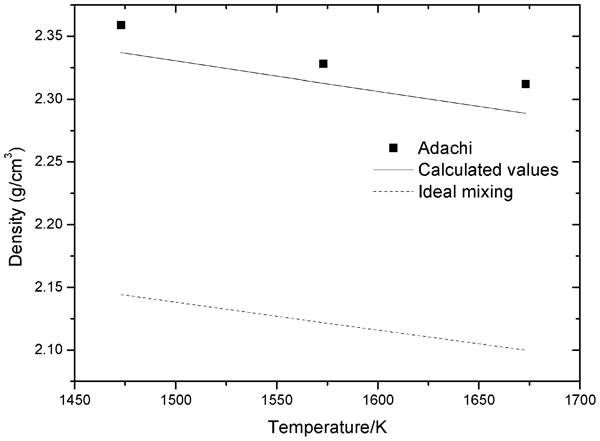
Comparisons between calculated and experimental values for CaO–Na2O–SiO2 system (9·6CaO–40Na2O–50·4SiO2 in mol.-%)
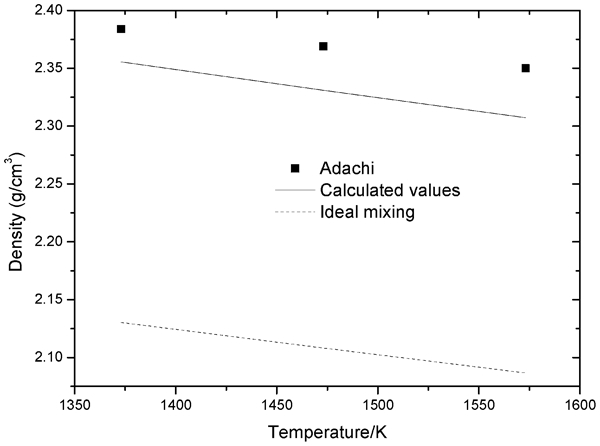
Comparisons between calculated and experimental values for MgO–Na2O–SiO2 system (9·6MgO–40Na2O–50·4SiO2 in mol.-%)
The molar volume values of some ternary aluminosilicate systems (Al2O3–CaO–SiO2 and Al2O3–Na2O–SiO2) were calculated using the present model. Experimental data for Al2O3–CaO–SiO2 system measured by Courtial and Dingwell 4 using double-bob Archimedean method with Pt or Ir bobs and crucibles, were employed for comparison. For the Al2O3–Na2O–SiO2 system, experimental data due to Riebling 26 using high temperature counterbalanced sphere viscometer–densitometer were adopted to check the performance of the present model. The calculated results are shown in Figure 6 Figs. 6 and 7. It can be seen from the figures that the calculated values are in good agreement with experimental data. The mean deviation is about 1·42% for Al2O3–CaO–SiO2 system and 0·7% for Al2O3–Na2O–SiO2 system.
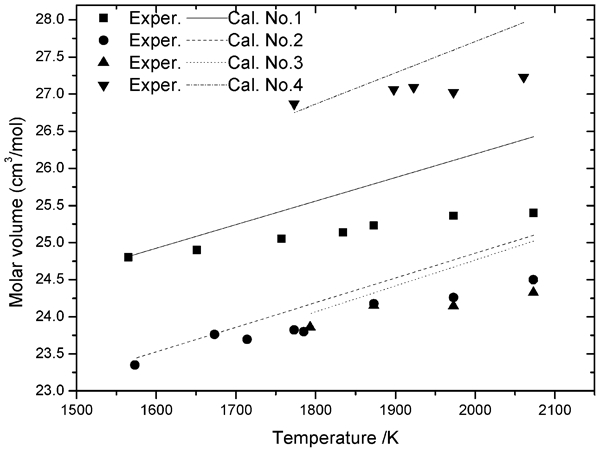
Comparisons between calculated and experimental molar volume values for Al2O3–CaO–SiO2 system (No. 1, 61·77SiO2–14·22Al2O3–23·47CaO; No. 2, 40·61SiO2–19·61Al2O3–38·35CaO; No. 3, 33·69SiO2–24·36Al2O3–41·8CaO; No. 4, 42·8SiO2–36Al2O3–20·72CaO; in mass-%)
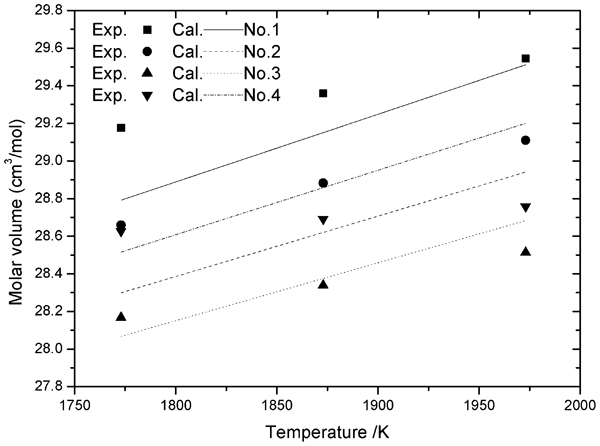
Comparisons between calculated and experimental molar volume values for Al2O3–Na2O–SiO2 system (No. 1, 60SiO2–13Al2O3–27Na2O; No. 2, 60SiO2–7Al2O3–33Na2O; No. 3, 67·2SiO2–4·9Al2O3–27·9Na2O; No. 4, 66·8SiO2–10·3Al2O3–22·9Na2O; in mass-%)
As a very important system in process metallurgy, quaternary Al2O3–CaO–MgO–SiO2 system is a base system for various types of slags, such as blast furnace slags, ladle slags, etc. The present model was also applied to calculated molar volume of this system. The experimental data by Courtial and Dingwell 5 were employed to compare calculated values with measured values. As shown in Fig. 8, the present model can predict accurate molar volume values that are consistent with experimental data. The mean deviation between calculated and experimental data for this system is 1·57%.
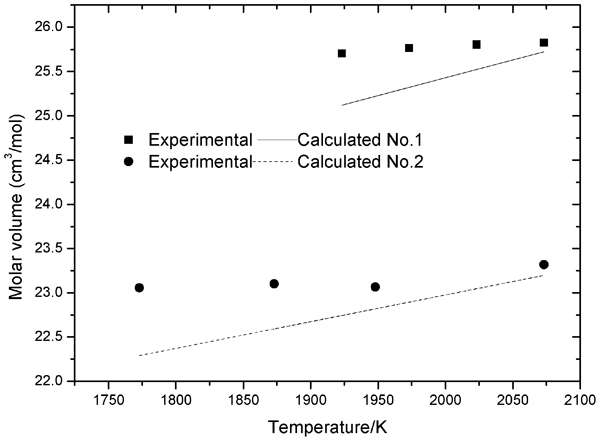
Comparisons between calculated and experimental molar volume values for Al2O3–CaO–MgO–SiO2 system (No. 1, 34SiO2–40Al2O3–16CaO–10MgO; No. 2, 43SiO2–21Al2O3–21CaO–15MgO; in mass-%)
It has been illustrated clearly in this study that there is a negative deviation from ideal mixing for molar volume of binary metal oxide–silica system. This behaviour is in line with many experimental investigations. Henderson et al. 21 measured the density of FeO–SiO2 system and found a positive deviation of density from ‘ideal density’ calculated for mechanical mixtures of FeO and SiO2. Tomlinson et al. 23 investigated the density of MgO–SiO2 and CaO–SiO2 system and found a more obvious deviation for CaO–SiO2 than MgO–SiO2.
The deviation of molar volume from ideal mixing behaviour may be related to distribution of anions in silicate melts. Molar volume of slag would be dependent on the ionic size and packing density. Variation of Si–O bond length would have some attributes on the negation deviation effect. It has been found by many crystallographic researches on silicates, that the length of Si–O bond connected to non-bridging oxygen is shorter than the bond to bridging oxygen. 27,28 This could be interpreted by the Cruickshank’s d–p π bonding model. 29 The Si–O bond connected to non-bridging oxygen has a high order of π bonding and shorter length compared to Si–O bond connected to bridging oxygen. Thus, in ametal oxide–silica system, the non-bridging oxygen brought by metal cations would decrease the Si–O bond length and thereby lead to smaller molar volume compared to values calculated by ideal mixing. Besides, the angles of Si–O–Si, Si–O–M and M–O–M would be variable with environmental of Si, which could also have some attributes on the non-ideal mixing.
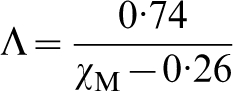
In this work, a relationship was established between negative deviation from ideal mixing and difference of reciprocal of optical basicities for network forming and modifying oxide. Optical basicity is found to correlate strongly to the deviation from ideal mixing behaviour of silicate melts. The order of the degree of deviation from ideal mixing for MO–SiO2 are CaO–SiO2>MgO–SiO2>MnO–SiO2>FeO–SiO2 (see Fig. 1), which is the same as order of corresponding optical basicity values: CaO>MgO>MnO >FeO (see Table 1).The correlation between optical basicity and negative deviation could be interpreted by bond ionicity and electronegativity of metal cations. Optical basicity values adopted here were calculated using Pauling electronegativities according to the following equation
12

Apart from negative deviation from ideal mixing for metal oxide and silicates, positive deviation was found in many slag systems with metal oxide and alumina. Experimental data for CaO–Al2O3 at 2473 K and MgO–Al2O3 at 2523 K by Elyutin et al.
30
showed a large positive deviation for molar volume. This positive deviation could be well interpreted in terms of coordination changes with composition. The introduction of metal oxide into alumina melts would lead to charge compensation of 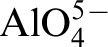
The mean deviation for the present calculations is within 2% totally, which is roughly identical to the experimental uncertainty. Although many models based on multilinear fitting can also provide calculation within 2%, the present model has a stronger structural basis and could give a clearer description for interrelation between molar volume and structure. Although deviations from ideal mixing for silicate melts have been found in many experimental works, there is no thorough modelling work and clear interpretation on these deviations before the present work.
Summary
A density calculation model for molten silicate and aluminosilicate slags, which is an extension of our previous model for silicate slags, was developed in this work. Molar volumes of molten slags were calculated using molar volume of mixing, which is correlated to differences between reciprocals of optical basicities of network forming oxides and those of network modifying oxides. Charge compensated 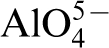
Footnotes
Acknowledgements
The financial supports from NSFC (no. 50704002 and no. 51174018) are gratefully acknowledged.