







Abstract
The Swedish steel industry has combined traditional methods such as life cycle analysis with less traditional methods such as preference analysis in order to move towards a closed steel eco cycle. The paper describes the use of conjoint analysis to study preferences of six different stakeholder groups regarding four environmental objectives (reduction in carbon dioxide emissions, reduced use of non-renewable resources, reduced use of non-renewable energy and weight reduction in products) and to identify gaps in preferences between the stakeholder groups. Our results suggested that there was a difference in preference between the stakeholder groups: respondents that were closer to the steel industry favoured all four environmental objectives, while members of public and political decision makers preferred a reduction in carbon dioxide emissions. One of the conclusions of our study is that there is a need of improved information to clients and public on the environmental benefits of product weight reduction.
Introduction
Over the last decades, the Swedish steel industry has developed its production processes to become energy efficient, to decrease environmental emissions and to raise the quality of steel products. Sustainability challenges for the industry include consumption of non-renewable resources such as ore and minerals, consumption of non-renewable energy, emission of carbon dioxide (CO2), non-return of scrap metal for recycling and loss of alloys in the residues from steel manufacture. 1–5 They also offer a more diverse product portfolio that focuses on products that bring significant sustainability benefits in the use phase. Advanced high strength steel is one example: when compared to mild steel, less steel is used to give the same functional performance. For instance, if a transport vessel such as a truck or container is manufactured using high strength steel, the payload it can carry will increase, the number of journeys required will be reduced and fuel and energy will be saved.
The Swedish Steel Producers’ Association (Jernkontoret) initiated a research programme in 2005 entitled ‘Towards a Closed Steel Eco-Cycle’ (see Fig. 1). The programme included both studies to improve the ecoefficiency of individual processes and applications (outer circle of Fig. 1) and studies involving global evaluation of the whole system (centre of figure). There were 12 different subprojects, classified into four research fields: environmental evaluation, steel utilisation, steel recycling and steel production. The environmental evaluation combined physical evaluation using life cycle analysis and material flow analysis and a study on stakeholder preferences using conjoint analysis.
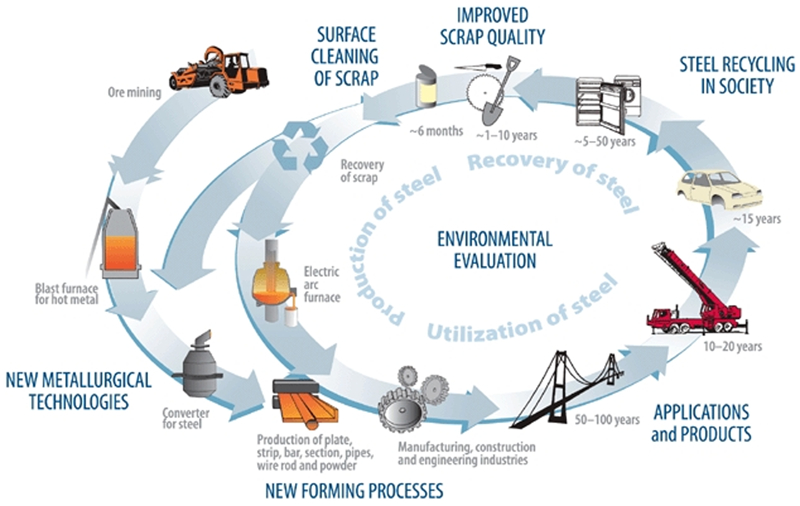
Steel Eco-Cycle research programme
For each of the 12 subprojects, four environmental objectives were quantified:
decreased use of non-renewable energy
decreased use of non-renewable resources
reduced carbon dioxide emissions
weight reduction in products.
Today, the main issue in industrial management is not only product economy and the solving of specific technical problems by improving production systems or specific product features. Instead, companies have to navigate between demands and pressure from authorities, public opinion and media regarding environment, energy and social responsibility, e.g. on working conditions. Thus, future sustainability issues will have to be based on a holistic view, simultaneously focusing on saving natural resources and energy (ecoefficient manufacturing) and on the safe use and recyclability of applications and products. 6 To succeed in meeting the environmental objectives, it is also important that the industry has good communication and cooperation with its stakeholders (both internal and external). For this reason, one of the subprojects was a study dedicated to that problem.
ISO 26000:2010 defines a stakeholder as ‘individual, group or organisation with an interest in any decision or activity of an organisation’. 7 In this study, that definition is interpreted as people or groups who have an interest in the company’s issues (for example environmental issues) and who are affected by the outcome of the company’s work. The company and its stakeholders have a mutual dependence to fulfil their goals. When strategic decisions are made, it is important to be aware of the expectations of different stakeholders. Stakeholder management has thus become an important instrument in a company’s work with environmental issues. Traditional stakeholder management includes identifying stakeholders, assessing the impact from each stakeholder group, analysing their respective interest and power of impact, prioritising the stakeholder groups and, finally, deciding on a communication/information straitegy. 8
Burchell and Cook 9 state that ‘the creation of an effective dialogue process is full of challenging barriers, but if successful, may create interesting new opportunities’. Principles such as transparency, credibility and responsiveness are crucial to successful communication.
It is important for decision makers to know about preferences and attitudes among different stakeholder groups, as increased understanding of attitudes could facilitate communication and increase possibilities for cooperation. 10,11 An attitude can be defined as ‘a psychological tendency that is expressed by evaluating a particular entity with some degree of favour or disfavour’. 12 Several methods are available to study attitudes among stakeholder groups. Attitude surveys, using questionnaires, 9 interviews and focus group discussions, 13,14 are common. Their drawback is that it can be difficult to collect sufficiently large data sets to be able to calculate differences between the stakeholder groups statistically. One important group of tools are stated preference studies. They are especially suitable when different attributes are to be weighed against each other (tradeoff). The results are then decomposed to reveal the preferences for each attribute. Usually, the time required for collecting responses is also lower. This type of study is especially suitable when one wishes to examine preferences for a phenomenon or situation that is conceptual.
In this study where preferences for environmental objectives were the focus of interest, the stated preference method of conjoint analysis was chosen. 14 A conjoint analysis study is based on a factorial design where all the attributes are varied in an ordered way. The factorial plan is often reduced to a fractional factorial design in order to keep the assessment load as low as possible for the respondent. The reduced factorial design makes the alternatives orthogonal, i.e. there is no covariation between the attributes/levels when they are presented to the respondents. Respondents are asked to assess the alternatives where attributes/levels are present. Thereby, respondents are forced to make a tradeoff between the attributes, and individual preferences can be estimated. Main effects and interaction effects can be calculated from the fractional factorial plan. The factorial effects are equal to the regression coefficients divided by two. Main effects and/or regression coefficients will specify the individual preferences. 15 The result matrix can be analysed using partial least squares regression (PLSR).
Although in most cases stated preference methods are used to evaluate specific situations, there are a few cases in the literature where a wider aim has been set. Studies where stakeholder preferences have been assessed using conjoint analysis (or related methods) include Choi and Shepherd, 16 Chung and Lee, 17 Dorow et al., 18 Kant and Lee, 19 Morgan-Davies and Waterhouse, 20 Wattage et al. 21 and Xenarios and Bithas. 22
Scope of paper
The scopes of this paper are
to describe the conjoint method and stakeholder studies in the Steel Eco-Cycle programme
to describe the preferences, in different stakeholder groups, towards the four environmental objectives listed above and to identify gaps, if any, in preferences between representatives from the industry and the stakeholder groups.
The paper also aims
to describe the characteristics of the individuals that emphasise weight reduction
to investigate whether the results of the conjoint analysis can be used to increase communication between stakeholder groups.
Method
Pilot study
To test whether the method was applicable to the research question, a pilot test was performed on a smaller group including students in environmental science from the University of Kalmar, representatives from the steel industry and members of the public. The students were chosen to represent the category ‘environmental experts’. Five attributes were investigated using a fractional factorial design with eight alternatives and one centre sample. A postal questionnaire combined with personal meetings was used to collect the data. The results were analysed using multiple linear regression, cluster analysis and PLSR. The results and plots were presented and discussed immediately after respondents had returned their questionnaires. The design of the main study was based on the experience gained from the pilot study.
Participants and procedure
Six stakeholder groups were chosen to assess the environmental objectives of the Steel Eco-Cycle (see Table 1).
Response rate and population size
Respondents from steelworks: three steelworks were visited and employees working in environment, quality, safety and management participated in the study. A short presentation was given, after which, the questionnaire was completed by the respondents. Finally, the individual results were calculated, were presented to the respondents and the results discussed.
Steel industry: postal questionnaires with prefranked return envelopes were sent to 138 companies. The recipients were a mix of people in or close to the steel industry, such as research institutes, subcontractors, consultants, suppliers and small steelworks. Respondents were asked to mark if they were employed at a steelworks, and, based on this information, the group was divided into two: steelworks and others. One reminder, complete with a return envelope, was mailed out.
Steel clients: four companies were visited. The companies all used steel as a raw material in their products. Employees worked in purchasing, quality control, environmental specialists and management. The procedure was the same as for the steelworks.
Professionals involved in environmental issues: 58 environmental experts participated in the study. The group consisted of people working at the Swedish EPA, county administrative boards, corporate environmental managers and environmental consultants. Participants were sent postal questionnaires with prefranked return envelopes. One reminder, complete with a return envelope, was sent.
Political decision makers (MPs): postal questionnaires were sent to the 349 members of the Swedish parliament. One reminder, complete with return envelope, was sent.
Members of the public: postal questionnaires (and one reminder) were distributed to 150 randomly selected addresses in six Swedish municipalities (in all 900 addresses). Three of the municipalities included large steelworks (Sandviken, Avesta and Borlänge). Three corresponding municipalities with no steel industry were chosen. In selecting the three corresponding municipalities, population size, educational level of the population, unemployment level, geographic size and dominant industry were compared. The aim was to find three municipalities that matched the three steel municipalities in as many factors as possible. Fifteen questionnaires were returned unopened because the addressee had moved.
Table 1 presents the response rates and population sizes.
Instruments
Conjoint analysis
The study used a rank based conjoint analysis, with a fractional factorial design with each objective (attribute) on two levels, giving eight alternatives. The design was resolution IV, with main effects and interaction effects confounded. No figures were used, as the levels were presented as increased or decreased environmental loads.
The questionnaire consisted of four parts, first a short letter explaining the aim and scope of the study. A second part briefly described and illustrated each environmental objective. The third part comprised the conjoint task, and the fourth part sociodemographic questions. Respondents were asked to state their gender, age and occupation.
To check for inconsistency in the responses, there was one ‘worst case’ and one ‘best case’ among the alternatives. The respondents had to rank these two alternatives as best versus worst. If this was not performed, the respondent was excluded from the study.
Multivariate calibration
The results were analysed by multivariate data analysis, partial least squares regression (PLSR). 23 It creates ‘latent variables’ by aggregating interrelated parameters, and these are then compared statistically. The software package Unscrambler 9·2 was used for the analysis. 24–26
The PLSR results can be presented graphically showing all individual responses. They are easy to interpret in the regression loading plot. Each individual is placed in the vicinity of the attribute or attributes he or she has given the highest priority to, i.e. the closer a respondent lies to an attribute, the higher she or he has ranked the alternatives where this particular attribute had high levels. The PLSR was used to illustrate the distribution of the respondents through the loading plot.
Results and discussion
In 2007, 286 responses were returned in the conjoint analysis study.
Demographics
Six original groups of respondents were chosen: respondents from steelworks, the steel industry, steel clients, professionals involved in environmental issues (environmental experts), decision makers and the public. The demographics of these groups were all comparable.
All respondents: the ages of all the respondents were normally distributed (kurtosis, 2·86; skewness, 0·13); 64% were men, and 36% were women. Eighty per cent of the respondents were married or cohabiting.
Respondents from steelworks: neither age distribution nor marital status diverged from the average.
Steel industry: the 50–60 year old age group was dominant, with younger respondents fewer in proportion to the average. In addition, married or cohabiting respondents dominated. Only 13% were women.
Steel clients: neither age distribution nor marital status diverged from the average. Only 13% were women.
Professionals involved in environmental issues: this group was dominated by people aged 31–40 years with a somewhat higher proportion living alone than average. Forty-eight per cent of these respondents were women.
Political decision makers (MPs): neither age distribution nor marital status diverged from the average.
Public: this was the only group with respondents over 65 years of age (11%), the retirement age in Sweden. The proportion of younger persons was also slightly higher (16% were younger than 30 compared to 11% overall). Marital status did not differ from the average. Forty-four per cent of this group were women.
A large number of responses in the study were completed incorrectly. Although the introductory letter differed somewhat between participating groups, the questionnaires were identical. For the groups that received a visit (respondents from steelworks and steel clients), only a small proportion of responses were inconsistent, as these groups were given an explanation of the study design.
Of the groups that received the questionnaire by mail, the steel industry and environmental experts managed the conjoint task well. Political decision makers and members of the public, however, had a larger proportion of answers where the best/worst alternatives were not correctly identified. Educational level, income, profession, personal interest and training might have influenced the ability and motivation to complete the questionnaire consistently. When the respondents with inconsistent answers were examined, a significant difference, with a 0·05 confidence level, was found in educational level between this group of respondents and the original groups of steelworks employees, steel industry employees, environmental experts and political decision makers. Additionally, there was a significant difference in income between inconsistent respondents and all other groups, with a 0·05 significance level.
Stakeholder preferences
Average preferences
Reduction in emissions of carbon dioxide was the attribute that most participants emphasised, while weight reduction in products was given least priority. Figure 2 shows the average multiple linear regression coefficients (equalling half the factorial main effects) for all respondents. The interaction effects C (decreased carbon dioxide emissions)×W (weight reduction in products), E (use of non-renewable energy)×R (use of non-renewable resources), R×W, E×C, R×C and E×W were confounded, but the effects were so small that they could be excluded from further analysis.
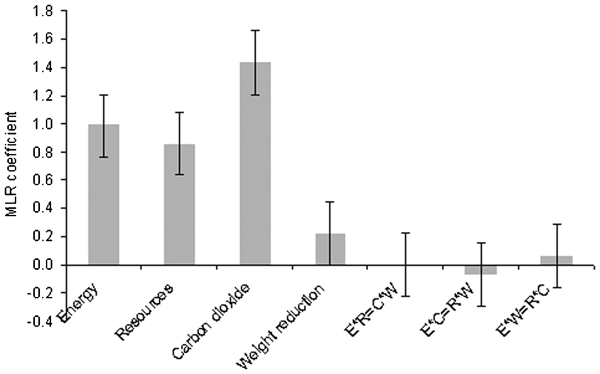
Multiple linear regression coefficients (average) for main and interaction effects with standard errors for the entire group of respondents (E: energy; R: resources; C: carbon dioxide; W: weight reduction)
In order to visualise the individual responses, a PLS2 regression–loading plot for all respondents is presented in Figure 3 Figs. 3 and 4. In Fig. 3, the first and second latent variables are plotted. Since only a few respondents prioritised product weight reduction, this attribute had only a small influence on the PLSR loading plot, while the opposite was the case for reduced carbon dioxide emissions.
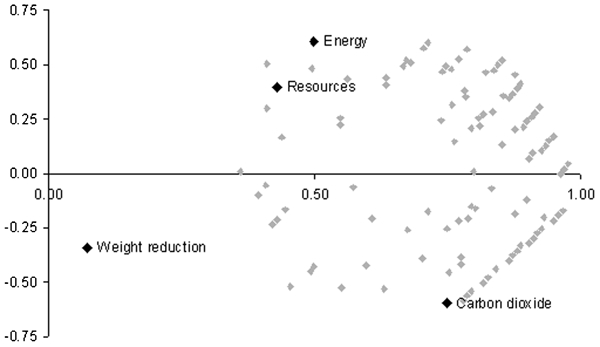
Regression loadings (PLS2), linking individual preferences to design variables for entire group of respondents; 84% of Y variance was explained on two latent variables
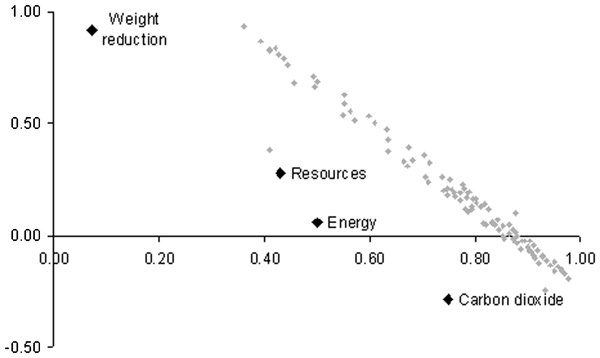
Regression loadings (PLS2), linking individual preferences to design variables for entire group of respondents; 80% of Y variance was explained on latent variables 1 and 3
One of the main advantages of a PLS2 regression loading plot is that it is fairly easy to interpret, similar to a map. The variance of the data set is projected onto latent variables so that the largest variance is plotted on latent variable 1 (left to right in Fig. 3). On latent variable 1, the variance of preferences for reduced carbon dioxide emissions is shown: the closer a respondent lies to an attribute in the figure, the clearer the preference for this attribute.
In Fig. 4, the first and third latent variables are plotted to show the importance of the four environmental objectives. Preferences for reduced carbon dioxide emissions are distributed along the first latent variable (left to right), while preferences for weight reduction are distributed on the third latent variable (bottom to top). Most of the respondents focus on reduction in carbon dioxide emissions (right side of latent variable one); in the middle lie use of non-renewable energy and use of non-renewable resources, and at the top of latent variable 2 are the respondents that prioritise weight reduction in products.
Stakeholder groups
When the average regression coefficients for the original groups of respondents were compared (analysis of variance), there was a significant difference between groups for the use of non-renewable resources and weight reduction in products. In the first case, differences in preferences between political decision makers and the public were found (p = 0·17), and in the second case, there were significant difference between the public and representatives from the steel industry (p = 0·08) (see Fig. 5). The public assigned less importance to weight reduction than the steel industry. Respondents representing steelworks, environmental experts and the public followed the average for the total population of respondents. The steel industry representatives showed a similar pattern, though there was wider variation concerning the weight reduction in products (see Fig. 5).
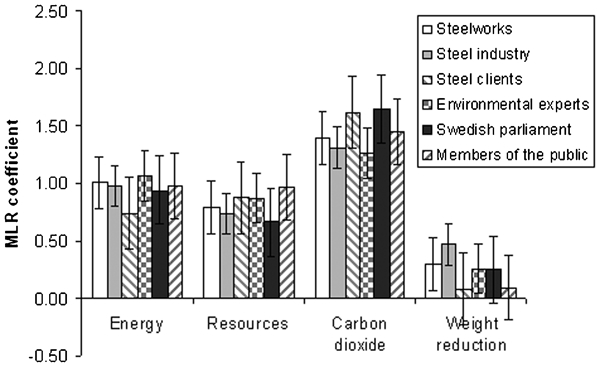
Multiple linear regression coefficient (averages) standard errors for original groups of respondents
Of the original groups, the respondents working at steelworks were the most diverse, recording all preferences. Although a reduction in carbon dioxide emission was the most preferred environmental objective, the other three objectives were also highlighted, each by several respondents. Steel industry representatives (subcontractors, suppliers, consultants and small steelworks) comprised two subgroups, one focusing mainly on weight reduction and the other on carbon dioxide. Steel clients, on the other hand, did not seem to agree with the aforementioned groups, instead focusing solely on carbon dioxide emission. The professionals involved in environmental issues (‘environmental experts’) tended to focus proportionally less on carbon dioxide emission (although the group was diverse) and more on the other three environmental objectives. Political decision makers, represented here by Swedish members of parliament, agreed well with the public, focusing on carbon dioxide emissions and the use of non-renewable energy.
No difference was found in preferences between members of the public living in a municipality with a steelworks and those living in a municipality without a steelworks.
The individual results are shown in the PLSR loading plots in Fig. 6, with preferences projected onto latent variables. Within the steel industry group, it is possible to discern two segments, one focusing on weight reduction in products and one on reduction in carbon dioxide emissions. Political decision makers (MPs) and steel clients focused more clearly on reduction in carbon dioxide emissions, assigning weight reduction in products lower priority (see Fig. 6a–f ).
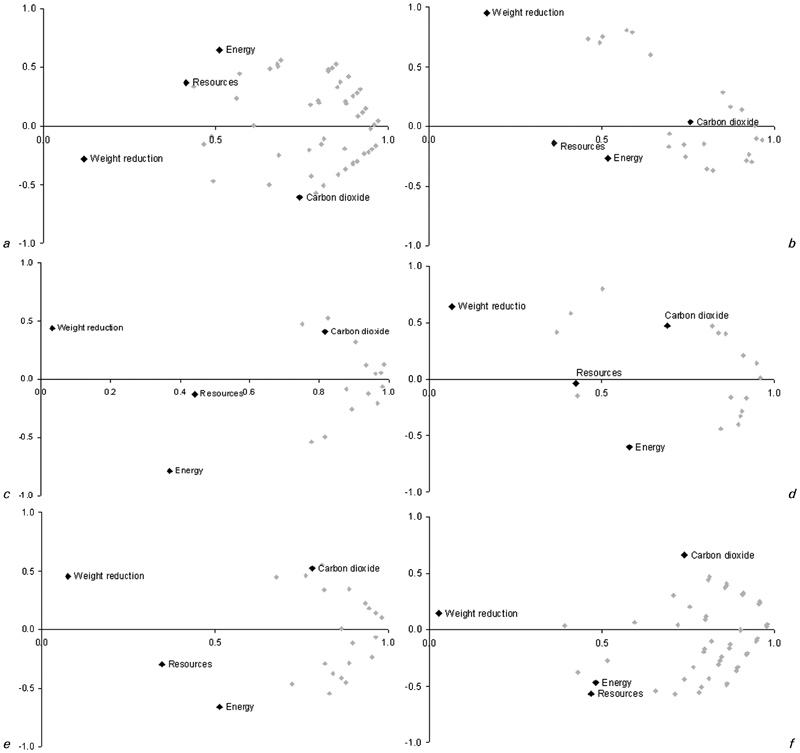
Regression loadings (PLS2) illustrating preferences of original groups of respondents. Y variance explained on first two latent variables in parenthesis
It is noteworthy that for 62% of respondents, regardless of their original group, the regression coefficient for weight reduction was zero or negative (i.e. it was not given high priority), while 2% of respondents had a regression coefficient that was negative or zero for carbon dioxide. The figures for the use of non-renewable energy and non-renewable resources were 4 and 5% respectively.
When the material was analysed with regard to significant connections (analysis of variance), the following results emerged:
respondents with a low income showed a higher preference for the use of non-renewable resources than respondents with a high income (p = 0·001)
compared to men, women recorded a greater preference for the use of non-renewable resources (p = 0·045)
high preferences for weight reduction in products were correlated to high educational level (p = 0·041).
The results of this study showed that there were differences between stakeholder groups and also that it was also possible to find subgroups of respondents that shared similar preferences. This is important information for the steel industry in their communication with its stakeholders. The study reveals that the four environmental objectives were assigned different importance by different stakeholder groups. Previous research has shown the importance of decision makers being familiar with the preferences of different stakeholder groups. 18–20,27
Occupational preferences
People working with environmental issues prioritised the same environmental targets as the average respondent. Respondents with jobs related to quality control were divided into two groups: one focusing on carbon dioxide emissions (as the average respondent) and one focusing on non-renewable energy and weight reduction in products. The group of respondents working in research and development was also divided into two subgroups: one focusing on weight reduction, and the other on carbon dioxide emissions, energy and resources.
Preferences among executive managers at the steelworks were also examined. Only 2 out of 20 focused on weight reduction in products. Most executive managers prioritised carbon dioxide emissions, followed by energy and resources. The same pattern was observed for production managers, though they reported even less interest in weight reduction in products and the use of non-renewable resources. Respondents who worked in purchasing for steel clients showed a proportionally greater interest in carbon dioxide emissions, while those from steel industry marketing and sales were more focused on resources and energy.
Weight reduction
Respondents with high priority for weight reduction were studied separately by selection of those with regression coefficients (equalling half the factorial effects) equal to or >1·0. For all respondents, carbon dioxide emission was the environmental objective that most respondents focused on. Use of non-renewable energy and use of non-renewable resources received less attention; weight reduction in products was prioritised by very few respondents: only 34 respondents had regression coefficients that were larger than one for weight reduction [five members of the public, 12 representatives from steelworks, five political decision makers (MPs), three environmental experts, two steel clients and seven steel industry]. The sociodemographic facts coincided well with the average: the composition of the group was comparable to the average, except that the group had higher educational levels and contained only a few representatives of the public.
There were several explanations for the fact that only a few of the respondents found weight reduction in products to be of any importance for the steel industry: high strength steel and weight reduction in products were generally not familiar to respondents outside the steel industry; it seemed that the public and the political decision makers in the Swedish parliament were unaware of the potential positive environmental effect of weight reduction in products if introduced on a wide scale. Most striking, however, was that even environmental experts, steel clients and, above all, the steelworks themselves did not seem to be fully aware of the benefits of weight reduction. These results also remained unchanged when examined by occupation. The findings suggest that the Swedish steel industry has not yet succeeded in communicating the benefits of high strength steel and reduced product weight. One of the clearest indicators of this was that executive managers at steelworks did not deem weight reduction in products an important environmental objective. As also suggested by Buysse and Verbeke, 28 the match or mismatch between the values of the management of the company and the values of the company (for example, environmental objectives) needs to be further studied.
Examining the respondents at the other end of the preference scale, respondents with negative regression coefficients for weight reduction were found to show significant differences to the average respondent: they were younger (p = 0·014), fewer were married or cohabiting (p = 0·01), they had higher than average incomes (p = 0·02) and a higher number than average had children living at home (p = 0·045).
Individual results
One important conclusion is that it could be of benefit to present the results on an individual basis. The primary reason is that individuals had different preferences, and these individual preferences varied greatly even within stakeholder groups. Therefore, displaying the results on an average basis only was not ideal. With the aid of the PLS plot, individual results could be shown in a way that was easy to interpret for individual respondents. The respondents that were visited in person (steelworks and steel clients) were given a number, and the results were analysed immediately. Respondents could then find their own number on the plot. This triggered lively discussion. A similar approach was suggested by Naes et al. 15
The pilot study had shown that discussions were livelier when members of the group felt sufficiently secure to express their opinions. Mixed groups with respondents that did not know each other or groups larger than 20 members had fewer comments and discussions were less fruitful. The experience gained from the pilot study was applied in the design of the full study, so that when the results were presented, no groups were more than 20. For practical reasons, it was not possible to present individual results to any group consisting of several stakeholder groups; it was therefore not possible to study the interaction between stakeholder groups. However, in the pilot study, there was one such group, and the results from that discussion suggest that the method could be rewarding. There is an opportunity for future research using this methodology on a larger scale to improve stakeholder communication and to initiate communication between stakeholder groups. Dorow et al. 18 draws similar conclusions: ‘informing management efforts of stakeholder preferences can also be the starting point for building a trustful relationship between managers and stakeholders, fostering cooperation and active involvement.’
The discussions proposed in this study could also be turned into focus group discussions, in which the conjoint study is evaluated at the same time as the attributes are discussed further and analysed by the respondents. Future research in this direction is recommended.
From the PLS plot, it was possible to distinguish previously unknown smaller subgroups. Although this way of dividing the respondents into segments is not as statistically reliable as cluster analysis or latent class analysis, it is a good way of scanning the data for further analysis. A further application of the results could be in tailoring information campaigns or training for specific groups of employees or external stakeholders. The method could also be used to improve internal and external communication.
Usefulness of method
Conjoint analysis demonstrated the preferences for the environmental objectives of the programme. There were four well defined environmental objectives, and the tradeoff that the respondents made illustrated the preference scale for the objectives. The study also showed some drawbacks with the method. The respondents faced a relatively complicated task that demanded the respondent’s time and concentration. Moreover, the respondent had to understand the task in order to perform the conjoint task correctly. The proportion of correctly completed conjoint questionnaires was markedly higher when the researcher visited the respondents in person to explain the task, indicating that the conjoint task was possibly too complex to be used in a postal questionnaire. Non-response bias was an obvious risk. This indicates that personal discussions between the researcher and the respondent are important in futures studies.
The environmental objectives of the study are those that the steel industry had chosen as objectives for the steel eco cycle research programme as such. They were chosen because they covered environmental issues that were relevant for the entire steel industry and could be understood and evaluated by representatives from both the steel industry and the steel industry stakeholders. A drawback can be that they are not fully independent from each other and thus not 100% ideal as attributes in a conjoint task.
Conclusions
A stakeholder analysis was carried out within the steel eco cycle using the conjoint method. The method detects the subconscious tradeoffs between alternatives.
Preferences for four environmental objectives were examined.
Quality improvements to reduce the weight of constructions and vehicles can be expected to have a positive environmental value. This is not fully understood by all stakeholders. One major conclusion was that only a few of the respondents found weight reduction in products to be of any importance to the steel industry.
A difference was found between the original stakeholder groups: stakeholder groups close to steelworks and the steel industry, together with environmental experts, seemed to prefer all four environmental objectives, while members of public and political decision makers focused more on emission of carbon dioxide alone.
Quality improvement to reduce the weight of constructions and vehicles can be expected to have a positive environmental value. This is not fully understood by all stakeholders. One major conclusion was that only a few of the respondents found weight reduction in products to be of any importance to the steel industry.
Individuals that showed a higher interest in product weight reduction were characterised by higher educational levels and were connected to the steel industry or worked with environmental issues.
A new way of presenting results to respondents was tested. We see great prospects in this way of stimulating communicating between different stakeholder groups.
Footnotes
Acknowledgements
This work was funded by the Foundation for Strategic Environmental Research (MISTRA) and the Swedish Steel Producers’ Association (Jernkontoret) through the research programme Towards a Closed Steel Eco-Cycle.