







Abstract
As a common component in metallurgical slag, CaO plays an important role in desulphurisation, dephosphorisation and absorption of non-metallic inclusions. In order to better understand the mechanism of the slag/metal reactions, the diffusion dynamics of calcium ions in CaO–Al2O3–SiO2 slags were studied. It was found that there was almost a linear relation between the logarithms of pre-exponential factor and diffusion activation energy. By combining the relation between the diffusion activation energy and the optical basicity corrected in the CaO–Al2O3–SiO2 slags, a simple model used to estimate the diffusion coefficient of calcium ion is proposed. The estimated values of the CaO–SiO2 and CaO–Al2O3–SiO2 systems agree well with the experiment data, with a mean deviation of 35·3 and 22·5% respectively.
Introduction
In metallurgical processes, diffusion phenomena occur in slag/metal reactions such as the desulphurisation and dephosphorisation of blast furnace slag and the absorption of inclusions in mould flux. The various reactions are completed by the diffusion and migration of ions in the slag and metal, but the reaction rate is always controlled by the diffusion in the liquid slag. 1 Because of its excellent desulphurisation and dephosphorisation properties, CaO is an important oxide in slags that could also combine with Al2O3 in liquid steel to form low melting point inclusions; hence, research into the dynamics of calcium ion diffusion would be a significant achievement.
Self-diffusion of various species present in the melts, where there are no chemical potential gradients, can occur by random motions. If the diffusion ion was replaced by its isotope, the diffusion process becomes tracer diffusion. Moreover, tracer diffusivity is considered to be equivalent to the self-diffusivity in liquids. 2 Towers et al. 3,4 investigated the diffusion of Ca45 in CaO–Al2O3–SiO2 molten slags by the radioactive tracer technique and the capillary method. The results suggested that the diffusion coefficient is in the range of 10−7–10−6 cm2 s−1 in the temperature range of 1623–1823 K. Niwa 5 improved Towers’ experiment device and also measured the diffusion coefficient of Ca45, the results of which had the same order of magnitude with Towers’ work. Saito and Maruya 6 used the semi-infinite medium method to obtain the diffusivity of Ca45 ions, in which the behaviours of Al2O3 and MgO were also discussed, and the range of temperature and composition of slags became wider. Keller et al. 7 used the capillary technique to measure the diffusivity of Ca45 ions in CaO–SiO2 molten slags, which was determined in the temperature range of 1773–1973 K, but the values were higher than that obtained by Saito and Maruya.
Goto et al. 8 calculated the tracer diffusivities of multicomponent oxide slags, which were based on the Nernst–Einstein relation. Recently, Zhang and Chou 9 used the same method to estimate the diffusion coefficient of calcium ions in CaO–Al2O3–SiO2 slags and also used the relation between the calcium ion concentration and diffusivities to calculate the diffusion coefficient. Nevertheless, both results they calculated were not satisfactory and were much larger than the true values. Because the volume and electrical conductivity of molten slags were both needed in the calculation process, it is a pity that we could not always acquire the necessary data for them.
Diffusion coefficient like viscosity and electrical conductivity is also an important physical property, the value of which could describe the rate of slag/metal reactions. Data on viscosity and electrical conductivity are plentiful, but are rather scarce for the diffusion coefficient of ions. In order to have good knowledge of the diffusion process of ions in slags, more reliable diffusion data are essential. The present study aims at developing a model to estimate the diffusion coefficient of calcium ions in slags related to the structure of slag, but not the relation between diffusion coefficient and viscosity or electrical conductivity.
Model descriptions
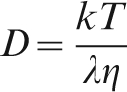
For a diffusion ion of i, the relationship between temperature and diffusion coefficient can be described by the Arrhenius type equation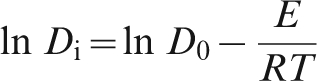
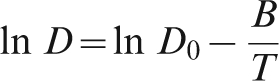

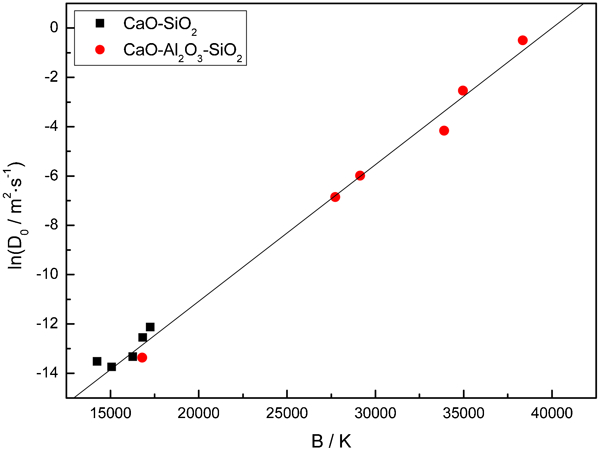
Relation between ln D 0 and B for CaO–SiO2 and CaO–Al2O3–SiO2 systems
Correlation between B and optical basicity
The diffusion coefficient is closely related with the structure of slag. NBO/T, optical basicity, free oxygen, bridging oxygen and non-bridging oxygen are commonly used to describe the structure of the slag. 10–15 In the current model, the structure of the slag was described by the optical basicity, which is also successfully used to estimate other physical properties of slag.
In the CaO–SiO2 system, CaO acting as the modifier is used to break down the network structure formed by SiO2. When Al2O3 is present in the melts, the condition is changed. It is widely accepted that Al3+ has a strong preference for the tetrahedral coordination structure 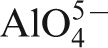

For the CaO–SiO2 and CaO–Al2O3–SiO2 systems, the parameter B is plotted as a function of corrected optical basicity in
Figure 2
Figs. 2 and 3. Furthermore, the approximate relation between Λ
corr and B can be expressed in the following form
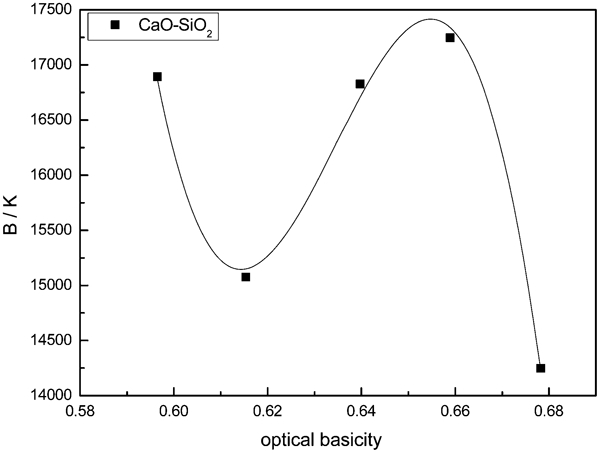
Relation between optical basicity and B for CaO–SiO2 system
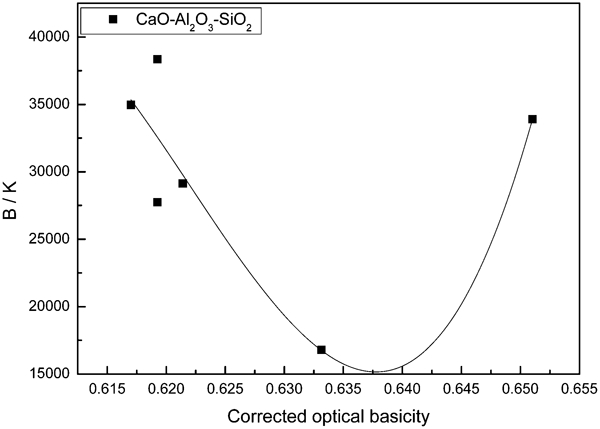
Relation between corrected optical basicity and B for CaO–Al2O3–SiO2 system
Model parameters for CaO–SiO2 and CaO–Al2O3–SiO2 systems
Results
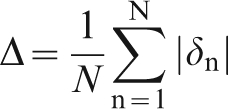
The relative deviation δ
n and the mean deviation Δ were used to evaluate the performance of the current model in estimating the diffusion coefficient of calcium ion, which were calculated as follows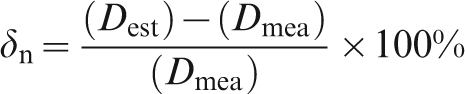
Comparisons between measured and estimated diffusion coefficients in CaO–SiO2 system
For the CaO–Al2O3–SiO2 system, the measured values are from Towers et al., 3,4 Niwa 5 and Saito and Maruya. 6 The comparison between measured and estimated values is shown in Table 3, with the mean deviation Δ of ∼22·5%. The relative deviation of each estimated value is also very low. Thus, it was concluded that the estimated diffusivity of calcium ions fit well with the measured values in the CaO–Al2O3–SiO2 system. In a slag of CaO–20 wt-%Al2O3–40 wt-%SiO2, the comparison between the measured diffusion coefficients of calcium ions with the calculated values by different researchers is shown in Fig. 4. It can be seen that the calculated values of Goto et al. 8 and Zhang and Chou 9 are a little larger than the measured ones, and that the present model provides a more accurate estimation for diffusivity values of calcium ion.
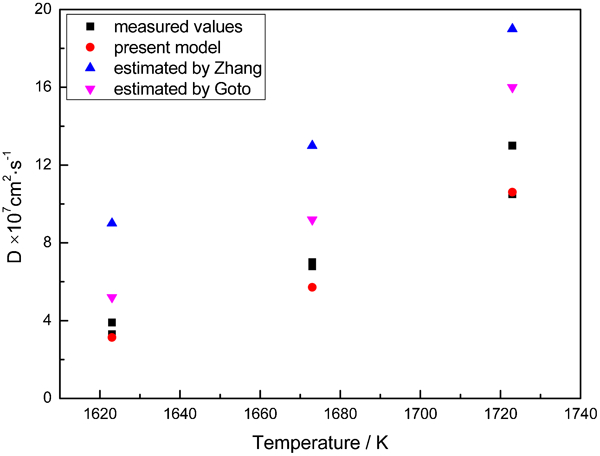
Comparisons of measured diffusion coefficients with estimated values
Comparisons between measured and estimated diffusion coefficients in CaO–Al2O3–SiO2 system
Discussion
For the CaO–SiO2 system, it is found that the diffusion coefficient decreases with increasing SiO2 (Table 2). This may be explained by the degree of melt polymerisation. Zhang and Jahanshahi
17
calculated three types of oxygen by cell model for the MO–SiO2 (M = Ca, Mg, Mn) system, and the results are shown in Fig. 5. It can be seen that 
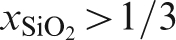


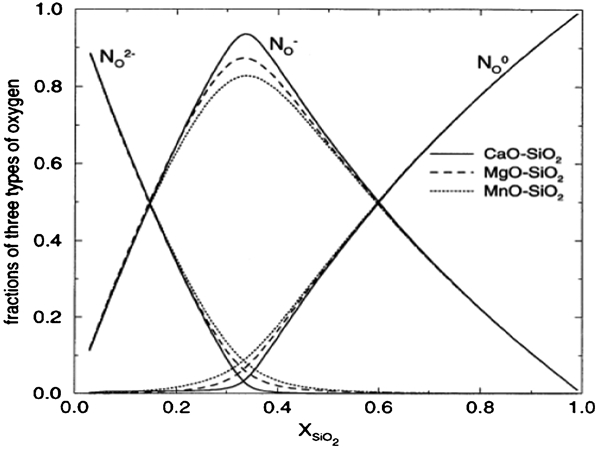
Composition dependence of fractions of three types of oxygen calculated by cell model for MO–SiO2 system
In general, the more network breaking oxide in the molten slag, the larger the optical basicity, and the lower the viscosity. Consequently, the diffusion activation energy should decline as the optical basicity increases; however, the data do not agree with that. As shown in Figure 2 Figs. 2 and 3, with the optical basicity increasing, the diffusion activation energy initially decreases and then increases, but for the CaO–SiO2 system, the diffusion activation energy decreases again at Λ>0·65. In the present study, the content of calcium oxide varied between 0·366 and 0·569 (mole fraction). Combining the phase diagram of CaO–SiO2 (Fig. 6), it is found that the liquidus temperatures of the CaO–SiO2 slags have the same changing trend with the value of the diffusion activation energy with the content of calcium oxide increasing, and the values of optical basicity 0·605 and 0·653 are the turning points respectively. Moreover, Eyring et al. 21 suggested that the driving force for diffusion came from the concentration gradient of diffusion ions, and the standard free energy changed with the jumping distance, the relation of which can be described by the curve in Fig. 7. Consequently, the increasing content of CaO may make the structure and physical properties of molten slags change, which results in the changing of the jumping distance of calcium ion and also the value of the diffusion activation energy.
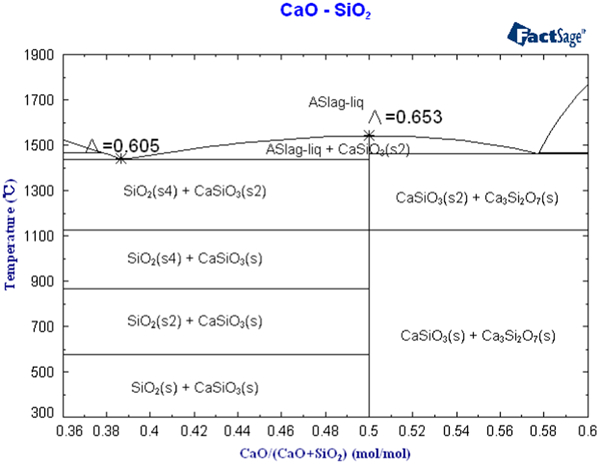
Phase diagram of CaO–SiO2 system
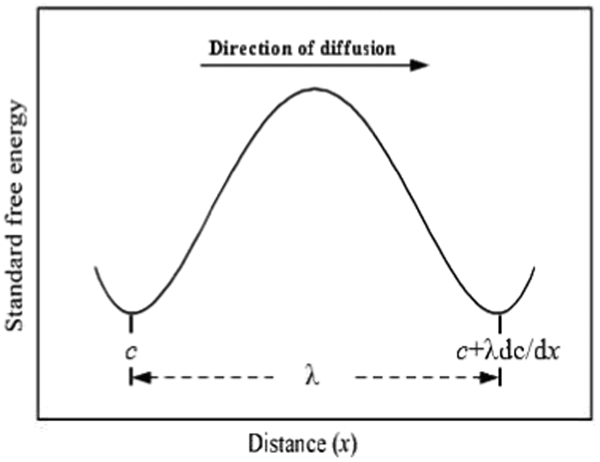
Relation between standard free energy and jumping distance
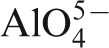
From a diffusion activation energy value point of view, the value of the diffusion activation energy of the CaO–Al2O3–SiO2 system is about 140–320 kJ mol−1, and 140 kJ mol−1 is almost the maximum value of the CaO–SiO2 system (115–145 kJ mol−1). In the CaO–Al2O3–SiO2 slag, the 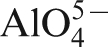
Conclusions
A simple method for the diffusion coefficient estimation of calcium ions in the CaO–Al2O3–SiO2 slags is proposed. In the model, there is an increasing function relationship between the logarithm of pre-exponential factor and the diffusion activation energy calculated by optical basicity. The comparisons between estimated and experimental values show good agreement. With increasing polymerisation degree of molten slag, the diffusion coefficient of calcium ions declines. Because of the charge balance in the CaO–Al2O3–SiO2 slag, the decreasing of free Ca2+ concentration and the weaker mobility of these calcium ions in [1/2Ca(AlO4)]4− result in a lower diffusion coefficient.
Footnotes
Acknowledgements
The financial support from the National Science Foundation of China (grant no. 51090384) is gratefully acknowledged.