







Abstract
The structurally related viscosity model proposed in our previous studies has been extended to TiO2 bearing melts. Experimental data on different systems containing CaO, MgO, Al2O3, TiO2 and SiO2 were assessed, and good agreement was achieved between the calculated and measured viscosities. It can be concluded that the addition of TiO2 results in a decrease in viscosity, which is consistent with the experimental findings.
Introduction
With the gradual consumption of high grade raw materials with high concentration of iron, sources of iron bearing materials such as titaniferrous ore, once regarded as uneconomic, are increasingly being used in the electric arc and blast furnace. However, the high content of TiO2 may result in significant issues such as poor reduction of the ore, change in the liquidus temperature of the slag and slag viscosity deviation from the optimum processing condition. In order to ensure efficient process operations, the variations of thermophysical and thermochemical properties with the addition of TiO2 should be understood, especially viscosity, which is essential to maintain stable operation.
Much work 1–9 has been done to study the influence of TiO2 on the viscosity of TiO2 bearing melts. In the temperature range of 1400–1625°C, Dingwell 1 measured the viscosity of 13 liquids along the CaSiO3–TiO2 plain with TiO2 content varying from 10 to 80 mol.-%. The viscosity decreased with the addition of TiO2. From the viscosity data of CaO–Al2O3–TiO2–SiO2 molten slag with CaO/SiO2 in the range of 0·6–1·20, Al2O3 in the range of 0–20 wt-% and TiO2 in the range of 0–50 wt-%, Ohno and Ross 2 found that an increase in titania content decreased the viscosity. The viscosity of blast furnace type CaO–MgO–Al2O3–TiO2–SiO2 slags has been studied by many researchers, 3–8 all of which show that TiO2 addition lowered the viscosity. However, theoretical models are lacking in estimating the viscosity of TiO2 bearing slags. 10 In our previous papers, 11–15 a structural based viscosity model that can be well applied to molten slags containing CaO, MgO, FeO, MnO, Al2O3, SiO2, Li2O, Na2O, K2O and CaF2 was proposed. The aim of the present study is to extend this model to the TiO2 bearing melts. Before constructing the model, first, the role of TiO2 on the structure of the slag should be clarified.
Structure of TIO2 bearing molten slag
From the larger ionic radius of Ti4+ ion (0·61 Å) relative to Si4+ ion (0·42 Å), 16 the Ti4+ ion appears unfit to replace the position of the Si4+ ion. Thus, in the TiO2 bearing molten slag, it seems that the Ti4+ ion may have a high oxygen coordination number in excess of 4 and mainly acts as a network modifier. Based on the X-ray photoelectronic spectroscopy (XPS) results of aluminosilicate melts containing 17 wt-%Al2O3 and 10 wt-%MgO, it is found that the fraction of bridging and non-bridging oxygen decreased with TiO2 addition, but the free oxygen increased with TiO2 addition. 4 Thus, the authors concluded that TiO2 seems to provide higher potential to depolymerise the slag network structure. However, it was found that the Ti4+ ion can also act as a network former cation with fourfold coordination of oxygen. 17 Mysen and Neuville 18 noted that the oxygen coordination of the Ti4+ ion varies with TiO2 content. At low TiO2 content, Ti4+ serves predominantly as a network modifier but as a network former at high TiO2 content. Using a combination of X-ray absorption near edge structure (XANES) and extended X-ray absorption fine structure (EXAFS) measurements, Greegor et al. 19 found that in the TiO2–SiO2 binary system, at TiO2 concentrations below ∼0·05 wt-%, Ti4+ is in a rutile-like octahedral coordination; with increasing TiO2 content, a two site model applies (fourfold and sixfold). At ∼9 wt-%TiO2, the sixfold/fourfold ratio increases appreciably with increasing TiO2 content.
According to the above analyses, it can be concluded that the oxygen coordination state of Ti4+ has a very complex relationship with composition. Thereby, it is hard to incorporate the actual structure changes (with TiO2 addition) into the viscosity model. For convenience of model treatment, a simplification is adopted, which is shown in the next section.
Model
The temperature dependence of viscosity is described by the Arrhenius law






Optimised values of model parameters


Results
Comparisons between measured and calculated viscosities for different TiO2 bearing melts are shown in Fig. 1, with the mean deviation (defined as 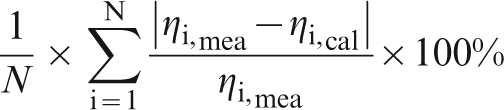
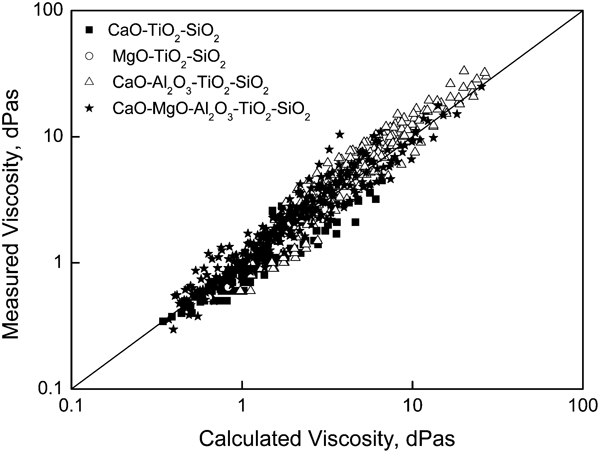
Comparisons between measured and calculated viscosities for different TiO2 bearing melts
MgO–TiO2–SiO2 system
Only two experimental values at 1500 and 1550°C for 35 mol.-%MgO–35%TiO2–30%SiO2 slag have been measured in this ternary system. 9 The calculated viscosities are 0·83 and 0·64 Poise respectively, which are close to the measured values of 0·64 and 0·53 Poise.
CaO–TiO2–SiO2 system
Dingwell 1 measured the viscosity of CaSiO3–TiO2 with the mole fraction of TiO2 ranging from 10 to 80% (shown in Fig. 2). The model calculated viscosities agree well with the measured values. From Fig. 2, it is apparent that at a given temperature the addition of TiO2 causes the viscosity to decrease. The iso-viscosity curves of the CaO–TiO2–SiO2 system at 1773 K is plotted by the present model as shown in Fig. 3, in which viscosities data of composition with different TiO2 contents and different CaO/SiO2 ratios 2 are also given for comparison. From Fig. 3, it can be seen that when adding TiO2 to a specific CaO–SiO2 melt, there is a decrease of viscosity, which is consistent with the experimental finding of Dingwell. 1 When substituting CaO by TiO2 along a constant content of SiO2, viscosity increases, whereas viscosity decreases when substituting SiO2 by TiO2 along a constant content of CaO.
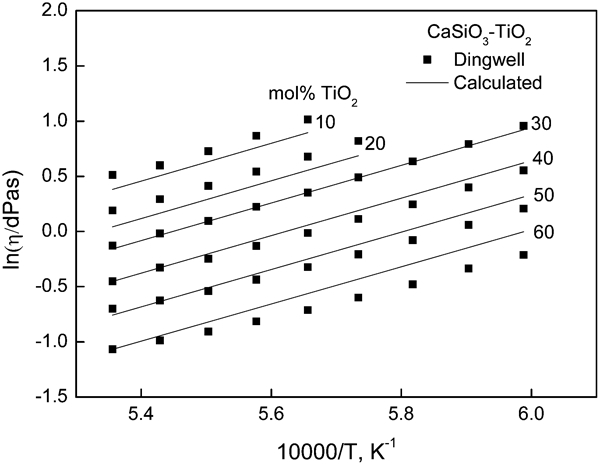
Comparisons between measured and calculated viscosities for CaSiO3–TiO2 join
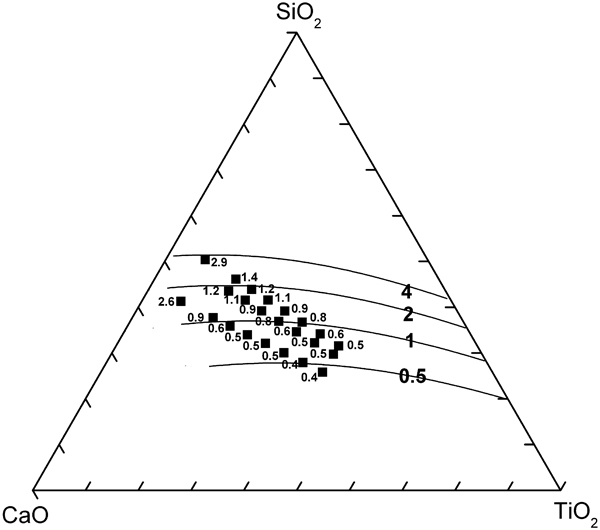
Iso-viscosity curves of CaO–TiO2–SiO2 system at 1773 K plotted by present model
CaO–Al2O3–TiO2–SiO2 system
Ohno and Ross 2 measured the viscosity of the CaO–Al2O3–TiO2–SiO2 system with TiO2 content in the range of 0–45 wt-% between 1400 and 1500°C. The viscosity data for composition with 20 wt-%Al2O3 are shown in Fig. 4. The present viscosity model can well represent the viscosity variation of this system. It can be seen from Fig. 4 that viscosity decreases with increasing TiO2 content or CaO/SiO2 ratio.
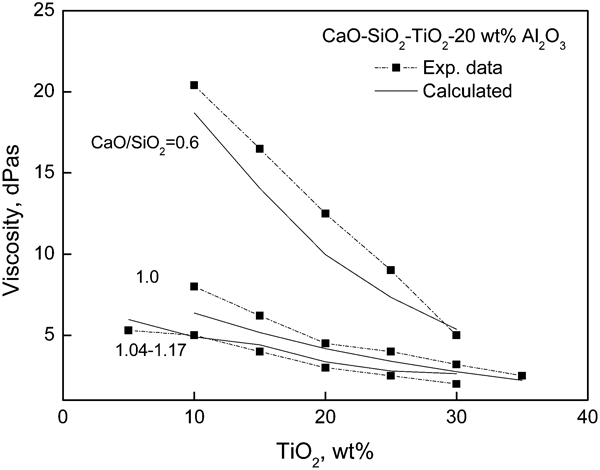
Comparisons between measured and calculated viscosities for CaO–Al2O3–TiO2–SiO2 system
CaO–MgO–Al2O3–TiO2–SiO2 system
This system is the fundamental slag system for the blast furnace and electric arc processes when smelting TiO2 bearing ores. Many experimental works 3–8 have been performed on this system, and more than 300 groups of measured viscosities data are collected. Good consistency between the measured and calculated viscosities was obtained, with the mean deviation of 20·0%. Figure 5 shows the variation of viscosity with TiO2 content and CaO/SiO2 ratio at 12 wt-%Al2O3 and 7 wt-%MgO, and it can be concluded that the same change tendency of viscosity with TiO2 content and CaO/SiO2 ratio is obtained as in the CaO–Al2O3–TiO2–SiO2 system (shown in Fig. 4).
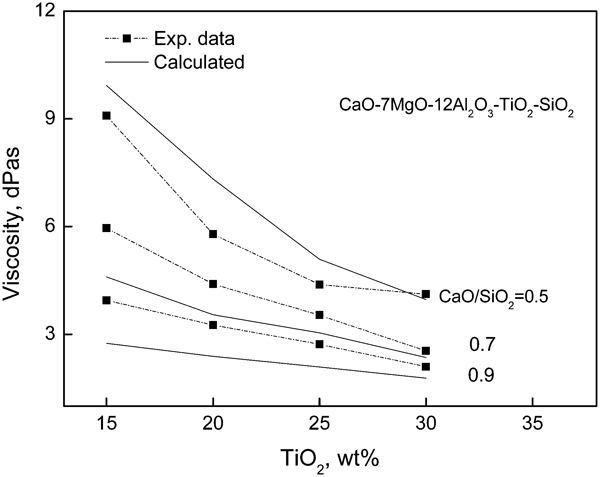
Comparisons between measured and calculated viscosities for CaO–MgO–Al2O3–TiO2–SiO2 system
Discussion
From the above examples, it can be seen that within a certain composition range, the addition of TiO2 always decreases the viscosity. In the CaO–TiO2–SiO2 ternary system, for example, when adding TiO2 to CaO–SiO2 melts, the absolute contents of CaO and SiO2 decrease but their ratio remains unchanged. From Fig. 3, viscosity decreases when substituting TiO2 by CaO while keeping the SiO2 content constant; viscosity increases when substituting TiO2 by SiO2 while keeping the CaO content constant. Thus, the ability of increasing viscosity follows the order: SiO2>TiO2>CaO. Therefore, when adding TiO2 to CaO–SiO2 melts, a decrease of CaO content increases viscosity, while a decrease of SiO2 content decreases viscosity, but generally, when decreasing the same content of CaO and SiO2, the viscosity increment is lower than the viscosity decrement for the great influence of SiO2 on viscosity. Thus, viscosity will decrease when adding TiO2 to the CaO–SiO2 melt, regardless of TiO2 acting as a network former or a network modifier. The same analyses can be applied to other multicomponent silicate systems containing TiO2.
The parameters optimised in the CaO–MgO–Al2O3–TiO2–SiO2 system can also be used in the melts containing other components. Viscosities of 17·6 wt-%Li2O–47%TiO2–35·9%SiO2 melt at different temperatures were measured by Dingwell.
1
Figure 6 shows the comparison between the measured and calculated values, which agree well. Comparisons between measured and calculated viscosities for 17·6 wt-%Li2O–47%TiO2–35·9%SiO2 melt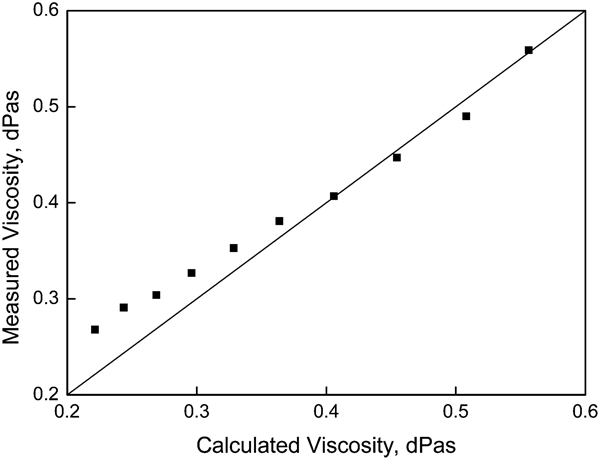
The present study mainly deals with the case of TiO2, but in the strong reducing conditions as in the blast furnace, part of TiO2 will be reduced by carbon to form a series of reduction products such as Ti2O3, TiO, TiC, TiN and Ti(C, N). Unlike TiO2, which behaves as an amphoteric oxide, generally, Ti2O3 and TiO behave more like basic oxides. The addition of Ti2O3 and TiO could decrease slag viscosity, 20 but modelling these two components into the viscosity model still needs much work due to the lack of experimental data. Slags containing TiC and TiN involve solid and liquid two phases for the high melting points of TiC and TiN, which cannot be melted at the smelting temperature, thereby viscosity will increase dramatically when TiC and TiN are present. 21
Conclusions
The present work mainly discusses the viscosity variation of CaO–MgO–Al2O3–TiO2–SiO2 molten slag. Our previous viscosity model has been extended to estimate the change of viscosity with composition and temperature. Good agreement was achieved between the experimental measured viscosities and the calculated viscosities. From the model estimation results, it can be concluded that the addition of TiO2 results in a decrease in viscosity.
Footnotes
Acknowledgements
The authors would like to thank the financial supports from the China Postdoctoral Science Foundation (grant no. 2012M510318) and the Chinese Natural Science Foundation (grant nos. 51174022 and 51234001).