







Abstract
This study provides an evaluation of the influence of chromium and sulphur on the decarburisation kinetics of Fe–Cr–C alloy droplets when exposed to argon gas mixtures containing carbon dioxide as the oxidant. For droplets containing the same amount of surface active sulphur, it was found that the decarburisation rate of iron–chromium droplets was substantially faster than that of chromium free alloys. This enhanced rate can be explained in terms of the attractive interaction between chromium and sulphur, which results in a decrease in the number of surface sites occupied by sulphur. An appropriate rate equation has been developed to characterise this behaviour. The findings from this work have beneficial implications with respect to the preferential oxidation of carbon rather than chromium when stainless steel is refined with argon–carbon dioxide gas mixtures.
Background
Since the advent of the argon oxygen decarburisation process, many investigations were undertaken to study and improve the various process routes for stainless steelmaking. The processes are often developed on the basis of manipulation of temperature, gas dilution and pressure, in which the latter is the basis for the vacuum oxygen decarburisation process. It has been recently demonstrated 1 that using CO2 for steel decarburisation is a promising approach for the retention of valuable alloying elements. In principle, CO2 decarburisation is similar to both the dilution (argon oxygen decarburisation) and vacuum (vacuum oxygen decarburisation) processes in that it lowers the oxygen potential in the steel bath, thus giving preference to the oxidation of carbon rather than chromium.
One of the earliest investigations studying the kinetics of CO2 decarburisation was by Baker et al. 2 Iron–carbon droplets with 0 to 5.5 wt-% C were levitated in an inert atmosphere, then subjected to constant flow of CO2–CO/He mixtures containing up to 100% CO2. The rate of decarburisation at 1933 K was found to be independent of carbon content in the melt, and the rate varied considerably with oxidant partial pressure in the gas phase. It was therefore concluded that decarburisation by CO2 is controlled wholly by diffusion in the gas phase at high carbon concentrations.
In their investigation involving levitation experiments at a pressure of 4.053 × 10⁶ Pa, El-Kaddah and Robertson 3 demonstrated that both decarburisation and carburisation of Fe–C liquid alloys by CO2–CO gas mixtures can be achieved. The kinetics of decarburisation, for 1 g droplets containing 5 and 5.5 wt-% C, was found to obey a model developed for convective mass transfer in the gas phase. Their assessment of the carburisation results, on the other hand, revealed that liquid phase resistance is significant at the reaction temperature of 1923 K. For the gas composition studied, 1.1 or 2.15% CO2, the carburisation rate was controlled by mixed transport of gas and liquid phase diffusion.
Lee and Rao 4,5 carried out decarburisation of levitated Fe–C–S droplets in a flowing CO–CO2 gas stream at 1973 K. The rate decreases significantly with increase in sulphur concentration in the melt. Sulphur, being surface active, was responsible for blocking available sites for CO2 dissociation. However, it was found that for gas streams containing 10% CO2 and flowing at 1 L min− 1, the retarding effect of sulphur diminishes as sulphur concentration increases past >0.05 wt-%. They observed that flowrate of the gas mixture has a relatively small effect on the decarburisation rate compared to the oxidant partial pressure in the gas mixture. It was thus concluded that the process is a mixed controlled scenario of both gas phase mass transfer and dissociative chemisorption of carbon dioxide.
Sun and Pehlke 6 have studied the kinetics of carbon oxidation in the presence of silicon and manganese in iron. They observed preferential oxidation of carbon when the alloy (3.35 wt-% C, 2 wt-% Si, 0.36 wt-% Mn) was exposed to CO2–N2 gas mixtures. Oxidation of Mn and Si only began when carbon levels were sufficiently low and the rate limiting step changed from CO2 transport in the boundary layer to solute diffusion in the liquid metal. It was found that sulphur, in the range of 0.002 to 0.5 wt-%, had negligible effect on the decarburisation rate.
Work by Simento et al. 7 has shown that the rate of decarburisation of Fe–C droplets, with initial carbon concentrations between 3.38 and 4.18 wt-% C, by CO2–N2 gas mixtures is jointly controlled by CO2 diffusion in the gas phase and subsequent dissociative chemisorption at the gas/metal interface. Small amounts of P (0.1 wt-%), Cr (0.5 wt-%) and S (up to 0.27 wt-%) were alloyed with the Fe–C melt to determine their effect on the decarburisation behaviour. From their experimental results, mostly at 1723 K, the effect of sulphur on the rate was found to obey the Langmuir isotherm for sulphur adsorption. For the melt compositions pertaining to their work, both chromium and phosphorus did not exhibit a noticeable effect on the rate.
It is clear from the above that, for high carbon melts, the rates of CO2 decarburisation were found to be controlled by either diffusion in the gas phase, surface chemical kinetics or a combination of both. However, limited mention was made with regard to the effects of other alloying elements commonly found in high alloy steel grades on the kinetics of decarburisation by CO2.
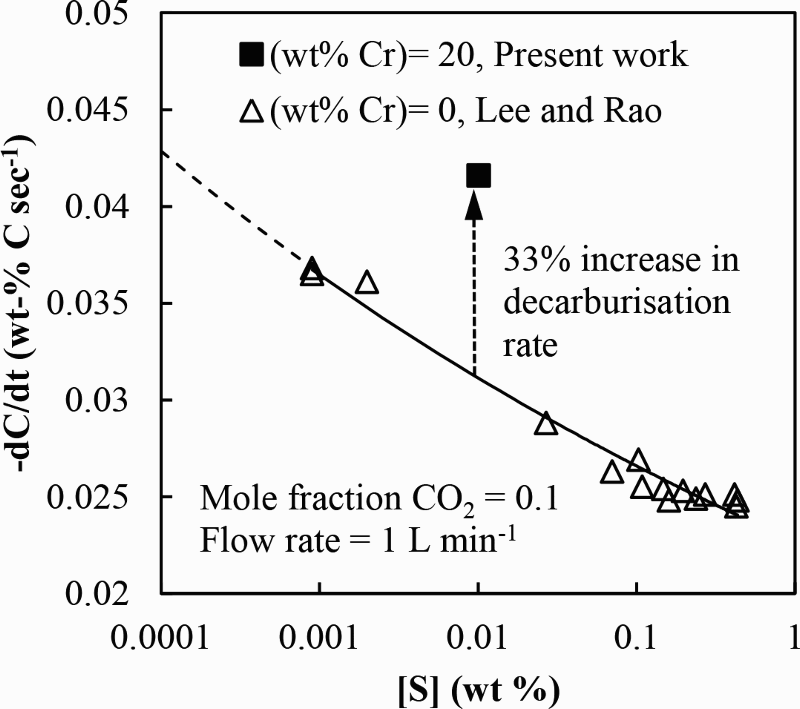
It has been indicated 8–11 that sulphur plays an important role in the kinetics of decarburisation by CO2. The presence of sulphur, even in low concentrations, was found to significantly decrease the decarburisation rate. It is generally understood that the blocking of available reaction sites by chemisorbed sulphur is responsible for the rate retardation. As shown in Fig. 1, with relevant data summarised in Table 1, decarburisation rate is hampered by the increasing sulphur concentration in the melt. However, the results from a recent study by the authors 12 suggest that 0.01 wt-% sulphur in the presence of 20 wt-% Cr did not have an adverse effect on the decarburisation rate of Fe–Cr–C droplets. It can be seen from Fig. 1 that chromium containing melts with 0.01 wt-% sulphur (▪) have similar behaviour to that of essentially sulphur free melts (Δ). This trend is consistently observed within a range of gas flowrates between 500and 1500 mL min− 1.
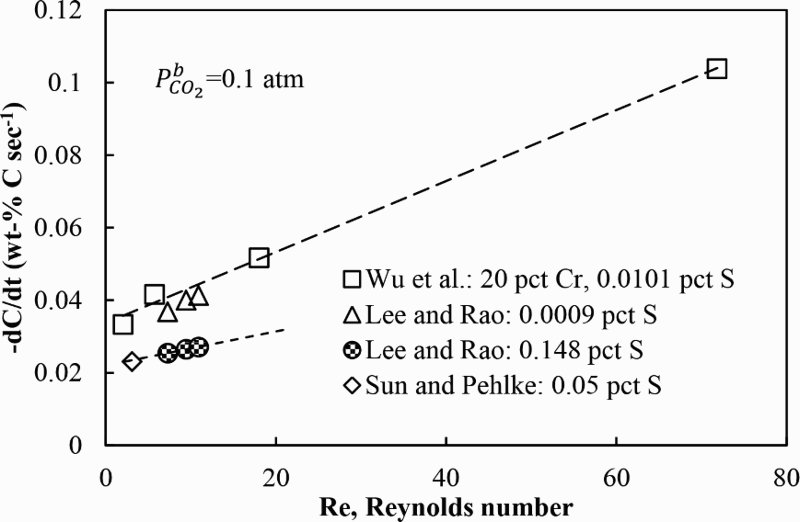
Effects of gas flow characteristics and melt sulphur content on rate of carbon removal
Experimental results for decarburisation
The presence of chromium in significant concentrations may have contributed to this observation due to its effect on reducing the sulphur activity at steelmaking temperatures. This would imply that chromium can mitigate the effect of sulphur coverage. Thus, the present investigation is aimed at providing further insight into the effects of sulphur in the presence of chromium on the decarburisation kinetics of Fe–Cr–C droplets involving CO2 as the oxidant gas.
Methodology
Materials
As detailed in the previous work, 12 Fe–Cr–C alloys were prepared by melting predetermined amounts of electrolytic iron, high purity chromium and graphite powders in an alumina crucible. Allowing sufficient time for the melt to reach homogeneity, alloy samples were subsequently taken by suction through a quartz tube, thereby producing rod shaped specimens with diameter of 4 mm. These rods were then sectioned into small pieces each weighing about 0.7 g.
Equipment
Using a similar approach to that by Lee and Rao 4 and Sun and Pehlke, 6 decarburisation experiments were performed using an electromagnetic levitation facility. A schematic diagram of the equipment is shown in Fig. 2. The levitation chamber consists of a quartz tube, 15 mm in outer diameter, 13 mm in inner diameter and 304 mm in length, sealed at the upper end with O rings and an optical grade quartz window to permit temperature measurement using a Chino two-colour IR pyrometer, which was calibrated against the melting point of copper to an accuracy of ± 15°. An O ring sealed, rotatable, aluminium platform provided a base for the lower chamber. The platform is fitted with a copper mould for droplet quenching and an alumina charging rod for loading solid specimens into the electromagnetic field within the levitation coil. The rotating action of the platform allowed either the copper mould or the charging rod to be aligned directly below the levitation chamber. The water cooled levitation coil was wound from copper tubing of 3.2 mm in outer diameter and consisted of two segments: the lower cone with three turns and the upper inverted cone with two reverse turns. The lower cone is responsible for providing the droplet with lifting force and heat, while the upper inverted cone controls the vertical and lateral stability of the levitated droplet. The power required for levitation was provided by a high frequency induction generator with a rated terminal output of 10 kW and a frequency range from 150 to 400 kHz.
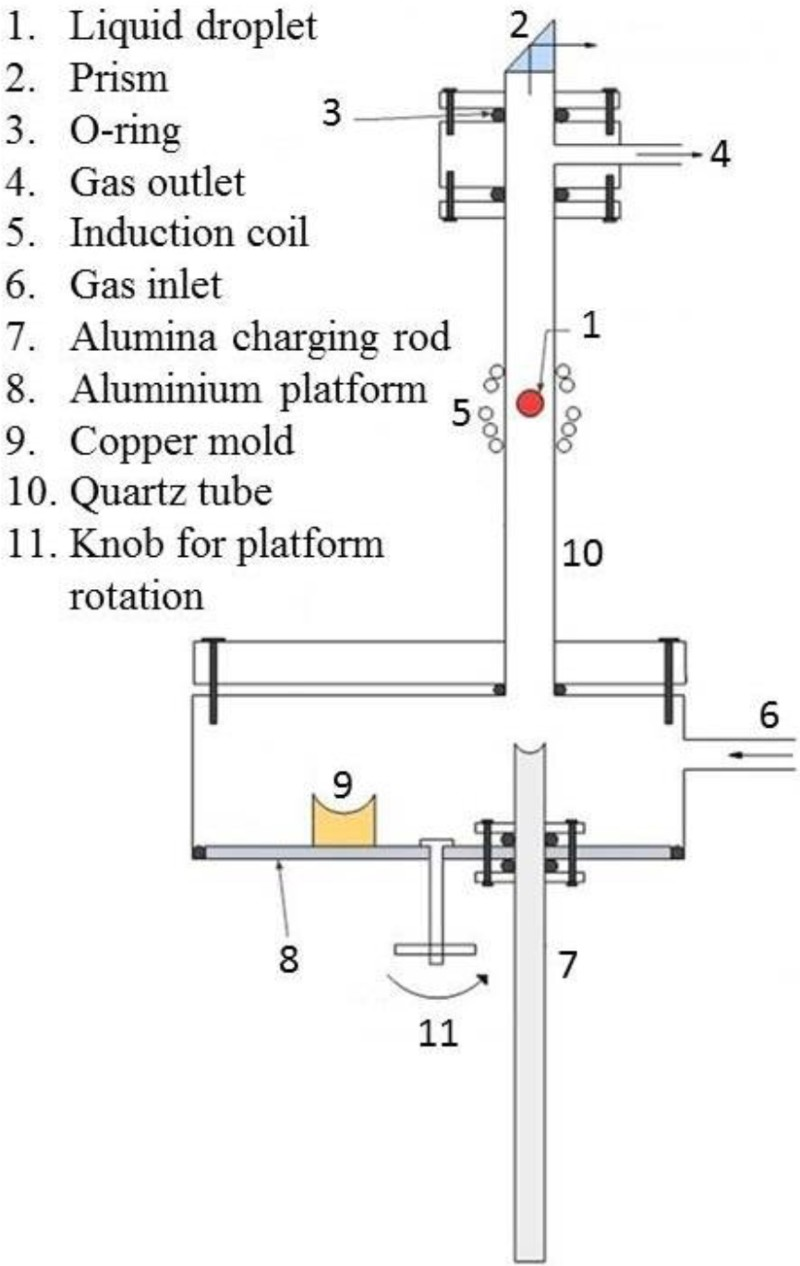
Schematic representation of electromagnetic levitation equipment
Procedure
Initially, the levitation chamber was purged with purified argon. The metal specimen, placed on the alumina charging rod, was raised to a position between the upper and lower sections of the coil. Upon application of power to the coil, the solid specimen was levitated and, depending on the intensity of applied current, would melt within 30 s. Once the droplet temperature had stabilised, a CO2 containing gas mixture was introduced into the reaction chamber at a predetermined flowrate. After various reaction times, the power was turned off, the droplet quenched in the copper mould and the carbon content determined using a LECO fusion analyser.
Development of appropriate rate equation
As discussed in previous work,
12
the rate of carbon loss is linear down to ∼1 wt-% C, which suggests that mass transport in the liquid phase is not the rate limiting step. If decarburisation is limited solely by the transport of CO2 from the bulk gas to the interface, the rate can be expressed as follows


The interfacial reaction for dissociative chemisorption of CO2 can be written as



Effect of chromium–sulphur interactions on decarburisation rate
As shown in Fig. 3, experimental measurements by Lee and Rao 4 have demonstrated the effect of sulphur concentration on the overall rate. The result from Wu et al. 12 , obtained under similar experimental conditions, is also superimposed on the plot. It can be seen that the process of decarburisation of Fe–C alloys containing 20 wt-% chromium (represented by ▪) is 33% faster than chromium free melts containing the equivalent amount of sulphur, based on the experimental results by Lee and Rao. 4
Effect of melt sulphur content on decarburisation rate
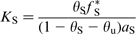
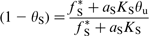
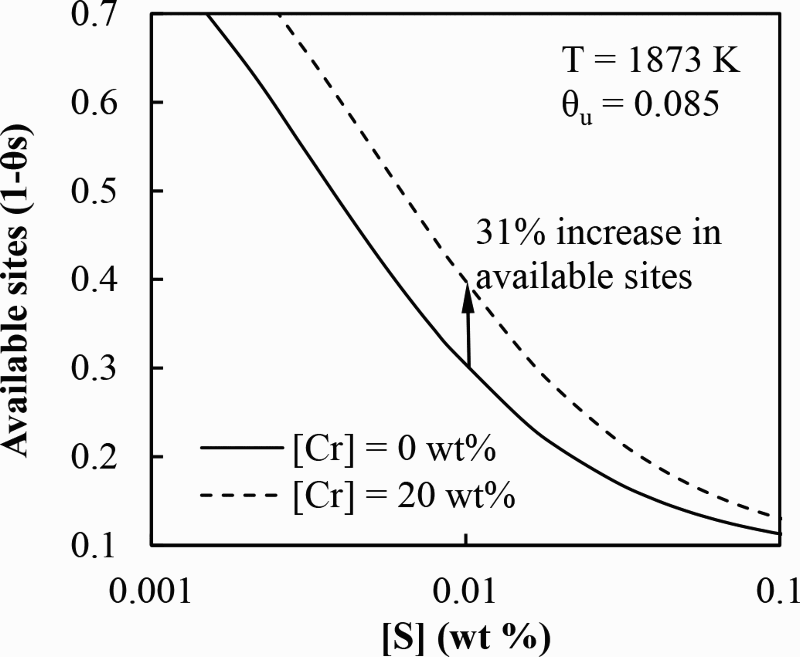
According to equation (7), the fractional surface sites available for the CO2 dissociative reaction (1 − θS), is an important parameter in decarburisation kinetics. It is evident from equations (6) and (7) that the rate would become a sole function of a
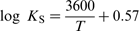
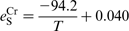
S if parameters such as droplet weight, temperature, gas composition and flowrate remain constant. Hence, the effect of an alloying element such as chromium on the decarburisation rate is reflected by virtue of the effect on the sulphur activity coefficient and consequently (1 − θS). The interaction parameter for effect of Cr on S as a function of temperature is given by the equation
13

Change of available surface sites with melt sulphur and chromium contents
Conclusions
The objective of the present work was to provide some insights into the effects of chromium, at higher concentrations, on the decarburisation kinetics involving CO2 as the oxidant gas. It was observed that the rate for Fe–20Cr–C alloys containing 0.01 wt-% S was 33% faster than that reported for chromium free melts with the same sulphur content and essentially the same as that for Fe–C alloys containing zero sulphur and zero chromium. The increase in decarburisation rate of iron–chromium–carbon–sulphur droplets can be explained by the attraction between chromium and sulphur solutes in the liquid phase, which decreases the sulphur activity and results in fewer surface sites occupied by surface active sulphur. This in turn has important implications with regard to preferential oxidation of carbon rather than chromium if stainless steel is refined with carbon dioxide rather than oxygen.
Acknowledgements
Appreciation is expressed to the Natural Sciences and Engineering Research Council of Canada, who provided funding for this project through a Discovery Research Grant.