







Abstract
Thermodynamic models for predicting phosphorus distribution ratio LP and phosphate capacity 


Introduction
Removal of phosphorus and sulphur from iron based melts is a long term challenge for metallurgical researchers and engineers to refine low or ultralow phosphorus and sulphur steel products with high performances. The technologies1–23 on simultaneous dephosphorisation and desulphurisation of iron based melts have been developed using CaO based or Na2CO3 based or mixture of CaO and Na2CO3 fluxes or slags since the 1970s through hybridising advantages of single dephosphorisation and desulphurisation processes. Beside the widely applied hot metal pretreatment technologies as desiliconisation, dephosphorisation and desulphurisation, the simul- taneous dephosphorisation and desulphurisation process is also used in secondary refining process of molten steel. Compared with phosphorus distribution ratio LP and sulphur distribution ratio LS based on slag–metal equili- brium reaction for representing dephosphorisation and desulphurisation abilities of slags, the defined phosphate capacity 


In comparison with tremendous studies on kinetics,1–4,6–17,19,23 the thermodynamic study on simultaneous dephosphorisation and desulphurisation reactions of iron based melts has not widely been reported for slags in a large variation range of slag oxidisation ability.5,18,20–22 The CaO–Fe
t
O–Al2O3 slag system has been recommended by Ban-ya et al.
20
for simultaneous dephosphorisation and desulphurisation in secondary refining process of molten steel. The distribution equilibria of oxygen, phosphorus and sulphur between CaO–FeO–Fe2O3–Al2O3–P2O5 slags and liquid iron were experimentally measured by Ban-ya et al.
20
The applied chemical composition of the slags by Ban-ya et al.
20
exhibits a large variation range of slag oxidisation ability corresponding to mass percentage of Fe
t
O from 1.88 to 55.50%. However, the related information on dephosphorisation and desulphurisation reactions of the slags was only discussed by Ban-ya et al.
20
based on mole fraction 

To further elucidate dephosphorisation and desulphurisation mechanisms of CaO–FeO–Fe2O3– Al2O3–P2O5 slags in this study, it is important to determine the reaction abilities of all components and the formed complex molecules in the slags simultaneously. It should be pointed out that the results on desulphurisation ability and potential of the slags will not be involved in this paper. The related information on desulphurisation mechanisms of the slags will be reported in the next step. Although numerous activity data of components in various slags had been measured and compiled in some handbooks on chemical metallurgy, activities of all components in CaO–FeO–Fe2O3–Al2O3–P2O5 slags cannot be found from the literature. With respect to experimental measurements of time consuming and requiring considerable expertise, calculating activities of all components in the slags by prediction models is a cost reduction alternative. Some activity prediction models have been proposed and summarised elsewhere,30,31 in which the modified quasi-chemical model 32 had been applied in commercial software of FactSage (jointly developed between Therm-fact/CRCT, Montreal, Canada, and GTT-Technologies, Aachen, Germany) and MTDATA (National Physical Laboratory, Teddington, Middlesex, UK) for equilibrium calculation 33 in multicomponent multiphase systems. The empirical coefficients should be more or less embodied in the summarised models30,31 for predicting activities of components, rather than all structural units such as complex molecules in slags. Thus, none of the activity prediction models can be applied in all slags without any limitations.
The defined mass action concentrations Ni of structural units or ion couples in slags based on the ion and molecule coexistence theory (IMCT)30,31,34–41 for metallurgical slags can be applied to reliably represent reaction abilities of components, like the traditionally applied activities aR,i of components relative to pure liquid or solid matters as standard state in the classical metallurgical physicochemistry. The feasibility and validity of replacing activities aR,i of components by the mass action concentrations Ni of structural units or ion couples in slags based on the IMCT has been verified through predicting desulphurisation ability and potential of CaO–SiO2–MgO–Al2O3 slags34,35 in blast furnace ironmaking process as well as CaO–SiO2–MgO–FeO–Al2O3–MnO slags36,37 in ladle furnace refining process. Meanwhile, the validity of the mass action concentrations Ni has also been testified by predicting dephosphorisation ability and potential of CaO–SiO2–MgO–FeO–Fe2O3–MnO–Al2O3–P2O5 slags38,39 in top–bottom combined blown converter steelmaking process. Furthermore, it has also been verified by Zhang 41 that the defined mass action concentrations Ni can be applied to successfully replace activities aR,i of components in various slags.
To provide more detailed information on the dephosphorisation mechanisms of CaO–FeO–Fe2O3–Al2O3– P2O5 slags and to verify the accuracy of the mass action concentrations Ni of structural units or ion couples in the slags for representing reaction abilities, a thermodynamic model for predicting dephosphorisation ability of the slags, i.e. the IMCT–LP model, has been developed by coupling with a thermodynamicmodel for calculating Ni of structural units or ion couples in the slags, i.e. the IMCT–Ni model, based on the IMCT.30,31,34–41 After that, a thermodynamic model for predicting dephosphorisation potential of the slags, i.e. the IMCT–


The ultimate aims of the seriate study can be summarised as to reveal and verify the accuracy of the mass action concentrations Ni for representing reaction abilities of structural units in slags, like the traditionally applied activities aR,i of components relative to pure liquid or solid matters as standard state and to enrich the foundations of dephosphorisation mechanism by the slags in a large variation range of slag oxidisation ability.
Cited experimental data of oxygen, phosphorus and sulphur distribution equilibria between CaO–FeO–Fe2O3– Al2O3–P2O5 slags and liquid iron
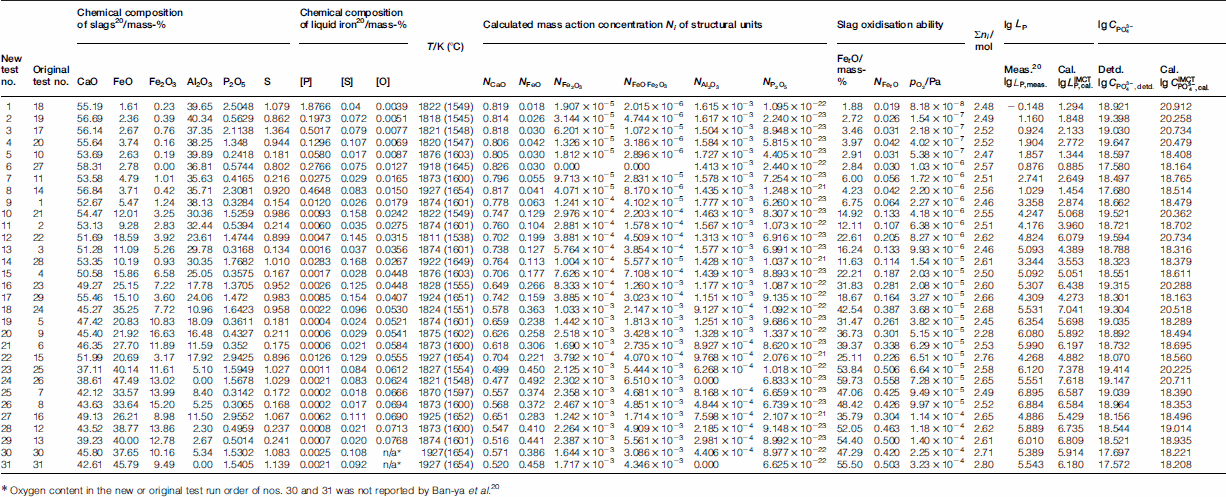
The original chemical compositions of both CaO–FeO– Fe2O3–Al2O3–P2O5 slags and liquid iron for 31 test runs of equilibrium experiments of oxygen, phosphorus and sulphur between 10 g liquid iron without carbon and 15 g CaO–Fe
t
O–Al2O3 slags from Ban-ya et al.
20
are summarised in Table 1 in a decreasing order or hierarchy of the calculated oxygen potential 
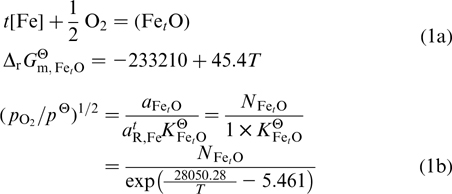
where 

Original chemical compositions of slags and liquid iron after Ban-ya et al.,
20
calculatedmass action concentrations Ni of structural units as components, calculated total equilibrium mole numbers Σni of structural units in 100 g slags, calculated oxygen potentialpO2based on

, measured
20
lg LP, measured by Ban-ya et al., predicted lg

from the developed IMCT–LP model, determined lg
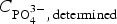
after Ban-ya et al.
20
and calculated lg
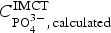
from the developed IMCT–

model for CaO–FeO–Fe2O3–Al2O3–P2O5 slags equilibrated with liquid iron in a temperature range from 1811 to 1927 K.
Thermodynamic model for calculating mass action concentrations Ni of structural units or ion couples in slags based on IMCT
Hypotheses
According to the classical hypotheses of the IMCT,30,31,34–41 the main assumptions for developing the thermodynamic model for calculating Ni of structural units or ion couples in CaO–FeO–Fe2O3–Al2O3–P2O5 slags, i.e. the IMCT–Ni model, can briefly be summarised as follows. First, structural units in the slags are composed of Ca2+ , Fe2+ and O2– as simple ions, Fe2O3, Al2O3 and P2O5 as simple molecules and calcium aluminates and so forth as complex molecules. Each structural unit occupies its independent position in the slags. Every cation and anion generated from the same component will take part in reactions for forming complex molecules in the form of ion couple (Me2+ + O2–) with simple molecules by taking MeO type oxide as an example. Second, reactions of forming complex molecules ci areunder dynamic chemical equilibrium between the bonded ion couples (Me2+ + O2–) and simple molecules. Third, structural units in the slags keep continuity in the range of the investigated concentration range. Fourth, chemical reactions of forming complex molecules ci conform to the mass action law54–56 through  by taking xMe1O·yMe2O as an example of complex molecule or associated molecule ci.
IMCT–Ni thermodynamic model for slags
Structural units in slags
The IMCT30,31,34–41 suggests that the extracted phosphorus from liquid iron into the slags can be bonded by ion couples (Fe2+ + O2–) or (Ca2+ + O2–) as well as iron oxides Fe t O to form structural units as P2O5, 3FeO·P2O5, 4FeO·P2O5, 2CaO·P2O5, 3CaO·P2O5 and 4CaO·P2O5 with the proceeding of simultaneous dephosphorisation and desulphurisation reactions. Hence, the applied CaO–FeO–Fe2O3–Al2O3 slags by Ban-ya et al. 20 will change from an open slag system without phosphate at the initial stage to a close slag system containing phosphate at the final stage equilibrated with liquid iron because the IMCT can only be applied to a close slag system. Therefore, the applied CaO–FeO–Fe2O3–Al2O3 slags by Ban-ya et al. 20 as an open slag system will be transformed to CaO–FeO–Fe2O3–Al2O3–P2O5 slags as a close slag system by omitting desulphurisation reactions.
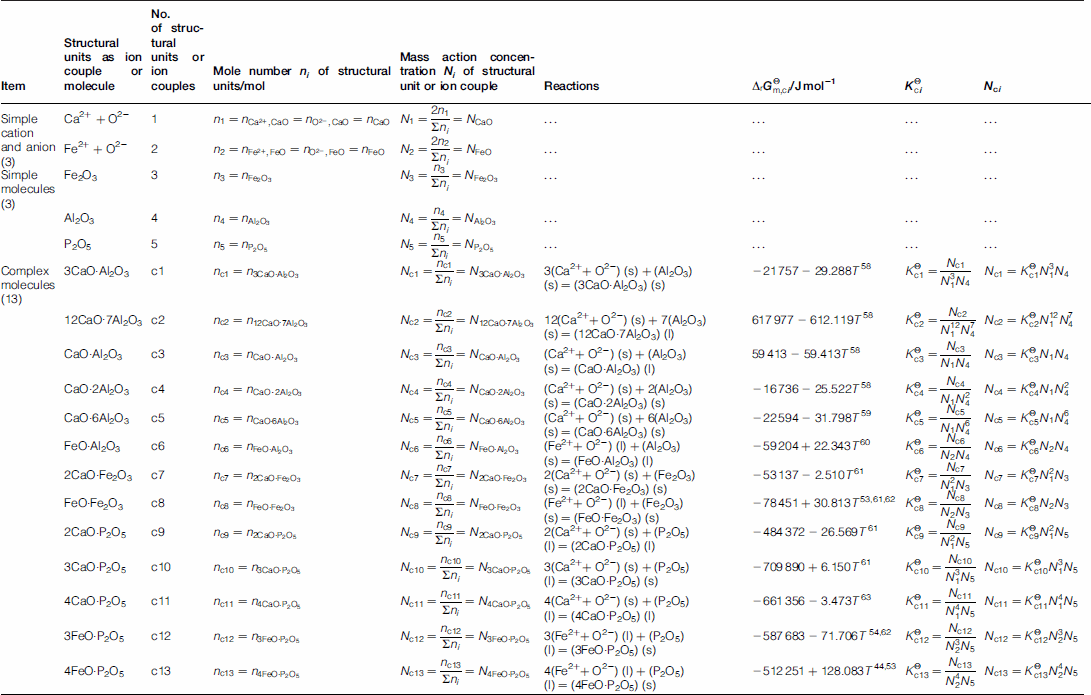
Expression of structural units as ion couples, simple or complex molecules, their mole numbers n and mass action concentrations Ni, chemical reaction formulae of possibly formed 13 complex molecules ci, their standard molar Gibbs free energy changes Δr

, standard equilibrium constants

and mass action concentrations Nci in CaO–FeO–Fe2O3–Al2O3–P2O5 slags equilibrated with liquid iron based on the IMCT
Development of IMCT–Ni thermodynamic model for slags
The mole number of the aforementioned five components as CaO, FeO, Fe2O3, Al2O3 and P2O5 in 100 g slags is assigned as  respectively. The defined30,31,34–41 equilibrium mole number ni of the aforementioned 18 structural units in 100 g slags is also expressed on the left region of Table 2 respectively. The total equilibrium mole number Sni (mol) of all 18 structural units in 100 g slags can be expressed as30,31,34–41

According to the defined30,31,34–41 Ni of structural unit i, which is a ratio of equilibrium mole number Ni of structural unit i to the total equilibrium mole number Σni of all structural units in a close slag system at a fixed amount, the mass action concentration Ni of structural unit i or ion couple(Me2+ + O2–) in slags can be calculated by30,31,34–41
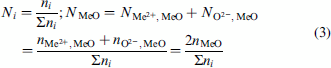
All the defined30,31,34–41 Ni of the formed ion couples from simple ions, the simple and complex molecules in the slags are also listed on the left region of Table 2.
The chemical reaction formulae of the possibly formed 13 complex molecules, their standard molar Gibbs free energy changes 


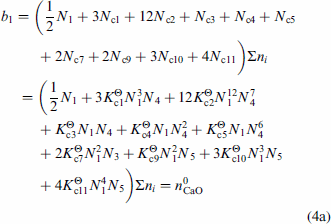
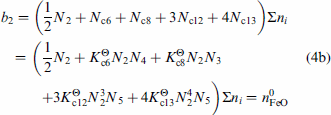
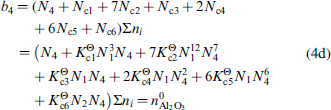
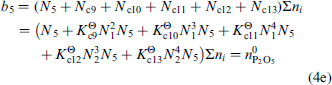
The mass conservation equations of five components in 100 g slags (mol) can be established from the definitions 30,31,34–41 of ni and Ni in Table 2 and Σni in equation (2) as

According to the principle that the sum of equilibrium mole fractions for all structural units in a fixed amount of slags is equal to unity, the summation of Ni for all 18 structural units in the slags can be described by30,31,34–41
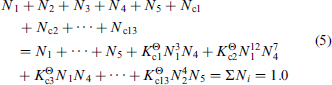
The equation group of equations (4) and (5) is the governing equations of the developed IMCT–Ni model for calculating Ni of structural units or ion couples in CaO–FeO–Fe2O3–Al2O3–P2O5 slags. However, no convergent solutions of the aforementioned six unknown variables can be obtained by solving the equation group because the solved values of 



Estimation of mass action concentrations Ni of structural units or ion couples containing P2O5 in slags
Absenting values of 


According to the estimated values of NP2O5 in Table 1, values of Nci for structural units containing P2O5 such as 3FeO·P2O5, 4FeO·P2O5, 2CaO·P2O5, 3CaO·P2O5 and 4CaO·P2O5 can also be determined, but will not be reported in this study for the sake of concision.
Re-evaluation of IMCT–Ni model
Similarities and differences between applied IMCT and other structural theories for slags
Obviously, some assumptions of both molecular theory and ionic theory for metallurgical slags have been embodied in the IMCT. The similarities and differences among the IMCT, molecular theory and ionic theory can be summarised as three statements.
41
First, molecular theory, which assumes all components as simple molecules and complex molecules in slags, can be applied to successfully elucidate some dephosphorisation and desulphurisation properties, although it cannot reasonably explain the electrical conductive characteristics as well as the electrolytic properties of slags. To obtain constant values of the standard equilibrium constants 
Actually, the classical hypotheses of the IMCT30,31,34–41 are to some degree similar with those of the associated solutionmodel,70–75 especially the ideal associated solution model.70,71
The defined Ni of the structural unit i or ion couple (Me2+ + O2–) in slags by equation (3) based on the IMCT looks like the defined activity aR,i by the molecular theory. As one of the most important structural theories for metallurgical slags, the molecular theory was first introduced to metallurgical slags by Schenck et al. 76 in the 1930s, and further applied by Chipman et al.,77–80 Darken et al.81,82 and so on since the 1940s. Zhang has verified in his book 41 and one article 83 that the calculated Ni of the components in the five slag systems as MnO–SiO2, FeO–Fe2O3–SiO2, FeO–Fe2O3–TiO2, FeO–Fe2O3–B2O3, CaO–FeO–Fe2O3–SiO2 slags are more accurate than the calculated activities aR,i of the components by the molecular theory, while the calculated Ni of the components in MnO–FeO–Al2O3 slags show the similar precision with the calculated activities aR,i by molecular theory.
Validity of replacing activities aR,i by mass action concentrations Ni of components in slags
It is well known that the sum of activities aR,i for the components in slags is not absolutely equal to unity, i.e. 

Results of IMCT–Ni model for slags
Relationship between mass percentage of five components and mass action concentration Ni of related structural units or ion couples in slags
The relationship between mass percentage and the calculated Ni of CaO, FeO, Fe2O3, Al2O3 and P2O5 for CaO–FeO–Fe2O3–Al2O3–P2O5 slags in a temperature range from 1811 to 1927 K is shown in Fig. 1 respectively. The good linear relationship between mass percentage and the calculated Ni for CaO, FeO and P2O5 can be observed in Fig. 1a, b and e; while the non-linear corresponding relationship with higher fitting degree can be found for Fe2O3 and Al2O3 in Fig. 1c and d. The results in Fig. 1 indicate that the calculated Ni of all five components, like mass percentages of components, can be applied to represent chemical composition of the slags.
Relationship between mass percentage and calculated mass action concentration Ni of CaO, FeO, Fe2O3, Al2O3 and P2O5 by developed IMCT–Ni model for CaO–FeO–Fe2O3–Al2O3–P2O5 slags in a temperature range from 1811 to 1927 K respectively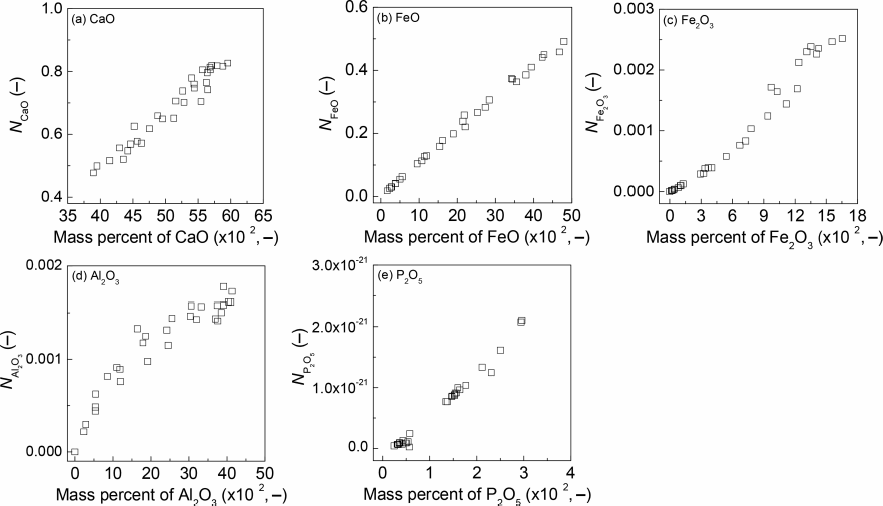
Validation of comprehensive mass action concentration

of iron oxides in slags
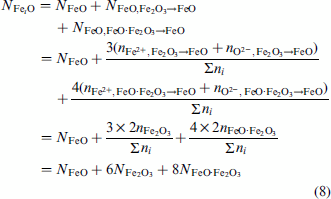
The IMCT suggests that all iron oxides in metallurgical slags are composed of ion couple (Fe2+ + O2–), simple molecule Fe2O3 and complex molecule FeO·Fe2O3. Thus, the related structural units of iron oxides can dynamically equilibrate as30,38–41


It can be derived from equation (7a) that the contribution of the simple molecule Fe2O3 to slag oxidisation ability is equivalent to three times that of the ion couple (Fe2+ + O2–). Likewise, the contribution of the complex molecule FeO·Fe2O3 to slag oxidisation ability is four times that of the ion couple (Fe2+ + O2–) as shown in equation (7b). Therefore, slag oxidisation ability expressed by the comprehensive mass action concentration 
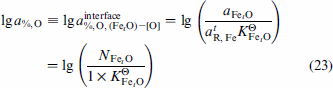
The activity 


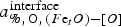
The activity a%,O of [O] in liquid iron mass percentage of element [O] as standard state can be determined through a%,O = [%O] f%,O according to the measured [%O] in liquid iron by Ban-ya et al. 20 as listed in Table 1. The involved activity coefficient f%,O of [O] can be determined by Wagner's equation as51,55,56

where A and B are two parameters related with the first order activity interaction coefficient 


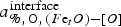
Comparison between the calculated activity Comparison between activity 


Validation of mass action concentration NP2O5 of P2O5 in slags
It is indicated by numerous researchers2,4,16,64–69 that activity coefficient Comparison between mass action concentration 


Summary of prediction models of activity coefficient of P2O5 in various steelmaking slags
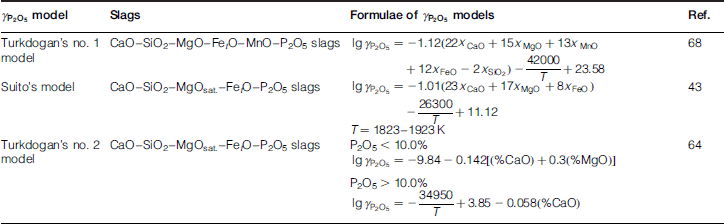
The calculated values of 


Thermodynamic models for calculating dephosphorisation ability and potential of slags based on IMCT
Thermodynamic model for calculating dephosphorisation ability of slags based on IMCT
According to the IMCT,30,31,34–41 the dephosphorisation reactions between CaO–FeO–Fe2O3–Al2O3–P2O5 slags and liquid iron can be represented by the ion couple (Fe2+ + O2–) or (Ca2+ + O2–) with iron oxides Fe t O to form six dephosphorisation products or molecules as P2O5, 3FeO·P2O5, 4FeO·P2O5, 2CaO·P2O5, 3CaO·P2O5 and 4CaO·P2O5 (J mol–1) as 38






The corresponding 


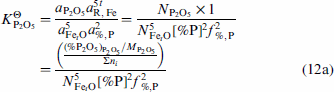
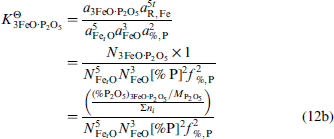
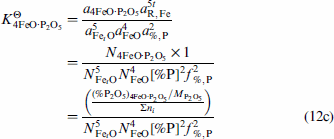
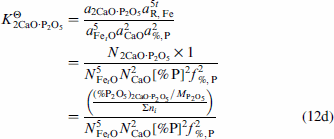
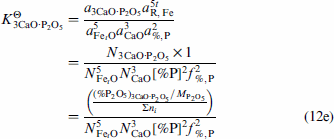
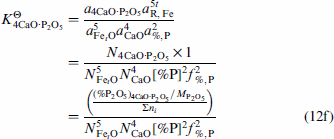
where 
 based on the IMCT.30,31,34–41 According to the expression of the related

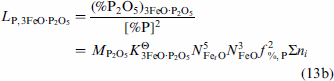
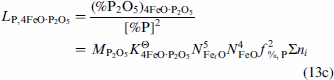
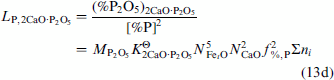
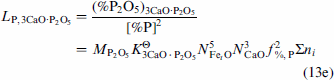
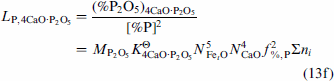
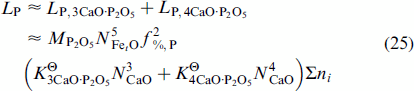
The total phosphorus distribution ratio LP between the slags and liquid iron can be derived from equation (13) as
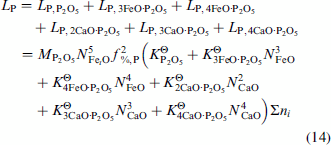
The equation (14) is the developed IMCT–LP model based on the defined30,38–41 


The involved activity coefficient f%, P of [P] in liquid iron in equation (14) can be calculated by Wagner's equation in equation (10). The value of 


Thermodynamic model for calculating dephosphorisation potential of slags based on IMCT
To establish the IMCT–

 and
and  have widely been applied to depict dephosphorisation ability of slags. To distinguish LP,


Relationship between phosphorus distribution ratio and phosphate capacity for slags
Relationship between phosphate capacity and phosphate capacity index for slags
It has been verified by Sano et al.85,86 that oxygen potential pO2 of slags >10−13 Pa results in the formation of phosphate 


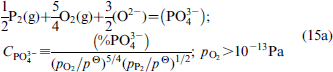
The definition of phosphate capacity index 
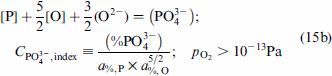
Phosphorus in slags is usually analysed as P2O5 by routine chemical analysis methods. In the view of the main dephosphorisation products as 3CaO·P2O5,
39
the mole number of 3CaO·P2O5 can be considered to equal that of the analysed total P2O5. According to the P and O equilibrium in phosphate 

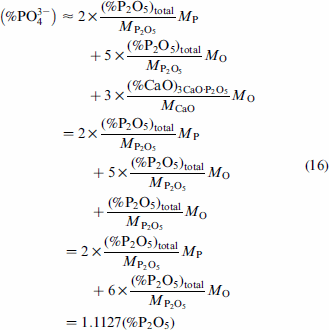
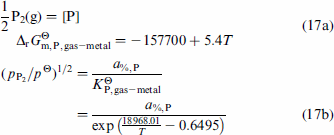
Comparing between the gas–slag dephosphorisation reaction in equation (15a) and the slag–metal dephosphorisation reaction in equation (15b), the gas–metal reaction of P2 dissolving into Fe based melts (J mol−1) can be expressed as 53
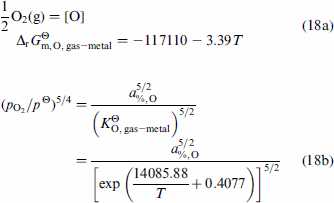
Likewise, the gas–metal reaction of O2 dissolving into Fe based melts (J mol−1) can be described by 53
The defined phosphate capacity 


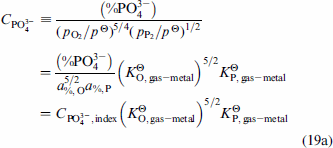
The relationship between 

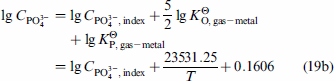
It can be obtained from equation (19b) that 


To describe precisely, phosphate capacity index 


Relationship between phosphorus distribution ratio and phosphate capacity for slags
The dephosphorisation reaction through slag–metal reaction (J mol−1) is usually described as53,87
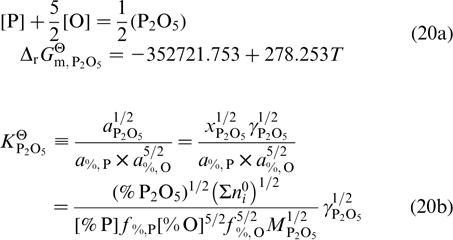
The expression of standard equilibrium constant 


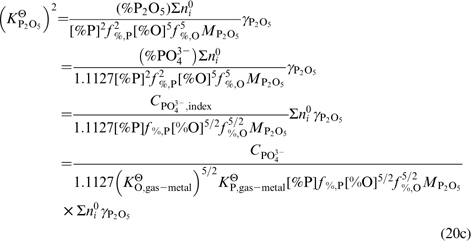
Consequently, the relationship between LP and 
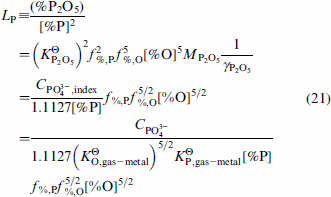
The relationship between LP and 


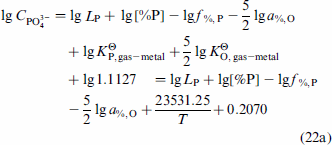
Likewise, the relationship between 


Additionally, the relationship between 

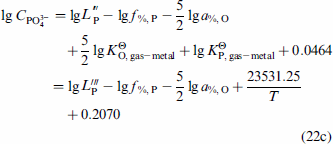
The equation group of equations (22a)–(22c) depicts the relationship between 



Establishment of thermodynamic model for calculating phosphate capacity of slags based on IMCT
The IMCT–
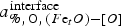


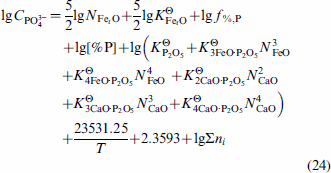
It can be obtained from the developed IMCT–


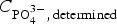
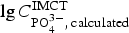
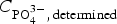
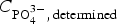
It should be emphasised that the claimed determined 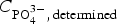



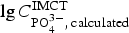



Evaluation of developed IMCT–LP and IMCT –

models for slags based on IMCT




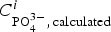

Summary of five phosphorus distribution ratio LP models and three phosphate capacity

models for various slags from related literature
Evaluation of developed IMCT– LP model for slags
Comparison between measured LP, measured and calculated

by developed IMCT–LP model for slags
Comparison between the measured
20
lg LP, measured by Ban-ya et al. and the calculated lg Comparison between measured
20
lg LP, measured by Ban-ya et al. and lg


Comparison between measured LP, measured and calculated

by other five LP models for slags
Evaluation of other five LP models
Comparing between the measured
20
values of LP by Ban-ya et al. and the predicted ones by the reported LP models is also of importance to verify the feasibility of the developed IMCT–LP model. Obviously, the comprehensive effects of temperature T and slag composition such as CaO, MgO, MnO, SiO2 and Fe
t
O or T·Fe or FeO on LP have been considered in the listed five LP models in Table 4. All the listed five LP models in Table 4 are empirical thermodynamic models from mathematical regression of experimental data. The main conclusions of the listed five LP models in Table 4 can be summarised as follows: increasing contents of basic components such as CaO, MgO and MnO can improve dephosphorisation ability; most LP models in Table 4 except for Healy's model
44
indicate that contribution of CaO on dephosphorisation ability is greater than that of MgO and MnO respectively the positive effect of iron oxides expressed as Fe
t
O or T·Fe or FeO on dephosphorisation ability is smaller than that of each basic component as CaO, MgO and MnO with the same content increasing temperature directly results in a decreasing tendency of dephosphorisation ability of slags due to the temperature dependence of the dephosphorisation reaction; a further decreasing trend of dephosphorisation ability of basic components such as CaO, MgO and MnO is seen by Sommerville's model46,47 SiO2 displays a very small contribution to dephosphorisation ability of slags most models indicate that P2O5 can reduce dephosphorisation ability of slags the individual effect of iron oxides Fe
t
O and basic oxide CaO has been embodied in the listed five P models, while the comprehensive of iron oxides Fe
t
O and basic oxide CaO on dephosphorisation ability is not explicitly expressed as one independent term in the listed five LP models.
Comparison between measured LP, measured and calculated

by other five LP models for slags
Comparison between the measured
20
lg LP, measured by Ban-ya et al. and the calculated 

Generally, all the models in Fig. 4b–f can be applied to reliably predict dephosphorisation ability of the slags, although none of the listed five LP models in Table 4 was developed for the studied slags without SiO2. The calculated values of LP by Healy's model 44 in Fig. 4b or Suito's no. 2model43,45 in Fig. 4c or Suito's no. 1model43,45 in Fig. 4f are more or less greater than the measured 20 ones by Ban-ya et al. The calculated values of LP by Suito's no. 3 model43,45 in Fig. 4d and Sommerville's model46,47 in Fig. 4e are more accurate than the calculated ones by other three LP models based on the measured 20 ones by Ban-ya et al. as criteria. Thus, the developed IMCT–LP model in Fig. 4a, Suito's no. 3 model43,45 in Fig. 4d and Sommerville's model46,47 in Fig. 4e can be used to reliably predict dephosphorisation ability of the slags.
The listed five LP models in Table 4, especially Suito's no. 3 model43,45 and Sommerville's model46,47 can only correlate with contents of components and temperature T coupled with the regressed coefficients from experimental data.However, thedevelopedIMCT–LP model in equation (14) can correlate with the determined Ni and Σni by the developed IMCT–Ni model for the slags, the standard equilibrium constant 
Evaluation of developed IMCT–

model for slags
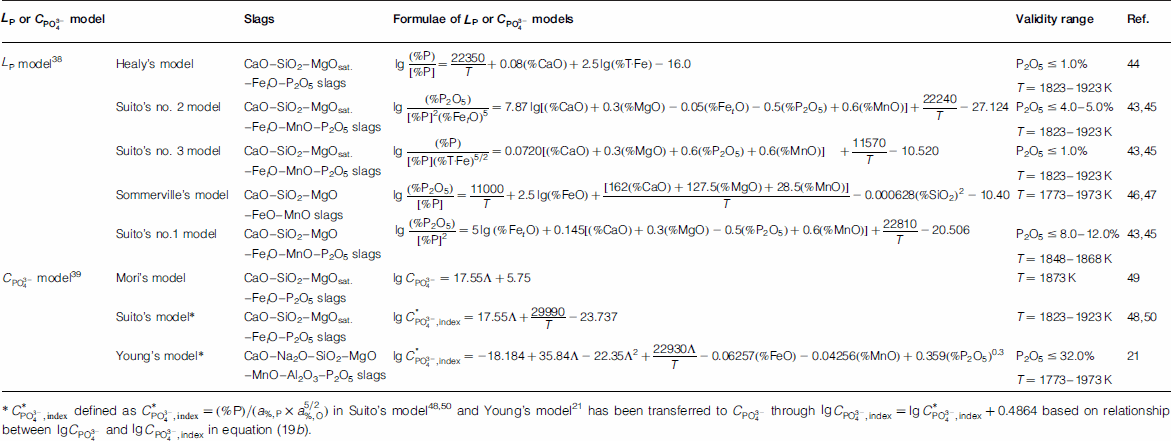
Comparison between determined
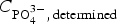
and calculated
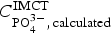
by developed IMCT–

model for slags
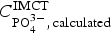
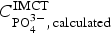
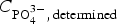
Comparison between the determined lg Comparison between determined lg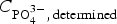


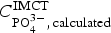

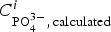

Comparison between determined
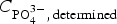
and calculated
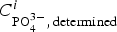
by some LP or

models for slags
Evaluation of other three phosphate capacity models
According to the relationship between LP and 


Comparing with the main conclusions from the listed five LP models in the section on ‘Evaluation of other five LP models’, the main statements from the listed three increasing contents of basic components such as CaO and decreasing contents of acidic components such as SiO2 and Al2O3 increase dephosphorisation potential and result in greater values of optical basicity greater optical basicity Fe
t
O and MnO show small negative effects on phosphate capacity P2O5 has a small promotive effect on phosphate capacity increasing temperature results in a decrease in phosphate capacity 


Comparison between determined
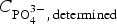
and calculated
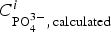
by different LP or

or models for slags
Comparison between the determined lg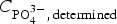
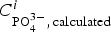






Influence of slag chemical composition on dephosphorisation ability and potential of slags
Influence of slag oxidation ability on dephosphorisation ability and potential of slags
The common consensuses21,42,44–48,50 on dephosphorisation reactions from the accumulated industrial experiences and experimental studies indicate that greater slag oxidation ability and lower temperature are two key factors to promote dephosphorisation from liquid iron or molten steel to slags. Three parameters as mass percentage of Fe
t
O through (%Fe
t
O) = (%FeO) + 0:9(%Fe2O3)54–56 based on mass conservation of iron, the calculated Relationship between calculated comprehensive a mass action concentration Relationship between mass percentage of Fe
t
O and measured20 ratio lg


The influence of mass percentage of Fe
t
O on the determined lg Relationship between mass percentage of Fe
t
O and determined lg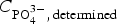
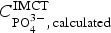





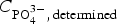

Certainly, the results in Fig. 8 by the developed IMCT–


Influence of slag basicity on dephosphorisation ability and potential of slags
The widely applied binary basicity (%CaO)/(%SiO2) cannot be used for the slags without SiO2. The more complex basicity [(%CaO) + 1:4(%MgO)]/[(%SiO2) + (%P2O5) + (%Al2O3)]38,51,54,55 can be applied. In the investigated slags, it was simplified to form (%CaO)/[(%P2O5) + (%Al2O3)]. The influence of the simplified complex basicity (%CaO)/[(%P2O5) + (%Al2O3)] on the measured
20
lg P, measured by Ban-ya et al. and the calculated lg Relationship of simplified complex basicity (%CaO)/[(%P2O5) + (%Al2O3)] a or optical basicity taking 


Three groups of values of optical basicity for FeO and Fe2O3 have been recommended as 


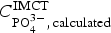
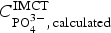
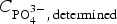
Similarly, the relationship between the simplified complex basicity (%CaO)/[(%P2O5) + (%Al2O3)] or optical basicity and the determined lg Relationship between a simplified complex basicity (%CaO)/[(%P2O5) + (%Al2O3)] or b optical basicity by taking 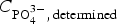


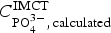

Comprehensive effect of Fe t O and CaO on dephosphorisation ability and potential of slags
Besides the individual effect of iron oxides Fe
t
O or basic oxide CaO, the comprehensive effect of iron oxides Fe
t
O and basic oxide CaO plays a pivotal role on dephosphorisation ability and potential of the slags. It has been verified byYang et al.38,39 that themass percentage ratios or the mass action concentration ratios of various iron oxides to basic oxide CaO can be applied to elucidate the comprehensive effect of iron oxides Fe
t
O and basic oxide CaO on dephosphorisation ability and potential of slags. Themass percentage ratio (%Fe
t
O)/(%CaO) of iron oxides Fe
t
O to basic oxide CaO can correlate good linear relationship with the corresponding mass action concentration ratio Relationship between mass percentage ratio (%Fe
t
O)/(%CaO) and corresponding mass action concentration ratio 


The relationship between the mass action concentration ratio Relationship between a mass action concentration ratio 


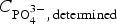
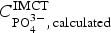


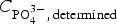

Thus, attaining reasonable conditions such as slag oxidisation ability, slag basicity, temperature and so forth is very important to strengthen dephosphorisation ability and potential of the slags. The optimal range of chemical composition for the slags with good dephosphorisation ability and potential can be summarised as follows: mass percentage of Fe
t
Oas 35.0%corresponding to the simplified complex basicity (%CaO)/[(%P2O5) + (%Al2O3)] should be controlled at about 3.0, which corresponds to optical basicity in a range of 0.90–0.95 the mass action concentration ratio NFetO=NCaO should be maintained at 0.45 corresponding to the mass percentage ratio (% FetO)/(% CaO) also as 0.45.


In addition, the lower temperature range from 1811 to 1828 K is also recommended for enhancing dephosphorisation ability and potential of the slags under the condition of maintaining required fluidity of the slags.
Quantitative contributions of dephosphorisation products to dephosphorisation ability and potential of slags based on IMCT
Contribution ratios of various dephosphorisation products to dephosphorisation ability of slags
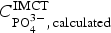
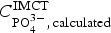
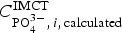
The respective phosphorus distribution ratios P,i of six dephosphorisation products as P2O5, 3FeO·P2O5, 4FeO·P2O5, 2CaO·P2O5, 3CaO·P2O5 and 4CaO·P2O5 in the slags equilibrated with liquid iron can be determined by the developed IMCT–LP mode in equation (14). The relationship between the calculated respective phosphorus distribution ratios 


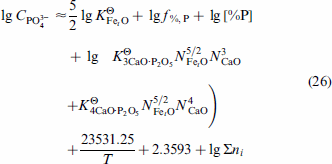
The product term 


Contribution of a calculated lg


Regressed formulae of calculated respective phosphorus distribution ratio

of six dephosphorisation products against calculated total phosphorus distribution ratio

by the developed IMCT–LP model and average contribution ratio of six dephosphorisation products to

for CaO–FeO–Fe2O3–Al2O3–P2O5 slags equilibrated with liquid iron in a temperature range from 1811 to 1927K based on the IMCT

It can be obtained from Table 5 that the contribution ratio of iron oxides Fe t O and CaO + Fe t O to LP for the slags is ∼0.0 and 100% respectively. The formed 3CaO·P2O5 accounts for 95.00%, and 4CaO·P2O5 contributes to 5.00% of the dephosphorisation products in the slags respectively. This result is similar with the obtained38,39 conclusion as that 3CaO·P2O5 accounts for 96.01%, and 4CaO·P2O5 contributes to 3.97% of the dephosphorisation products in the CaO–SiO2–MgO–FeO–Fe2O3–MnO–Al2O3–P2O5 slags during the top– bottom combined blown converter steelmaking process.
Contribution ratios of various dephosphorisation products to dephosphorisation potential of slags
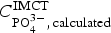
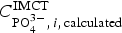
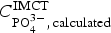
Regressed expressions of calculated respective phosphate capacity
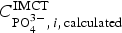
of six dephosphorisation products against calculated total phosphate capacity
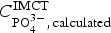
by developed IMCT–

model and average contribution ratio of six dephosphorisation products to
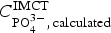
for CaO–FeO–Fe2O3–Al2O3–P2O5 slags equilibrated with liquid iron in a temperature range from 1811 to 1927K based on IMCT

It can be obtained from Table 6 that the contribution ratio of iron oxides Fe
t
O to 


The product term 
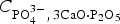

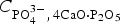


Obviously, the obtained contribution ratio of 3CaO·P2O5 or 4CaO·P2O5 to 

Conclusions
The thermodynamic models for predicting phosphorus distribution ratio LP and phosphate capacity The calculated mass action concentrations Ni of structural units or ion couples based on the IMCT can be applied to accurately represent reaction abilities of components in the slags, like activities aR, i of components relative to pure liquid or solid components as standard state. Furthermore, the calculated comprehensive mass action concentration of iron oxides Fe
t
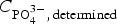
O as The measured phosphorus distribution ratio LP, measured of the slags can reliably be predicted by the developed IMCT–LP model and other two reported models as Suito's no. 3 model and Sommerville's model. The determined phosphate capacity An exponentially growing relationship of phosphorus distribution ratio in logarithmic form lg LP against slag oxidisation ability and the simplified complex basicity (%CaO)/[(%P2O5) + (%Al2O3)] or optical basicity can be established for the slags, respectively. The linearly increasing relationship of phosphate capacity in logarithmic form lg The respective phosphorus distribution ratio LP, i and the respective phosphate capacity Not only the individual effect of various iron oxides and basic oxide CaO but also the comprehensive effect of CaO + Fe
t
O, which can be described by the mass action concentration ratio 





Footnotes
Acknowledgement
This work is supported by the National Natural Science Foundation of China (NSFC) by grant no. 51174186.