







Abstract
In this study, the effect of using phosphate bonding materials such as sodium hexametaphosphate (SHMP) and sodium tripolyphosphate was investigated in the presence of water and recycled magnesia carbon (MgO–C) refractory aggregates as raw materials. For this purpose, different compounds are prepared, and some parameters such as bulk density, volume per cent of apparent porosity and cold crushing strength were measured at different temperatures (200, 500 and 1100°C), and phase and microstructure studies were performed by X-ray diffraction, SEM and energy dispersive spectroscopy. Statistically, effects of the factors were also determined using the analysis of variance method. Results indicated that MgO–C monolithic refractory samples were successfully produced from recycling the spent MgO–C bricks, and use of these phosphate binders especially that of 5 wt-%SHMP produce some phosphate bonds like Mg2P2O7, Mg3(PO4)2 and AlPO4 and improve the physical and mechanical properties.
Introduction
Magnesia carbon (MgO–C) refractories have been extensively applied in the steelmaking process, for instance, as the lining of basic oxygen furnaces, electric arc furnaces, ladles and RH (Ruhrstahl-Heraeus) vacuum degassers because of their excellent refractory properties. These materials mainly consist of magnesia and graphite. 1–4
Magnesia in MgO–C refractories has the characteristics such as high melting point and high refractoriness. Nevertheless, a main problem especially in the development of magnesia based castables is its tendency to react with water to form magnesium hydroxide (brucite). The density mismatch between magnesia (3.5 g cm− 3) and brucite (2.4 g cm− 3) causes stresses inside the castable during the drying process, which results in the formation of cracks and finally in low mechanical properties. Studies on the hydration of magnesia and on the dehydration of magnesium hydroxide (brucite) have been thoroughly reported in a lot of literatures during the last decades in order to avoid the brucite [Mg(OH)2] production. Among the additions, microsilica seems to be one of the most effective due to the protective layer build-up of silicic acid around the fine MgO particles after the SiO2 and water contact during mixing. 5–7
Carbon has characteristics such as high thermal conductivity, low thermal expansion and low wettability by melt and slag. Owing to these advantages, there was a tendency to use more carbon in the refractories to have better corrosion resistance and thermal shock resistance. But with the progress in technology and knowledge, it has become clear that higher carbon content (graphite, carbon black and pyrolytic carbon from the resins or pitches) in the refractories imparts several drawbacks such as low mechanical strength and poor oxidation resistance. 7–12
The main problem especially in the development of water based oxide–carbon refractory castables is the non-existence of a suitable and satisfying economical binder system, which is compatible with water. Previous literatures showed that phosphate binders provide better high temperature mechanical properties than silicate or sulphate binders. The phosphate type binder that is the most often used is a glassy sodium polyphosphate. The nature of the phosphate bond changes during the setting process. Sodium tripolyphosphate (STPP), Na5P3O10 and sodium hexametaphosphate (SHMP), (NaPO3)6, are commonly used in the making of refractory castables and in advanced ceramic processing. 13–15
After the refractory materials have reached to the end of their service life, they do not have much value and should be replaced with new refractories manufactured from natural raw materials, and as a result, the spent refractories are buried in the valuable natural resources. By considering the responsibility of companies to protect the environment and control the waste, this is essential to recycle and reuse these materials. In addition, the practice with recycled spent refractory also gave additional benefits in terms of energy consumption, refractory consumption, melting time and lower requirements of fluxes. One of the spent refractory applications is to recycling them as repair materials. 16–18
The general aim of this work is to evaluate the physical and mechanical behaviour of MgO–C castables used in steelmaking ladles, which is composed of MgO–C spent refractory aggregates as raw materials and phosphate binders, at a temperature close to that used in the preheating of the ladles.
Experimental
Spent refractory characterisation
The spent MgO–C bricks used to the slag line of ladles were analysed by X-ray fluorescence and X-ray diffraction (XRD) methods, which are shown in Table 1 and Fig. 1 respectively.
X-ray fluorescence of spent MgO–C bricks
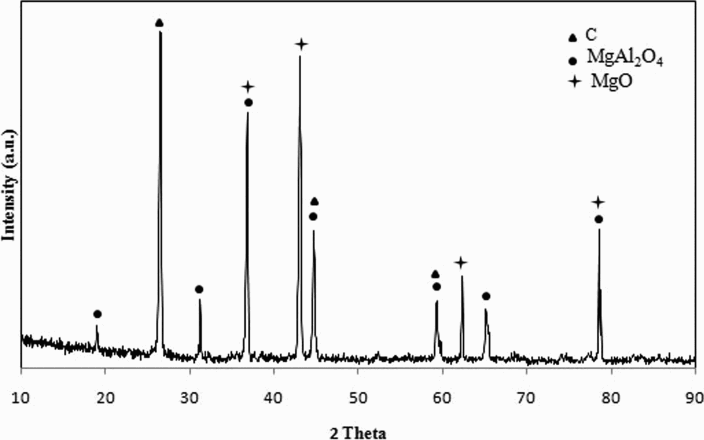
X-ray diffraction pattern of spent MgO–C bricks
Preparation of recycled aggregates
In order to prepare the recycled aggregates, first, the MgO–C spent refractories were crushed and screened in different particle size portions. Then, the formulation was optimised using Andreasen's particle packing model (equation (1)). The formulation of aggregates is 12, 21 and 67% in the sizes of 3–5, 1–3 and 0–1 mm respectively.
Preparation and characterisation of samples
Table 2 shows the composition of prepared refractory mixes. The used binders were industrial grades of SHMP and STPP added in 0, 3 and 5 wt-%. The compositions were mixed with water in a laboratory mixer and, after homogenising, casted in 50 × 50 × 50 mm cubic die. Then, the samples were dried at 200°C for 7 h and heat treated in an electric furnace at 500 and 1100°C for 3 and 2 h respectively with adding 3 wt-% silicon carbide to the sample compositions as an antioxidant. The flowchart of the MgO–C sample preparation is shown in Fig. 2.
Composition of monolithic refractory samples
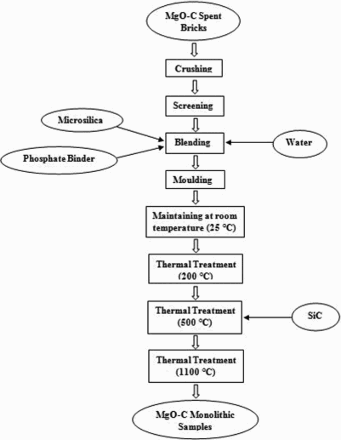
Flowchart of processing MgO–C monolithic samples
The bulk density (BD) and per cent of apparent porosity (%AP) of the specimens, as well as their cold crushing strength (CCS) were measured according to ASTM C133 and ASTM C20 standard tests respectively.
The mineralogical composition of the samples was determined by qualitative XRD together with observations made by scanning electron microscopy equipped with energy dispersive X-ray spectroscopy (SEM/EDS). The XRD analysis was performed on powdered samples, using Cu K α radiation (1.5418 Å), with a voltage of 40 kV and 30 mA of current. The angular interval used was 2θ = 10–90°, with a step size of 0.05° and scan rate of 1° min− 1 after crushing and passing via a sieve of mesh size 180.
Moreover, the statistical analysis was carried out with one-way analysis of variance (ANOVA) test, a statistical technique, in order to determine the level of significance (p < 0.05) (SPSS v. 20 program). All values are presented as the mean ± standard deviation.
Results and discussion
Evaluation mechanical and physical properties
Cold crushing strength, BD and %AP were determined at different temperatures (200, 500 and 1100°C). Figure 3 shows the mean values of the measured CCS, BD and apparent porosity of at least three monolithic refractory samples. It can be clearly seen that there are the general trend of changes in properties in all compounds at different temperatures. As the results show, there are significant (p < 0.05) differences between samples both in physical and mechanical tests, and the mechanical strength (Fig. 3a ) and BD (Fig. 3b ) increased, and the %AP (Fig. 3c ) decreased significantly by increasing the amounts of phosphate binders, which may be due to the chemical reaction between binders and spent refractory aggregates. Sample H2 with 5 wt-%SHMP had the highest value of CCS and BD and the lowest value of apparent porosity. In contrast, Sample F (phosphate binder free) had the lowest mechanical and physical properties between all compounds, and in general, the samples that contain SHMP exhibited better properties in comparison with the samples that contain STPP.
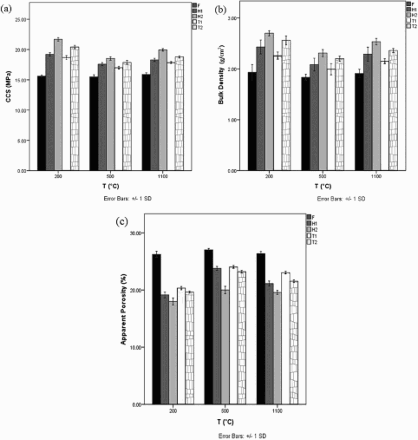
Variation of mechanical and physical properties of MgO–C samples ar e different temperatures (200, 500 and 1100°C): a cold crushing strength (MPa), b bulk density (g/cm3) and c per cent of apparent porosity; all values are presented as mean±standard deviation; significance level was set at 0.05
At 200°C, the highest amount of physical and mechanical properties can be observed. At this temperature, no ceramic bonding occurred, and this phenomenon may be due to the formation of phosphate bonds, but as it can be seen, when the temperature increases, the physical and mechanical properties of the samples decrease; in the temperature range from 200to 500°C, there is an abrupt drop in CCS and BD, which may have resulted from changing the state of the phosphate bonds. However, for 1100°C, the BD and apparent porosity improved. This behaviour may be attributed to the ceramic bonds being formed. 19
In order to have a better investigation of the operation of these phosphate binders, we used XRD.
Evaluation of phases and macrostructure
Figures 4 and 5 show the XRD patterns of the refractory samples at the different temperatures (200, 500and 1100°C), which contain 5 wt-%SHMP and STPP respectively.
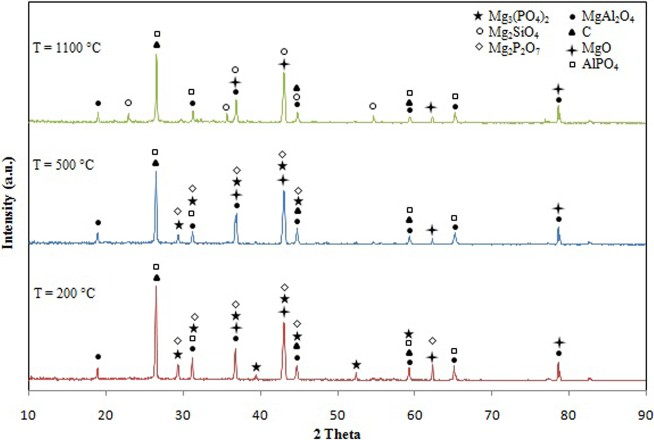
X-ray diffraction patterns of refractory samples at different temperatures (200, 500 and 1100°C), which contain 5 wt-%SHMP
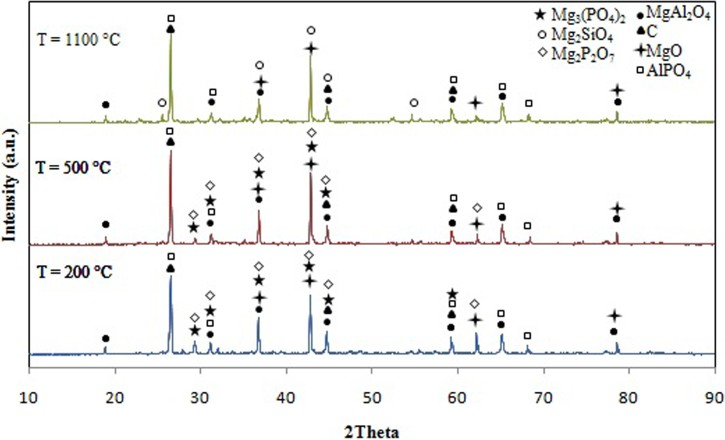
X-ray diffraction patterns of refractory samples at different temperatures (200, 500 and 1100°C), which contain 5 wt-%STPP
In these patterns, we can see phosphate phases such as Mg2P2O7, Mg3(PO4)2 and AlPO4 especially at 200°C, which resulted from reactions between phosphate binders with magnesia and alumina, existing in spent refractory aggregates.
The results indicate that by increasing the temperature (up to 500and 1100°C), the state of phosphate bonds has changed and has gone forward to decomposition, so the refractory samples can be used to repair the ladles at preheating temperatures, and at high temperatures, ceramic bonds, which resulted from sintering processes such as forsterite (Mg2SiO4), which formed from the reaction between MgO and microsilica and observed in XRD patterns of H5 and T5 at 1100°C, will be responsible to secure the physical and mechanical properties. By entering forsterite to the open porosities, the strength and physical properties of the refractory samples can improve. 20
Figure 6 shows the results derived by SEM/EDS related to MgO–C monolithic refractory samples (200°C) with 5 wt-%SHMP (Fig. 6) at different magnifications, in which the needle-like phosphate phases can be observed in Fig. 6b and confirmed by the EDS result. This in situ reaction bonding is responsible for reinforcing the microstructure and the increase in BD and CCS of the refractory samples. 21
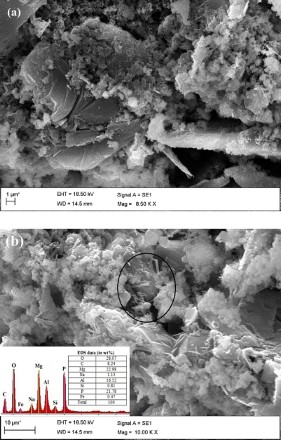
Analysis (SEM/EDS) of MgO–C samples with 5 wt-%SHMP at 200°C a magnification marker is 1 μm and b magnification marker is 10 μm with EDS spectrum result corresponding to the specific region marked in figure
Conclusions
By considering that the use of spent refractories as raw materials of composition in the production of monolithic refractories will minimise significantly the amounts of refractory landfilling, MgO–C monolithic refractory samples were successfully produced from recycling the spent MgO–C bricks and physical and mechanical properties of the refractories made from spent refractory aggregates, and phosphate binders have been investigated with the following conclusions. First, the addition of phosphate binders such as SHMP and STPP had a positive influence on the physical and mechanical properties of MgO–C refractories at 200°C, which may have resulted from the formation of Mg2P2O7, Mg3(PO4)2 and AlPO4 phases. Moreover, the samples with 5 wt-%SHMP showed the best properties among others. Finally, by increasing the temperature (up to 500and 1100°C), the state of the phosphate bonds changed and went forward to decomposition. Thus, it can be concluded that these refractory samples can be used to repair the ladles at preheating temperatures, and at a high temperature, ceramic bonds resulted from sintering processes will be responsible to secure the physical and mechanical properties.
Footnotes
Acknowledgements
The authors are thankful to Mr Chami in Advanced Materials Research Center in IslamicAzad University of Najafabad branch for their helpful cooperation.