







Abstract
A three-dimensional (3-D) mathematical model to predict raceway diameter has been developed based on previous 2-D studies. The results show that the 3-D simulated results on raceway diameter are in good agreement with measurements of two Chinese blast furnaces. Moreover, it is more precise than previous models. The effect of blast velocity, bed porosity and particle diameter has been investigated. An increase in gas velocity relative to a decrease in velocity leads to a larger downward frictional force so that the raceway diameter is smaller. A low bed porosity and a small particle diameter result in low normal pressure in the Cartesian region and low radial pressure in the radial region, which is not beneficial for smooth operation.
List of symbols
diameter of the particle/m
hearth diameter/m
raceway diameter/m
tuyere diameter/m
the acceleration due to gravity, 9.81 m s− 2
factor arising due to resolution of vertical force along the radial direction, whose value is the same with p
effective height of packed bed/m
lateral pressure coefficient
bed weight per unit volume/N m− 3
factor contributing to the total area of the raceway, given as 0.8 16
tuyere number
factor arising due to resolution of rational force along the vertical direction
blast pressure/Pa
atmospheric pressure/Pa
top pressure of blast furnace/Pa
radius of radial region/m
radius of raceway/m
blast temperature/K
standard temperature/K
top temperature to blast furnace/K
blast velocity/m s− 1
gas velocity in the Cartesian region/m s− 1
volume of blast furnace/m3
blast flowrate/m3 min− 1
porosity of packed bed, given as 0.42
internal angle between the particles, given as 32° 30
shape factor of particles, given as 0.7 19
angle of friction between the particle and wall, given as 20° 30
coefficient of the viscosity of gas/kg (m s)− 1
coefficient of friction between the particle–particle
coefficient of friction between the particle and wall
gas density/kg m− 3
gas density at standard conditions/kg m− 3
particle density, given as 1050 kg m− 3
particle–wall frictional shear stress/N m− 2
particle–particle frictional shear stress/N m− 2
Introduction
The raceway of a blast furnace (BF) is an important region for producing most of the reducing gas and supplying heat. Owing to the large force of the hot blast injected through the tuyeres at a high velocity, raceways can be formed in front of the tuyeres. The size and shape of a raceway play a significant role in the gas distribution and the stable operation. On this account, a lot of research on raceway phenomena, especially raceway penetration, has been made in recent decades.
Many authors 1–4 have predicted raceway penetration by experimental measurements and empirical correlations. However, these correlation results have limitation for predicting the raceway size. In order to explain the mechanism of raceway formation, Szekely et al. 5,6 developed a formulation based on the macroscopic momentum balance to estimate the raceway size. Flint et al. 7 strengthened the physical model of raceway formation, but the force balance analysis was too simplistic in that only pressure loss and weight of overburden were considered. After it was found experimentally that cavities formed by an increase in gas flow were smaller than those formed by a decrease in gas flow in a static bed, 8 Gupta et al. 9–13 started to apply a two-dimensional (2-D) model to simulate the phenomena in BF lower zone and to predict the raceway size. In addition, the effect of frictional properties on raceway size was paid much attention. 14–15 Subsequently, the mechanism of raceway hysteresis was explained successfully by this 2-D force balance model. 16–18 Guo et al. 19 modified and improved this model and obtained more precise predictions recently. The raceway size was also simulated by some other 2-D models 20–26 such as discrete element method and stress model. Furthermore, there have been some attempts to model the conditions in the raceway by 3-D numerical models. 27–28
From the above description, it is clear that a 3-D model of raceway size is very rare at present. It is necessary to improve this model more closely to actual BF situation. In addition, the cases of decreasing, and increasing gas velocity had different influences on frictional force and raceway size, which need to be comprehensively analysed. In this work, a 3-D mathematical model has been established to predict the raceway diameter in a packed bed based on previous studies. The results are validated with the measurements of two Chinese BFs and also compared with previous 2-D models. Both cases of decreasing and increasing gas velocity are reported. The normal pressure in the Cartesian region and radial pressure in the radial region were analysed for these two cases. The effect of bed porosity and particle diameter will be also discussed. The study will contribute to a comprehensive understanding of raceway formation based on force balance.
Three-dimensional mathematical model of raceway
According to the two dimensional model of Gupta et al.,
14–18
a force balance equation is established, as shown in equation (1). The 3-D mathematical model of raceway size was also developed on this basis. Without considering the interaction of raceways, only one raceway is regarded as the analysis object and the others are considered the same. Figure 1 shows the packed bed of solids of height H and diameter D
H. The gas is injected through the tuyere (diameter D
T) with a velocity v
b. The packed bed is divided into two regions including the Cartesian region and the radial region. In the Cartesian region, there is a constant velocity v
H, whereas the gas velocity v(r) varies with the distance from centre in the radial region. Isobaric conditions are assumed in the raceway, and gas flows radially from the centre of the raceway. r
0 and R represent the radius of the radial region and radius of raceway respectively.
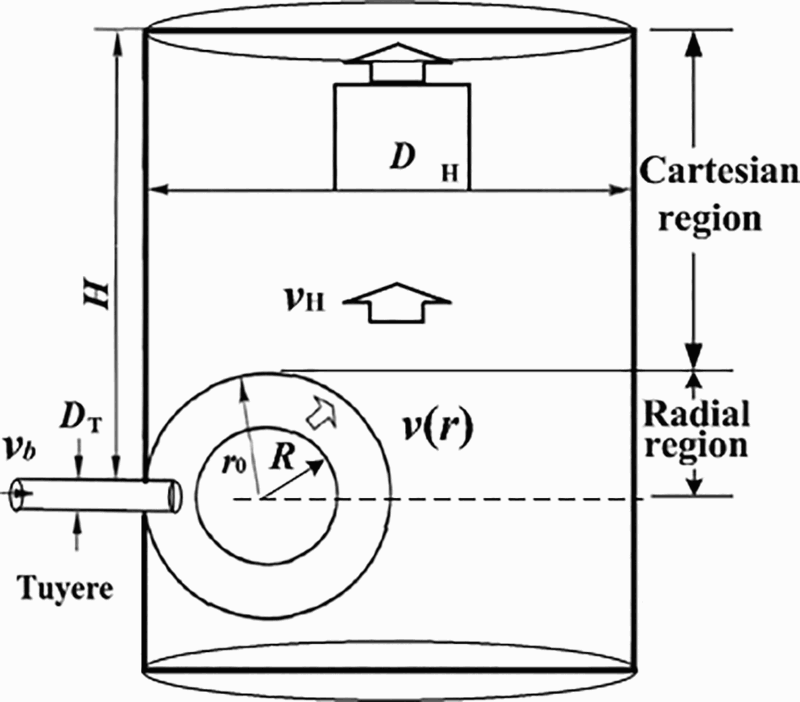
Schematic diagram of 3-D model for raceway including radial region and Cartesian region
Gas velocity distribution
Based on the law of mass conservation, the mass flowrate of gas at the tuyere and at the bed surface in the Cartesian region gives



In addition, transition between the radial region and Cartesian region occurs when r = r
0. The corresponding velocity at this distance is given by


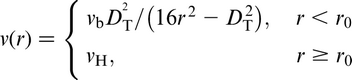
Pressure force in Cartesian region
The pressure force per unit volume exerted by the gas in the packed bed is given by the Ergun equation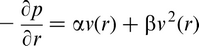

In the Cartesian region, the pressure force per unit volume can be expressed as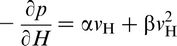

Pressure force in radial region
The gas velocity in the radial region is very high; thus, the viscous term of Ergun equation can be neglected because it is far less than the inertial term (
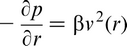
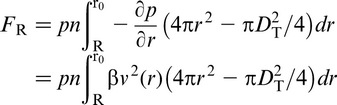


The total pressure force exerted by the gas in the packed bed is given by
Frictional force in Cartesian region
The frictional force in the Cartesian region is considered for both increasing and decreasing gas velocity. First, an elemental force balance in the Cartesian region is introduced at the condition of decreasing velocity. The case of increasing velocity is similar.
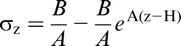
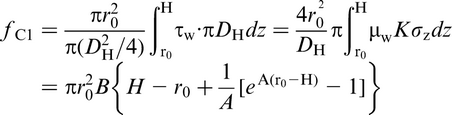
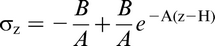
The particle–wall frictional force is in the upward direction against the downward movement of particles when the gas velocity decreases. Figure 2 shows the forces acting on a control element in the Cartesian region for decreasing velocity. It is assumed that the normal stress on the lower surface of the element σz acts in the upward direction at any distance z from the bottom of the Cartesian region. The height of the element is dz. σz+dσz is normal stress acting on the upper surface of the element in the downward direction and τw is the particle–wall frictional stress. M is the bed weight per unit volume. The forces acting on the element can be written as



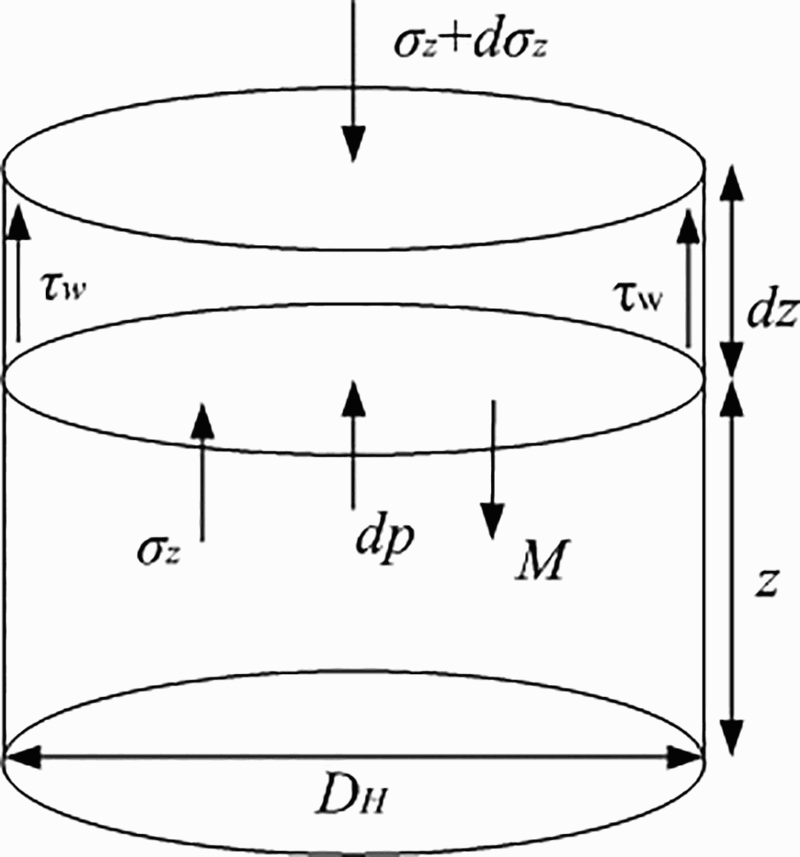
Forces acting on control element in Cartesian region for decreasing velocity
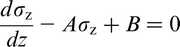
Simplifying equation (12) based on equations (13) and (14) gives




Frictional force in radial region
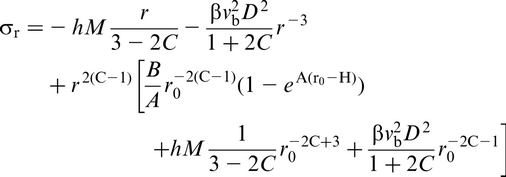
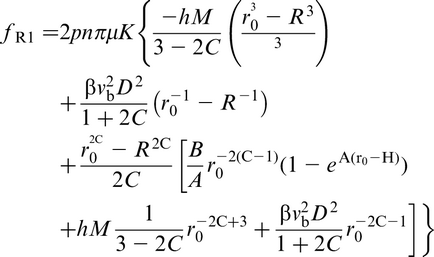
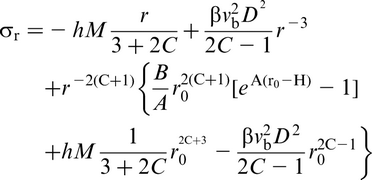
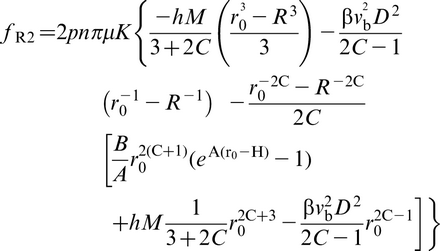
The frictional force in the radial region is also considered for both increasing velocity and decreasing velocity. At the condition of decreasing velocity, the force balance of the spherical element in the radial region is illustrated in Fig. 3. The total forces acting on the element along the radial direction can be written as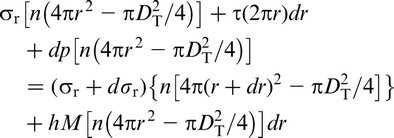

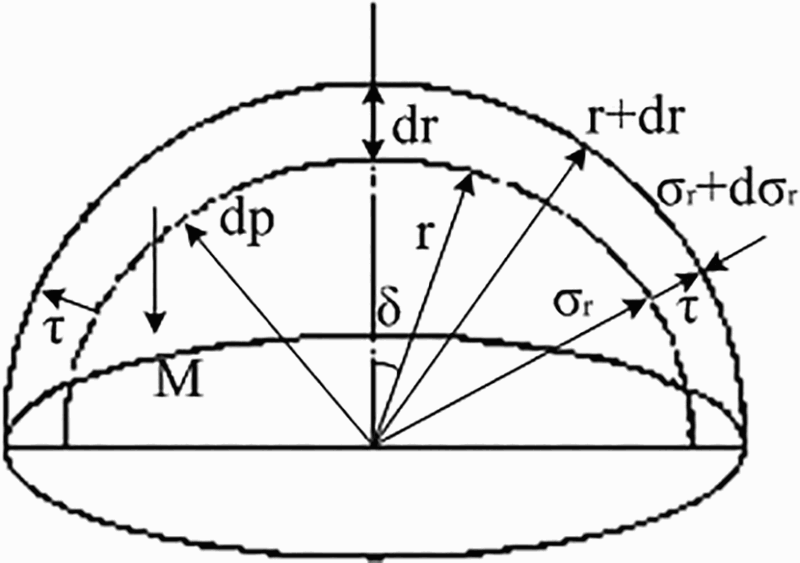
Forces acting on control element in radial region for decreasing velocity
The particle–particle frictional stress gives

The pressure force exerted by the gas on the particles gives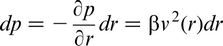

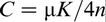
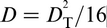





Bed weight
The bed weight over the raceway roof is as follows
Overall force balance
Considering all forces (equations (9), 10 , 11 , 19 , 21 , 30 , 32 and (34)) after some simplification, the overall force balance can be given as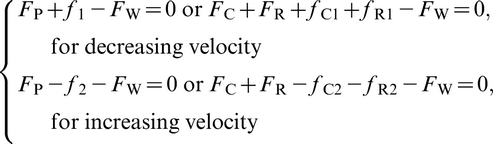
Results and discussion
Actual BF calculation
The original mathematical model developed by Gupta was built according to a 2-D cold model.
14–18
For actual BF, some parameters should be modified and combined with operating parameters, which is similar to Guo's work.
19
Blast velocity: Gas velocity above hearth: Gas density:
where V
b0 is the blast volume flowrate; T, T
0 and T
1 denote blast temperature, standard temperature and top temperature respectively; P, P
0 and P
1 indicate blast pressure, standard pressure and top pressure respectively; ρ0 represents gas density under standard condition. Because of combustion in the raceway and heat transfer from the bosh gas to the descending solid phase, it should be noted that the temperature change experienced in the actual BF. This will affect the gas volume flowrate. For convenience of calculations, the change of volume flowrate is ignored in this model.


BFs no. 1 and no. 2 are two Chinese BFs, whose volumes are 120 and 2000 m3 respectively. The main parameters of these two BFs are listed in Table 1. Blast furnace no. 1 was dissected after shut down, and the raceway was filled up with special materials in order to conserve its features. Figure 4 shows the photo of the preserved raceway cavity after removing these materials. The raceway depth is ∼700 mm, and the height is ∼600 mm. Table 2 gives the comparisons of raceway diameter between measurement and prediction results. The predictions from the present 3-D model agree well with the measured raceway sizes. In addition, the results from 3-D model are more precise than that from modified 2-D model and Gupta's model under the same calculating parameters.
Main parameters of BF no. 1 and BF no. 2
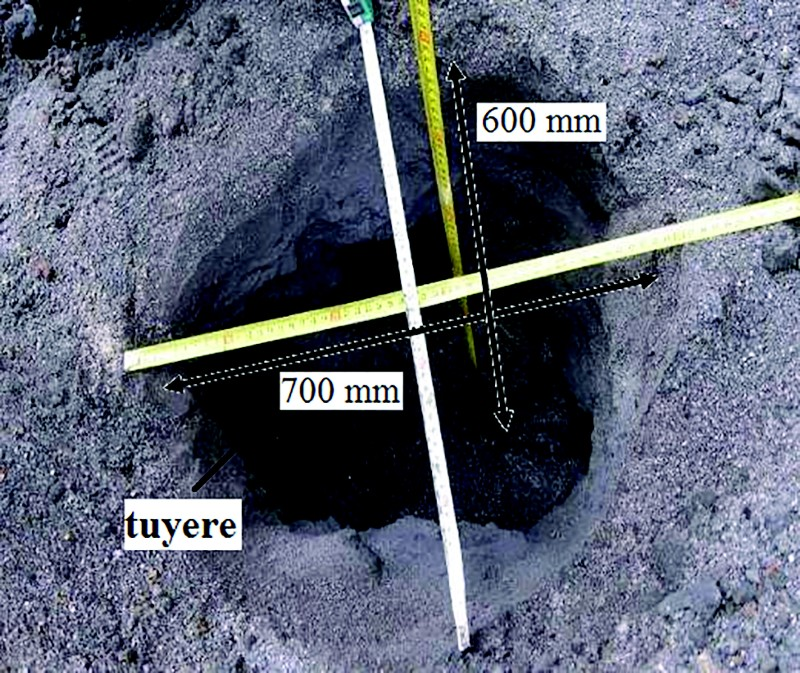
Photo of preserved raceway cavity for BF no. 1
Comparisons of raceway diameter between measurement and prediction models
Comparison of original stress and simplified stress in radial region
The following results are on the basis of the parameters of BF no. 2. In order to compare the difference between original radial stress (differential equation of original radial stress for decreasing velocity in equation (26)) and simplified radial stress (differential equation of simplified radial stress for decreasing velocity in equation (27)) in the radial region, the radial stress in the radial region is calculated for both decreasing velocity and increasing velocity, as shown in Fig. 5. The original radial stress in equation (26) is solved numerically. The relative error between original radial stress and simplified radial stress is very small despite decreasing gas velocity or increasing gas velocity. This means the results are still reasonable after simplification.
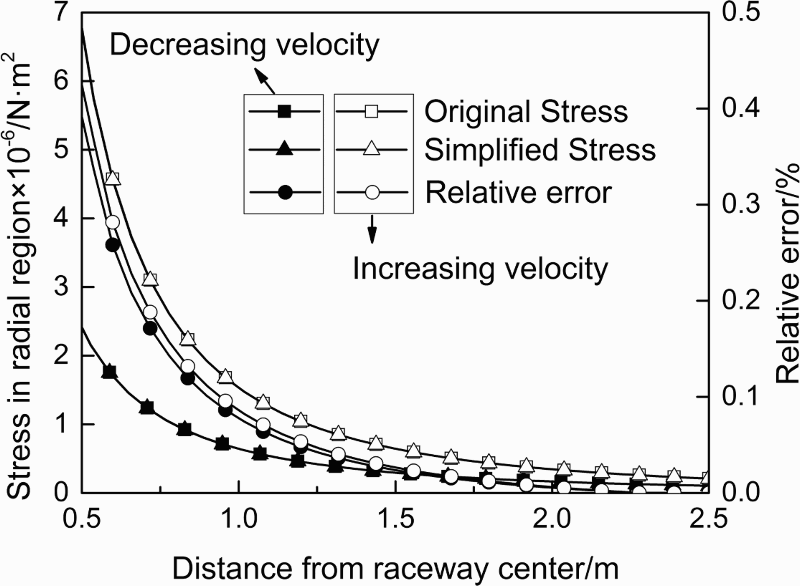
Comparison of initial stress and simplified stress in radial region
Influence of blast velocity
The influence of blast velocity on raceway diameter is shown in Fig. 6. The raceway diameter increases gradually with increasing blast velocity from 180 to 300 m s− 1. In addition, the raceway diameter is larger for decreasing gas velocity than that for increasing gas velocity. This is mainly caused by the different sizes of stress and different directions of frictional force. With a decreasing velocity, the dimension of raceway will generally reduce; therefore, there is upward frictional force in direction to restrain the shrink of raceway. However, the raceway will expand with increasing velocity so that the frictional force is generally in the downward direction. Thus, at the same blast velocity, the total upward force on the raceway roof for decreasing velocity is obviously larger than that for increasing velocity. This means it can support a larger raceway for decreasing velocity than that for increasing velocity.
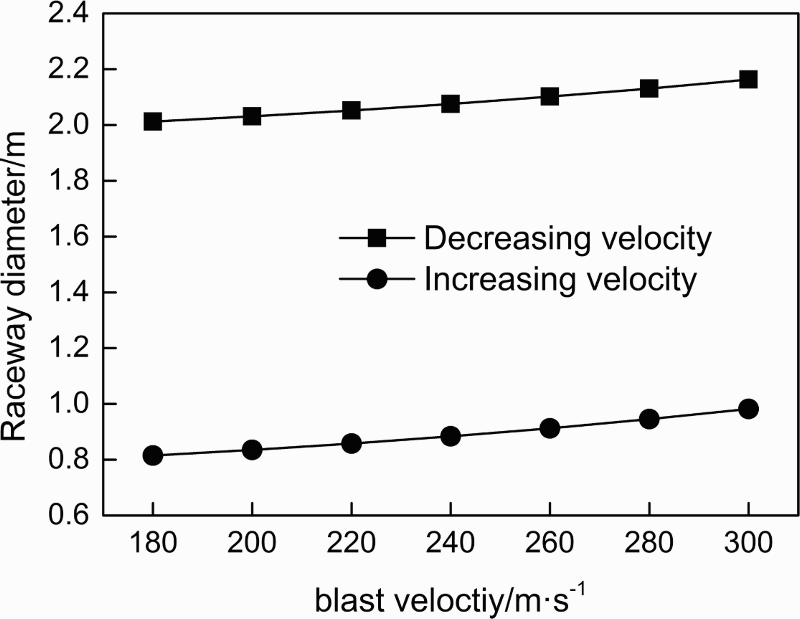
Influence of blast velocity on raceway diameter
Sarkar et al. 15 studied the effect of gas flow experimentally with a 2-D cold model. It was found that the raceway penetration for decreasing velocity could be several times that for increasing velocity. Gupta et al. 16 calculated that the pressure drop for an increasing velocity was always greater than that for a decreasing velocity, which led to the different results between increasing velocity case and decreasing velocity case.
In fact, both cases of decreasing velocity and increasing velocity can generally occur in an actual BF. When the blast velocity is stable, the descent of the packed bed is very slow, normally at a constant speed (∼0.001 m s− 1) under stable operation. 29 Therefore, the force balance may be maintained. However, the frictional force in the packed bed still exists and acts in an upward direction because of the slow downward movement of burden. When blast velocity varies, all the forces exerting on the packed bed will change. The former force balance is disrupted, and raceway size fluctuates until a new force balance is established.
Influence of bed porosity
Figure 7 shows the influence of bed porosity on normal stress (in the Cartesian region) and radial stress (in the radial region). In the Cartesian region, the normal stress decreases with increasing height from bottom of the Cartesian region. Similarly, the radial stress decreases with increasing distance from raceway centre in the radial region. On the other hand, with decreasing bed porosity, the normal stress in the Cartesian region and the radial stress in the radial region will decrease. Especially, at a very small porosity, the stress reduces quickly and approaches to 0. It may offer more resistance to gas flow and burden descending, which is not beneficial for smooth operation.
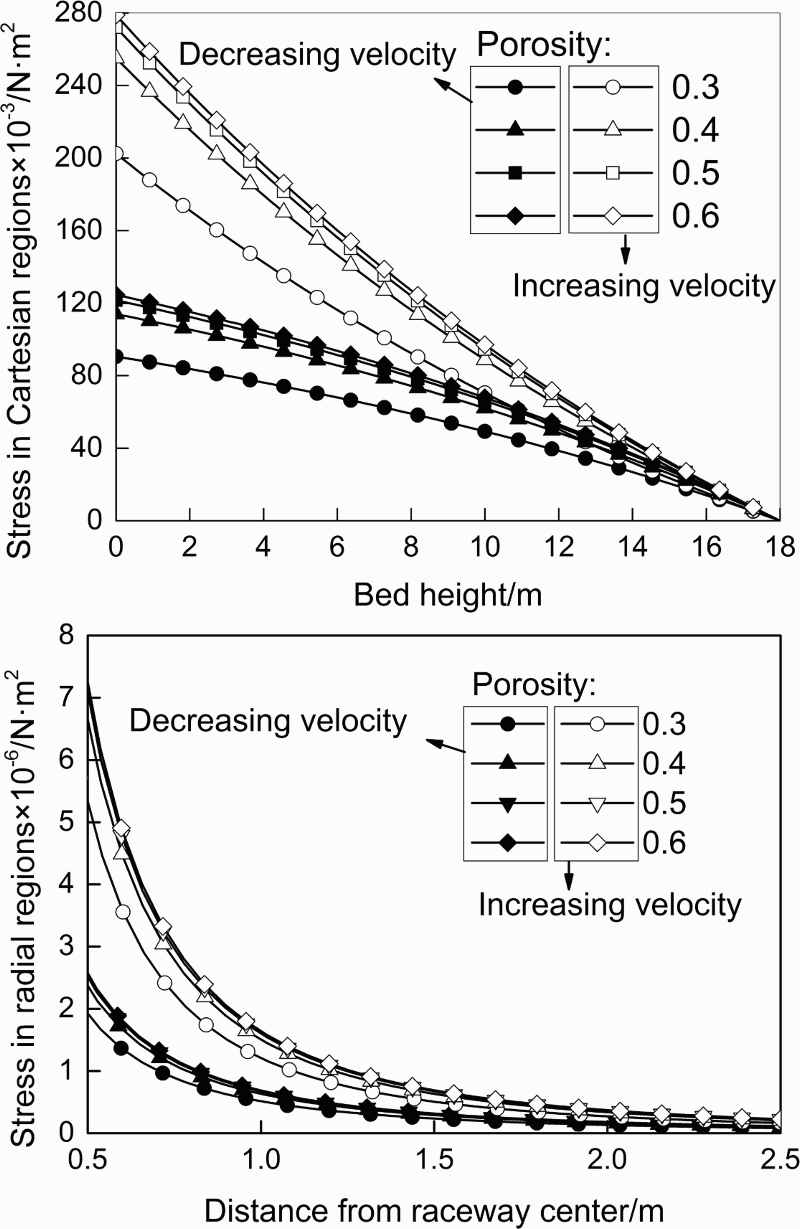
Influence of bed porosity a normal stress in Cartesian region and b radial stress in radial region
Figure 8 presents the influence of bed porosity on raceway diameter. It can be observed that the effect of bed porosity on raceway size is sensitive. The raceway diameter increases with decreasing bed porosity. It is seen that a low porosity of packed bed will lead to large pressure force exerted by gas and large raceway size correspondingly. The raceway diameter for decreasing velocity is also larger than that for increasing velocity at the same bed porosity.
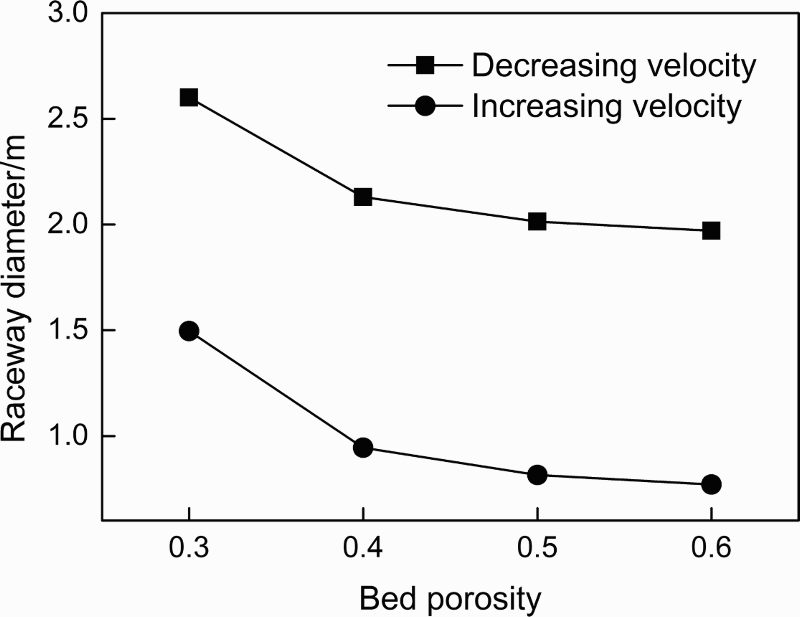
Influence of bed porosity on raceway diameter
Influence of particle diameter
The influence of particle diameter on normal stress (in the Cartesian region) and radial stress (in the radial region) is shown in Fig. 9. The normal stress in the Cartesian region and radial stress in the radial region will decrease with decreasing particle diameter. A small particle diameter is adverse to gas flow and burden descent.
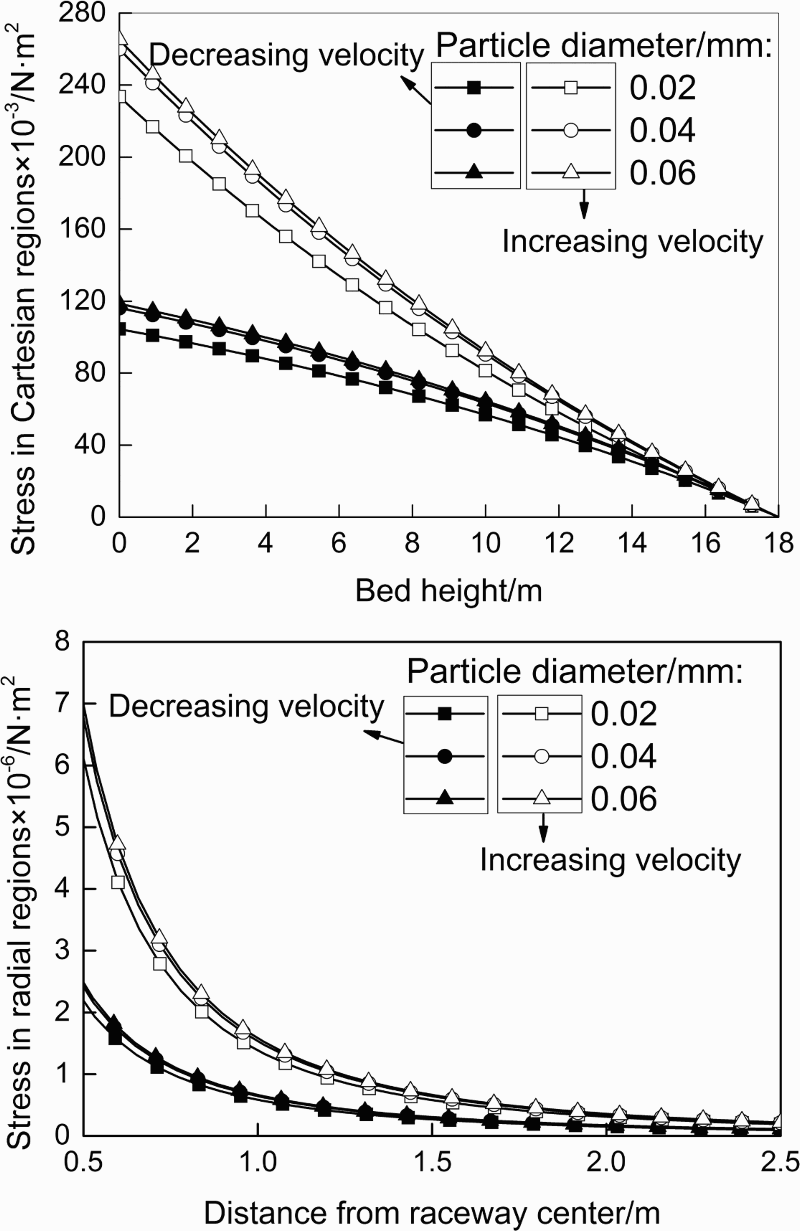
Influence of particle diameter on a normal stress in Cartesian region and b radial stress in radial region
Figure 10 shows the influence of particle diameter on raceway diameter. It can be seen that the raceway diameter increases with decreasing the particle diameter. The small diameter of solid particles in the packed bed will result in a large pressure force exerted by gas and large corresponding raceway size. It can also be seen that the raceway diameter for decreasing velocity is larger than that for increasing velocity at different particle diameter.
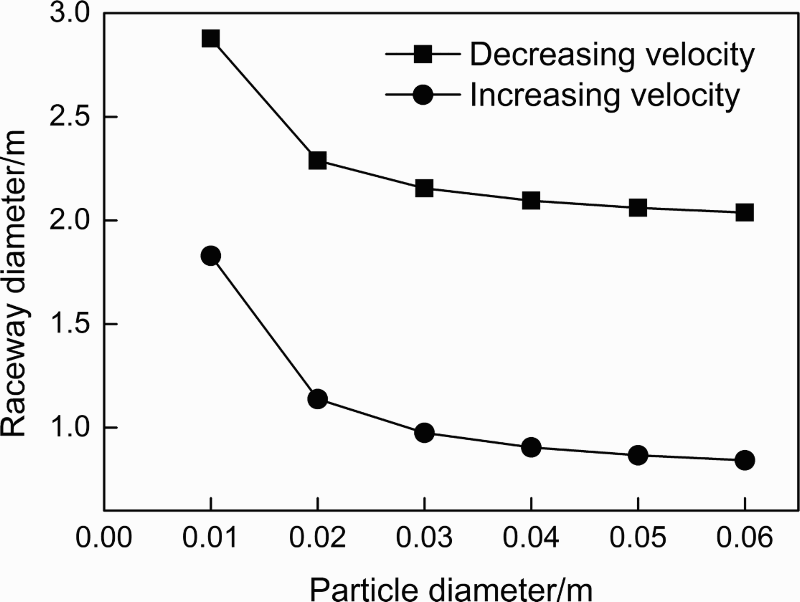
Influence of particle diameter on raceway diameter
The present 3-D mathematical was developed based on Gupta's 2-D model, where the radial region is regarded as a circle and the Cartesian region is a rectangle. Therefore, it is a necessary attempt to develop the radial region as a sphere and the Cartesian region as a cylinder for 3-D model. From the calculated results predicted in the 2000 m3 BF, the raceway size is large, and it is difficult to consider some adverse factors of affecting the raceway size like high pulverized coal injection, uneven burden distribution and so on in this model. A spherical raceway is also applied in order to simplify the 3-D model. These facts may lead to such a large raceway size, especially raceway width. It should be noted that the raceway in a real BF is more like an ellipsoid than an ideal sphere, even though a sphere has more stability and lower stress concentration. Future work will focus on improve the shape of raceway as more accurately.
Conclusions
Based on previous 2-D studies, a 3-D mathematical model has been successfully developed to predict raceway diameter. The results have been validated and presented on the basis of parameters from two Chinese BFs. It suggests that the 3-D model can predict the raceway diameter reasonably well.
The raceway diameter in the decreasing gas velocity case is larger than that in an increasing gas velocity case because of different frictional forces (direction and value). Decreasing bed porosity and particle size will increase the raceway diameter; however, this leads to a large normal stress in the Cartesian region and large radial stress in the radial region, which is not beneficial for smooth BF operation. The shape of raceway is more like an ellipsoid than a sphere and further work will be geared toward studying an ellipsoidal raceway and simulating its size more accurately.
Footnotes
Acknowledgements
The authors acknowledge financial support from grant 61271303 from the National Natural Science Foundation of China.