







Abstract
A thermodynamic model for predicting sulphur distribution ratio L
S between CaO–FeO–Fe2O3–Al2O3–P2O5 slags and liquid iron, i.e. the ion and molecule coexistence theory (IMCT)–L
S model, has been developed for slags in a large variation range of slag oxidisation ability based on the IMCT. The developed IMCT–L
S model has been verified with measured data of oxygen, phosphorus and sulphur distribution equilibria between the slags and liquid iron from the literature. The results indicate that the desulphurisation reaction is mainly controlled by reaction (CaO)+[S] = (CaS)+[O] in the reducing zone with the optimised standard molar Gibbs free energy change of 






Introduction
CaO based, Na2CO3 based or a mixture of CaO and Na2CO3 fluxes or slags over a large variation range of slag oxidisation ability have widely been applied in simultaneous dephosphorisation and desulphurisation processes of iron based melts since the 1970s.
1–26
The CaO–Fe
t
O–Al2O3 slag system has been recommended by Ban-ya et al.
20
for simultaneous dephosphorisation and desulphurisation during secondary refining process of molten steel. The distribution equilibria of oxygen, phosphorus and sulphur between CaO–FeO–Fe2O3–Al2O3–P2O5 and liquid iron were experimentally measured by Ban-ya et al.
20
The applied CaO–FeO–Fe2O3–Al2O3–P2O5 slags by Ban-ya et al.
20
exhibits a large variation range of slag oxidisation ability, which corresponds to mass percentage of Fe
t
O from 1.88 to 55.50%. In addition, the designed chemical composition of the slags by Ban-ya et al.
20
follows the CaO saturation line, but is not saturated with CaO, according to CaO–Fe
t
O–Al2O3 phase diagram at elevated temperatures. The related information on dephosphorisation and desulphurisation reactions of the slags was discussed by Ban-ya et al.
20
based on mole fraction 

The recognised viewpoints of desulphurisation 21,28–32,37–69 by fluxes or slags in a large variation range of slag oxidisation ability for simultaneous dephosphorisation and desulphurisation in secondary refining process of molten steel can be concluded as follows: controlling a reasonable slag oxidisation ability is very important to achieve the aim for simultaneous dephosphorisation and desulphurisation of molten steel; 24,25 fluxes or slags with high content of basic oxides as well as middle or high content of iron oxides can effectively remove phosphorous from iron based melts; 8,9,20,68 and fluxes or slags with higher slag oxidisation ability can only exhibit smaller desulphurisation ability as summarised by Wei 68 from numerous experimental results 20,54,68,69 and tremendous industrial practices. However, the desulphurisation mechanism and the reasons of greater dephosphorisation ability coupled with smaller desulphurisation ability for a fixed fluxes or slags in a large variation range of slag oxidisation ability are not clearly explained and deep probed. 20,54,68,69
The recognised desulphurisation mechanism of iron based melts from numerous studies since the 1940s
21,28–32,37–69
can be summarised as follows:
21,43,68,70
slags with high content of basic oxide CaO or Na2O and low content of ferrous oxide FeO without ferric oxide Fe2O3, i.e. slags with lower slag oxidisation ability, is beneficial to desulphurisation reactions
21,28–32,37–69
there are huge differences of desulphurisation ability among components of CaO, MgO, FeO and MnO in slags with lower slag oxidisation ability or smaller content of ferrous oxide FeO
28–32,54,69
slag oxidisation ability described by oxygen potential sulphide
Thus, the desulphurisation products in metallurgical slags for iron based melts must only be sulphide 


Comparing with the defined phosphate capacity 


The obtained asymmetric V type relationship of desulphurisation ability of CaO–FeO–Fe2O3–Al2O3–P2O5 slags against content of iron oxides was not theoretically explained by Ban-ya et al. 20 Thus, the experimental results of the slags equilibrated with liquid iron by Ban-ya et al. 20 are cited to develop sulphur distribution ratio L S prediction model based on the IMCT, 27–36 i.e. the IMCT–L S model.
The IMCT
27–36
was originally developed to represent reaction abilities of structure units including components and the formed complex molecules in metallurgical slags by the defined mass action concentrations N
i
of structure units or ion couples according to the mass action law. None of empirical coefficients is embodied in the IMCT
27–36
for predicting reaction abilities of structure units or ion couples. The defined N
i
of structure units or ion couples in various slags have been verified
27–36
to be consistent with the reported activities 


The desulphurisation mechanism of CaO–FeO–Fe2O3–Al2O3–P2O5 slags in a large variation range of slag oxidisation ability has first been proposed based on the experimental results by Ban-ya et al.
20
According to the proposed desulphurisation mechanism of the slags, a thermodynamic model for predicting L
S between the slags and liquid iron, i.e. the IMCT–L
S model, has been developed and verified through comparing the measured
20


It should be emphasised that beside the aforementioned eight 


Desulphurisation mechanism of slags in large variation range of slag oxidisation ability after Ban-ya et al.
The original chemical compositions of both CaO–FeO–Fe2O3–Al2O3–P2O5 slags and liquid iron for 31 test runs of equilibrium experiments for oxygen, phosphorus and sulphur between 10 g liquid iron without carbon and 15 g CaO–Fe
t
O–Al2O3 slags from Ban-ya et al.
20
have also been reported by Yang et al. elsewhere
27
in a decreasing hierarchy of the calculated oxygen potential 
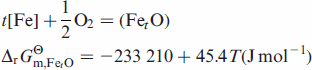
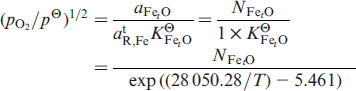


Relationship between reaction abilities of components and various slag oxidation abilities
Three parameters as mass percentage of Fe
t
O through 



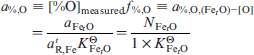





The relationship of three parameters for representing slag oxidisation ability against the calculated
27


Relationship of a1, a2 mass percentage of Fe
t
O or b1, b2 calculated
27


Influence of various slag oxidation abilities on measured desulphurisation ability by Ban-ya et al.
The relationship between mass percentage of Fe
t
O or the calculated
27


Relationship of a mass percentage of Fe
t
O or b calculated comprehensive mass action concentration


Similar results have also been reported by many researchers
54,68,69
and briefly discussed by Wei.
68
The widely accepted conclusions
20,54,68,69
can be summarised as that slags containing Fe
t
O content < 5.0–8.0% as reducing slags show greater desulphurisation ability; slags with Fe
t
O content >5.0–8.0% as oxidising slags display a smaller desulphurisation ability; pure Fe
t
O at temperature of 1873 K (1600°C) exhibits a smaller desulphurisation ability with L
S as 3.60, i.e. 


Deduction of desulphurisation mechanism of slags in large variation range of slag oxidisation ability
It has widely been accepted
54,68,69
that calcium sulphide CaS will be the main desulphurisation products in CaO based slags with FeO content < 2.0% as reducing slags, which can be applied in blast furnace ironmaking process or ladle furnace (LF) refining process or reduction period in electric arc furnace (EAF) steelmaking process, while ferrous sulphide FeS will be the major desulphurisation products in CaO based oxidising slags with Fe
t
O content >12.0% as oxidising slags, which can be used in LD converter steelmaking process or simultaneous dephosphorisation and desulphurisation operation in secondary refining process of molten steel. Thus, it can be deduced through combining Figs. 1 and 2 that desulphurisation reaction of the studied slags should be controlled by CaO with CaS as desulphurisation product under the condition of mass percentage of Fe
t
O or 


Theoretically, a small amount of FeS can be generated in reducing slags. It has been obtained by Yang et al. 30,31 that the generated FeS in CaO–SiO2–MgO–FeO–MnO–Al2O3 reducing slags can only account for about 0.60–0.81% of desulphurisation products during LF refining process. Therefore, the contribution of FeS as desulphurisation product in reducing slags can be ignored.
Under this circumstance, the distinguishing line between reducing and oxidising zones in Fig. 2 has been represented by CaS and FeS as desulphurisation product.
Thermodynamic model for calculating sulphur distribution ratio L S between CaO–FeO–Fe2O3–Al2O3–P2O5 slags and liquid iron based on IMCT
Establishment of IMCT–L S model for slags based on IMCT
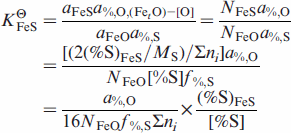
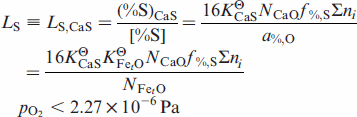
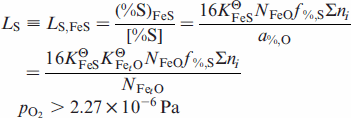
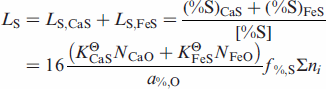
According to the deduced desulphurisation mechanism in the section on ‘Deduction of desulphurisation mechanism of slags in large variation range of slag oxidisation ability’, two kinds of desulphurisation products, CaS and FeS, can individually be generated in CaO–FeO–Fe2O3–Al2O3–P2O5 slags equilibrated with liquid iron based on the aforementioned criterion for mass percentage of Fe
t
O or 










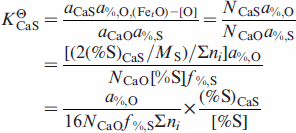







Determination of standard molar Gibbs free energy change of desulphurisation reaction for forming CaS or FeS in slags
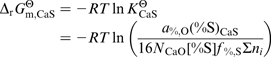
Optimising

of desulphurisation reaction for forming CaS in slags
The desulphurisation reaction in equation (4a) for forming CaS as desulphurisation product can be rewritten according to the classically chemical metallurgy as


Summary of reported standard molar Gibbs free energy change
of desulphurisation reactions for forming CaS or FeS in slags from various references


a comparison of optimised standard molar Gibbs free energy change


The smaller values of 







Selecting

of desulphurisation reaction for forming FeS in slags
The desulphurisation reaction in equation (4b) for forming FeS as desulphurisation product can also be rewritten as


Verification of developed IMCT–L S model for slags
Two steps have been applied to evaluate and verify accuracy of the developed IMCT − L
S model. The first step is to compare the measured
20


Summary of four sulphur distribution ratio L
S prediction models and eight sulphide capacity
prediction models from related literature




Comparison between measured

and calculated

by IMCT–L
S model for slags
Comparison between the measured
20


Comparison between measured
20
sulphur distribution ratio

It should specially be emphasised that the calculated 


It can be deduced that CaS can be considered as the sole desulphurisation product in the slags of the reducing zone, while FeS can be treated as the complete desulphurisation product in the slags of the oxidising zone. Separating reducing and oxidising zones for the slags in a large variation range of slag oxidisation ability is very important to accurately predict desulphurisation ability by the developed IMCT–L S model in equations (6a) and (6b).
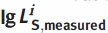
Comparison between measured

and calculated
by other L
S or

models
Comparison between measured

and calculated

by other L
S models
Four sulphur distribution ratio L
S models for various metallurgical slags such as Suito's model,
25
Narita's model,
13
Tsao's model
58
and Sosinsky's model
73
have chronologically been summarised in the upper region of Table 2. Comparison between the measured
20


Comparison between measured
20
sulphur distribution ratio


It can be concluded through comparing Fig. 4 with Fig. 5a–d that the developed IMCT–L S model is better than the summarised four L S models for predicting desulphurisation ability of the slags in a large variation range of slag oxidisation ability. The summarised four L S models correspond to their specially assigned slag type and chemical composition range. In addition, the embodied empirical coefficients in the summarised four L S models are regressed from the assigned experimental data. The deduced desulphurisation mechanism as described in the section on ‘Deduction of desulphurisation mechanism of slags in large variation range of slag oxidisation ability’ should be applied for the investigated slags in a large variation range of slag oxidisation ability.
Comparison between measured

and calculated

by other

models
Numerous data of sulphide capacity 




Comparison between the measured
20

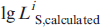


It can be observed in Fig. 5e–l
that Ban-ya's model
20,74
and the KTH model
75–78
can be applied to precisely predict L
S of the slags, while other six 


Influence of slag chemical composition on desulphurisation ability of slags
Influence of reaction abilities of components on desulphurisation ability of slags
It has been verified
27
that the calculated mass action concentrations N
i
of CaO, FeO, Fe2O3 and Al2O3 in the slags are more reasonable than the mass percentage of the corresponding components for representing reaction abilities of the slags. The relationship of the calculated
27
N
i
of CaO, FeO, Fe2O3 and Al2O3 against the measured
20





Relationship of calculated
27
mass action concentration N
i
of (a) CaO, (b) FeO, (c) Fe2O3, (d) Al2O3 and (e) FeO·Fe2O3 as structural units or ion couples against measured
20
sulphur distribution ratio

The forward tick shaped or the asymmetric V type relationship between 


Obviously, the effect of 


To the result that the influence of 


To the finding that the effect of 


Consequently, it can be derived that the effect of 


Influence of slag basicity on desulphurisation ability of slags
The commonly applied complex basicity 

















Relationship between a simplified complex basicity (%CaO)/[(%Al2O3)+(%P2O5)] or b optical basicity of slags by taking


In addition, the obtained criterion of optical basicity as 0.80 for distinguishing reducing and oxidising zones is the same as the applied one for describing relationship between 
Comprehensive effect of Fe t O and CaO on desulphurisation ability of slags
It has been proposed by Yang et al.
32,33,35
that the mass percentage ratios and the mass action concentration ratios of various iron oxides to basic oxide CaO expressed by (%FeO)/(%CaO) or (%Fe2O3)/(%CaO) or (%Fe
t
O)/(%CaO) and 














Relationship between mass percentage ratio a (%FeO)/(%CaO) or b (%Fe2O3)/(%CaO) or c (%Fe
t
O)/(%CaO) or d (%FeO)/(%Fe
t
O) or e (%Fe2O3)/(%Fe
t
O) and corresponding mass action concentration ratio


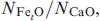
The relationship between 














Relationship between mass action concentration ratio a







The asymmetric V type relationship between 










However, a forward tick shaped or an asymmetric V type relationship of 






Conclusions
A thermodynamic model for predicting sulphur distribution ratio L
S between CaO–FeO–Fe2O3–Al2O3–P2O5 slags and liquid iron, i.e. the IMCT–L
S model, has been developed by coupling with the deduced desulphurisation mechanism for the slags in a large variation range of slag oxidisation ability, which corresponds to mass percentage of Fe
t
O changing from 1.88 to 55.50%, based on the IMCT. The developed IMCT–L
S model has been verified by comparing the measured The desulphurisation reaction is mainly controlled by (CaO)+[S] = (CaS)+[O] for the slags in the reducing zone corresponding to mass percentage of Fe
t
O smaller than 6.75%. However, the desulphurisation reaction is completely predominated by (FeO)+[S] = (FeS)+[O] for the oxidising zone corresponding to mass percentage of Fe
t
O>6.75%. The standard molar Gibbs free energy change The measured sulphur distribution ratio The calculated mass action concentrations N
i
of structural units or ion couples, like activity The backward tick shaped or the asymmetric V type relationship between sulphur distribution ratio L
S and the simplified complex basicity The asymmetric V type relationship between sulphur distribution ratio L
S and the mass action concentration ratio 












Footnotes
Acknowledgement
This work is supported by the National Natural Science Foundation of China (NSFC) under grant no. 51174186.