







Abstract
Atom probe tomography (APT) was used to study the evolution of clusters and fine precipitates during the annealing of severely deformed interstitial free steel. No dissolution of pre-existing Ti4C2S2 and FeTiP precipitates occurred during room temperature equal channel angular pressing (ECAP) and subsequent cold rolling. Ti rich clusters in the matrix may serve as precursors to even further precipitation at longer annealing times. While all fine precipitates detected by APT exhibited a variety of non-stoichiometric compositions, near equilibrium composition was found in the order of magnitude coarser precipitates observed by TEM.
Keywords
Introduction
Severe plastic deformation (SPD) techniques induce ultrafine grained (UFG) microstructures with consequent increases in strength and reductions in elongation in steels and other structural alloys.1–4 In order to optimise the strength–ductility balance of as SPD materials, later heat treatments causing recovery and/or recrystallisation are indispensable. Although the transition from coarse grained to UFG microstructures during SPD processing is conventionally tracked via TEM or electron backscattering diffraction, atom probe tomography (APT) provides a powerful three-dimensional technique to analyse solute segregation and clustering at the atomic level.5 To date, APT work on UFG materials has been mainly restricted to light metals, 6 6,7 with the exception of cementite dissolution studied in pearlitic steel. 8 8,9 Here, the authors present an insight into cluster and precipitate evolution during the early stages of annealing of an SPD interstitial free (IF) steel.
Experimental and analytical procedure
A commercial Ti stabilised IF steel [(Fe–0·01C–0·12Mn–0·01Si–0·01P–0·01S–0·08Ti–0·06Al–0·07N (at-%)] was subjected to eight passes, route BC, room temperature equal channel angular pressing (ECAP) and then further cold rolling (CR) to 95% thickness reduction. Processing details are given elsewhere.
10
10,11 The as ECAP and (ECAP+) CR samples were isothermally annealed at 600°C for 300 and 1800 s respectively in a salt bath. Following this, the deformed and annealed samples were examined using the local electrode atom probe (Cameca LEAP, Gennevilliers, France) at the University of Sydney. Tips were prepared by electropolishing5 from square rods cut along the normal and transverse directions of the ECAP billet and CR sheet respectively. Atom probe tomography was undertaken at ∼20 K with a pulse repetition rate of 200 kHz and laser energy of 0·2 nJ. The maximum separation envelope method5 was utilised for identifying clusters and fine precipitates in the analysed volume. In order to eliminate the effect of random fluctuations, cluster identification is restricted to a minimum of 20 atoms with the proviso that each of them are ⩽1 nm apart (dmax = 1 nm) from their nearest neighbour. The Guinier radii rG of clusters/precipitates were calculated from the radii of gyration lg using the equation5

Results and discussion
The presence of a few fine precipitates in the ferrite matrix of the ECAP and CR conditions (Fig. 1) coupled with several other APT tips that returned no precipitates at all indicates their very low numbers in the as SPD condition. The composition of the precipitate (rG≈4 nm) in the as ECAP tips was (50·47±1·61)Fe–(40·17±1·58)Ti–(5·52±0·74)C–(3·12±0·56)S, whereas after CR, the precipitate (rG≈6 nm) was (60·12±0·53)Fe–(17·60±0·41)Ti–(9·68±0·32)C–(6·22±0·26)S–(1·39±0·13)P. Unlike the matrix precipitate observed for the as ECAP condition, the precipitate after CR was detected on the planar grain boundary running parallel to the tip. This is to be expected as plane strain deformation via severe CR leads to an alignment of longitudinal grain boundaries with the rolling plane. The slight elongation of these precipitates concurrent with their respective deformation modes (Fig. 1) and the matching trail of alloying element segregation suggest their presence before SPD, with only minor decomposition occurring during cold working. Thus, the present results indicate almost no dissolution of pre-existing precipitates during ECAP and subsequent CR and contradict earlier findings of near complete dissolution of cementite (Fe3C) in an as SPD pearlitic steel. 8 8,9 In support of these findings, the literature reports about 184 and 123 kJ mol−1 as the typical enthalpies of formation for TiC12 and FeTiP13 precipitates respectively. These values greatly exceed the formation enthalpy of Fe3C (∼25 kJ mol−1)12 and even the binding energy between pairs of carbon atoms and edge/screw dislocations in body centred cubic Fe (about 40–80 kJ mol−1). 14 14,15 Thus, despite the significant increase in dislocation density11 (>1015 m−2) after ECAP and/or CR, there is a lack of driving pressure for complete dissolution of these precipitates.11 Additionally, fine Ti rich (>85%) clusters were also observed after 95% CR. Here, a distinction between clusters and precipitates is based on their crystallographic arrangements. While clusters are a preferential segregation of atoms in the ferrite matrix, precipitates exhibit clearly defined atomic planes, which are different from the matrix planes of Fe atoms.
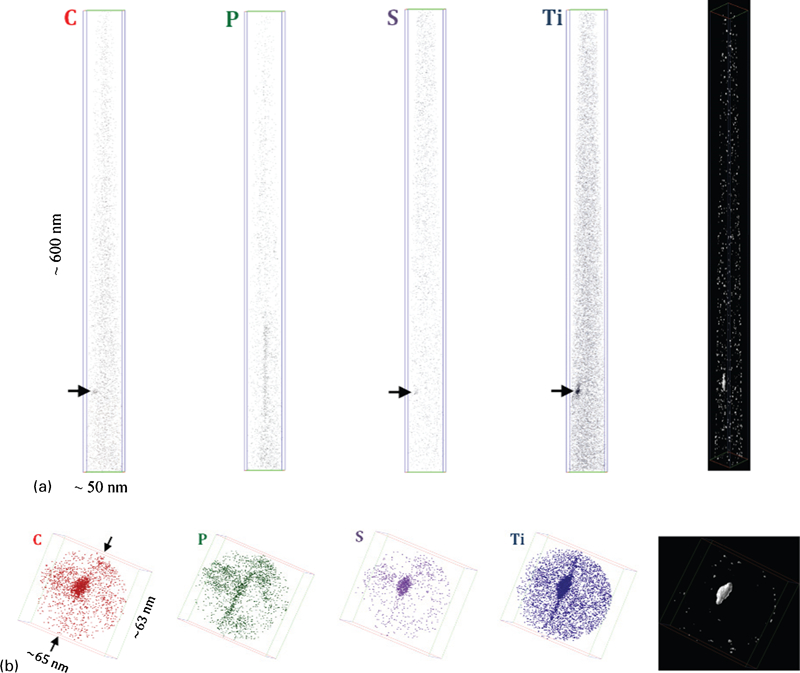
Elemental atom probe maps and corresponding 1 and 5 at-%Ti isoconcentration surfaces showing precipitates in IF steel after a ECAP (total number of atoms ∼31·4 million) and b CR (total number of atoms ∼6·5 million): arrow in a indicates precipitate, while arrow in b indicates segregation along boundary
After annealing to 300 s, the ECAP tips showed two types of clusters with compositions of >90 at-%Ti and (79·17±8·29)Ti–(16·67±7·61)P (Fig. 2a). Precipitate (rG≈6–15 nm) compositions after ECAP and 300 s annealing varied from (17·6±6·00)Fe–(7·50±1·46)Ti–(75·00±6·85)P to (53·8±0·44)Fe–(24·50±0·38)Ti–(10·11±0·27)C–(10·11±0·27)P–(6·25±0·22)S. The coarse precipitate (rG≈10 nm) in the ECAP samples after 1800 s annealing exhibited higher solute concentrations of (14·03±1·00)Fe–(29·25±1·66)Ti–(27·04±1·56)C–(5·05±0·65)P–(18·95±1·32)S.
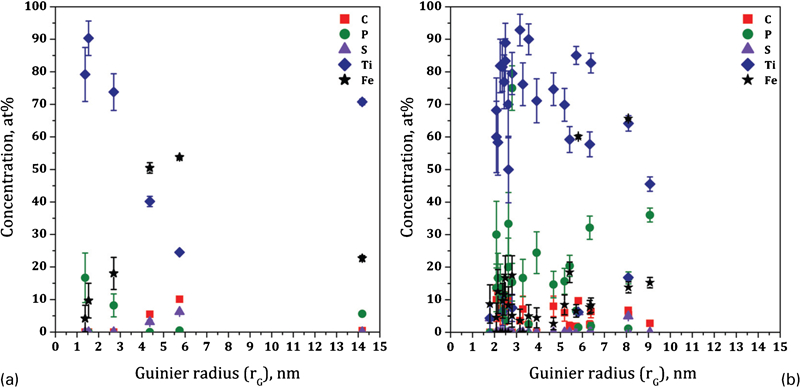
Effect of cluster/fine precipitate size on composition after a ECAP and b CR and subsequent annealing
In addition to small TiCP precipitates (Fig. 2b), the 300 s annealed CR tips contained clusters with a range of compositions from (17·6±6·00)Fe–(7·50±1·46)Ti–(75·00±6·85)P to (3·57±3·51)Fe–(92·85±4·87)Ti–(3·57±3·51)C as shown in Fig. 3. Coarser precipitates (rG≈8 nm) with compositions approximately similar to the as CR condition were observed after 1800 s annealing (Fig. 4).
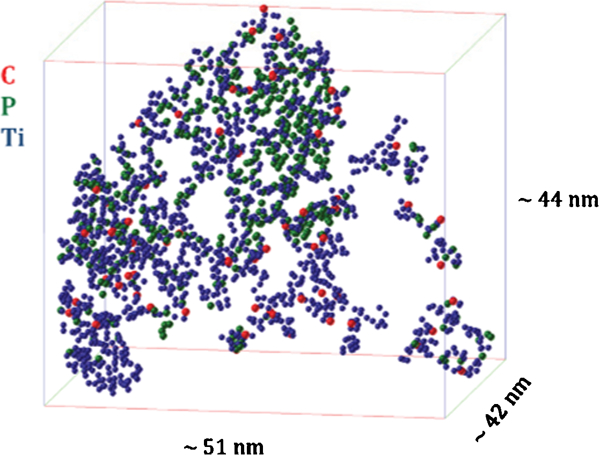
Atom map of clusters after CR and annealing at 600°C for 300 s (matrix atoms are suppressed by maximum separation method using dmax = 1 nm)
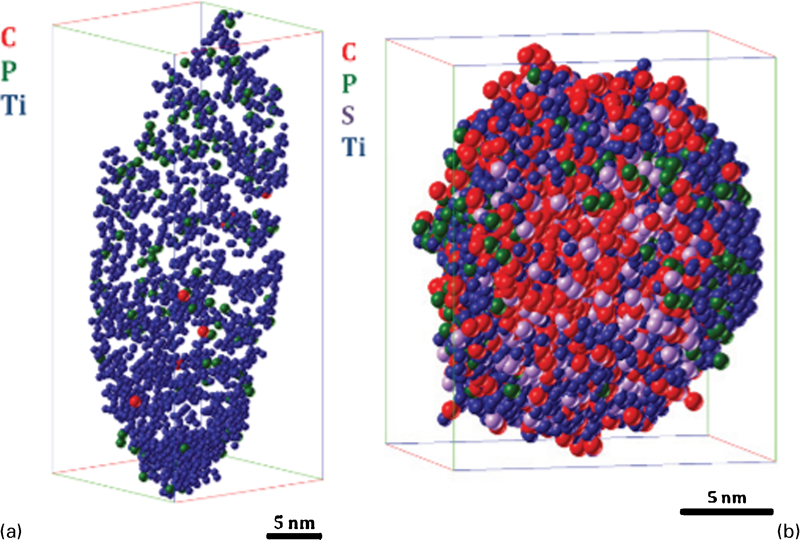
Representative a TiP precipitate (with traces of C) after ECAP and 300 s annealing and b TiCPS precipitate after ECAP or CR and 1800 s annealing: matrix atoms are suppressed by maximum separation method using dmax = 1 nm
For both annealing times, a change in composition/size of existing precipitates can be expected primarily due to the diffusion of carbon. Compared to a carbon diffusion distance of about 50–100 μm, estimates based on binary diffusion 16 16,17 show that P and Ti diffuse only <100 nm and <1 nm respectively. Consequently, the latter two elements will not contribute significantly to the growth of precipitates. Alternatively, it can be considered that these precipitates were the same as those present in the microstructure even before SPD and that only minor changes in their composition occurred during annealing at 600°C up to 1800 s.
It is interesting to note that the composition of clusters/precipitates detected by APT irrespective of their size or SPD processing is non-stoichiometric,18 which has not been reported earlier. However, the near stoichiometric composition of coarser (about 80–140 nm) Ti4C2S2 precipitates for up to 1800 s annealing estimated by energy dispersive X-ray spectrometry via TEM indicates their size dependent compositional variation (Fig. 5). Although the tendency of Ti rich cluster formation and its enrichment with C, S and/or P is clearly visible with increasing size, it should be kept in mind that the maximum distance separation method could overestimate the composition of fine clusters, as the determination of the interface between the cluster and matrix remains subjective, and an aggressive removal of solvent atoms occurs from the surface of the precipitate.19
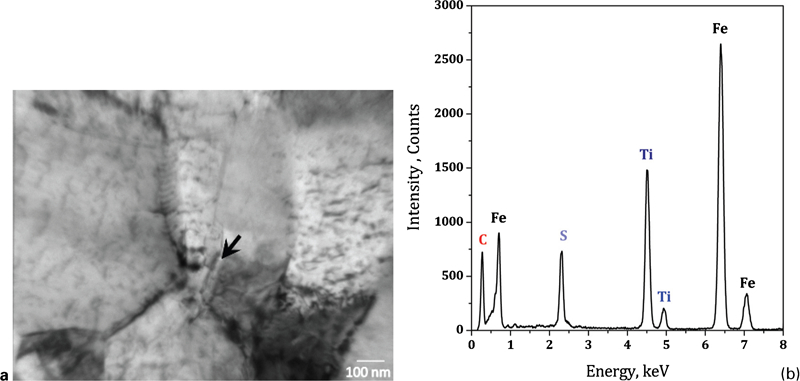
a typical Ti4C2S2 precipitate after CR and 300 s annealing and b EDS spectrum of precipitate (Fe peaks are from matrix)
Conclusions
APT detected very low numbers of Ti4C2S2 and FeTiP precipitates in the ferrite matrix of the ECAP and CR conditions. These pre-existing precipitates remained stable throughout SPD due to the lack of driving pressure for complete dissolution. After annealing up to 300 s, Ti rich clusters were observed, which may serve as precursors to even further precipitation at longer annealing times. Irrespective of their size or SPD processing, APT detected non-stoichiometry in the composition of the fine clusters/precipitates. On the other hand, TEM analysis of an order of magnitude larger precipitates showed near equilibrium stoichiometry. This indicates compositional variation with concurrent growth.
Footnotes
Acknowledgements
The authors would like to thank Dr A. Carman, University of Wollongong, for focused ion beam and TEM. APT was undertaken under the auspices of the AMMRF agreement with the University of Wollongong.