







Abstract
The microstructure of alloy 909, a low coefficient of thermal expansion Fe-Co-Ni superalloy was examined in the solution treated and over aged condition, following a previous communication by the authors on the solution treated and commercially aged alloys. In the commercially aged alloy, only the Laves and the γ‚ phases were observed. With some indication, however, of alignment of the γ‚ phase along crystallograpic directions in the austenitic matrix. This alignment of the γ‚ phase has been previously reported as a precursor to the growth of the ϵ phase from the γ‚ phase. Analysis by TEM showed that the platelet phase was hexagonal (NiFeCo)2(TiNb) with some variations in the stoichiometry about 2:1 ratio. Tensile and hardness testing indicated that the presence of the platelet shaped ϵ phase in the solution treated and overaged condition was not as effective in the strengthening of the alloys as the spherical γ‚ in the commercially aged and solution treated condition. In addition to the presence of ϵ phase, blocky A2B Laves phase was abundant, which prevents excessive grain growth up to ∼1040°C
Introduction
Alloy 909 is an Fe–Co–Ni based low thermal expansion superalloy with excellent combination of high short term tensile strength and elevated temperature notch rupture strength. The alloy finds applications in aerospace and land based gas turbine engines. Alloy 909 is a precipitation hardenable, low coefficient of thermal expansion alloy developed from the earlier Fe–Co–Ni controlled expansion alloys Incoloy 903 and Incoloy 907.
Conflicting reports exist, however, on the occurrence and crystal structure of some phases, in part being a function of the varying solution and aging treatments used. Heck et al.1 showed during processing that the hexagonal Laves phase formed from 800 to 1040°C. The Laves phase was observed as two- and four-layer structures by Chen et al.;2 Heck et al.1 surmised that on aging, the γ′ phase precipitated as Ni3(TiNb) precipitating intragranularly in the temperature range 538–760°C, as well as ϵ″ and ϵ phases. These two latter phases precipitated out in a needle-like fashion. The ϵ″ phase, being a transitional one, could transform as a function of time and temperature to the ϵ phase. According to Heck et al.,1 the ϵ″ phase is a distorted hexagonal (NiFeCo)3(NbTi) phase (A3B), which precipitated from 700 to 950°C, both inter- and intragranularly. The ϵ phase precipitated initially at grain boundaries from the ϵ″ phase as angular, blocky or as an acicular intergranular hexagonal phase with a Widmänstatten DO19 (Ni3Sn) type structure.
Controversy exists, however, regarding the crystal structure of the ϵ phase. As shown by Heck et al.,1 the phase is reputed to be hexagonal (Table 1). Chen et al.,2 however, via extensive TEM analysis, believed that the phase is orthorhombic (Table 1). Several papers by Kusabiraki and co-workers3–5 using TEM again indicated a preference for the ϵ phase to be hexagonal. Variations in the analyses are not unexpected, however, as heat treatments vary considerably from the solution treatment and aging recommended by the supplier.
Chemical composition analysis, wt-

A previous publication by the authors6 evaluated the microstructure of alloy 909 in the solution treated and aged condition (STA), which consisted of solution treatment at 982°C, air cooling, followed by aging at 712°C for 8 h, furnace cooling to 621°C, holding at 621°C for 8 h and air cooling. This treatment was shown by Smith and Holderby7 to give the best combination of mechanical properties. In the solution treated (ST) condition, apart from the austenitic matrix, only inter- and intragranular Laves phase was present as globular particles. The Laves phase in this alloy is necessary to control the grain size of the alloy during thermomechanical processing and solution treatment. In the aged condition (STA), the Laves phase was still present as well as an L12 γ′ phase based on a (Ni3,TiNb) composition. In addition, there were some evidence of the γ′ lining up on matrix planes to form a potential precursor to the ϵ phase. As a follow-up investigation to the STA microstructural analysis, the present study is concerned with understanding the effect of a solution treated and overaged condition (STOA) on the microstructure of the alloy and in determining precipitate(s) morphologies, crystalline structures and chemical compositions.
Experimental
Alloy 909 (Incoloy 909) wrought material was purchased in the form of round bar 16 mm diameter from Special Metal Corporation in the solution treated and commercially aged condition (STA) conforming to the chemical composition in Table 1.
Re-solution treatment involved holding at 982°C for 20 min, followed by air cooling, with the overaging treatment involving holding at 770°C for 17·8 h, air cooled to room temperature (STOA). Heat treatment was carried out in flowing argon, and the samples were wrapped in 0·005″ thin stainless steel foil to limit oxidation. The heat treated material had an average grain size of 10 μm as measured by the linear intercept method.
Optical microscopy and SEM samples were prepared by standard metallographic methods and etched with Kalling's waterless reagent. The optical microscopy equipment consisted of a Zeiss microscope with a Clemex image analyser. A scanning electron microscope equipment consisted of a JEOL 5900 SEM with an ultrathin Oxford energy dispersive spectrometer attachment. A TEM/STEM consisted of an ultrathin window EDAX Genesis energy dispersive spectrometer.
Samples by TEM were prepared from 3 mm discs of 250 μm thickness using wire electrodischarge machining from bulk sample. The 250 μm thickness was later thinned down using mechanical abrasion using a series of 320, 400, 600 and 1000 grit abrasive papers. The mechanically abraded samples were electroetched by standard procedure (20 V and 0·01 A) using an electrolyte consisting of 90 ethyl alcohol and 10 perchloric acid at temperatures from −40 to −50°C. The samples were carefully washed with ethyl alcohol dried before TEM. The equipment consisted of a JEOL ×200 microscope with an EDX attachment supplied by Genesys Inc.
Differential scanning calorimetry using a Netsch 400P was carried out at 2·5°C min−1 heating rate from ambient to 1300°C to evaluate the dissolution of the aged γ′ and Laves phases. Tensile test pieces were prepared from the ST, STA and STOA conditions and tested to the ASTM E8 specification on an Instron 8330 tester. Microhardness testing was carried out in accordance with the ASTM E384 specification on a LECO Make Hardness Tester in Vickers scale with a load of 500 g.
Results and discussion
A comparison of the optical microstructures of the solution treated and solution treated and overaged alloy is shown in Figs. 1 and 2 respectively. As can be seen from the ST alloy, ‘black grains’ are present in the microstructure as well as a Laves phase, which controls the matrix austenite grain size to ∼10 µm. No other precipitates such as borides or carbides were observed due to the very low boron and carbon content in the alloy. The black grains were discussed in a previous paper by the authors, and the reader is referred to Ref. 6 for further details.
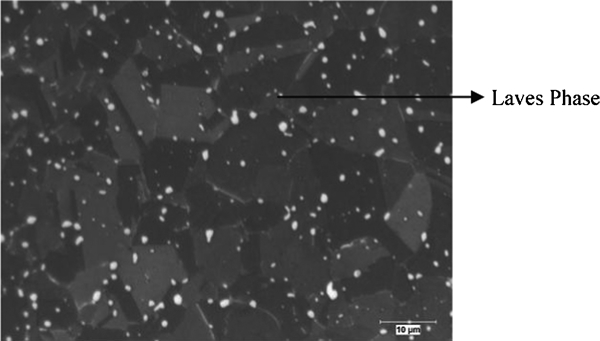
Optical micrograph of alloy 909 in ST condition
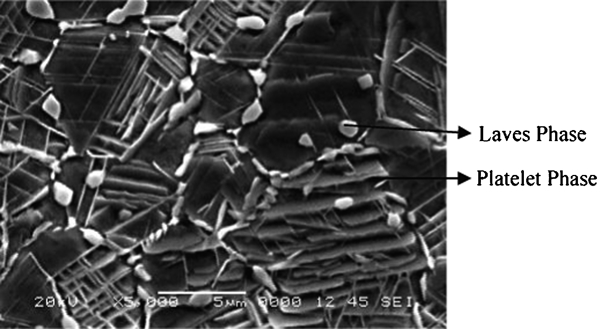
Image (SEM) of STOA alloy 909
Figure 2 shows a SEM image of alloy 909 in STOA condition showing the globular phase as well as copious amounts of the acicular or a platelet-like phase. The globular phase precipitated on grain boundaries and also intragranularly. In this manner, the globular phase aids in controlling the grain growth of the alloy during heat treatment. As previously evaluated and shown in Table 2, TEM/EDX analysis showed the globular phase to be the Laves phase of composition A2B (NiFeCo)x ((TiNb)y. Again, the x/y ratio from actual results is 2·3∶1.
Analysis of phases in heat treated alloy 909 using SEM or TEM/EDX, at-

A bright field image of the globular Laves and acicular phases is shown in Fig. 3. Figure 4 shows a bright field image of the Laves phase and selected area diffraction pattern (SADP), which indicates that the Laves phase is hexagonal in agreement with other researchers. 1 1,4 There was no orientation relationship observed of the Laves phase with the matrix.

Image (TEM) of STOA alloy 909

a bright field image of Laves phase and b SADP of Laves phase in direction parallel to zone axis
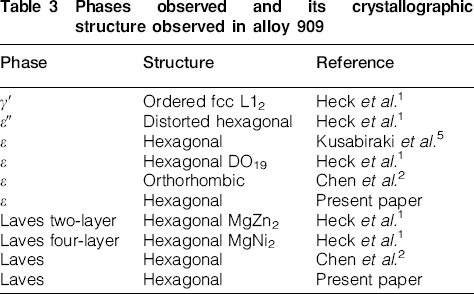
Along with the globular Laves phase in Fig. 3, the copious precipitation observed in the SEM as an acicular phase is readily seen. Figures 5–7 show the acicular phase and accompanying SADPs. The SADPs show that, in agreement with previous researchers,1,3–5 the acicular phase is the hexagonal ϵ phase with [001] γ //to [2°2°2°] ϵ. The crystal structure of γ′, Laves and ϵ phases found in the literature and the results from the present work are shown in Table 3.

a bright field and b dark field TEM images of ϵ phase in the STOA condition (inset: SADP from
zone axis showing superlattice reflections from ϵ phase); scale bar shows 100 nm
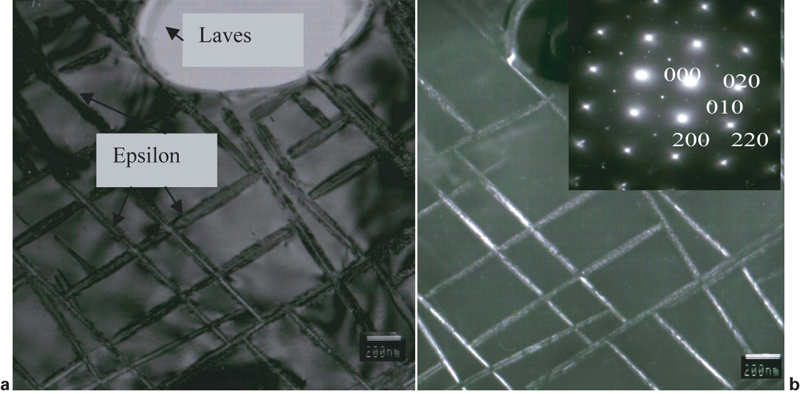
a bright field and b dark field TEM images with SADP (inset): beam along [001] γ showing superlattice reflections pertaining to ϵ phase

Dark field TEM image of STOA alloy 909 showing presence of ϵ phase (inset: SADP shows superlattice reflection spots due to ϵ phase, beam along
direction and superlattice reflections corresponding to  )
)
Phases observed and its crystallographic structure observed in alloy 909
Guo et al.,3 through extensive selected area diffraction analysis, determined that the lattice structure of ϵ platelets are ordered and hexagonal close packed. Note, however, that Chen et al.2 have concluded that the ϵ phase is orthorhombic rather than hexagonal in alloy 909. This is in disagreement with Heck et al.,1 Kusabiraki and co-workers3–5 and the present paper.
The ϵ phase with stacking order (abab) has been shown by Kusibiraki et al.5 to form from the metastable γ′ phase having stacking order (abcabc). At temperatures in excess of ∼750°C, the phase can also precipitate directly out into the austenite matrix. It has been previously reported in the literature that ϵ phase (platelet) precipitates were present in the aged condition but not in commercially aged heat treatment condition.1,3–5 The previous investigation by the authors6 did not confirm the presence of ϵ phase in the STA condition, though there were some similar evidence to that of Guo et al.,3 showing γ′ particles precipitating in a line type fashion, likely at an early stage in the transformation to the ϵ platelets. Guo et al.3 have also concluded that when aged at higher temperatures (770°C), the ϵ platelets precipitate directly from the supersaturated γ matrix. Owing to the presence of antiphase boundaries (APBs) in the ϵ platelets, it was confirmed to belong to a highly ordered superlattice. These ϵ platelets intersect with each other to Widmänstatten-like morphology as shown in Figs. 3 and 5–7.
In an earlier publication by Heck et al.,1 the existence of a ϵ″ phase was proposed. This ϵ″ phase was another platelet type precipitate being a transformation stage between the γ′ and the ϵ phase. The difference between ϵ and ϵ″ is not completely understood, as no further detailed crystallographic studies on ϵ″ in alloy 909 are reported in the literature except that by Heck et al.1 who have shown that TEM SADP of ϵ″ is similar to fcc γ′ <001>. It is not known whether previous researchers meant the transitioning phase between γ′ and ϵ by ϵ″. Kusabiraki showed that the ϵ phase was not a very stable phase; as with time and temperature, the phase can transform into the cellular η type phase. These cellular type precipitates form after a long exposure (>1000 h) to intermediate temperatures.4 The η phase is similar to Ni3Ti, a topologically closed pack structure of type DO24, which was not found in the present study.
Consequently, as shown by both Heck et al.1 and Kusabiraki and co-workers,3–5 the relatively stable precipitate in the alloy is the ϵ phase rather than the γ′ phase. Thus, the phase can either, at temperatures below ∼750°C, transform from the γ′ phase or, at higher temperatures, precipitate directly in the matrix in a Widmänstatten type orientation.3
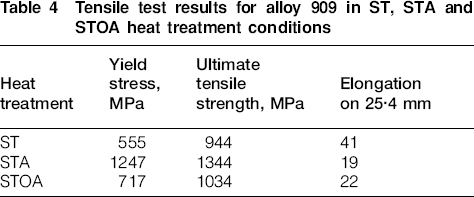
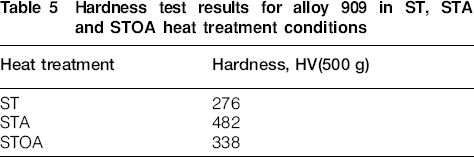
The question then occurs as to what effect the ϵ phase has on the yield strength of the alloy relative to the γ′ phase. Table 4 shows the tensile data for the ST, STA and STOA heat treatment conditions and the ΔYS factor for the STA and STOA heat treatments relative to the ST condition. While the effect of the ϵ phase at a ΔYS of 162 MPa is considerably less than that of the γ′ phase at 689 MPa, it can be seen that the ϵ phase still has a significant effect on the yield stress. Metallographic evidence in support of this effect is shown in Fig. 8, with APBs being present in the STOA ϵ phase. These boundaries are known to form where antiphase domains meet, which have the wrong neighbours resulting in APBs with higher energy than the surrounding matrix.8 Guo et al.3 have also shown the presence of a highly ordered APB type structure in the ϵ phase in the overaged condition. As shown by Stoloff,8 the antiphase domains being formed by a nucleation and growth process can strengthen alloys containing ordered superlattices. Thus, the copious amount of ϵ phase shown in Figs. 3 and 5–7 contributed to the yield stress over and above that of the ST condition as shown in Table 4. A similar trend can also be observed from the hardness test results, as shown in Table 5.
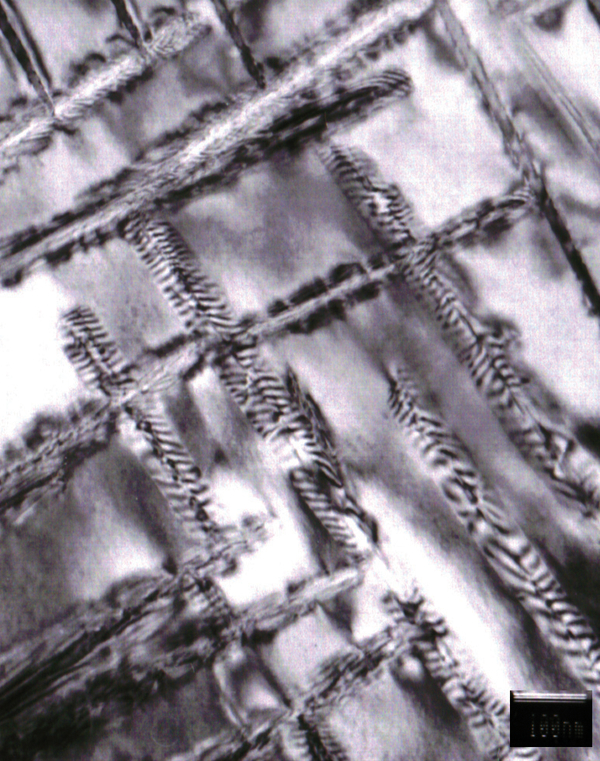
Bright field TEM image of ϵ precipitates showing APBs (scale 100 nm)
Tensile test results for alloy 909 in ST, STA and STOA heat treatment conditions
Hardness test results for alloy 909 in ST, STA and STOA heat treatment conditions
Summary
In STOA condition, Laves and ϵ phases are present, with complete absence of γ′ phase.
The Laves phase complies with A2B composition, while the ϵ phase complies with the A3B composition (similar to γ′ phase as reported by previous research1).
The TEM investigation of crystal structure of ϵ phase confirms it to be hexagonal phase (hexagonal close packed) and not orthorhombic phase as reported by Chen et al.2
The presence of copious amounts of ϵ phase in STOA condition was observed to reduce the yield strength and hardness compared to γ′ strengthened commercially STA condition.
The ϵ phase exhibits ordered APBs, confirming the earlier research by Guo et al.3