







Abstract
Crystal growth from all three states of matter, i.e. vapour, liquid and solid, produces the dendritic morphology. A well known vapour case is the snowflake. Most liquid metal products solidify by forming dendrites. Crystal growth from an already crystalline matrix is also found to produce precipitates with a dendritic morphology. However, dendritic precipitates were scarcely observed to form from liquid state. In the present paper, a directionally solidified nickel based superalloy was designed to show the dendritic growth of precipitates from the liquid state. The formation of carbides led to the negative temperature gradient and constitutional supercooling in the residual liquid melts as a result of the release of latent heat and ejecting of forming precipitate elements respectively. This resulted in the formation of dendritic primary precipitates.
According to the precipitation behaviour, γ′ phase can be classified into two types: primary γ′ grows from liquid metals, and secondary γ′ precipitates grow from the solidified γ matrix.1 The growth morphology of γ′ has been proposed to progress from spheres to cubes, to doublet of plates, to octet of cubes and then to thin plates.2 In addition, dendritic secondary γ′ precipitates have been observed in specimens subjected to heat treatment,3–9 and their development has been thought as a very natural phenomenon.10 Dendritic growth has been thought to occur only when a diffusion process dominates the rate at which the phase transformation proceeds.11
The dendritic γ′ precipitate, by virtue of its extended surface, has a considerably increased surface free energy and is therefore thermodynamically unstable compared with the equilibrium shape. The origin of the dendrite must therefore result from the growth kinetics. The development of dendritic secondary γ′ precipitates has been well elucidated by Grosdidier et al.7 The first stage occurs in a highly saturated matrix, and the γ/γ′ interface is still coherent. Therefore, although the growth mechanism forces the eight branches of the octodendrite to extend in the 〈111〉 directions, the dendrite arms present steps along the {001} planes to accommodate the elastic strain. When the dendrite arms are sufficiently away from one another, secondary and even ternary branching occur. As growth progresses, it is more and more controlled by the diffusion of solute atoms through the depleted matrix, and the growth rate decreases. At this stage, trapping of mobile dislocations is often sufficiently advanced, and with the associated loss of coherency, the interface becomes smoother. Further aging allows the eight different units of the octodendrite to coarsen to reduce the surface area of the γ/γ′ interface. This leads to the formation of a dendritic shape.
However, the formation of dendritic γ′ precipitates from liquid state needs further consideration. Dendritic structures forming from liquid metals involve two distinctly different growth conditions, which differ in the way in which the latent heat of fusion is carried away from the interface.12 One is growth from an undercooled melt, in which, generally, an equiaxed dendritic crystal forms. In this case, the latent heat of fusion is dissipated through the cooler liquid ahead of the interface. The negative temperature gradient in the liquid at the interface is gained. Another case is directional solidification or constrained growth, in which a positive temperature gradient in the liquid is imposed so that the latent heat of fusion is dissipated through the solid.
In the present paper, experiments were performed on an experimental nickel based superalloy. The nominal chemical composition is Ni–0·3C–16Cr–8W–1·5Mo–5Al–Nb+Co<5 (wt-%). The alloy was directionally solidified by high rate solidification process in an industrial vacuum induction furnace. The solidification of the γ matrix proceeds by dendritic growth. At the end of the solidification process, several types of carbides, such as MC, M6C and M23C6, form by the release of the latent heat in the grain boundary or the interdendritic area. As the dendritic γ′ precipitates were surrounded by the γ matrix, electrochemical corrosion was applied to get rid of the γ matrix using a solution of 21 mL H3PO4+17 mL H2SO4+12 mL H2O (2 V dc and 0·2 A).
Figure 1 illustrates the possible site for the formation of the dendritic γ′ precipitates from the liquid state. It was provided that the temperature gradient in the dendritic γ matrix was imposed by the high rate solidification process without the influence of the latent heat. Consequently, the positive temperature gradient corresponds to the dashed line.
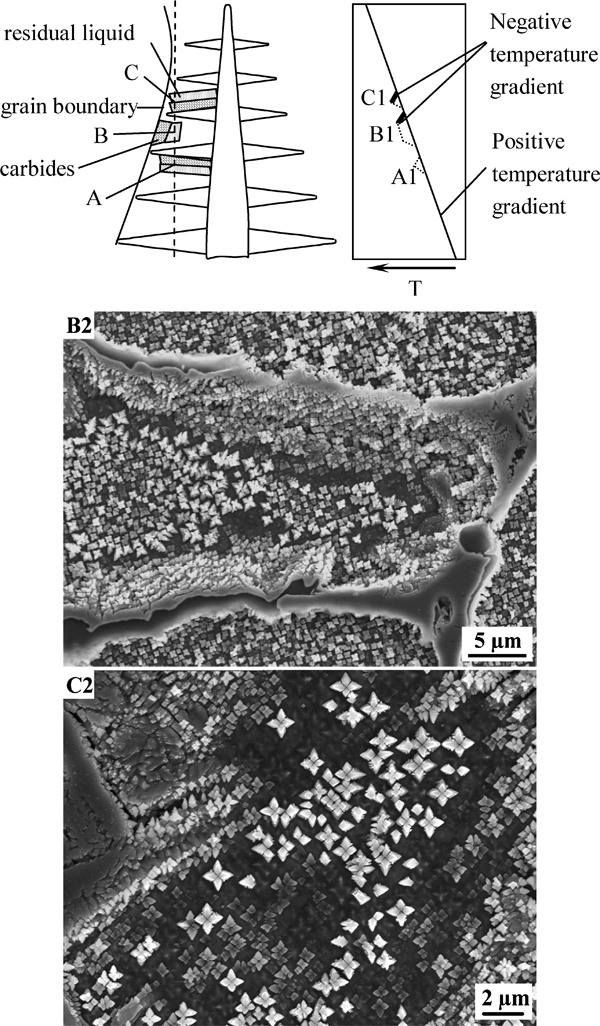
Schematic diagram of formation of dendritic primary γ′ precipitates, in which B and C are satisfied with proper conditions for dendritic growth of precipitates, and B2 and C2, which correspond to B and C respectively, show equiaxed dendritic primary γ′ precipitates
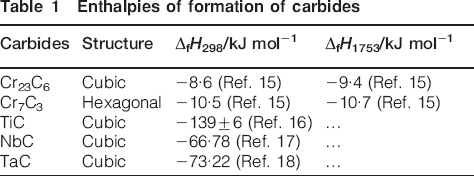
The solidification of the γ matrix proceeds by dendritic growth. At the end of the solidification process, several types of carbides, such as MC, M6C, M23C6, etc., form by the release of the latent heat in the grain boundary or the interdendritic area. The enthalpies of formation of carbides13–16 are listed in Table 1. It was provided that the carbide reaction occurred at a constant pressure. Then, Q = ΔfH. Consequently, it was inevitable that the temperature gradient was changed as a result of the release of latent heat Q by the formation of carbides. Carbon is a strong positive segregation element. Accordingly, there exist three preferring precipitate sites for carbides. The solidification interface of carbides is a source of latent heat, which needs to be dissipated. The superposition of the latent heat and the positive temperature gradient resulted in the negative temperature gradient (see B1 and C1 in Fig. 1), which facilitated the precipitation of dendritic γ′. In the case of A, carbides precipitated below the secondary dendritic arms, and no dendritic primary γ′ precipitates will be observed due to the lack of a negative temperature gradient in the residual liquid melts (see A1 in Fig. 1). B and C had proper temperature gradient conditions for the precipitation of dendritic γ′ precipitates. Equiaxed dendrites can be found in the supercooled liquid, as well as growing as a result of constitutional supercooling. MC carbides absolutely contain no aluminium, whereas M6C and M23C6 contain a few.17 Accordingly, during the precipitation of carbides, γ′ forming elements, such as aluminium, were ejected and concentrated in the residual liquid melts. This may lead to constitutional supercooling. Hence, the combination of constitutional supercooling and negative temperature gradient resulted in the primary equiaxed dendritic γ′ precipitates. Actually, B2 and C2 corresponded to B and C in Fig. 1 respectively.
Enthalpies of formation of carbides
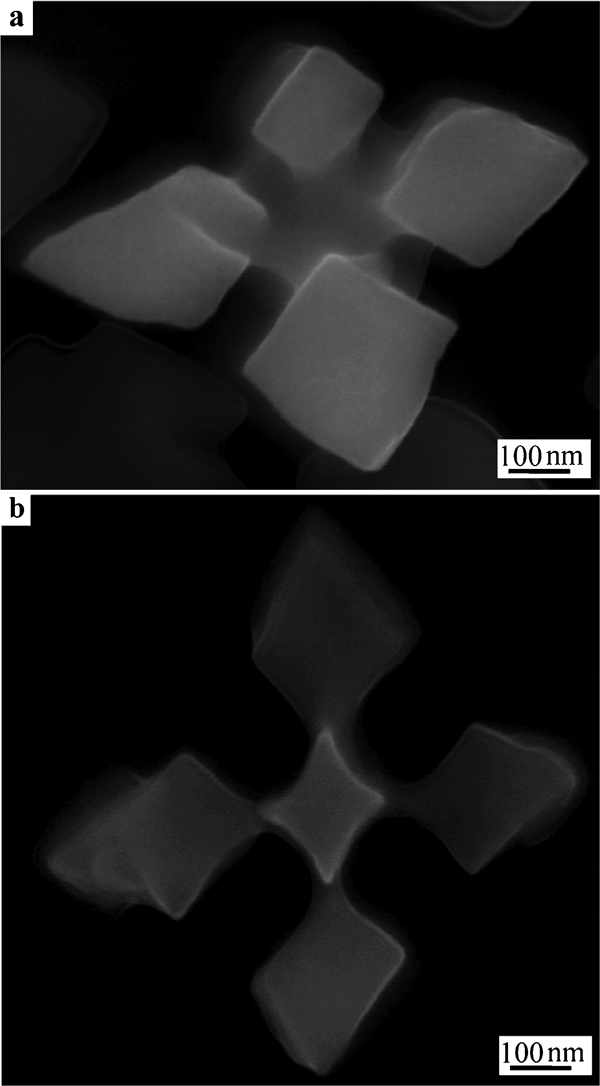
Dendritic crystal growth patterns, with the hierarchical structure of the primary, secondary and higher order branches, have fascinated scientists for several centuries.18 At very low precipitate sizes, interfacial energy is prominent, and spherical or quasi-spherical shapes are favoured. The anisotropy of surface tension and instabilities results in side branching. The growth direction is a compromise between the direction of maximum thermal gradient and the direction of crystallographic favourable growth. Although the temperature field of the residual liquid was complex, the growth of dendritic primary precipitates was regular (see Fig. 1). Branches of precipitates were found to arrange along the same direction. It was also found that both eight corners and four edges of cubic γ′ precipitates extend to form dendritic γ′ precipitates, as clearly shown in Fig. 2. The size of the nucleation core growing from the corners was ∼200 nm, whereas that growing from the edges was 100 nm.
Growth rhythm of dendritic primary precipitates
Further growth of the branches occurred. This resulted in the hierarchical structure of the primary, secondary and higher order branches of the dendritic primary γ′ precipitates (see Fig. 3). However, in most cases, not all branches had the opportunity to grow at the expense of liquid melts. Figure 3a shows that three branches were preferred to grow, leading to the formation of anisometric dendritic γ′. Furthermore, the observed dendrite growth pattern appeared to be typical equiaxed dendritic γ′ precipitates, with three order branches (see Fig. 3b). Some branches of many primary equiaxed precipitates were observed to separate on the surface of large carbides (see Fig. 1, C2). This indicates that there existed a poor combination of one order branches as well as that between equiaxed ones and carbides.
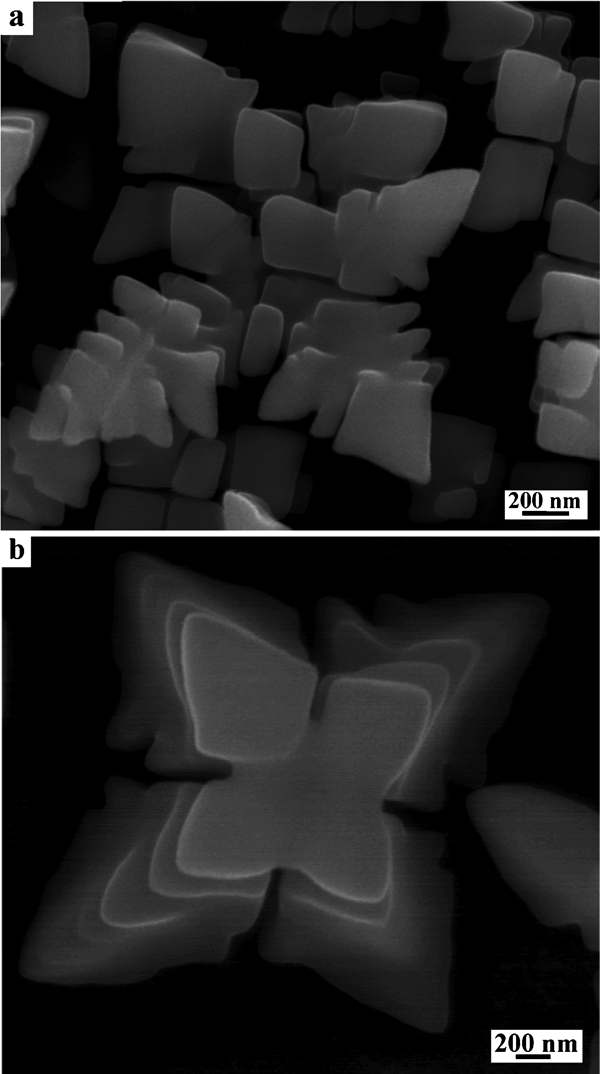
Hierarchical structure of dendritic primary precipitates
Conclusion
In summary, dendritic γ′ precipitates have been observed to form from residual liquid melts in an experimental directionally solidified nickel based superalloy. The generation of the dendritic primary precipitates can be attributed to the formation of carbides that lead to the negative temperature gradient, and constitutional supercooling resulted from the release of latent heat and ejecting of γ′ forming elements.