







Abstract
Full homogenisation behaviour of a Ni3Al based alloy containing Cr, Mo, Zr and B was investigated. At the as cast condition, the microstructure of this alloy consists of a γ solid solution γ′(Ni3Al) and a low melting point structure. At first, the low melting point structure, which is detrimental for full homogenisation process, was eliminated by annealing the specimens at 1100°C. After this prerequisite process, based on differential thermal analysis results, 1260°C was determined for the full homogenisation annealing temperature. The results showed that this alloy cannot be fully homogenised without the formation of locally melted regions. In order to explain the mechanism of this local melting phenomenon during full homogenisation treatment, some heating cycles were performed at 1200 and 1240°C. A scanning electron microscope equipped with energy dispersive spectroscopy and differential thermal analysis was used for introducing the local melting (incipient melting) mechanism. It was found that the difference in zirconium solubility limit in the γ and γ′ phases is the main reason for the negative response to full homogenisation treatment.
Introduction
IC221M is an intermetallic alloy based on the Ni3Al (γ′) phase and contains several constituents, such as chromium, zirconium, molybdenum and boron. This alloy has reached the most significant stage of commercialisation in high temperature applications.1 These elements are added to this system in order to improve its physical and mechanical properties. Chromium is added for suppressing oxygen induced embitterment. The addition of molybdenum is for improving the ambient and high temperature strength, and that of zirconium is for improving the high temperature strength. This element also improves the castability of the alloy.2 In order to overcome the brittleness of the alloy, a minor amount of boron is added to it.3 In the as cast condition, IC221M has a dendritic structure. The Ni solid solution (γ) is the first phase that segregates from the melt and has an fcc structure. In the dendritic regions, γ′ precipitates from γ during cooling to room temperatures. In the interdendritic area, γ and γ′ segregates from the remaining liquid as a result of a eutectic transformation and can be seen as a cellular structure.4 Like the nickel solid solution, Ni3Al (γ′) also has an fcc structure. In the final step of solidification, a zirconium rich structure segregates from the melt and consists of a peritectic transformation in the form of γ-Ni7Zr2 and a eutectic transformation in the form of γ-Ni5Zr–Ni7Zr2.5 The as cast microstructure is non-equilibrium, and therefore, heat treatment and working at high temperatures can significantly affect its properties and performance.6 On determining the working and heat treatment temperatures of this alloy, the γ′ solvus temperature is significant. The solvus temperature of the γ′ phase in the dendrites and interdendrites is different due to the microsegregation of the alloying elements in these domains.7 The distribution/partition coefficient k of the alloying elements is used to describe the direction and extent of the microsegregation during solidification. Under equilibrium conditions and by neglecting undercooling at the dendrite tips, the first solid to form from the liquid, which is the dendrite core, will have a composition of kCo. Co is the nominal composition of the alloy, and k is the equilibrium partition coefficient. Elements with k>1 segregate to dendrites, and elements with k<1 tend to segregate to interdendrites.8 On this basis, elements such as aluminium and zirconium tend to segregate to interdendrites (k<1), and chromium and molybdenum segregate to dendrites (k>1).9 In the previous papers, 4 4,5 the effects of γ′ subsolvus temperatures on the microstructures of this alloy were investigated. In the present paper, annealing was accomplished in temperatures higher than the solvus temperature of γ′, and the changes in the microstructure of the alloy were investigated. This type of heat treatment is called full solution or homogenisation and may have deleterious effects on the microstructure, such as local melting.10 This phenomenon especially is important in alloys like IC221M with boron and high level of zirconium, which tend to lower the solidus temperature.11
Experimental
The chemical composition of the IC221M alloy used in the present work is Ni–7·9Al–7·7Cr–1·4Mo–1·7Zr–0·008B (wt-%). The alloy was produced with vacuum arc remelting furnace. Full homogenisation annealing of the alloy was investigated. To do this, at first, the low melting point structure of the alloy was eliminated with annealing at 1100°C for ⩾20 h. In the next step, full homogenisation annealing was performed on samples that were subjected to first step annealing, i.e. elimination of high zirconium structure. The full homogenisation annealing cycle used for these specimens consists of ⩾20 h of heating at 1100°C followed by 2·5 h of heating at 1260°C. This heating cycle has been determined using differential thermal analysis (DTA) results. In order to explain the events that occurred during full homogenisation annealing, two heat treatments were conducted at 1200 and 1240°C on samples that undergone first step annealing treatment.
After annealing, all the specimens were prepared for metallography with polishing and etching with glyceria (glycerin/HCl/HNO3, 2∶2∶1). These samples were examined with a scanning electron microscope equipped with an energy dispersive spectroscope analyser. In addition, DTAs were used to clarify the mechanism of full homogenisation response of the alloy. The heating and cooling rates in the DTA test were selected to be 10°C min−1.
Results and discussion
Elimination of zirconium rich structure and γ–γ′ eutectic
Before full homogenisation annealing treatment, the high zirconium structure in the microstructure should be eliminated. This is because the high zirconium structure melts at temperatures below that required for full homogenisation treatment. As discussed elsewhere,4 the high zirconium structure is a non-equilibrium structure and can be eliminated by annealing for ⩾20 h at 1100°C. The differential thermal analysis curves of as cast and 20 h annealed specimens at 1100°C are shown in Fig. 1. The first peak in the DTA curve of the as cast specimen occurs at ∼1186°C and denotes the liquation of the high zirconium structure. Lee and Santella6 believe that this peak is related to the L→γ-Ni5Zr eutectic temperature and takes place in the final step of solidification. In the authors’ previous paper,5 the transformations occurred in the narrow range of temperatures, in which the first peak taking place was discussed. It was claimed that a series of transformations take place in the narrow range of temperatures around this peak. These transformations, which occur in the final steps of solidification, are L+γ′→γ+Ni7Zr2, L→γ+Ni7Zr2 and L→γ+Ni7Zr2+Ni5Zr respectively. The second peak in this curve is the γ′→γ transformation peak. It is clear from Fig. 1 that after ∼20 h annealing in 1100°C, the first peak is eliminated in the DTA curve. The microstructure of the as cast and annealed specimens for ∼48 h at 1100°C is shown in Fig. 2a and b respectively. Elimination of the zirconium rich structure by annealing treatment can be followed from these micrographs. Furthermore, the elimination of γ–γ′ eutectic in the interdendritic area, which is another prerequisite for applying full homogenisation annealing, can be inferred from Fig. 2b. The response of the microstructure to this type of heat treatment will be discussed in the next section.
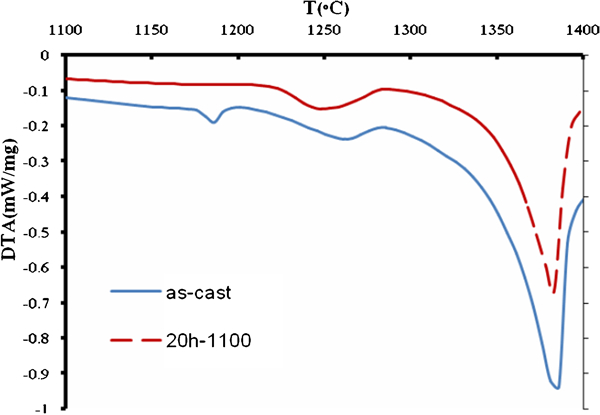
Differential thermal analysis curves of as cast and annealed specimens4
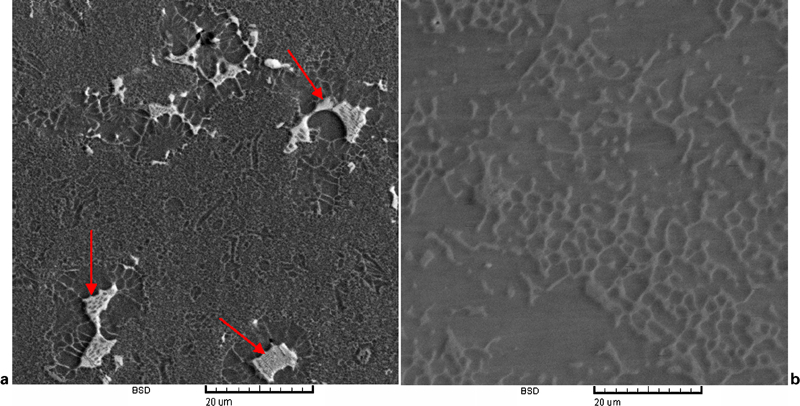
Backscattered SEM image of a as cast and b 48 h annealed at 1100°C: arrows show zirconium rich structure
Full homogenisation annealing
An SEM image of the specimen subjected to full homogenisation annealing is shown in Fig. 3. The heating cycle in this case was 20 h annealing at 1100°C followed by 2·5 h at 1260°C and water quenching. The occurrence of the γ′→γ transformation can be deduced from this micrograph. In addition, some bright spot-like and narrow strip-like regions, which are indicated with black and white arrows respectively, can be seen in the microstructure. These regions are rich in zirconium. The chemical composition of these regions is shown in Table 1. In regions near the strip-like high zirconium regions, there are regions in which the spot-like regions are not observed. The chemical composition of these regions is also given in Table 1. The chemical composition of these regions shows that these regions are depleted from zirconium. As the high zirconium regions are eliminated from the microstructure in the first step of full homogenisation annealing (Fig. 2b), therefore, these regions should be formed at temperatures higher than 1100°C. The microstructure of the specimen subjected to 20 h annealing at 1100°C and 10 h at 1150°C followed by 12 h at 1200°C is shown in Fig. 4. It is clear from this micrograph that the bright strip- and spot-like regions do not form after annealing at temperatures up to 1200°C. This temperature is ∼14°C higher than 1186°C, which is the first peak in the DTA curve of the as cast specimen, i.e. the temperature where the high zirconium regions begin to melt. The similarity of the microstructure after this annealing condition and the microstructure of the annealed specimen for 48 h at 1100°C (Fig. 2b) is evident. Furthermore, this temperature is below the temperature of the γ′→γ transformation, i.e. the second peak in the DTA curves in Fig. 1. Therefore, it can be concluded that these high zirconium regions form after annealing at temperatures in which the γ′→γ transformation takes place. In order to identify the physical nature of these high zirconium content regions, a DTA test was applied on the specimen subjected to full homogenisation annealing. The heating and cooling DTA curves of the specimen subjected to this treatment are shown in Fig. 5a. It can be seen that the peak of liquation of the zirconium rich structure has appeared again. The area of the peak region in the DTA curve of this condition is ∼2·5 times greater than that of the as cast condition in Fig. 1. Based on these results, it can be concluded that the high zirconium regions after full homogenisation annealing are the result of an incipient (local) melting in the microstructure. Furthermore, there is some delay time between the second peak, i.e. γ′→γ transformation in the DTA curve, and the formation of the incipient melting in the microstructure. This fact can be inferred from the DTA curve of the specimen subjected to high zirconium eliminating annealing (Fig. 5b). The heating cycle was carried out up to 1290°C. Cooling from this temperature resulted in a peak at ∼1220°C (marked as 2 and is the same peak as 1), but there is not any evidence for liquid formation on heating to 1290°C. If such a liquid was being formed, it should be solidified at ∼1170°C and should cause an exothermic peak on the cooling curve of the DTA graph (this range of temperature was shown in a circle on the cooling curve).4 Therefore, it can be briefly mentioned that these locally melted regions are the results of γ′→γ transformation, but they take place after the occurrence of this transformation. Consequently, it can be inferred that this alloy cannot be fully homogenised. Before explaining the mechanism of the formation of these melted regions in the microstructure during full homogenisation annealing, some aspects should be considered.
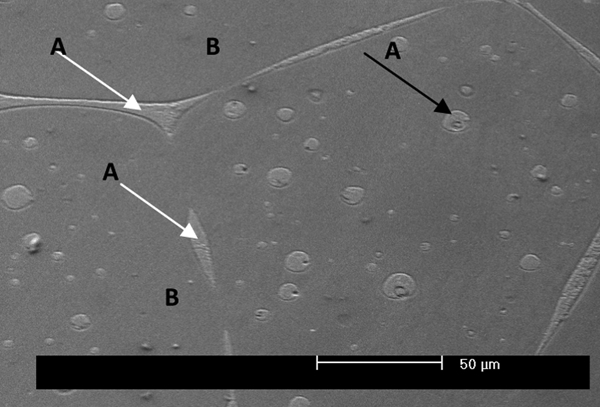
Image (SEM) of specimen subjected to full homogenisation annealing: annealing condition was 20 h at 1100°C followed by 2·5 h at 1260°C and water quenching4
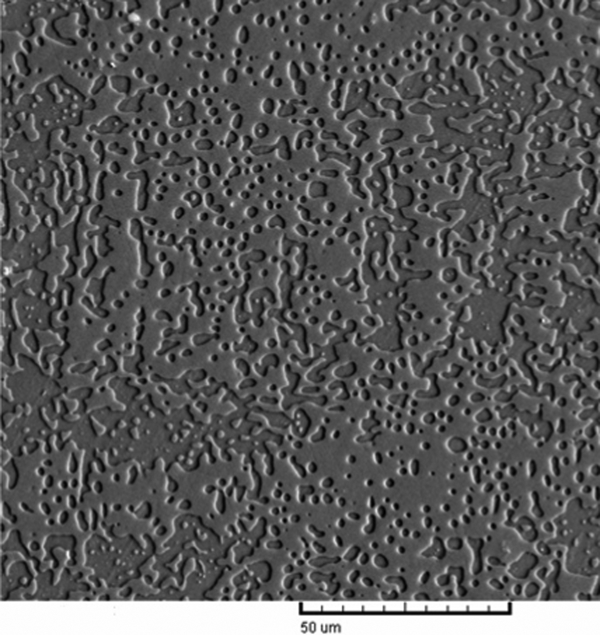
Backscattered SEM image of specimen annealed for ∼12 h at 1200°C after 20 h annealing at 1100°C followed by 10 h at 1150°C
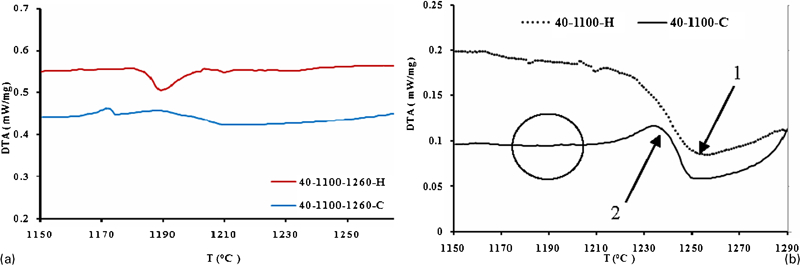
Heating (H) and cooling (C) DTA curves of specimen subjected to a full homogenisation annealing and b high zirconium regions eliminating annealing4
First, the solubility of zirconium in the nickel solid solution is lower than its solubility in the Ni3Al (γ′) phase.4,12–14
Second, the lattice parameter of the γ′ phase is smaller than that of the γ phase (aγ′<aγ),15 but it increases linearly with zirconium content of γ′.14 It seems that in this alloying system, the lattice parameter of the γ′ phase is greater than that of the γ phase.
Third, according to the Ni rich side of the Ni–Al binary phase diagram, the γ′ phase is stable up to its melting point. The reason why the γ′ to γ transformation begins at the γ/γ′ interface is as follows: assume a γ′ precipitate in the γ matrix (Fig. 6). An imaginary circle is plotted inside this precipitate. This system is heated to a temperature higher than the γ′ solvus temperature. Regarding the stability of the γ′ phase, it is impossible that the γ′ to γ transformation begins in regions inside this imaginary circle and should be located outside it. If the radius of this circle is selected at any amount less than the γ′ precipitate radius, the γ′ to γ transformation will take place outside of it. Therefore, if the γ′ to γ transformation has to take place, it should be at the γ′/γ interface.
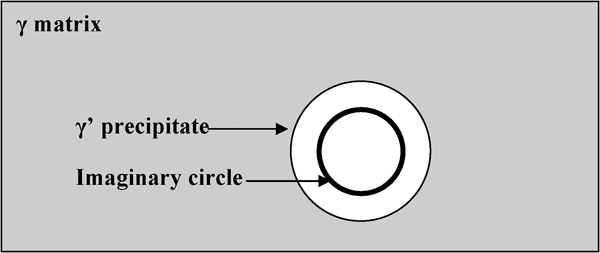
Schematic micrograph showing γ′ precipitates in γ matrix: imaginary circle has been drawn inside γ′ precipitate
Fourth, as the aluminium content of the alloy in the interdendritic regions is higher than that in the dendritic regions, the γ′→γ transformation temperature in the interdendrites is higher than that in the dendrites (Fig. 7). 7 7,16
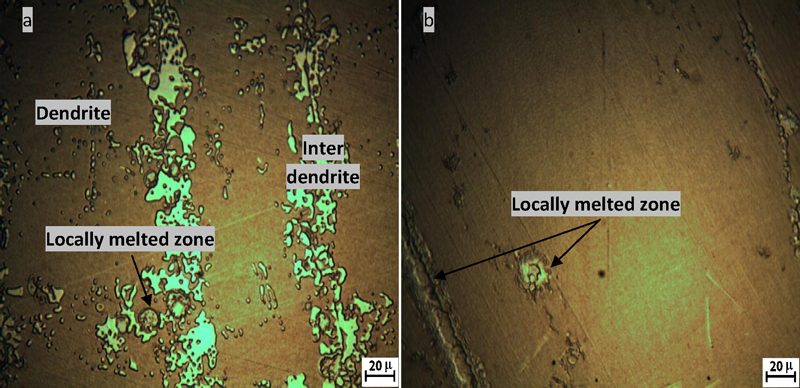
Optical micrographs showing difference in γ′ solvus temperature in dendritic and interdendritic regions of IC221M. Annealing condition in a and b is 20 h at 1100°C followed by 30 min at 1240°C and 20 h at 1100°C followed by 30 min at 1260°C respectively. Locally melted regions can also be observed in these micrographs
Based on these instances, the incipient melting mechanism of the alloy during full homogenisation annealing heat treatment can be explained as follows.
The liquid formation mechanism during the γ′→γ transformation in the microstructure of the alloy is schematically shown in Fig. 8. During the first step of annealing treatment in which the zirconium rich structure is eliminated, the zirconium of this structure dissolves in the interdendritic and dendritic areas. In the dendritic area, regions close to the interdendrites are especially affected from this dissolution (Fig. 9). These regions, which have higher zirconium content compared with other regions, are marked with grey in Fig. 8a. On full homogenisation annealing, when the temperature of the specimen reaches the γ′→γ transformation temperature, the γ′ phase transforms to γ. In the dendritic regions in which the γ′ phase is present as precipitates, this transformation starts at the γ/γ′ interface. There are two types of γ′ precipitates. In some of the γ′ precipitates, the zirconium content is lower than or equal to its solubility in the γ phase at the full homogenisation temperature. In others, especially those near the interdendritic regions, the amount of zirconium is higher than its solubility limit in the γ solid solution. In the precipitates that lie in the first condition, the γ′→γ transformation takes place without any liquid formation. In the precipitates that lie in the second condition, during the transformation, the margin levels of this element reject into the front of the γ′→γ transformation and dissolve into the γ′ phase and also to the cavities formed by the coalescence of vacancies during transformation. This increases the zirconium content of the γ′ precipitates to their solubility limit in the annealing temperature. After this, continuing the annealing treatment will result in the accumulation of zirconium in front of the progressive transforming interface. Furthermore, by the accumulation of zirconium in the cavities, regions with high zirconium content formed (Fig. 8b). At this moment, based on the Ni–Zr phase diagram, local melting of the interface of these newly formed regions and γ phase takes place. The zirconium of this region diffuses to the melted γ phase and increases its zirconium content (Fig. 8c). It should be emphasised that alloying elements, such as Al and Cr, dissolve in the γ′ and γ phases, and it seems that they have no significant effects, if any, on incipient melting. Therefore, although it is better to use the Ni–Al–Zr or Ni–Al–Cr–Zr phase diagram, these diagrams should have solubility limits for this purpose; it is reasonable using the Ni–Zr binary phase diagram.
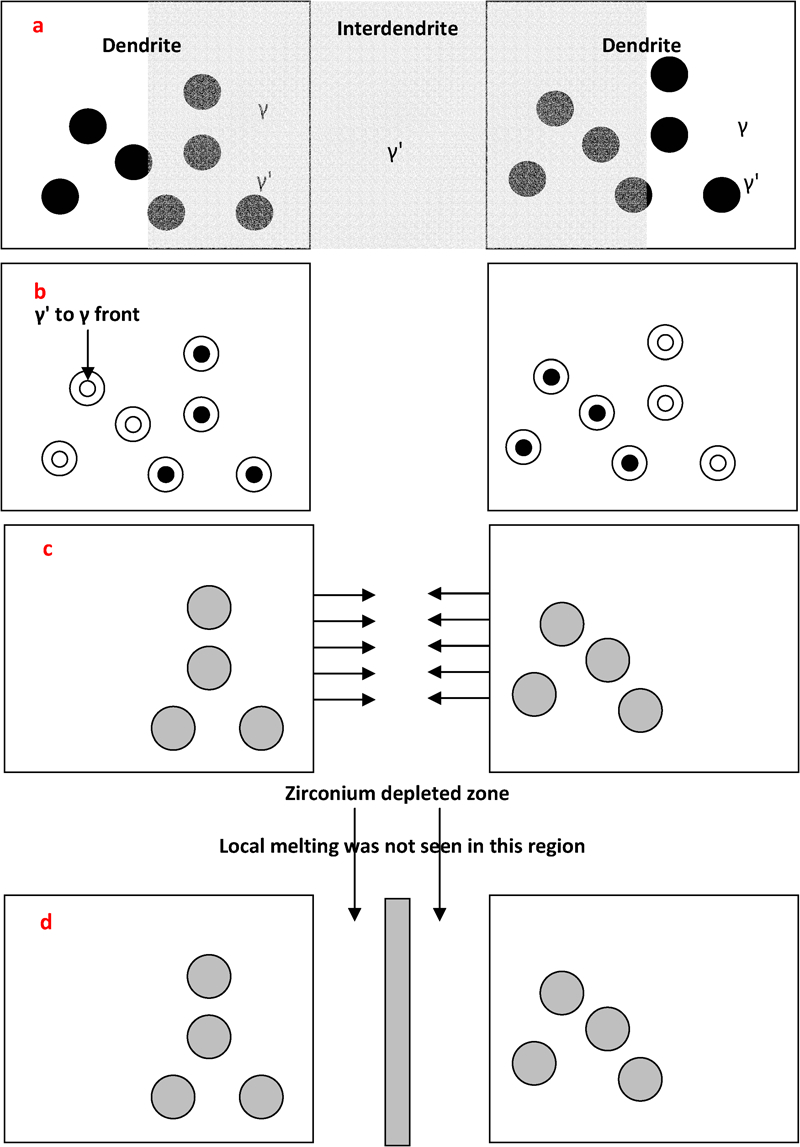
Schematic representation of incipient melting mechanism during full homogenisation annealing of IC221M
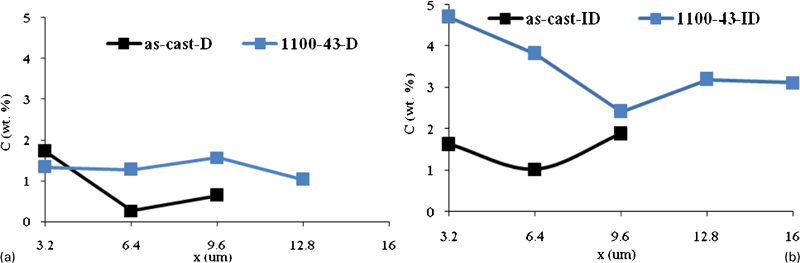
Zirconium content in a dendritic and b interdendritic regions in as cast and annealed (43 h at 1100°C) condition: these regions were selected near high zirconium structure
In the interdendritic regions, the zirconium content is higher than its solubility in the γ phase. As the γ′→γ transformation temperature in these regions is higher than that in the dendritic area, at the beginning of this transformation, all of the dendrites have transformed to γ phase. Therefore, one of the major areas for the transformation of γ′ to γ phase in these regions will be the dendrite/interdendrite interface. In addition, in the interdendrites, there are some γ phases that are the result of γ–γ′ eutectic elimination and can be the nuclei of the γ′→γ transformation. In these areas, similar to dendritic regions, during transformation, zirconium is rejected into the γ′ cavities, which formed throughout the transformation. The remaining events are similar to that occurring in the dendrites. The only difference is the morphology of the melted regions, which are flattened or strip-like. This arose from the dendrite/interdendrite flat interface before transformation. Regions near these strip-like high zirconium regions, in which local melting does not take place, are the evidence for the rejection of zirconium from the newly formed γ phase during the transformation of γ′ to γ (Fig. 8d). As mentioned before, these regions are depleted from zirconium (region ‘B’ in Table 1).
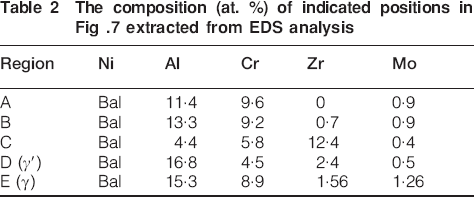
Slow cooling from the annealing temperature would cause reprecipitation of the γ′ phase (Fig. 10). In addition, resolidification of melted regions takes place. These regions are also seen in this micrograph. The chemical composition of the indicated area in Fig. 10 and Table 2 shows that regions that do not melt after full homogenisation annealing are depleted in zirconium. A comparison of the γ′ precipitate size in the annealed specimen for 48 h at 1100°C followed by 30 min at 1240°C and the size of the resolidified regions of specimen annealed for 48 h at 1100°C followed by 30 min at 1260°C, i.e. 2·3 and 4·2 μm (Fig. 11), implies that the melted area after full annealing treatment extends to the γ matrix.
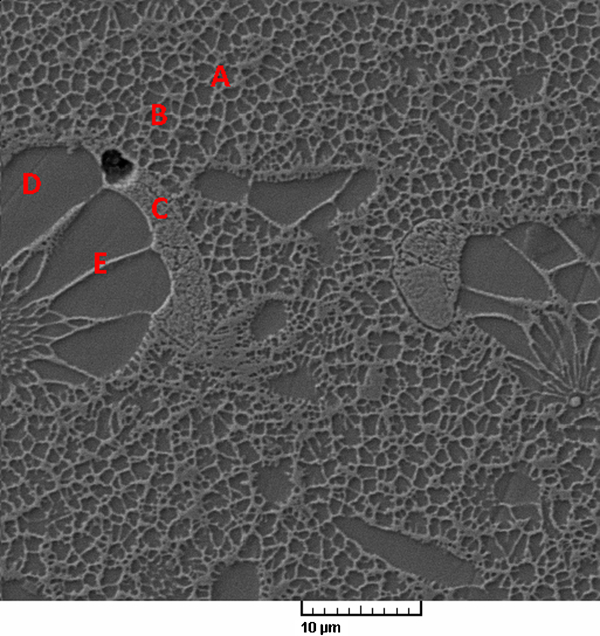
Microstructure of specimen annealed for 40 h at 1100°C followed by 25 h at 1260°C after furnace cooling
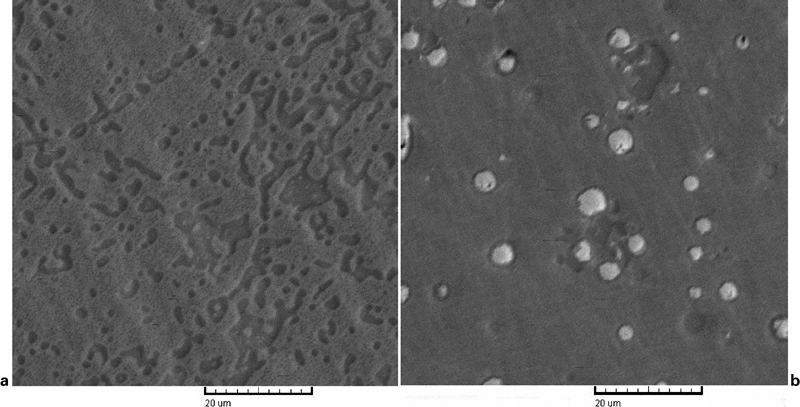
Images (SEM) of specimens annealed for 30 min at a 1240°C and b 1260°C: these specimens in their previous step undergone 48 h annealing at 1100°C
Conclusions
The full homogenisation behaviour of a Ni3Al base alloy containing Cr, Mo, Zr and B was investigated in the present research. Regarding the mechanism of γ′→γ transformation, it can be claimed that this alloy cannot be homogenised without the formation of locally melted regions. The initiation site of γ′→γ transformation, in addition to the fact that the solubility limit of zirconium in the γ′ phase is much higher than that of the γ solid solution, is the major reason for this claim. During transformation, the excess amounts of zirconium move inside of the γ′ phase. When the level of zirconium in γ′ reaches its solubility limit, precipitates at the moving front and also at the voids which form during transformation. This newly formed area has a low melting point. At this time, independent of the heating regime, incipient melting takes place. Therefore, it can be concluded that this alloy cannot be fully homogenised without the formation of local melted regions. These regions substantially locate in the interdendritic regions and in regions near the dendrite/interdendrite interface in the dendritic area. The difference in zirconium solubility in the γ and γ′ phases is identified as the main reason for this incipient melting. During γ′→γ transformation, the extra amounts of zirconium in relation to its solubility in the γ solid solution are rejected to the γ′ phase and also to the cavities that form during transformation. When the level of this element reaches the solubility limit of the γ′ phase, zirconium is gathered in the γ/γ′ interface and causes liquation.
The composition (at. %) of indicated positions in Fig. 3 extracted from EDS analysis
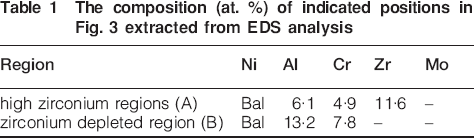
The composition (at. %) of indicated positions in Fig .7 extracted from EDS analysis
Footnotes
Acknowledgements
The present research was performed under the sponsorship of the Advanced Material Research Center (AMRC) and the Iran Aluminum Research Center (IARC).