







Abstract
The workhardening Cu47·5Zr47·5Al5 and the worksoftening Zr52·5Cu17·9Ni14·6Al10·0Ti5·0 bulk metallic glasses before and after precompression deformation were characterised for thermal and mechanical behaviours. The predeformation introduces excessive free volume in both glasses. Cu47·5Zr47·5Al5 and Zr52·5Cu17·9Ni14·6Al10·0Ti5·0 exhibit substantial workhardening and worksoftening behaviours respectively. For Cu47·5Zr47·5Al5, the precompression has a negligible effect on serrations in the plastic flow during nanoindentation, which is related to the hardening of a shear band, while for Zr52·5Cu17·9Ni14·6Al10·0Ti5·0, the precompression moderates serrations in the plastic flow during nanoindentation, which is associated with the softening of a shear band. Strengthening from mechanically induced nanocrystallites at shear bands is responsible for the workhardening of Cu47·5Zr47·5Al5, which overwhelms softening due to the introduction of excessive free volume.
Introduction
The developments of metallic glass compositions with the sluggish crystallisation kinetics have made it possible to fabricate bulk metallic glasses (BMGs) of millimetre, even centimetre sizes.1–3 Although these materials have extraordinarily high yield strengths, their engineering applications are limited because of their low plasticity.1 The premature and catastrophic fracture of BMGs is imputed to the excessive propagation of narrow bands with the highly localised plastic deformation, i.e. shear bands. Undoubtedly, the poor plasticity and the catastrophic fracture endanger the structural safety and hinder the extensive applications of BMGs.
Recently, Das et al. reported that Cu47·5Zr47·5Al5 and Cu50Zr50 BMGs have extensive workhardening capability, and consequently, their fracture strains in compression are up to 7·9 and 18 respectively.4 As well known, BMGs generally display worksoftening, and their plastic strain before failure is <2 in compression and almost zero in tension. The extraordinary mechanical behaviours/properties of Cu47·5Zr47·5Al5 and Cu50Zr50 BMGs are attractive, which are different from those of common BMGs that show worksoftening and poor plasticity. The origin of this unique workhardening behaviour is still in debate.5–9
Currently, there are mainly two viewpoints on the workhardening of Cu47·5Zr47·5Al5 and Cu50Zr50 BMGs. One is that their unique as cast structures favour branching of shear bands, 4 4,10 and the other is that the in situ mechanically induced nanocrystallisation at a shear band leads to strain hardening and large plasticity. 5 5,6 Using the high resolution transmission electron microscopy, Das et al. observed nanocrystallites of 2–5 nm in the as cast Cu50Zr50 and only some structural inhomogeneities below the nanometre level in the as cast Cu47·5Zr47·5Al5.4 Very tiny nanocrystallites in an amorphous matrix of BMGs may not be efficient to cause workhardening and enhance the plasticity significantly. 4 4,7 Das et al. suggested that the structural inhomogeneities promote the nucleation of shear bands throughout the bulk materials and enable their branching, leading to the global plasticity. The interaction of shear bands decreases their sharpness, hinders their rapid propagation and increases the flow stress of the materials, resulting in the workhardening behaviour.4 Kim et al. found two amorphous phases formed by the liquid phase separation and macroscopic structural heterogeneity in the as cast Cu47·5Zr47·5Al5 and assumed that these unique structures enhance branching of shear bands during plastic deformation.10 Using high resolution transmission electron microscopy, Chen et al. excluded the structural inhomogeneities of as spun Cu50Zr50 ribbons, detected the deformation induced nanocrystallisation at shear bands of bent Cu50Zr50 ribbons and proposed that these ‘self-locked’ shear bands are responsible for workhardening.6The work of Kumar et al. also suggested that a large plasticity of the Cu47·5Zr47·5Al5 BMG is exclusively attributed to the deformation induced nanocrystallisation rather than the presence of phase separation or quenched in crystallites.5
An instrumented nanoindentation is a useful probe for studying the mechanical response of various materials to micro- to nanoscale loads. This technique has been applied widely to the investigation of mechanical behaviour of metallic glasses. In the present paper, an instrumented nanoindenter is utilised to study the mechanical behaviours of the workhardening Cu47·5Zr47·5Al5 and the worksoftening Zr52·5Cu17·9Ni14·6Al10·0Ti5·0 (Vitreloy 105) BMGs in as cast and deformed conditions. It is expected that the present work can provide insight to the relationship between the plastic flow and the shear banding behaviours of the BMGs, and it may be helpful for improving the mechanical properties of the BMGs.
Experimental
Cu47·5Zr47·5Al5 and Zr52·5Cu17·9Ni14·6Al10·0Ti5·0 (at-) BMGs were prepared by arc melting a mixture of the constituent elements in a purified argon atmosphere. In order to obtain the homogeneity, the alloy ingots were remelted several times before casting into a water cooled copper mould using an in situ suction casting facility. The resulting cylindrical BMG rods have a dimension of 2 mm in diameter and 30 mm in length. The amorphous structures of the as cast BMGs were confirmed by X-ray diffraction.
The specimens for the precompression deformation have a dimension of 1 mm in height h×2 mm in diameter d, with an h/d ratio of 0·5. The precompression tests were performed to a final plastic strain of 55 at a strain rate of 10−1 s−1 using a materials test system servohydraulic mechanical testing machine. The shear band patterns on the side surfaces of the deformed specimens were observed using a scanning electron microscope.
Differential scanning calorimetry (DSC, PerkinElmer DSC7) was used to characterise the thermal properties of the as cast and deformed BMGs. DSC was run two times for each specimen from 50 to 600°C at the heating rate of 20°C min−1in an argon atmosphere. Taking the second scan as a baseline, any thermal effects from the structural evolution during heating were investigated.
The nanoindentation tests were performed with a Hysitron TriboScope (Minneapolis, MN, USA). The diamond tip was used with a cubic shaped indenter. The loading phase of indentation was carried out under the load control at the loading rates of 0·5, 0·1 and 0·02 mN s−1 to a maximum load of 3 mN. The surfaces of the as cast and predeformed BMG specimens were polished mechanically for nanoindentation tests. At least five indents were made on each specimen with the separation between adjacent indents of 20 μm. The load–displacement curves and the hardness values were obtained from the indentation experiments. The hardness values were corrected for the effect of pile-ups by determining the actual contact area.
Results
In the present work, up to 55 of plastic strain was developed in the uniaxial precompression of both workhardening and worksoftening BMG specimens with an h/d ratio of 0·5. As a geometrical constraint, a small height to diameter h/d ratio can favour a BMG specimen to accommodate a large plasticity.11 Extensive scanning electron microscope observations demonstrate that the precompression deformation introduced a large number of shear bands into two BMGs without crack formation, as shown in Fig. 1. In Zr52·5Cu17·9Ni14·6Al10·0Ti5·0, shear bands are straight and approximately parallel to each other, which is a typical characteristic of BMGs, 12 12,13 while in Cu47·5Zr47·5Al5, the shear bands are wavy and deflected, which are similar to previous observations. 4 4,14There are more shear bands in Cu47·5Zr47·5Al5 than in Zr52·5Cu17·9Ni14·6Al10·0Ti5·0.
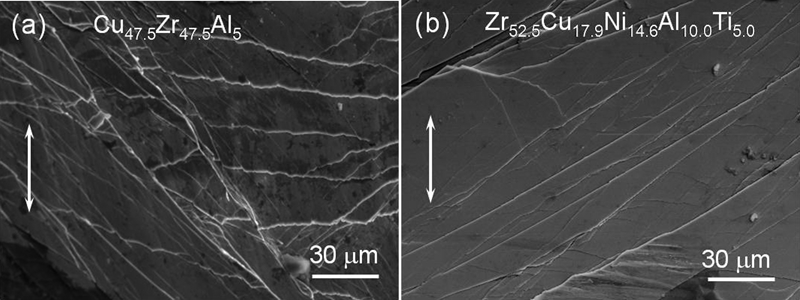
Shear bands on side surfaces of a Cu47·5Zr47·5Al5 and b Zr52·5Cu17·9Ni14·6Al10·0Ti5·0 that were subjected to 55 of plastic deformation in compression: arrows indicate loading direction
DSC experiments demonstrate that both Cu47·5Zr47·5Al5 and Zr52·5Cu17·9Ni14·6Al10·0Ti5·0 BMGs before and after the precompression display typical thermal behaviours of amorphous materials. There are an obvious exothermic peak for crystallisation and an endothermic peak for a glass transition for both glasses. From the DSC curves, the typical thermal properties were derived, as shown in Table 1. The large amount of the exothermic heats of crystallisation ΔHx of both as cast BMGs further indicates the good amorphicity of their structures. The precompression deformation has a negligible effect on the glass transition temperature Tg and crystallisation temperature Tx for both BMGs. However, the predeformation reduces the exothermic heats of crystallisation ΔHx, which may be correlated to the mechanically induced nanocrystallisation within shear bands. The exothermic reactions manifesting the structural relaxation are clearly observed just below Tg for both BMGs before and after the precompression deformation, as shown in Fig. 2. The deformation increases the structural relaxation exothermic heats ΔHo for both BMGs, which are attributed to the introduction of excessive free volume in the deformed BMGs.15 The deformed glasses contain larger amounts of free volume than the as cast ones.
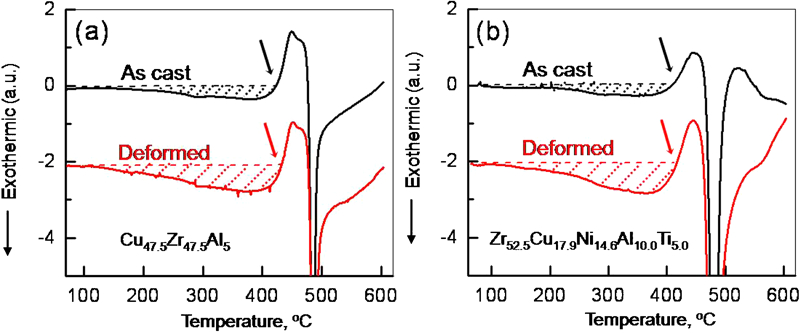
Enlarged DSC scanning curves of a Cu47·5Zr47·5Al5 and b Zr52·5Cu17·9Ni14·6Al10·0Ti5·0 before and after compression deformation, showing structural relaxation exothermic heats ΔHo below Tg (dashed line areas): arrows indicate Tg
Thermal properties of as cast and predeformed BMGs measured from DSC*
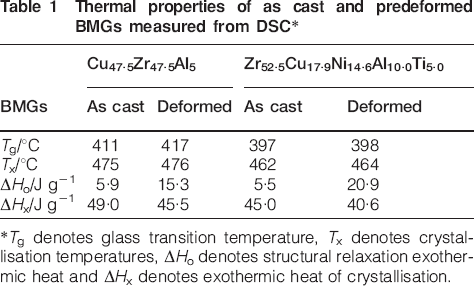
*Tg denotes glass transition temperature, Tx denotes crystallisation temperatures, ΔHo denotes structural relaxation exothermic heat and ΔHx denotes exothermic heat of crystallisation.
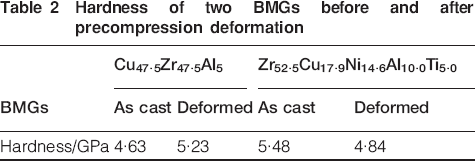
Table 2 shows the hardness values of the as cast and predeformed BMGs, which were obtained from the nanoindentation tests. It is worth mentioning that the hardness was derived from the nanoindentation with a maximum load of 3 mN and at a loading rate of 0·1 mN s−1. Owing to an indentation size effect, the hardness values for amorphous alloys, derived from nanoindentation, are higher than those obtained from macro- or microhardness testers. 16 16,17 Thus, the numbers presented are only used for the comparison between the as cast and deformed states for the two BMGs. From Table 2, it can be seen that Cu47·5Zr47·5Al5 does display substantial workhardening, while Zr52·5Cu17·9Ni14·6Al10·0Ti5·0 shows obvious worksoftening. The precompression deformation results in a 13 increase and 12 decrease in hardness for Cu47·5Zr47·5Al5 and Zr52·5Cu17·9Ni14·6Al10·0Ti5·0 BMGs respectively.
Hardness of two BMGs before and after precompression deformation
Figures 3 and 4 display the typical load–displacement curves and the corresponding strain rate–displacement curves for the as cast and deformed BMGs at various loading rates. From the nanoindentation data, the strain rates

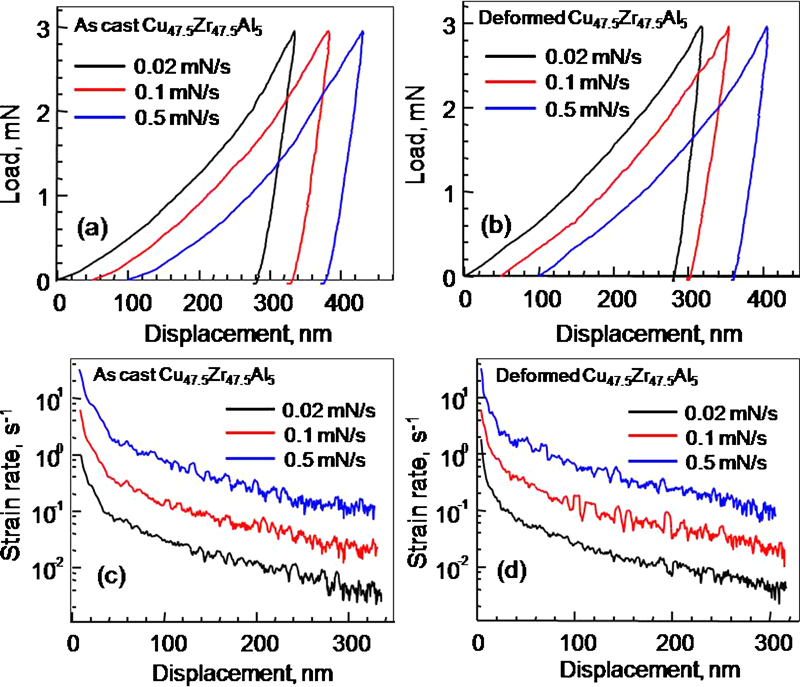
a, b load–displacement curves and c, d corresponding strain rate–displacement curves for a, c as cast and b, d deformed Cu47·5Zr47·5Al5 BMGs at various loading rates during nanoindentation: in order to avoid overlapping, curves were shifted along displacement and strain rates respectively
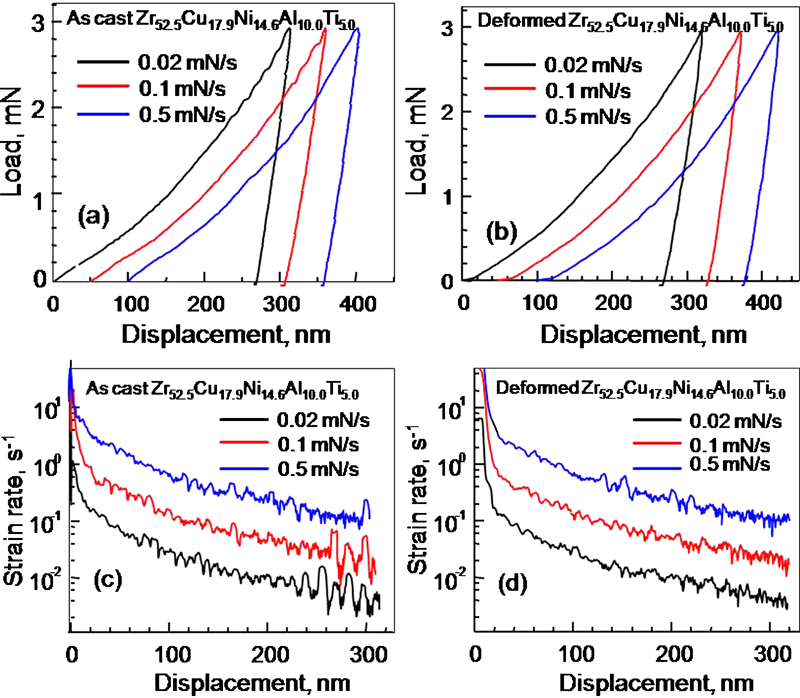
a, b load–displacement curves and c, d corresponding strain rate–displacement curves for a, c as cast and b, d deformed Zr52·5Cu17·9Ni14·6Al10·0Ti5·0 BMGs at various loading rates during nanoindentation: in order to avoid overlapping, curves were shifted along displacement and strain rates respectively
Discussion
Amorphous alloys contain a significant amount of free volume. The free volume is one of the most important structural features in amorphous alloys, which substantially affects the mechanical, physical and chemical properties. DSC is one of the effective methods to characterise the structural relaxation that is closely related to the free volume in amorphous alloys, which is frozen during cooling. In a DSC thermogram, the exothermic reaction just below Tg is a result of the annihilation of free volume and structural relaxation. The exothermic heat is proportional to the amount of escaping free volume.15 The present work demonstrates that for both Cu47·5Zr47·5Al5 and Zr52·5Cu17·9Ni14·6Al10·0Ti5·0 BMGs, the exothermic heats during structural relaxation in the predeformed states are significantly larger than those in the as cast states (Table 1 and Fig. 2), indicating that the predeformed glasses contain a larger amount of free volume than the as cast ones. It is well known that the inhomogeneous deformation introduces excessive free volume that is entrapped at shear bands. The excessive free volume tends to escape, and at elevated temperatures, their kinetics becomes significant. Using DSC and density measurement, Slipenyuk and Eckert15 demonstrated the decrease in free volume that resulted from the relaxation annealing at low temperatures. Even though a quantitative distinction in free volume between the as cast and deformed glasses cannot be made in the present work, a qualitative or semiquantitative difference is clearly observed. The present work is the first to uncover that deformation also can introduce excessive free volume into the workhardening Cu47·5Zr47·5Al5 BMG.
For both Cu47·5Zr47·5Al5 and Zr52·5Cu17·9Ni14·6Al10·0Ti5·0 BMGs, the precompression reduces the exothermic heats of crystallisation ΔHx (Table 1). This trend indicates that crystallisation must occur during the precompression deformation. In fact, mechanically induced nanocrystallisation at shear bands was observed before for both Cu47·5Zr47·5Al5 (Ref. 5) and Zr52·5Cu17·9Ni14·6Al10·0Ti5·0 BMGs.20 The present DSC results demonstrate that both the workhardening and worksoftening BMGs have similar structural evolutions during the plastic deformation, i.e. the introduction of excessive free volume and nanocrystallisation. Such structural evolutions occur exclusively at shear bands, which accommodate a large plastic strain. 8 8,21 It is interesting to note that the similar structural changes lead to different mechanical behaviours, that is, workhardening versus worksoftening.
Nanoindentation indicates that the precompression deformation causes the hardening and softening for Cu47·5Zr47·5Al5 and Zr52·5Cu17·9Ni14·6Al10·0Ti5·0 BMGs respectively (Table 2). Such difference in mechanical behaviour must result from their deformation structures, i.e. shear bands. As described previously, the structural changes of both BMGs caused by the predeformation are the introduction of excessive free volume and the nanocrystallisation at shear bands. An increase in the free volume increases the average atomic distance and, thus, lowers the resistance to plastic deformation, i.e. the strength. Jiang et al.22 also observed the decreases in the hardness values in the order of the as relaxed, as spun and as rolled states of the amorphous Al86·8Ni3·7Y9·5 ribbon, while the free volume in these states is expected to increase in the opposite order. This is the reason why a BMG, like Zr52·5Cu17·9Ni14·6Al10·0Ti5·0, generally displays worksoftening rather than workhardening. Undoubtedly, the excessive free volume disfavours the workhardening of Cu47·5Zr47·5Al5, and, contrarily, favours worksoftening. It is reasonable to deduce that the nanocrystallites that formed at shear bands during the predeformation are attributed to the workhardening of Cu47·5Zr47·5Al5, even though they also exist in the worksoftening Zr52·5Cu17·9Ni14·6Al10·0Ti5·0. The mechanically induced nanocrystallites and the deformation introduced excessive free volume at shear bands compete with each other in strengthening and weakening BMGs. In fact, the mechanically induced nanocrystallisation is widely observed. 20 20,21 However, excessive free volume at shear bands usually overwhelms these nanocrystallites in affecting the strength. As a result, BMGs hardly display the workhardening behaviour.
The serrated plastic flow has been observed extensively under various loading modes in metallic glasses.12–14,18,19,23,24 Wright et al. suggested that the serrated plastic flow is caused by the formation of individual shear bands.24 Using an infrared camera, Jiang et al. recently observed in situ dynamic shear banding processes during uniaxial compression of a Zr based BMG and demonstrated that the serrations in the plastic flow correspond to individual shear banding events.12 In the nanoindentation, the as cast and predeformed Cu47·5Zr47·5Al5 BMGs exhibit moderately serrated plastic flow (Fig. 3). Jiang et al. observed much smaller serrations in the uniaxial compression of Cu47·5Zr47·5Al5 compared to those of a worksoftening Zr based BMG. They attribute it to smaller intervals between shear banding operations.14It is important to note that no appreciable distinction in serrations between the as cast and predeformed Cu47·5Zr47·5Al5 can be made in the plastic flow curves (Fig. 3). Therefore, it can be deduced that for the workhardening Cu47·5Zr47·5Al5, plastic flow results mainly from the formation of new shear bands rather than the spatial repetition of shear banding at pre-existing shear band locations. In contrast, for the worksoftening Zr52·5Cu17·9Ni14·6Al10·0Ti5·0, the precompression deformation significantly moderates the serrations in the plastic flow (Fig. 4). The relatively smooth plastic flow in the predeformed BMG indicates that pre-existing shear bands that were introduced during the precompression deformation favour the formation of shear bands, probably acting as nucleating sites by lowering the activation energy. For the worksoftening Zr52·5Cu17·9Ni14·6Al10·0Ti5·0, the pre-existing shear bands are a weak link in an amorphous matrix and preferential sites for the subsequent plastic flow. It is observed that predeformation reduces serrations in the subsequent plastic flow.22
The present work indicates that there is a relationship between the properties of shear bands and macroscopic mechanical behaviours (workhardening versus worksoftening). A shear band is the sole structural feature in the inhomogeneously deformed BMGs. It is subjected to a shear strain of up to 102–103 upon each shear banding operation, which is dependent on the applied strain rates.8 Such a large strain significantly modifies its structure, such as the introduction of excessive free volumes, formation of nanovoids and even nanocrystallisation.9,21,25–30The structural defects of excessive free volume and nanovoids at a shear band would deteriorate its mechanical strength, causing worksoftening, while the mechanically induced nanocrystallisation may benefit its strength, which is deduced from the work of the thermal nanocrystallisation.31–36It is reasonable to deduce that the competition between the introduced structural defects and nanocrystallisation at a shear band may result in either softening or hardening of a shear band, even though the softening of a shear band is extensively observed, 16 22 16,22,37 and no hardening of a shear band is detected except for the Cu47·5Zr47·5Al5 and Cu50Zr50 glasses.4–10 The properties of a shear band must depend exclusively on its own structure. The properties of a pre-existing shear band may affect the subsequent shear banding operations and consequently the macroscopic mechanical performance of BMGs.
Conclusions
The workhardening Cu47·5Zr47·5Al5 and the worksoftening Zr52·5Cu17·9Ni14·6Al10·0Ti5·0 BMGs before and after precompression deformation were characterised for the thermal and mechanical behaviours. The main results can be summarised as follows:
Compression deformation introduces excessive free volume in both the workhardening Cu47·5Zr47·5Al5 and worksoftening Zr52·5Cu17·9Ni14·6Al10·0Ti5·0 BMGs.
The Cu47·5Zr47·5Al5 and Zr52·5Cu17·9Ni14·6Al10·0Ti5·0 BMGs exhibit substantial workhardening and worksoftening behaviours respectively.
For Cu47·5Zr47·5Al5, precompression deformation has a negligible effect on serrations in the plastic flow during nanoindentation, which is related to the workhardening of a shear band, while for Zr52·5Cu17·9Ni14·6Al10·0Ti5·0, precompression deformation moderates serrations in the plastic flow during the nanoindentation, which is associated with the worksoftening of a shear band.
Strengthening from mechanically induced nanocrystallites at a shear band is responsible for the workhardening of Cu47·5Zr47·5Al5, which overwhelms softening due to the introduction of excessive free volume.
Footnotes
Acknowledgements
The present work was supported by the National Science Foundation (NSF) International Materials Institutes (IMI) Program (grant no. DMR-0231320), with Dr C. Huber as the Program Director. YDW thanks the financial support by the National Natural Science Foundation of China (grant no. 50725102).