







Abstract
Acoustic emission (AE) monitoring has been used to detect split formation during room temperature low blow Charpy impact testing of high strength thick strip steels. The AE signal analysis identified separate signals originating from hammer impact, plastic deformation (verified using Charpy impact testing on mild steel with no splits) and split initiation/growth. The presence of splits was confirmed by sectioning and fractography, and the splits were brittle in nature. A possible correlation between the AE signal features and fracture mode is presented.
Introduction
The use of acoustic emission (AE) monitoring, during tensile testing of steels, has shown an increase in AE activity after the yield point in ferritic1–3and austenitic4 steels due to an increase in dislocation motion. During fatigue testing, AE activity increased after crack onset in ferritic,5–8 austenitic9and dual phase 10 10,11 steels due to the appearance of a crack growth signal in addition to the plastic deformation signal. However, the absolute number of AE events during fatigue testing has been observed to be dependent on the steel microstructure and mechanical properties, 5 5,6 mode of loading and sample geometry 11 11,12and presence of a chemically aggressive environment. 13 13,14 Analysis of the AE signals obtained during impact testing of fatigue precracked Charpy specimens of dual phase steel has been able to separate the time at which the AE activity is dominated by plastic deformation from that associated with crack growth.15 In the present paper, the preliminary results of AE monitoring during Charpy impact testing of high strength strip steel, which show splits on the ductile fracture surface of the upper transition regions, are presented.
Experimental
Low blow Charpy impact tests were carried out using standard 55×10×10 mm specimens made from an annealed low carbon mild steel and an as rolled strip steel [0·063C–1·61Mn–0·097Si–0·980Ni–0·105Mo–0·066Nb–0·089Ti–0·007V (wt-)] provided by Tata Steel UK Ltd. Testing was carried out at room temperature using an Instron Charpy testing machine at 20, 40, 60, 80 and 100 J impact energies. Room temperature failure energies were measured to be 125 J for the high strength steel and 180 J for the mild steel. The AE was recorded on an industrial hardware station using one broadband single piezoelectric sensor, a preamplifier of 2/4/6 type and AEWin for PCI2 version E3.61 software, produced by Physical Acoustics Corporation (USA). The AE signal analysis was carried out using AEWin and Wave Viewer E1·11 software. The sensor was non-permanently attached using white soft paraffin to one end of the Charpy sample, and data were collected by wave streaming.
Results and discussion
During the low blow impact testing of mild steel, two different AE signatures were recorded: from the hammer impact and elastic deformation of the machine and from the plastic deformation of the sample (Fig. 1). Post-impact inspection showed that the mild steel samples were bent through an angle in the range of 3–27° (Fig. 2). No cracking was observed. The power spectrum of the acoustic wave part originating from plastic deformation exhibited its highest peak below 50 kHz. No significant variation in acoustic signature was observed with an increase in impact energy from 40 to 100 J. A slight (by up to 10 dB) increase in signal amplitude with an increase in impact energy can be related to an increase in the volume of the sample that is plastically deformed. This is consistent with the effect of the deformed sample volume on the AE activity reported earlier for the tensile testing of steel.3
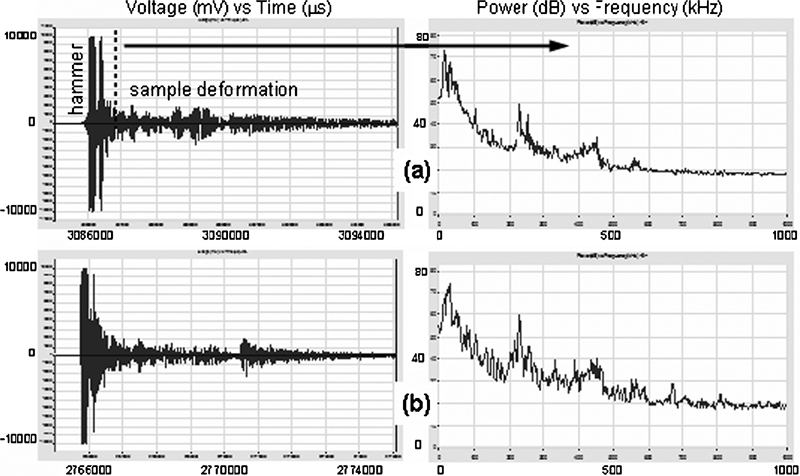
Acoustic waves (left) and power spectra (right) for sample deformation stage during testing of mild steel at a 60 J and b 80 J impact energies
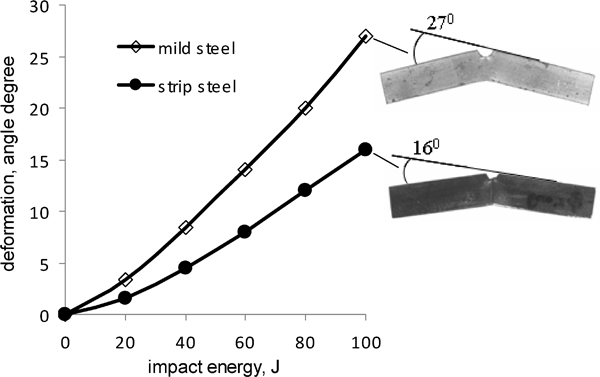
Dependence of sample deformation on impact energy (images of mild and strip steel samples after testing at 100 J are inserted)
In contrast to the mild steel tests, the AE response for the strip steel tests varied with impact energy (Fig. 3). Two separate AE signatures were observed during testing at 40 and 60 J: from the hammer impact and elastic deformation of the machine and from the sample plastic deformation (Fig. 3a). Moreover, three AE signatures were observed during testing at 80 and 100 J: from hammer impact and elastic deformation of the machine, from the sample plastic deformation and from crack (split) initiation (Fig. 3b). The occurrence of splits during low blow testing was confirmed by post-test microscopic examination of the sectioned samples (Fig. 4a). The predominant fracture mode for the splits was transgranular cleavage (Fig. 4b). The power spectrum of the acoustic wave part originating from the sample plastic deformation exhibited the highest peak below 50 kHz, as also seen for the mild steel sample. Similarity in the AE power spectra for the plastic deformation of both steels was expected, as their microstructures are predominantly ferrite. The power spectrum of the acoustic wave part originating from split crack initiation and growth exhibited two peaks in the 200–500 kHz frequency range and three times higher energies (compared to plastic deformation) in the 500–1000 kHz frequency range. The higher frequencies of the AE signal from crack initiation and growth, compared to plastic deformation, can be explained by a shorter duration of the fracture process than that of deformation by multiple dislocation slip. Higher peak frequencies for steel brittle fracture, compared to plastic deformation, have been reported during the tensile testing of dual phase steels; 10 10,16 however, the absolute values of peak frequencies varied with the steel microstructure. More detailed investigation is required to quantify dependences between AE signal parameters and steel microstructure and fracture mode.
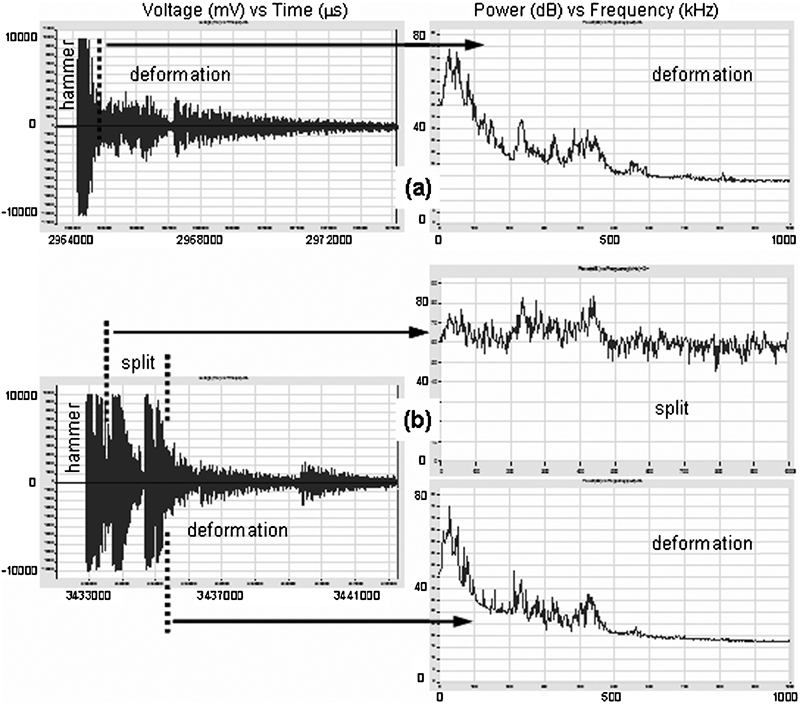
Acoustic waves (left) and power spectra (right) during testing of strip steel samples at a 60 J and b 80 J impact energies
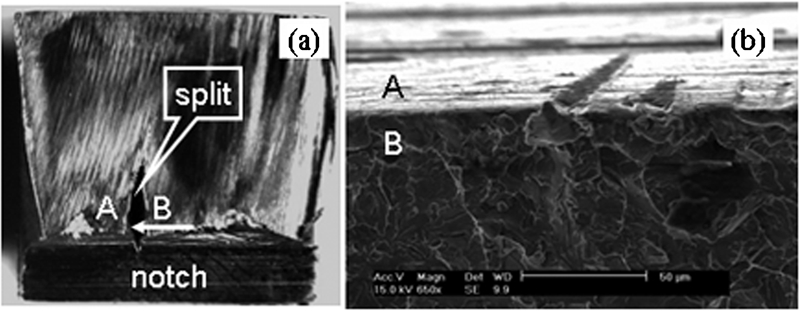
a optical micrograph of sample cross-section (A) through notch showing split and b scanning electron micrograph of fracture surface (B) in strip steel sample after testing at 80 J impact energy
Conclusions
Acoustic emission monitoring technique has been used for the first time during low energy impact testing of high strength strip steels. A possibility to detect an acoustic signal originating from brittle split/crack formation on the background signal from plastic deformation has been shown. The peak frequency of the AE signal has been identified to be <50 kHz for the deformation of ferrite and to be in the range of 200–500 kHz for the transgranular cleavage of ferrite.
Footnotes
Acknowledgements
The authors would like to acknowledge the Schools of Metallurgy and Materials, and Electrical, Electronic and Computer Engineering for the provision of test facilities at the University of Birmingham. Personal gratitude is to Professor C. Roberts, Birmingham Centre for Railway Research and Education, for the provision of the AE monitoring system.