







Abstract
The precipitate hardened plastic mould steel 10Ni3MnCuAl after aging at 510°C is investigated by optical microscopy, X-ray diffractometry, TEM and three-dimensional atom probe. The results show that its microstructure is granular bainite with a certain amount of retained austenite after soluted and cooled in furnace, and its content decreases until close to 0. By TEM observation, the age hardening of the 10Ni3MnCuAl steel is mainly ascribed to the precipitation of a high density, ultrafine and fully coherent NiAl precipitation with the B2 structure at 510°C for 4 h, and a multicomponent precipitate can be found in steel for 100 h aging. The three-dimensional atom probe researches show that its age hardening derives from a spherical multicomponent precipitate containing Fe, Ni, Al, Mn and Cu, and the content of Fe decreases with aging time, while those of Ni, Al, Mn and Cu are opposite, and the ratio between Ni and Al is roughly 1, and the Cu precipitates are surrounded by Ni, Al and Mn clusters for 100 h aging. The hardness variation is related to the size and number density of the precipitates, and it follows the cutting mechanism during early aging while obeys Orowan mechanism during overaging.
Introduction
The development of precise plastic industry leads to the necessity of developing high performance mould steels. Precipitation hardenable steels have been used for this application due to their high strength, good impact toughness and excellent weldability.1,2 The investigated 10Ni3MnCuAl steel belongs to this group. This steel is usually supplied in the solution treated condition, with hardness ranging from 30 to 34 HRC. After aging at temperature between 480 and 550°C, its hardness reaches 40–44 HRC, and it can meet the requirement of excellent polishing properties in contrast to quenched and tempered prehardened steel such as AISI P20 and DIN 2738. It is hardened by the precipitation of NiAl and ϵ-Cu based on conventional transmission electron microscope (TEM) in the prior result.3 Although TEM investigations of the precipitation in the materials are successful only after prolonged heat treatments when the precipitates are large enough to allow their identification by analysis of electron diffraction patterns, some details for the precipitates could not be received. Nowadays, atom probe microscopy is proved to be effective in the investigation of small precipitates, and it has been used for extensive studies on the precipitation behaviour of maraging steel.4–8 Therefore, microstructure evolution in precipitation hardening plastic mould steel 10Ni3MnCuAl after aging is discussed in the present paper.
Experimental
The 10Ni3MnCuAl steel used in the present study was obtained commercially in the form of a plate of 15 mm thickness. It was provided by the Baosteel Company, and its chemical composition is shown in Table 1. The samples were solution heat treated at 880°C for 2 h, followed by furnace cooling and then isothermally aged at 510°C for as long as 100 h to observe the kinetics of precipitate coarsening. Hardness was measured at room temperature.
Chemical compositions of 10Ni3MnCuAl steel

The phase constituent in samples was analysed by X-ray diffractometry (XRD) on a model of D/max-2200/PC using copper target. The machine was operated at 40 kV and 40 mA, and the scanning speed 2θ was 1° min−1. The retained austenite content was calculated from the intensities of 220 austenite peaks and those of the 211 reflections from ferrite.
Metallographic specimens were observed by a Nikon LV150 optical microscope after mechanically polishing and etching with 4 nital. The TEM samples were cut into 0·5 mm slices, followed by mechanically thinning to 0·05 mm, finally to foils in a twin jet electropolisher. A JEOL JEM-2010EX TEM operating at 200 kV was also employed to characterise the microstructures of the 10Ni3MnCuAl steel, and an energy dispersive X-ray spectrometer (EDXS) installed on the TEM was used for the microanalytical measurement with the specimens held in a beryllium holder.
Square rods of 0·5×0·5×25 mm were cut from the isothermally aged samples. These rods were then electropolished to sharp needle shaped specimens for three-dimensional atom probe (3DAP) analysis, and the sharp tips were prepared using standard techniques by electrolytical polishing, as described in Ref. 9. The 3DAP experiments were carried out at ∼80 K under ultrahigh vacuum conditions (<2×10⁻⁸ Pa) in the instrument manufactured by Oxford NanoScience Ltd (Oxford, UK). Data reconstruction, analysis and visualisation were performed using the PoSAP software supplied with the instrument. In order to detect clusters, a cluster search algorithm based on the maximum separation method was used. The minimum number of atoms Nmin, the separation distance dmax, the surround distance L and the erosion distance dero, which are important values for the effectiveness of the cluster algorithm, were determined based on the method described elsewhere.10 Here, using Al and Ni, dmax, L, dero and Nmin were set to 0·3, 0·5, 0·5 and 10 respectively, and simultaneously, dmax, L, dero and Nmin were set to 0·5, 0·5, 0·5 and 10 to search Cu clusters. The R of a precipitate containing n atoms in a reconstruction is equated to the radius of the volume equivalent sphere and given by


Results and discussion
Hardness
Hardness measurements as a function of holding time at 510°C are plotted in Fig. 1. It can be seen that the steel exhibits significant precipitation hardening behaviour at this temperature. The hardness increases from <34 to >38 HRC within the 0·5 h of isothermal aging, and it reaches its peak hardness after 10 h, and prolonged aging shows a little decrease from the peak hardness value. At 100 h of aging, it decreases to ∼40 HRC, indicating that the steel is overaged.
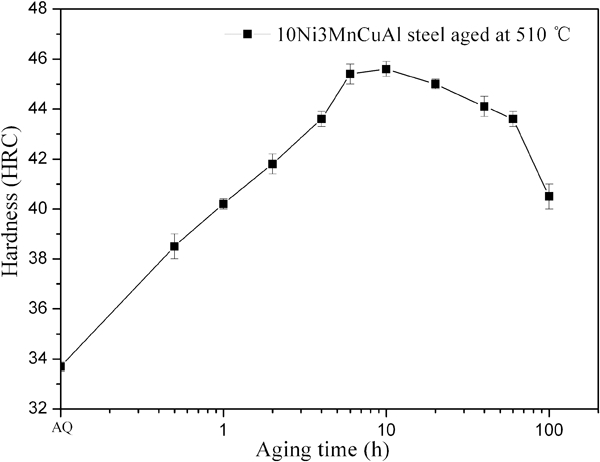
Variation in hardness of 10Ni3MnCuAl steel with aging time at 510°C
Microstructure
As presented in Fig. 2, the 10Ni3MnCuAl steel without aging has 8·6 retained austenite whose amount decreases with aging time, and it is almost 0 for 100 h aging.
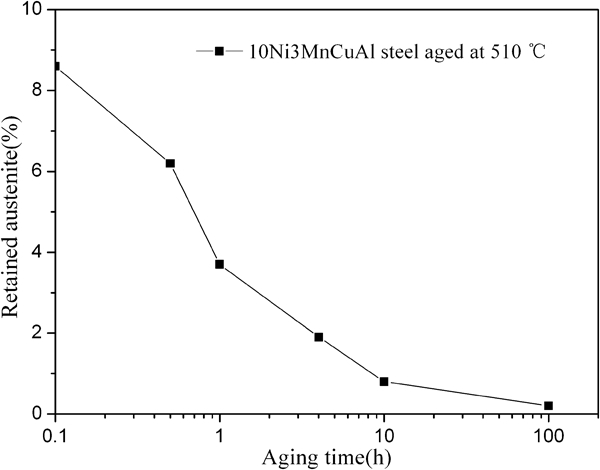
Variation in retained austenite with tempering temperature
Figure 3 displays the optical microscope microstructure of the 10Ni3MnCuAl steel after furnace cooled from 880°C. The microstructure consists of an island phase, and it is granular bainite. It is mainly characterised by bainitic ferrite laths and retained austenite island morphology in TEM, as shown in Fig. 4a. In addition to the similar laths and island morphology to the soluted state, the fine precipitates in the sample aged at 510°C for 4 h are also shown in Fig. 4b. Although some visible dislocations are in association with these precipitates, they distribute homogeneously not only at dislocationsm but also randomly in the matrix. The corresponding selected area diffraction pattern in Fig. 4c shows the {010} superlattice reflections that derive from the precipitate within the [001] zone axis pattern of the matrix. The 010 superlattice reflections correspond to small precipitates with a B2 (CsCl) structure, which can be inferred as NiAl intermetallic compound according to composition. The high resolution TEM image demonstrated in Fig. 4d proves that the precipitates are fully coherent with the matrix. The circled regions show ordered lattice planes, which correspond to the NiAl precipitates. The precipitate size is about 1–4 nm, and their interparticle distances are about several nanometres. The spherical precipitate is found in the overaged condition, presented in Fig. 4e, and the EDXS (Fig. 4f) indicates that it contains Fe, Ni, Mn, Cu, Al and Cr, which is not simple NiAl or Cu phase, and related to multiple component precipitates.
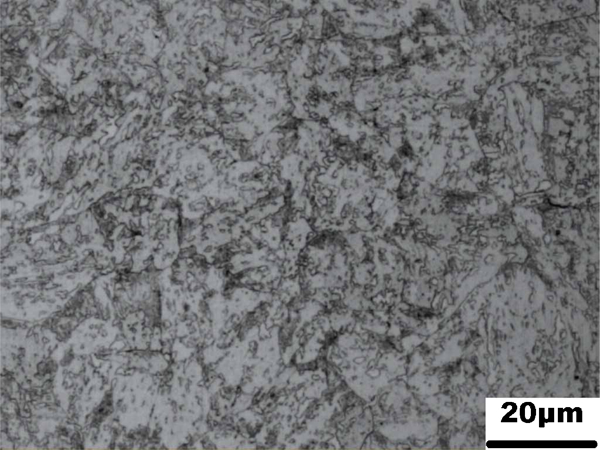
Optical microstructure of 10Ni3MnCuAl steel after soluted and cooled in furnace
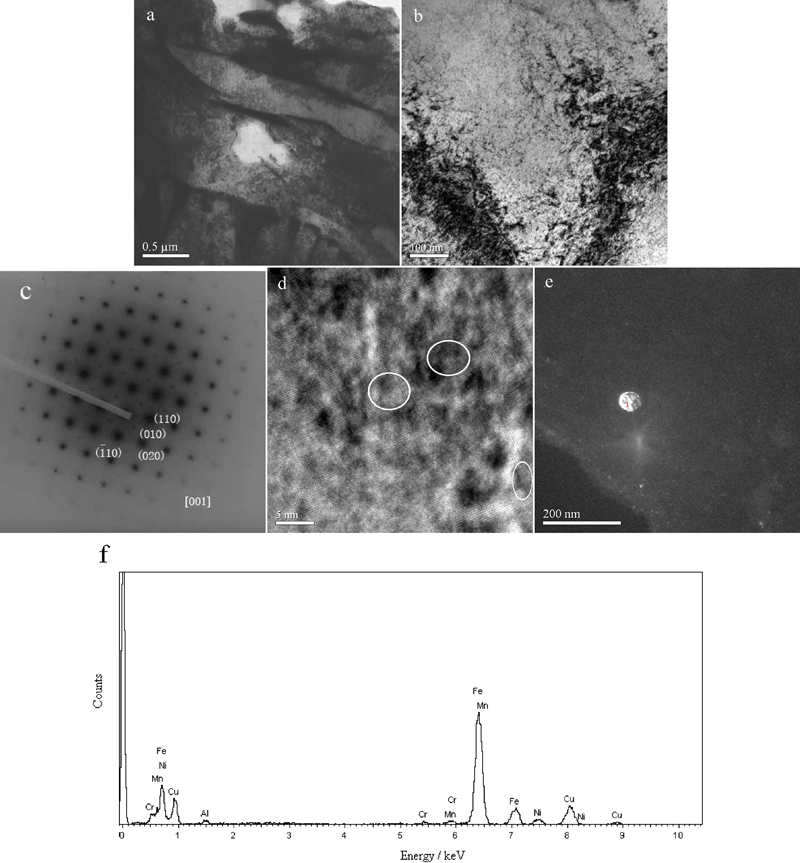
a images (TEM) of 10Ni3MnCuAl steel after soluted and cooled in furnace, b TEM bright field image of 10Ni3MnCuAl steel after aging at 510°C for 4 h, c electron diffraction pattern from [0 0 1] zone axes of α-Fe matrix (small superlattice diffraction spots are from NiAl precipitates with B2 structure), d high resolution TEM image shows precipitates are coherent with matrix, e TEM dark field image shows spherical precipitate in 10Ni3MnCuAl and f EDXS for spherical precipitate
3DAP analysis
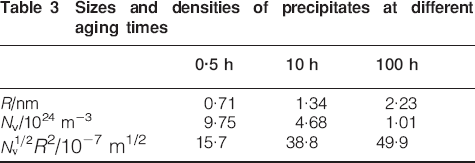
Because the precipitates presented in the aging condition are extremely fine, their density, size difference and chemical compositions are difficult to estimate by TEM, especially when a strongly magnetic matrix impedes examination. The samples under different aging times are investigated by 3DAP to understand the precipitation hardening behaviour, and the reconstruction of elements in different aging conditions is shown in Fig. 5, with each dot in the maps representing one atom. Ni, Al and Cu clusters can be seen in Fig. 5a, and 126 clusters containing Ni and Al in the sample for 0·5 h aging can be found by the software, and their average compositions are given in Table 2, where the concentration of Fe in the precipitates is over 50 at- and that of Ni and Al is ∼20 at-. The concentration of Cu in the NiAl clusters is higher than 1 at-, and most Cu clusters assemble around the area where Ni and Al appear. Carbon enrichment regions also appear in Fig. 5a, and their composition is determined to be 91·2Fe–0·32C–0·52Si–1·09Mn–0·09Cr–3·3Ni–2·95Al–0·28Cu (at-), which can be inferred as austenite. The separation of the Ni , Al , Mn and Cu rich part of precipitates became clearer (Fig. 5b) with the aging time amount to 10 h, and these atom maps reveal that precipitates are in spherical shape, and their equivalent radius and number density calculated are 1·34 nm and 4·68×1024 m−3, as shown in Table 3. The concentrations of Ni and Al change little, while that of Fe decreases to ∼50 at- and that of Mn and Cu increase. When the aging time extends to 100 h, the number density of precipitates decreases to 1·01×1024 m−3, while the equivalent radius increases to 2·23 nm. The concentration of Fe, Ni and Al changes distinctly and takes almost one-third of each. Cu rich parts are encased by NiAl precipitates, presented by circled precipitates in Fig. 5c. Both NiAl and Cu precipitates are still spherical, which coincided with the TEM observation. Moreover, several carbon enrichment regions can also appear, most of which Mo and Cr enrich, which can be inferred as carbides.
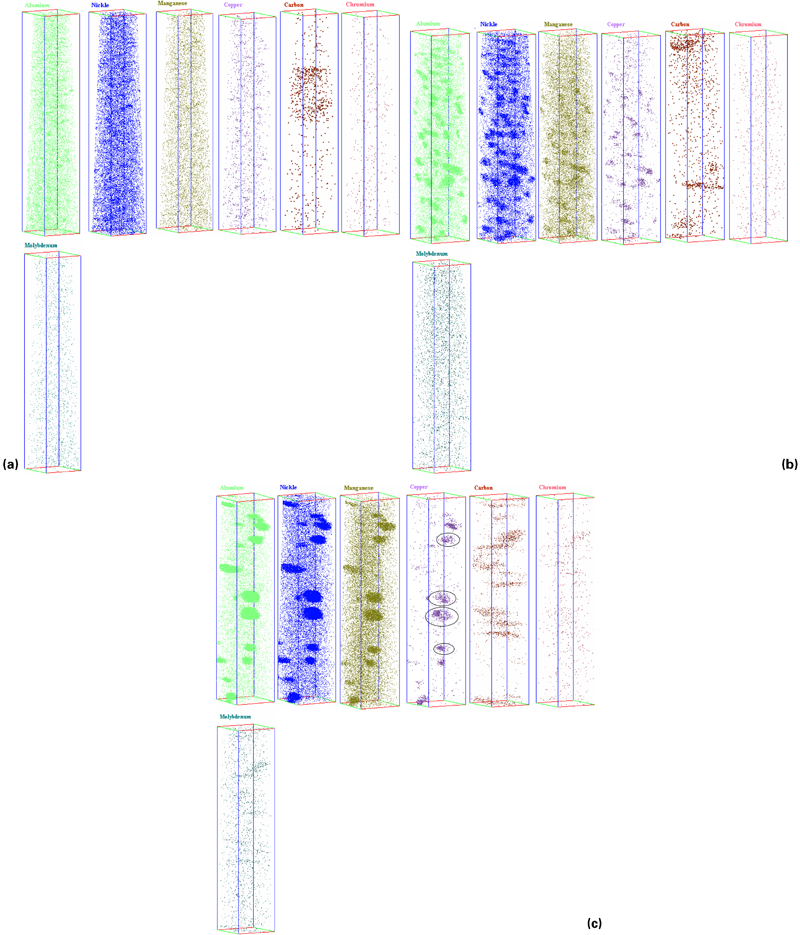
Three-dimensional reconstructions revealing distribution of Al, Ni, Mn, Cu, C, Mo and Cr in 10Ni3MnCuAl steel aging at 510°C for a 0·5 h, b 10 h and c 100 h: analysed volume is 13×13×63 nm, and size of C atoms was made larger to enhance display
Compositions of precipitates measured from PoSAP data/at-

Sizes and densities of precipitates at different aging times
The overall composition (at-) and standard deviation σ of the investigated material in different heat treatment conditions are obtained by 3DAP. The error on the concentration values can be estimated by the standard deviation according to σ = c(1−c)/n, where c is the measured concentration, and N is the total number of detected ions.7
Discussion
As the 10Ni3MnCuAl steel contains a certain content of alloy elements, especially about 3 wt-Ni and 1·8 wt-Mn, which intensively increase hardenability, proeutectoid ferrite and pearlite are not observed, and only bainite is present even if it is cooled in furnace after solution. The alloy elements have enough time to diffuse when austenite transforms during the slow cooling condition, which makes the untransformed austenite have different amounts of carbon and alloy content; some of these austenite still retain during the subsequent continuous cooling to room temperature besides their most transformation. These retained austenite together with the matrix (Fig. 4a) forms the granular bainite (Fig. 3), which is similar to Ref. 11. They decompose with aging time and still exist for 4 h aging, which are proved by XRD and 3DAP.
Selected area diffraction on specimens aged for 4 h reveals the existence of ordered coherent NiAl B2 type precipitates exhibiting a (1 0 0)NiAl//(1 0 0) α orientation relationship with the bainitic matrix. Owing to the highly magnetic matrix and the lack of sufficient elastic strain contrast caused by the marked coherence of matrix and NiAl, it is difficult to characterise the sample aged for 0·5 h by means of TEM, but 3DAP reconstruction reveals that the hardness increase is from the NiAl and Cu precipitates, similar to Refs. 8 and 12. Owing to the small lattice mismatch between matrix and NiAl precipitates, leading to a low interfacial energy and a high saturation of Ni and Al in the as quenched matrix (high chemical driving force) and to a certain dislocation density of bainite (nucleation is preferentially at dislocations), the nucleation and dense distribution of NiAl precipitates imply the presence of a low nucleation barrier. Moreover, Cu precipitates very quickly in the Fe matrix due to its low solubility in α-ferrite,12–16 and Cu can reduce the lattice constant of NiAl in Ni(Al,Cu) ternary alloys,15 which results in a lower misfit to the bcc matrix. Therefore, their nucleation energy is lowered, and the NiAl precipitates are accompanied by the precipitation of Cu, which are proved by TEM and 3DAP. Similar to the chemical compositions given for NiAl precipitates in PH13-8 steel,5,7 the chemical compositions of NiAl in 10Ni3MnCuAl steel are far from that of stoichiometric binary NiAl because they contain a high Fe content and a certain content of Cu and Mn, although the ratio between Ni and Al is roughly equal to 1 irrespective of aging time. The amounts of Ni and Al in the precipitates increase during further aging at the expense of Fe (Table 2). Their chemistry converges towards the stoichiometric composition of NiAl, but even after aging for 100 h at 510°C, 30Fe, a little Mn and Cu are still incorporated. It should be mentioned that Cu coclusters with Ni and Al for 0·5 h of aging, and the Cu precipitates are surrounded by Ni, Al and Mn clusters for 100 h of aging, which is similar to the observations of aged multicomponent Fe–Cu based alloys reported in Ref. 16.
The hardness variation in 10Ni3MnCuAl steel during aging can be analysed by the cutting and Orowan mechanisms. During ∼10 h of aging, the strengthening is according to the cutting mechanism, and the detailed explanation is as follows: the hardness H is proportional to the precipitation strengthening portion of the flow stress Δτ,17 and Δτ∝f1/2r1/2, as proposed by Gerold and Haberkorn,18 i.e. H∝Δτ∝f1/2r1/2, where f is the volume fraction of precipitates, and r the radius of precipitates. In addition, based on the spherical precipitates, f can be expressed by f = n(4/3)πr3, where n is the number density of the precipitates. Combining the above two equations, the hardness can be expressed as H∝n1/2r2. Based on Nv and R shown in Table 3, n1/2r 2 has similar tendency to hardness between 0·5 and 10 h of aging. However, the precipitate size still increases with aging after 10 h, but it is over a critical value for the cutting mechanism, and the hardness change is based on the Orowan mechanism. In addition, as the size of particles is also in nanometres, the hardness does not decrease too much.
Conclusions
The hardness of the precipitate hardening plastic mould steel 10Ni3MnCuAl increases continuously with isothermal aging at 510°C within 10 h and then decreases, but after aging for 100 h, it is still ∼6 HRC higher than that in the quenched state. Its microstructure is granular bainite with a certain amount of retained austenite after soluted and cooled in furnace, which decreases with aging until close to 0. By TEM observation, its age hardening is mainly due to the precipitation of a high density, ultrafine and fully coherent NiAl precipitation with the B2 structure at 510°C for 4 h, and the multicomponent precipitate can be found in steel for 100 h of aging. The 3DAP researches show that its age hardening derives from the multicomponent precipitate containing Fe, Ni, Al, Mn and Cu, and the concentration of Fe decreases with aging time, while those of Ni, Al, Mn and Cu are opposite, and the ratio between Ni and Al is roughly 1. The hardness variation is related to the size and number density of the precipitates, and it follows the cutting mechanism during early aging and obeys the Orowan mechanism during overaging.
Footnotes
Acknowledgements
The authors gratefully acknowledge the financial support of the China Post-doctoral Science Foundation (grant no. 20100470674) and the Shanghai Leading Academic Discipline Project (project no. S30107). Special thanks are also extended to Professor W. Q. Liu and Professor D. H. Ping for useful discussions. Thanks are also given to Dr N. Min, J. C. Peng and X. X. Wang in the Instrumental Analysis and Research Center, Shanghai University.