







Abstract
In the present paper, a new creep law describing the high temperature strain rate of materials, which is applicable to both high and low values of stresses, is proposed. In a similar way to the known hyperbolic sine law, the proposed equation guarantees a potential behaviour for low stress values (in accordance to the power law of creep) and a pure exponential behaviour for high stress values, according to the power breakdown law of creep. The differences and possible advantages of the proposed equation are analysed in comparison with the hyperbolic sine law.
Introduction
The creep rate of materials depends strongly on both temperature and stress, and many creep equations have been proposed. Many of these equations relate the secondary (steady state) strain rate under creep or hot deformation conditions  with the absolute temperature T and stress σ, to which the material is subjected, both for tension and compression. To facilitate the expressions below, the notation will be simplified by defining the normalised stress x as the quotient x = σ/E or x = σ/G (always positive or zero), with E and G being Young's and shear modulus of the material respectively (it is worth noting that both E and G take values on the order of 104 MPa, and the stresses are rarely higher than 500 MPa; therefore, the x values are generally very small).
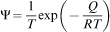
With the same intention as before, the function accounting for the thermal dependence Ψ = Ψ(T) is defined as
In any case, it is commonly accepted that, for low x values (approximately x<10−3), the steady state creep strain rate  is well described by the expression known as the creep power law
1
1,2
is well described by the expression known as the creep power law
1
1,2

Conversely, it has also been verified that this same magnitude  , when x takes higher values (approximately x>1·5×10−2), is better described by an exponential type expression, known as the creep power law breakdown or creep exponential law
1
1,2
, when x takes higher values (approximately x>1·5×10−2), is better described by an exponential type expression, known as the creep power law breakdown or creep exponential law
1
1,2

Some authors studied whether it would be possible to find a single function that describes the  behaviour over the whole range of x. Garofalo,5 under creep conditions, and Sellars and Tegart,6 under hot deformation conditions, proposed the next general expression known as the creep hyperbolic sine law


However, when x→∞ sinh(αx/n) = (1/2)[exp(αx/n)−exp(−αx/n)]≈(1/2)[exp(αx/n)], and


Modelling
However, the function defined in equation (4) is not the only one that can be proposed to satisfy the previous lower and upper x limits, and neither is it the easiest. The alternative function proposed in the present work is

Indeed, when x→0, the expression [exp (αx/n)−1]≈(αx/n), and then  , recovering the expression of equation (2).
In the same way, for x→∞, the expression (exp(αx/n)−1)≈exp(αx/n), and then  , which coincides with the expression of equation (3) provided that A′ = A(n/α)n.
Results and discussion
As shown in Fig. 1, equations (4) and (7) fit in the lower and upper limits to the power and exponential laws respectively. Note that two different graphs are necessary because, in order for the matching to be possible, equations (4) and (7) require different values of the coefficient A′; A′ = [n/(2α)]nA in the case of the hyperbolic sine law, and A′ = A(n/α)n for the expression proposed in the present paper.
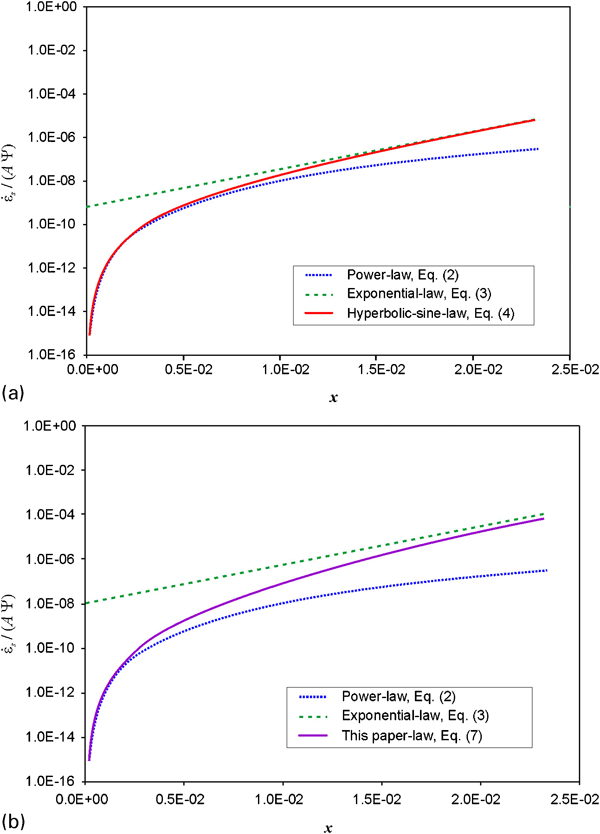
Representation of convergence with power and exponential laws in lower and upper limits in case of a hyperbolic sine law (equation (4)) and b equation proposed in present paper (equation (7)): values n = 4 and α = 400 have been arbitrarily considered
Both equations fit the lower and upper limits well, and the main difference resides in the different values of A′. This difference provokes a more pronounced exponential growth in the expression proposed in the present work. It is interesting to note that the need of an equation to convert a power to an exponential behaviour means that the power behaviour has a restricted validity range in comparison with the range that is usually assumed. The supposed validity of the creep power law might be due to the existence of theoretical models that, based on micromechanical arguments, can justify such behaviour. 1 1,2 Nevertheless, in a rigorous way, the power behaviour is only supported in very specific conditions.
The results found for many pure metals in creep tests lasting from a few hours to a few weeks in the medium stress regimes suggest that the secondary creep rate is well described by a power law with n≈4–6. However, when secondary creep rates are determined from creep curves obtained from quicker creep tests, it has been verified that the exponent n has a value near 1 in the low stress regimes, reaches values near 4 at high stresses and finishes with an exponential behaviour.1 This complexity suggests that a pure power law is not adequate unless a value of n depending on the stress level is accepted, which distorts the law, making it similar to an exponential law.
However, with a law such as the one proposed in the present paper (equation (7)), which is nearly exponential, this incoherence can be avoided. The same argument can be put forward in defence of the hyperbolic expression, although its growth is slower. Only an experimental study could elucidate which of the expressions represents reality better. From a purely mathematical viewpoint, there seem not to be advantages for any of them.
It could be an advantage that the new expression only uses one exponential instead a hyperbolic sine (which is two exponentials together). This simplicity could open the way to a possible theoretical justification of the law based on micromechanical arguments, something that, to our knowledge, has not been possible with the hyperbolic expression.
Conclusions
In summary, a new expression for the description of the strain rate of creep was proposed. Like the known hyperbolic sine law, the new expression also covers the low and high stress ranges and is similar to the power law behaviour for the low stress regime and to the exponential law for the higher stress regime. Both expressions are not, however, equivalent because different values of the pre-exponential factor are needed in the exponential law. The simplicity of the proposed expression might be its main virtue.
Footnotes
Acknowledgements
The authors are grateful to FEDER/MCyT, Madrid, and Junta de Andalucía for funding this research within the framework of project nos. MAT2007-61643 and P08-TEP-3537 respectively.