







Abstract
Indentation tests were performed on samples of 6061 aluminium alloy in the annealed, T4 and T6 temper conditions. The tests were performed over a range of loading rates to study the effect of indentation strain rate  on the indentation depth dependence of the average indentation stress σind. While
  changes by several orders of magnitude during the constant loading rate nano-/microscale indentation tests, we observed that the strain rate sensitivity of σind increases with decreasing indentation depth for all the samples tested. By applying an obstacle limited dislocation glide description of the deformation process, we were able to demonstrate that the apparent activation energy of the obstacles to dislocation glide increases with decreasing indentation depth and is also dependent upon the heat treatment condition of the 6061 test material. This suggests that, based upon the assumption of the operative deformation mechanism chosen, the strength of the dislocation–obstacle interactions that limit the rate of deformation is significantly increased in indentations of depth <∼4 μm.
Introduction
It is usually observed during nano- and microscale indentation testing that the measured average indentation stress σind is significantly increased when the indentation depth h is less than several micrometres.1–10 This has been explained in terms of the increased applied stress necessary for a dislocation to glide through the high density of ‘geometrically necessary’ dislocations required to accommodate the large localised strain gradients around submicrometre deep indentations2,6,9,11–13 or in terms of the increased stress necessary to nucleate dislocations from a small volume of metal, beneath the indentation, which may have no easy dislocation–nucleation sources. Either of these ‘glide limited’ or ‘nucleation limited’ mechanisms may affect the strain rate sensitivity of the indentation stress of shallow indentations compared to deep indentations. No investigation has been performed to date on the role that indentation strain rate plays in the observed indentation depth dependence of σind. Simple dimensional analysis of a geometrically self-similar indentation, such as a pyramidal indentation, indicates that the average indentation strain rate  must be directly dependent upon the ratio of the indentation velocity and the indent depth
  .8,9,14–20 One would, therefore, expect that
  would become quite large when h is small. This could account, at least in part, for the observed indentation depth dependence of σind. The objective of the present paper is therefore to assess the influence of indentation strain rate on the dependence of σind upon indentation depth and to determine if there exists a depth dependence of the strain rate sensitivity of σind.
Experimental
Test material
The present study was performed on 6061 aluminium alloy in three standard heat treatment conditions: annealed (O), T4 and T6 tempered. The annealed condition was obtained by heating the samples at 413°C for 2–3 h. The T4 temper was performed by solution annealing for 3–4 h at 520°C followed by water quenching and then aging at room temperature for over 18 h. The T6 temper was performed with a similar solution quenching treatment followed by ageing at 160–200°C for 6 h. The T6 temper produced a peak aged 6061 alloy.
The test material contained large equiaxed grains of average size from 50 to 200 μm. Cube samples, 5 mm on edge, were prepared from each thermal condition, and one surface of each sample was further ground and polished to a final surface roughness of 0·05 μm.
Indentation tests
Room temperature microindentation tests were performed with a diamond Berkovich indenter on a NanoTest indentation testing platform made by Micro Materials Ltd (Wrexham, UK). Indentations were made at loading rates of 10, 100, 500, 1000 and 2000 mN s−1 to a maximum load of 2000 mN in order to obtain σind data as a function of indentation depth at different values of  . During each test, the indentation depth h, corrected for both thermal drift and elastic compliance of the test frame, was recorded at intervals of 100 ms. Between three and five indentation tests were performed at each loading rate on each of the three thermal conditions.
Calculation of projected area function of indentation
The projected area of an ideal three-sided Berkovich pyramidal indentation is expressed, in terms of the indentation depth h, as




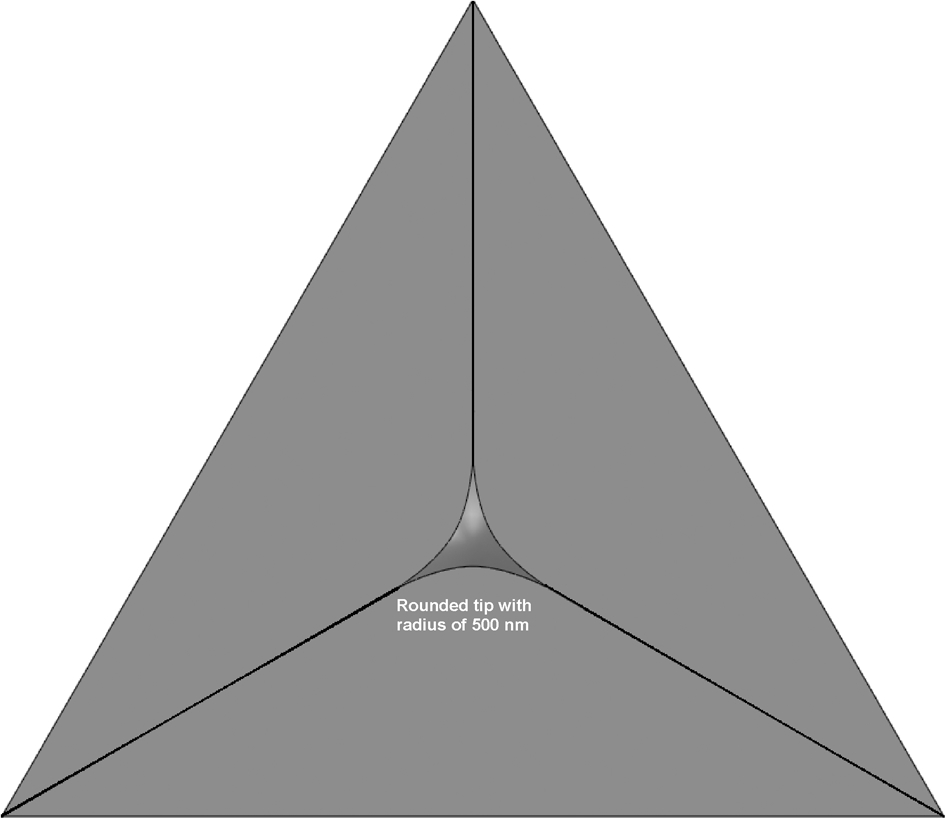
Schematic representation of three-sided Berkovich pyramidal indenter with its tip blunted to radius of R = 500 nm: indentation contact area A(h) resulting from this indenter is given by equation (3)
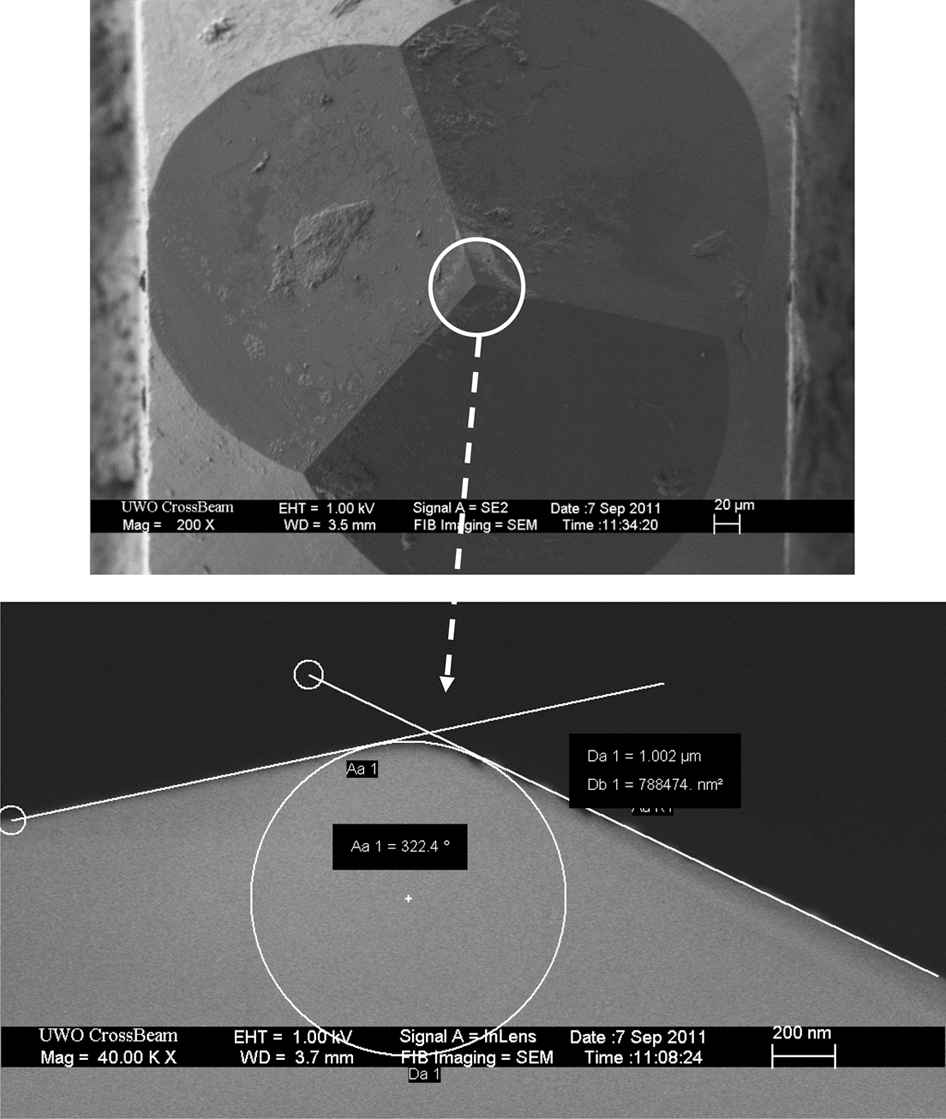
Images (SEM) of Berkovich indenter that was used in present study: radius of indenter tip is 500 nm
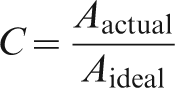
The parameter C in equation (4) was then determined experimentally by measuring, with scanning electron microscopy, the actual contact area Aactual of an indentation of known depth and comparing this value with the ideal projected area Aideal of an indentation of the same depth, calculated from equation (3). The parameter C is then32,33
Results
Indentation test results
Figure 3 shows typical plots of the indentation force F versus indentation depth h for tests performed on each of the 6061 thermal conditions at each of the indentation loading rates.
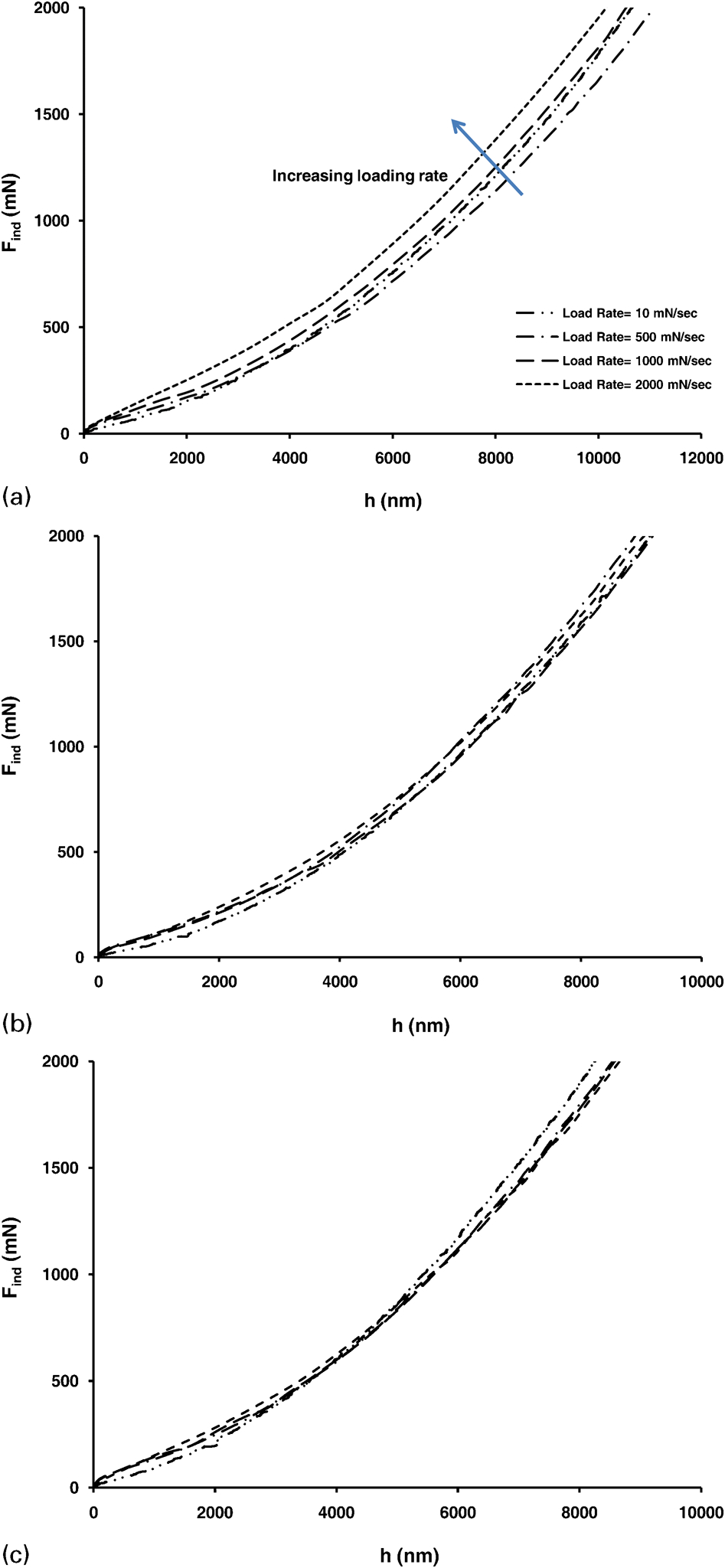
Indentation force versus indentation depth curves for 6061 aluminium alloy test material, indented at four loading rates, in a 6061-O, b 6061-T4 and c 6061-T6 thermal conditions
During pyramidal indentation,  is a linear function of
  . We therefore express an ‘apparent’ average indentation strain rate as
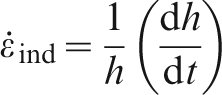
 upon h are shown in Figs. 4 and 5. Both σind and
  increase significantly, by several orders of magnitude in the case of
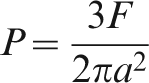
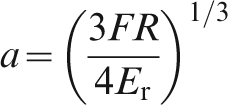
  , when h is <∼4 μm. In the case of the indentation stress, σind increased to up to 6·5 GPa for the smallest indentation depth considered (h = 500 nm). While this magnitude of σind is large and clearly reflects the commonly observed indentation size effect, its magnitude is considerably less than the Hertzian elastic contact stress P, which is given for a rigid spherical indenter of radius R, indenting a flat surface as35,36
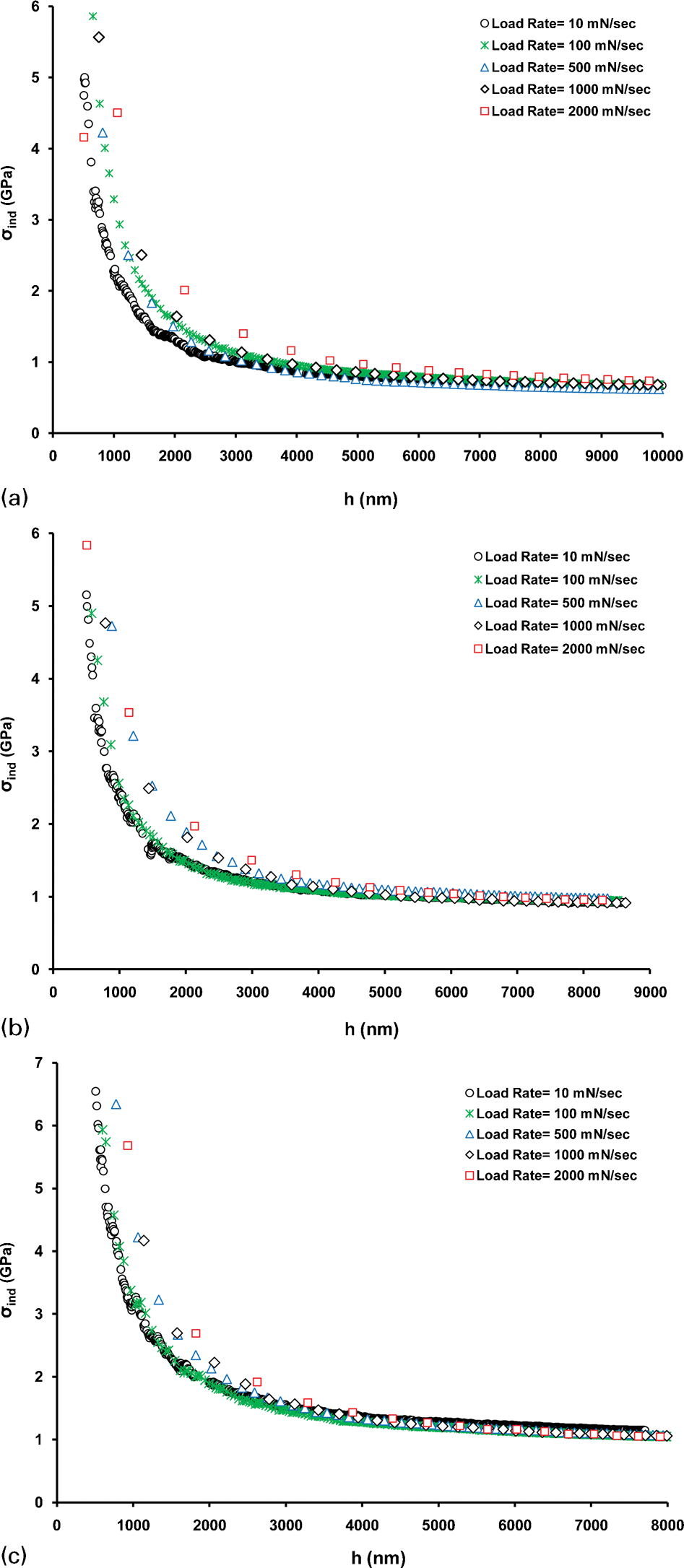
Average indentation stress σind (equation (4)) versus indentation depth for 6061 aluminium alloy test material, indented at four loading rates, in a 6061-O, b 6061-T4 and c 6061-T6 thermal conditions

Apparent average indentation strain rate
(equation (6)) versus indentation depth h for 6061 aluminium alloy test material, indented at four loading rates, in a 6061-O, b 6061-T4 and c 6061-T6 thermal conditions
Discussion
Strain rate sensitivity of σind
The 6061 aluminium alloy test material shows a nonlinear logarithmic dependence of σind upon  (Fig. 6). The data in this figure were obtained from indentation depths ranging from 0·5 to 8·0 μm. Because indentation tests were performed at a range of loading rates, we can extract, from Fig. 6, data that show the dependence of σind upon
  at specific levels of h.

Logarithmic plots of σind versus
at loading rate of 10 mN s−1 for 6061-O, 6061-T4 and 6061-T6 thermal conditions
Figure 7 shows logarithmic plots of σind versus  for indentations of nine depths from h = 0·5 to 8·0 μm. The strain rate sensitivity increases with decreasing h. This can be illustrated by performing linear regression analysis of the data in Fig. 7 and plotting the measured slope, the strain rate sensitivity m, as a function of indentation depth (Fig. 8). The parameter m displays a clear dependence upon both h and the heat treatment condition of the 6061 aluminium alloy.

Logarithmic plots of σind versus
at different indentation depths for a 6061-O, b 6061-T4 and c 6061-T6 thermal conditions

Variation of strain rate sensitivity parameter
versus indentation depth h for 6061-O, 6061-T4 and 6061-T6 aluminium alloys: strain rate sensitivity of σind clearly increases with decreasing h
When the indentations are deep (h>4·0 μm), the value of m is <0·02 and is in good agreement with the values of m obtained from constant uniaxial strain rate and strain rate change tests performed on 6061 aluminium alloy tensile samples. 37 The magnitude and the test to test scatter of m increase significantly with decreasing indentation depth.
Depth dependent mechanism of indentation deformation
The indentation depth dependence of m (Fig. 8) suggests that, for the 6061 aluminium alloy samples tested in the present study, there exists an indentation depth dependence of the underlying deformation mechanism. This dependence may arise from either increased difficulty to glide a dislocation through the indentation plastic zone or the increased difficulty to nucleate a dislocation in the region of a shallow, compared to a deep, indentation. Either mechanism will cause a change in the strain rate sensitivity of σind.
We can express the time dependent deformation during indentation as an obstacle limited dislocation glide process where  can be expressed as42,43
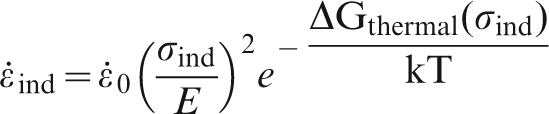
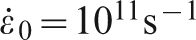 is a material constant44 and kT has its usual meaning.
Figure 9 shows the calculated ΔGthermal(σind) versus  for indentations made at depths h from 0·5 to 8·0 μm. The fact that the dependence of ΔGthermal(σind) upon
  is dependent upon both h and heat treatment condition indicates that the strength of the obstacles changes with both of these parameters. Because ΔGthermal(σind) decreases with increasing σind and
  , we can extrapolate the data trends in Fig. 9 and define ΔGthermal(σind) occurring at a very low strain rate, say,
  , as the apparent activation energy ΔG0 of the obstacles that are limiting the dislocation nucleation–glide process. Figure 10 shows the resulting ΔG0 versus h for the three 6061 heat treatment conditions tested. One can clearly see that the activation strength ΔG0 of the deformation rate controlling obstacles, whether they are physical obstacles impeding dislocation glide or represent nucleation stress to create a dislocation in the otherwise perfect material beneath the indenter, increases when h is small, <∼4 μm, and increases, for any value of h, when the 6061 alloy is in the tempered, T4 and T6, conditions. Because the difference in these two thermal conditions relative to the annealed condition is the presence of coherent ‘particles or solute clusters’, we can deduce that ΔG0 must be dependent, at least in part, upon physical obstacles that pre-exist in the microstructure.

Plots of thermal activation energy ΔGthermal (equation (9)) versus
at different indentation depths for 6061-O, 6061-T4, and 6061-T6 thermal conditions

Variation of apparent activation strength ΔG0 of obstacles that limit dislocation glide versus indentation depth h. ΔG0 was taken as value of ΔGthermal at very low indentation strain rate
. ΔG0 increases with decreasing h for three material conditions tested, which suggests that nature of operative dislocation–obstacle interaction is indentation depth dependent
Conclusions
The present study of the effect of indentation strain rate  on the indentation depth dependence of the average indentation stress σind of the 6061 aluminium alloy has indicated that while
  decreases by several orders of magnitude as the indentation depth increases during a typical nano-/microscale indentation test, its effect on σind does not completely account for the commonly observed depth dependence of σind. This is confirmed by our observation that the strain rate sensitivity m, determined from indentations of a constant depth but differing values of
  , increases with decreasing indentation depth.
We analysed the depth dependence of the strain rate sensitivity of σind by assuming that the deformation during indentation occurred, for all depths from 500 nm to 8 μm, by a thermally activated dislocation nucleation–glide limited process. The apparent activation energy of the obstacles that either interfere with the glide of existing dislocations or represent sites for the nucleation of new dislocations was calculated and found to increase with decreasing indentation depth.
While the data, and the analysis, presented in the present paper cannot identify definitively which type of feature, obstacles that limit the glide of pre-existing dislocations or obstacles that represent dislocation nucleation sources, are responsible for the observed increase in the strain rate sensitivity of σind when the indentation depth is small, our observation that the apparent activation strength of these features also increases with tempering of the 6061 aluminium alloy suggests that pre-existing obstacles to dislocation glide have an important influence on the strain rate sensitivity of σind of the 6061 alloy over all the indentation depths tested.