







Abstract
The dependence of permeability and grain size on annealing temperature was investigated, and a corresponding model was proposed. A surprising phenomenon wherein the grain size first decreases and then increases with increasing annealing temperature was analysed and explained by using this model. Moreover, it was also found that excellent soft magnetic properties were obtained when annealed at temperature near 0·6 times that of the melting point. Theoretical analysis results are in excellent agreement with experiments.
Introduction
In recent decades, widespread attention has been paid to Fe based nanocrystalline alloys in the fields of both physics and material science because of their excellent soft magnetic properties.1–5 Among these magnetic properties, permeability is one of the most important physical quantities to characterise soft magnetic materials, which are known to depend on their microstructure, especially the grain size.6 Moreover, it is also known that Fe based nanocrystalline alloys have special two-phase structures (amorphous matrix and inserted nanocrystals), generally obtained from their amorphous precursors after annealing. Furthermore, the grain size D greatly depends on the annealing conditions, especially the temperature;7 therefore, it is predicted that the permeability would definitely have a close relationship with the annealing temperature. Generally speaking, the grain size increases with the annealing temperature;8–10 thus, we can infer from it that the permeability should decrease with increasing annealing temperature, according to the random anisotropy theory.6 In fact, a maximum permeability always appears at a certain annealing temperature,11,12 and a surprising phenomenon that the grain size will first decrease and then increase with increasing annealing temperature was found,13–18 and it may be very important to the soft magnetic properties of Fe based nanocrystalline alloys. However, these surprising phenomena did not attract enough attention, and little investigation has been conducted to interpret this variation. In addition, it is known that these alloys did not begin to nanocrystallise when the annealing temperature was below the primary crystallisation temperature (Tx1), which led to imperfect soft magnetic properties, and when the annealing temperature is higher than the secondary crystallisation temperature (Tx2), the precipitated impurities further annealed caused the deterioration of the soft magnetic properties. Therefore, when Fe based nanocrystalline alloys are synthesised, the annealing temperature is generally controlled between Tx1 and Tx2, and the optimal annealing temperature (Topt) is then determined according to the soft magnetic properties, especially permeability.19,20 If the relationship between permeability and annealing temperature can be established and the optimal annealing temperature can be predetermined during this temperature range (Tx1<Ta<Tx2), the experimental procedures will be simplified further.
In order to determine the optimal annealing temperature and explain the experimental phenomena of Fe based nanocrystalline alloys during annealing, a theoretical model concerning the variations of grain size and permeability with annealing temperature for Fe based nanocrystalline alloys was proposed based on the random anisotropy theory21 and the nucleation and growth theory.22
Theoretical model
Amorphous alloys are thermodynamically unstable and have a tendency to transit into crystallites after the annealing treatment. This crystallisation process consists of two elementary steps: nucleation of embryos (crystallisation centres) and the following growth of crystallites from these embryos. According to the nucleation and growth theory,23–26 the nucleation rate I and the grain growth rate U can be expressed as


In the nanocrystallisation process during annealing, the grain size D of Fe based nanocrystalline alloys was determined by both the nucleation rate I and the growth rate U,22 which can be written as
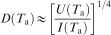


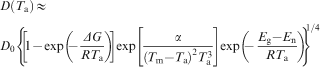
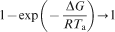 . Therefore, equation (6) can be further simplified as
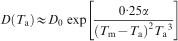

By substituting equation (8) with equation (7), the relationship between permeability and annealing temperature can be obtained as

Results and discussion
In the proposed model discussed above, the heating process, cooling process and other factors were not taken into account, so it is applicable only for different annealing temperatures in isochronal annealing. In the practice of nanocrystalline alloy preparation, the annealing temperature was generally controlled as Tx1<Ta<Tx2, and the annealing time is usually 1 h,29 during which the values of α, Tm, Js, K1 and A would show very little change.8,21 Therefore, the grain size and permeability of Fe based nanocrystalline alloys are mainly determined by the annealing temperature in these cases.
Relationship between grain size and annealing temperature
It can be obtained from equation (7) that the change of grain size with annealing temperature is
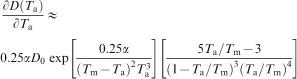
It has been reported that the primary crystallisation temperature Tx1 and the secondary crystallisation temperature Tx2 for Fe73·5Cu1Nb3Si13·5B9 alloy are about 760 and 900 K respectively.30,31 Moreover, previous experiments13 also showed that the grain size of this alloy has a clear valley value when annealed for 1 h at a temperature range of Tx1<Ta<Tx2. The grain size first decreased with increasing annealing temperature, but when the annealing temperature reached a minimum of ∼823 K, the grain size then began to increase. This experimental result has been confirmed by transmission electron microscopy.13 Similarly, the investigation on the grain size of Fe77·5Si15·5B714 and Fe76·5Si15·5B7Cu114 also showed the same changing tendency, and the annealing temperatures corresponding to the minimum grain size were 875 and 775 K respectively. The theoretical curves of grain size as a function of annealing temperature were fitted based on equation (7) for Fe73·5Cu1Nb3Si13·5B9, Fe74·5Nb3Si13·5B9 and Fe76·5Si15·5B7Cu1 alloys during the temperature range of Tx1<T<Tx2, as shown in Figs. 1–3 respectively.
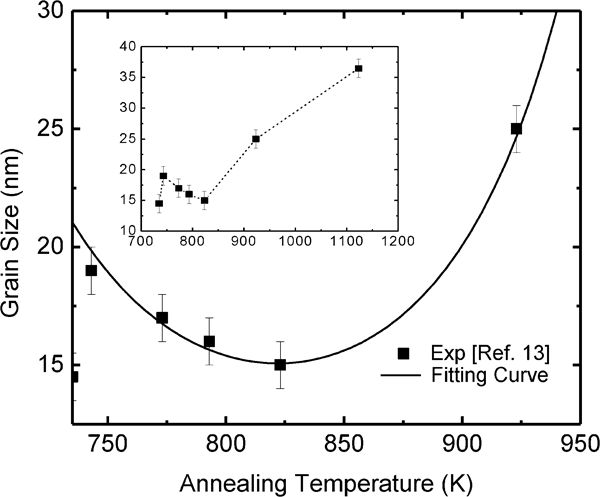
Comparisons of experimental data13 and calculations of grain size with annealing temperature for Fe73·5Cu1Nb3Si13·5B9
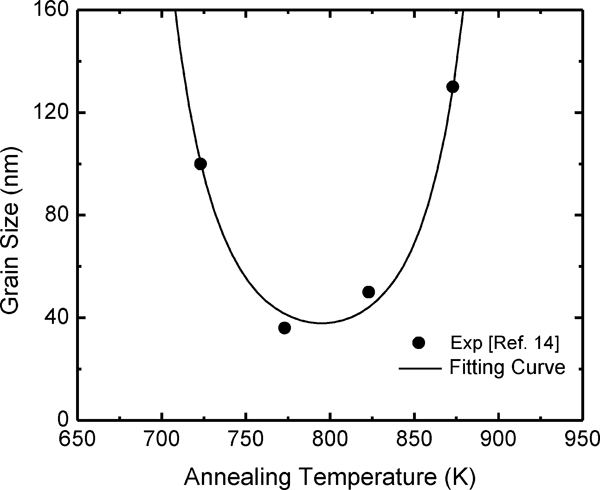
Comparisons of experimental data14 and calculations of grain size with annealing temperature for Fe77·5Si15·5B7
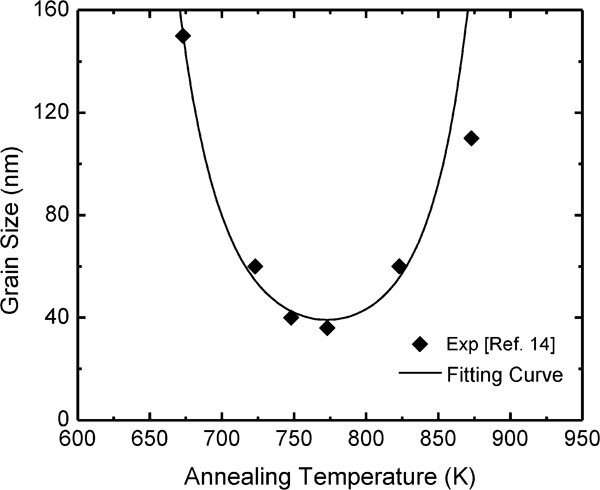
Comparisons of experimental data14 and calculations of grain size with annealing temperature for Fe76·5Si15·5B7Cu1
In addition, it was found that the same changing tendency exists for many nanocrystalline alloys, e.g. Fe78B13Si9,15 Fe74·5Nb3Si13·5B9,16 Fe73·5Cu1Ta3Si13·5B9,17 and Fe73·5Cu1Nb3Si13·5B9,18 that is, the grain size first decreases and then increases with annealing temperature, and minimum grain sizes were presented. The theoretical model is in good agreement with the experimental data.
Relationship between permeability and annealing temperature
The change of permeability with annealing temperature for Fe based nanocrystalline alloys during the crystallization process can be obtained from equation (9), which can be expressed as

Experiments concerning the permeability and annealing temperature of Fe73·5Cu1Nb3Si13·5B9,32 Fe74·5Nb3Si13·5B916 and Fe73·5Cu1Ta3Si13·5B933 have been reported previously. Theoretical curves of permeability changing with annealing temperature for these alloys can be fitted using equation (9). By comparing theoretical curves with experimental data, the surprising phenomenon was found that permeability first increases when the annealing temperature is above the primary crystallisation temperature (Tx1), while it began to decrease when the annealing temperature is higher than the optimal annealing temperature. A clear peak value presents in this annealing process, as shown in Figs. 4 6 respectively.
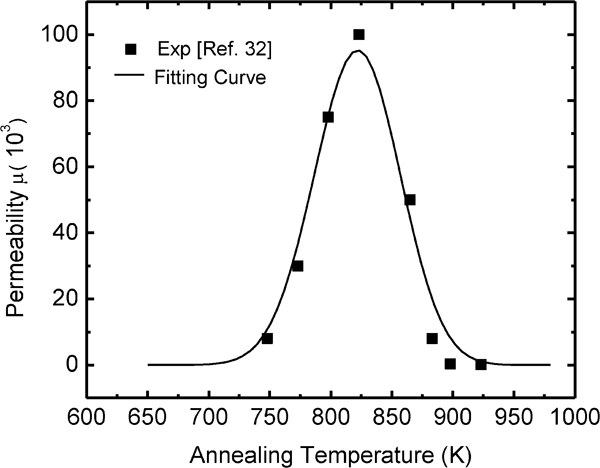
Comparisons of experimental data32 and calculations of permeability with annealing temperature for Fe73·5Cu1Nb3Si13·5B9
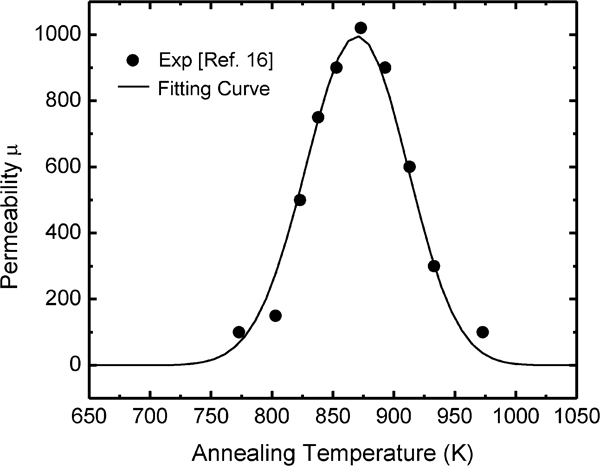
Comparisons of experimental data16 and calculations of permeability with annealing temperature for Fe74·5Nb3Si13·5B9
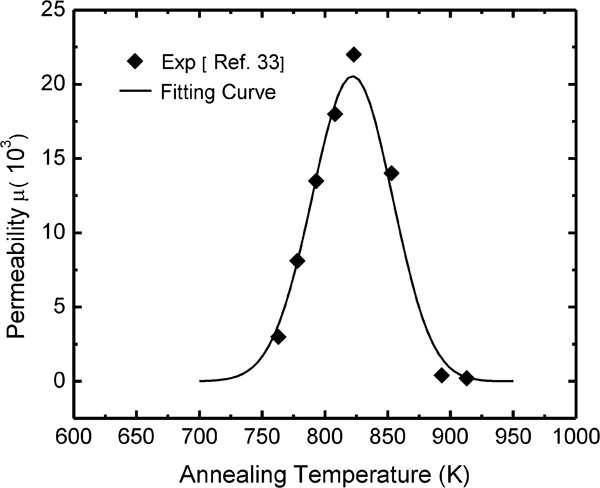
Comparisons of experimental data33 and calculations of permeability with annealing temperature for Fe73·5Cu1Ta3Si13·5B9
In addition, based on the experiment data of the famous Fe73·5Cu1Nb3Si13·5B9 (Ref. 12), the same changing tendency was also found, that is, that permeability will first increase and then decrease with the annealing temperature. The theoretical model is in excellent agreement with the experimental data during annealing.
Determination of optimal annealing temperature
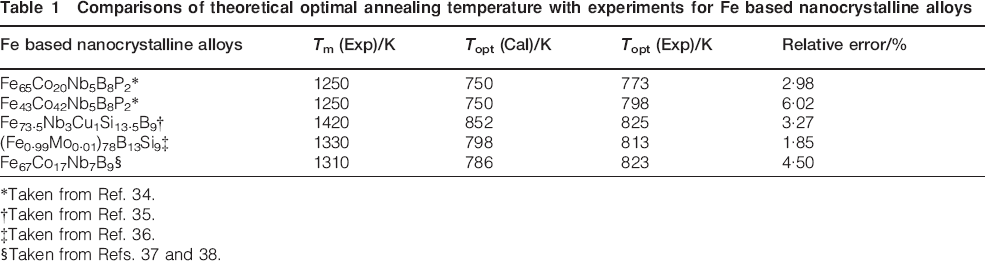
As discussed above, the minimum grain size corresponds to the maximum permeability present when Fe based nanocrystalline alloys are annealed at a certain temperature during the annealing range Tx1<Ta<Tx2, and the optimal annealing temperature should be Ta≈0·6Tm as analysed in equations (10) and (11), that is, the optimal annealing temperature for Fe based nanocrystalline soft magnetic alloys is ∼0·6 times that of the melting point. Then, theoretical values of the optimal annealing temperature were calculated and subsequently compared with the existing experiments for several Fe based nanocrystalline alloys, which are found in good agreement with each other, with a maximum error of <6·1, as shown in Table 1.
Comparisons of theoretical optimal annealing temperature with experiments for Fe based nanocrystalline alloys
*Taken from Ref. 34.
†Taken from Ref. 35.
‡Taken from Ref. 36.
§Taken from Refs. 37 and 38.
Table 1 shows that permeability first increases and then decreases with the annealing temperature during Tx1<Ta<Tx2, which is mainly due to the fact that the grain size has an inverse changing tendency in this annealing range. Moreover, when the annealing temperature reaches ∼0·6 times that of the melting point, the grain size becomes the smallest, and the permeability becomes the largest.
Conclusions
A theoretical model that related grain size and permeability to annealing temperature during annealing between the primary crystallisation temperature and the secondary crystallisation temperature was proposed, and the optimal annealing temperature was pointed out to be 0·6 times that of the melting point. The physical mechanism concerning the presence of the minimum grain size and the maximum permeability during this annealing range was explained based on this model. The theoretical values are in good agreement with the existing experimental data.
Footnotes
Acknowledgements
The present work was supported by the National Natural Science Foundation of China (grant no. 51074155), the National Basic Research Program of China (grant no.2010CB226805) and the Key Project of the National Natural Science Foundation of China (grant no.50834004).