







Abstract
Minor Sr can effectively improve the mechanical properties such as yield strength, ultimate tensile strength and elongation of AZ31 magnesium alloys. In the present work the authors try to explain the mechanisms from the effect of minor Sr on the precipitates in AZ31 magnesium alloys. The research results indicate that 0·25Sr addition has obvious influence on the precipitates both in the as cast and as extruded AZ31 alloys, resulting in the improvement of the mechanical properties. For the as cast AZ31 magnesium alloys, after Sr addition the precipitates were refined and Al4Sr phase formed, while for the as extruded AZ31 magnesium alloys the Sr addition was found to refine both the micrometre sized and nanometre sized precipitates, and also helping their solution during hot extruding.
Introduction
Magnesium alloy is the lightest structural alloy commercially available and has great potential for applications in automotive, aerospace and other industries. At present, although the volume of wrought magnesium products is considerably less than that of casting, wrought magnesium alloys may have more development potential. AZ31 alloy is one of the most widely used commercial wrought magnesium alloys; its ductility and formability, however, are comparatively low. It is well known that the poor ductility and formability of magnesium alloys at room temperature are attributed to their hexagonal close packed crystal structure and highly anisotropic dislocation slip behaviour. Finer and more uniform distribution of intermetallic phases and precipitates can improve the mechanical properties, formability, and machinability of magnesium alloys. Recent investigations are mostly focused on the grain refinement of the alloys. It has been reported that adding minor Sr to AZ31 alloy can effectively reduce the grain size of the alloy and thus enhance its mechanical properties such as yield strength (YS), ultimate tensile strength (UTS) and elongation.1–4 However, the reasons for such effects of Sr addition are not well understood. The present work will focus on the effects of Sr addition on the precipitates of AZ31 magnesium alloys and which may tell us the reason why Sr addition can refine the grain size and enhance the mechanical properties of the alloy.
Experimental procedures
The AZ31+0·25Sr (wt-) alloy was prepared from commercial AZ31 alloy, pure Mg, pure Zn and Al–10·5Sr master alloy. The AZ31 alloy was melted in an electrical resistance furnace using a graphite crucible and protected by a flux addition. When the melting temperature reached ∼700°C, pure Mg, pure Zn and Al–10·5Sr master alloy were weighed and added into the melt with 0·25 wt-Sr addition. The furnace was heated to 740°C and held for 80 min. The melt was then poured into a permanent coated mould with a dimension of Φ90×255 mm. Commercial AZ31 alloy was also remelt and cast using upper experimental procedures as a control example. After being homogenised at 688 K for 12 h the alloys were extruded by a 500T extrusion machine at 330°C with extrusion ration of 28·3 and the extrusion speed 4–6 m min−1.
Scanning electron microscopy (SEM) samples of the as cast alloys were prepared by 8 nitric acid. The TEM and SEM samples of the as extruded alloys were prepared by electron polish with the solution of 5 vol.- perchloric acid in ethanol. The SEM observations were performed on a Zeiss ULTRA plus. The transmission electron microscopy (TEM) observations were done on a Philips CM120 Biofilter and the energy dispersive spectroscopy (EDS) analyses were performed using a JEOL 3000F. The compositions of the castings were analysed by X-ray fluorescence spectrometer. The mechanical property test of the as extruded alloys was carried out by a CMT-5105 at room temperature. The YS, UTS and elongation data were obtained from an average of three tests. The chemical compositions are listed in Table 1.
Mechanical properties of AZ31+xSr alloys

Results and discussion
The results of mechanical properties of the alloys are listed in Table 1, from which it can be seen that minor Sr addition can effectively improve both the strength and ductility for the as extruded alloys. The YS, UTS and elongation rate increased by 9 and 25 MP respectively, while the elongation rate improved from 16·5 to 19·3. As it is known that AZ31 magnesium alloys have low elements content, and most elements should be solid soluted in the matrix under room temperature, only a few Mg17Al12 precipitates are formed and Mg17Al12 phase has no heat treatment strengthening effect. Therefore, grain refinement strengthening is one of the most important strengthening methods for AZ31 magnesium alloys. Grain refinement can elevate the properties and improve the formability for magnesium alloys. As shown in Fig. 1 minor Sr refined the grains for AZ31 magnesium alloys both as cast and as extruded, the grain sizes for the as extruded alloys with and without Sr were 11·3 and 8·7 μm respectively.
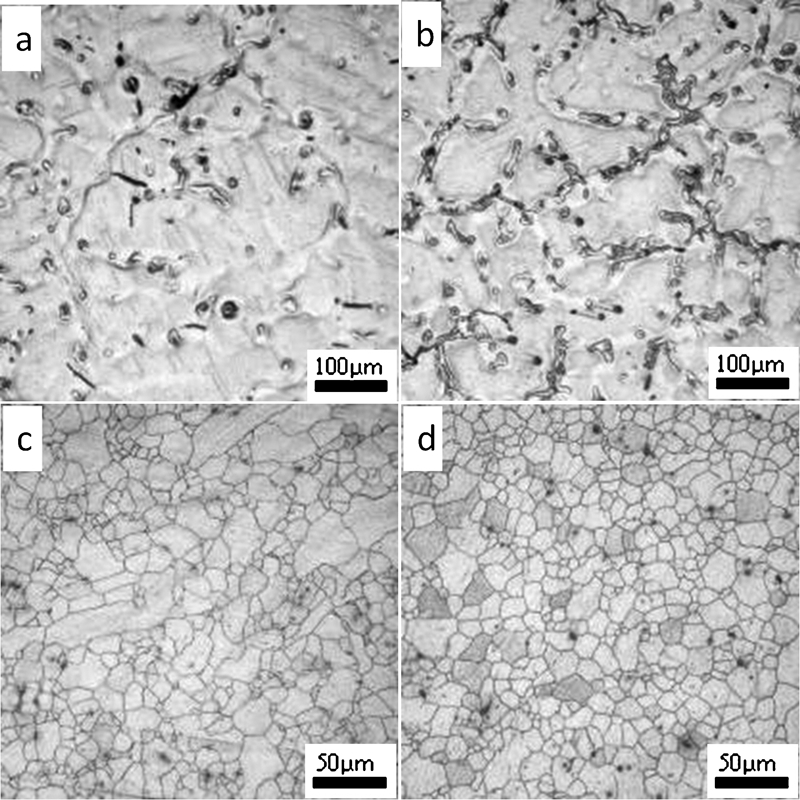
Optical micrographs of alloys
Generally, recent researches show that Sr has great grain refinement effects on AZ31 magnesium alloys but the refinement mechanism is not all clear. Currently there exist two mechanisms, namely, growth restriction factor mechanism and super cooling mechanism. The former suggests that Sr can increase the growth restriction factor values thus refined the grains. While the latter suggests that the supper cooling degree increases during solidification thus the grain growth of the α-Mg grains is restrained. Some researchers also believe that Sr can be a growth restriction factor for the matrix, which means that during solidification Sr will rapidly be enriched in the liquid ahead of growing interface and then restrict the grain growth. The grain refinement is also related to the heterogeneous nucleation during solidification.5 However, as the lattice disregistry between Sr containing phases and α-Mg phases is >6, Sr containing phases could not act as heterogeneous nucleus for the α-Mg phase.6 Precipitates are also important to the microstructure and mechanism. The finer the precipitates are, the better the mechanisms will be. The following paragraphs will discuss the influences of Sr on the precipitates of the as cast AZ31 magnesium alloys.
Influence of Sr on precipitates of as cast AZ31 alloys
The solidification sequence of the AZ31 alloy is as follows: first Al–Mn phase formed, then primary α-Mg formed and eutectic reaction (α-Mg+Mg17Al12), followed by the precipitation of Zn rich intermetallic phases.5 The XRD results in Fig. 2 suggest that the main phase in the as cast AZ31+xSr is α-Mg. Owing to its low fraction volume, Mg17Al12 phase in the AZ31 alloy (Fig. 2a) has no obvious peaks. While after the addition of the Al–10·5Sr the authors can find Mg17Al12 phase peak in the AZ31+0·25Sr alloy (Fig. 2b). The addition of Sr consumes Al for Al4Sr, which means that less Al is available to form the Al12Mg17 in the eutectic reaction. However, due to the XRD results Al12Mg17 phases were discernible in AZ31+Sr and not in AZ31, mainly following conclusions can be made: Sr addition in AZ31 magnesium alloys caused the decrease in the solute distribution coefficients for Al. This means that the Sr addition can promote the segregation for Al in the liquid phases during solidification, therefore more Al12Mg17 phases formed. On the other hand the authors can easily find Mn reach phases in both alloys but cannot also find spare phase's peak in the AZ31 alloy, while the authors can find obvious peaks for Mn reach phase in the AZ31+0·25Sr alloy. Another new Sr containing phase, Al4Sr, was also identified in the AZ31+0·25Sr alloy.
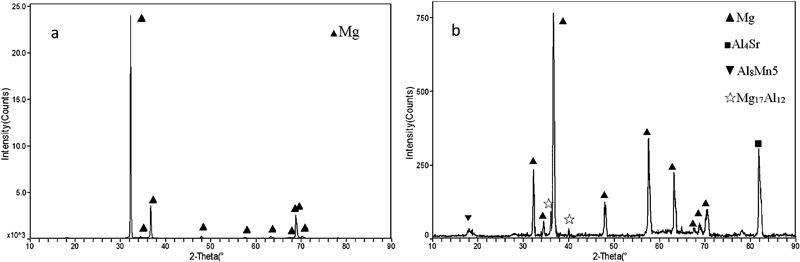
X-ray diffraction results of as cast AZ31 and AZ31+0·25Sr
Figure 3 shows the SEM images of the as cast AZ31+xSr alloys, from which the authors can see that, the as cast alloys exhibit obvious coarse dendrite structure. The discontinuous network-like second phase is embedded in the grain boundary. From Fig. 3a it can be seen that the second phases in the AZ31 alloy mainly are acicular, block-like and round dot-like. From Fig. 3b it can be seen that with the increasing Sr addition the acicular-like phase almost disappeared and the round dot-like phase increased, the block-like phase also increased and a new short irregular stick-like phase formed. Combine with the Fig. 2 XRD results and Fig. 4 EDX images of the as cast AZ31 and AZ31+0·25Sr alloys the authors can make the conclusion that the acicular-like and round dot-like phase is Mg17Al12 phase, the block-like phase is Al–Mn phase and the new short irregular stick-like phase is Al4Sr phase. The solubility of Sr in α-Mg matrix is 0·1, while the Sr addition is 0·25, extra Sr formed Al4Sr particles. The EDS show that the Al/Mn is 1·73, contrary to the XRD and research of Laser and co-workers.7,8 The authors can make the conclusion that this kind of precipitates is Al8Mn5 phases. From Fig. 3 it can also be seen that after the addition of Sr the total amount of the second phases keep increasing, the morphology of the precipitates in the grain boundaries exhibits more flock-like and refined the grains. The precipitates formed in the grain boundaries can block the grain growth. The more precipitates formed, the smaller the grains will be.
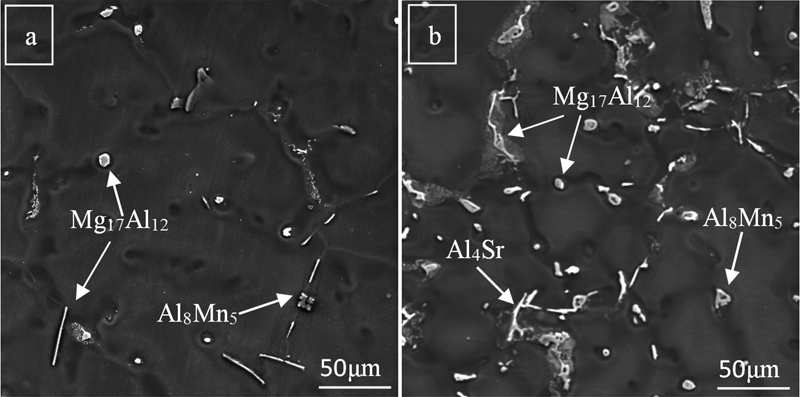
Images (SEM) of as cast alloys
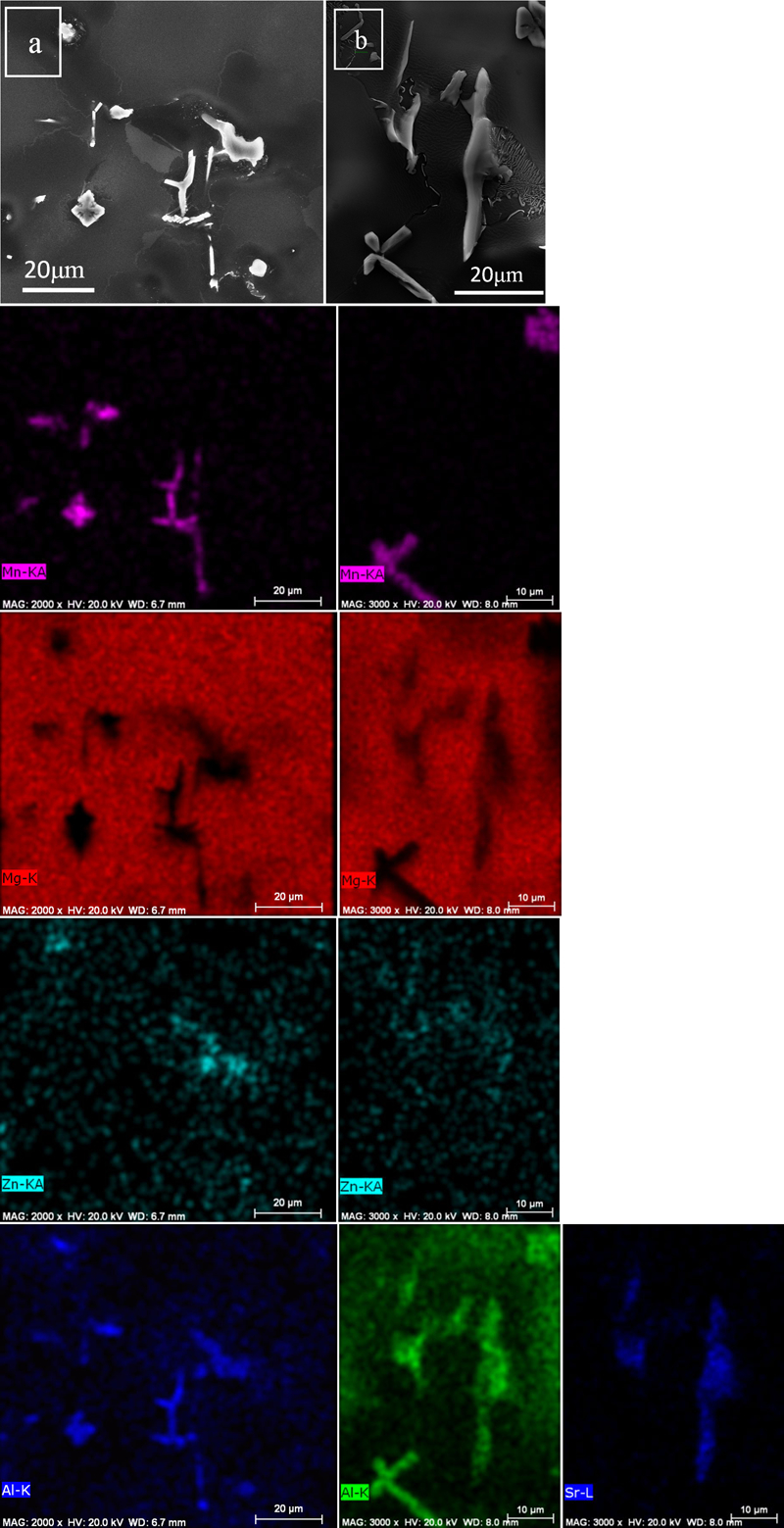
Images (EDS) of as cast alloys
Influence of Sr on precipitates of as extruded AZ31 alloys
In this research the authors found that for the as extruded AZ31 magnesium alloys both the alloys with or without Sr addition have two kinds of precipitates. One is relatively large with micrometre size which can clearly observe under the scanning electron microscope and optical microscope. The other is relatively small with nanometre size which can only observed under the TEM. Figure 5 shows the SEM images of the micrometre size precipitates in the alloys, from which it can be seen that before the Sr addition (Fig. 5a), the precipitates is about 1–10 μm, but after Sr addition (Fig. 5b) the precipitates refined a lot, which turns out to be about 500 nm to 5 μm and the distribution of the precipitates are more uniformly dispersed. In the AZ31 magnesium alloys the EDS shows that the precipitates are Al8Mn5 phases and after Sr addition the precipitates containing both Al8Mn5 and Al4Sr.
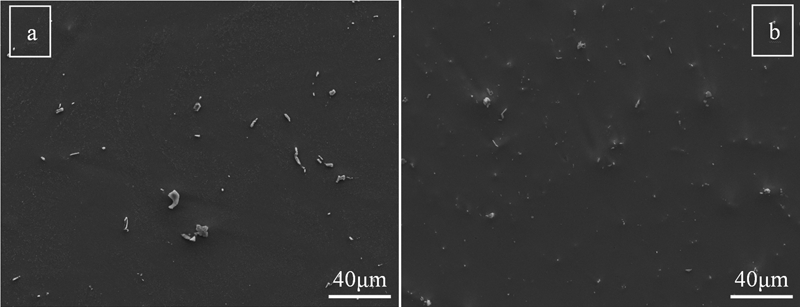
Images (SEM) of as extruded alloys
After the addition of Sr the authors can find another type of precipitates embedded in the grain boundary which are ∼500 nm (see Fig. 6). However, unfortunately since they are too small the EDS in SEM can hardly tell us what they are. Since this type of precipitates can only be found in the alloys with Sr addition they should be Al4Sr phase. The small strip-like precipitates embedded in the grain boundary can effectively prevent the grain growth.
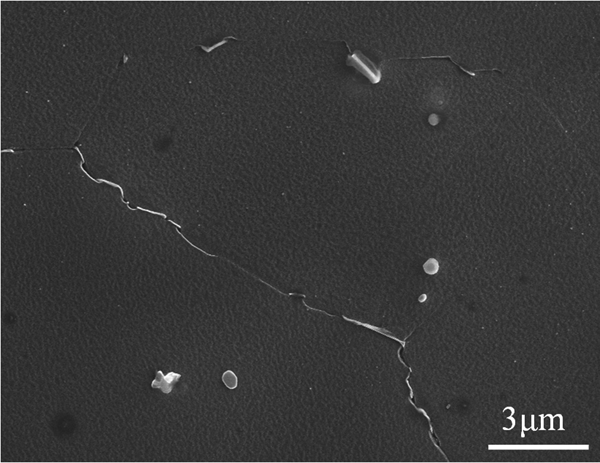
Images (SEM) of precipitates in grain boundary in as extruded AZ31+0·25Sr alloys
Figures 7 and 8 show the TEM bright field images of the nanometre sized precipitates in the as extruded alloys both transversal and longitudinal from which it can be seen that the precipitates have no big difference and the diffraction patterns of the precipitates are irregular. The authors can make a conclusion that the precipitates have no specific orientation relationship with the matrix. From Figs. 7a and 8a it can be seen that the percipitates are mainly in rod shape of about 50–200 nm long with circular or elliptic cross-section of about 10–20 nm in diameter. After Sr addition the amount of this type of precipitates decreased obviously and their shape changed to ball-like about 10–20 nm in diameter (see Figs. 7b and 8b). As the authors can see the Sr addition refined the precipitates may have also promoted their solution during hot extruding.
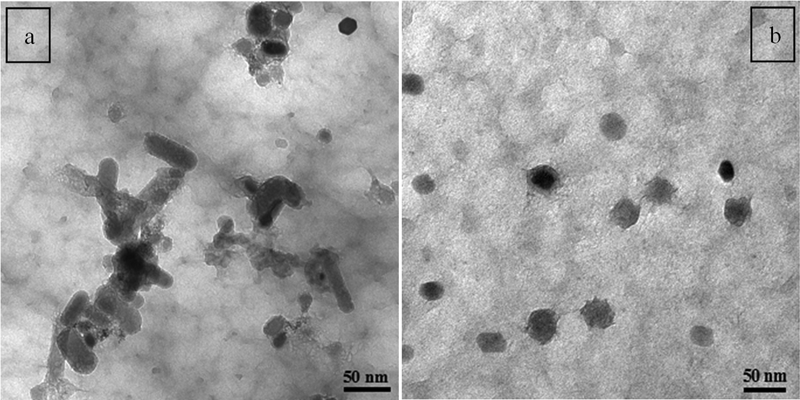
Bright field image (TEM) of as cast alloys from transversal
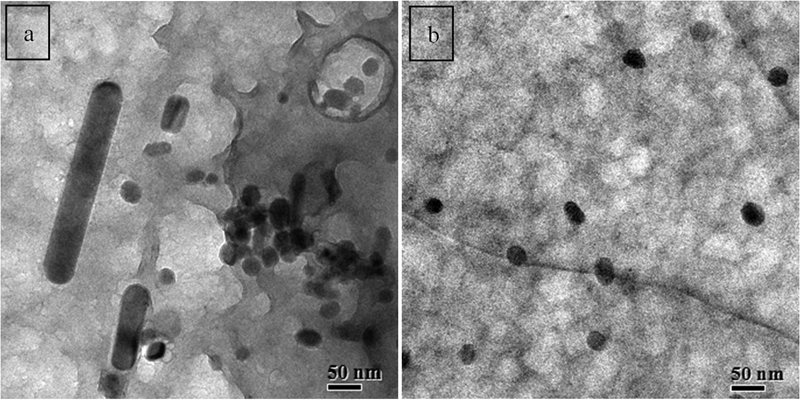
Bright field image (TEM) of as cast alloys from longitudinal
Figure 9 shows the TEM bright field image in high resolution and the EDX spectrum of the nanometre sized of precipitates. The TEMEDS analyses showed that these precipitates contain aluminium and manganese and the average Al/Mn (by at-) is 1·82 so it should be Al8Mn5 precipitates. Al8Mn5 is formed before the nucleation of α-Mg; it does not serve as a nucleation site for it. Therefore, no orientation relationship with the matrix is expected. This is coincided with the conclusion which made from Figs. 7 and 8 that the precipitates have no specifically orientation relationship with the matrix. Dispersed Al–Mn precipitates are also found in die cast Mg–Al–Sr magnesium alloys both before and after creep deformation with either constant temperature and multilevel load or constant load but multilevel temperature, with the load and temperature levels of 150 h duration by Kunst and co-workers.9,10 and they think that these precipitates can back-side pinning of dislocations which cause strengthening of the matrix. However, if the precipitates are too large it will separate the matrix and negatively impact the mechanical properties of the alloys. The smaller the Al–Mn precipitates were and the more uniformly they distributed, the better the mechanical properties of the alloys will have.
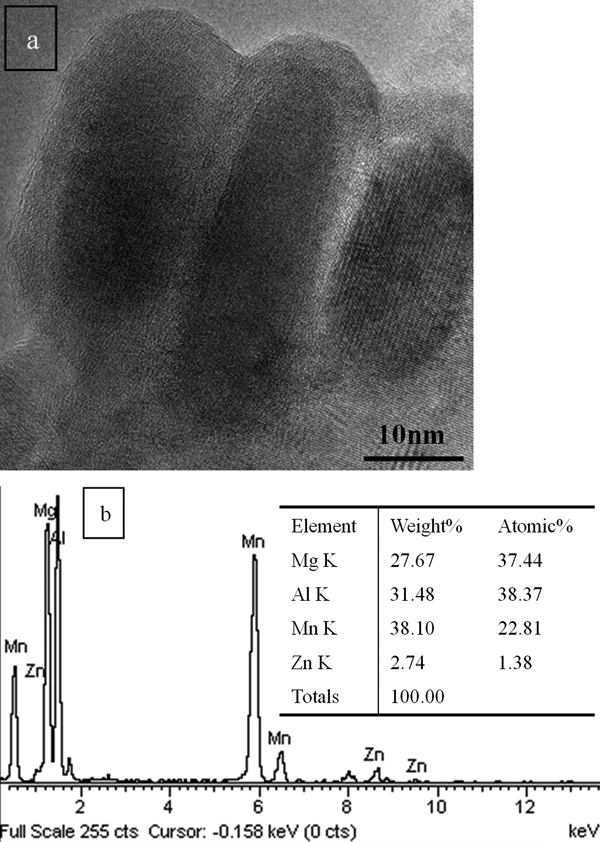
a TEM bright field image and b EDX spectrum of nanometre sized of precipitates
Conclusions
0·25Sr addition as a great impact on the precipitations and their coagulation for AZ31 magnesium alloys are both as cast and as extruded. Both the strength and ductility for the as extruded alloys were effectively improved, with the YS increased by 9 MP, the UTS increased by 25 MP and the elongation improve from 16·5 to 19·3.
The precipitates in the AZ31 magnesium alloys are β-Mg17Al12 and Mg8Mn5 phases, with 0·25Sr addition a new phase Al4Sr formed in the grain boundary. With Sr addition more precipitates formed in the as cast AZ31 magnesium alloys, and the β-Mg17Al12 and Mg8Mn5 precipitates in the as extruded alloys have been effectively refined.
There are two types of precipitates in the as extruded AZ31+xSr alloys, namely, the micrometre sized precipitates of about 1–10 μm or 500 nm–5 μm after Sr addition. The nanometre sized precipitates of about 50–200 nm long and about 10–20 nm in diameter. After Sr addition the amount of the nanometre sized precipitates decreased and their shape changed to ball-like with diameters about 10–20 nm.
Footnotes
Acknowledgements
This work is supported by the Natural Science Foundation project of Chongqing Science and Technology Commission (grant no. cstc2011jjA50019).