






Abstract
The SiCp/Cu–Al composites with 72·7 vol.-%SiC particles were prepared by pressureless infiltration, and Cu coated SiC particles (SiC/Cu composite powder) were used as reinforcements for aluminium matrix. The effects of moulding pressure, infiltration temperature and infiltration time on the infiltration depth were studied by orthogonal test. The morphology and phase structure of the composites were analysed by scanning electron microscopy and X-ray diffraction. The results show that under moulding pressure of 10 MPa, infiltration temperature of 850°C and infiltration time of 3 h conditions, the SiCp/Cu–Al composite structure is uniform and dense without obvious porosity defects, and the thermal expansion coefficient is close to thermal expansion coefficient of the Turner model.
Keywords
Introduction
With excellent high quality of thermal conductivity, low coefficient of thermal expansion (CTE), high strength, high chemical stability, low density and wear resistance, and high volume fraction (40–70 vol.-%), SiCp/Al composite enjoys great potential for application in the realm of electronic packaging.1–5 Currently, the infiltration of liquid aluminium alloy into SiC preforms with open pores is one of near net shape process accepted by most material researchers. Pressure infiltration routine has been successfully applied in industry by several companies. Pressureless infiltration attracts considerable attention in recently years, as it has the advantage of low cost, simple practice and great availability of industrialisation. However, the realisation of pressureless infiltration is very difficult in this system owing to the poor wettability between SiC and Al. In addition, Al4C3 was formed in uncoated SiC particle reinforced aluminium matrix composites prepared by pressureless infiltration. It is undesirable because Al4C3 is a hydrophilic and brittle phase and prone to act as thermal diffusion barrier at the interface. So, the long term stability of uncoated SiCp/Al composites during thermal cycling and exposure to moist environments remains to be evaluated.
In the present paper, the SiC/Cu composite powders were fabricated by chemical plating technology and pressed into performs, and then, the SiCp/Cu–Al composites with near net shape and high volume fraction were manufactured by pressureless infiltration. The microstructure and thermal properties of SiCp/Cu–Al composites were studied.
Experimental
The 6066 aluminium alloy is used as a matrix material. The main chemical composition of the 6066 aluminium alloy is Al–0·13Si–4·13Cu–0·08Zn–0·21Fe–1·58Mg–0·54Mn–0·02Ni–0·04Ti (wt-%). The average size of the β-SiC particulates is ∼10 μm.
The Cu coating on the SiC particles was fabricated via chemical plating technology. The formulation of plating liquid is shown in Table 1. The plating liquid was prepared according to Table 1 and then placed in a water bath at 50°C and was added with a certain amount of SiC particles. Using a constant temperature magnetic stirrer for mechanical stirring, the stirring speed is 20 rev min−1. After 20 min, the final deposition of particles was filtered, rinsed, and dried at 80°C.
Formulation of plating liquid

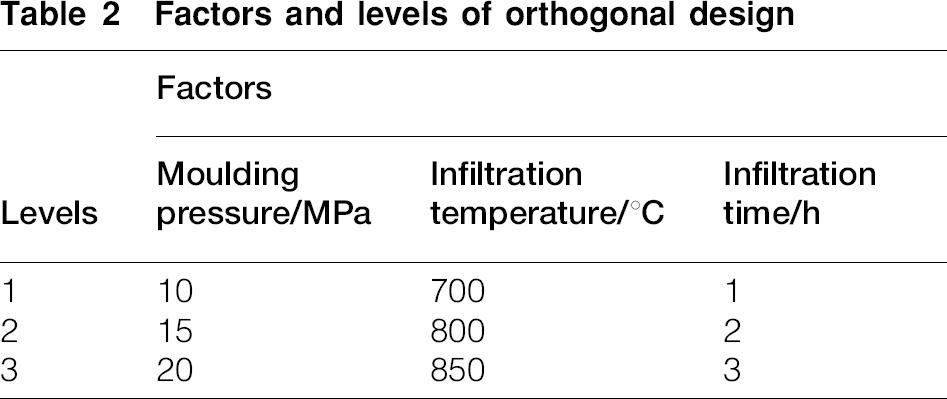
The SiC/Cu composite powders were processed into performs by mould pressing method. The binder is polyvinyl alcohol. Samples were press formed at 10, 15 and 20 MPa for 30 s respectively. In order to prevent perform deformation and cracking, the method of phased warm drying was used to dry performs in the process. The infiltrated experiment was carried out using a ZM-25-16 vacuum molybdenum wire furnace. The infiltration temperatures are 700, 800 and 850°C, and infiltration times are 1, 2 and 3 h. To establish the optimum preparation condition, the orthogonal experiment was used. The factors and levels of orthogonal design are shown in Table 2.
Factors and levels of orthogonal design
The specimen dimension of SiCp/Cu–Al composite is Φ15×15 mm. The samples were cut longitudinally along the middle line by electrical discharge machining method, and infiltration depth was measured by vernier calliper.
The surface structure of the SiC/Cu composite powders was investigated by D/max-2400 X-ray diffractometer (XRD) and 6460LV scanning electron microscopy. The XRD was also applied to investigate the phase composition of SiCp/Cu–Al composites. The microstructure of composites was observed by GX-71 optical microscopy. The coefficient of thermal expansion (CTE) of composites was measured by PCY-III coefficient of linear expansion tester.
Results and discussion
Orthogonal experiment
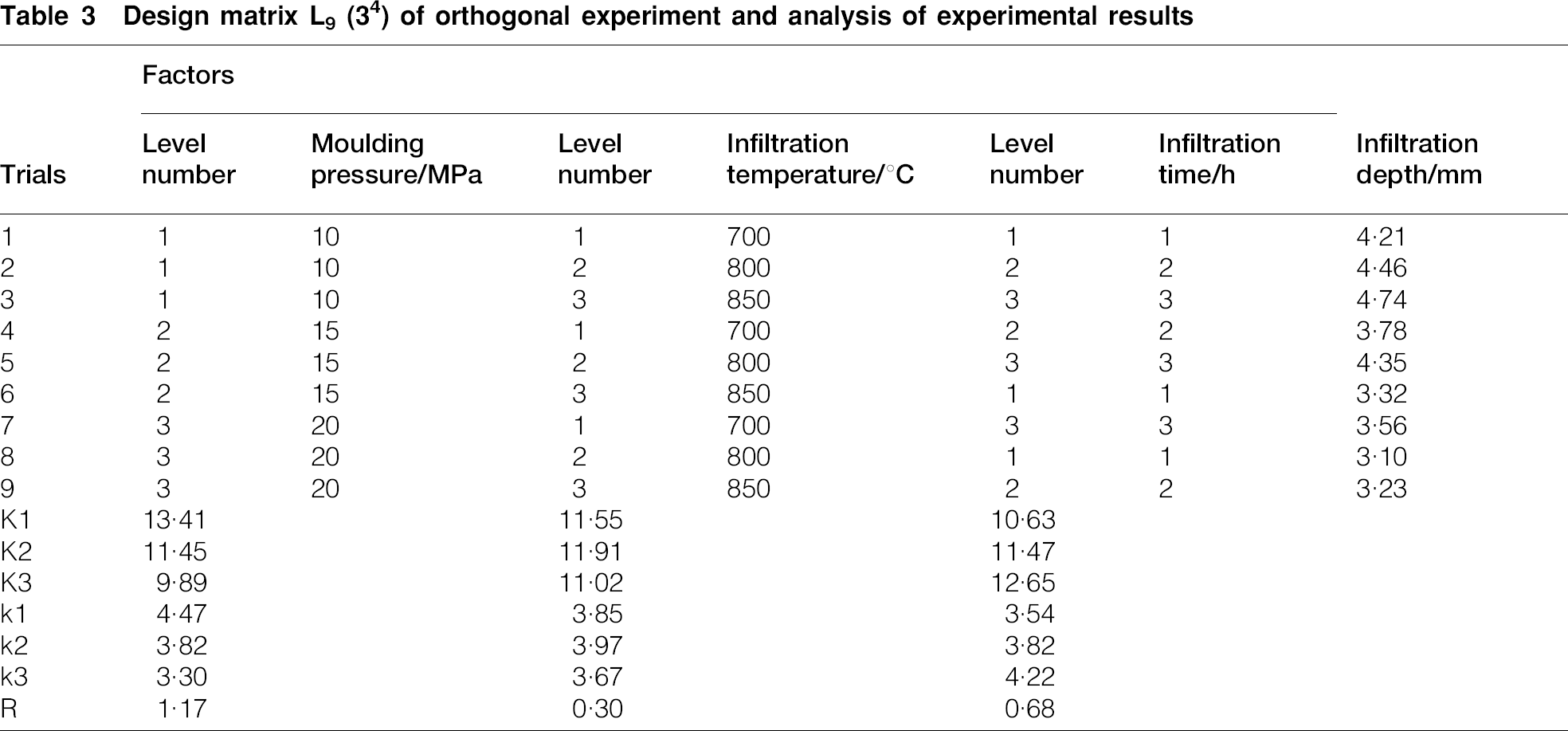
Orthogonal experiment method is a scientific method of arranging and analysing multifactor experiment. The reliable regularity can be discovered by fewer experiments. For the orthogonal array of L9 (34), it means that the orthogonal experiment has three levels, four factors and nine orthogonal trials. The content of L9 (34) and the analysis of the experimental results are given in Table 3. Where Kij is the sum of infiltration depth for factor i at level j in all orthogonal trials, kij is the average of Kij, and Ri is defined as the distance between the extreme values of factor i, which reflects the effect of different levels of factor i on the infiltration depth. If the R of one factor is big, it means different levels of this factor have the great effect on the infiltration depth. Usually, this factor is the main factor. On the contrary, if the R of one factor is small, then it means different levels of this factor have less effect on the infiltration depth. Usually, this factor is the minor factor.
Design matrix L9 (34) of orthogonal experiment and analysis of experimental results
The visual analysis diagrams for each factor are shown in Fig. 1. It can be seen that with the increase in moulding pressure, the infiltration depth decreases gradually. This is because the preforms were prepared by cold briquetting process, and the greater pressure is, the closer pattern materials get. The more contact point and contact surface of accumulation are, the greater the perform density is, and the smaller the porosity is. The molten aluminium is difficult to enter the preforms.

Visual analysis diagrams of infiltration depth
Along with the increase in temperature, the infiltration depth increases firstly, and then decreases. From 700 to 800°C, with the increase in temperature, the infiltration depth increases.
Because of the rise in temperature, on the one hand, the viscosity of molten aluminium alloys decreases, and the mobility is better, On the other hand, the incubation period shortens in the process of infiltration, and the effective infiltration time increases within the same time. Above 800°C, the infiltration depth decreases with increase in temperature, which may be atomic diffusion for copper coating layer of SiC/Cu preforms in incubation period leading to densification. It can reduce the size of the pores, even make them closed, and further drop infiltration rate of liquid aluminium.
The size of SiC/Cu composite powders is varied. There are two kinds of pores in the process of formation of performs. One is the large pore among the neighbouring larger particles; the other is the small pore among smaller particles. In the early infiltration of the preform, molten aluminium alloy mainly fills in the larger pores by fluxion. However, in the process of densification, molten aluminium alloy fills in the smaller pores by capillary action. The dynamics theory of capillary action shows that spontaneous infiltration depth h and time t have the following relationship6

In the present paper, using SAS software to analyse variance for each parameter, the command ‘PROC ANOVA, CLASS A B C; MODEL y = A B C.’ was entered in SAS programming window; the analysis results are shown in Table 4, where A is the moulding pressure, B is the infiltration temperature, C is the infiltration time, and DF, SS, MS and Sig. respectively represent degree of freedom, standard deviation square, mean square and level of significance test.
ANOVA

As can be seen from Table 4, the Sig. values are <0·0001 for A, B and C. The results show that three factors have significant influence on infiltration depth. To study the impact of moulding pressure, infiltration temperature and infiltration time on infiltration depth have an extremely important significance.
From Fig. 1 and Table 4, it also can be seen that the optimum conditions are as follows: the moulding pressure is 10 MPa, infiltration temperature is 850°C and infiltration time is 3 h.
As can be seen from the range results, moulding pressure is the most important factor in all process parameters, then infiltration time, and then infiltration temperature. The infiltration depth is the highest for no. 3. Therefore, the no. 3 is optimal condition in the nine orthogonal experiments.
SiC/Cu composite powders
Scanning electron microscopy analysis
To improve the interfacial bonding strength between SiC particles and aluminium matrix and to inhibit the formation of Al4C3 resulting from direct contact between the SiC particles and the Al melt, copper was deposited on the surfaces of the SiC particles to obtain the Cu coated SiC particles. Figure 2 illustrates the surface morphology of original SiC particles and SiC/Cu composite powders. In Fig. 2, it can be seen that the Cu coated SiC particles feature anomalous shapes with sharp edges and obvious cleavage steps resulting from mechanical milling. Cu coating is continuous and compact, spreading on the surface of the SiC particles uniformly. Moreover, coating is denser in the edge of SiC particles. This is because the specific surface area of particle edges is large, the surface energy is high and the energy of Cu non-uniform nucleation is smaller, so as to promote the Cu nucleation.

Surface morphology of a original SiC particles and b SiC/Cu composite powders
X-ray diffractometer analysis
Figure 3 displays the phase composition of SiC/Cu composite powders by XRD analysis. As shown in Fig. 3, there are two main diffraction peaks: SiC and Cu. The latter diffraction peak is high and sharp. This indicates that the content of Cu is higher in SiC/Cu composite powders, which shows good crystallinity.

Phase composition of SiC/Cu composite powders
SiCp/Cu–Al composites
Microstructure of SiCp/Cu–Al composites
The optical microstructure of SiCp/Cu–Al composites is shown in Fig. 4. As illustrated, the SiC particles are distributed throughout the Al matrix uniformly. Complete infiltration of the packed SiC particles is achieved, and no pores or obvious defects are observed in the composites. The intermediate layer (Cu coating) can be combined with the SiC metallurgically and wetted by Al matrix very well. At the same time, the Cu coating and molten aluminium interact with each other, resulting in interdiffusion and dissolution action and formation of CuAl2 compounds at the interface, which lead to a decrease in interfacial energy.7 Molten aluminium is more easily impregnated into the preform. The uniform and dense structure are advantageous to the composite material for electronic packaging, which not only can improve the thermal conductivity of the composite materials but also can increase the strength, elastic modulus and dimensional stability and extend the lifecycle of composite materials. Generally speaking, the infiltration quality of the Cu coated SiC/Al composites is excellent, and the SiC particles appear to be well bonded to the Al matrix.

Microstructure of SiCp/Cu–Al composites
The volume fraction of SiCp/Cu–Al composites is 72·7 vol.-% under the optimum conditions by Image Pro Plus software. The high SiC particles restrain the thermal expansion of matrix. With the increase in SiC particles, this inhibition is more obvious. The lower the CTE of composite, the better the performance of electronic packaging. The well known Young–Dupre equation is described below

Phase analysis of SiCp/Cu–Al composites
Figure 5 shows XRD spectra of SiCp/Cu–Al composites. As shown in Fig. 5, there are four main diffraction peaks: SiC, CuAl2, AlCu and Cu9Al4. The contents of the phase are 32·95, 44·22, 8·57 and 14·26% respectively. The brittle phase Al4C3 is not found in SiC/Cu–Al composites. The Cu coating on SiC particles is shown to be effective to prevent the formation of Al4C3. Meanwhile, the Cu coating can enhance the interfacial bonding strength between SiC particles and Al matrix and improve the thermal stability of SiC particles as well.

X-ray diffraction pattern of SiCp/Cu–Al composites
Thermal expansion coefficient of SiCp/Cu–Al composites
According to the measure of elongation of the specimen, by equation (3), the relation of CTEs of SiCp/Cu–Al composites and temperature is shown in Fig. 6


Variation of CTE of SiCp/Al composite with temperature
It can be seen that the CTEs of the composites increase with increasing temperature (Fig. 6), due to the thermal expansion nature of matrix alloy and the restriction at the interface between the Cu coated SiC and the Al matrix. Compared with CTE of the matrix alloy (23×10−6 K−1), that of SiCp/Cu–Al composites is significantly reduced.
On the assumption of only stresses existing in the interface, thermal expansion model for composites advanced by Turner8 could be expressed as follows

Considering that stress and shear stress both exist in the interface, a mended model represented by Kerner9 is shown as follows




The physical parameters of matrix alloy and silicon carbide particle are shown in Table 5. The experimental CTE of SiCp/Cu–Al composite (at 80°C) and theoretical CTEs are given in Table 6.
Physical parameters of matrix alloy and silicon carbide particle

Experimental CTE of SiCp/Cu–Al composite (at 80°C) and theoretical CTEs (×10−6 K−1)

From Table 6, it can be seen that the Kerner model theoretical calculated value is higher than the experimental value. This is mainly because the reinforcing phase is spherical in the model, while the SiC particles are irregular in practice. However, the experimental CTE of SiCp/Al composite is close to Turner model. In addition, the CTE is lower than that of the matrix alloy and higher than that of SiC, significantly.
Conclusions
Al matrix composites reinforced with Cu coated SiC particles are fabricated by pressureless infiltration successfully. The SiC particles are dispersed in the Al matrix uniformly, and the interfacial bonding between the SiC particles and the Al matrix is tight.
The Cu coating on SiC particles is effective to prevent the formation of Al4C3 and to improve the interfacial bonding strength between SiC particles and Al matrix. Furthermore, it solves the problem of wettability between SiC and molten aluminium.
The moulding pressure is the most important factor in all process parameters, then infiltration time, and then infiltration temperature.
The SiCp/Cu–Al composites are manufactured by pressureless infiltration. The optimum conditions are as follows: moulding pressure of 10 MPa, infiltration temperature of 850°C and infiltration time of 3 h. The volume fraction of SiC particles is 72·7 vol.-% in SiCp/Cu–Al composites.
The CTE of SiCp/Cu–Al composites is lower than that of the matrix alloy and higher than that of SiC. It is close to CTE of the Turner model.
Footnotes
Acknowledgements
The author of the present article would like to express profound gratitude to Professor S. M. Du for the valuable comments and helpful cooperation during the course of this research. The author also appreciates valuable services made by all personnel of Xi'an University of Science and Technology, China.