







Abstract
Different zones of welded joints are subjected to different temperature fields during the process of welding. Furthermore, in multi-pass welding, heating and cooling cycles, which occur due to the overlap of the pass beads, lead to the formation of complex microstructures. A method of evaluating the creep response of a multipass weld based on the micromacro mechanics approach is introduced. Multipass weld microstructures consisting of a columnar zone, which can be related to the microstructure of a single pass weld, and a heat affected zones are considered. To model the microstructure of the multipass weld metal the representative volume element (RVE) method is employed. Numerical tests on one-component loading of the RVEs are performed and creep material properties for equivalent weld material reported for welds with different number of passes.
Introduction
The long term monitoring of equipment working under high pressure at high temperatures shows that it is important to take into account influence of creep and damage in weldments. 1 Quite often, welded constructions are found damaged before the predicted lifetime of components. One of the reasons for that is a mismatch in creep deformation properties between the weld and the parent metal in combination with non-favourable weld shapes, stress concentrations developed within the weldment. It should be noted that the design rules of weldments under pressure are based only on the long term fracture properties of weldable material at uniaxial tension. However, in reality, such constructions operate at multiaxial stress state conditions. In addition, mechanical properties in the zone of the weld material depend on the direction. These problems are especially important for modern turbine industry among others. The high temperature of steam and high pressure in supercritical steam turbines require application of steels with improved properties with long term durability. For implementation of these requirements, a family of new heat resistant steels with 9–12Cr is designed. The 9–12Cr steels are used in both boilers and in steam turbines for many components including pipes, headers, rotors and casings with a maximum operating temperature of 620°C. 2 In general, these alloys have lower coefficients of thermal expansion and higher thermal conductivities than austenitic steels and should therefore be more resistant to thermal cycling. A typical weld in a component consists of parent material, heat affected zone and weld metal. The two parent materials joined by the weld may be made from the same material or different. The weld and parent material can have the same or different composition. However, even for welds joined by the weld metals with the same composition as the parent materials, the creep properties in parent, heat affected zone and weld materials will be different. 3 Thus, the weldments are highly complex heterogeneous structures. Moreover, in the case of multipass welds, the weld material is also inhomogeneous. It consists of overlapping weld beads that will create specific heat affected zones within the weld metal because of cooling and heating from the next pass. A single weld bead generally consists of a columnar solidification structure. However, in multipass weld, when the further bead is laid over the previous one, part of it will be recrystallised, and this will create coarse and fine grained structure. 4 All of these factors make it important to take anisotropy into account in modelling creep behaviour of the multipass weld. 5
Constitutive equations of anisotropic creep
The strain rate–stress relations for creep for anisotropic materials are based on the assumption of the existence of the creep potential. The creep potential hypothesis is widely used for continuum mechanics modelling of isotropic and anisotropic creep.
6
During the secondary creep stage, strain rate is defined by the scalar valued potential W(σ) and the flow rule
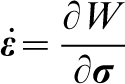
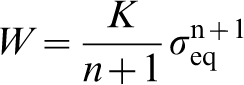
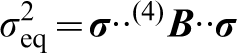
The equivalent stress is invariant with respect to the coordinate system. The form of equivalent stress depends on the symmetry type of material. Materials of columnar, coarse and fine grained zones are assumed to be isotropic. In case of isotropic creep, equivalent stress is suggested as von Mises type
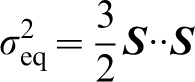

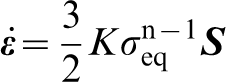
 . For the Norton–Bailey type potential the flow rule results in



Numerical analysis of anisotropic creep in multipass welds
To model the anisotropic creep of multipass welding, the RVE is created as prismatic body with the transversal section shown on the Fig. 1. This section is considered as the repeated unit cell periodically distributed in the plane OXY. The axis Z is directed along the weld seam. Material properties of weld metal grain size zones are assumed isotropic. To describe the creep behaviour of weld metal zones, Norton creep law is used (equation (5)).
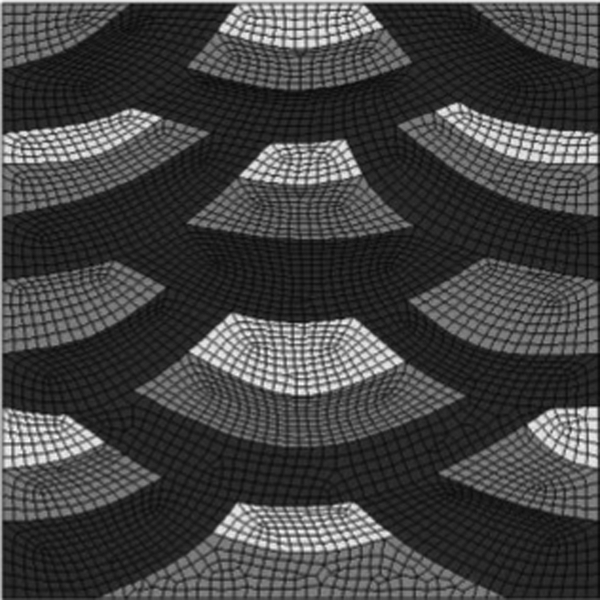
Finite element model of RVE
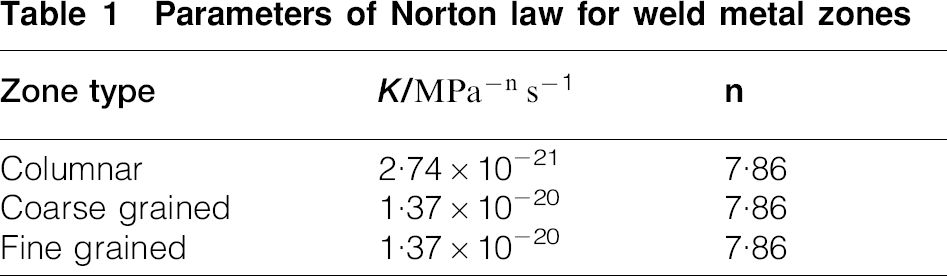
Material parameters used for equation (5) are taken from Ref. 8 and are presented in Table 1. It should be noted that it is impossible to make the specimens directly from fine and coarse grained zones independently, that is why for this heat affected zones, material properties in Ref. 8 are assumed equal.
Parameters of Norton law for weld metal zones

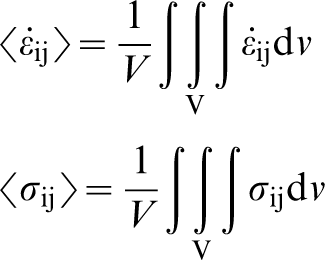
The creep law for the homogenised continuum is presented by the averaged components in the volume V of the unit cell


 and 〈σkl〉 are the averaged creep strain rates and stresses, which correspond to uniform macroscopic strain rate and stress
Let us consider a numerical experiment performed on an RVE of uniaxial tension in the 11 direction. Average creep strain rate  in case of uniaxial tension is related with average stress
  through the following equation (if b1111 = 1)



 for different time levels. From the results of numerical experiments, one can extract the set of strain rate
  values for the different moments of time ti (i = 1, 2, …, N).
Strain rate values on the macroscopic level can be obtained by the least squares method
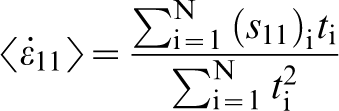
 levels are made. The result of this series of M experiments is the set of
  for different stress values
  (i = 1, 2, …, M).
To process the results of numerical experiments, relation (13) is presented in logarithmic coordinates



 , creep law of homogenised material will be as follows


Parameters of tensor B multiplied by K/MPa−n s−1
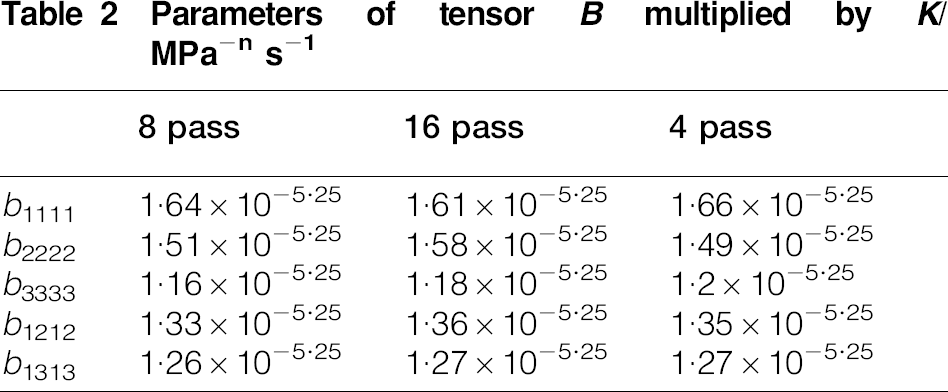
Distributions of the components σ11 and σ22 on steady state creep stage during numerical experiments on tension are shown in Fig. 2 respectively.
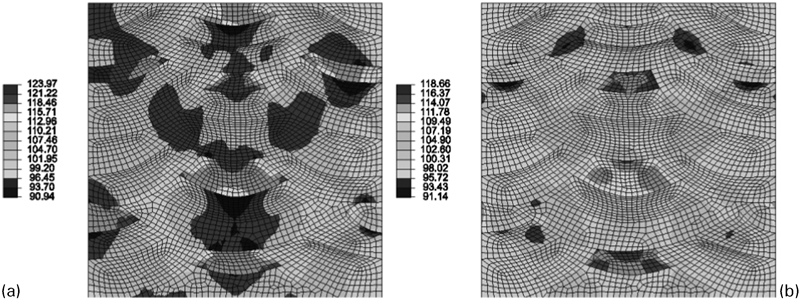
Equivalent creep stress redistribution after 1000 h of creep a σ11 and b σ22 (MPa)
Conclusions
As a result of finite element analysis on one-component loadings of a representative volume equivalent, total strains are obtained, and by processing them using averaging procedure, the material constants for constitutive equation of the equivalent material are found. To take into account scaling effects and also the welding operational features, three types of RVEs with different number of passes were considered.